Best Business Telecom Services Near Me: Your Local Guide


A bad telecom decision usually shows up on an ordinary day, not during a planned outage. Calls start clipping in the middle of patient coordination. A dispatch team loses mobile data in the one neighborhood where crews are already behind. A campus building cutover goes live, then nobody can explain why numbers aren't routing correctly. By the time the provider says it's “being investigated,” your staff is already doing manual workarounds.
That's why a search for business telecom services near me shouldn't end with whichever provider runs the most ads in your city. For hospitals, universities, government offices, research facilities, and multi-site businesses, telecom sits inside daily operations. It affects uptime, security, billing accuracy, and how fast your team can recover when something goes wrong.
Why Your Next Telecom Provider Matters More Than Ever
Most buyers still treat telecom like a utility line item. That's a mistake. A provider isn't just selling circuits, handsets, or cloud voice seats. They're taking responsibility for a piece of your operating environment that staff rely on every hour.
The market is big enough that choice is not the problem. The problem is filtering noise. The U.S. telecommunications subsector included about 35,244 private-industry establishments in 2023, and IBISWorld estimates 1,344 wireless telecommunications carrier businesses in the U.S. in 2026, up from 1,288 in 2025, which shows how broad and complex the supplier ecosystem is for organizations searching for local options (IBISWorld wireless telecommunications carrier business counts).
Telecom is now an operational dependency
When I evaluate providers, I don't start with speed claims. I start with failure impact. If voice drops for an administrative office, that's annoying. If voice, mobile data, or call routing fails for a hospital department, field operation, or public-facing service desk, staff immediately lose time and confidence.
That's why local evaluation has to move past storefront proximity. Buyers comparing vendors in Atlanta or any other major metro should think in terms of facility support, response discipline, and last-mile clarity, not just whether the provider's office is nearby.
The right telecom partner reduces operational friction. The wrong one adds hidden labor every week.
A useful first comparison point is to review how providers position connectivity options in your market, including guides to business internet providers near me. Don't use those pages as your final decision tool. Use them as a starting map, then pressure-test every claim against your own facility requirements.
What good buyers do differently
Strong telecom buyers ask harder questions earlier:
- What fails first: Voice, internet, mobile coverage, failover, or billing workflows.
- Who gets hit: Front desk staff, nurses, dispatchers, call center teams, facilities, or remote users.
- What recovery looks like: Manual rerouting, temporary numbers, hotspot backup, or complete work stoppage.
That mindset changes the whole procurement process. You stop shopping for a package and start evaluating a provider's ability to support your real environment.
Before You Search Map Your Internal Telecom Needs
Typing business telecom services near me before you've documented your current environment usually leads to a poor shortlist. Sales teams will gladly sell you features. They won't define your operational requirements for you.
A practical starting point is the telecom audit model. Providers that perform audits typically review voice, data, wireless, and equipment contracts, and they note that the process can uncover savings by correcting billing errors, renegotiating rates, and eliminating unused services. That matters because organizations that buy on price alone often miss duplicate lines, wrong-rate plans, and services nobody is using anymore (telecom audit FAQ and common savings areas).
Build your baseline before calling providers
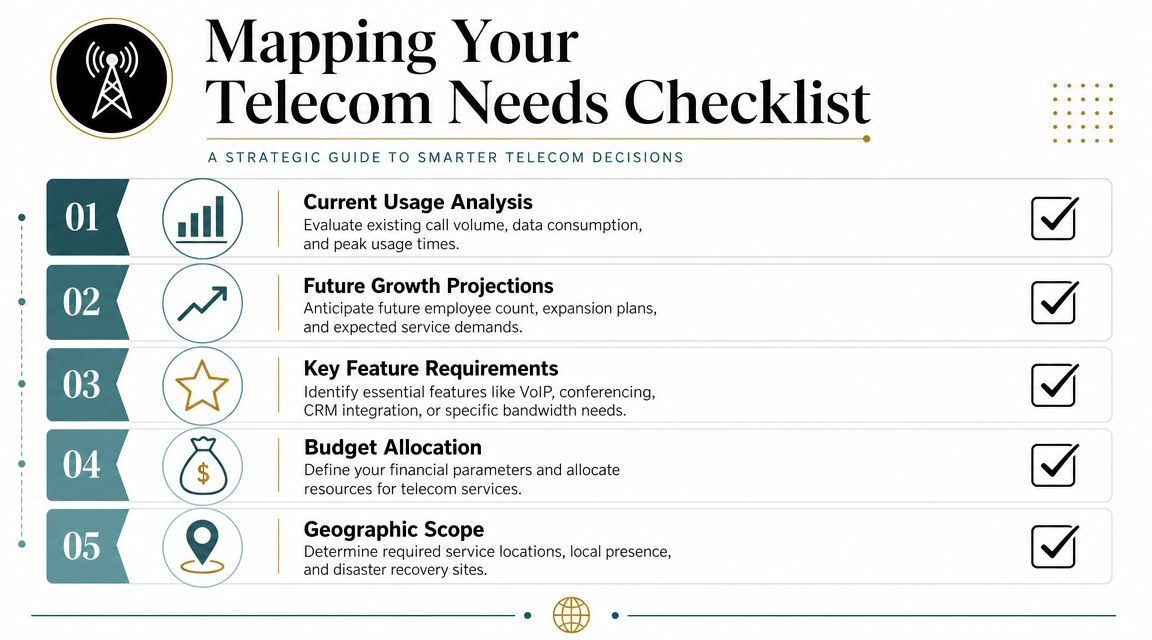
Start with what's live today, not what should be live.
I usually want one working document that covers every location, every carrier, every circuit, every wireless pool, every voice platform, and every contract renewal date. If your finance team has one version, your network team has another, and your telecom vendor has a third, you don't have an inventory. You have a future dispute.
Your self-audit checklist
Use this as the minimum internal review before you compare local telecom vendors.
- Voice environment: List direct inward dial ranges, hunt groups, call queues, fax dependencies, analog lines, elevator or alarm lines, and any legacy PRI or SIP dependencies that still exist.
- Internet and data circuits: Document circuit types, provider names, contract terms, demarc locations, public-facing critical services, and which buildings have no real redundancy.
- Wireless and mobility: Review field staff coverage complaints, device counts, pooled plans, number ownership, porting complexity, and whether certain job sites consistently create dead zones.
- Equipment and edge hardware: Inventory firewalls, routers, SD-WAN appliances, managed switches, cellular failover devices, and any provider-owned gear that creates handoff ambiguity.
- Billing and contracts: Match invoices to active services. Look for unused numbers, disconnected locations still being billed, rental charges for equipment you no longer have, and auto-renew terms no one is tracking.
Practical rule: If nobody can tell you which circuits are mission-critical within one meeting, stop shopping and finish the audit first.
Map needs by business process, not by product
Many teams often drift. They ask for “better VoIP” or “more bandwidth” when the actual issue is a broken workflow.
For a lab operation, hospital support unit, or field service business, map telecom to the work itself:
| Operational need | Telecom requirement to define |
|---|---|
| Dispatch and coordination | Stable voice, mobile data coverage, and fast issue escalation |
| Building operations | Clear demarcation, documented cabling, and support for site changes |
| Remote and hybrid staff | Secure voice access, reliable conferencing, and consistent authentication |
| Seasonal or project-based work | Contract flexibility and scalable service changes |
| Multi-site continuity | Redundant connectivity and tested failover paths |
If your facility also has physical layer issues, review related infrastructure needs alongside carrier services. A page on network cabling services in Dallas is a useful reminder that internal building infrastructure and carrier performance often get confused, even though they're separate problems.
What not to do
Three common mistakes show up in almost every weak telecom migration:
- Buying from the demo: A polished portal or phone demo doesn't tell you whether the provider can manage your cutover cleanly.
- Ignoring old contracts: Renewal traps and billing overlap can undermine an otherwise good migration.
- Letting each department define needs alone: Telecom touches IT, finance, operations, facilities, and compliance. One team alone won't catch every risk.
Once the audit is complete, your buying position changes. You're no longer asking vendors what they offer. You're asking whether they can support a defined environment without creating new operational drag.
Essential Technical Features for Institutional Telecom
Institutional telecom decisions fall apart when buyers let providers keep the discussion at the marketing level. “Business-grade,” “enterprise-ready,” and “advanced communications” don't mean much unless the provider can explain how the network behaves under real load, at your locations, with your applications.
That matters in a communications market handling enormous scale. One industry source puts global communications services revenue at about $1.43 trillion, and in the U.S. there were 390.99 million mobile subscriptions in 2024, which reflects how much enterprise connectivity now depends on dense combinations of fiber, wireless, and VoIP (telecommunications industry statistics summary).
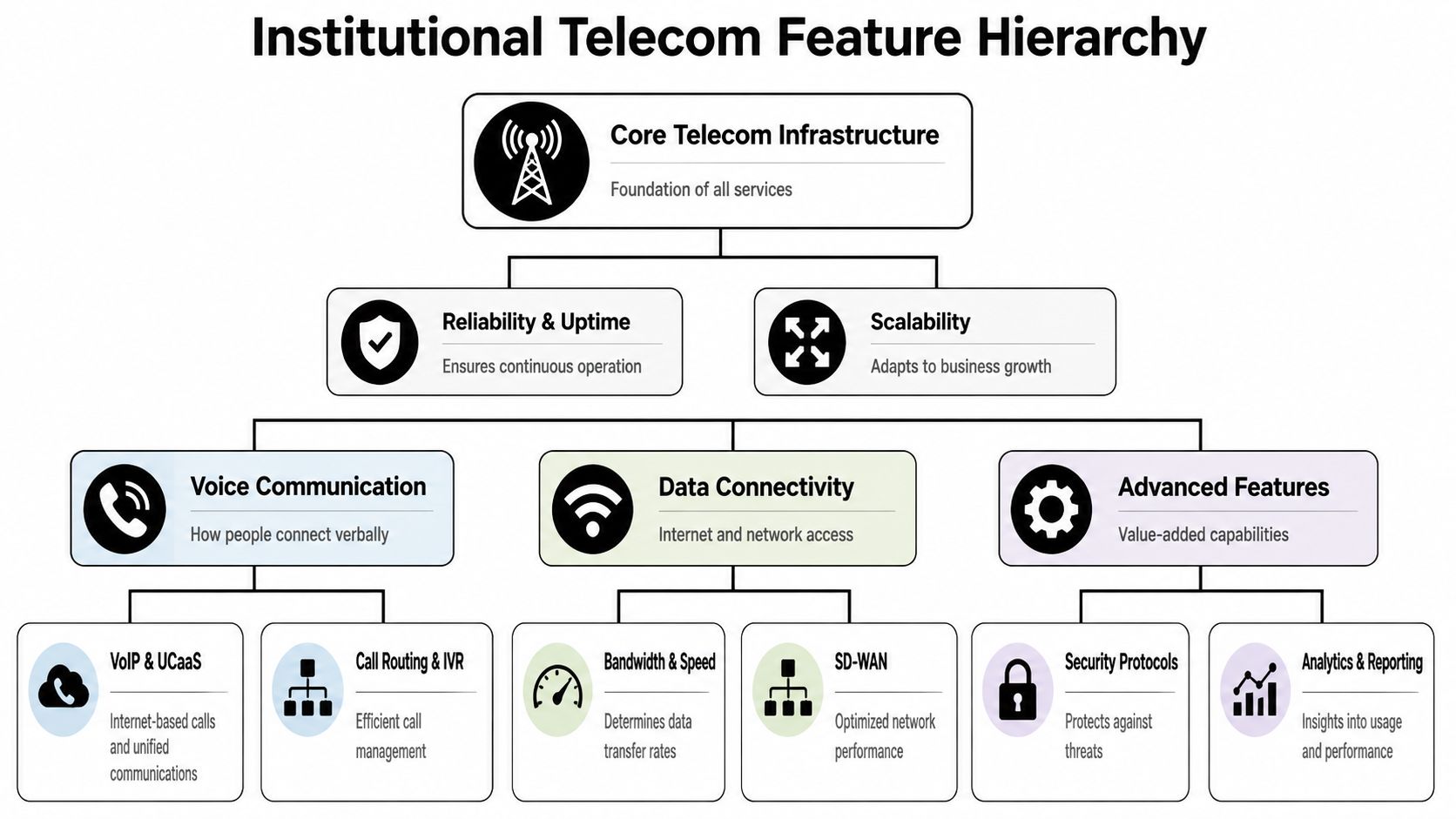
Reliability starts with traffic control
Bandwidth matters, but raw speed alone won't protect critical traffic. In a hospital, university, or administrative campus, the key question is whether the network can prioritize the right applications when usage spikes.
That's where Quality of Service, usually shortened to QoS, becomes a practical issue instead of a technical buzzword. If your voice traffic, video meetings, paging integrations, and business-critical apps all compete equally, the user experience degrades fast during peak use.
Use plain language with providers. Ask which traffic classes they prioritize, how voice is protected during congestion, and what happens when a site saturates unexpectedly.
SD-WAN is useful when you have complexity
SD-WAN makes the most sense when an organization has multiple sites, mixed carriers, failover requirements, or a need to route traffic differently by application. It's not mandatory for every site, but it's often the right answer when you've outgrown simple branch connectivity.
A strong provider should be able to explain SD-WAN in operational terms:
- Application-aware routing: Critical systems take the best available path.
- Carrier diversity: One underperforming circuit doesn't force the whole site into poor performance.
- Central policy control: IT can manage traffic behavior across locations without ad hoc local tweaks.
If a provider pitches SD-WAN but can't explain failover behavior clearly, keep digging.
Voice platforms should fit call flow, not just licensing
Cloud voice, SIP, and unified communications platforms can be excellent. They can also become a mess if the deployment team doesn't understand call routing, number management, failover logic, and user provisioning.
I'd rather work with a provider that asks detailed questions about attendants, queue overflow, emergency calling workflows, and mobile client behavior than one that leads with a low seat price. Buyers comparing platforms may find it useful to review practical explanations of the advantages of 3CX phone systems, especially if they're weighing flexibility, management style, and hosted-versus-managed trade-offs.
If the provider can't whiteboard your call flow in a way your operations team understands, they probably can't migrate it cleanly either.
For organizations evaluating modern calling and collaboration together, a local comparison of unified communications providers near me can help frame the conversation around integration instead of just dial tone.
Redundancy needs a design, not a promise
Every provider says they support uptime. Fewer can explain your actual backup path.
Ask specific questions about:
| Feature | What to verify |
|---|---|
| Internet redundancy | Is backup delivered by diverse physical path or just a second service on similar infrastructure |
| Voice continuity | What happens to inbound and outbound calling during a primary outage |
| Mobile backup | Can key staff work from managed wireless failover if a site drops |
| Power resilience | Which provider-managed devices remain available during local power events |
| Site recovery | How quickly can service be restored after a building-specific incident |
The phrase I look for is clear operating model. If the provider can't tell you how voice, data, and failover behave at each site, you don't have resilience. You have assumptions.
Vetting Telecom Providers for Security and Compliance
Security used to sit next to telecom. Now it sits inside it. Cloud voice, mobile management, remote access, carrier portals, number porting, logging, and support workflows all create exposure points that buyers can't afford to treat as secondary.
A major gap in local telecom marketing is that it rarely connects product features to cyber-risk and regulatory requirements. Providers increasingly bundle connectivity with security services, which means buyers in healthcare, education, and government need targeted questions about encryption, logging, and support SLAs before they sign (business communication solutions and security-first procurement concerns).

Ask questions that force precise answers
A provider that says “we take security seriously” hasn't told you anything. Push for specifics.
Use direct questions like these:
- Encryption: How is voice or signaling traffic protected in transit, and which services support encryption by default versus by configuration?
- Logging and retention: What events are logged, how long are logs retained, and who can access them?
- Administrative access: How do provider staff authenticate to management systems, and how is privileged access reviewed?
- Incident response: If number routing breaks, credentials are exposed, or a suspicious change appears, what is the escalation path and response ownership?
- Porting controls: What safeguards reduce unauthorized or error-prone number moves?
- Support boundaries: Which security tasks are included, and which remain entirely on the customer side?
- Regulated environments: What experience does the provider have supporting environments with HIPAA-style confidentiality and audit expectations?
Look for evidence, not posture
Security posture is easy to market. Process evidence is harder to fake.
Ask providers to walk through a real change-control scenario. For example, how they handle admin changes, number ports, call recording settings, and emergency routing modifications. The details matter. Good teams have approval paths, documented rollback procedures, and clear ownership boundaries.
Buyers in regulated environments should assume telecom migrations create compliance risk until the provider proves otherwise.
This is also where your security team should evaluate broader monitoring visibility. If you're trying to correlate telecom events with endpoint, identity, and infrastructure activity, it helps to understand how unified threat correlation solutions fit into a wider incident response model.
Security questions that expose weak providers quickly
A short comparison matrix helps during vendor interviews:
| Question area | Strong answer sounds like | Weak answer sounds like |
|---|---|---|
| Logging | Specific event types, retention approach, access controls | “We have logs if needed” |
| Access control | Named roles, approval process, privileged account handling | “Our engineers can get in when needed” |
| Incident handling | Defined severity path, ownership, communication expectations | “Support will look into it” |
| Regulated support | Familiarity with customer audit and documentation needs | “We work with many industries” |
If you're screening providers by geography, don't stop at “local.” Review whether their broader telecom solutions near me positioning aligns with your security and operational requirements, then validate the details live.
How to Truly Vet Business Telecom Services Near You
The phrase business telecom services near me sounds local, but the primary buying issue is architectural. Buyers don't need the closest provider. They need the provider that can clearly explain what service is available at their exact address, how it gets into the building, and what happens if that path fails.
That distinction gets overlooked constantly. Generic service-area pages rarely answer the buyer's real question, which is what network quality to expect at a specific building. In practice, the best local choice is often the provider with the clearest last-mile architecture and the fastest path to real installation at your facility (address-level telecom serviceability and last-mile guidance).

Service area maps are not service validation
A provider may say your city is covered. That doesn't mean your facility can get dedicated fiber, fast installation, diverse routing, or the same service class as the building across the street.
I've seen buyers assume they were ordering true fiber when the final design relied on a very different last-mile method. That kind of misunderstanding changes installation time, performance expectations, and backup design.
Ask for building-specific answers on these points:
- Access method: True fiber, fiber-backed cable, fixed wireless, copper-based service, or another architecture.
- Construction needs: Whether the order requires new build, landlord approval, riser work, conduit access, or street-side coordination.
- Demarcation details: Where service lands, who owns the handoff, and what equipment the provider installs.
- Redundancy reality: Whether the backup path is physically distinct or just contractually separate.
- Support logistics: Who shows up onsite if there's a physical issue, and how local dispatch works.
Demand site-level proof
Don't settle for “available in your area.” Ask for documentation or a serviceability confirmation tied to your address.
A clean vetting process usually looks like this:
- Submit every service address you care about, including backup locations and temporary sites.
- Request the exact access method proposed for each address.
- Ask whether installation requires construction or landlord coordination.
- Verify expected handoff and provider equipment so your network team can plan.
- Review outage and failover behavior for each site independently.
- Confirm what the SLA covers and what it doesn't.
Generic local pages help with discovery. They do not answer deployment reality.
Use a script that forces useful answers
Most telecom sales conversations drift unless you control them. A direct email template works better than an open-ended “tell us about your services.”
We are evaluating business telecom services for a specific facility and need address-level validation before discussing packages or pricing. Please confirm the exact service type available at our building, the last-mile delivery method, whether new construction or landlord coordination is required, estimated installation path, provider-owned equipment at demarc, options for physical redundancy, outage escalation process, and the support SLA for both remote and onsite issues. If you propose voice services, include number porting process, failover behavior, and who owns cutover coordination.
That message gets you closer to reality fast.
Compare providers on clarity, not polish
Here's the rule I use. The provider with the clearest answers usually becomes the safer choice, even if another vendor has a shinier proposal.
A practical scorecard looks like this:
| Evaluation point | What you want |
|---|---|
| Address validation | Specific and building-level |
| Last-mile explanation | Plain English, no evasive wording |
| Install path | Clear dependencies and responsibilities |
| Onsite support model | Defined local or regional field process |
| Voice migration handling | Explicit cutover and porting ownership |
| SLA explanation | Terms that match business impact |
If a provider resists this level of detail, assume you'll be discovering the hard parts during implementation. That's the wrong time to learn how your building is really served.
Making Your Final Decision with Confidence
A sound telecom decision doesn't come from one great sales call. It comes from discipline. You audit what you already have. You define business requirements in operational language. You translate those needs into technical criteria. You pressure-test security and compliance. Then you validate service at the actual building, not at the city level.
That approach matters because rollout success depends less on any single network promise and more on execution discipline. In telecom service launches, the strongest benchmark is process discipline, including a collaborative product plan, embedded QA, accurate billing from day one, and automated workflows that reduce operational drag (successful telecom service offering practices).
The final shortlist should answer five questions
Before signing, make sure the chosen provider can answer all of these without hedging:
- Can they support your exact sites: Not just your metro area.
- Can they explain the design clearly: Including failover, demarcation, and call flow.
- Can they support regulated operations: With specifics on logging, access, and escalation.
- Can they bill accurately from day one: With contract visibility and clean provisioning.
- Can they manage the rollout without creating manual cleanup: For IT, finance, facilities, and operations.
If you're still comparing carrier mixes and access types, broader market roundups like this guide to find top business internet services can help frame the field, but the final decision should still come back to your locations, your risk profile, and your internal requirements.
For organizations balancing telecom planning with wider facility and IT lifecycle work, it also helps to review adjacent topics like telecommunications services in Dallas, especially when network changes intersect with decommissioning, relocation, or surplus equipment handling.
The best provider isn't the one with the shortest brochure. It's the one that can support your operations with fewer surprises after the contract is signed.
If your telecom upgrade, office move, lab decommission, or infrastructure refresh is creating a backlog of retired electronics or surplus equipment, Scientific Equipment Disposal can help you handle the downstream part correctly. S.E.D. supports Atlanta-area businesses, hospitals, universities, government agencies, and research facilities with compliant pickup, de-installation, secure media handling, and sustainable recycling for lab and IT assets.