Managed Telecom Services Near Me: A Buyer’s Guide


You're probably not searching for managed telecom services near me because everything is running smoothly.
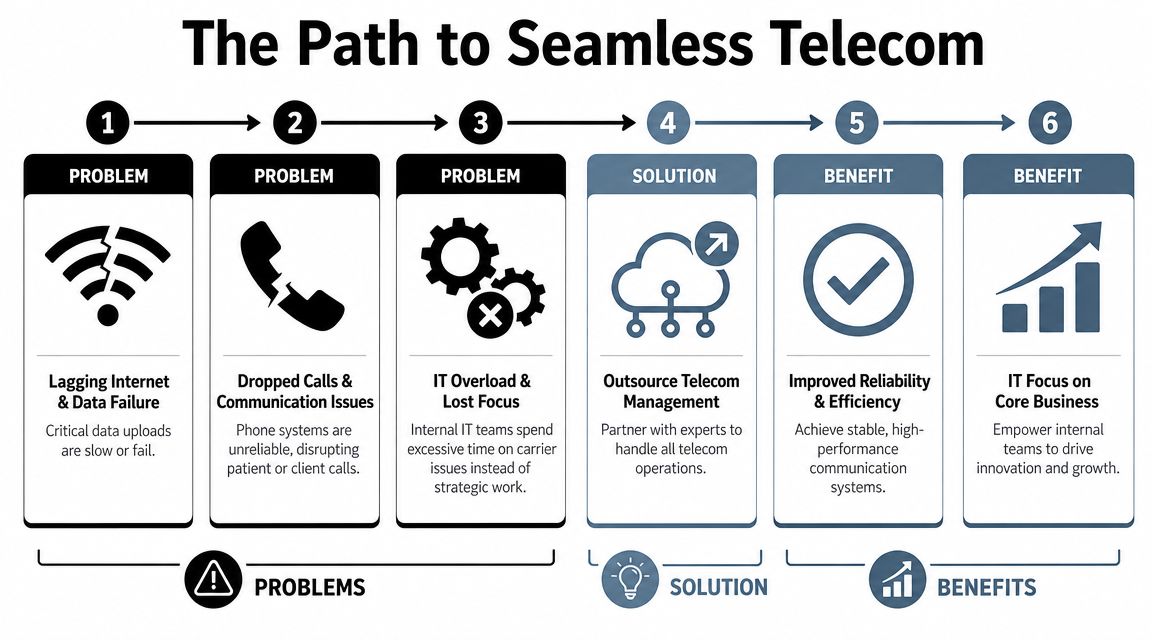
More often, the search starts after a failure. A clinic in Atlanta misses patient calls because the phone system drops connections. A research lab waits on a large file upload that should've finished already. An internal IT team burns half a day arguing with a carrier about a circuit order while actual business projects sit untouched. At that point, “near me” stops being a convenience search and becomes a risk-control search.
That's why this decision deserves more than a quick vendor comparison. A strong telecom partner doesn't just sell internet or voice service. They take control of the moving parts that create outages, billing confusion, weak escalation, and missed changes across carriers, circuits, phones, licenses, and locations.
Why Smart Organizations Outsource Telecom Management
In-house telecom management usually breaks down the same way. One person knows the carrier contacts. Another person tracks invoices in spreadsheets. Someone else handles office moves. Nobody has a complete view of circuits, contracts, voice platforms, failover paths, and support commitments.
That model can work when your environment is small. It starts failing when you add multiple sites, cloud voice, remote users, compliance requirements, and more than one carrier.
Grand View Research estimated the global telecom managed services market at USD 20.67 billion in 2022 and projected USD 55.29 billion by 2030, with a 13.4% CAGR, reflecting a broader shift from in-house administration to specialized providers that manage cost, security, and cloud adoption at scale (Grand View Research telecom managed services market report).
What outsourcing changes in practice
A capable provider takes routine telecom operations away from your IT staff and puts them into a controlled process. That includes carrier coordination, service ordering, incident escalation, invoice review, documentation, and day-to-day service governance.
If you already understand how managed IT works, the telecom version follows a similar logic. You aren't buying random support hours. You're paying for operational ownership, specialized skills, and a defined service model.
Practical rule: If your internal team spends more time chasing carrier tickets than improving systems, telecom management has already become an outsourcing candidate.
For Atlanta organizations with labs, clinics, warehouses, or multiple offices, local execution still matters. A provider that can coordinate on-site work, verify handoffs, and support location-based changes is often more useful than a remote help desk that only opens tickets. Businesses comparing support options often start with local service categories such as telecom maintenance services in Atlanta because physical presence affects response quality.
Why the shift keeps accelerating
Organizations usually outsource telecom for business reasons, not technical curiosity.
- Cost pressure: Telecom waste hides in overlapping contracts, legacy lines, unused licenses, and disconnected ordering processes.
- Skill gaps: Most internal IT teams are strong on systems and applications, but fewer have deep carrier-management experience.
- Focus: Teams want to spend time on security, cloud platforms, endpoints, and business applications instead of arguing over billing disputes.
- Reliability: A provider that monitors and manages telecom operations continuously can catch issues earlier than a reactive internal model.
The search term may be local. The reason behind it is strategic.
Defining Your Telecom Needs Before You Search
Before you contact providers, get your own house in order. Most disappointing telecom engagements start with a buyer saying, “We just need better service,” without defining what “better” means.
The better approach is to document your current environment in a way a provider can't easily blur with a generic sales pitch.
Start with an internal inventory
Write down every service you're paying for and every service your teams rely on. That sounds basic, but it's where most organizations discover gaps.
Include:
- Circuits and connectivity: fiber, cable, broadband, wireless backup, private links
- Voice services: PRI, SIP, VoIP seats, call center licenses, fax lines, analog lines for alarms or elevators
- Locations: headquarters, branch offices, labs, clinics, warehouses, remote users
- Contracts: carrier names, renewal dates, notice periods, pricing terms
- Owners: who approves changes, who opens tickets, who receives invoices
If you can't tie a billed service to a location, person, or business need, flag it immediately.
Translate pain into buying criteria
Organizations adopt managed telecom services primarily for cost reduction, access to skilled manpower, and better focus on core business. A major use case is contract consolidation, where a provider audits agreements and removes redundant services left behind after office moves or decommissions (research on telecom managed services adoption and contract consolidation).
That means your pain points should become specific goals, not broad complaints.
| Pain point | Better objective |
|---|---|
| Bills seem too high | Identify unused services and consolidate contracts |
| Users report random outages | Improve escalation and require documented incident ownership |
| IT spends too much time on carriers | Shift vendor coordination to a managed provider |
| A facility can't afford downtime | Build redundancy and local response expectations |
| Compliance concerns keep coming up | Require documented security controls and support boundaries |
Don't ask vendors to “optimize telecom.” Ask them how they'll handle your renewals, failed installs, billing disputes, site adds, and service disconnects.
Build your scorecard before the first call
Create a one-page decision sheet with the questions that matter to your organization.
Use categories like these:
- Cost control
- Are you trying to reduce waste, simplify contracts, or both?
- Operational burden
- Which telecom tasks consume your team's time now?
- Service quality
- Which applications or departments suffer most when connectivity or voice performance slips?
- Site complexity
- Are you managing a single site, multiple buildings, or multiple states?
- Compliance exposure
- Do any workflows involve protected data, regulated communications, or strict retention requirements?
This prep work changes the dynamic immediately. Instead of listening to a standard sales deck about “reliability” and “innovation,” you can ask direct questions tied to your environment. That's how you find the provider that fits your business, not the one with the best pitch.
Essential Features of a Modern Telecom Provider
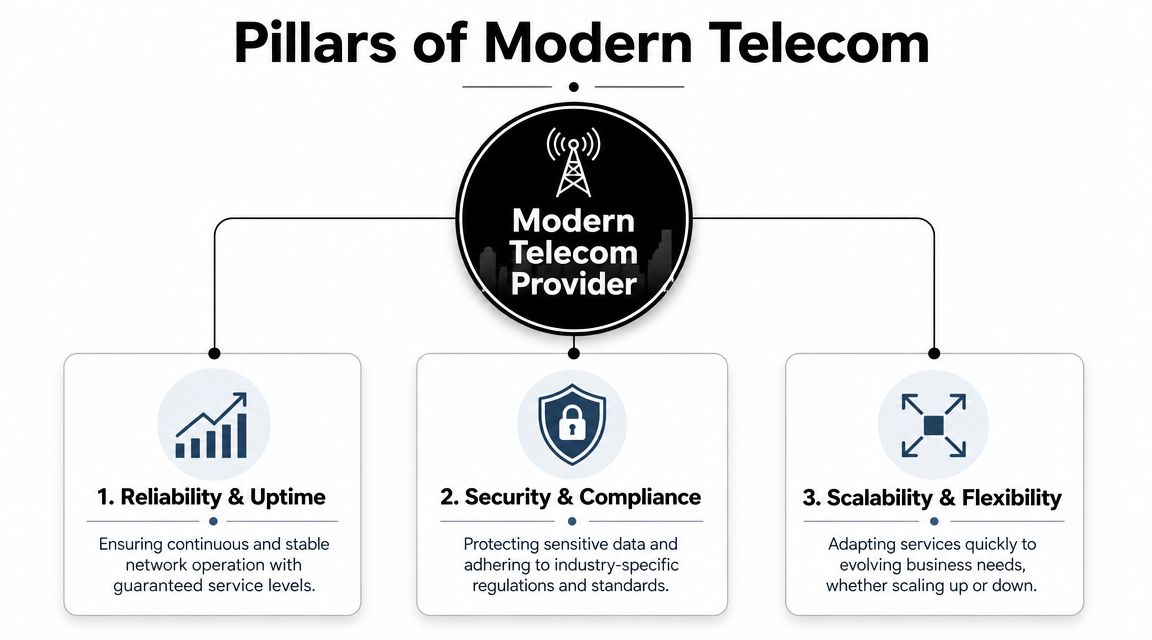
A modern telecom provider should do more than resell circuits and hand you a support number. If that's all they offer, you're still doing most of the management work yourself.
The test is whether they can own the operational layer across connectivity, voice, and network administration.
Connectivity that fits the site
Start with access. Every location has different realities. A clinic in one part of metro Atlanta may have several fiber options. A smaller site may depend on cable plus wireless failover. A warehouse may need stable WAN connectivity more than premium voice features.
Ask whether the provider supports and manages combinations such as:
- Primary access using fiber or broadband
- Secondary failover using another carrier or wireless path
- Site-specific recommendations based on serviceability, not sales preference
- Carrier coordination for installs, repairs, and escalations
A reseller often stops at “we can quote that.” A strong managed provider explains why one design fits your location better than another.
Voice and collaboration support that isn't shallow
Voice problems create immediate business pain. Patients can't reach staff. Departments miss calls. Auto attendants break. Hunt groups route incorrectly after a move. New users wait too long for provisioning.
That's why “fully managed” voice should include platform administration, user changes, call flow updates, troubleshooting, and coordination between your internet service and your voice environment. If you're comparing communication platforms, a useful parallel category is unified communications providers near me, because voice service without management depth rarely holds up under daily operational pressure.
Network management separates operators from order-takers
Here, many buyers miss the difference.
The most effective managed model uses a centralized inventory for telecom assets and validates every Move/Add/Change/Disconnect, often called MACD. Without structured MACD tracking, organizations often keep paying for ghost services long after the business need has disappeared (telecom cost management guidance on inventory and MACD control).
A provider with real operational maturity should be able to show you:
- A single system of record for circuits, handsets, licenses, contracts, and locations
- Invoice reconciliation against that inventory
- Change logging for every add, move, disconnect, and service modification
- Recurring audits to catch drift between what exists, what's billed, and what's needed
If a provider can't explain how they track disconnects and billing cleanup, they're not managing telecom. They're brokering services.
What good looks like
You don't need every advanced feature on day one. But you do need evidence that the provider can scale with you.
Look for three signs:
- They document the environment clearly
- They own service changes from request through closure
- They can explain support boundaries without vague language
That combination matters more than polished branding. Telecom performance depends on process discipline far more than on marketing.
Evaluating Security Compliance SLAs and Pricing
A polished proposal can hide a weak operating model. This is the stage where buyers need to slow down and read what the provider is promising.
That matters even more now because the North America telecom managed services market was valued at USD 5.23 billion in 2024 and is expected to reach USD 15.13 billion by 2032, driven by cybersecurity demand and cloud adoption. More providers are entering the market, which makes careful review of security commitments and SLAs more important (Data Bridge Market Research on the North America telecom managed services market).

Security and compliance questions that deserve proof
If you operate in healthcare, research, education, or government, don't accept broad statements like “we take security seriously.” Ask for clear descriptions of responsibility.
Focus on:
- Administrative access: Who can change configurations, and how is access controlled?
- Data handling: What telecom data is stored, retained, or exposed to support teams?
- Incident process: How are security events identified, escalated, and communicated?
- Compliance support: Can the provider explain where their role starts and stops in your regulated environment?
If your broader environment includes cloud workloads and formal audits, resources on ensuring cloud audit readiness can help you ask better control questions across providers, not just telecom vendors.
How to read an SLA without getting distracted
Most buyers look at uptime first. That's understandable, but uptime alone doesn't tell you how support behaves.
Review the SLA for these items:
| SLA element | What to look for |
|---|---|
| Service scope | Which services are covered, and which are excluded |
| Response commitments | Whether the provider defines how quickly they acknowledge issues |
| Escalation path | Who owns severe incidents and how escalation works |
| Maintenance rules | How planned work is announced and handled |
| Credits or penalties | Whether missed commitments have real consequences |
A provider can sound responsive in sales calls and still write a contract that gives you very little recourse.
Watch for this: “24/7 support” often means 24/7 ticket intake, not 24/7 engineering action.
If you're reviewing local options, directories and comparison pages like best telecom company in Atlanta can help you build a shortlist, but the contract language still decides whether the service is usable.
Pricing that looks simple and costs more later
Telecom pricing gets messy when providers combine recurring fees, pass-through carrier charges, setup work, MACD labor, hardware, and support tiers into one quote.
Ask every vendor to separate:
- Monthly recurring charges
- One-time implementation fees
- Carrier pass-through costs
- Support included vs billed separately
- MACD and after-hours work
- Contract term and renewal language
Then ask a blunt question: what changes the invoice after go-live?
That single question often reveals whether the provider runs transparent operations or relies on add-on billing after you've committed.
Finding a True Local Partner in the Atlanta Area
A local address doesn't prove local capability. That's the first assumption to challenge.
Plenty of firms show up for managed telecom services near me searches because they rent a sales office, use local phone numbers, or target metro keywords. That doesn't mean they can improve resilience at your site in Atlanta, Decatur, Marietta, Alpharetta, or Norcross.
Local should mean operational depth
The key question is whether the provider improves resilience or merely resells someone else's network. Buyers should ask for evidence of multi-carrier network design and local incident response capability, especially as the telecom managed services market is projected to reach $66.34 billion by 2032 and more providers will market themselves as “local” without matching infrastructure depth (Fortune Business Insights telecom managed services market outlook).
That means you should ask for specifics, not branding language.
Ask questions like:
- Which carriers do you actively work with in the Atlanta metro?
- Can you design primary and backup service on different carriers?
- Who handles on-site coordination when a circuit install goes wrong?
- Do you have local technical staff or only local sales staff?
- How do you handle a site outage after business hours?
What a strong Atlanta provider should know
A true local partner usually knows the practical details that national sales teams gloss over.
They should understand:
- Carrier availability by building or corridor
- Where fiber options are strong and where they're limited
- How to coordinate access with property management
- What local dispatch and handoff delays look like
- How to support multi-site organizations spread across metro Atlanta
That doesn't mean a national provider is automatically wrong. Some national firms have excellent operations. But if their “local” story collapses the moment you ask about dispatch, carrier diversity, or on-site escalation, you're looking at a remote sales model, not a local telecom partner.
A provider earns the word local when they can show how they'll support your building, your outage path, and your carrier mix. Not when they mention an Atlanta ZIP code.
A simple way to separate operators from resellers
Ask each provider to walk through one realistic scenario. For example: your primary circuit fails at a clinic, voice quality degrades, and you need both a carrier escalation and an on-site check.
Then listen carefully.
A real operator will explain ownership, escalation, failover, communication, and next steps. A reseller usually says they'll “open a ticket with the carrier.” That answer tells you exactly how much value they add.
If you're comparing regional options, lists of local telecom companies can help identify who claims a local presence. Your job is to test whether that presence is technical or just commercial.
Your Provider Vetting Checklist and RFP Guide
By the time you reach vendor demos and proposals, the goal is simple. Make every provider answer the same questions in the same format.
That's the only way to compare them fairly.
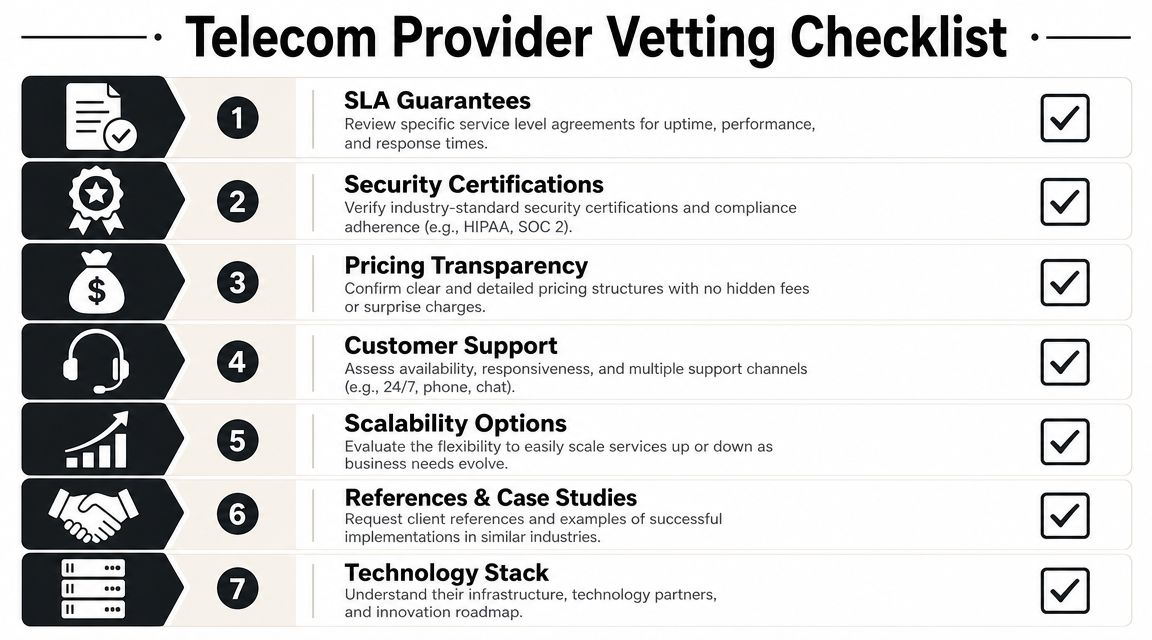
Managed Telecom Provider Vetting Checklist
| Category | Question/Check | Importance |
|---|---|---|
| SLA guarantees | Does the contract define service scope, response commitments, escalation, and credits clearly? | High |
| Security posture | Can the provider explain access control, incident handling, and compliance boundaries in writing? | High |
| Inventory management | Do they maintain a centralized record of services, contracts, and locations? | High |
| MACD process | How are adds, moves, changes, and disconnects tracked through closure? | High |
| Pricing transparency | Are recurring, one-time, and support-related charges separated clearly? | High |
| Local support | Do they have actual Atlanta-area operational coverage, not just sales presence? | High |
| Carrier strategy | Can they support multi-carrier design for resilience? | High |
| Voice administration | Who handles call flow changes, user provisioning, and troubleshooting? | Medium |
| Reporting | What recurring reports do they provide on billing, inventory, incidents, and renewals? | Medium |
| Contract flexibility | What happens at renewal, expansion, downsizing, or site closure? | Medium |
| References | Can they provide relevant customer references in similar environments? | Medium |
| Roadmap fit | Can their platform support your likely future needs without a full replacement? | Medium |
If you're starting from a broad search, pages focused on business telecom services near me can help frame the market. But your checklist should remain stricter than any directory or marketing page.
A practical RFP structure
Keep the RFP short enough that providers will answer it well, but detailed enough that they can't hide behind vague language.
Use these sections:
Current environment
- Number and type of locations
- Existing voice, internet, and network services
- Known pain points and constraints
Required services
- Connectivity management
- Voice platform support
- Carrier coordination
- MACD handling
- Billing reconciliation
- Local support expectations
Security and compliance
- Administrative controls
- Incident response process
- Documentation requirements
- Regulated environment considerations
Service model
- Support hours
- Escalation path
- Onboarding plan
- Reporting cadence
Commercial terms
- Pricing format
- Contract term
- Renewal terms
- Exit support
Questions worth asking live
Some of the best answers won't appear in writing unless you ask directly.
Use questions like these during presentations:
- Show me how you track a disconnect from request to billing confirmation.
- Show me a sample inventory report.
- Who owns the carrier relationship during an outage?
- What changes trigger extra charges?
- How do you support a new site opening on a short timeline?
- What does your local support model look like in metro Atlanta?
The best provider usually isn't the one with the longest feature list. It's the one with the clearest operating model.
A good telecom partner should reduce uncertainty. If the proposal, sales process, and contract all leave you guessing, the day-to-day service probably will too.
If your telecom review is happening alongside a lab closure, office move, data center cleanup, or equipment refresh, Scientific Equipment Disposal can help Atlanta-area organizations handle the physical side of the transition. Their team supports secure, compliant pickup and disposal of lab equipment, electronics, servers, and storage assets, which is often a practical part of telecom and IT changeovers.