Top 7 Telecommunications Services Dallas Providers (2026)

Your Dallas business is growing, but your connection may be lagging behind it. Video calls break up, cloud apps hesitate at the wrong moment, and large file transfers crawl when your team needs them done now. Those aren't minor IT annoyances. They slow billing, frustrate staff, and make customers feel the friction.
That's why choosing telecommunications services Dallas businesses can rely on is a strategic decision, not just a utility purchase. Dallas sits in a serious telecom market. The region has more than 864 privately owned telecom companies in Dallas, plus dozens of public companies with a North American headquarters or major regional presence, according to One America Works' summary of Dallas telecom scale. In practice, that means buyers have options, but also a lot of noise to sort through.
The local environment raises the stakes. Dallas is one of the most interconnected cities in the country, with dense fiber infrastructure, access to Tier 1 network providers, major internet exchanges, and carrier hotels such as Infomart, according to DataBank's Dallas connectivity overview. That's great news if you need resilient, low-latency connectivity. It also means weak provider selection stands out fast because better alternatives usually exist.
This guide gets to the point. Below are seven practical options for Dallas telecom buyers, followed by a comparison section and a buyer's checklist you can use on provider calls. The focus isn't marketing language. It's where each provider tends to fit, where each one doesn't, and what trade-offs matter when uptime, support, install timelines, and redundancy are on the line.
1. AT&T Business
A Dallas firm opening a second office usually asks the same question first. Do we want one carrier that can handle internet, voice, wireless backup, and support under one contract, or do we split services across multiple vendors and manage the coordination ourselves?
AT&T is often the first serious option in that discussion because it can cover a lot of ground. For Dallas businesses, the appeal is straightforward: one provider can supply business fiber, dedicated internet, voice, mobility, and managed network services. That does not automatically make it the lowest-cost path. It often does make escalation cleaner when circuits, failover, and carrier support all sit with the same provider.
Where AT&T fits best
AT&T makes the most sense when a business wants a single carrier responsible for the primary connection and at least part of the backup plan. That can work well for companies standardizing on fiber plus wireless failover, or for teams that need DIA, Ethernet, SD-WAN, and mobility to fit into the same procurement process.
I usually put AT&T higher on the list for multi-site organizations than for a single small office. A healthcare group, law firm, manufacturer, or regional services company with several locations can benefit from having fewer vendors to manage, even if the monthly rate is not the cheapest available at every site.
- Best use case: Primary wired service with wireless backup from the same carrier.
- Strongest buyer profile: Mid-market and enterprise teams with multiple locations or shared IT standards.
- Watch closely: Quote-based installs, construction dependencies, and contract terms tied to address availability.
Practical rule: Ask AT&T to quote both business fiber and dedicated internet. Headline speeds matter less than packet loss, jitter tolerance, repair commitments, and how sensitive your applications are to latency.
What works and what doesn't
AT&T's strength is breadth. A company can start with standard business connectivity, then add dedicated circuits, managed networking, or mobility as requirements change. That helps when an office grows faster than expected or when the business wants one escalation path instead of separate internet and wireless providers.
The trade-off is complexity. Serviceability is highly address-specific, advanced installs can depend on local build work, and enterprise quotes are rarely fast. If your Dallas site has a firm go-live date, ask for install intervals, construction assumptions, demarc details, and failover design in writing before you sign.
That matters even more for sites with compliance, uptime, or application sensitivity concerns. Clinics, engineering offices, call centers, and firms pushing large files over VPN should press for clear answers on SLA terms, support tiers, and whether the proposed handoff is shared or dedicated.
If your planning work also includes cloud voice or hybrid connectivity outside Dallas, this cloud telecom services guide for Houston businesses is a useful parallel read because many of the same buying questions apply across Texas markets.
Use AT&T Business if your priority is broad service coverage, one-carrier accountability, and a practical path to combine wired and wireless under the same provider.
2. Spectrum Business and Spectrum Enterprise
Spectrum is a common first quote in Dallas because it serves two different buyer types under the same parent. Spectrum Business is the practical SMB option. Spectrum Enterprise is the version you bring in when the site needs dedicated fiber, enterprise SLAs, and more serious network engineering.
That split matters. Too many buyers assume “Spectrum” is one thing. It isn't.

The real trade-off with Spectrum
For smaller offices, clinics, and retail sites, Spectrum Business is often attractive because cable-based internet can be easier to install and broadly available across DFW. If the site just needs dependable business internet and voice without enterprise complexity, it's a reasonable starting point.
For larger operations, the equation changes. Standard business cable is still a shared access model, and that shows up in upload behavior, jitter consistency, and peak-time predictability. When your workflows involve constant cloud backup, VoIP sensitivity, imaging transfers, or heavy VPN use, Spectrum Enterprise is the more appropriate side of the house.
What to ask before you sign
Don't ask Spectrum only for speed tiers. Ask which product line you're being sold, and whether the handoff is shared HFC or dedicated fiber.
- For SMB offices: Ask whether the standard business service is enough for your upload profile.
- For clinics and call-heavy teams: Ask how voice quality is protected if data usage spikes.
- For growing sites: Ask how an upgrade path to Spectrum Enterprise would work without a full rip-and-replace.
Don't compare Spectrum Business against dedicated fiber offers as if they're interchangeable. They solve different problems.
Spectrum's main strength is progression. A small office can start on a simpler service and later move toward enterprise fiber within the same broader provider ecosystem. That can reduce procurement friction.
Its weakness is also obvious. If you buy the lower-tier service expecting dedicated-fiber behavior, you'll be disappointed. Use Spectrum Business when broad availability and straightforward onboarding matter. Escalate to Spectrum Enterprise when uptime, jitter control, or route diversity starts to matter more than entry-level simplicity.
3. LOGIX Fiber Networks
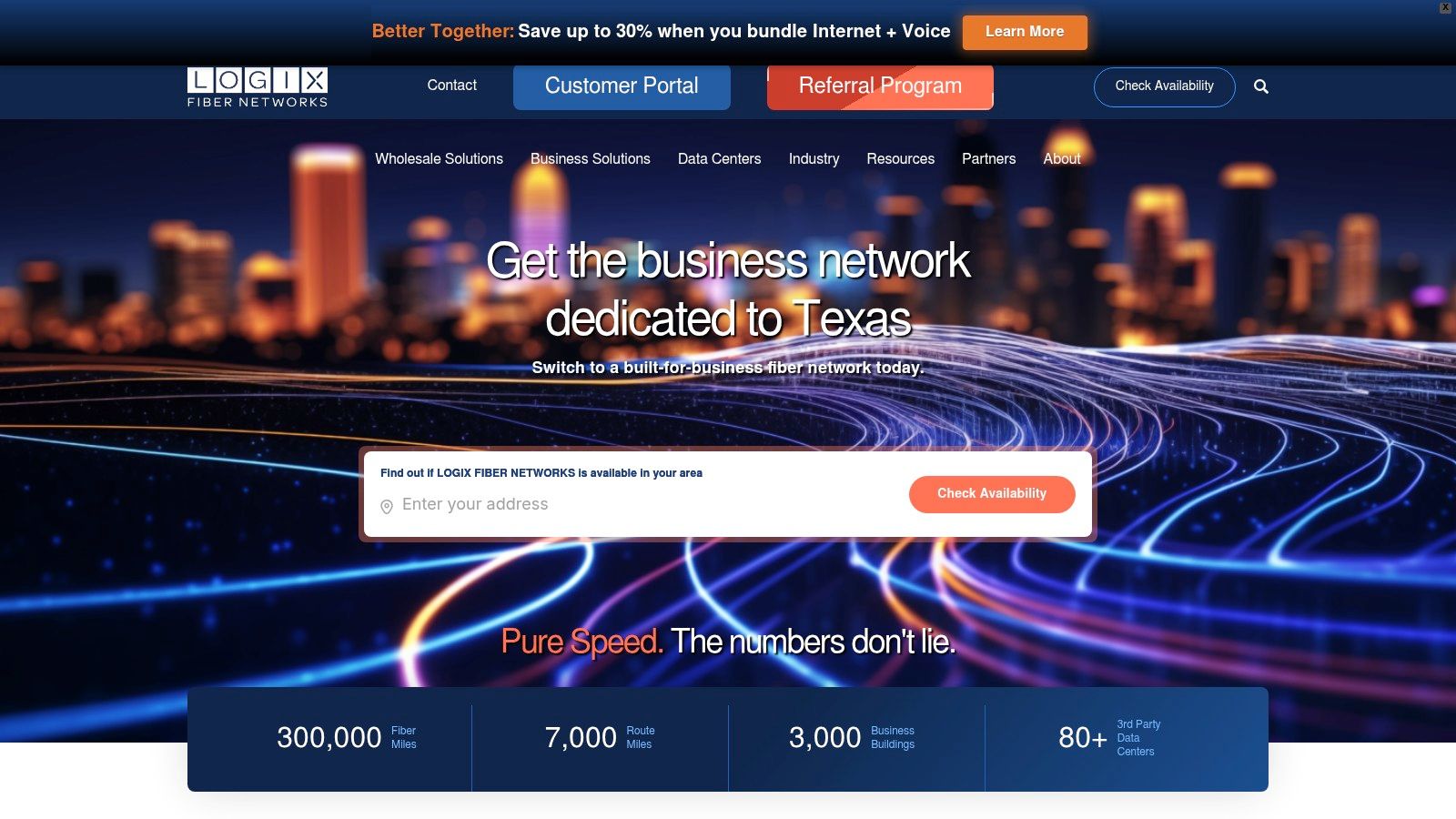
A Dallas firm with 60 staff, a VoIP-heavy front desk, and a private link into a nearby data center usually shops differently than a five-person branch that just needs internet installed next week. LOGIX fits the first case far better than the second.
LOGIX tends to attract Dallas buyers who want a Texas-focused carrier with dedicated fiber options, business voice, and metro connectivity from a provider that knows the regional market. In practice, that usually means more consultative sales engineering, more discussion about building access and route proximity, and fewer one-size-fits-all quotes.
Why Dallas buyers consider LOGIX
LOGIX is strongest where metro fiber matters. That includes offices that need dedicated internet, predictable latency across Dallas-area sites, SIP or voice services, or connectivity into regional data center environments. For law firms moving large files, engineering teams pushing CAD data, healthcare groups with site-to-site traffic, and mid-market companies that want a provider with local operating depth, LOGIX often lands in the serious-shortlist category.
The trade-off is simple. If your building is already on-net or close to LOGIX plant, the service can be a strong fit. If the address is off-net, the quote, timeline, and construction risk can change the economics fast.
That is the first filter I use.
Where LOGIX works well, and where it does not
LOGIX is rarely the fastest answer for a small office that values quick installation over carrier design options. The provider makes more sense when the business has clear technical requirements and enough usage to justify dedicated fiber instead of a lower-cost shared service.
A good buying pattern is to treat LOGIX as a targeted option, not a default option. Shortlist it when the site has real bandwidth symmetry needs, low tolerance for jitter, regional interconnection needs, or a support preference that favors a smaller operating footprint over a national carrier model. For a broader view of how regional carriers compare in another major market, this guide to local telecom service providers for businesses in Chicago is a useful reference point.
Questions to ask before you sign
LOGIX proposals deserve more technical scrutiny than a simple speed-and-price comparison.
- Is the building on-net, near-net, or fully off-net? That answer affects install time, construction charges, and contract value.
- What is the handoff and access design? Confirm whether you are buying dedicated fiber end to end and what the demarcation looks like in the suite.
- What are the repair and escalation paths? Regional support can be a strength, but you still want the service-level details in writing.
- What happens if bandwidth needs double in 12 months? Ask how upgrades are delivered and whether the original circuit design limits expansion.
- Do you need inside wiring work as part of the project? If so, this Dallas network cabling services guide is relevant because provider performance depends on the quality of the internal cabling plant.
Use LOGIX Fiber Networks when the site supports it and the business has requirements that justify a more engineered solution. If the location is off-net or the project needs a quick, low-friction turn-up, a larger incumbent or a temporary wireless option may be the better call.
4. Side-by-side comparison of Dallas telecom services
A Dallas IT lead with three quotes on the table usually is not choosing between equal services. They are choosing between different network models, install realities, and support structures. That is why this section matters. The table and checklist later in this guide are meant to work together, so you can screen providers quickly and then pressure-test the finalists with the right technical questions.
Dallas is large enough, dense enough, and varied enough that provider fit changes by address. A law firm in Uptown, a warehouse in Irving, a healthcare office in Plano, and a manufacturing site in South Dallas can get very different answers on fiber availability, build cost, and repair expectations. Brand matters less than the physical serving situation and the tolerance for downtime.
How to read the comparison
Use the comparison table as a screening tool. Then use the buyer's checklist to challenge the proposal behind the marketing language.
Start with four filters:
- Access type: Cable, DIA, wireless, dark fiber, and wavelength services solve different problems.
- Building status: On-net, near-net, and off-net often matter more than the logo on the proposal.
- Time to install: A low monthly rate can lose its appeal if construction adds months to the project.
- Failure tolerance: Primary internet, backup internet, and transport should not be judged by the same standard.
The provider summaries in this article should help you sort the field fast:
- AT&T: Broad service catalog and useful for businesses that want one carrier for multiple sites and service types.
- Spectrum: Often a practical choice when you need easier SMB procurement or enterprise fiber in the right building.
- LOGIX: Strong fit for Texas sites that need a more engineered regional fiber option.
- Verizon: Best reserved for fast deployment, temporary use, or wireless backup scenarios.
- Zayo: Better suited to transport, interconnection, and higher-capacity network designs than basic branch internet.
- Crown Castle Fiber: Worth serious review where route design and custom fiber construction affect resiliency goals.
- Astound: A legitimate competitive option in serviceable pockets, especially if pricing pressure matters.
What buyers often miss
The biggest mistake is comparing unlike services as if they were interchangeable. A cable broadband quote can look attractive next to DIA until packet loss, jitter, support structure, and uptime expectations become part of the discussion. A wireless backup link can be a smart design choice, but it should not be scored like a fully diverse primary fiber circuit.
Procurement teams also miss building-specific constraints. Landlord rules, riser congestion, suite demarcation, and inside wiring condition can change the actual cost and timeline after the order is signed.
For companies that operate in multiple metros, this business telecom provider comparison in Chicago is a useful cross-market reference because it shows how provider fit shifts with local building stock, carrier density, and access methods.
Shortlist by architecture first, then compare contract terms, install commitments, and support details. That approach usually prevents the expensive mistake of buying the wrong service class because the quote looked cheaper on page one.
5. Verizon Business Internet
A Dallas branch is ready to open on Monday, but the fiber handoff is still tied up in landlord approvals and riser access. In that situation, Verizon often solves the immediate business problem faster than a traditional wired install.
That is Verizon's real value in this market. It gives Dallas businesses a practical way to get a site online quickly, keep a temporary location working, or add a secondary path without waiting on construction.
Where Verizon wins
Verizon is a strong fit for sites that need service now, not after a long fiber interval. I see it work well for branch launches, pop-up locations, construction offices, and SD-WAN backup designs where the goal is continuity rather than maximum throughput.
It also fills a useful role in buildings where adding a second wired circuit is harder than it sounds. Property management approval, riser congestion, suite build-out delays, and inside wiring issues can all slow a second carrier order. A wireless path can bypass some of that friction and give you real path diversity at the access layer.
For Dallas buyers, that distinction matters. Two wired circuits in the same building are not always completely diverse if they depend on similar entrance paths or building infrastructure.
Where Verizon falls short
Wireless business internet is address-dependent. Performance can vary with signal conditions, local congestion, and the physical characteristics of the building.
For a small branch that mainly runs web apps, voice, and light cloud traffic, that may be acceptable. For a larger office with heavy file sync, constant SaaS usage, VPN concentration, or strict latency targets, it often is not the right primary link.
Verizon does offer enterprise-grade wired options, including dedicated internet, but buyers should evaluate those separately from 5G or LTE service. They solve different problems, and pricing should be judged against the right benchmark.
- Strong fit: Fast-turn branch openings, backup connectivity, temporary sites, and locations waiting on wired service
- Weaker fit: Primary connectivity for bandwidth-heavy offices that need highly consistent performance
- Best buying move: Ask Verizon to quote fixed wireless and DIA as separate designs, with separate install intervals, SLAs, and support terms
A 5G backup link can keep a branch up during a fiber outage. It should not be treated as equivalent to a primary wired circuit for every Dallas office.
Use Verizon Business Internet if deployment speed, failover, or short-term flexibility matter more than a fully wired design on day one.
6. Zayo
Zayo isn't the first call for a small office. It is often the right call for a serious one.
If your Dallas operation depends on data center connectivity, large transport capacity, private circuits, dark fiber, or long-haul reach, Zayo belongs near the top of the list. This is the kind of provider buyers bring in when they care about backbone quality, route design, and how traffic moves between facilities, not just whether the office can get online.
Why Zayo makes sense in Dallas
Dallas-Fort Worth is one of the most active U.S. data center and telecom hubs. CBRE describes it as a 1 GW colocation market with a 2.4% overall vacancy rate, about 700 MW of colocation space under construction, and 94.5% preleasing for that pipeline, with roughly 3 GW planned, according to CBRE's Dallas-Fort Worth data center market analysis. In plain English, Dallas is a carrier-dense environment where interconnect strategy matters, and providers like Zayo are built for that layer of the stack.
For hospitals, research environments, campus networks, and data-heavy enterprises, Zayo's product set lines up well with those needs. DIA, Ethernet, wavelengths, dark fiber, and high-capacity transport are all in its wheelhouse.
The trade-off
Zayo usually isn't the easiest buying process. The sales cycle is more enterprise-oriented, construction can be real for off-net locations, and the offering is overkill for many small businesses.
- Best fit: Data-intensive organizations, campuses, interconnect-heavy environments.
- Not ideal for: Small offices that just need basic internet and voice.
- Key question: Is your building on-net, near-net, or fully off-net?
Use Zayo when connectivity is part of your core infrastructure, not just an office utility.
7. Crown Castle Fiber
Crown Castle Fiber is the provider you evaluate when diversity matters as much as raw bandwidth. That usually means healthcare campuses, university environments, multi-building facilities, and enterprise sites where a second path can't be an afterthought.
Its strength isn't low-cost SMB internet. It's project-based fiber design, private laterals, route diversity, and small-cell expertise where facility density and mobility matter.
When Crown Castle is the smart add-on
Many Dallas buyers look at choosing a single provider. For resilience, that approach is often incorrect. A superior design is to pair a primary ISP with a separate, diverse secondary path from an independent infrastructure owner. Crown Castle fits well into that second-provider role.
This matters more in Dallas submarkets where enterprise-grade resilience isn't equally straightforward in every neighborhood. Texas still has 777,115 unserved broadband serviceable locations and 364,991 underserved locations, and in Dallas County, Zayo's ARPA-funded middle-mile build is intended to lower barriers for local ISPs and improve competitive access in historically underserved areas, according to Benton's coverage of unserved and underserved broadband in Texas. That broader context is a reminder that “available” doesn't always mean “redundant, diverse, and enterprise-ready.”
What to expect
Crown Castle projects are often customized. That means design, rights-of-way, and construction timing can vary a lot.
- Strong fit: Hospitals, campuses, private network builds, and sites that need route diversity.
- Weak fit: Budget-sensitive SMBs looking for a quick plug-and-play replacement for a standard business internet line.
- Best question: Can Crown Castle provide a materially different physical path from your primary carrier?
For readers comparing dense-market telecom strategies across regions, this look at telecom company considerations in Atlanta is a useful counterpart.
Use Crown Castle when your main goal is infrastructure resilience, not just a monthly internet circuit.
8. Astound Business Solutions
A Dallas office manager gets three telecom quotes for the same suite and ends up with three different answers on speed, install time, and contract terms. Astound is often the provider that changes that conversation. At the right address, it gives SMB and mid-market buyers a credible alternative to the usual incumbent shortlist.
Its value is less about brand recognition and more about deal structure. Astound can be useful when a business needs a lower-cost access option, a second quote to pressure pricing, or a practical fit for a building that already has its facilities in place. In real projects, that last point matters a lot. A provider can look strong on paper and still be slow or expensive if your building needs new construction or landlord approvals.
Why Astound makes the shortlist
Astound Business Solutions offers business internet, dedicated connectivity, and voice services that can fit smaller offices, multi-site organizations, healthcare groups, and some public-sector locations. The main advantage is straightforward. In buildings where Astound already serves tenants, the path to service is often simpler than starting a new fiber build from scratch.
That does not make it the best option by default. It makes it worth quoting.
I usually put Astound into the comparison table when a client wants to test whether the local market is competitive at that address. Sometimes Astound wins on monthly cost. Sometimes it loses on service depth but helps expose inflated pricing from a larger carrier. Both outcomes are useful if you are treating this article as a buying guide, not just a provider list.
Where Astound fits, and where it does not
The trade-off is address variability. One Dallas building may qualify for fiber or dedicated internet access, while another only has coax-based business internet. That changes expected performance, SLA terms, and how well the circuit holds up under sustained upload demand, voice traffic, or cloud backups.
Ask direct questions.
- Good fit: SMBs and mid-market offices in Astound-served buildings that want a serious quote outside the national carriers.
- Less ideal: Buyers who need guaranteed symmetry, strict uptime commitments, or multi-site standardization across many Dallas locations.
- Best question: What service type is available at this exact suite today, and is the quote based on shared coax, fiber internet, or dedicated fiber?
If you are comparing regional options before you build your final matrix, this guide to telecom services near me for business buyers is a useful reference point. Teams that also plan to bundle network support with outsourced IT should review MSP selection criteria from CitySource Solutions, especially around escalation ownership and response commitments.
Use Astound Business Solutions in Dallas when your building is inside its stronger footprint and you want a practical counterweight to larger carrier quotes.
9. Your buyer's checklist for Dallas providers
A Dallas office signs a two-year term because the monthly rate looks good. Then the install slips three weeks because building access was never cleared, the handoff lands in the wrong telecom closet, and nobody can say whether the backup path is diverse. That is why a buyer's checklist matters. Price is only one line item. The true decision is whether the service will hold up under your traffic, your building constraints, and your support expectations.
This article is built to help with that decision, not just hand you a provider list. Use this checklist alongside the comparison table to pressure-test each quote the same way. That is how you separate a clean proposal from one that hides risk in the fine print.
Ask these ten questions on every call
- Actual performance: What symmetrical speeds can this exact Dallas address support today?
- Connection type: Is this dedicated or shared, and what does congestion look like during business hours?
- SLA details: What uptime commitment is in the contract, and what credits or remedies apply if service fails?
- Install timeline: What can delay delivery at this site, including construction, landlord approval, riser access, or equipment lead times?
- Scaling path: If this office doubles traffic or adds voice, cameras, or heavy cloud backup, how does the upgrade work?
- Diversity options: Is there true physical route diversity for this building, or just a second circuit that enters through the same path?
- Support team: Who owns the ticket after hours, and do you hand off support between local staff, a carrier NOC, and third-party contractors?
- Policy limits: Are there caps, shaping policies, port restrictions, or terms that affect VPN, VoIP, or large uploads?
- Real monthly cost: What is the recurring bill after promo periods, equipment charges, taxes, and managed router fees?
- Relevant references: Can you share examples of Dallas customers with a similar building type, user count, or application mix?
One answer I listen for is precision. Strong carrier teams can usually tell you whether a site is on-net, what the install dependency is, and who controls the last mile. Weak answers tend to sound polished but vague.
Field note: If a provider cannot explain route diversity in plain language, assume failover may not work the way your operations team expects.
If you want a wider local search before you score vendors, this guide to finding telecom services near you for business is a practical companion resource. Teams that are also evaluating outsourced support should compare telecom support terms against MSP accountability standards from CitySource Solutions.
Dallas Telecom Services: 9-Point Comparison
| Provider | Implementation Complexity 🔄 | Resource Requirements ⚡ | Expected Outcomes 📊 | Ideal Use Cases 💡 | Key Advantages ⭐ |
|---|---|---|---|---|---|
| AT&T Business | Medium, published fiber quick for some tiers; DIA often quote-based with longer installs | Fiber-fed addresses; wireless failover option; bundling available | Reliable fiber with strong SLAs on dedicated services and wireless fallback | Businesses wanting one nationwide provider with wireless failover and site support | Nationwide scale, deep DFW footprint, transparent starter pricing for some tiers |
| Spectrum Business / Spectrum Enterprise | Low–Medium for SMB HFC installs; Medium–High for enterprise DIA builds | HFC (coax) for SMBs; dedicated fiber/DIA for enterprise; broad availability | Affordable SMB broadband up to 1 Gbps; enterprise-grade DIA where on-net | SMBs needing fast install and firms planning to upgrade to enterprise DIA | Wide availability, simple SMB installs, upgrade path under same corporate umbrella |
| LOGIX Fiber Networks | Medium, mostly on‑net fiber; address‑specific quotes for off‑net | Dense metro fiber, data‑center presence, 24/7 Texas NOC, peering access | Low‑latency metro fiber with responsive local support and peering options | Texas businesses prioritizing regional support, low latency and data‑center interconnects | Regional focus, local NOC, strong Dallas footprint and peering options |
| Side-by-Side Comparison (meta) | Low, informational summary to aid selection | Minimal technical resources; requires vendor data collection | Quick shortlist and side‑by‑side evaluation of providers | Early-stage vendor screening and internal procurement alignment | Concise comparative snapshot to guide shortlisting and RFP planning |
| Verizon Business Internet (5G/LTE & DIA) | Low for 5G/LTE rapid-turnup; Medium–High for fiber DIA deployments | Wireless (5G/LTE) for fast installs; fiber DIA via sales/quote | Rapid temporary or backup connectivity; variable throughput based on RF conditions | Temporary sites, fast‑turn branches, and resilient SD‑WAN failover paths | Very fast deployment for branches and failover; reliable option while wired builds complete |
| Zayo | High, enterprise builds, long‑haul and dark fiber projects can have long lead times | Extensive metro and long‑haul assets, dark fiber, high‑capacity wavelengths | High‑capacity, low‑latency backbone and data‑center interconnects | Data centers, campuses, service providers, and bandwidth‑intensive enterprises | Tier‑1 backbone, dark fiber and wavelength options up to 400 Gbps |
| Crown Castle Fiber | High, project‑based design, ROW and construction timelines typical | National fiber plus small‑cell infrastructure; custom lateral builds | Diverse private fiber paths and improved mobile capacity in dense areas | Hospitals, campuses, private networks, and mobility‑dense corridors | Expert in diverse routing, private laterals and small‑cell integration |
| Astound Business Solutions | Low–Medium, neighborhood‑dependent availability; DIA often quote‑based | Fiber and HFC options by neighborhood; hosted voice and DIA where served | Competitive SMB internet and DIA where available; industry references for public sector | SMBs and municipalities in served Dallas neighborhoods seeking alternatives | Competitive local alternative to incumbents with public‑sector/healthcare experience |
| Your Buyer's Checklist (meta) | Low, checklist to standardize vendor evaluation | Time to gather vendor responses and verify claims | Clear view of true speeds, SLA terms, costs, install timelines and support model | Final contract review and comparison of shortlisted providers | Systematic set of questions to expose hidden costs, SLA remedies and scalability |
Making Your Final Decision and Taking the Next Step
The right telecom provider in Dallas depends less on brand recognition than on fit. A law firm near the Arts District may need dedicated fiber, strong SLAs, and low-latency cloud access for document systems and voice. A new retailer in Bishop Arts may care more about getting online quickly, keeping costs predictable, and adding a backup path later. A hospital, lab, or university environment may need a mix of primary fiber, diverse secondary service, and data-center-aware transport that a basic internet quote won't cover.
That's the main lesson from this market. Dallas has real telecom depth, but that doesn't mean every service at every address is equally suitable. Some providers are strongest as full-service incumbents. Some shine as regional fiber specialists. Some are best used as backup or rapid-turn-up options. Others only make sense once your business reaches the scale where dark fiber, private circuits, or route diversity justify the complexity.
The practical way to move forward is simple. Pick your top two or three providers based on your business model, not just your budget. Then give each one the same detailed information: exact address, current bandwidth use, voice requirements, failover expectations, and any compliance or uptime constraints. If you manage multiple Dallas locations, provide all of them at once. Multi-site quoting often reveals very different provider strengths than a single-site inquiry does.
When the quotes come back, don't look at monthly recurring cost first. Start with service architecture. Is the service shared or dedicated? Is the secondary path diverse, or just sold as diverse? Who owns support after hours? What triggers construction? How long could the install really take if landlord approvals or outside plant work are involved? Those answers tell you more about operational risk than the top-line price ever will.
I'd also recommend separating “must-have” from “nice-to-have” before the final call. Must-haves are things like reliable upload performance, real SLA commitments, voice stability, or a second path for outage protection. Nice-to-haves might include bundling discounts, consolidated billing, or optional managed services. Providers are good at steering the conversation toward extras. Your job is to keep them pinned to what your site requires.
For many Dallas businesses, the smart answer isn't one provider. It's a primary and a backup designed around different failure modes. A wired primary with wireless failover is often enough for a branch office. An enterprise site may need two physically distinct wired paths from different infrastructure owners. A campus or medical environment may need that plus data center interconnect strategy. The checklist in this guide is there to force those distinctions early, before you sign a contract that looks good on paper but fails under load or during an outage.
If you're still deciding where to begin, start with shortlist logic:
- Choose AT&T if you want broad service breadth and single-provider simplicity.
- Choose Spectrum if your site is SMB-friendly now but may need an enterprise upgrade path later.
- Choose LOGIX if you want a Texas-focused fiber provider and your address supports it.
- Choose Verizon if speed of deployment or wireless failover is the immediate priority.
- Choose Zayo if your Dallas connectivity is infrastructure-grade and tied to data movement.
- Choose Crown Castle if route diversity and custom fiber design are central to resilience.
- Choose Astound if you want a competitive regional alternative in a served area.
A smart telecom decision pays off for years. It reduces downtime, stabilizes cloud performance, keeps voice and video usable, and gives your staff one less thing to fight with every day. In a market as connected and competitive as Dallas, that's worth doing carefully.
If your Dallas telecom upgrade also means retiring old servers, switches, storage arrays, lab gear, or other electronics, Scientific Equipment Disposal can help you close the loop responsibly. S.E.D. supports businesses, hospitals, labs, schools, and government agencies with secure, compliant e-waste and laboratory equipment disposal, including on-site pickup, de-installation, and data-bearing asset handling.