Telecom Solutions Near Me: A B2B Decommissioning Guide


You search telecom solutions near me because a real project is already on your desk. Maybe an office move is scheduled. Maybe a clinic is shutting down a satellite location. Maybe a lab has an old telecom closet packed with switches, patch panels, phones, UPS units, and unlabeled cabling that nobody wants to touch.
At that point, the search results usually don't match the job. You need help with carrier coordination, cabling, de-installation, packing, secure handling, and disposal. Instead, you get residential internet pages, neighborhood availability checkers, and generic ISP offers.
That mismatch creates expensive mistakes. Teams buy connectivity but forget the handoff. They schedule movers before circuits are documented. They pull old hardware without addressing stored data. They leave abandoned cabling in ceilings and racks because nobody owns the final cleanup. In regulated environments around Atlanta, that isn't a minor oversight. It's a project risk.
Beyond the Search Results What 'Telecom Solutions' Really Means
A common scenario starts with a shutdown notice or relocation plan. Facilities wants the space cleared. IT wants the network kept alive until the last workable day. Compliance wants proof that retired devices were handled correctly. Procurement searches telecom solutions near me and gets a list of internet providers.
That's the first problem.
A carrier sells connectivity. A business telecom solutions provider may handle connectivity, but its key value is often in the surrounding work: cabling, demarc extension, rack de-installation, voice system removal, circuit coordination, inventory control, and secure end-of-life handling.
Why search results often miss the real need
Search engines tend to surface what they can classify easily. Residential fiber plans are easy to index. Business decommissioning support is not. That leaves buyers comparing the wrong categories.
A team planning a move doesn't just need "internet." It needs answers to questions like these:
- Who will identify active versus abandoned circuits before anyone disconnects hardware?
- Who owns the patching and labeling problem in the MDF, IDF, or telecom closet?
- Who removes phones, routers, switches, firewalls, and wireless gear without disrupting the cutover?
- Who handles retired assets that may still contain sensitive data or configuration history?
For a useful outside perspective on how businesses compare connectivity options in another market, this guide to reliable NZ business connectivity is worth reviewing because it reflects the same broader issue. Business telecom buying isn't just about advertised speed. It's about fit, resilience, and support.
Some organizations also realize too late that unified communications is part of the same lifecycle. If you're sorting out voice platforms, carrier handoffs, and retirement of legacy systems, this overview of unified communications providers near me helps frame the difference between a software service and the physical infrastructure around it.
Practical rule: If your project includes removal, relocation, cutover, or shutdown work, you're not shopping for an ISP alone. You're shopping for lifecycle support.
What actually counts as a telecom project
In business settings, telecom isn't a single purchase. It's an operational chain. The internet circuit is one part. The owned equipment, the in-building plant, the voice environment, and the retirement process are the rest.
That distinction matters because budgets, timelines, and risk all change once physical infrastructure enters the picture.
The Full Stack of Business Telecom Infrastructure
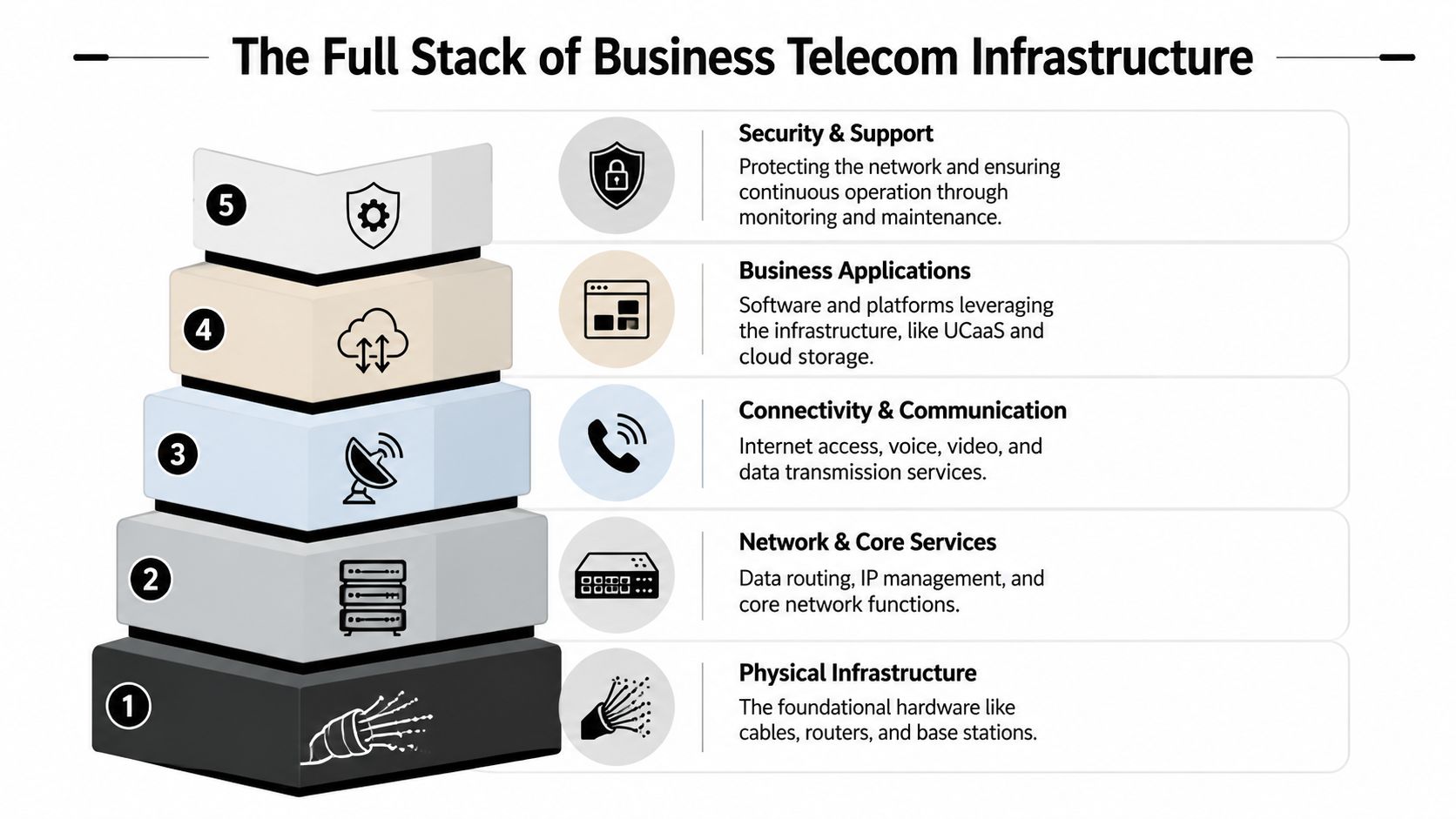
The phrase telecom solutions near me is often used as shorthand. The problem is that shorthand hides what they are responsible for. A better way to think about telecom is like a building utility system. The carrier is only one layer. The in-building plant, edge devices, voice services, and support processes are separate layers with separate failure points.
Start with the physical layer
The physical layer is what many online guides ignore. It includes fiber runs, copper cabling, patch panels, racks, ladder tray, wall plates, and terminations. If that layer is sloppy, every service above it suffers.
This is also where business projects diverge from residential search intent. A review of market content notes that searches for "telecom solutions near me" are often dominated by residential ISP results, which leaves a gap for buyers who need site surveys, structured cabling, or decommissioning support according to Greenlight Networks market observations.
A local business may own or be responsible for:
- Structured cabling that has to be documented before removal
- Patch fields and cross-connects that determine what can be disconnected safely
- Cabinet and rack equipment such as switches, routers, firewalls, and PDUs
- Legacy voice hardware including handsets, controllers, paging components, and gateways
Then move up to service and application layers
Once the physical plant is stable, the network stack becomes easier to assess.
A practical way to break it down:
Network and core services
Switching, routing, DHCP, VLAN design, firewalling, and wireless management live here.Connectivity and communications
This is the carrier side: internet access, SIP, private circuits, and WAN handoffs.Business applications
UCaaS, cloud storage, telehealth tools, and collaboration platforms depend on the lower layers working properly.Security and support
Monitoring, access control, logging, backups, and maintenance keep the stack usable in day-to-day operations.
For teams reviewing telephony and SIP specifically, this complete guide for business communications is a useful companion because it helps connect voice architecture decisions to the wider telecom stack.
The internet service is visible. The infrastructure burden usually isn't. That's why companies underestimate what has to be inventoried, touched, disconnected, packed, and retired.
Why this matters at end of life
A lot of owned telecom equipment sits in a gray zone. It's not quite "IT" to facilities. It's not quite "building infrastructure" to network admins. During a shutdown, that ambiguity creates delay.
The fix is simple. Build an asset list by layer. Identify what is carrier-owned, what is leased, what is business-owned, and what must be wiped, recycled, returned, or removed from the premises.
The End-of-Life Challenge Decommissioning and Disposal
Installation gets attention because people can see the result. Decommissioning gets ignored because it happens at the end, under deadline, when everyone wants the site cleared fast. That's exactly why it deserves more discipline.
Retired telecom gear can hold configuration files, credentials, call logs, cached data, and storage media. Even when a device looks obsolete, it may still represent a security issue. In healthcare, research, education, and government environments, that risk follows the equipment until it is properly sanitized and documented.

The three risks teams underestimate
The first risk is data exposure. Firewalls, routers, switches, voice appliances, and network storage can retain information long after service ends. Pulling gear from a rack isn't the same as sanitizing it.
The second is compliance failure. Hospitals, clinics, labs, universities, and public agencies often have internal disposal requirements that go beyond "remove and recycle." They need chain of custody, proof of destruction for storage media, and a process that stands up to audit questions.
The third is project drag. Poorly planned removal work slows facility turnover. Teams lose time sorting mixed equipment, tracing mystery cables, and deciding on the fly what should be returned, scrapped, wiped, or palletized.
Why janitorial removal isn't enough
General cleanout vendors can clear a room. That doesn't mean they can distinguish live uplinks from abandoned runs, identify devices that require sanitization, or separate reusable telecom hardware from regulated electronic waste.
That's why organizations often look for specialists when asking where to recycle telecom equipment near me. The actual requirement isn't just recycling. It's secure and defensible disposition.
Operational reality: A decommissioning crew needs to know what not to unplug, what must be documented, and which devices may still present a data risk.
What proper decommissioning includes
A disciplined telecom retirement project usually includes:
- Asset identification so nobody mistakes a live circuit component for scrap
- Segregation of media-bearing devices for wiping or shredding
- Safe removal practices for racks, cable bundles, wall gear, and powered equipment
- Environmental handling that routes electronics through appropriate recycling channels
- Final documentation for internal records, facilities closeout, and compliance review
This isn't housekeeping. It's risk control.
How to Choose a Local Telecom Partner
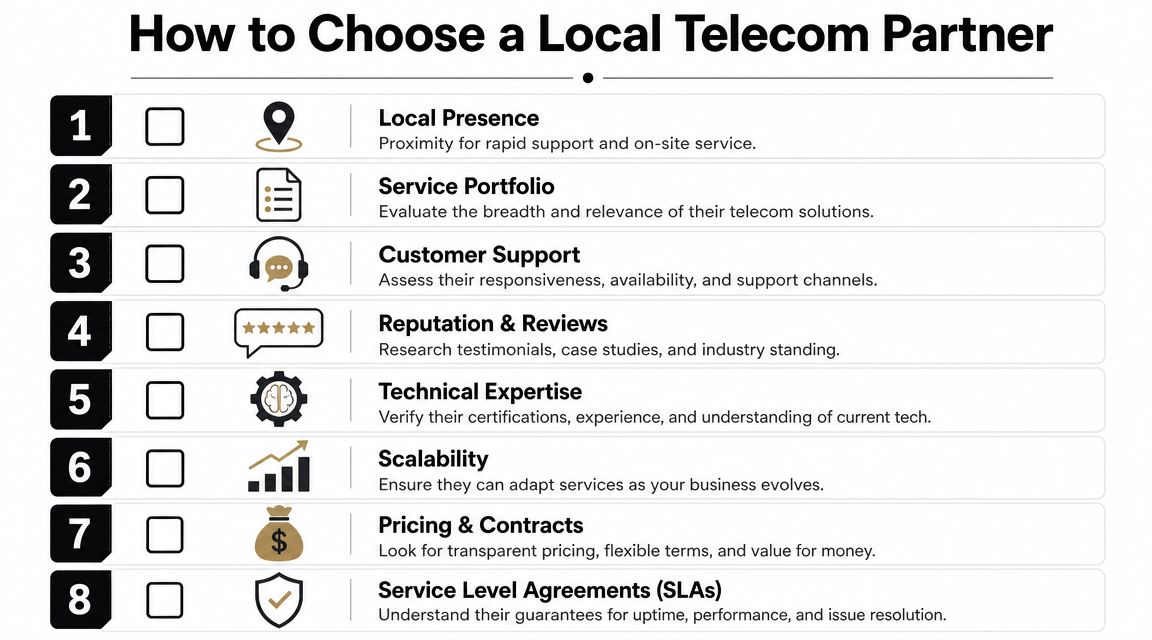
Choosing a local provider gets easier when you stop asking, "Can they provide telecom?" and start asking, "Can they execute the exact work this site needs?" That's a different test.
In business environments, the service quality depends on the full stack around the circuit. For technical buyers, structured cabling, Ethernet Private Line, and managed network services are part of the core evaluation. Best practice is to define requirements for interfaces, uptime, and whether you need dedicated Ethernet or on-site cabling integration, not just a generic internet package, as noted in this review of Ethernet Private Line options in Chicago.
Questions that reveal real capability
Use these questions in vendor calls and site walks.
- Logistics: Do you handle on-site de-installation, packing, and pickup with your own crews and vehicles, or do you broker the work out?
- Technical scope: Can you identify carrier-owned equipment versus customer-owned equipment at the demarc, rack, and endpoint level?
- Security: What media sanitization or destruction standard do you follow for drives and storage-bearing devices?
- Documentation: Will you provide serialized inventory, pickup records, and destruction documentation if required?
- Coordination: Can you work with facilities, IT, and compliance at the same time, or do you expect one point of contact to sort everything out?
- Cabling: Do you remove abandoned patching, voice gear, and in-room hardware, or only loose electronics?
- Scheduling: Can the work align with a move, lease exit, or phased shutdown without forcing unnecessary downtime?
What works and what doesn't
What works is a provider that asks for floor plans, closet access, rack photos, and a list of known carriers before showing up.
What doesn't work is a vendor who gives a flat quote after hearing only "we have some old network equipment."
A serious partner should also understand whether you need dedicated access, a managed handoff, or support from a broader list of local telecom companies for parts of the project that extend beyond disposal.
If a vendor can't explain how they separate active infrastructure from retired assets, they aren't ready for a facility move or shutdown.
A short qualification scorecard
| Review area | Strong answer | Weak answer |
|---|---|---|
| Site readiness | Requests survey details and scope | Prices from a rough verbal description |
| Asset handling | Differentiates network, voice, and media-bearing devices | Treats everything as generic e-waste |
| Project control | Coordinates around cutover windows | Wants open-ended access |
| Compliance support | Provides records and destruction proof | Offers verbal assurances only |
Telecom Asset Disposition in Action A Project Walkthrough
The cleanest telecom projects follow a sequence. Not because process is fashionable, but because every skipped step creates rework. A typical site closure or network room retirement usually involves multiple parties: internal IT, facilities, building management, a carrier, and the disposition team.
For hospitals, labs, and enterprise sites, the benchmark for a business telecom provider isn't just internet availability. The critical issue is whether the provider can support business-grade SLAs and scalable bandwidth, especially where voice, cloud applications, and secure transfer depend on fiber-based last-mile access with lower latency and more symmetric throughput, as described in this overview of business broadband and provider differences in Chicago.
That matters during decommissioning because cutover timing and old equipment removal have to line up.
A representative project flow
1. Initial consultation and survey
The first pass is about scope control. Teams identify telecom closets, MDF and IDF locations, visible rack hardware, voice systems, cable density, stair or elevator access, and any equipment that may still be live.
2. On-site de-installation and tagging
Technicians disconnect retired devices in a controlled order. Routers, switches, firewalls, handsets, access points, and related equipment are tagged so nothing gets mixed with active gear or leased equipment awaiting return.
3. Packing and transport
Once sorted, equipment is packed by category. Delicate network hardware, loose handsets, rack accessories, and storage-bearing devices shouldn't all go into the same container. Chain of custody starts here, not later.
4. Data destruction and downstream processing
Any drive-bearing or storage-capable device moves through sanitization or physical destruction as required. Recyclable materials are separated from parts that require different handling streams.
5. Final reporting
The best projects end with records, not assumptions. Asset summaries, destruction confirmation, and pickup documentation give IT and compliance teams a clean closeout. If your organization is evaluating secure downstream handling, this guide to IT asset disposal is a useful reference point.
DIY vs. Professional Telecom Asset Disposition
| Factor | DIY Approach | Professional Service (S.E.D.) |
|---|---|---|
| Asset identification | Staff guesses what is active, obsolete, or leased | Structured review of equipment before removal |
| Data handling | Inconsistent sanitization decisions | Defined wipe or destruction workflow |
| Packing and transport | Uses available boxes and internal labor | Purpose-built logistics and on-site handling |
| Cutover coordination | Often reactive and rushed | Scheduled around project milestones |
| Documentation | Partial records, if any | Formal reporting and traceable disposition |
| Compliance support | Depends on internal bandwidth | Built into the service process |
Where projects usually break
Most failed decommissions don't fail because removal is hard. They fail because ownership is unclear. IT assumes facilities is handling disposal. Facilities assumes IT already sanitized the gear. Procurement assumes the carrier will remove everything. Nobody is fully wrong, but the result is still a mess.
Clear assignment beats good intentions. One team has to own inventory, one has to approve disconnects, and one has to control final disposition.
Secure Telecom Solutions in the Atlanta Metro Area
In the Atlanta metro, "near me" should mean more than local sales coverage. It should mean local execution. If a site in Norcross, Decatur, Alpharetta, Marietta, or downtown Atlanta needs a telecom room cleared, assets packed, and sensitive hardware processed securely, the provider has to be able to show up, work the site, and move material without making the customer build the process for them.
That local capability matters because dense metro telecom environments increasingly depend on fiber availability and fiber-to-the-premise buildout. In a major market proxy, Houston broadband comparison data shows AT&T Fiber available to about 95% of the city with speeds up to 5,000 Mbps, EzeeFiber reaching 8,000 Mbps in select areas, and Xfinity offering up to 2,000 Mbps in parts of the market according to broadband comparison data for Houston. The same source also notes Houston's median fixed broadband download speed of 335.54 Mbps, with AT&T Internet median download speeds of 365.99 Mbps, upload speeds of 311.06 Mbps, and latency around 16 ms. The practical takeaway for Atlanta-area organizations is qualitative but clear: in major metros, high-capacity fiber is the benchmark, and local telecom decisions increasingly hinge on whether fiber and business-grade support are available at the premise.
What Atlanta organizations should look for
Hospitals and clinics need more than a provider that can sell a circuit. They need support around old voice systems, network racks, backup links, and secure retirement of devices that touched protected data.
Universities and school districts often face a different version of the same challenge. Campus buildings accumulate legacy phones, patching, wireless hardware, and mixed electronics over years of incremental upgrades. During a renovation or closure, that history becomes physical work.
Corporate offices, labs, and public agencies usually need three things at once:
- Local pickup and on-site labor
- Secure media sanitization or destruction
- Responsible electronics recycling with documentation
When those requirements converge, the right Atlanta-area partner isn't the one with the loudest connectivity ad. It's the one that can manage the last mile of the project inside your building and the last step after the equipment leaves it.
Frequently Asked Questions About Telecom Equipment Disposal
What should we do with old office phone systems and handsets
Don't treat them as harmless junk by default. Desk phones, PBX components, gateways, voicemail appliances, and conferencing hardware may contain configuration data or storage. Inventory them first, then route them through reuse, recycling, or secure destruction based on condition and data risk.
Can someone clean out abandoned cables in our telecom closet
Yes, but only after active services are identified. Abandoned patch cords, voice bundles, and legacy cross-connects can be removed, but the work should follow a documented review so nobody cuts something still supporting a live circuit or device.
Why do we need a Certificate of Destruction for network hardware
Because verbal confirmation isn't enough when hardware may have stored sensitive data. A formal record supports internal controls, audits, and regulated disposal workflows. If your team needs that documentation, review how a Certificate of Destruction supports telecom and IT asset closeout.
Can we mix telecom gear with general office cleanout items
It's better not to. Telecom equipment needs different handling than furniture, paper files, or ordinary trash. Keeping it separate protects chain of custody, improves inventory accuracy, and reduces mistakes during pickup and downstream processing.
If you're in the Atlanta metro and need a practical partner for telecom equipment removal, secure media sanitization, and compliant recycling, Scientific Equipment Disposal offers the on-site pickup, de-installation support, and documented disposition process that business shutdowns, moves, and upgrades demand.