Best Telecom Consulting Services Los Angeles


Your telecom environment usually starts looking manageable, then turns into a finance and operations problem. Bills keep arriving from multiple carriers. A cloud voice migration is half-decided. One office has stable fiber, another still relies on a legacy circuit nobody wants to touch, and your team is trying to compare providers while also keeping users online.
That's a common point for companies shopping for telecom consulting services in Los Angeles. The mistake is assuming the answer is merely “find a consultant” or “get better rates.” In Los Angeles, the true work is broader. You need strategy, contract discipline, carrier coordination, and someone who can push an installation across the finish line when building access, permitting, and local logistics get messy.
Why Your Los Angeles Business Needs a Telecom Strategy

Los Angeles isn't a side market. It's one of the country's most important telecom environments because of its size, economic weight, and operational complexity. Los Angeles County is the nation's most populous county with nearly 10 million residents, and top consulting firms treat telecom as a major advisory category. Bain notes it has worked with over 90% of the world's top 30 telecom players, many of whom have a major presence in LA, which reinforces how serious this market is for enterprise buyers (Global IT on managed telecom services in Los Angeles).
A CFO feels that complexity in cost drift. An IT Director feels it in outages, uneven carrier performance, and project delays. The same company often has both problems at once.
What a telecom strategy actually fixes
A telecom strategy should answer a short list of practical questions:
- Cost control: Which services are necessary, redundant, or misaligned with current usage?
- Service resilience: Where do you need redundancy, diverse paths, or stronger service commitments?
- Growth support: Can your network support new sites, cloud voice, remote work, and heavier video traffic?
- Execution ownership: Who handles ordering, porting, cutovers, and escalation when installation stalls?
Without those answers, businesses default to buying piecemeal. That's how they end up with mismatched contracts, hidden overlap between carriers, and no clear owner for implementation.
A good telecom plan doesn't start with vendor demos. It starts with operational reality, what locations you run, what applications matter, and what downtime actually costs your business.
Teams that want a grounded view of telecom delivery models can also review Faberwork telecom success stories, which are useful for seeing how telecom work often spans beyond simple sourcing into broader solution delivery.
For local businesses comparing support models, this overview of telecom services near me is also a helpful reference point for understanding the range of service categories in the market.
Defining Your Telecom Needs and Project Scope
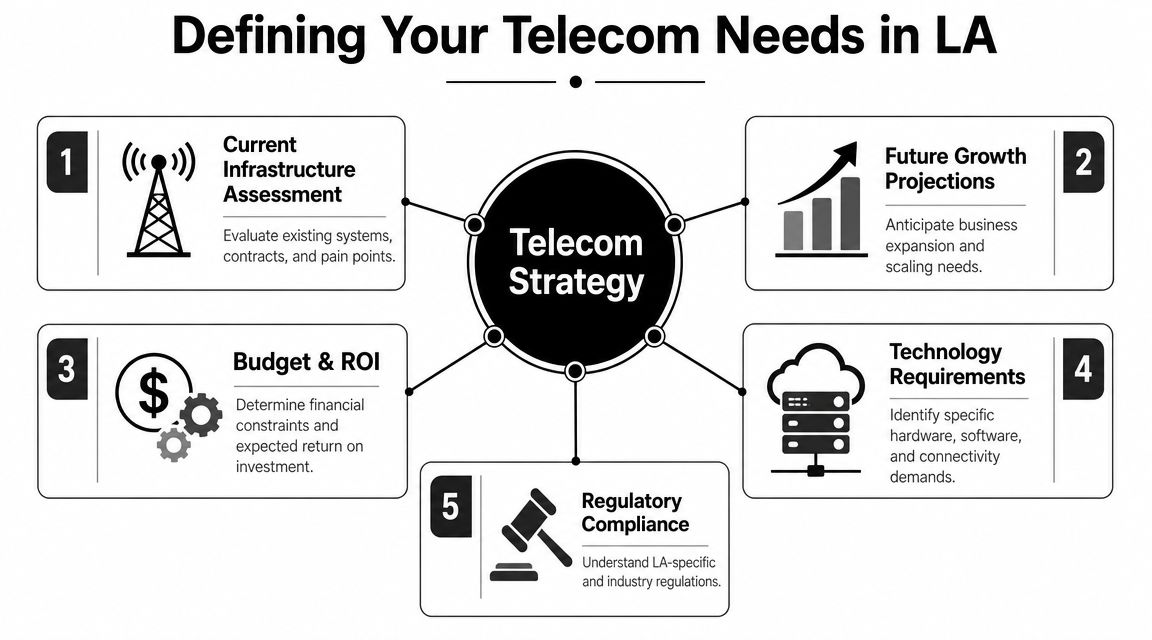
Most telecom projects go sideways before the consultant is even hired. The root issue is scope. If your internal team says “we need help with telecom,” that can mean an invoice audit, a carrier sourcing exercise, a UCaaS migration, a fiber resilience redesign, or full project coordination across several sites.
That difference matters because telecom consulting no longer means basic phone-system advice. Industry evolution has pushed firms well beyond PBX recommendations. A company profile for In-Telecom says it was founded in 2009 as a consulting and business telephone system solution provider and later evolved into a full-service technology company offering voice, data, and managed services (ZoomInfo company profile for In-Telecom). That mirrors what buyers in Los Angeles should expect today. Modern consultants need to understand contracts, networks, cloud communications, inventory, and managed service operations.
Start with the current-state baseline
Before you talk to providers, document what you already have.
Contracts and terms
Pull every carrier agreement, addendum, renewal date, and service order. If nobody can quickly answer when key agreements expire, you're not ready to source replacements.Inventory by location
List circuits, voice services, mobile lines, internet handoffs, contact center platforms, and backup connectivity. Match each item to a site owner or department.Billing and dispute history
Gather invoices and note recurring credits, unresolved disputes, and services that look unfamiliar.Performance pain points
Track where users complain about call quality, unreliable failover, slow installs, or support issues.Business changes ahead
Office consolidation, new clinics, hotel renovations, warehouse expansion, or cloud migrations all change the telecom brief.
Define the project you actually need
A practical scope statement is usually more useful than a long wish list. Try framing the need in one of these ways:
- Audit-driven scope: “We need a full telecom inventory, billing review, and contract rationalization.”
- Transformation scope: “We're moving from legacy voice to UCaaS and need architecture, carrier coordination, and cutover support.”
- Expansion scope: “We're adding sites and need provider selection plus installation management.”
- Resilience scope: “We need to redesign connectivity for uptime, not just reduce monthly spend.”
Practical rule: If your scope includes service ordering, porting, installation scheduling, or multi-site cutovers, you don't just need an advisor. You need operational ownership built into the engagement.
That's why it helps to align IT with business goals before drafting requirements. If finance is focused on spend reduction while operations is focused on uptime, your consultant needs to solve for both. Otherwise, the project gets approved on one set of assumptions and judged on another.
Businesses comparing long-term support structures may also want to review managed telecom services near me to separate one-time consulting from recurring management.
Crafting an RFP That Attracts the Right Partners
A weak RFP gets generic proposals. You'll receive polished slides, broad claims about optimization, and very little clarity on who's doing the work. A strong RFP forces firms to show their method, assumptions, and operational depth.
The benchmark worth anchoring to is straightforward. Organizations often realize 20–30% telecom expense savings after a consulting engagement, with common savings streams including 15–30% from contract negotiations and 10–25% from technology optimization (Innowave Telecom on telecom consulting myths). Those figures don't mean every project should be judged only on cost cutting. They do mean your RFP should ask how a bidder identifies savings, validates them, and separates one-time credits from recurring improvements.
What your RFP should require
Use plain language and insist on concrete deliverables:
- Business context: State your locations, operating model, major applications, and whether the project is cost-driven, resilience-driven, or migration-driven.
- Current environment: Include carriers, known pain points, contract status, and whether your records are complete or messy.
- Required deliverables: Ask for an inventory baseline, optimization recommendations, implementation plan, governance model, and post-cutover support expectations.
- Savings methodology: Require bidders to show how they calculate savings and how they validate actual service use against invoices and inventory.
- Execution model: Ask which activities they perform directly and which depend on brokers, subcontractors, or carrier project teams.
Questions that separate serious bidders from slideware
Use direct questions that require LA-specific judgment.
Describe your experience managing service installations in high-density commercial buildings in Los Angeles, including building access coordination and cutover planning.
Explain how you reconcile invoices, inventory, and actual service utilization before presenting a savings estimate.
Identify which project tasks your team owns directly, which are handled by carriers, and which require third-party implementation support.
If a fiber install is delayed by local coordination issues, how do you manage timeline risk, escalation, and stakeholder communication?
Ask for sample work product
Don't just ask for references. Ask to see examples of:
- inventory baselines
- savings trackers
- implementation plans
- escalation logs
- governance dashboards
That request changes the entire tone of the proposal process. Firms that mainly sell introductions to carriers tend to stay high level. Firms that operate telecom programs can usually show sanitized examples of how they manage them.
If you're benchmarking vendors that also support broader communications environments, this guide to business telecom services near me can help you compare where consulting ends and service support begins.
How to Evaluate and Score Telecom Consultant Proposals
Once proposals arrive, the easiest mistake is treating them like bids for commodity bandwidth. They aren't. Two firms can recommend similar carriers and still produce completely different outcomes because one knows how to govern execution and the other disappears after contract signature.
Price matters. It just shouldn't be the lead variable.
What to score beyond cost
Look for four things in every proposal.
First, diagnostic discipline. Does the consultant start with inventory, billing, and contract reconciliation, or do they jump straight to recommendations? If they skip the baseline, they're asking you to trust assumptions.
Second, clarity of role. Some firms are true advisors. Some are carrier brokers with consulting language wrapped around them. Some can coordinate implementation but only if you ask for it explicitly.
Third, team quality. You want to know who will run workshops, who will deal with carriers, and who will own escalation during cutovers. Senior people often appear in the sales process and vanish later.
Fourth, fit for your operating environment. A multi-site healthcare group, hospitality operator, property manager, and logistics company all have different telecom risk profiles. Generic “enterprise experience” isn't enough.
Sample Telecom Consultant Evaluation Scorecard
| Evaluation Criteria | Weight (%) | Vendor A Score (1-5) | Vendor B Score (1-5) | Notes/Comments |
|---|---|---|---|---|
| Understanding of current environment | ||||
| Methodology for inventory and baseline | ||||
| Cost optimization approach | ||||
| Implementation and project management depth | ||||
| LA market coordination experience | ||||
| Team credibility and operating experience | ||||
| Reporting and governance model | ||||
| Fee structure and commercial alignment | ||||
| Reference quality | ||||
| Security and operational risk awareness |
You don't need a perfect spreadsheet. You need a disciplined way to force trade-offs into the open.
What strong finalists do differently
Strong finalists usually do three things well:
- They challenge your assumptions. If your inventory is incomplete, they say so.
- They distinguish advisory from execution. They don't imply that sourcing a carrier equals delivering a working service.
- They explain failure modes. Good proposals discuss billing errors, hidden services, building access delays, and cutover risk.
The best proposal often isn't the cheapest one. It's the one that makes hidden work visible.
There's also value in seeing how other technical service buyers evaluate specialized partners. For example, teams comparing security delivery options can learn from how MSPs seeking pentesting partners assess expertise, handoff quality, and white-label execution. The principle carries over to telecom. Who owns the outcome matters more than who gave the best pitch.
Local teams that expect ongoing break-fix support or escalation help should also compare consultants against broader telecom support services in Los Angeles so the scoring model reflects operational needs, not just sourcing needs.
Navigating LA-Specific Telecom Hurdles
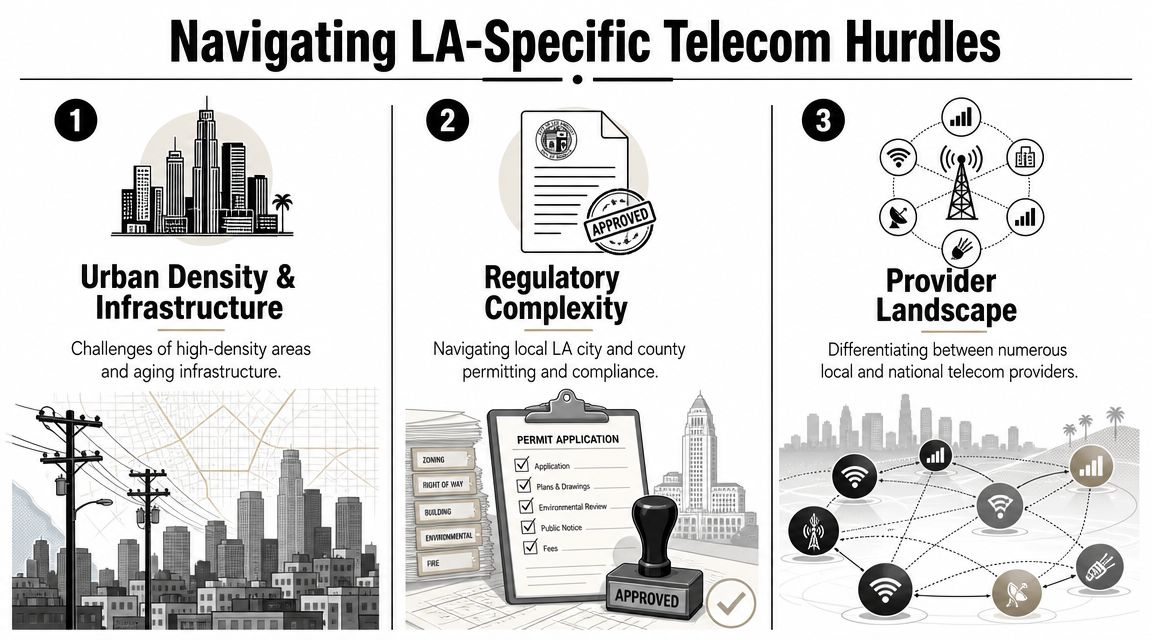
Many telecom consulting engagements frequently falter. A consultant helps you evaluate options, a broker helps you get quotes, and then everyone acts surprised when the project slows down because nobody owns building coordination, permit tracking, site readiness, or installation sequencing.
In Los Angeles, that gap is expensive. In dense metro markets like LA, telecom project success often depends more on local process coordination involving permits, right-of-way, and construction than on carrier selection alone. Scope gaps between advisory work and hands-on execution are a major source of delays and cost overruns (DataField USA on telecom project consulting).
Consultant versus broker versus implementation lead
A seasoned buyer separates these roles early.
| Role | What they usually do well | Where they often stop |
|---|---|---|
| Strategic consultant | Audit environment, define target state, support RFPs, evaluate vendors | Day-to-day installation management |
| Carrier broker | Compare provider options, negotiate offers, place orders | Multi-stakeholder execution once orders are submitted |
| Implementation project manager | Drive timelines, coordinate carriers, manage cutovers, handle blockers | Broader strategic redesign unless specifically scoped |
If your project is simple, a broker may be enough. If you're replacing services in one straightforward office with clear demarcation, available pathways, and no construction dependencies, you may not need much more.
If the project touches multiple locations, older buildings, local street work, landlord approvals, or phased migrations, you usually need all three capabilities somewhere in the stack.
Pricing models and what they encourage
Telecom engagements are often sold in one of three ways:
- Contingency-based compensation can align with savings, but it can also skew the work toward bill reduction and away from resilience or implementation effort.
- Flat-fee consulting works well when scope is well defined. It reduces ambiguity but only if the statement of work is explicit about execution support.
- Hourly support is useful for targeted advisory work or rescue situations, but it can become inefficient if no one owns the plan.
The commercial model should match the business objective. If your main risk is failed execution, don't choose a model that pays only for savings identification.
Ask one hard question before signing. "Who owns the project when the carrier misses a milestone and the building manager won't release access?"
Contract and SLA points worth negotiating
Don't leave these buried in procurement redlines.
- Escalation ownership: Name who escalates with carriers and how quickly issues move to executive attention.
- Milestone accountability: Tie timelines to site surveys, order submission, construction status, activation, and acceptance.
- Acceptance criteria: Define what “installed” means. Circuit up isn't enough if voice, failover, or handoff testing isn't complete.
- Change control: Require written approval for scope changes caused by site conditions, access issues, or construction surprises.
In Los Angeles, the problem usually isn't lack of available providers. It's lack of coordinated delivery.
Onboarding Your Consultant for a Successful Engagement
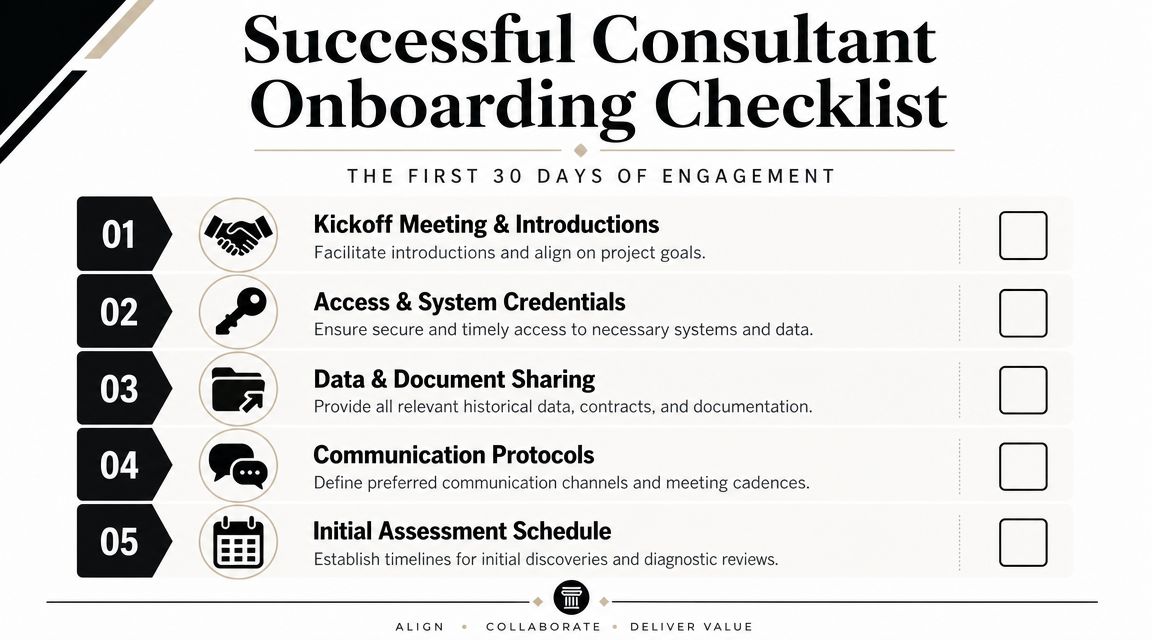
Signing the agreement doesn't create momentum by itself. The first month determines whether the engagement becomes a controlled program or a slow-moving thread of meetings and missing documents.
A useful benchmark comes from BCG's transformation research. Successful technology transformations are composed of 10% algorithms, 20% technology and data, and 70% operational change focused on people and processes (BCG on the new formula for success). That ratio fits telecom projects well. The toolset matters, but execution discipline matters more.
The first 30 days should look organized
Your consultant should have access to the people and records required to establish facts quickly.
Kickoff and stakeholder map
Include finance, IT, operations, facilities, and any site-level contacts who control access or vendor approvals.Document transfer
Share contracts, invoices, order records, service inventories, escalation contacts, and diagrams that still reflect reality.Decision rights
Clarify who can approve changes, who signs orders, and who owns final acceptance.Communication cadence
Set a recurring operating rhythm for status reviews, issue logs, and executive checkpoints.
Don't bundle unlike services under one label
One of the most common mistakes is calling everything “telecom consulting.” That label hides real differences in responsibility. Strategy, brokerage, and field execution are related, but they aren't interchangeable.
If your consultant is responsible for recommendations only, say that. If they're also responsible for carrier management, implementation governance, and cutover planning, put those duties into the engagement terms and meeting cadence from day one.
Operational friction usually doesn't come from the network design. It comes from unclear ownership, bad records, and slow decisions.
Teams managing broader communications support models may also find it useful to compare these expectations against telecom repair services near me, especially when deciding what belongs in the consultant's scope versus routine support channels.
Conclusion Your Next Steps
The right telecom consulting services in Los Angeles do more than shop rates. They help you define the underlying problem, build a disciplined sourcing process, separate strategy from brokerage, and make sure somebody owns implementation when conditions on the ground get complicated.
For most organizations, the best next move is internal, not external. Gather contracts. Clean up the site list. Identify current pain points. Decide whether this is mainly a cost project, a resilience project, a migration project, or a multi-site delivery project. Then write an RFP that reflects that reality.
If you do that well, proposal quality improves fast. You'll spot who can think, who can negotiate, and who can deliver.
If your organization is also planning a lab shutdown, office technology refresh, or secure retirement of legacy IT and electronics, Scientific Equipment Disposal is a practical resource for compliant, sustainable asset disposition. Their team supports businesses that need coordinated pickup, secure data handling, and responsible recycling without adding more operational drag to an already complex infrastructure project.