Telecom Support Services Los Angeles Your 2026 Guide


Your Los Angeles office isn’t down. It’s half-down, which is usually worse.
One site can still reach the internet, but calls are dropping. Another location has working Wi-Fi, yet the front desk phones won’t register. Finance is chasing three carrier invoices that don’t match the contract terms anyone remembers signing. Facilities needs a cabling vendor for a remodel, IT needs a faster circuit, and nobody wants to own the handoff between the carrier, the phone provider, and the building.
That’s the point where many companies start looking for telecom support services Los Angeles firms, not because they want another vendor, but because they need one accountable operator across a messy stack of circuits, cabling, VoIP, carrier tickets, and on-site repairs.
Keeping Your Los Angeles Business Connected
A common Los Angeles scenario looks like this. A company has a headquarters near Downtown, a warehouse further east, and a smaller admin office on the west side. Each location has different building constraints, different carriers available, and different service histories. Over time, the telecom environment turns into a patchwork.

At first, teams try to manage it internally. Then the avoidable friction starts piling up. One invoice includes old services that should’ve been disconnected. A move-add-change request sits in limbo because the phone vendor says it’s a switch issue and the switch vendor says it’s a carrier issue. Local staff starts improvising workarounds that keep the business running for the day but make the network harder to support next month.
That’s where a solid telecom support partner earns its keep. The right provider doesn’t just fix outages. They coordinate carriers, manage installs, clean up billing, document circuits, and keep ownership clear when multiple vendors are involved. If your environment is shifting toward hosted voice, remote access, and hybrid applications, it also helps to understand how broader cloud networking strategies affect branch design and failover planning.
Los Angeles is also a serious telecom market, which means buyers have options and noise. In March 2026, ZoomInfo’s Los Angeles telecommunications ranking showed Garrett Aviation Services at $409.3 million in annual revenue, highlighting how competitive the local market is and why managed support plays a meaningful role in business communications infrastructure, according to ZoomInfo’s Los Angeles telecom company ranking.
Practical rule: If your team spends more time coordinating telecom vendors than improving service, you don’t have a staffing problem. You have an accountability problem.
For companies comparing support approaches in different markets, this example of on-site telecom services in Houston is useful because it shows how location-specific field support changes the procurement decision.
What Telecom Support Services Actually Include
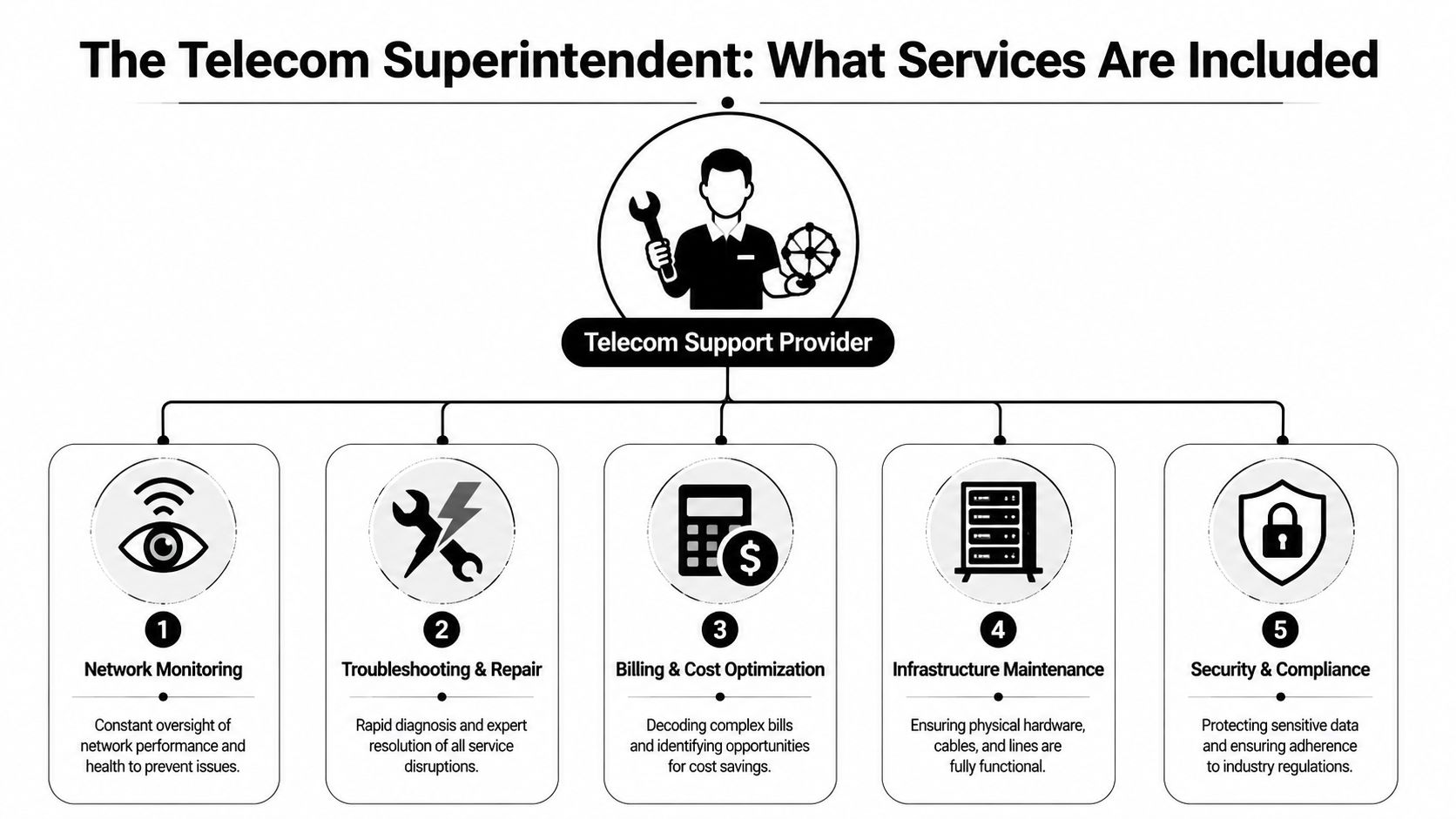
The easiest way to think about telecom support is this. A provider acts like a building superintendent for your communications systems. They’re responsible for keeping the essential systems usable, coordinating specialists when needed, and preventing small issues from becoming operational problems.
Foundational services
These are the basics most businesses think of first.
- Internet and carrier management. The provider tracks active circuits, renewals, demarc details, and escalation paths.
- VoIP and UC support. That includes handsets, softphones, hunt groups, auto attendants, call routing, and user provisioning.
- Moves, adds, and changes. New desks, suite reconfigurations, seasonal staffing changes, and office expansions all fall here.
If you’ve inherited a telecom setup with poor documentation, this foundational layer matters more than any advanced feature set. A network that’s fast but undocumented is still fragile.
Operational support
Mature support teams separate themselves from basic help desks.
In Los Angeles, on-site telecom support often involves dispatching certified technicians within hours for critical issues, with field diagnostics that can identify SIP registration failures or VLAN misconfigurations, followed by hot-swappable replacements to reduce service disruption, as described in this Los Angeles business telephone systems guide from Dove Communications.
That sounds technical, but the operational point is simple. Good support teams don’t guess. They test. They isolate the fault domain, whether the problem is at the handset, switch, circuit, configuration, or carrier edge.
When a provider says they “support phones,” ask what they actually touch. Handsets only, or the switching, PoE, VLANs, firewall rules, carrier ticketing, and on-site replacement process too?
If your team is dealing with jitter, clipping, one-way audio, or intermittent call drops, this guide on fixing VoIP call quality problems is worth reading because it breaks down the usual causes in practical terms.
Strategic support
This is the part buyers often skip until they’ve had one expensive outage or one painful office move.
A stronger telecom support relationship usually includes:
- Lifecycle planning. Which circuits should stay, which should be replaced, and what dependencies exist before a migration.
- Security coordination. Telecom and network teams should align on access, change control, and exposure points.
- Cloud and hybrid integration. Voice, messaging, branch connectivity, and application access increasingly overlap.
For organizations with legacy systems, this broader view matters. Replacing a PRI, moving to hosted UC, or redesigning cabling during a remodel affects more than dial tone. It affects operations, security, and future relocation costs.
A broad service checklist can help frame the conversation, especially if you’re also comparing local vendors against a more general telecom repair services near me search result that may not reflect your actual environment.
Choosing Your Service Model Managed vs Break-Fix
Not every business needs the same support model. Some need a partner watching the environment continuously. Others need a capable technician only when something fails. The mistake is choosing based only on monthly price.
The real difference
Managed telecom services are proactive. You’re paying for ongoing oversight, ownership, and a defined response framework.
Break-fix services are reactive. You call when there’s a problem, get scoped labor, and pay for the incident.
Both can work. The right choice depends on downtime tolerance, internal staff depth, and how many moving parts your telecom estate has.
| Feature | Managed Services | Break-Fix Services |
|---|---|---|
| Cost structure | Recurring monthly spend | Variable incident-based spend |
| Response model | Predefined process and service expectations | Best-effort scheduling unless contract terms say otherwise |
| Accountability | One provider typically owns ongoing documentation and coordination | Ownership often resets with each ticket |
| Planning value | Better for lifecycle management and recurring changes | Better for isolated repair needs |
| Fit | Multi-site offices, healthcare, legal, logistics, customer service teams | Small offices, temporary sites, very lean operations |
When managed support makes sense
Managed service is usually the better fit when your business depends on phones and connectivity all day, not just occasionally. A law office, clinic, lab, property management group, or distributed operations team usually benefits from ongoing ownership because telecom issues rarely stay isolated. A call-routing problem might indicate a switch problem. A switch problem might point to a cabling issue. Managed support keeps one party responsible for sorting that out.
It’s also the cleaner choice when you have multiple sites. Los Angeles businesses often occupy a mix of old and new buildings, and each site can have different handoff conditions, riser access, and carrier options. A managed provider builds and keeps that knowledge.
When break-fix is enough
Break-fix can be perfectly reasonable if you have one small office, low call volume, capable in-house IT, and simple needs. It can also work for short-term spaces, temporary operations, or secondary facilities where downtime is inconvenient but not mission-critical.
Procurement shortcut: If an outage creates revenue loss, patient impact, or front-desk failure, treat telecom support as an operational service, not an occasional repair expense.
This broader look at telecom maintenance services in Atlanta is a helpful comparison because it shows how support expectations change once maintenance becomes a standing responsibility rather than a one-off ticket.
Navigating Los Angeles Telecom Challenges
Los Angeles has telecom issues that don’t show up in generic support brochures. A provider can be technically competent and still struggle here if they don’t understand local building stock, uneven carrier access, field logistics, and project coordination across a very spread-out metro.

The fiber lottery is real
Two offices can be only a few miles apart and have very different connectivity options. One building may have multiple carriers with straightforward turn-up paths. Another may have limited riser space, older cabling pathways, or a landlord-controlled telecom room that slows every install.
That changes procurement in a big way. The best provider isn’t always the one with the flashiest proposal. It’s often the one that asks early questions about building access, demarc location, conduit path, and who controls approvals.
A lot of wasted project time comes from skipping that field reality. Sales teams quote ideal conditions. Field teams inherit the exceptions.
Seismic resilience isn’t optional
Los Angeles facilities managers already think about backup power, physical safety, and continuity. Telecom should sit inside that same planning discipline. If a site loses commercial power, if a closet shifts, or if a building becomes inaccessible, your communications plan needs alternatives.
That can mean diverse carrier paths, survivable call routing, documented failover procedures, and making sure critical voice and data equipment are installed in a way that supports business continuity planning. The right answer varies by building and business type, but the core principle doesn’t. Telecom support in LA has to account for physical disruption, not just logical uptime.
A provider that can’t explain your communications recovery plan in plain language probably doesn’t have one.
Carrier-neutral infrastructure matters in LA
For businesses that need redundancy or low-latency regional interconnection, Los Angeles has an advantage. Telecom support providers often build around carrier-neutral facilities such as DataBank’s LAX1 at One Wilshire. In December 2024, AT&T’s integration there expanded the ecosystem with 100Gbps+ backbone access and less than 1ms intra-LA latency, according to DataBank’s announcement on AT&T at the Los Angeles data center.
That doesn’t mean every business needs data center interconnection. It does mean experienced LA providers know when carrier-neutral options can solve resilience, handoff, or performance problems more effectively than trying to force everything through a single local loop.
Permitting and field coordination can derail timelines
The technical design might be fine. The project still stalls if nobody owns permits, landlord approvals, access windows, and site coordination. This is especially true for exterior pathways, rooftop work, structured cabling changes, or any install that touches shared building infrastructure.
Ask support firms how they handle these practical constraints:
- Building coordination. Who speaks to property management and engineering.
- Carrier handoff management. Who verifies the demarc and test conditions before install day.
- Change documentation. Who updates diagrams, labels, and service inventories after the cutover.
If your telecom work also touches structured cabling, this look at network cabling services in Dallas is a useful reminder that physical layer quality still drives a large share of “mystery” telecom issues.
How to Vet Telecom Support Providers in LA
Los Angeles gives buyers plenty of options. That’s good for competition, but it also makes weak providers easier to hide in the crowd. California has 2,737 businesses in the Wireless Telecommunications Carriers industry as of 2026, with 39,907 employees, which is one reason careful vetting matters when selecting a reliable partner, based on IBISWorld’s California wireless telecommunications carriers industry data.
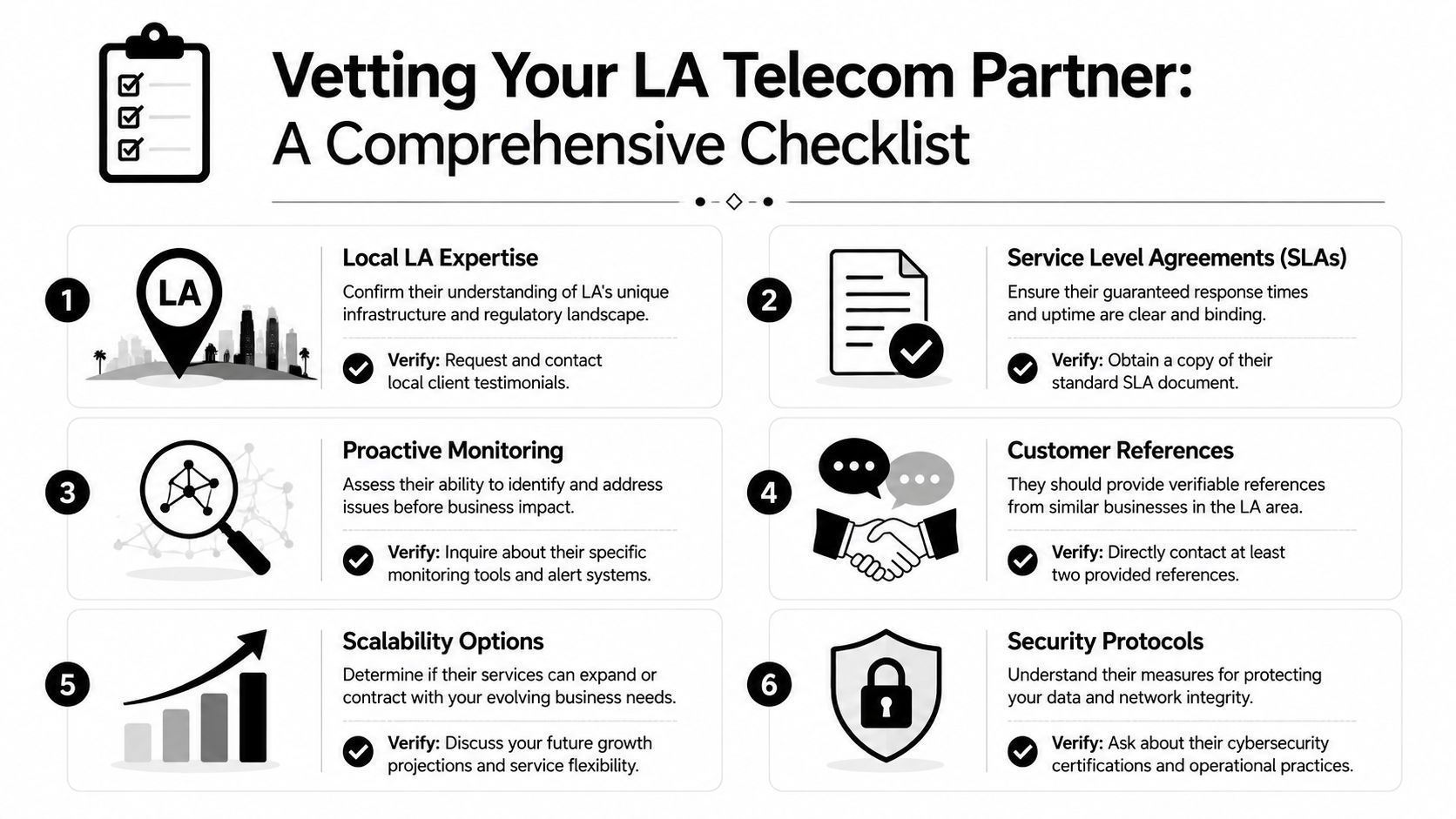
What to verify before you shortlist
Start with proof, not promises.
- Local field presence. Ask where their engineers are based and who handles on-site work in Los Angeles.
- Carrier fluency. They should be comfortable working across incumbent carriers, fiber providers, hosted voice platforms, and landlord constraints.
- Documentation discipline. Request examples of inventory records, circuit schedules, escalation matrices, and post-change documentation.
- Escalation ownership. Find out whether they own the carrier ticket through resolution or just open it and wait.
A provider that only talks about “excellent service” is still at the marketing stage. A provider that can show sample workflows is much closer to operational reality.
Questions worth asking in the interview
Don’t ask generic questions like “Do you offer support?” Everyone says yes. Ask questions that reveal process maturity.
Here are better ones:
- Describe your first 30 days after takeover. What do you inventory, what do you document, and what risks do you usually uncover first?
- How do you handle a multi-vendor outage in a tenant building? Listen for clear ownership, not vague coordination.
- What’s your process for an office move or floor remodel? Good providers will talk about pre-surveys, riser paths, patching, labeling, and cutover planning.
- How do you support business continuity for a Los Angeles site? You want a practical answer, not a buzzword list.
- What falls outside your standard support scope? This question often reveals future surprise charges.
Ask for one redacted example of a service review or monthly summary. Mature providers usually have one ready.
Red flags that show up early
Some warning signs appear before the contract stage.
| Red flag | Why it matters |
|---|---|
| No named service lead | You may end up navigating an anonymous ticket queue |
| Unclear on-site process | Field work is where weak providers lose control |
| No sample documentation | Poor records create long outages and messy transitions |
| Overpromising on every building | LA building conditions vary too much for blanket claims |
One more practical filter helps. Search behavior can bury good local firms under broad directories, so compare your shortlist against what appears in a general telecom system support near me search and then verify who has local operating depth.
Common Pitfalls and How to Avoid Them
Many telecom buying mistakes start with a false assumption. Buyers think the expensive part is the install or the monthly circuit. It often isn’t. The expensive part is the confusion created by a poorly scoped agreement.
Contracts that look simple but aren’t
The first trap is the long agreement with weak accountability. If the contract defines support vaguely, everything becomes an exception. Moves cost extra. Carrier coordination costs extra. After-hours work costs extra. Documentation updates somehow weren’t included.
The second trap is the SLA that sounds strong but doesn’t bind much. “Response” may only mean someone acknowledged the ticket. It may not mean remote triage started, a field technician was dispatched, or a workaround was implemented.
A better approach is to ask providers to define three things in writing:
- What starts the clock
- What counts as response
- What counts as resolution or workaround
Scope creep during upgrades
Telecom upgrades often uncover hidden work. Legacy patching isn’t labeled. Old handsets are still assigned. A carrier handoff lands in a closet with no usable patch path. None of that is unusual in Los Angeles.
What matters is how the provider handles it. Good firms identify likely exception areas before work begins and document assumptions. Weak firms use every surprise as a billing event.
If the quote doesn’t mention testing, labeling, rollback planning, and post-cutover cleanup, the job isn’t fully scoped.
The e-waste problem most telecom plans ignore
As LA County expands fiber and broadband access, one gap remains easy to miss. Businesses upgrading infrastructure need a secure, HIPAA-compliant plan for disposing of surplus routers, servers, and cabling, which is a significant issue often left out of telecom support discussions, as noted in Los Angeles County’s broadband partnership announcement.
That matters because old telecom gear can still contain configuration data, storage, or retained business information. If your support provider coordinates upgrades but has no clear asset disposition plan, the project isn’t complete. For healthcare, labs, and regulated environments, that’s not a housekeeping issue. It’s a compliance issue.
Your Next Steps for Procurement
Start with an internal audit. Build a list of circuits, carriers, phone systems, cabling dependencies, key contacts, recurring pain points, and any known building constraints. If that inventory is incomplete, that alone tells you support needs to improve.
Then choose the service model that fits your risk profile. If downtime creates operational pain immediately, move toward managed support with clear ownership and documented escalation. If your environment is simple and noncritical, break-fix may still be appropriate, but only with a clean scope and known response expectations.
Finally, interview a short list of local providers and make them explain their operating model in plain language. Ask who handles field work, who owns carrier tickets, how they document changes, and what gets billed outside the contract. If your procurement team needs a broader framework for vendor evaluation, Cloud Tech Gurus' procurement solutions offer a useful reference point for structuring the process.
The best telecom support services Los Angeles firms don’t just sell support hours. They reduce ambiguity, tighten accountability, and make your communications environment easier to run.
If your Los Angeles telecom upgrade, office move, or infrastructure refresh is generating retired phones, switches, servers, storage, or lab-connected electronics, Scientific Equipment Disposal can help you close out the project responsibly. S.E.D. provides business-focused pickup, de-installation support, secure media handling, and compliant electronics recycling for organizations that need a practical plan for surplus IT and technical equipment.