Find Top Small Business Telecom Providers Houston for 2026


Your Houston business runs on data. Calls route through cloud phone systems, card terminals need stable internet, cameras back up to the cloud, and staff expect every app to work all day. If you're comparing small business telecom providers in Houston, you're usually not shopping for raw speed alone. You're trying to avoid dropped VoIP calls, slow uploads, surprise install delays, and the kind of outage that stops revenue.
That matters even more in Houston because telecom buying here is tied to business resilience. A Rice Kinder Institute summary on Houston small businesses reported that 69% were profitable, while 46% had cash buffers of less than two weeks, which is exactly why many owners prioritize predictable monthly contracts, bundled services, and lower downtime risk over chasing the cheapest sticker price. In my experience, that leads to a more practical question: which provider gives you the right primary connection, the right backup path, and support that fits how your business operates?
Houston also isn't a one-network city. The local market includes national carriers and regional fiber operators with serious backbone depth. One Houston telecom directory highlights providers with large network footprints, including Consolidated Communications with over 57,500 fiber route miles, Everstream with 15,000 miles of fiber, UPN with 12,000 fiber route miles serving 9,500 end-customer sites across 300+ communities in 21 states, and Zayo with more than 72,000 route miles and over 11,000 illuminated buildings. That breadth is good news for buyers because it gives Houston firms real options across fiber, cable, and wireless.
If you're also reworking your web presence while evaluating connectivity, these expert reviews of website design agencies are a useful companion read. For now, let's get straight to the provider list.
1. AT&T Business
AT&T Business is one of the first providers I check for Houston offices that need room to grow. If you're opening a clinic, moving a professional office, or supporting multiple locations, AT&T usually belongs on the short list because it can cover internet, voice, wireless backup, and more advanced networking under one account.
The practical appeal is simplicity. A small firm can start with business fiber and hosted voice, then move into SIP, SD-WAN, private networking, or failover without replacing vendors. That isn't always the cheapest route, but it often reduces finger-pointing when something breaks.
Best fit in Houston
AT&T works well for businesses that need stable upstream performance, static IP options, and a path into larger network design later. Think medical practices sending imaging, law firms moving large files, accounting offices with remote staff, or warehouse operations that can't tolerate unstable uploads.
For companies comparing Dallas and Houston service planning, this look at telecommunications services in Dallas is useful because it shows how multi-market businesses often standardize around one carrier when they want common support and billing.
Practical rule: If your business expects to add locations, ask AT&T to quote both your current site and the next likely site. A provider can look great at one address and much less attractive once you expand.
What works and what doesn't
AT&T Business Fiber is attractive where the address is already serviceable. When fiber is live in the building or nearby, deployment is much smoother than a fresh construction job. If you need dedicated internet access or private connectivity between sites, AT&T can support that step up without forcing a full redesign.
What doesn't work as well for small owners is the quoting process. Pricing usually depends on address, term, construction status, and product bundle. That's normal in business telecom, but it means you need a clean quote review, not just a sales call.
A few trade-offs stand out:
- Strong growth path: AT&T can support fiber internet, VoIP or SIP, wireless, and broader WAN design under one vendor.
- Useful backup option: Adding wireless failover from the same carrier can simplify support and billing.
- Install timing risk: New fiber builds can take longer than cable or fixed wireless, especially if your building isn't already connected.
AT&T is rarely the fastest provider to quote and install, but it's often the safer long-term choice for organizations that don't want to outgrow their first decision. Visit AT&T Business Houston to check local business service options.
2. Comcast Business
If speed to install matters more than network purity, Comcast Business is often one of the most practical small business telecom providers in Houston. I recommend it most often for retail, standard offices, restaurants, and small warehouses that need business internet and voice quickly without waiting on fiber construction.
The strength here is the broad cable footprint. In many Houston buildings, Comcast can turn service up faster than a new fiber order. That changes the conversation for tenants on short move-in timelines.
Where Comcast makes sense
Comcast fits businesses that want a straightforward bundle. Internet, Business Voice, SIP or PRI options, and LTE or 5G backup can all sit in one package. For many small operations, this adequately fulfills their entire telecom needs.
It also helps when the business doesn't need dedicated internet performance but does need decent reliability and predictable support. Front-desk-heavy businesses, professional offices, and service companies often land here because the package is easy to understand.
Recent Houston-facing telecom marketing also shows a gap I see in real buying decisions. The Spectrum Business Houston page largely focuses on availability and speed, while many owners still need harder guidance on failover design, outage tolerance, and fiber-versus-wireless backup. Comcast sits in that same decision zone. It can be a solid primary line, but you still need to decide whether your operation needs a second path.
The real trade-offs
Cable internet can perform very well for many small businesses, but it's still a shared medium. If your office moves giant files all day, hosts many cloud desktops, or depends on very consistent upload performance, fiber is usually cleaner.
Comcast becomes more attractive when you value deployment speed and bundling over engineered perfection.
- Fast turn-up: Cable service is often quicker to install than fresh fiber construction.
- Good migration path: Business Voice and SIP options work well for PBX replacement or cloud phone rollouts.
- Shared-medium limits: Peak-time consistency can vary compared with dedicated fiber services.
For a lot of Houston businesses, Comcast is the “good enough to run the company” option. The mistake is assuming “good enough” also means “good enough during an outage.” Those are separate decisions.
Ask specifically about wireless backup, contract structure, and what happens after any introductory pricing period. You can review local business offerings at Comcast Business Houston.
3. LOGIX Fiber Networks
LOGIX Fiber Networks has a very different profile from the big national brands. This is the provider I bring in when a business wants business-only fiber, regional accountability, and a support conversation that feels closer to an engineering discussion than a consumer sales process.
That matters in Houston. A lot of firms don't need a giant national carrier. They need a provider that understands Texas commercial buildings, dedicated internet access, hosted voice, and multi-site connectivity without burying the buyer in oversized enterprise packaging.
Why buyers choose LOGIX
LOGIX is best for businesses that care about uptime language, dedicated circuits, and cleaner support paths. Medical offices, private schools, engineering firms, and back-office operations often fit well here because they want fiber designed for business traffic rather than an adapted residential-style service.
The company also makes sense for Houston organizations that need local implementation support around cutovers, voice migration, or WAN design. If your move includes telecom cabinet work or onsite coordination, services like onsite telecom services in Houston become part of the planning conversation alongside the carrier order itself.
Practical strengths and limits
LOGIX offers dedicated internet access, hosted voice, Ethernet, and SD-WAN options. That stack is attractive when one provider is expected to support both connectivity and a business communications rollout. The service tends to feel purpose-built for commercial use, which is exactly what many buyers want.
One provider detail worth noting from the planning notes is the cited high-availability SLA target of 99.999% availability. If you're evaluating LOGIX on that basis, verify the exact contract language in your quote and ask what remedies apply, because SLA wording matters as much as the headline figure.
Here's where LOGIX tends to win and lose:
- Regional support advantage: Texas-focused teams can be easier to work with when you need quick decisions.
- Business-first network posture: Dedicated fiber is usually a better fit for uptime-sensitive offices than shared cable.
- Expansion constraint: If you expect to add many out-of-state sites, you'll need to ask how LOGIX handles off-footprint coverage.
LOGIX usually isn't the choice for the smallest, most price-sensitive buyer. It is often the better choice for businesses that care more about service design and accountability than a low teaser rate. You can review the provider at LOGIX Fiber Networks.
4. Phonoscope Fiber
Phonoscope Fiber stands out because it's a Houston-native provider. That local identity matters more than people think. When a telecom company knows the local building stock, the common service corridors, and the way Houston commercial properties are managed, installs and escalations often move differently.
I usually look at Phonoscope when a client wants a local fiber option instead of defaulting to a national contract. It's especially worth checking if your address is in a core Houston business corridor or an on-net building.
Where Phonoscope has an edge
Phonoscope is attractive for businesses that want local coordination and don't need a giant national footprint. A professional office, medical tenant, or multi-suite operation in a well-served part of Houston may get a more direct experience here than with a bigger carrier.
The provider's local focus also helps when building management, riser access, and install coordination are the primary obstacles, not the circuit itself. In many small business telecom projects in Houston, the provider that can coordinate the building fastest wins.
Local providers don't win every deal on price or product breadth. They win when your address is a strong fit and you need people who know the market instead of reading from a national script.
What to confirm before signing
Phonoscope's biggest advantage is also its biggest limitation. Local networks can be excellent where they are dense, but availability varies more by exact address. Don't assume the provider that serves the building next door can serve your suite on the same timeline.
I also tell owners to ask for the full implementation picture:
- Serviceability status: Confirm whether the address is on-net, near-net, or needs construction.
- Voice options: If you need phone service, verify how business fiber and fiber phone are packaged.
- Escalation path: Ask who manages install updates, building access coordination, and trouble tickets.
Phonoscope can be a very smart pick when the building is a fit and local responsiveness matters. It is less compelling if your company expects broad national standardization or if your next locations are outside Texas. You can explore local business options at Phonoscope Fiber.
5. Astound Business Solutions
Astound Business Solutions is one of those providers that can be very good for the right Houston address and completely irrelevant for the next one over. That's not a criticism. It's the reality of a footprint shaped by regional facilities and the legacy enTouch plant.
If your building falls inside Astound's workable service area, the provider can be a practical alternative to the larger brands. If it doesn't, there's no point trying to force the fit.
When Astound is worth the quote
Astound tends to make sense for small and midsize businesses in parts of Houston where the network already has solid presence. It's a reasonable option for standard business internet and voice if you want regional support and don't need the full enterprise stack of a Tier-1 telco.
This is also where related services matter. If you're shifting communications into the cloud, planning around cloud telecom services in Houston can help you evaluate whether a regional access provider is enough on its own or should sit under a broader voice and collaboration strategy.
The address matters more than the brand
With Astound, I spend less time debating the logo and more time verifying the exact serviceability result. The mix of HFC and fiber means one address might qualify for a perfectly workable business package while another gets a less attractive option or no service at all.
That creates a very specific buying process:
- Check the address first: Don't compare plans until serviceability is confirmed.
- Ask about plant type: Find out whether the building is served by cable infrastructure or fiber.
- Review support expectations: Regional teams can be responsive, but product breadth may be narrower than a national carrier's.
Astound is often strongest as a value-oriented local contender in its better-served pockets of Houston. It is usually weaker for businesses that need advanced networking, broad multi-state coverage, or a deep bench of enterprise add-ons. To evaluate current business availability, visit Astound Business Solutions.
6. Verizon 5G Business Internet
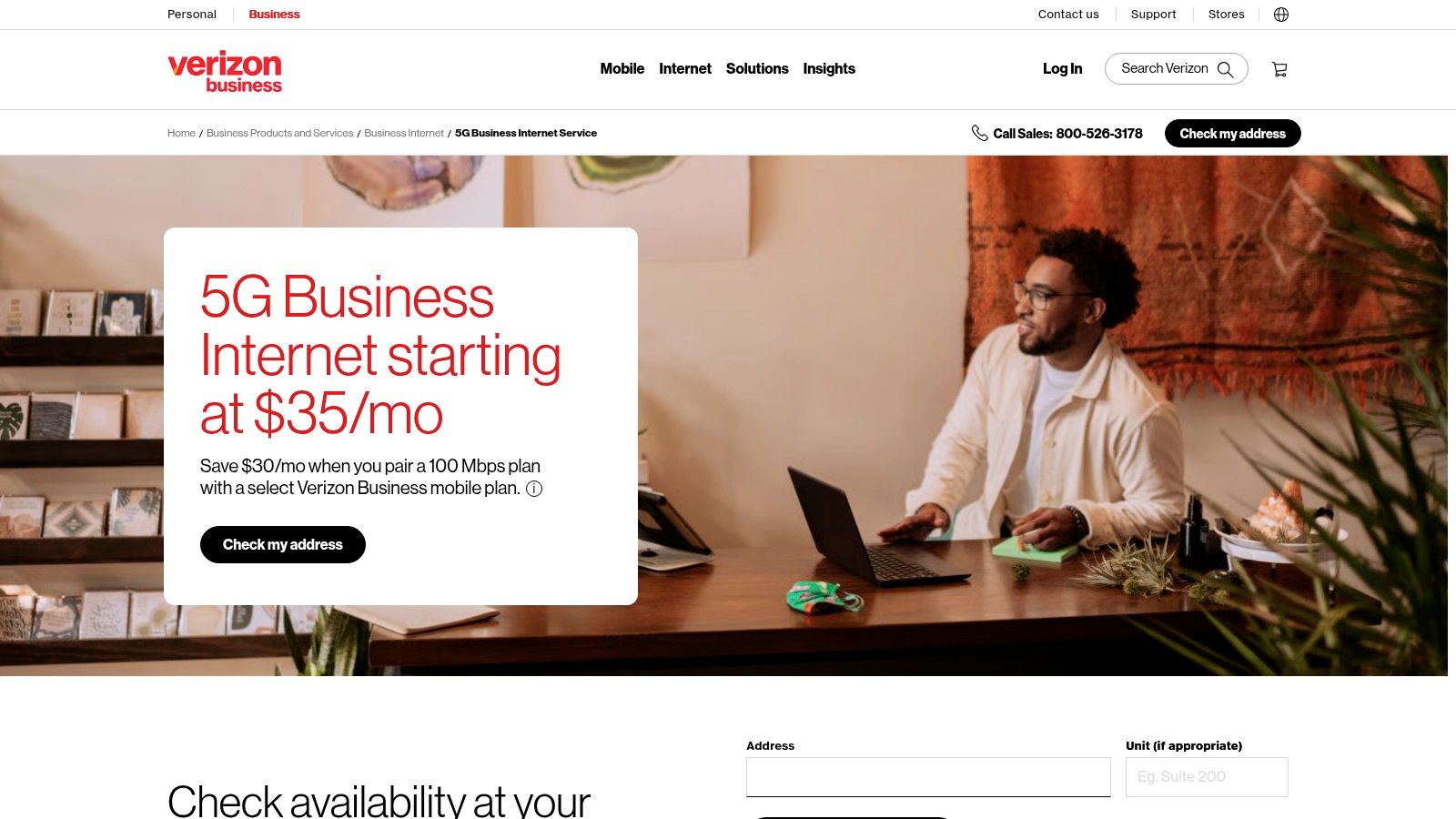
Verizon 5G Business Internet belongs in this list because Houston buyers shouldn't evaluate wired service in isolation anymore. For many small businesses, the best telecom design isn't fiber versus wireless. It's fiber plus wireless, or cable plus wireless, with each line doing a different job.
I use Verizon most often in three situations: rapid startup openings, temporary swing spaces, and failover for businesses that can't wait on a wired install. It can also work as a primary connection for lighter office use if the location tests well.
Where Verizon fits best
Verizon's strength is deployment speed. No trenching, no waiting on building construction approvals, and no long delay for a basic business connection. That's valuable if you're opening quickly, supporting a project site, or trying to add resilience before storm season.
It's also one of the easier ways to create path diversity. If your main line is wired, adding a wireless backup from a different access method can reduce single-point failure risk. For companies comparing support options more broadly, these telecom services near me can help frame the difference between carrier access and hands-on implementation help.
What buyers get wrong about 5G
The biggest mistake is treating fixed wireless like guaranteed fiber. It isn't. Performance depends on local signal conditions, placement, building materials, and area congestion. That's why I don't judge Verizon 5G on marketing claims. I judge it on a site test and the business role it's expected to fill.
Used correctly, Verizon is excellent. Used as a drop-in replacement for dedicated fiber in a demanding environment, it can disappoint.
- Best backup use case: Great for resilient secondary connectivity behind a wired primary.
- Strong temporary-site option: Useful for launches, relocations, or short-term project offices.
- Needs site validation: Always test indoor placement, router setup, and real application performance.
Don't ask whether 5G is “good enough.” Ask what job you want it to do. Backup internet, short-term primary service, and mission-critical core connectivity are three different jobs.
For businesses that want faster deployment than traditional wireline can provide, Verizon 5G Business Internet is worth checking.
7. T-Mobile 5G Business Internet
T-Mobile 5G Business Internet is usually the easiest wireless business service to understand at first glance. That's a real advantage for small companies that don't have a network engineer on staff and just want a backup line or a simple primary connection for a light office.
I see T-Mobile work well for small professional offices, startups, field teams, pop-ups, and businesses in transition. The hardware is portable, setup is straightforward, and the buying process tends to be simpler than traditional telecom procurement.
The practical use case
T-Mobile is rarely the first choice for a heavily wired, uptime-sensitive operation. It is often the right choice for affordable resilience and portability. If your team moves spaces, opens temporary sites, or wants a second internet path without construction, T-Mobile has a clear role.
It can also fit companies building a broader communications stack around mobility and cloud tools. If that sounds like your setup, these unified communications providers near me are relevant because the internet line is only one layer of how staff stay reachable.
Simple doesn't mean no due diligence
T-Mobile's appeal is predictable purchasing and fast activation. That's great. What still matters is confirming the technical details before you order. If you need advanced routing, static addressing, or support for a specific security appliance, verify that before treating it like a business-grade replacement for wired service.
A clean buying checklist for T-Mobile looks like this:
- Test the exact address: Eligibility and performance are location-specific.
- Check feature fit: Confirm gateway behavior, IP options, and router compatibility.
- Match it to the workload: Fine for light to medium business use. Less ideal when strict SLA expectations drive the decision.
T-Mobile is one of the better options when the priority is low-friction deployment and a practical backup path. It becomes less attractive when the site depends on deterministic performance, specialized networking requirements, or strict latency expectations. Review current business offerings at T-Mobile for Business.
Houston Small Business Telecom: 7-Provider Comparison
| Provider | 🔄 Implementation Complexity | Resource Requirements | 📊 Expected Outcomes | Ideal Use Cases | ⭐ Key Advantages / 💡 Tips |
|---|---|---|---|---|---|
| AT&T Business | Moderate–High (fiber builds, contracts, managed services) | On-site fiber readiness, enterprise CPE, possible term agreements | High-capacity symmetrical speeds (up to 5 Gbps where available), scalable and nationally supported | Clinics, labs, multi‑site offices needing scalable bandwidth & static IPs | ⭐ Enterprise-grade product set and nationwide reach; ⚡ wireless failover option. 💡Negotiate term pricing |
| Comcast Business | Low–Moderate (fast turn‑up on coax; fiber where on‑net) | Coax/fiber availability at address, standard business CPE, optional LTE/5G backup | Reliable broadband up to 1 Gbps (shared medium; peak variance possible), predictable bundles | Small/medium offices needing quick installs and bundled voice services | ⭐ Broad local footprint and simple bundles; ⚡ faster installs vs new fiber. 💡Watch promo/contract details |
| LOGIX Fiber Networks | Moderate (dedicated fiber provisioning, SLA coordination) | Dedicated fiber handoff, business routers, possible construction for off‑net builds | Business‑grade DIA with strong SLA targets and symmetrical performance | Uptime‑sensitive Texas sites and regional enterprises | ⭐ Regional, business‑only network with strong SLAs; 📊 built for reliability. 💡Good for local support needs |
| Phonoscope Fiber | Low–Moderate (fast if on‑net; moderate for off‑net quotes) | On‑net building access preferred, business CPE, quote‑based pricing | Competitive metro fiber performance with quicker installs on‑net | Houston businesses in core corridors (e.g., Medical Center) | ⭐ Houston‑centric backbone and local support; ⚡ quicker local installs if on‑net. 💡Confirm on‑net status |
| Astound Business Solutions | Moderate (mixed HFC/fiber plant; address lookup needed) | Address verification, mixed HFC/fiber CPE depending on area | Value‑priced internet/voice where available; coverage varies by neighborhood | Businesses in legacy enTouch neighborhoods or regional metro areas | ⭐ Regional coverage and responsive teams; good value in served areas. 💡Verify serviceability per address |
| Verizon 5G Business Internet | Low (fast deploy; self or pro install) | Strong local 5G signal, gateway/router, minimal construction | Rapidly deployed fixed‑wireless with variable throughput; ideal primary for light use or robust secondary/failover | Temporary sites, swing spaces, rapid deployments, backup circuits | ⭐ Very fast deployment and clear plan terms; ⚡ excellent for quick backups. 💡Test on‑site signal, not a DIA substitute |
| T‑Mobile 5G Business Internet | Low (simple activation and self‑install) | Address‑based eligibility, portable gateway, minimal setup | Affordable fixed‑wireless for light/medium use or backup with price‑lock options | Small businesses, pop‑ups, relocatable sites, secondary circuits | ⭐ Predictable pricing and portable hardware; ⚡ easy relocation. 💡Confirm static IPs/advanced routing in advance |
Checklist & FAQs: Selecting Your Houston Telecom Provider
The biggest mistake Houston businesses make is choosing a provider before defining the role of the circuit. You should decide whether you're buying a primary connection, a backup connection, or a hybrid design first. Once that is clear, the provider shortlist gets much smaller and much more realistic.
For most companies, the answer isn't one provider and one line. It's a wired primary plus a wireless backup, or a budget-friendly cable primary plus a stronger circuit at the revenue-critical site. That's especially important in Houston, where weather exposure and outage risk make resilience a buying factor, not just an IT preference.
A practical shortlist process
Start with your exact address, not the provider brand. Houston serviceability is hyper-local. One suite may have fiber options while the building across the street doesn't. Ask every provider whether the location is on-net, near-net, or build-required, and get that answer in writing.
Then define what has to stay online during an outage. Many owners assume they need full-facility backup when they really need only core tools: phones, payment processing, EHR access, dispatch software, VPN, or a few cloud apps. That distinction affects whether a 5G backup line is enough or whether you need a second wired path.
Use this working checklist when requesting quotes:
- Primary use case: Specify whether the circuit is for main internet, backup, voice, or multi-site traffic.
- Critical apps: Name the applications that can't go down, such as VoIP, EMR, cloud POS, cameras, or file sync.
- Install constraints: Ask about building access, riser work, demarc extension, and expected handoff type.
- Contract terms: Review term length, renewal language, any introductory pricing structure, and support commitments.
- Failover design: Ask whether the provider supports automatic backup and what equipment is required.
- Support path: Get clarity on who owns service issues if internet, voice, and backup sit in different places.
Questions owners should ask before signing
A quote can look fine and still be wrong for the site. Ask the provider what happens if the building isn't ready, whether construction is needed, and who coordinates with property management. If the answer is vague, expect delays.
Ask whether the service is shared or dedicated, and whether the business really needs dedicated service. Many don't. A law office with ordinary cloud usage may run well on cable or 5G plus backup. A clinic moving large files, running hosted voice heavily, and needing clean uptime may need fiber from day one.
Buy for the outage scenario, not just the normal day. Most providers look acceptable when everything is working.
Common Houston telecom questions
Is fiber always the best choice?
No. Fiber is usually the cleanest primary connection for businesses that depend on stable upload speed, voice quality, and growth capacity. But cable can be a smart fit for standard offices, and 5G can be excellent as backup or for rapid deployment.
Should a small business add wireless backup?
If an outage stops revenue, the answer is usually yes. A backup line is often easier to justify when you compare it to lost appointments, missed calls, failed transactions, or idle staff.
Can 5G replace wired internet?
Sometimes, but it depends on the workload and location. For lighter use, temporary sites, and some small offices, it can work well. For stricter uptime expectations or more demanding traffic, I still prefer wired primary service.
What matters more, speed or support?
Support and install reality matter more than most owners expect. A provider with a slightly lower speed tier but a workable local install and clear support path can be the better business choice.
Final decision framework
If your business is small, budget-conscious, and needs service fast, start with Comcast, Astound, Verizon, or T-Mobile depending on the address and use case. If your operation is more sensitive to uptime, hosted voice quality, or future network growth, look first at AT&T, LOGIX, or Phonoscope based on building fit.
If you're moving, opening, or consolidating sites, don't treat telecom as a last-week task. Build it into the project plan early, alongside phones, firewalling, Wi-Fi, and any onsite de-installation or equipment transition work. In some organizations, that also overlaps with broader operational vendors, including companies such as Scientific Equipment Disposal when a site move involves retiring IT or lab-related assets responsibly.
The right Houston telecom setup is the one that matches your building, your risk tolerance, and your actual downtime cost. Get two or three real quotes, ask hard questions about install status and failover, and choose the design that keeps the business operating when Houston weather or infrastructure problems hit.
If your Houston telecom upgrade is part of a larger office, clinic, lab, or IT transition, Scientific Equipment Disposal can help with compliant equipment pickup, de-installation logistics, and secure e-waste handling for retired electronics and related assets.