Find Top Local Telecom Companies in Atlanta


Your network upgrade usually starts with a simple request. A new clinic opens. A research lab moves floors. A university adds another building. Someone asks for more bandwidth, better Wi-Fi, or a second circuit for failover.
Then the actual work starts.
For Atlanta hospitals, universities, public agencies, and corporate IT teams, choosing among local telecom companies isn't just a procurement task. It's a long-term infrastructure decision that affects uptime, support response, physical pathways, security posture, and what happens to the old hardware once the new service goes live. If the provider is wrong, the pain shows up later in outages, delayed installs, cramped telecom rooms, and closets full of retired switches nobody wants to touch.
The best decisions connect the front end and the back end. You evaluate the provider, the plant, the service model, the contract, the support team, and the building standards. Then you plan the refresh, cutover, de-installation, and disposal of replaced telecom equipment so the project finishes cleanly.
Choosing Your Next Infrastructure Partner in Atlanta
In Atlanta, telecom buying gets complicated fast because the market looks broad until you narrow it to your actual building, your actual street, and your actual operating risk. A provider may look strong on paper and still be a poor fit for a hospital imaging wing, a campus lab building, or a downtown multi-tenant office with crowded risers.
Start with the building, not the brochure
Most telecom projects go sideways because buyers start with advertised service instead of site conditions. Before you compare carriers, confirm a few basics:
- Pathway reality: Check conduit, riser access, telecom room condition, and whether your landlord or facilities team controls access windows.
- Service handoff: Ask where the provider will terminate service and whether your team needs to supply rack space, power, patching, or cross-connects.
- Redundancy limits: Two services from two brands aren't automatically diverse if they enter the property through the same path.
- Operational ownership: Decide who manages the edge devices, who replaces failed hardware, and who documents the cutover.
That framework is similar to how experienced teams vet any outside technology partner. A practical reference is Nutmeg Technologies' guide on how to choose a managed service provider, especially for thinking through accountability, escalation, and support fit before you sign.
What matters in high-stakes environments
Hospitals and universities don't buy connectivity the same way a small office does. They need a provider that can work around restricted access, after-hours change windows, compliance concerns, and coordination with in-house networking teams.
Practical rule: If a provider can't clearly explain install dependencies, demarc location, support escalation, and hardware ownership, they're not ready for a complex site.
In practice, the right partner is the one that can support the entire lifecycle. That includes pre-install surveys, realistic implementation planning, structured cabling compatibility, maintenance expectations, and a clean plan for removing retired gear after the migration.
What Are Local Telecom Companies Really
National carriers handle the long haul. Local telecom companies handle the last mile, the handoff into your property, and many of the support realities that determine whether a circuit is useful or just technically available.
Think of it this way. The national backbone is the interstate. The local provider is the network of city streets, utility corridors, building entrances, and service routes that gets connectivity to your front door.

Why local matters operationally
For a business buyer, local reach changes everything. It affects how quickly a provider can install, whether they already serve your building, how they dispatch field techs, and how much control they have over the physical plant.
A provider that owns or tightly manages access infrastructure can often give clearer answers about splice points, building entry, and repair coordination. A provider that relies heavily on leased access may still be a good option, but it usually introduces more handoffs and more parties during trouble resolution.
How this model developed
The current market didn't appear by accident. The Telecommunications Act of 1996 opened local markets to new entrants, required incumbents to share network services at fair rates, and helped foster the competitive environment that shaped today's local telecom model, as discussed in this industry history from Fabricated Knowledge.
That matters in Atlanta because it explains why buyers see a mix of incumbent phone companies, cable operators, fiber-focused providers, and specialized business carriers in the same metro. Some own more infrastructure. Some lease strategically. Some are strong in dense commercial corridors and weak in older suburban campuses.
Last mile service is where projects succeed or fail
If you're sourcing telecom for a hospital, lab, or campus, don't treat all provider footprints as equivalent. Ask how the provider reaches your building, what plant they control, and what dependencies sit between their sales promise and your live circuit.
For organizations comparing broader communications options, it's also useful to look at how regional access fits into voice and collaboration decisions through resources on unified communications providers near you.
The last mile is where marketing language meets construction crews, riser closets, patch panels, and repair dispatch. That's why local capability matters more than brand familiarity.
Telecom Services for Demanding Industries
A hospital doesn't consume telecom services the way a law office does. A university doesn't behave like a warehouse. A data center doesn't tolerate the same failure modes as an administrative building. That is why a one-size-fits-all carrier evaluation usually fails.

Healthcare needs low friction and low tolerance for failure
Hospitals and clinics care about bandwidth, but they care more about consistency. Imaging systems, voice services, remote specialist access, patient portals, and building systems all ride on infrastructure that has to stay predictable under load.
In these environments, local telecom companies need to support:
- Dedicated connectivity: Internet access is only one piece. Many healthcare sites need private transport between locations, support for segmented traffic, and stable latency for clinical applications.
- Change control discipline: Cutovers often happen around patient care schedules. A provider that can't plan around restricted windows creates risk.
- Physical security coordination: Telecom closets, MDFs, and IDFs may sit inside controlled spaces. Provider access has to align with facility rules.
- Fast restoration paths: A long outage turns into an operational problem quickly when voice, records access, or imaging transfer are affected.
Universities need scale in bursts
Campus environments are messy by design. Residence halls, lecture spaces, research facilities, public venues, and administrative offices all behave differently. Usage spikes during registration, streaming events, synchronous learning, and lab workloads.
For universities, the provider needs to support both wide-area transport and the messy inside-building side of the equation. That's where telecom standards matter. Campus and building telecom standards often recommend Category 6a or fiber for 10 GbE applications, which helps prevent copper runs from becoming bottlenecks during moves, adds, and changes, according to the New Mexico building and campus distribution standards.
If the carrier hands off a strong service into a weak cabling environment, users still blame the network team. They're not wrong.
Corporate IT and data-heavy facilities need path diversity
In enterprise settings, the conversation usually shifts from "Can we get service?" to "How do we reduce single points of failure?" That's where local telecom companies separate into tiers.
Some can deliver a single fiber handoff well. Fewer can explain route diversity clearly, coordinate dual-entry design, or work cleanly with SD-WAN, cloud interconnect strategies, and multi-site failover planning.
A practical way to evaluate these options is to compare business packages, transport options, and support models across affordable telecom services near you, then narrow the list based on site-specific engineering instead of price alone.
What works and what doesn't
What usually works in demanding environments:
- Provider plus facilities coordination: Early walk-throughs with IT, facilities, and the carrier prevent demarc surprises.
- Clear handoff documentation: Patch panel, rack, power, labeling, and responsibility boundaries should all be documented before install day.
- Inside plant review: Structured cabling, uplinks, and closet conditions should be checked before ordering premium external service.
What usually doesn't work:
- Buying on speed only: Fast service won't fix poor pathway design or underpowered network closets.
- Assuming redundancy: Two circuits can still fail together if they share building entry or upstream dependencies.
- Ignoring lifecycle impact: New circuits often trigger router, firewall, switch, and UPS replacements that need planning.
Buy telecom the way you buy critical infrastructure. Verify the handoff, the path, the room, and the recovery model. Then worry about the monthly rate.
Navigating the Atlanta Telecom Vendor Landscape
Atlanta buyers typically run into four broad categories of providers. The names differ, but the operating models stay fairly consistent. If you know the model, you can usually predict the strengths and weak spots before the sales cycle gets too far.
The regulatory distinction still affects design
Local telecom companies are commonly treated as local exchange carriers, or LECs. They interconnect with other LECs within a local access transport area, or LATA. Traffic leaving that local area is handled by interexchange carriers, or IXCs. That distinction still affects service design and cost, as outlined by GlobalSpec's overview of telephone service providers.
For business customers, this isn't just telecom trivia. It can shape routing, number portability workflows, wholesale access, and multi-site voice design.
Comparison of Local Telecom Vendor Types
| Vendor Type | Primary Infrastructure | Typical Strength | Potential Weakness |
|---|---|---|---|
| Incumbent local carrier | Legacy copper and broad regional fiber footprint | Deep coverage, established field operations, familiar enterprise products | Legacy processes can be slower, and terms may be less flexible |
| Competitive local carrier | Mix of leased facilities and owned network | Flexible deal structure, targeted metro focus, business-oriented support | More dependency on third-party access in some buildings |
| Cable business provider | Coax and fiber-hybrid networks, plus business fiber in many areas | Strong metro availability, practical business bundles, broad SMB reach | Performance and service design can vary by location and plant type |
| Fiber-focused provider | Purpose-built fiber in selected corridors and commercial buildings | Symmetrical high-capacity service, strong fit for enterprise sites | Footprint can be narrow, and build-out timing can be uncertain |
How to choose among them in Atlanta
The right category depends on the building and the use case.
If you're in a legacy hospital campus or spread across older properties, the incumbent may still have the easiest path into the site. If you're in a dense commercial corridor with modern riser access, a fiber-focused provider may be the cleaner choice. If contract flexibility matters more than broad footprint, a CLEC can be attractive. If you need decent availability across many ordinary offices, cable business service may be perfectly adequate.
One shortcut is to ask every bidder the same three questions:
- What physical infrastructure do you own on the path to this address?
- What parts of the install depend on another carrier or landlord approval?
- Can you document route diversity in writing if we buy primary and backup service?
If you're comparing firms in the metro, this local roundup of the best telecom company options in Atlanta can help frame the vendor mix, but the final decision still comes down to engineering fit at your property.
A Vetting Checklist for Atlanta Institutions
Carrier proposals often look polished. The weak points show up in the details buyers forget to ask about. For hospitals, universities, and government sites, vetting needs to go beyond monthly cost and advertised bandwidth.
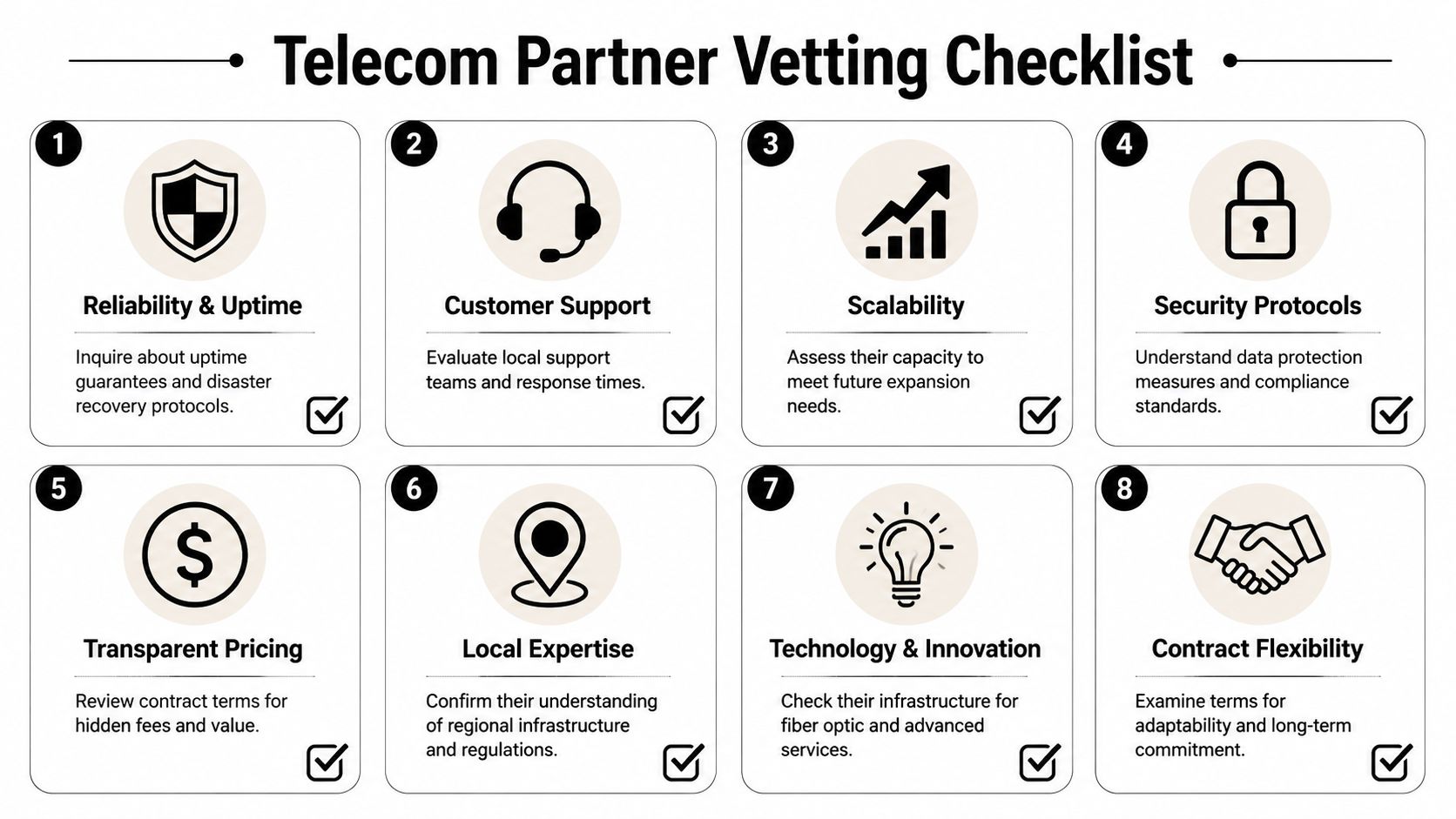
Reliability questions that expose real capability
A useful test is simple. Ask the provider to describe what happens when service fails at 2 a.m. on a weekend in a restricted building. The answer tells you more than the slide deck.
Recent industry discussion has made an important distinction. Enterprise buyers need to separate "connectivity available" from "connectivity dependable" because coverage alone doesn't guarantee uptime or security for mission-critical operations, as noted in the CCA discussion of regional provider roles and enterprise-grade concerns.
Use that distinction as your baseline.
- SLA definition: Ask how uptime, outage credits, maintenance windows, and repair targets are defined.
- Escalation path: Get named roles or at least role-based escalation steps. You want to know who owns a chronic issue after frontline support.
- Restoration method: Ask whether the provider dispatches its own crews, contractors, or another carrier's technicians.
- Redundancy proof: Require a plain-English explanation of path diversity, not a marketing statement.
Buyer check: If a provider avoids specific answers on route diversity, outage handling, or support ownership, assume the service has more dependencies than the proposal shows.
Security and physical plant review
Telecom isn't just circuits. It's cabinets, power, smart hands, provider CPE, exposed patching, and access procedures.
Ask these questions:
- Who owns and manages the edge hardware? If the provider installs a router or optical device, clarify replacement and patching responsibility.
- How is physical access controlled? Hospitals, labs, and campuses often have stricter access rules than ordinary commercial offices.
- What documentation do you receive? You need demarc details, labeling standards, support contacts, and cut sheet documentation.
- How are hardware refreshes handled? Old provider gear has to come out cleanly, especially after service migrations.
Contract and lifecycle questions
Many organizations stop too early. The contract should match the lifecycle of the environment, not just the initial install.
A practical checklist:
- Term fit: A short lease and a long telecom commitment can trap you.
- Expansion rights: Ask how easy it is to add bandwidth, secondary circuits, or another building.
- Move scenario: Clarify what happens if your department relocates within metro Atlanta.
- Decommissioning responsibility: Determine who removes abandoned cabling, retired CPE, and replaced electronics.
- End-of-service handling: Get written clarity on return, pickup, or disposal obligations for provider-owned gear.
For teams doing early market scans, a local list of telecom services near you can help build an initial shortlist, but the shortlist is only the start. True protection comes from disciplined questioning.
What experienced teams document before signing
Strong IT and facilities teams usually insist on a small set of artifacts before contract execution:
| Document or confirmation | Why it matters |
|---|---|
| Service demarc description | Prevents install-day disputes about where service ends |
| Building access requirements | Avoids delays tied to escorts, badges, or after-hours rules |
| Hardware ownership list | Clarifies who supports and removes network equipment |
| Escalation contacts | Speeds response during real incidents |
| Diversity statement | Tests whether backup service is actually independent |
Dependable service isn't a logo on the invoice. It's the combination of local access, support ownership, room readiness, and documented recovery procedures.
Closing the Loop with Secure Equipment Decommissioning
A telecom project isn't finished when the new circuit passes traffic. That's the midpoint.
The end of the job is what happens to the old switches, routers, firewalls, WAN appliances, UPS units, and storage hardware that just got displaced. In hospitals and universities, that gear often carries saved configs, logs, labels, and media that shouldn't sit in a closet waiting for somebody's future cleanup day. It also takes up rack and storage space that operations teams need back immediately.
The upgrade creates a disposal problem
Every serious telecom refresh creates three parallel tasks:
- Cut over live service without disruption
- Remove replaced hardware without losing traceability
- Retire assets in a way that meets security and environmental requirements
That last part is where projects often stall. Facilities may remove the rack gear, but not own the data risk. IT may know what's sensitive, but not have trucks, labor, or approved recycling channels. Procurement may assume the carrier handles it, even when the replaced equipment belongs to the customer.
One option Atlanta organizations use for this part of the lifecycle is telecom system support near you, including providers that coordinate de-installation, secure media handling, and compliant electronics recycling. Scientific Equipment Disposal in Norcross is one such local service. According to the company information provided, it offers on-site de-installation, pickup logistics, DoD 5220.22-M 3-pass hard-drive wiping, media shredding for obsolete or failed drives, and certified recycling for business and institutional electronics.
Finish the project all the way
The practical sequence is straightforward. Select the telecom partner with full awareness of site constraints. Plan the handoff, hardware responsibilities, and cutover. Then schedule the decommissioning of retired equipment as part of the same project timeline, not as an afterthought.
That closes the security gap, clears valuable space, and leaves your documentation cleaner for the next audit, move, or refresh.
If your Atlanta organization is replacing network, server, or lab-related electronics during a telecom upgrade, Scientific Equipment Disposal provides business-focused pickup, de-installation, secure data destruction, and compliant recycling support for hospitals, universities, government sites, and corporate IT environments.