Telecom System Support Near Me: A Decommissioning Guide


You’re probably dealing with this right now. The new cloud phone system is approved, the move date is on the calendar, or a floor renovation is finally happening. But in the telecom closet, nothing is simple. There’s an aging PBX, patch panels with labels no one trusts, retired switches still mounted in the rack, handsets in storage bins, and cabling that was installed across multiple projects by multiple vendors.
That’s when a search for telecom system support near me changes meaning.
At first, many teams want break-fix help. Then they realize the underlying problem is retirement, removal, data handling, chain of custody, and compliant disposal. A telecom room that’s leaving service can still create risk long after the dial tone is gone. Voicemail appliances, call servers, gateways, firewalls, and network-attached gear may hold configurations, logs, credentials, and storage media that can’t just be tossed in a pallet box.
Your Search for Telecom Support Ends Here But a New Challenge Begins
A common scenario looks like this. A hospital is replacing a legacy phone environment. A university is clearing an MDF before a building renovation. A corporate office is consolidating sites after moving users to VoIP. The live cutover gets all the attention. The old equipment gets pushed to the end.
Then someone opens the telecom room and sees the backlog. Wall-mounted controllers. Legacy handsets. UPS units. Shelf after shelf of retired boards and spares. A file cabinet with backup media and admin notes. Suddenly the search for "telecom system support near me" isn’t about uptime. It’s about how to get this gear out without creating a security, compliance, or facilities problem.

If your immediate concern is stabilizing voice service before retirement, this guide on how to resolve your VoIP issues is useful because it separates live service troubleshooting from the decommissioning work that follows. Those are different jobs, and teams get in trouble when they treat them as one vendor task.
A lot of organizations also discover that repair and retirement require different partners. A company that can keep phones online isn’t automatically set up to remove rack gear, document asset custody, wipe storage media, or coordinate responsible downstream recycling. If you’re sorting through that distinction, this overview of telecom repair services near me helps clarify where maintenance stops and end-of-life work begins.
Old telecom gear isn’t junk the moment it leaves production. Until it’s inventoried, secured, sanitized, and documented, it’s still an operational liability.
Treat the room like a controlled project, not a cleanup task. That mindset changes vendor selection, scheduling, internal approvals, and the paperwork you require before anything leaves the site.
Beyond Maintenance The Hidden Need for Telecom Decommissioning Support
Most search results for telecom system support near me assume you need help keeping systems running. That’s the wrong frame if your equipment is coming out of service.
The market gap is real. Public telecom support content says very little about what happens when PBX systems, server-grade networking equipment, and legacy phone infrastructure reach end-of-life. That leaves decision-makers without practical guidance on responsible decommissioning or data-security standards such as DoD 5220.22-M sanitization, as noted by the Nebraska Public Service Commission resource context.
Why maintenance vendors often stop short
A maintenance provider is usually built around response, diagnosis, parts, and restoration. Their workflow is designed to preserve service. Decommissioning requires a different operating model:
- Physical removal planning that accounts for racks, cable pathways, building access, elevator use, loading docks, and shutdown windows
- Data handling for devices that may include drives, flash storage, configuration backups, or retained call data
- Asset accounting so finance, IT, compliance, and facilities can all reconcile what was removed
- Recycling and downstream controls so the retired hardware doesn’t disappear into an undocumented scrap stream
That’s why a generic low-voltage contractor or scrap hauler often isn’t enough. They may be competent at disconnecting equipment, but that doesn’t mean they can provide the audit trail a regulated facility needs.
The hidden risk inside retired telecom rooms
Retired telecom gear tends to be scattered across categories, which is part of why teams underestimate it. One project may involve call servers, gateways, desktop phones, PoE switches, UPS units, batteries, patch fields, wireless controllers, copper cabling, fiber jumpers, and storage media. Another may include specialty systems inside clinical, research, or restricted environments where access control matters as much as disposal.
Practical rule: If a device ever stored settings, credentials, logs, recordings, or user associations, assume it needs a documented data disposition decision before removal.
The failure point is usually procedural. Someone says the gear is obsolete, which is true. Then the organization acts as if obsolete means harmless, which often isn’t true at all.
What good telecom decommissioning support looks like
A proper partner won’t start with a truck. They’ll start with scope. They’ll ask what’s live, what’s dark, what must remain in place, what contains media, and who approves release. They’ll separate recoverable assets from scrap, identify items that require wiping or destruction, and define documentation before pickup day.
That’s the difference between maintenance support and end-of-life support. One preserves service. The other closes the lifecycle without leaving behind compliance exposure.
How to Find and Vet Specialized Telecom Disposal Partners
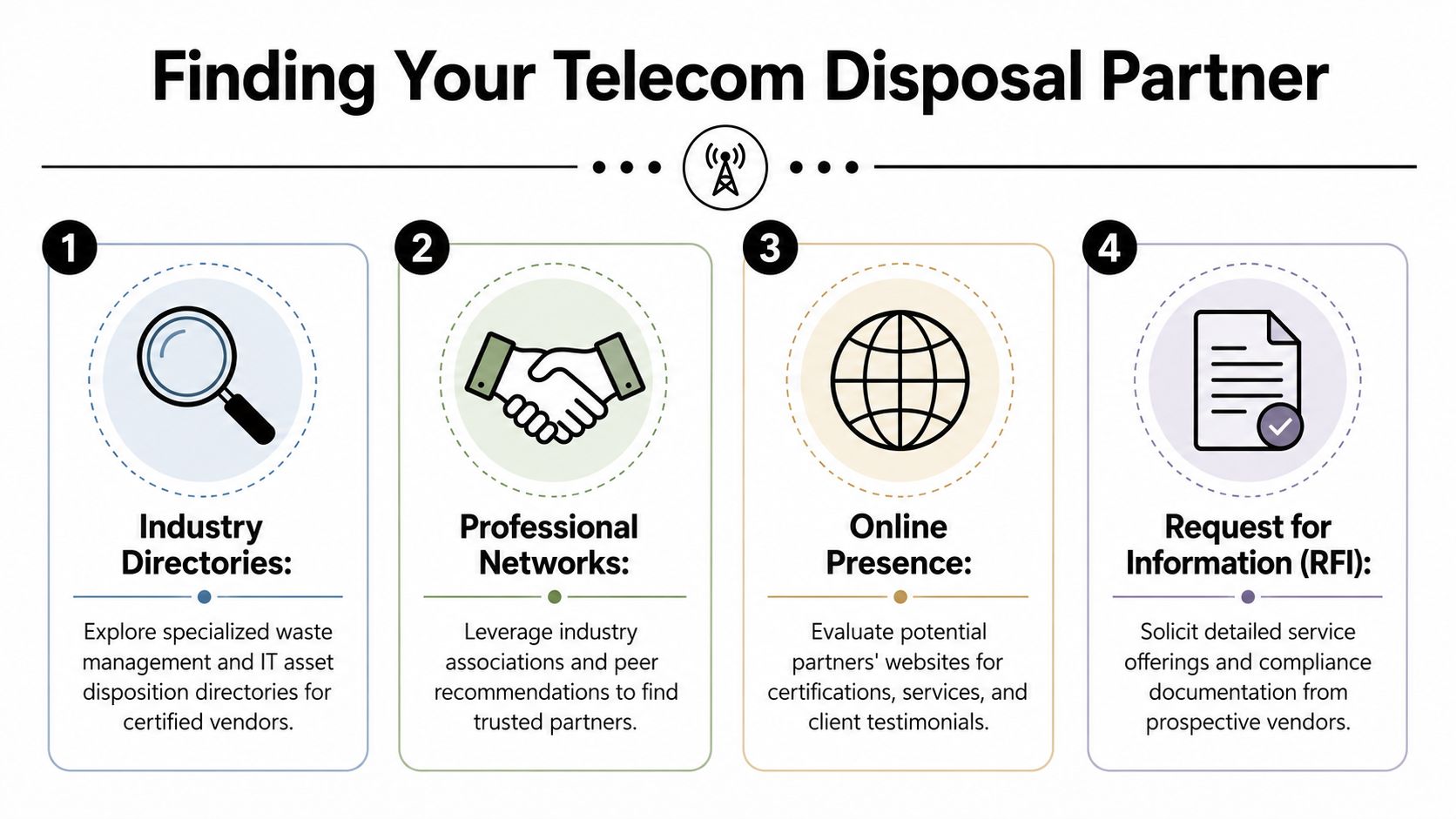
Finding the right partner takes more than typing telecom system support near me into a search bar and calling the first result. De-installation work sits at the intersection of telecom, facilities, logistics, and IT asset disposition. You need a vendor that can operate in all four.
Employment in telecom technician roles is projected to decline 3% from 2024 to 2034, yet the field still produces about 23,200 openings annually because employers need replacement talent. The median annual wage was $64,310 in May 2024, and specialized telecom infrastructure roles earn more, according to the U.S. Bureau of Labor Statistics occupation profile. That matters because the people who can safely identify, disconnect, and remove complex telecom hardware aren’t interchangeable with general labor.
Start with the right search channels
Google maps and local business listings are only the first pass. Strong candidates also show up through real estate move managers, facilities contacts, data center operators, and commercial decommissioning referrals. If your project is tied to a relocation, this 2026 guide for business moves is worth reviewing because it highlights operational issues that often affect telecom timing, access windows, and sequencing.
You can also narrow the field by looking specifically for organizations that present themselves as electronics recycling, IT asset disposition, or decommissioning specialists rather than general junk removal. For broader screening criteria, review a specialized e-waste recycling company page and compare how candidates describe chain of custody, inventory handling, and pickup procedures.
What separates a specialist from a hauler
A scrap hauler talks mainly about volume and pickup. A specialist talks about asset classes, media handling, building coordination, and reporting.
Look for signs like these:
- Scope language that matches your environment. Terms such as PBX, MDF, IDF, switches, servers, handsets, and de-installation signal actual familiarity with telecom environments.
- Document-first sales process. Serious vendors ask for photos, rack lists, floor access details, and a rough asset inventory before they quote.
- Comfort around regulated spaces. Hospitals, research facilities, schools, and public agencies need vendors who understand controlled access and internal signoff.
- Clear downstream answers. If a vendor gets vague when you ask where material goes after pickup, keep looking.
Local versus nationwide support
There isn’t one right answer. A local provider may move faster, know the buildings and municipalities, and give you better direct communication. A nationwide partner may fit multi-site standardization if you’re retiring gear across several states.
What matters is whether the company can match your footprint with real operational capacity. Ask who performs on-site work, who transports assets, who handles media destruction decisions, and who issues final reporting. If those answers drift into subcontractor ambiguity, your risk rises.
A polished website doesn’t prove decommissioning capability. The useful proof is procedural. Inventory templates, site-readiness requirements, chain-of-custody forms, and post-project reporting samples.
Read reviews like a buyer, not a consumer
Consumer-style praise about friendliness matters less than comments about scheduling discipline, documentation quality, responsiveness during pickup windows, and whether the vendor handled surprises without losing control of the project.
For this kind of work, the best vendors sound operational, not flashy. That’s what you want.
Your Vetting Checklist Critical Questions for Compliance and Security
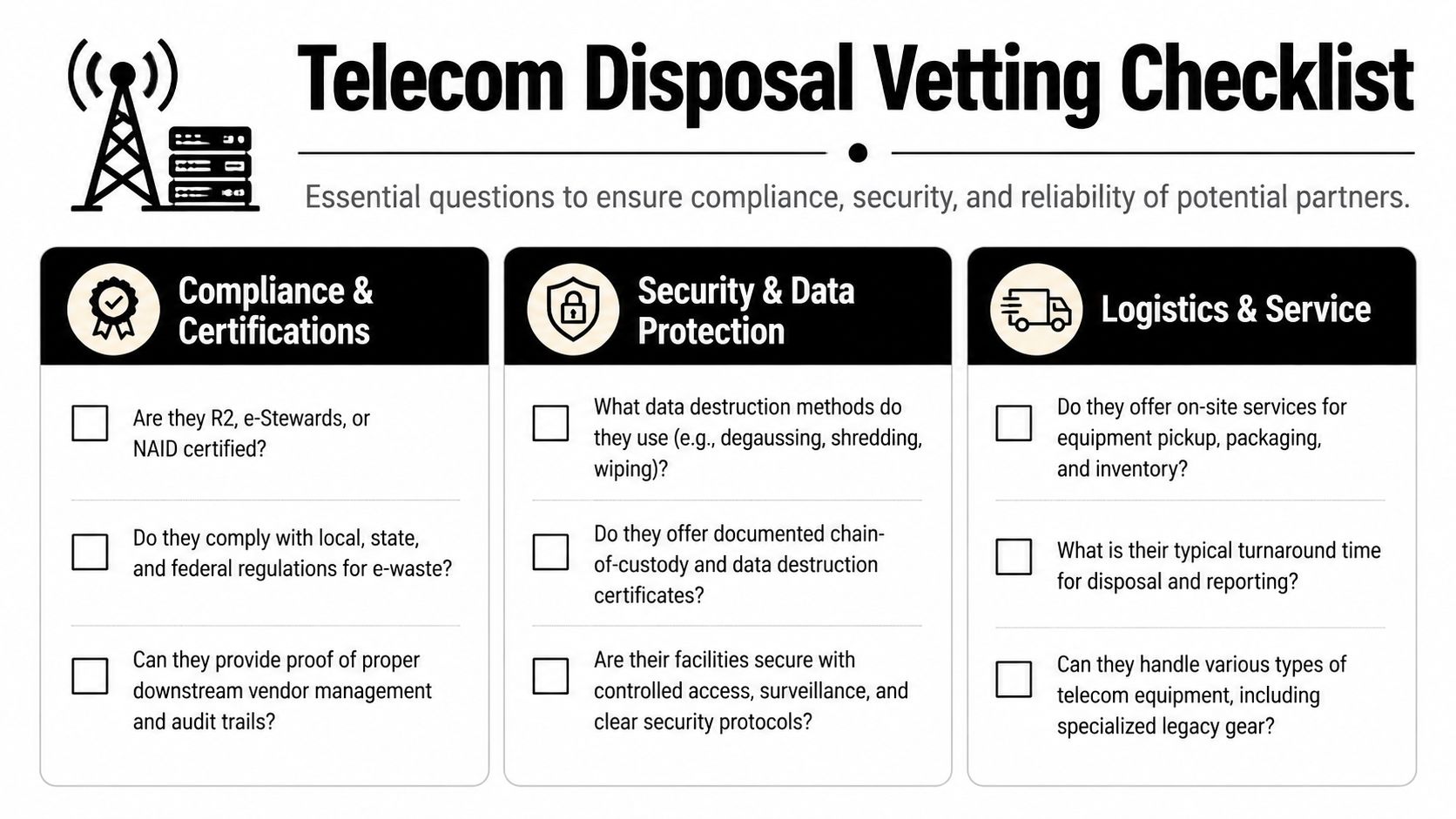
Once you’ve built a shortlist, the interview process should get specific fast. Don’t ask whether they’re experienced. Ask how they handle exact failure points. You’re trying to learn whether the vendor can keep control of assets, data, and documentation from the moment a technician enters the room until the final certificate lands in your inbox.
For live telecom networks, 99.999% availability and low MTTR are recognized service KPIs. Those same ideas can be used as a proxy for decommissioning reliability when you ask about issue resolution protocols, escalation paths, and documented service-level commitments, as discussed in this telecom KPI overview.
Compliance and certifications
Start here because compliance claims are easy to make and easy to overstate.
Ask questions like:
- Which certifications do you hold? Ask for current documentation, not a verbal summary.
- How do you manage downstream vendors? You need to know whether materials are audited after they leave the initial pickup stream.
- Can you provide traceable project records? Good vendors should already have a standard answer.
What a strong answer sounds like: the vendor can explain their process in plain language, provide records without hesitation, and show that documentation is part of the normal workflow, not a special favor.
Security and data protection
Many telecom retirement projects face challenges when teams prioritize servers but overlook storage embedded in telecom appliances, voicemail systems, call recording platforms, and mixed-use network hardware.
Ask:
- Which assets do you classify as data-bearing?
- Do you wipe, shred, degauss, or use a combination based on device type and condition?
- How do you maintain chain of custody from rack removal through final disposition?
- Will you issue destruction records tied to asset identifiers?
If you want to see what formal end-state documentation should resemble, review a sample certificate of destruction. It helps separate vendors with mature reporting from vendors who rely on vague completion emails.
If a provider says, "We usually just remove everything and sort it later," that’s a warning sign. Sorting decisions affect security. Those decisions should be defined before pickup.
Logistics and site control
A good decommissioning project is disciplined on the ground. That means loading paths, labels, access approvals, staging rules, and pickup timing are all established in advance.
Questions worth asking:
- Who packs loose equipment and accessories?
- How are rack units labeled during removal?
- What happens if the team finds unidentified gear that might still be active?
- Can you work in restricted areas with escorts or limited-hour access?
- How do you handle batteries, UPS equipment, and mixed electronic waste?
The answers should show pause points, not just speed. A vendor that never stops to verify status can remove the wrong asset.
Reliability under project pressure
Operational maturity becomes evident when considering these scenarios. Ask how they handle missed access windows, incomplete inventories, disputed assets, or surprise findings in the rack. Ask who gets called when something doesn’t match the scope.
A useful checklist is simple:
| Review area | What to ask | Good sign |
|---|---|---|
| Escalation | Who owns issue resolution on project day? | Named contact with authority |
| SLA mindset | Do you document response and reporting commitments? | Written process |
| Chain of custody | When does custody begin and end? | Clear handoff points |
| Reporting | What final documents are included? | Inventory plus destruction/disposition records |
A vendor doesn’t need a perfect script. They need a controlled process.
Executing the Decommission Logistics Data Destruction and Disposal
After selection, execution is where the project either stays clean or becomes expensive. The mistake I see most often is rushing into removal before the client and vendor agree on asset status, media handling, and site logistics. Once a truck is booked and a room is opened, ambiguity spreads fast.
Start with inventory. Not a perfect inventory. A usable one. You need enough detail to separate live from retired, data-bearing from non-data-bearing, owned from leased, and standard equipment from anything unusual. Model names help. Rack location helps more. Photos often help most.
Build the project around control points
A telecom de-installation should have explicit pause points. The vendor arrives, reviews the scope, confirms exclusions, tags material, and only then starts disconnection. If the room contains overlapping infrastructure, someone from your side must be available to answer status questions in real time.
Use a written sequence such as this:
| Phase | Key Tasks | Primary Responsibility (Client/Vendor) | Timeline Example |
|---|---|---|---|
| Discovery | Review room photos, asset list, access limits, and shutdown approvals | Client | Before pickup scheduling |
| Scope confirmation | Confirm what stays, what goes, and what needs data destruction | Client and Vendor | Before on-site work |
| Site preparation | Clear pathways, reserve dock or elevator access, notify security | Client | Prior to arrival |
| On-site de-installation | Label, disconnect, remove, palletize, and document assets | Vendor | Project day |
| Data disposition | Wipe, shred, degauss, or segregate media per approved method | Vendor | During or after pickup |
| Final reporting | Deliver inventory summary and disposition records | Vendor | After processing |
That table looks basic. In practice, it prevents arguments.
Data destruction has to be asset-specific
One rule matters here. Don’t assume telecom hardware is non-data-bearing just because it isn’t a traditional server. Modern and legacy telecom systems can retain user associations, call logs, voicemail data, credentials, and network settings. Disposal decisions should follow the device, not the label on the room.
You should ask the vendor what method they’ll use by asset type. A functioning drive may be eligible for wiping. Failed or obsolete media may require physical destruction. Certain environments also prefer magnetic destruction methods for selected media. If you need a practical primer on that last category, review what a degausser is used for.
Field note: Data destruction isn’t the final step. Documentation is. If you can’t match the destruction record to the removed asset set, your audit trail is incomplete.
A separate internal review helps too. Teams that already use formal risk reviews for infrastructure changes should apply the same discipline here. This resource on strategies for identifying IT security threats is useful because it reinforces the habit of finding exposure before a project creates it.
What to expect on pickup day
A controlled vendor won’t treat the room like a warehouse cleanout. The team should verify scope at arrival, use a consistent labeling method, and stage material so your staff can still identify what left the room. If a vendor starts stacking unlabeled chassis, cards, handsets, and drives into mixed gaylords without documentation, stop the work and reset the process.
Practical expectations include:
- Access discipline. Security, escort rules, and room authorizations should already be resolved.
- Packaging logic. Fragile devices, loose accessories, media, and mixed cabling shouldn’t all travel together.
- Exception handling. Unexpected assets should be quarantined for client review, not loaded out.
- Visible records. Pickup manifests, serial capture when applicable, and custody signoff should happen the same day.
Disposal is more than getting gear off-site
Removal only solves the space problem. The actual disposal outcome still matters. You want to know which equipment was reused, which was recycled, which media was destroyed, and how the vendor closed the loop.
Buyers often get vague language instead of proof. Ask for final reporting that ties the physical project to the documentation trail. If your compliance or legal team asks what happened to the retired telecom estate, you should be able to answer without reconstructing the project from email threads.
A finished telecom decommission should leave you with three things: an empty room, a clean audit trail, and no uncertainty about where the equipment went.
S.E.D.'s Integrated Solution for Atlanta Metro Businesses
In a telecom market this large, end-of-life support isn’t a side issue. The U.S. telecommunications market was valued at over USD 468 billion in 2023, which underscores how much infrastructure eventually needs retirement and disposition, according to Grand View Research's U.S. telecom services market analysis. In Atlanta and the surrounding business corridor, that translates into a steady need for vendors that can remove aging telecom assets with the same discipline used to deploy them.

For hospitals, clinics, universities, data centers, government offices, and corporate IT teams around Norcross, Alpharetta, Marietta, and the wider metro area, the practical requirement is straightforward. You need one partner that can show up, de-install equipment safely, manage data-bearing assets correctly, move material with its own logistics capability, and document the outcome in a way compliance teams can use.
That’s where an integrated provider stands out. Instead of splitting the job across a telecom contractor, a recycler, and a separate destruction vendor, organizations can reduce handoffs and simplify accountability. The fewer custody transfers you create, the easier it is to maintain control of the project.
A local buyer looking for telecom system support near me often starts with maintenance intent, then realizes the bigger issue is retirement planning. If that’s your situation in Atlanta, a provider with dedicated telecom maintenance services in Atlanta and decommissioning capability is easier to evaluate because the service context is already aligned with your environment.
The best decommissioning partner doesn’t just remove hardware. They remove uncertainty from the last stage of the asset lifecycle.
That matters most in buildings where shutdowns, access windows, and data controls are tightly managed. When a vendor understands facility realities, the project stops feeling like a disposal chore and starts running like controlled infrastructure work.
If you need a partner that can handle telecom de-installation, secure data destruction, compliant electronics recycling, and coordinated pickup across the Atlanta metro, Scientific Equipment Disposal is built for exactly that kind of project. Their team supports hospitals, labs, universities, corporate IT departments, and public agencies with on-site logistics, DoD 5220.22-M wiping, shredding for obsolete media, and practical guidance that keeps decommissions orderly from first inventory to final documentation.