Affordable Telecom Services Near Me: 2026 Atlanta Guide


Your team is ready, but the video call is lagging. A critical file upload to the cloud is crawling. In Atlanta, that usually means you're losing time twice. Once in the moment, and again later when staff repeat work, reschedule meetings, or wait on systems that should've been instant.
That's why searching for affordable telecom services near me can't stop at the cheapest advertised rate. Metro Atlanta has overlapping footprints from Norcross to Marietta, neighborhood-by-neighborhood fiber pockets, older commercial buildings with limited wiring, and plenty of promotions that look better on a landing page than they do on your first invoice.
This guide cuts through that noise with a local-first mindset. If you're running a clinic, lab, university department, office, or multi-site operation, start with the practical checks that save the most frustration.
- Start with aggregator tools: Use the FCC National Broadband Map or a commercial provider comparison tool to build a first-pass list for your exact business address.
- Check with your building manager: In Buckhead, Midtown, Perimeter, and other multi-tenant properties, management often knows which carriers are already lit in the building. That can change install timing and construction costs.
- Ask neighboring businesses: Real-world experience matters more than marketing language. Nearby tenants can tell you whether a provider performs well during peak hours, how fast support responds, and whether installs happen on schedule.
To help visualize service zones, consider a map showing provider hubs and operating density across the metro, including Alpharetta, Norcross, Decatur, Marietta, and Peachtree City. That kind of local view often explains why one side of a corridor has fiber and the other still relies on cable or wireless.
Now to the short list that matters.
1. AT&T Business Fiber
A common Atlanta problem looks like this. Your team signs a lease, move-in is on schedule, cloud systems are ready, and then the internet order stalls because the building has AT&T on the block but not lit to your suite. That is why we treat AT&T Business Fiber as a serviceability question first and a pricing question second.
For Atlanta businesses that depend on Microsoft 365, VoIP, cloud backups, imaging files, VPN traffic, or steady video calls, AT&T is often one of the better first providers to check. Symmetrical fiber helps when staff upload as much as they download, which is normal for clinics, labs, accounting firms, and professional offices. From S.E.D.'s perspective helping other local organizations evaluate connectivity, AT&T belongs on the shortlist in areas like Alpharetta and Norcross only after you confirm the exact suite can be installed without construction delays.
Where it fits best
AT&T is usually a strong fit for fixed business locations that want fiber as the primary circuit and expect to stay put long enough to benefit from a clean install. It also makes sense for companies that already use AT&T wireless and want one carrier relationship for billing and support.
The trade-off is straightforward. Availability can look better on a coverage map than it does at the unit level. In older office parks and multi-tenant buildings, one tenant may have fiber while the suite next door still needs additional work. That difference affects install time, setup cost, and sometimes whether the deal is worth pursuing at all.
What works and what to verify
AT&T tends to work well for businesses that need:
- Symmetrical speeds: Better for cloud-heavy workflows, hosted phones, file sync, and remote collaboration.
- A clearer growth path: Fiber usually handles added users and heavier application demand better than fixed wireless.
- Carrier consolidation: If you already run AT&T mobility, bundling can simplify procurement and support.
The weak spots are predictable, and they matter:
- Address checks can be misleading: Verify service at the suite level, not just the building address.
- Building conditions affect delivery: Older properties may require extra inside wiring, landlord approval, or a longer install window.
- Promo pricing does not tell the whole story: Contract terms, install charges, and repair responsiveness matter more than the first-month rate.
One practical step saves time here. Ask AT&T sales for a written serviceability check tied to your exact suite number and ask whether the quoted install is standard or construction-dependent. If you are comparing carriers for a business continuity plan, that answer is often more useful than the advertised speed tier.
Businesses doing a broader Atlanta telecom provider comparison for reliability and support should keep AT&T in the top group when fiber is confirmed. Start with the official AT&T Business Fiber page.
2. Comcast Business

Your office internet drops on a Tuesday morning, the phones start clipping, card payments slow down, and the landlord says fiber buildout is still months away. In a lot of Atlanta-area buildings, especially older properties in Norcross, Doraville, parts of Alpharetta, and mixed-use corridors, Comcast Business ends up on the short list for a simple reason. It is often the service you can get installed without a long construction process.
From S.E.D.'s perspective, that matters. Businesses do not buy internet in theory. They buy workable uptime, a reasonable install window, and support that does not leave operations exposed.
Comcast Business is usually strongest where speed of deployment and broad address coverage matter more than perfect upload performance. Its business packages can combine cable internet, voice, security tools, and wireless failover under one account. For a small office without internal IT staff, that can reduce vendor sprawl and make support easier to manage.
It also fills a different role than fiber-first options. Comcast is often the practical pick for offices running standard cloud apps, web-based CRM, VoIP, POS systems, and regular video meetings, especially if the building has limited carrier choice. Businesses comparing providers across the metro area often include it in a broader review of the best telecom company in Atlanta.
The trade-off is straightforward. Cable can work well for day-to-day business traffic, but it is usually less attractive for teams with heavy upstream use, large recurring backups, or systems that are sensitive to latency variation. If your next step includes hosted communications, distributed staff, or a broader move toward cloud-based voice and collaboration, this guide to cloud telecom services for distributed operations gives useful context for what to check before you sign.
A few checks make Comcast quotes more useful:
- Verify availability at the suite level, not just the street address.
- Ask whether the quoted service is coax, fiber, or a mix of both inside the building.
- Confirm upload speeds, not just download speeds.
- Get the contract term, post-promo price, install fees, and backup options in writing.
- Ask how support and replacement timelines work for your class of service.
One caution from local experience. A building can show as serviceable while your specific suite still needs inside wiring, landlord approval, or scheduling that stretches the install. That is common in multi-tenant properties and worth checking early.
If you need broad availability, one-bill simplicity, and a realistic path to fast activation, Comcast Business deserves a serious look. Review current options on the Comcast Business site.
3. Google Fiber for Small Business
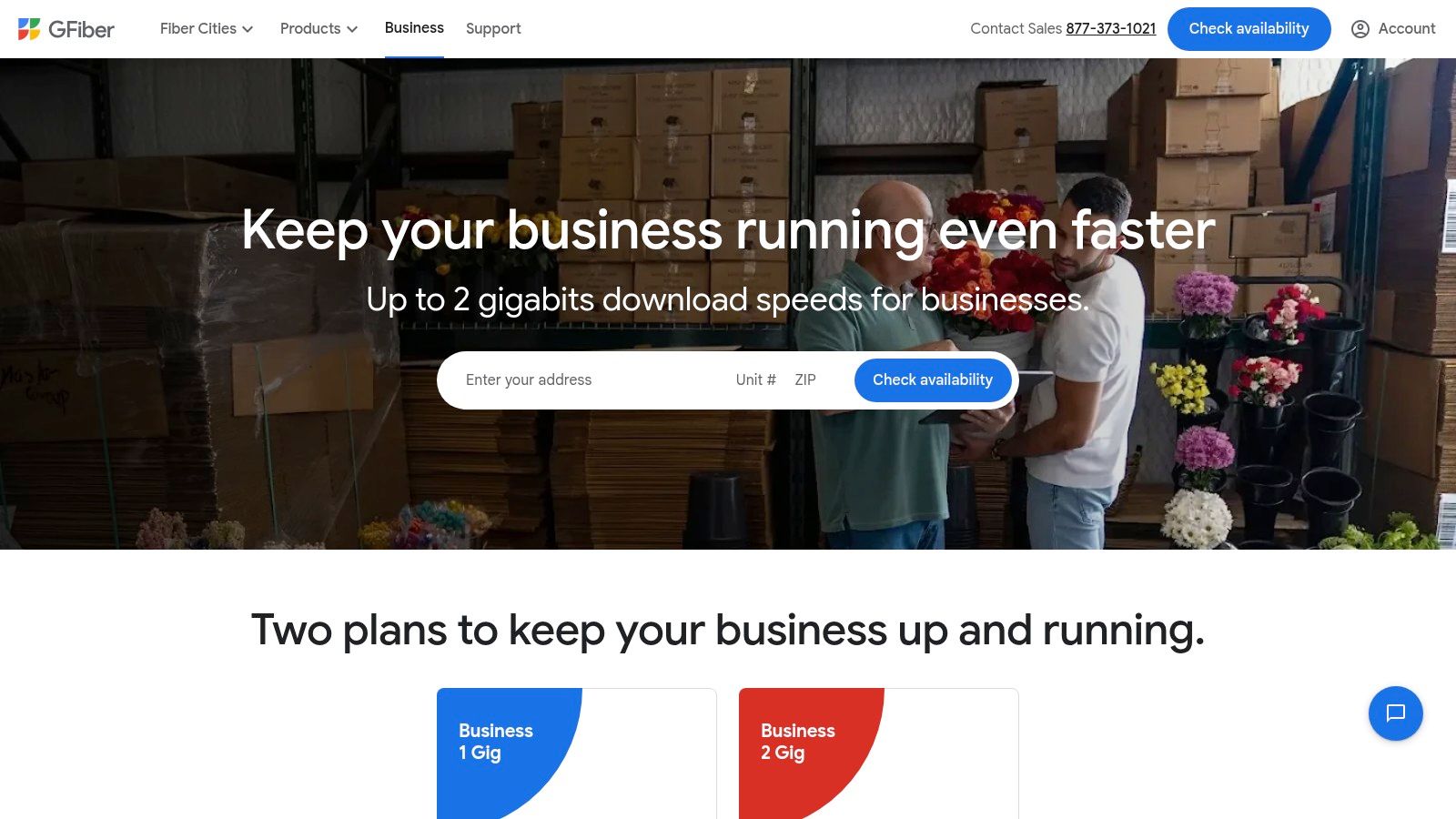
A team in Alpharetta signs a lease, plans around cloud phones and shared files, then learns the building next door can get Google Fiber while their suite cannot. That is the actual GFiber buying experience in metro Atlanta. The product is attractive. Availability decides whether it matters.
From our side at S.E.D., Google Fiber for Small Business stands out for one reason. It is usually easy to understand. Businesses that want symmetrical fiber, fewer plan variations, and less back-and-forth during procurement often put GFiber near the top of the list once an address qualifies.
Where Google Fiber fits best
GFiber works well for smaller offices that do a lot of real-time and upstream-heavy work. That includes cloud phone systems, frequent video calls, offsite backups, shared design files, and SaaS tools that stay open all day. In those environments, simple service with predictable performance often beats a cheaper quote that creates support tickets later.
It is also a sensible option for companies standardizing around hosted communications and distributed access. If that is part of your plan, this guide to cloud telecom services for distributed operations helps frame what to check between internet access, voice, and continuity planning.
What Atlanta buyers should verify first
Coverage is still the main filter. In Atlanta, Norcross, Alpharetta, and nearby business corridors, service can change by building, floor, or even suite.
Before you spend time comparing plans, confirm:
- Exact suite availability: Street-level qualification is not enough in multi-tenant buildings.
- Install scope: Ask whether your space needs new inside wiring, access approval, or additional scheduling with property management.
- Business support terms: Confirm who handles outages, replacement equipment, and escalation for your account type.
- Static IP and add-on needs: Some businesses need more than basic internet on day one.
- Cutover timing: If you are replacing an active connection, get a realistic install window before setting a disconnect date.
That last point matters. We have seen Atlanta-area businesses assume a fiber-ready address means a quick turn-up, only to lose a week or more to building access, closet work, or landlord coordination.
The trade-off
Google Fiber is often one of the cleaner business internet options available. The trade-off is narrow reach. Comcast and Spectrum usually win on footprint. Verizon and T-Mobile can be faster to activate in the right fixed wireless scenario. GFiber tends to win when the address qualifies and the business wants straightforward fiber service without a complicated package structure.
A few reasons buyers like it:
- Symmetrical speeds: Better for uploads, conferencing, cloud backups, and remote collaboration.
- Simpler buying process: Fewer plan combinations and less promotional complexity.
- Clean fit for cloud-first offices: Easier to match with VoIP, shared storage, and hybrid work setups.
A few reasons to pause:
- Address-specific availability: Two offices in the same submarket can get very different answers.
- Fewer tier choices: Some businesses want more pricing and speed steps between entry and premium service.
- Building dependency: Landlord rules and existing infrastructure can slow an otherwise good option.
If your Atlanta-area address qualifies, GFiber deserves a serious look. Start with the official Google Fiber for Small Business page.
4. Spectrum Business
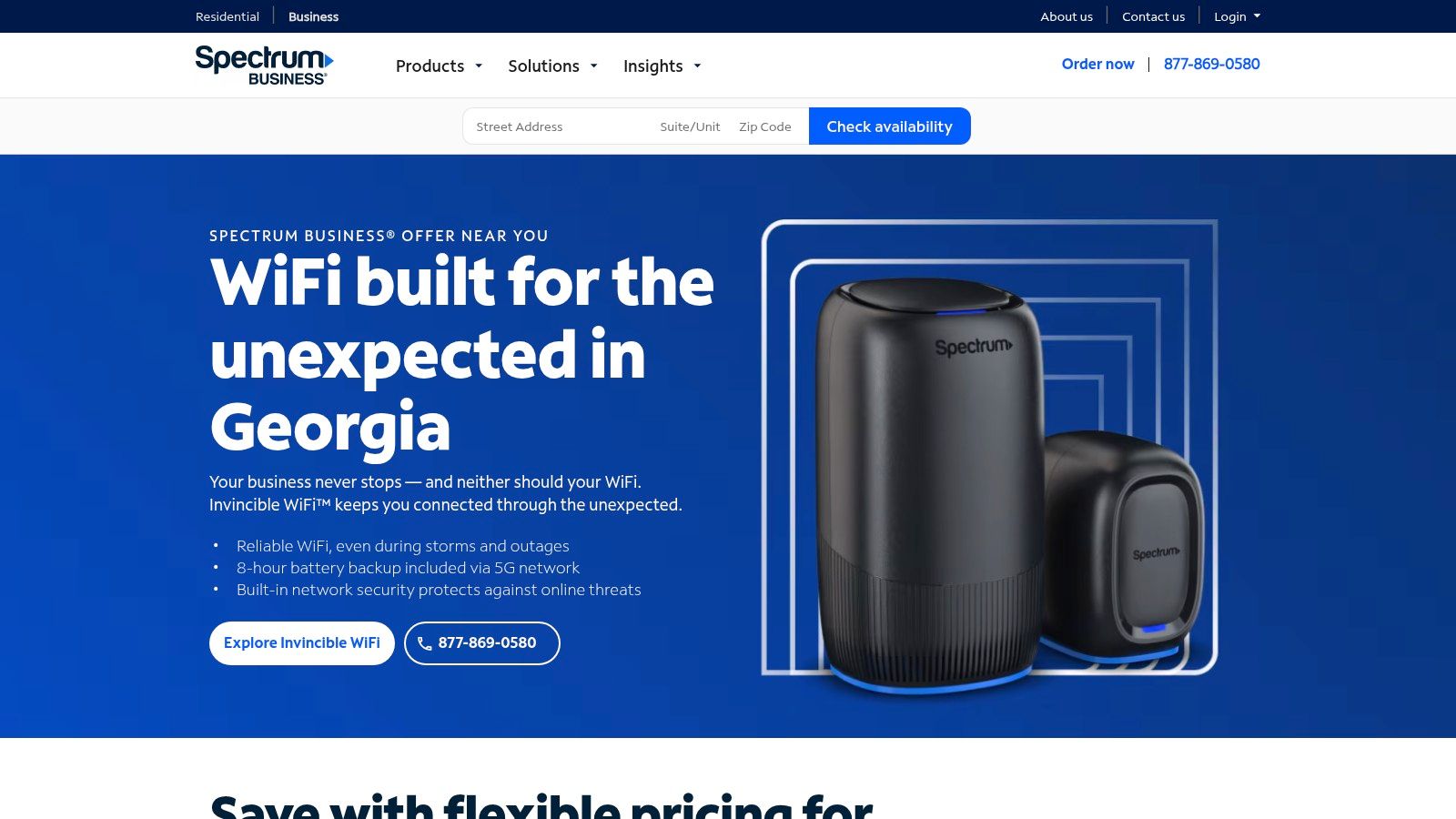
A Norcross office signs a lease, plans a quick move, and finds out the fiber option for that suite will take longer than expected. That is often where Spectrum Business enters the conversation. For many Atlanta-area businesses, especially in suburban submarkets, Spectrum is the provider that is available now, at a price point that can work for routine office operations.
From S.E.D.'s perspective, that matters. We help local businesses think past the advertised speed tier and ask a harder question. Will this connection support phones, cloud apps, card payments, cameras, and day-to-day work at your specific address in Alpharetta, Marietta, Duluth, or Lawrenceville?
Where Spectrum tends to fit
Spectrum Business usually makes the most sense for companies that need broad coverage, reasonable installation odds, and simpler month-to-month flexibility than some fiber builds allow. It is commonly a practical fit for admin offices, light industrial locations, professional services firms, and branch sites where availability matters as much as raw performance.
The main reasons it stays on the shortlist are straightforward:
- Good suburban serviceability: Spectrum often reaches buildings where full fiber options are limited or delayed.
- Familiar business packaging: Internet, voice, and related services are easier to bundle for smaller teams.
- Useful flexibility: Many buyers look at Spectrum when they want to avoid locking into a long term commitment too early.
- Solid backup candidate: In some offices, cable is a sensible secondary circuit behind a primary fiber line.
The trade-off buyers need to verify
Spectrum can be a good operational choice, but buyers should verify the last-mile service type before signing. In many buildings, the service is delivered over hybrid fiber-coax rather than dedicated fiber all the way to the suite. That affects upload capacity, latency consistency, and how well the connection holds up under heavier cloud use.
Ask the rep one direct question. “What is the exact service type at my suite, and what are the typical upload speeds on that tier?”
That answer matters more than the phrase "fiber-powered."
For a business running VoIP, large file syncs, offsite backups, or constant video meetings, the difference between coax-based service and full fiber shows up quickly. For a smaller office handling email, browsing, web apps, and standard conferencing, Spectrum may be more than adequate. The right choice depends on workload, not branding.
Our advice is to check Spectrum against at least one other option using a local business internet provider comparison for Atlanta-area companies. Then confirm serviceability at the suite level, not just the building address.
Spectrum can be a solid business utility when you need a provider with broad metro reach and a realistic path to installation. Review current local options on the Spectrum Business Georgia page.
5. Verizon 5G Business Internet
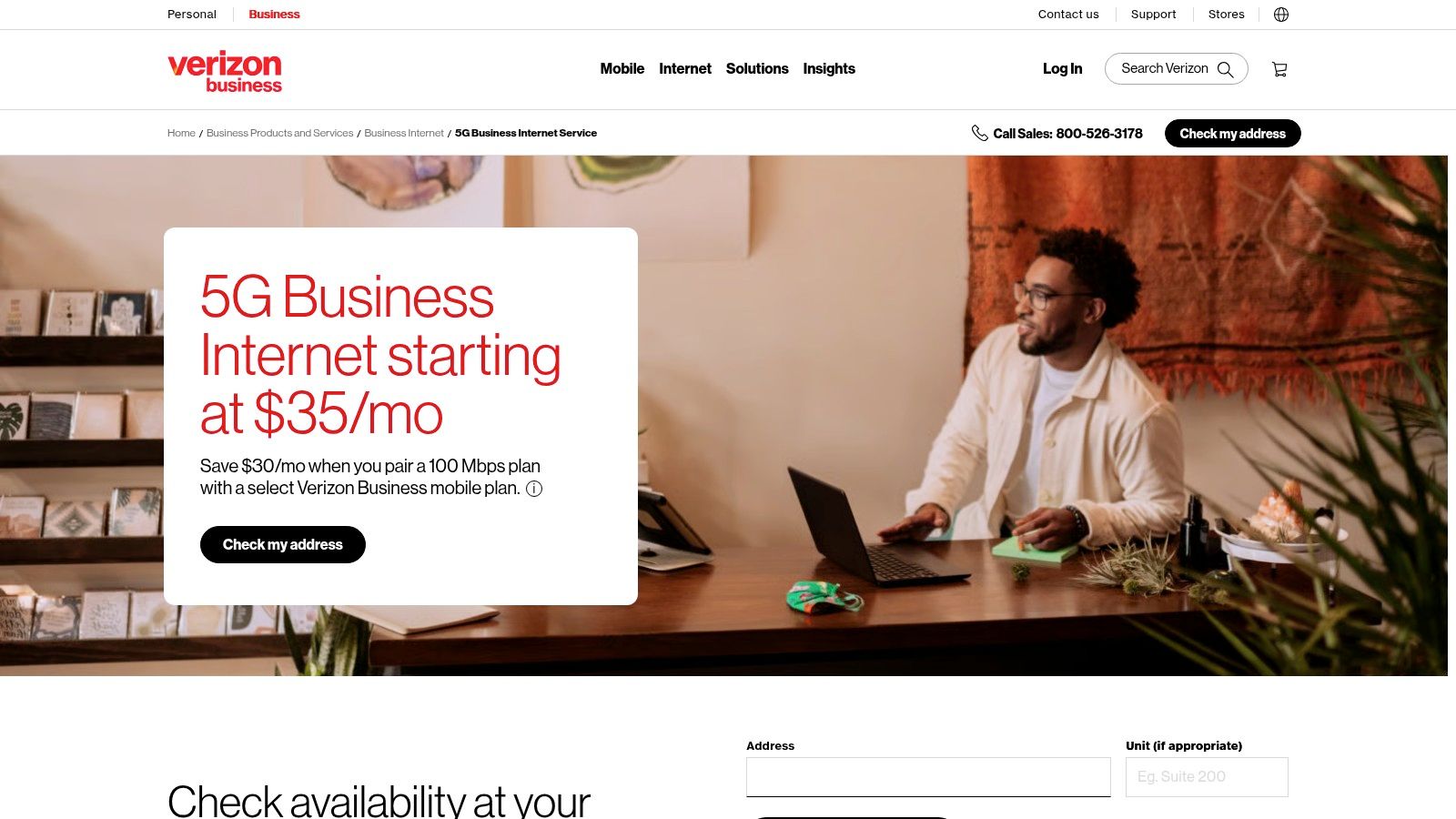
A Norcross office signs a lease on Monday and needs internet before staff arrives the following week. Fiber construction is uncertain. Cable install dates keep slipping. In that situation, Verizon 5G Business Internet deserves a serious look.
From our side at S.E.D., this is the Atlanta-area use case where fixed wireless earns its place. It gives businesses a practical way to get online fast, cover a temporary location, or add a second path for continuity without waiting on construction crews or landlord approvals.
Where Verizon 5G works best
Verizon is usually strongest when speed of deployment matters more than getting the highest possible upload capacity. That makes it a realistic option for pop-up operations, satellite offices, project spaces, field teams, and businesses opening a suite in areas where wired availability changes block by block.
For Atlanta buyers, the key question is not whether 5G is available somewhere nearby. It is whether the service performs well at your exact address, inside your suite, during your working hours. Alpharetta and Norcross can both show coverage on a map and still deliver very different indoor results depending on building materials, placement, and local tower load.
A good Verizon fit often looks like this:
- Fast activation: You need service in days, not after a construction interval.
- Flexible location planning: The office may be temporary, recently leased, or likely to move.
- Business continuity: You want a backup connection behind fiber or cable so phones, card payments, and cloud apps stay up during an outage.
If your phone system and collaboration stack also depend on that backup path, this guide to unified communications providers for Atlanta-area businesses helps frame the conversation beyond internet alone.
The trade-off to verify before you buy
Wireless service can be very good. It is not identical to wired service.
Performance depends on signal conditions, building layout, congestion, and the kind of traffic your team sends all day. Download speeds may look attractive, but upload performance and consistency are what usually separate a workable primary connection from a backup-only link.
That is why we recommend a short verification process before signing:
- Test service at the suite, not just the street address.
- Ask whether Verizon will support an on-site placement check for the gateway.
- Run real workload tests, including video calls, file uploads, VPN sessions, and cloud app use during business hours.
- Confirm whether the plan is intended to serve as a primary connection, failover connection, or temporary install.
For lighter office use, Verizon 5G can be a cost-effective primary service. For heavy uploads, large backup windows, always-on VPN traffic, or latency-sensitive work, it is often better as a secondary circuit behind wired internet.
Our advice as one Atlanta business helping another is simple. Use Verizon 5G Business Internet when you need speed, flexibility, or redundancy. Just verify the address-level fit before you treat it as your main line. Start with the Verizon 5G Business Internet page.
6. T-Mobile 5G Business Internet
A common Atlanta scenario goes like this. A small office in Norcross or Alpharetta needs internet fast because the move happened before the carrier install window did. T-Mobile 5G Business Internet often makes that problem manageable. It is easy to order, quick to set up, and often priced low enough to work for startups, field offices, temporary spaces, and backup connectivity.
At S.E.D., we usually frame T-Mobile as a speed-to-service option first. The value is not just the monthly rate. The value is getting a site online without waiting on construction, circuit delivery, or landlord approvals that can drag on for weeks.
T-Mobile usually fits best in a few business cases:
- Fast turn-up: A new suite needs service now.
- Short-term occupancy: Pop-up locations, project sites, and swing space benefit from a connection you can move.
- Secondary internet path: A wired primary line stays in place, and T-Mobile covers outages or failover events.
- Light office workloads: Email, cloud apps, web use, and moderate video calling are often a better fit than heavy upstream traffic.
It can also pair well with a broader communications plan. If you are reviewing mobile service, calling, and collaboration together, this guide to unified communications providers near me helps connect the internet decision to the rest of your stack.
Choosing the right service depends on the consistency within your suite.
With T-Mobile, signal quality can change by floor, window line, wall material, and time of day. A street address check is a starting point, not proof that the service will hold up in the exact office where your team works. That matters more in multi-tenant buildings, older construction, and areas where nearby wireless demand rises during business hours.
Before signing, verify a few things that Atlanta businesses often skip:
- Test the gateway where it will sit, not just near the front window.
- Run video meetings, cloud backups, VPN sessions, and file uploads during your busiest hours.
- Ask whether the plan is intended to serve as a primary connection or a backup connection for your workload.
- Check service behavior at the specific suite if you are in a larger property, especially in denser corridors and mixed-use areas.
For many small offices, T-Mobile 5G Business Internet is a practical and affordable tool. For teams with constant uploads, large sync jobs, always-on VPN traffic, or strict uptime requirements, wired service is usually the safer primary line.
Use T-Mobile where it matches the job. Verify the suite, test the workload, and decide based on business continuity, not just the promo price. The official starting point is the T-Mobile Business Internet page.
7. Kinetic Business by Windstream
A business in Norcross adds a second location, assumes one of the big Atlanta providers will be the obvious fit, and then runs into a serviceability wall. That is usually where a provider like Kinetic Business by Windstream enters the conversation.
From our side at S.E.D., this is not a brand we put at the top of every Atlanta shortlist. We do put it on the verification list for outer-metro addresses, light industrial corridors, and regional Georgia sites where coverage can vary block by block. In the right building, Kinetic can be a practical business option with internet and related services under one account. In the wrong building, it drops out fast.
Where Kinetic makes sense
Kinetic is usually worth checking for businesses that want to reduce vendor sprawl and confirm whether a less-publicized provider has usable wired service at the exact address.
It often fits teams that want:
- One provider for more than access: Internet, Wi-Fi, security, and continuity tools may be easier to manage through a single business account.
- A value-first option: Where Kinetic has the network in place, pricing and packaging may compare well against more familiar brands.
- A simpler operating model: Lean IT teams often prefer fewer handoffs when they are troubleshooting service, equipment, and account issues.
The local test is simple. Do not judge Kinetic by name recognition. Check whether your specific suite in Alpharetta, Norcross, or another Atlanta-area submarket qualifies for the service level your operation needs.
What to verify before you sign
Kinetic is an availability-driven buy. The first question is not whether Kinetic looks good on paper. The first question is what Kinetic can install at your address, in your suite, with business terms that match your uptime needs.
Ask for the access type, expected install timeline, equipment details, and support terms in writing. If your phones, cameras, guest Wi-Fi, POS systems, or cloud apps all ride the same connection, confirm how the provider handles outages, replacement equipment, and escalation. Those details matter more than a headline promo.
There is also a sector-specific consideration for regulated environments. For healthcare, labs, schools, and facilities handling connected equipment, telecom choices can affect security controls and operational handoffs beyond internet access alone. If that applies to your site, review the provider's business services carefully on the Windstream Business site.
Kinetic can be a good local fit. Verify the exact address, confirm the service type, and compare it against the continuity needs of the business, not just the monthly rate.
Top 7 Affordable Telecom Providers, Local Comparison
| Provider | 🔄 Implementation Complexity | ⚡ Resource Requirements & Deployment Speed | 📊 Expected Outcomes (⭐ Quality) | 💡 Ideal Use Cases | Key Advantages |
|---|---|---|---|---|---|
| AT&T Business Fiber | Moderate, fiber provisioning with optional 5G backup setup | High bandwidth needs for multi‑gig; fast local installs in Atlanta | ⭐⭐⭐⭐, symmetrical multi‑gig performance; SLA and outage credits | Multi‑gig offices, cloud/VDI, sites needing resilient primary links | Competitive bundle promos with AT&T wireless; 30‑day risk‑free and outage guarantees |
| Comcast Business (Cable/Fiber) | Low–Moderate, coax self‑install common; DIA fiber requires pro install | Wide tier choices (300 Mbps–2 Gbps); same‑day/next‑day installs often available | ⭐⭐⭐⭐, reliable for SMBs; performance depends on coax vs DIA | Businesses needing broad coverage, bundled security, predictable budgeting | Broad coverage, SecurityEdge included, price‑lock options |
| Google Fiber for Small Business | Low, simple, flat provisioning where available | Moderate equipment needs (Wi‑Fi6 included); few optional fees | ⭐⭐⭐⭐⭐, consistent symmetrical speeds and clear SLA | Cloud/VoIP‑heavy offices needing predictable throughput | Flat‑rate pricing, included routers/mesh, strong SLAs |
| Spectrum Business (Charter) – Georgia | Low, common HFC/coax installs; easy promos and no‑contract options | Typical cable speeds (100–500 Mbps); Invincible WiFi with 5G backup | ⭐⭐⭐, good regional value but often not full FTTP | Budget‑conscious SMBs, suburban locations, no‑contract requirements | No‑contract flexibility, contract buyout offers, integrated 5G backup |
| Verizon 5G Business Internet (FWA) | Very low, fast fixed‑wireless turn‑up; pro install optional | Low physical install; performance depends on 5G coverage and congestion | ⭐⭐⭐, variable throughput/latency; good as primary in strong coverage | Secondary sites, pop‑ups, temporary or rapid‑deploy primary/backup links | Quick deployment, discounts with Verizon mobile bundles, long price guarantees |
| T‑Mobile 5G Business Internet | Very low, fast self‑install and portable hardware | Low setup overhead; speeds vary by location; fiber in select zones | ⭐⭐⭐, variable performance; cost‑effective for many SMB needs | Relocatable sites, low‑cost primary, backup circuits, bundled customers | Competitive entry pricing, multi‑year promos, easy relocation |
| Kinetic Business by Windstream | Moderate, fiber where built; bundles simplify setup | Symmetrical fiber where available; some locations may be DSL | ⭐⭐⭐⭐, strong where fiber exists; variable based on availability | Clinics, schools, small IT teams wanting turnkey bundles | Turnkey "Business Ready" bundles, local support, transparent pricing |
Your Checklist for Choosing the Right Telecom Partner
A business in Norcross signs a low monthly internet deal on Monday, schedules install for Friday, and learns the day before go-live that fiber stops at the building MPOE and never reaches their suite. The promo price looked fine. The service match did not. We see versions of this across metro Atlanta, especially when a team is trying to open fast, relocate, or replace a failing connection without checking the details that affect uptime.
From S.E.D.'s perspective, helping another Atlanta-area business means looking past the rate card. The practical question is whether a provider can support your operation at your exact address, with the install path, support terms, and backup options your site needs. Alpharetta, Norcross, and nearby business corridors can vary block by block, and multi-tenant buildings add another layer because landlord approval, riser access, and inside wiring can delay an otherwise available service.
Use this checklist before you sign:
- Verify exact serviceability: Ask each carrier to confirm service for your specific suite or unit, not just the building address. If the provider says fiber is available, ask whether it is already lit to your suite or if construction, landlord approval, or new inside wiring is still required.
- Match the circuit to the workload: A small office handling browsing, POS traffic, VoIP, and light video meetings can often run well on cable or strong fixed wireless. A clinic, lab, engineering team, or cloud-heavy office usually needs better upload capacity, lower latency variation, and a clearer uptime commitment.
- Read the SLA and repair terms: Look at uptime language, mean time to repair, outage credit rules, and whether support is best-effort or backed by business-grade commitments.
- Audit the full bill: Ask what happens after the introductory period, whether autopay is required, and which charges sit outside the advertised monthly rate, including equipment, install, static IPs, taxes, and early termination fees.
- Test support before you buy: Call with a real business question. Ask about failover, static IP availability, installation lead time, and escalation paths. One call can show you whether you will get a knowledgeable business team or a consumer script.
- Plan for continuity: Ask how to add a backup circuit, wireless failover, or a second location later. The primary limitation with many low-cost plans is not headline speed. It is how little flexibility they give you once the business grows or an outage hits.
Affordability still matters, but business buyers should measure it against downtime risk, installation surprises, and upgrade friction. A cheaper circuit that cannot support voice quality, cloud backups, or same-day troubleshooting often costs more after the first outage.
This matters most during office moves, lab shutdowns, telecom refreshes, and equipment replacements, when digital continuity and physical asset handling overlap. If your team is retiring network gear, decommissioning a lab, or managing data-bearing devices in Norcross or across metro Atlanta, those projects should be coordinated instead of treated as separate workstreams.
Scientific Equipment Disposal supports that side of the job with secure, compliant, and sustainable handling of retired lab and IT assets, including DoD-compliant hard drive sanitization for organizations that need a documented chain of custody. If your team also wants sharper demand generation on the telecom side, this resource on grow your telecom business marketing is a useful read.
If your organization is planning a lab shutdown, office move, telecom refresh, or secure IT asset disposal in metro Atlanta, Scientific Equipment Disposal can help you coordinate the physical side cleanly. S.E.D. handles pickup, de-installation, packing, compliant recycling, and DoD 5220.22-M hard drive wiping for hospitals, clinics, universities, corporate IT teams, and government facilities, with responsive local service from Norcross across the region.