Best Local Telecom Service Providers for Businesses Chicago


If you're searching for local telecom service providers for businesses Chicago, you're probably already feeling the pain of a network that's no longer good enough. Maybe your office has outgrown shared broadband. Maybe your phones get choppy during client calls. Maybe your clinic, lab, or warehouse is adding locations and the current provider can't give you clean failover, predictable support, or a contract that makes operational sense.
Chicago gives you a lot of choice, which is good and bad. It's a dense telecom market with national carriers, fiber specialists, business-only providers, and neighborhood-strong regional operators. As of December 25, 2025, there are 69 verified telecommunications service providers operating in Chicago. That depth helps buyers, but it also creates a common problem. Business owners end up comparing marketing pages instead of comparing real fit.
The right provider isn't just an ISP. It's part of your operating model. It affects uptime, voice quality, cloud access, branch connectivity, vendor access, remote work, and how fast your team can recover when a circuit drops. If you're modernizing your company's network setup, you need more than a list of names.
This guide gets to the point. It focuses on providers Chicago businesses shortlist for internet, voice, Ethernet, SD-WAN, and hybrid wireless backup. More important, it explains the trade-offs. Some providers are great if your building is already on-net. Some are strong only for enterprise contracts. Some work best as a secondary carrier, not your primary. Some are fast to install but weaker on deep customization.
Use this as a procurement tool, not a directory. The goal is simple. Shortlist the providers that match your building, your uptime needs, and your support expectations, then avoid getting stuck with a circuit that looked cheap on paper and became expensive in downtime.
1. Comcast Business Chicago
Comcast Business is usually one of the first providers I check for Chicago offices because it can cover a lot of situations without forcing a custom enterprise build on day one. If you need standard business broadband fast, Comcast is often in the conversation. If you need Dedicated Internet Access, Metro Ethernet, voice, managed WiFi, or SD-WAN for a larger rollout, it can stay in the conversation as requirements get more serious.
That range matters. A lot of businesses start by asking for internet and end up needing voice, guest WiFi segmentation, firewall handoff, or a redundant secondary path six months later. Comcast tends to be strong when you want one carrier that can support that growth.
Where Comcast fits best
Comcast Business makes the most sense in offices where broad on-net coverage or straightforward building access already exists. In Chicago business districts, that's often the case, and the value is speed to deployment plus a mature product catalog. For multi-site operators, that matters more than marketing copy about raw speeds.
What works well:
- Primary circuit for general business operations: Good for firms that need stable connectivity without designing a carrier-grade WAN from scratch.
- Secondary circuit for resilience: A practical option when you're pairing providers for continuity.
- Voice plus access bundle: Useful when the business wants fewer vendors to manage.
What doesn't work as well:
- Budget assumptions based on shared broadband ads: Dedicated services are a different product with different economics.
- Buildings with unclear entrance facilities: Pricing and lead times can swing if the building isn't straightforward.
Practical rule: Don't compare Comcast's shared broadband quote against another carrier's DIA quote as if they're the same service. They aren't.
For healthcare groups, labs, and facilities replacing network hardware during upgrades, it's also worth thinking beyond activation. Telecom changes often create a pile of retired switches, phones, access points, and cabling that still need proper handling. Teams planning refresh cycles can pair network work with telecom maintenance services in Chicago so the project doesn't stall at the disposal stage.
You can review Comcast's business offerings directly at Comcast Business.
2. AT&T Business Chicago
A Chicago firm with one headquarters, a few branch sites, and a growing remote workforce usually ends up looking at AT&T early. That makes sense. AT&T can cover fiber, dedicated internet, Ethernet, SD-WAN, voice, and wireless under one provider relationship, which simplifies contracting and support for teams that do not want to manage a patchwork of carriers.
The catch is simple. AT&T is only as attractive as the address qualification and install path behind the quote.
For procurement, that matters more than the product catalog. A polished proposal does not tell you whether your building is already lit, whether access depends on a riser issue, or whether landlord approval will add weeks to delivery. In Chicago, those details often decide whether AT&T is the right primary carrier or a provider to keep on the shortlist while you verify alternatives.
Where AT&T fits best
AT&T usually makes the most sense for businesses that want consistency across access, voice, and mobility, especially if they expect to add sites outside Chicago. It is also a practical option for companies that want one escalation path for wireline and wireless service, even if that convenience sometimes comes with slower quoting and more internal process.
Common good fits include:
- Multi-site companies standardizing vendors: Helpful when procurement wants one master service relationship instead of separate local contracts.
- Organizations pairing fiber with wireless failover: A sensible design for offices that need business continuity without building a custom carrier mix on day one.
- Businesses with compliance, legal, or support requirements: Enterprise terms and support structures are often a better fit than lighter SMB offerings.
- Teams comparing price against service scope: AT&T is not always the low-cost option, but it can be cost-justified if you need bundled access, voice, mobility, and managed networking.
The trade-off is procurement friction. AT&T can be slower than smaller or more regionally focused providers when construction, entrance facility work, or landlord coordination is involved. I tell clients to treat the first quote as the start of verification, not the finish line.
Use a checklist. Confirm building serviceability, installation dependencies, expected lead time, demarc location, backup options, and SLA terms before you compare AT&T against a lower monthly number from another carrier. Businesses trying to control spend during that process should also review options for affordable telecom services near me so the shortlist reflects both technical fit and realistic budget boundaries.
Ask AT&T a direct question: Is this address serviceable with existing facilities today, or does delivery depend on new construction or third-party building work? That answer will tell you more than a coverage map.
For organizations evaluating calling platforms alongside connectivity, especially during office consolidation or phone system replacement, it helps to compare unified communications providers near me before locking the access contract.
You can review service options at AT&T Business.
3. Astound Business formerly RCN Chicago
Astound Business is the provider I look at when a Chicago company wants a regional operator with a more agile feel than the biggest incumbents. In the right neighborhoods and buildings, Astound can be a very practical choice for SMB and mid-market sites that don't need a national carrier relationship to get dependable business internet and voice.
The key phrase is "in the right neighborhoods." Astound isn't the provider you choose first and figure out later. You qualify the address first, then decide whether the economics and install path make sense.
Best use cases for Astound
Astound is often attractive for offices that want business internet over fiber or hybrid fiber-coax, plus voice, without paying enterprise-carrier pricing for every location. If your needs are straightforward, that can be a smart move.
Common good fits include:
- Single-site offices: Law firms, agencies, accounting offices, clinics, and smaller operations that want responsive local service.
- Cost-conscious branch sites: Locations that need reliable access but not custom WAN architecture.
- Redundant access in served buildings: Especially when you're trying to diversify away from the incumbent.
The downside is consistency by building. Two tenants in the same neighborhood can have very different installation experiences depending on existing wiring, landlord policies, and exact serviceability. That's why Astound needs a real pre-sales check, not a quick website assumption.
Astound can be excellent value when the building is already serviceable. It becomes less compelling when your location needs unusual construction or deeper enterprise support layers.
Chicago businesses that are trying to balance reliability with budget often end up comparing Astound against a premium DIA option. That's a valid exercise, but keep the objective clear. If you're seeking practical, lower-friction access, Astound deserves a look. If you're designing around stringent uptime commitments, compare it against dedicated services carefully.
If affordability is the main pressure point, it's worth reviewing options for affordable telecom services near me before committing to the first promotional quote.
Astound's business offerings are available at Astound Business.
4. Zayo
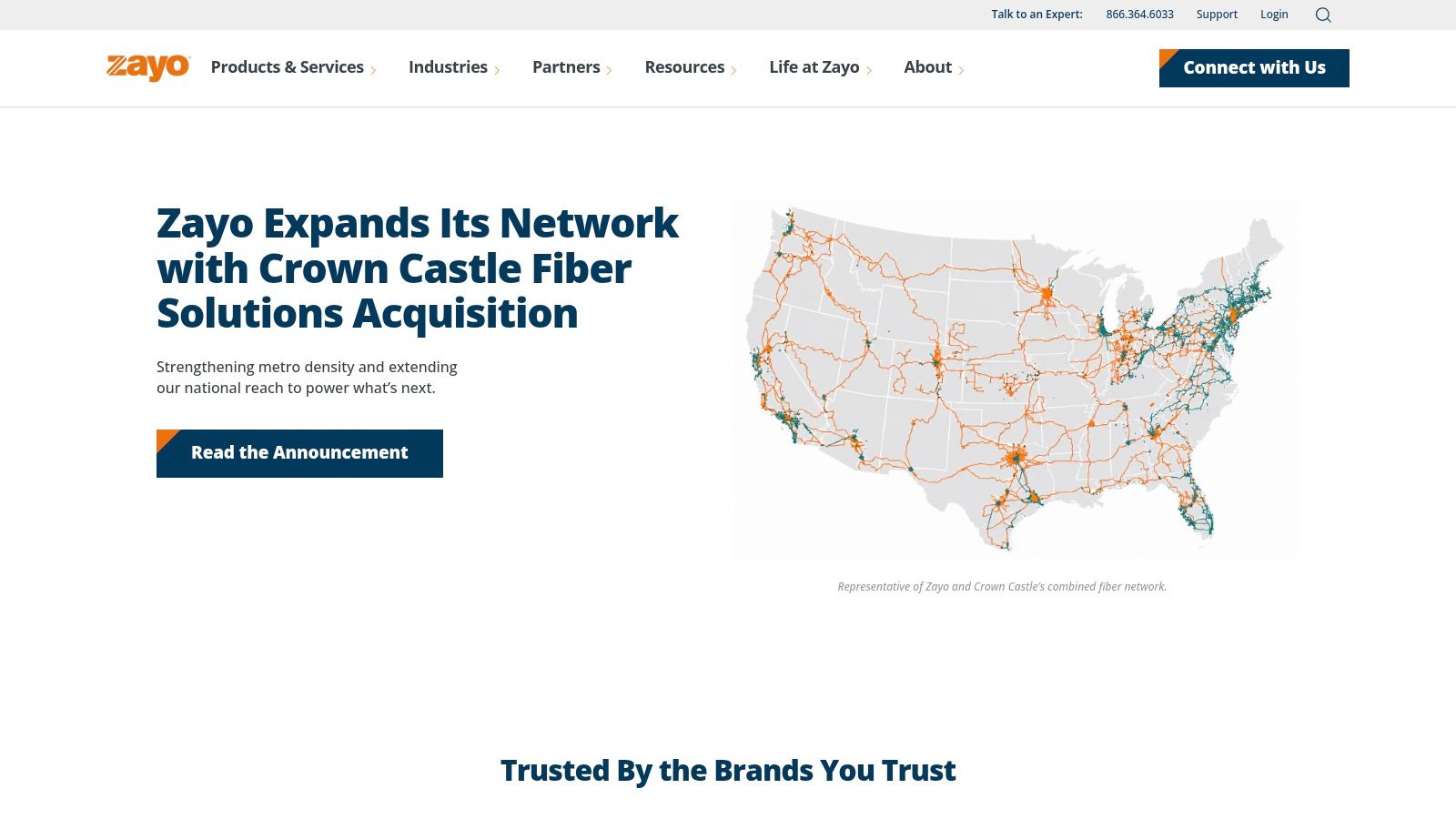
Zayo isn't the provider most small offices start with, but it's one of the first names infrastructure-heavy businesses should evaluate. If you're operating data-intensive workloads, linking facilities, feeding a data center footprint, or designing around route diversity, Zayo is in a different category from standard business broadband providers.
Many buyers make a mistake at this stage. They treat every provider on the list as a substitute. Zayo is often the better fit when your problem is architecture, not just access.
Why enterprises shortlist Zayo
Zayo is strongest in fiber infrastructure. Dark fiber, wavelengths, Ethernet, DIA, and data center interconnect are the types of services that matter when low latency, high capacity, and custom pathing are part of the requirement. In Chicago, that's relevant for trading environments, healthcare systems, research operations, major campuses, and any business with serious east-west traffic.
It tends to work well for:
- High-bandwidth interconnects: When ordinary broadband is nowhere near enough.
- Custom redundancy designs: Especially when physical route diversity matters.
- Carrier-grade transport needs: For businesses that think in terms of topology, not just monthly cost.
It tends to work less well for:
- Basic SMB internet buying: Overkill if all you need is office connectivity and phones.
- Procurement teams that want quick installs: New laterals and custom designs can take time.
Buy Zayo when the network itself is strategic. Don't buy Zayo just because the brand sounds enterprise-grade.
For Chicago firms with data center presence, colo racks, or significant replication traffic, Zayo can be a better anchor carrier than a mass-market business ISP. For a small office with common SaaS usage and modest staff counts, it usually isn't the most efficient answer.
Review Zayo's service portfolio at Zayo.
5. Lumen formerly CenturyLink Level 3

Lumen is a familiar choice for enterprises that still think in backbone, transport, and multi-site networking terms. That's a good thing. The former Level 3 heritage means Lumen often comes up in projects involving DIA, Ethernet, IP transit, cloud connectivity, and data-center-heavy traffic patterns.
For Chicago businesses with several sites or a meaningful cloud footprint, Lumen is worth serious review. For a simple office move with basic internet requirements, it may be more provider than you need.
What stands out with Lumen
Lumen's strength is less about flashy packaging and more about network depth. The provider is often a strong fit when your IT team wants symmetrical fiber where available, transport options that scale, and enterprise SLAs that line up with broader infrastructure planning.
Practical scenarios where Lumen tends to shine:
- Multi-site networks: Especially if you're tying offices to cloud or private infrastructure.
- Data-center-heavy operations: Good fit where backhaul and interconnect matter.
- Procurement teams that want a mature enterprise carrier: Particularly for larger contract structures.
The weak point is address-level predictability. Lumen can be excellent in one building and require construction in another building a short distance away. That means every quote should include a real serviceability check, not just a verbal confirmation from sales.
If your migration also touches hosted applications, voice routing, or cloud edge connectivity, it's useful to think of telecom procurement as part of a broader architecture decision. Teams handling that overlap often benefit from reviewing cloud telecom services in Houston for comparison points on how providers package cloud-connected communications services.
Lumen is usually a better fit for network planners than for buyers shopping a lowest-monthly-cost internet line.
You can review current products and enterprise services at Lumen.
6. Cogent Communications
Cogent is one of the most straightforward providers on this list if your building is already on-net and your main need is high-capacity internet at a competitive price. That "if" matters. In the right building, Cogent can be a smart buy. In the wrong building, the economics and lead times change fast because third-party loops enter the picture.
This is why Cogent often gets strong reviews from network teams and mixed reactions from less technical buyers. The service can be a good deal, but only when the fit is right.
When Cogent makes sense
Cogent is usually best for businesses that know what they're buying. DIA, Ethernet transport, IP transit, and colocation are practical offerings, and the provider tends to appeal to firms that don't need a huge managed-services wrapper around the access circuit.
Good fit examples include:
- On-net downtown offices: Fast path to serious internet capacity.
- Tech-forward teams: Buyers comfortable managing more of the stack themselves.
- Cost-aware enterprises: Especially when comparing bandwidth economics in carrier-rich buildings.
Less ideal examples include:
- Off-net suburban or difficult-access buildings: Added loop complexity can erase the pricing advantage.
- Companies wanting a broad managed portfolio: Cogent isn't usually the all-in-one answer.
One of Cogent's advantages is clarity. It often competes best when the procurement team asks a simple question: "Is this building on-net, and if not, what loop is required?" If the answer is favorable, move forward. If not, look elsewhere.
A provider can be cheap and still be the wrong choice. With Cogent, the wrong choice usually starts with ignoring building status.
For Chicago businesses buying internet capacity for office users, development teams, or colo-connected operations, Cogent deserves attention. Just don't treat it as a universal fit across all business types.
You can explore service options at Cogent Communications.
7. Everstream Business Only Fiber
A Chicago company with cloud apps, voice traffic, and interoffice data usually notices the limits of a general-purpose ISP at the worst time. Packet loss shows up during a client call. A circuit issue gets routed through a consumer-style support flow. The business is paying for "business internet" but still not getting an enterprise buying experience.
That is the lane where Everstream tends to stand out.
Everstream is built around business fiber, not retail bundles adapted for commercial accounts. For Chicago buyers, that matters less as a branding point and more as a procurement filter. If the project calls for dedicated internet access, Ethernet WAN, dark fiber, or data center connectivity, Everstream is often worth pricing beside the larger incumbents and national carriers.
The trade-off is straightforward. Everstream can be a strong fit at the right address, but address qualification matters more here than with providers that have broader national coverage. A good procurement process should verify three things early: building serviceability, construction requirements, and the SLA tied to the actual product being quoted.
Where Everstream fits best
Everstream usually earns a place on the shortlist in cases like these:
- Mid-market and enterprise locations: Teams that need dedicated fiber rather than shared broadband.
- Dual-carrier network designs: Businesses that want carrier diversity away from the incumbent.
- Multi-site operations in the Midwest: Especially when regional consistency matters more than nationwide standardization.
- IT-led buying processes: Buyers who care about route diversity, handoff options, and support structure.
Its limits are just as important to acknowledge.
If a company wants one provider to cover every office across the country, Everstream's smaller footprint can become a constraint. If the Chicago site is off-net or the building owner complicates access, timeline and install cost can change quickly. Those details belong in the first call, not after legal review.
From a decision-making standpoint, Everstream is usually not the low-effort option. It is often the right option when fiber quality, business support, and network design matter enough to justify a tighter qualification process. That is a meaningful distinction, and it is exactly the kind of detail Chicago businesses should use when comparing providers on more than headline availability.
For organizations that want an engineering-focused fiber provider instead of a broad bundle of voice, mobile, and branch add-ons, Everstream deserves a serious look.
You can review Everstream's network and business services at Everstream.
8. Verizon Business wireline plus 5G Business Internet

A Chicago office signs a lease, the staff move-in date is fixed, and the fiber install date slips. That is the kind of situation where Verizon Business becomes useful fast.
Verizon belongs on a serious shortlist because it gives buyers two different tools under one provider. Wireline services fit standard business internet and enterprise network needs. 5G Business Internet gives IT teams a faster way to bring a site online, stand up backup connectivity, or keep a project moving while the permanent circuit works through construction, landlord access, or building telecom delays.
That mix changes the buying discussion. Instead of asking only, "Who has fiber in this building?" the better procurement question is, "Do we need a primary circuit, a temporary bridge, a secondary path, or some combination of the three?" Verizon is one of the few providers in this Chicago comparison that can credibly fill multiple roles.
Where Verizon usually fits best
The strongest Verizon use cases are straightforward.
- Bridge connectivity: A new office, pop-up location, or remodel site needs service before fiber is installed.
- Backup internet: The business wants a second path that is less likely to fail for the same reason as the primary wired circuit.
- Standardized national buying: Companies already using Verizon for mobile or branch connectivity may prefer one contracting and support relationship.
The trade-off is equally clear. Fixed wireless can be very good, but it is still radio-based access. Performance varies by building construction, window exposure, equipment placement, nearby congestion, and local signal conditions. For email, web apps, point-of-sale, and general office use, that may be perfectly acceptable. For latency-sensitive production systems or sites with heavy, constant upstream traffic, I would still verify whether wireline is the better primary service.
This is also where a verification process matters more than marketing claims. Before signing, ask for the install method, expected indoor equipment placement, minimum term, data policy, support escalation path, and whether the quoted service is intended as primary WAN or temporary business continuity access. Teams that already rely on local support vendors for telecom repair services near Chicago businesses should also confirm how Verizon handles on-site troubleshooting versus remote support.
Pros, limits, and buying guidance
Verizon is attractive when speed to service matters almost as much as long-term network design.
- Pros: Fast deployment potential, useful failover option, and easier alignment for companies already in the Verizon ecosystem.
- Pros: Good fit for temporary sites, branch openings, and continuity planning.
- Cons: Wireless performance must be tested at the exact address, not assumed from a coverage map.
- Cons: A 5G offer should not be treated as equivalent to dedicated fiber without reviewing workload requirements and SLA details.
Chicago businesses in construction trailers, healthcare overflow sites, retail openings, event spaces, and field-heavy operations often get real value from this model because waiting on a full wireline build can hold up revenue, staff onboarding, or customer service.
Review Verizon's business services at Verizon Business.
9. Windstream Enterprise
Windstream Enterprise is less about raw access and more about managed outcomes. If you need DIA or Ethernet plus managed SD-WAN, SASE, UCaaS, and security under one commercial umbrella, Windstream becomes much more attractive than a plain connectivity provider.
This matters for distributed businesses. A company with several branches, a remote workforce, security controls to enforce, and a desire for one support portal often gets more value from an integrative provider than from buying point solutions one by one.
Managed services first
Windstream Enterprise is typically strongest when the network team wants policy, visibility, and vendor consolidation. The company can aggregate local loops from other carriers while providing the overlay, support model, and service management layer the customer lives with day to day.
That creates a clear trade-off.
- Advantage: One provider can coordinate connectivity, security, and voice.
- Advantage: Good fit for organizations that don't want to self-integrate everything.
- Limitation: Last-mile dependence on other carriers can affect timing and troubleshooting.
- Limitation: Not always the cheapest route if all you need is a single internet pipe.
For Chicago businesses with multiple clinics, branch offices, field service locations, or hybrid work environments, Windstream can simplify operations significantly. For one office that only needs internet and phones, it may be too much structure.
Organizations that are also planning lifecycle support for old telecom hardware, handsets, routing gear, and branch equipment should think about the cleanup side early. That often overlaps with telecom repair services near me and disposition planning during a managed network refresh.
You can review Windstream's enterprise offerings at Windstream Enterprise.
10. GTT Communications

GTT is a strong option when your Chicago operation isn't the whole network. If your business has multi-region traffic, international sites, cloud on-ramps, or a need for carrier diversity beyond the local metro, GTT becomes more relevant than providers focused mainly on a single market.
A lot of businesses won't need that depth. But the ones that do usually know it. They're managing cloud architectures, vendor traffic across regions, or global office connectivity and want a provider whose portfolio includes DIA, IP transit, Ethernet, SD-WAN, and security under a broader backbone strategy.
Where GTT earns its place
GTT tends to fit businesses with complex geography and higher architectural demands. It's often not the easiest provider to scope because the portfolio is broad, and off-net service can still depend on local-loop partners. But that same breadth is useful when the business wants fewer strategic providers across many markets.
Strong-fit scenarios include:
- International or multi-region firms: Better alignment with broader network footprints.
- Cloud-heavy environments: Especially where interconnect and transport matter.
- Diverse-carrier strategies: Good for buyers that don't want all services tied to the same incumbent.
A practical concern is project definition. GTT works best when the buyer comes prepared with site lists, bandwidth needs, failover expectations, and a clear distinction between underlay and overlay requirements. Without that, proposals can become harder to compare.
Chicago organizations in healthcare, research, and regulated environments should also think about what providers don't usually explain well enough: secure handling during migrations. A Spectrum Business Chicago page highlights the underserved issue of compliance and data security requirements in telecom setups, particularly when old telecom equipment is being decommissioned.
The more locations and providers you manage, the more valuable a coherent network strategy becomes. GTT is usually a strategy buy, not an impulse buy.
Explore the portfolio at GTT Communications.
Top 10 Chicago Business Telecom Providers Comparison
| Provider | ✨ Core Connectivity & Features | ★ Reliability / Performance | 💰 Pricing / Value | 🏆 Standout Strength | 👥 Best-fit Customers |
|---|---|---|---|---|---|
| Comcast Business (Chicago) | DIA, Metro Ethernet, SD‑WAN, Voice, managed Wi‑Fi | ★★★★☆ | 💰💰 | Wide Chicago fiber footprint; dependable primary/dual‑carrier | Mid → large enterprises needing local on‑net coverage |
| AT&T Business (Chicago) | Business Fiber up to 5Gb, DIA, SD‑WAN, wireless backup | ★★★★☆ | 💰💰💰 | Strong SLAs; integrated wireline + wireless | Enterprises requiring strict SLAs & wireless backup |
| Astound Business (formerly RCN) | Fiber / hybrid coax internet, hosted voice, packaged tiers | ★★★★ | 💰 | Competitive SMB pricing; agile installs | SMBs/SMEs in Astound‑served neighborhoods |
| Zayo | Dark fiber, high‑capacity wavelengths, Ethernet, DIA | ★★★★★ | 💰💰💰 | Carrier‑grade fiber density for ultra‑high bandwidth & diversity | Large enterprises, data centers, low‑latency needs |
| Lumen (CenturyLink/Level 3) | DIA, Ethernet, Fiber+ Internet, cloud interconnect | ★★★★ | 💰💰 | Large IP backbone; on‑demand provisioning | Multi‑site networks and cloud‑centric workloads |
| Cogent Communications | On‑net DIA, Ethernet transport, colocation | ★★★★ | 💰 | Flat‑rate high‑capacity internet where on‑net | Cost‑sensitive high‑bandwidth users in on‑net buildings |
| Everstream | Symmetrical DIA, Ethernet WAN to 100G, dark fiber, cloud peering | ★★★★ | 💰💰 | Business‑only fiber with strong cloud peering | Enterprises seeking non‑incumbent fiber options |
| Verizon Business | DIA, Ethernet, SD‑WAN + 5G/LTE fixed‑wireless Business Internet | ★★★★ | 💰💰💰 | Fast 5G installs for rapid deployment/backup | Branches needing quick failover & wireless/wireline mix |
| Windstream Enterprise | Managed SD‑WAN / SASE, DIA, UCaaS, managed security | ★★★★ | 💰💰 | Single‑vendor managed connectivity + security portal | Distributed enterprises wanting managed services |
| GTT Communications | DIA, IP transit, Ethernet, SD‑WAN, global cloud on‑ramps | ★★★★ | 💰💰 | Top‑tier global IP backbone & cloud interconnects | Multi‑region / global enterprises and cloud peering needs |
Your Procurement Guide From Shortlist to Service Activation
A provider list only helps if it leads to a clean buying decision. In Chicago, the biggest mistakes usually aren't technical. They're procurement mistakes. A team assumes "fiber available" means on-net service. A buyer compares broadband, DIA, and fixed wireless as if they're interchangeable. A contract gets signed before anyone has mapped support escalation, demarc location, construction responsibility, or what happens when a circuit fails after hours.
Start with due diligence at the building level. Ask every provider whether your address is on-net, near-net, or fully off-net. Those three answers look similar in sales language and behave very differently in real life. On-net usually means faster deployment and cleaner pricing. Near-net can still be attractive, but construction, landlord coordination, or entrance-facility work may change both timeline and commercial terms. Off-net often means another carrier is involved somewhere in the chain, which affects both cost and accountability.
Then read the SLA like an operator, not like a shopper. Uptime language matters, but so does mean-time-to-repair, credit structure, maintenance windows, and the exact definition of an outage. A flashy uptime promise doesn't help much if the support path is weak or the credit is trivial relative to your business interruption risk. Ask who answers first, who owns escalation, and how local dispatch is handled in Chicago.
Ask one direct question on every quote call: "If this circuit goes down at 2 a.m. on a weekday, what happens next, in order?" The quality of the answer tells you a lot.
You should also force providers to explain pricing in plain terms. For business buyers, the key distinction isn't just cheap versus expensive. It's shared broadband versus dedicated internet, flat-rate versus variable elements, managed versus unmanaged service, and bundled versus separately billed components. If you're pricing SD-WAN, ask what's included in the base proposal and what sits in a different SKU such as security, hardware, licensing, or local access. If you're pricing wireless backup, ask whether the quote includes installation, device management, and business support terms or just service access.
A clean procurement path usually follows a predictable order. Shortlist two or three providers. Qualify the address. Get written quotes with installation assumptions. Request a site survey when needed. Review SLA language and support structure. Confirm demarc location and inside-wiring responsibility. Redline contract terms that matter to your legal and operations teams. Only then should you lock the order.
For Chicago companies with sensitive environments, that process needs one more layer. Hospitals, clinics, labs, and research facilities should ask how the provider handles migrations involving voice endpoints, firewalls, routers, and retired network gear. The market talks constantly about speed and pricing. It talks less about secure transition work, equipment removal, and compliant data handling when old telecom assets leave service. That's a gap buyers should close themselves during procurement.
The right final choice usually isn't the provider with the best brochure. It's the provider that fits your building, supports your risk model, and answers operational questions clearly before the contract is signed. For a small office, that may be a regional carrier with practical pricing and fast install. For a multi-site enterprise, it may be a provider with stronger overlays, stronger SLAs, or better national consistency. For a critical site, the best answer is often two providers, not one.
Use the shortlist aggressively. Make every carrier prove serviceability, timeline, support quality, and commercial clarity. That's how you choose a telecom partner that will still make sense after the install is done and the first outage test arrives.
If your Chicago telecom upgrade, site closure, lab move, or network refresh leaves you with retired servers, routers, storage, phones, and other electronics, Scientific Equipment Disposal can help you clear the equipment side responsibly. S.E.D. supports compliant, sustainable disposal of lab and IT assets, including on-site de-installation, packing, pickup, and data sanitization with DoD 5220.22-M 3-pass wiping for applicable drives. For hospitals, clinics, research facilities, data centers, and corporate IT teams managing decommissioned telecom gear, that's a practical way to keep the infrastructure project from turning into an e-waste problem.