Telecom Maintenance Services Chicago: Top 7 Providers 2026

Your Chicago office loses connectivity, the phones go choppy, and nobody knows whether the problem sits with the carrier, the building riser, the patching in your IDF, or an aging PBX that should've been retired years ago. That’s the moment most companies realize internet service and internal telecom infrastructure aren’t the same thing. If your cabling plant is messy, your demarc is undocumented, or your voice system has no real support path, downtime keeps repeating.
That’s why choosing telecom maintenance services Chicago businesses can rely on is less about finding a generic contractor and more about matching your problem to the right specialty. Some vendors are built for large union jobs and campus environments. Others are better at fast-response restoration, managed voice support, or outside-plant fiber work. The wrong fit usually shows up as slow triage, finger-pointing, and recurring outages.
The broader maintenance market supports that shift toward more structured service. In the U.S. telecom equipment repair market, on-site repairs reached about USD 3.06 billion in 2024 and accounted for nearly 45% of the market, while transmission equipment represented about USD 2.72 billion or nearly 40% of the market, according to telecom equipment repair market analysis. In plain terms, businesses still need people on site when network hardware fails, especially in dense urban environments like Chicago.
If your issue is really call quality rather than a total outage, start with this guide on how to address bad VoIP phone sound. Then use the list below to find the provider that fits your environment.
1. Continental Electrical Construction Company
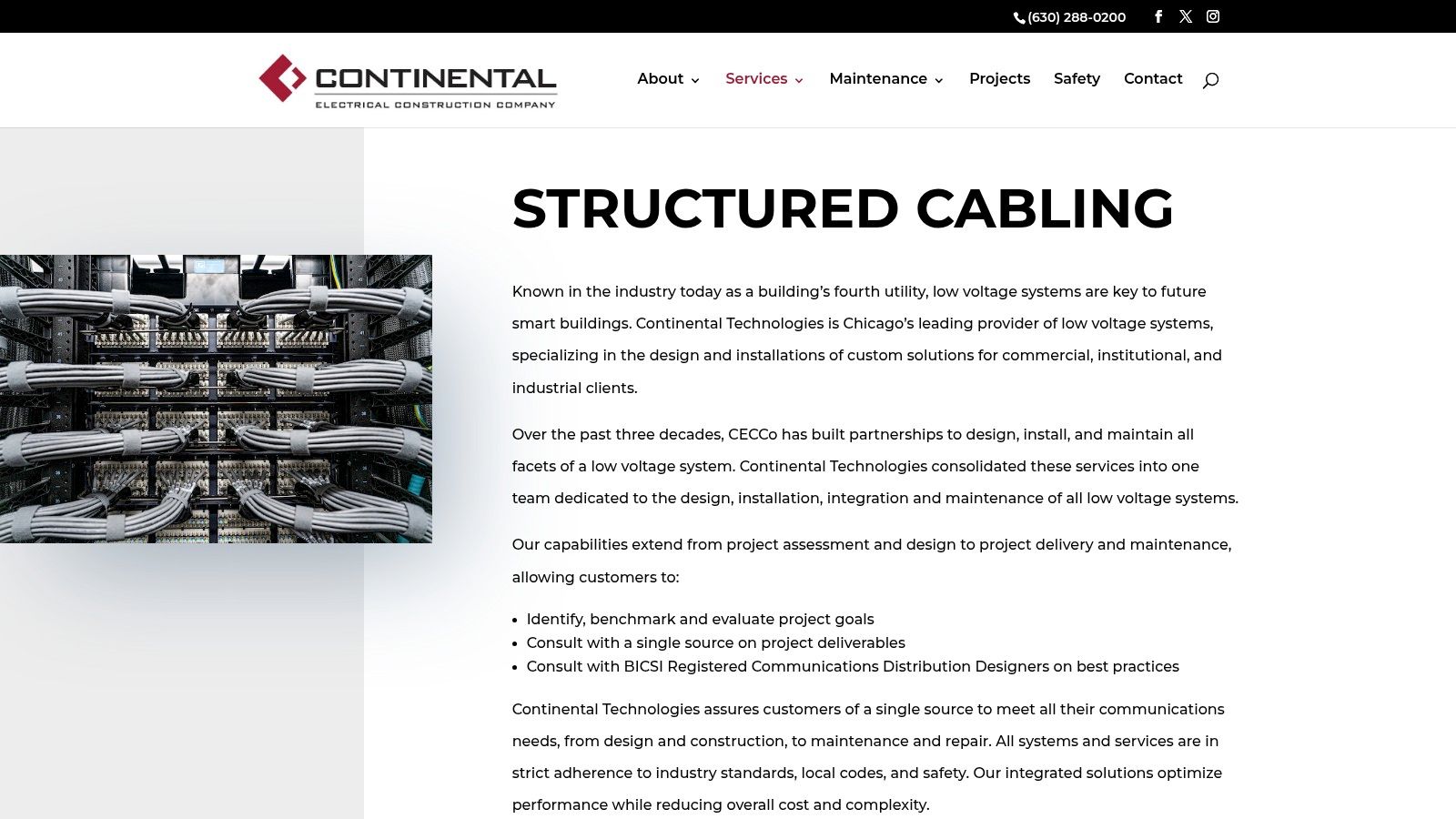
A common Chicago failure scenario starts like this: a tenant reports intermittent phones, IT finds errors on a fiber handoff, facilities discovers the telecom room has power and pathway issues, and no one owns the full fix. That is the kind of problem Continental Technologies low-voltage services is built to handle.
Continental fits businesses whose telecom uptime depends on the building as much as the equipment. Hospitals, campuses, industrial plants, and public-sector facilities often need a contractor that can work across cabling, pathways, code requirements, access restrictions, and closeout documentation without losing control of the job. In those environments, a narrow break-fix vendor can solve the symptom and still leave the root cause in place.
Their advantage is accountability across the full project cycle. The same organization can assess the site, coordinate installation, integrate related systems, test performance, and stay involved for maintenance. That matters when outages turn into scope disputes between the cabling crew, electrical contractor, and in-house team.
Best fit for large, process-heavy environments
Continental stands out if your business has multiple telecom rooms, strict documentation standards, or union labor requirements. Those conditions change what "good service" looks like. Speed still matters, but process discipline matters just as much because poor records and inconsistent workmanship create repeat failures.
A few points make them a strong match:
- End-to-end responsibility: Assessment, installation, integration, testing, and maintenance sit under one roof.
- Standards-based execution: BICSI RCDD involvement supports cleaner design decisions and better documentation.
- Better fit for after-hours incidents: Larger field teams usually provide stronger bench depth for urgent restoration work.
I usually give owners a simple rule here. If your site has compliance exposure, critical occupancies, or a history of contractor finger-pointing, choose the firm with stronger procedures, not just the lowest hourly rate.
There is a trade-off. Continental is better suited to enterprise and institutional work than to a small office with a single IDF and a handful of voice or data drops. Expect quote-based pricing and a project threshold that may feel high if you only need light maintenance.
If you are comparing vendors by facility type instead of by brand name, this needs-based view is more useful than a generic directory. A provider like Continental belongs in the "large-site infrastructure and maintenance" category. Businesses with lighter needs may want a smaller specialist. Teams planning multi-site standards can also compare how similar projects are framed in other markets through telecom maintenance services for Atlanta business facilities.
2. MALKO Communication Services
A common Chicago service ticket starts like this: users say calls drop near the elevators, Wi-Fi feels inconsistent on two floors, and the carrier insists its circuit is fine. That is the kind of problem MALKO Communication Services is built for.
MALKO Communication Services fits best when your maintenance issue sits inside a large occupied building and touches more than one system. Healthcare, education, mixed-use, and commercial properties run into this often. The complaint may sound like telecom, but the root cause can sit in the in-building wireless layer, shared pathways, an IDF problem, or poor coordination between cabling and another low-voltage trade.
That broader field capability is MALKO's main advantage. They handle structured cabling, DAS, AV, and security. For an owner or facilities lead, that can reduce handoffs and shorten diagnosis time. One vendor can trace whether the failure is a damaged cable, a coverage gap, a bad termination, or an issue introduced during another low-voltage change.
Where MALKO stands out
The differentiator here is DAS support. Plenty of contractors can patch copper, pull fiber, and certify a link. Fewer are set up to maintain distributed antenna systems in occupied buildings where coverage complaints turn into tenant issues, patient experience issues, or missed calls for field staff.
That makes MALKO a strong match in the "multi-system building maintenance" category, not the basic break-fix category. If your building operations depend on reliable indoor cellular coverage as much as clean cabling, that distinction matters.
What they do well:
- DAS plus cabling support: Useful when coverage complaints and telecom faults overlap.
- Union workforce: A practical fit for buildings with labor rules, controlled access, or formal site procedures.
- Cross-trade coordination: Helpful when security, AV, and telecom share pathways, closets, and maintenance windows.
I usually advise clients to separate "network outage" from "user connectivity complaint" before choosing a vendor. In dense buildings, those are not always the same problem. MALKO is stronger when the issue crosses that line and starts affecting wireless coverage, shared infrastructure, or multiple low-voltage systems at once.
The trade-off is straightforward. If you only need routine MAC work, patching, or a small amount of troubleshooting in a simple office suite, MALKO may be more vendor than you need. Their value goes up as the building gets more complex, more occupied, and more sensitive to disruption.
Teams comparing this service category across markets can also review how similar on-site telecom support for complex building systems is framed in other cities.
3. Chicago Low Voltage Services
Chicago Low Voltage Services is the practical emergency pick for wiring problems, demarc extensions, and telecom plant troubleshooting. If you need a team that looks like a service contractor first and a brochure second, CLV is one of the clearest options on this list.
Their site is basic, but that isn’t always a negative in this segment. Some of the best field teams don’t spend much time polishing marketing language. What matters is whether they handle emergency calls, know copper and fiber, and can certify what they touch. CLV checks those boxes, including 24/7 emergency service and ANSI/TIA certification testing.
Why maintenance-first shops matter
Chicago businesses often don’t need a redesign. They need restoration. A contractor that spends most of its time on maintenance usually gets to root cause faster than a firm oriented mostly around new installs.
CLV is a good fit when you need:
- Emergency response: Wiring faults, damaged terminations, closet issues, or tenant-impacting outages.
- Testing and certification: Useful after repairs, tenant turnover, or messy inherited cabling.
- Demarc and plant troubleshooting: Important when the carrier says service is up but your users still can’t connect.
The trade-off is scale. This doesn’t look like the first call for a massive multi-building campus transformation. It looks like the right call for SMB and mid-market organizations that need responsive field service from union labor without a lot of ceremony.
That profile aligns with a broader trend toward proactive maintenance. In North American telecom services, operators have achieved 30% to 50% reductions in unplanned downtime through real-time monitoring and data-driven tools, while truck-roll costs can represent up to 20% to 30% of field operations budgets, according to telecom services market insights from Hyde Park Capital. Even if you’re not implementing analytics yet, choosing a maintenance-oriented contractor now makes that transition easier later.
For businesses evaluating response-driven support models in other markets, this is the same buyer logic behind onsite telecom services for urgent restoration.
4. Kace Communications

Kace Communications is one of the more balanced providers in the Chicago market because it sits at the intersection of voice systems and physical infrastructure. That matters for businesses with a still-important phone environment. Law firms, clinics, schools, manufacturers, and multi-tenant offices often discover that voice trouble isn’t only a carrier issue. It can be a switch issue, a riser issue, a demarc issue, or a bad handoff between old PBX hardware and newer VoIP gear.
Kace covers PBX and VoIP support, structured cabling, wireless access points, riser management, and demarc extensions. That mix is useful when your outages don’t stay confined to one layer.
Best for phone systems plus cabling
A lot of contractors are strong on cable but thin on voice. Others can support voice platforms but don’t want to touch risers, closets, or standards-based cabling work. Kace sits in the middle, and that’s valuable for organizations carrying a mix of legacy and modern telecom systems.
Their practical strengths include:
- PBX and VoIP support: Good for businesses that haven’t fully standardized on a single modern voice platform.
- RCDD oversight: Helpful when moves, adds, changes, and redesigns need to follow structure rather than improvisation.
- Riser and demarc work: Important in multi-floor Chicago buildings where internal telecom ownership gets blurry fast.
When a provider can support both the phone system and the cabling behind it, troubleshooting gets shorter and accountability gets clearer.
One thing to note is capacity. Kace looks well suited to local and regional business environments, but if you’re planning a very large multi-site rollout with highly standardized national execution, you’ll want to ask hard questions about bench depth and project management coverage.
Kace also sits close to an underserved issue in telecom maintenance services Chicago companies often overlook. Existing local providers tend to emphasize installation, repair, PBX, VoIP, and wireless support, but many don’t clearly address secure data wiping or compliant recycling for retired telecom hardware, as noted in this discussion of telecom maintenance gaps and e-waste handling in Chicago. If your upgrade involves decommissioning old voice or network equipment, ask that question early, not after the gear is already stacked in a closet.
5. Chicago Datacom
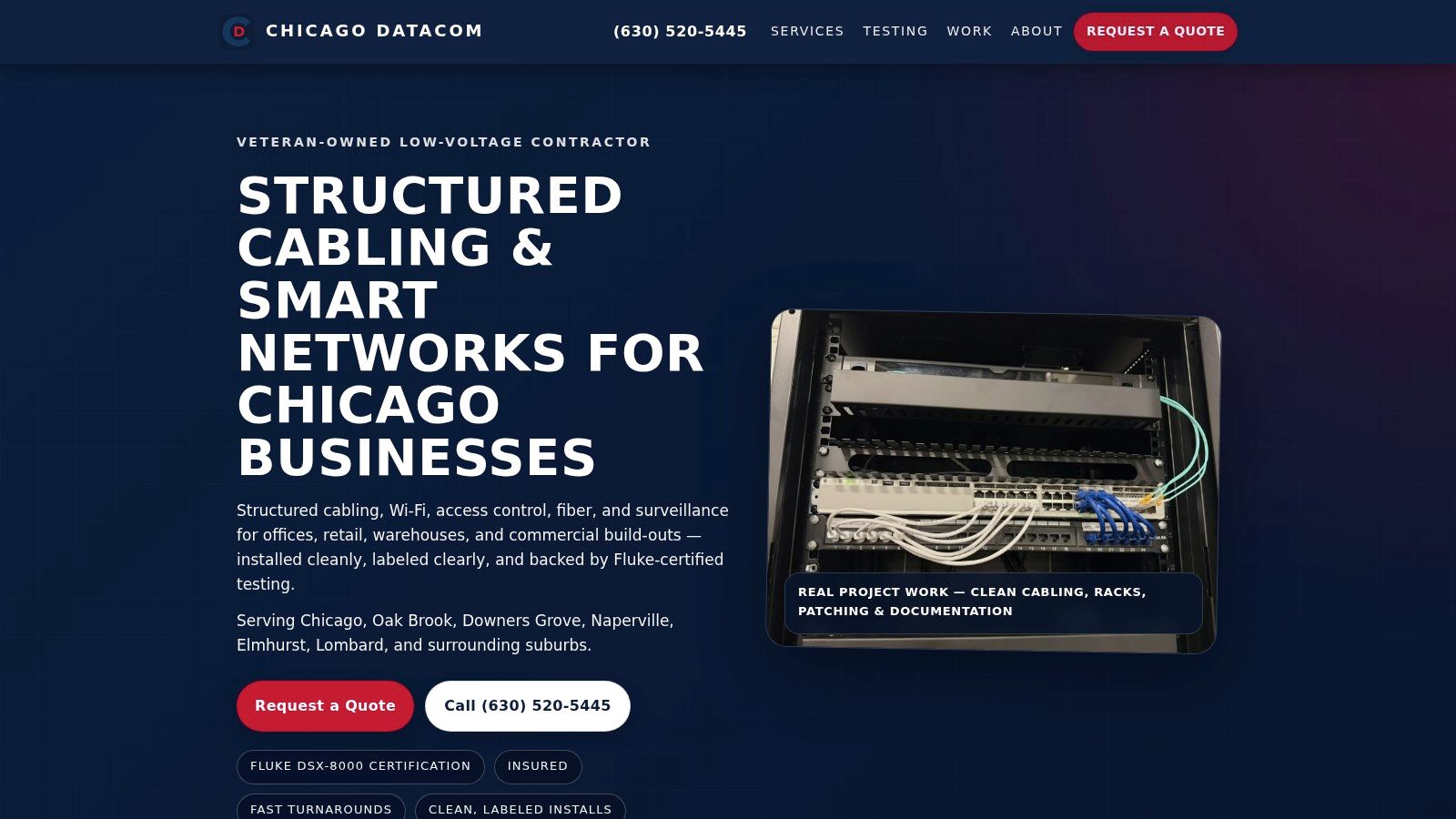
A common Chicago handoff looks like this. New tenant, old rack, no labels, mixed copper and fiber, and nobody can say with confidence which patch feeds which suite. In that situation, the right vendor is not the flashiest installer. It is the one that can turn a messy plant into something your IT staff and future contractors can support.
Chicago Datacom fits that need well. Their value is less about selling a packaged maintenance plan and more about fixing the root cause behind recurring service calls: poor documentation, weak labeling, and installs that were never finished to a supportable standard. If your business problem is repeated troubleshooting time, finger-pointing between vendors, or expensive adds and changes, this is a practical category to consider.
Best for cleaning up infrastructure so maintenance gets easier
Chicago Datacom makes the most sense for office buildouts, tenant improvements, and mid-sized commercial spaces where the cabling plant needs to stay serviceable after the install crew leaves. That is a different buying decision than choosing an emergency-response contractor or a managed voice provider.
What stands out:
- Fluke test certification and reporting: Useful when you need proof that the cabling plant passed before blame shifts to switches, phones, or the carrier.
- Fiber and backbone work: Helpful in buildings with MDF and IDF connectivity problems, uplink instability, or undocumented fiber runs.
- Labeling and closeout records: These reduce service-call time later, especially during tenant turnover, remodels, and network upgrades.
The trade-off is straightforward. Their site presents them more as a structured cabling and project-delivery firm than a provider built around recurring support contracts. For some owners, that is fine. If your main issue is bad physical infrastructure, correcting that first often saves more money than buying a maintenance agreement on top of a disorganized plant.
This is also where buyers should ask sharper service questions. Who handles after-hours failures? How are MACs quoted? Will the same team that installs the work return for troubleshooting, or does support move to a different group? Good documentation helps, but response model still matters.
Industry guidance from BICSI on administration, labeling, and records exists for a reason. Clear telecom documentation shortens fault isolation, reduces avoidable truck rolls, and makes future changes less disruptive to the business. Chicago Datacom aligns well with that operating discipline, which is why they fit this list as the provider to call when maintainability is the underlying problem, not just the latest outage.
If you are comparing vendors by support model, it also helps to review what businesses usually expect from local telecom repair service options before you decide whether you need project cleanup, recurring maintenance, or both.
6. Xclutel
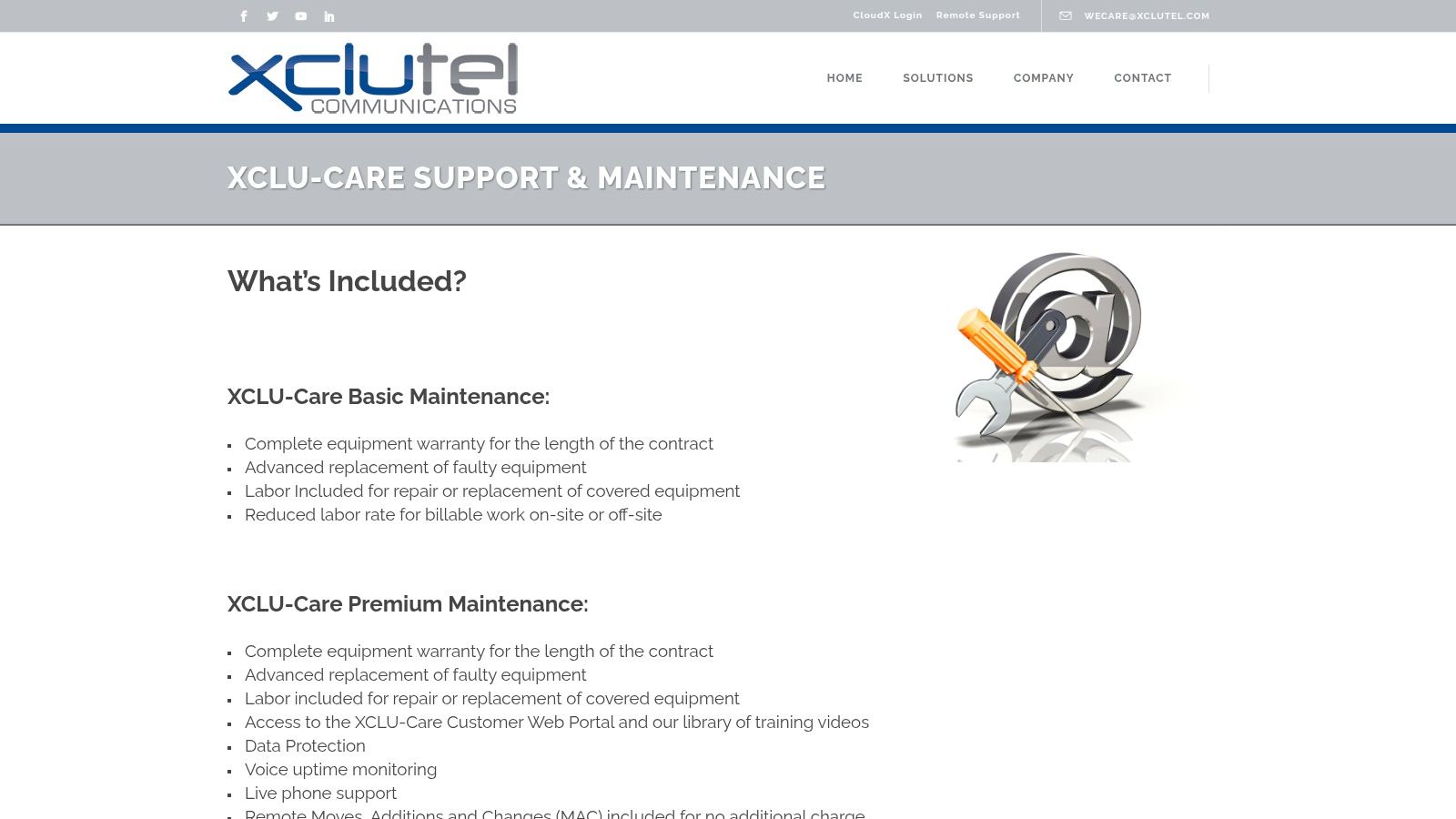
Xclutel maintenance plans are a different buy from the field-service contractors above. This is the managed-support option for businesses that want defined care plans around their voice environment instead of time-and-materials service whenever something breaks.
That distinction matters. Some owners want a trusted installer they can call as needed. Others want a provider to own equipment warranty handling, advanced replacement, repair labor, remote MACs, monitoring, and support under a more packaged framework. Xclutel leans into the second model with Basic and Premium support tiers.
Best for packaged voice maintenance
This works best when your business depends heavily on a supported phone platform and you’d rather pay for predictability than scramble during outages. The appeal is the structure, not just the technical work.
What stands out:
- Defined maintenance tiers: Easier to budget than ad hoc repair visits.
- Advanced replacement coverage: Important when failed handsets or core voice components need quick swap-outs.
- Remote support and monitoring: Useful for organizations that don’t have internal telecom admins.
A managed voice plan is usually worth it when your staff can’t afford to spend half a day deciding whether to call the carrier, the phone vendor, or your IT person.
The biggest caution is platform fit. These plans make the most sense when your phone environment aligns with what Xclutel supports natively. If you run a highly customized legacy PBX or a mix of unsupported systems, the packaged model may not map cleanly.
This category also lines up with the growth of predictive maintenance in telecom. AI-driven predictive maintenance has delivered up to 40% reduced service disruptions and 30% lower emergency repair costs, while the broader telecom services market is projected to increase by USD 726.1 billion from 2026 to 2030 at a 6.1% CAGR, according to AI predictive maintenance in telecom analysis. Xclutel’s support structure isn’t the same thing as full AI operations, but it reflects the same business move away from pure break-fix.
For companies comparing managed support options across markets, this resembles what buyers usually seek in telecom repair services with ongoing support expectations.
7. Nawrot Corporation
Nawrot Corporation is the specialist on this list. If your problem is outside-plant fiber, splice integrity, plant audits, or emergency restoration after a cut, this is the lane where specialization beats generalist breadth.
A lot of companies waste time calling inside-wire contractors for problems that live in outside plant. When the issue involves carrier-grade fiber, splice cases, route documentation, or restoration after construction damage, you want a contractor who does that work every day. Nawrot’s focus on scheduled maintenance, inspections, audits, testing, and 24/7 emergency restoration makes it a strong fit for ISPs, carriers, utilities, and larger organizations with serious fiber exposure.
When fiber reliability is the whole game
This is the right partner when MTTR on fiber outages is your main concern. A contractor who regularly handles splicing and carrier-grade testing usually restores service faster because they don’t need to learn the environment while the outage is already active.
Nawrot is strongest when you need:
- Emergency fiber restoration: Especially after cuts, weather events, or route damage.
- Splice case inspections and audits: Good for preventing latent failures.
- Carrier-grade testing: Important where documentation and proof matter as much as the repair itself.
The trade-off is equally clear. If your needs are mostly inside plant, PBX support, Wi-Fi troubleshooting, or office MAC work, Nawrot is too specialized. You may need them plus another provider for the full telecom stack.
This category is becoming more important as operators modernize networks. One recent market note points to limited local adoption of AI-driven predictive maintenance, while also describing pilot results in the Chicago area and a gap among smaller providers, according to Chicago telecom AI monitoring and predictive maintenance commentary. Even without leaning on advanced analytics, fiber operators that schedule audits and inspections usually avoid the worst kind of outage, the one that was developing undetected for months.
Chicago Telecom Maintenance: 7-Provider Comparison
| Provider | 🔄 Implementation Complexity | ⚡ Resource Requirements | 📊 Expected Outcomes | 💡 Ideal Use Cases | ⭐ Key Advantages |
|---|---|---|---|---|---|
| Continental Electrical Construction Company (Low Voltage) | High, end-to-end lifecycle, standards-driven | High, large union crews, equipment, 24/7 support | Single-source delivery, certified installs, reduced hand-offs | Large campuses, hospitals, government sites | ⭐⭐⭐⭐ Scale, consolidated accountability, emergency support |
| MALKO Communication Services | Moderate–High, multi-discipline (DAS/AV/security) integration | Moderate, regional union workforce, DAS specialists | Improved in-building wireless and cabling maintenance | Large buildings needing DAS plus AV/security support | ⭐⭐⭐ Deep DAS maintenance expertise, long local history |
| Chicago Low Voltage Services (CLV) | Low–Moderate, maintenance-first, rapid-response focus | Moderate, union technicians available 24/7 | Fast restoration, ANSI/TIA-certified testing and documentation | SMBs/mid-market sites needing emergency wiring fixes | ⭐⭐⭐ Rapid emergency response and practical restoration focus |
| Kace Communications | Moderate, PBX/VoIP plus structured cabling support | Moderate, union techs, RCDD oversight | Balanced phone-system upkeep and cabling management | Sites with legacy PBX/VoIP and moves/adds/changes needs | ⭐⭐⭐ Strong PBX/VoIP support with RCDD-design oversight |
| Chicago Datacom | Moderate, installation-centric with strict testing | Moderate, Fluke DSX-8000 testing, documentation resources | Clean, labeled installs and thorough test reports for easier maintenance | Tenant refreshes, quick turnarounds, new installs | ⭐⭐⭐ Documentation-heavy installs that lower future maintenance effort |
| Xclutel (XCLU-Care) | Low, packaged managed-maintenance plans (Basic/Premium) | Low–Moderate, monitoring, portal, spare-equipment programs | Predictable, SLA-style coverage, remote MACs and uptime monitoring | Organizations wanting carrier-adjacent managed voice support | ⭐⭐⭐⭐ Clear maintenance tiers, integrated monitoring and replacements |
| Nawrot Corporation | High, specialized outside-plant fiber construction/splicing | High, carrier-grade splicing teams, 24/7 emergency crews | Fast MTTR for fiber outages, carrier-grade testing and audits | ISPs, carriers, utilities prioritizing OSP fiber reliability | ⭐⭐⭐⭐ Deep fiber splicing/testing specialization and rapid restoration |
Your Checklist for Selecting the Right Telecom Partner
A common Chicago failure scenario starts at 8:15 a.m. The phones sound choppy, one suite loses internet after a closet change, and nobody can tell whether the problem sits in the carrier handoff, the building cabling, or an aging PBX. At that point, the right vendor is the one whose core strength matches the fault. Fast dispatch matters, but fit matters more.
That is the lens to use here. This list is more useful as a matching framework than a simple ranking. Some providers are better for large union jobs. Some are stronger in emergency restoration. Others fit managed voice support, clean documentation, or outside-plant fiber work. If you choose by specialty instead of brand familiarity, you usually get faster restoration, fewer repeat calls, and less confusion over responsibility.
Start with the operating problem, not the proposal.
- Pin down the failure pattern: Recurring fiber cuts call for outside-plant expertise. Unstable handsets or legacy phone issues call for PBX and VoIP support. Messy closets, unlabeled patching, and frequent moves/adds/changes call for a cabling-focused team with disciplined documentation.
- Match the labor model to the site: Ask whether the provider can work in union buildings, occupied facilities, healthcare environments, or multi-tenant properties. A capable technician who cannot meet site rules still creates delay.
- Get written response terms: Ask for after-hours coverage, target response windows, escalation paths, and what counts as a billable emergency visit versus covered support.
- Require closeout documentation: Test results, labeling standards, updated port maps, as-builts, and change logs reduce future troubleshooting time and cut handoff risk when staff or vendors change.
- Verify who performs the work: Some firms self-perform nearly everything. Others mix in subcontractors based on scope or schedule. That can work fine, but you should know who will show up before an outage, not during one.
- Check end-of-life handling: If the project includes retired PBX gear, switches, storage, or copper and fiber plant, ask how equipment removal, data handling, and chain of custody are documented.
There is also a larger business reason to tighten vendor selection. The U.S. Census Bureau reported that more than half of firms with employees used cloud-based computing services in 2023, which means more sites now depend on stable internal wiring, voice systems, and edge equipment to reach the applications staff use every day (U.S. Census Bureau, Annual Business Survey). As more business functions ride on connected systems, reactive break-fix support gets expensive fast.
If you are reviewing carrier service along with inside wiring and voice support, this guide to business internet is a useful companion read.
A good telecom partner does more than restore service. They reduce uncertainty, document the environment properly, and help you choose the right support model for the risk you have. That is the standard business owners should use.
If your Chicago telecom upgrade also leaves you with retired switches, PBX hardware, storage media, or other sensitive electronics, Scientific Equipment Disposal is worth contacting. S.E.D. helps organizations handle secure, sustainable equipment disposition with on-site de-installation, packing, pickup, and compliant data sanitization, including DoD 5220.22-M 3-pass wiping for supported drives. For hospitals, schools, labs, and IT teams managing telecom or adjacent network hardware during refresh projects, that closes an important gap after the maintenance work is done.