Atlanta’s Role in Cybersecurity Innovation: A 2026 Guide

Atlanta ranked 4th in the U.S. for the number of cybersecurity companies, and Georgia's cybersecurity sector carries a $5 billion annual economic impact, according to Atlanta technology industry statistics. That combination changes how business leaders should think about the city. Atlanta isn't only a strong regional market. It's a decision-making center for security talent, commercial security products, and enterprise cyber operations.
For leaders in healthcare, higher education, finance, logistics, and digital infrastructure, that matters beyond software buying. Cybersecurity innovation in Atlanta increasingly shapes how organizations protect data across its full lifecycle, from cloud workloads and identity systems to retired laptops, lab instruments, storage arrays, and decommissioned servers. That physical layer often gets left out of industry roundups. It shouldn't.
Why Atlanta Matters for National Cybersecurity
Cyber risk in Atlanta is tied to sectors that move money, patients, freight, research data, and network traffic every day. That concentration gives the city national weight. Security products and operating models tested in Atlanta are often shaped by regulated environments first, then carried into broader enterprise use.
The reason is structural. Atlanta sits inside one of the country's denser mixes of financial services, healthcare systems, higher education, logistics networks, and telecom operations. A cyber company serving this market has to solve for auditability, uptime, third-party risk, and data handling across both digital systems and physical assets. That produces a different kind of innovation than a startup scene built mainly around consumer software.
Why decision-makers outside Georgia should care
For business leaders, Atlanta matters because it functions as a working test bed for security under operational pressure. The region's large enterprises are not buying security in the abstract. They are buying for payment systems, clinical workflows, student records, carrier infrastructure, warehouse operations, and distributed endpoint fleets. That pushes vendors and internal security teams toward controls that survive procurement scrutiny, regulator questions, and day-to-day operational constraints.
Three practical implications follow:
- Controls are shaped by regulated buyers: Vendors that succeed in Atlanta usually have experience with compliance-heavy sales cycles, documented processes, and integration into mature IT environments.
- Security work extends beyond software: In this market, protecting data includes device custody, chain of custody records, media sanitization, and documented retirement of data-bearing equipment.
- Regional practices can scale nationally: When enterprises, service providers, and institutions cluster in one metro, their vendor standards and operating expectations often spread through national procurement and hiring patterns.
That last point is easy to miss. Cybersecurity is often described as a cloud, network, and identity problem. In practice, regulated organizations also carry physical data risk in retired servers, storage arrays, telecom hardware, laptops, and specialized lab devices. Atlanta's concentration of large enterprises makes that issue more visible because asset turnover happens at meaningful scale, especially among organizations managing Atlanta-area telecom operations and infrastructure partners.
For national security strategy, the implication is straightforward. A city matters more when it connects software defense to real-world data stewardship. Atlanta does that. It links threat detection and governance to the less visible controls that determine whether sensitive information stays protected when equipment is redeployed, resold, recycled, or destroyed.
The Foundations of a Cybersecurity Hub
Atlanta didn't become a cybersecurity center by accident. Its cyber position emerged from overlapping waves of technical development. Academic research created early depth. Telecom and digital communications expanded the need for infrastructure security. Commercial growth pulled in security vendors and enterprise buyers. Public-sector cyber activity added another layer of permanence.

Research came first
Long before cybersecurity became a standard board-level concern, Georgia's research institutions were building the technical base that modern security work depends on. Georgia Tech now describes cybersecurity as a balance between innovation and security, which is a useful way to understand Atlanta's trajectory in the first place. The city didn't just add cyber firms. It built an environment where advanced computing, product development, and security requirements kept colliding.
That matters because durable cyber ecosystems usually start with institutions that can keep producing talent, research, and applied ideas across business cycles.
Commercial demand made the ecosystem stick
Academic strength alone doesn't create a market. Atlanta's commercial history helped translate technical capacity into recurring demand. Telecom, enterprise IT, and adjacent digital industries created a steady need for identity controls, network protection, compliance, and operational resilience.
The result was an ecosystem that behaves differently from smaller startup-heavy markets. Atlanta's cybersecurity development has been tied to large operating environments where uptime, regulation, and customer trust all carry direct business consequences. That tends to favor security work that's practical, integrated, and repeatable.
A similar pattern shows up in how local organizations have had to think about cloud architecture and risk posture. Many of the same pressures behind cyber growth also shape cloud security trends for Atlanta organizations, especially where hybrid infrastructure and compliance overlap.
Atlanta's cyber story is less about a sudden boom than a long accumulation of capabilities that now reinforce each other.
Atlanta's Key Cybersecurity Players and Institutions
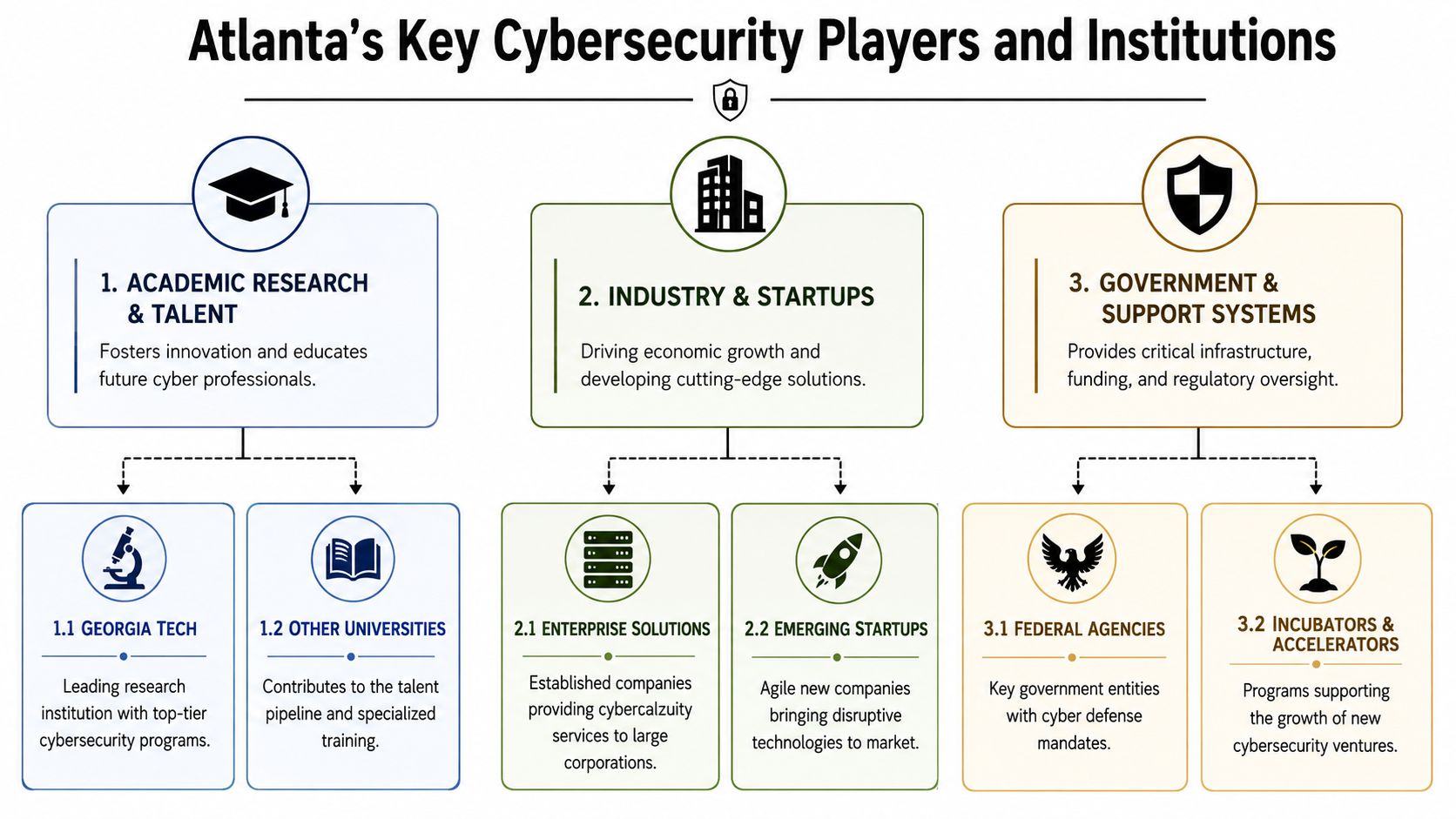
Atlanta's cybersecurity ecosystem works because three groups keep reinforcing one another: academic institutions, government and military infrastructure, and private firms. Georgia is home to the U.S. Army Cyber Command Center, major research institutions, and hundreds of private firms, creating a dense local partnership and talent pipeline that feeds regulated industries such as finance and healthcare, according to Georgia's technology sector overview.
The three pillars
Academia provides the research backbone and the labor pipeline. Georgia Tech stands out because it shapes both advanced security thinking and practical workforce development. Other universities across the state extend that effect by supplying graduates, applied research, and specialized training.
Government and military institutions give the region strategic weight. They don't just add prestige. They anchor demand for high-standard security practices, influence training priorities, and create opportunities for collaboration around defense, resilience, and critical infrastructure.
Private companies turn ideas into deployable services and products. In Atlanta, that includes mature enterprise providers as well as younger firms serving specific needs such as governance, incident response, managed security, and security engineering for regulated sectors.
Why the mix matters for regulated industries
A lot of cities have universities. A lot have startups. Fewer have all three pillars functioning in close proximity while serving sectors that are heavily audited and data-intensive. That's why Atlanta is especially relevant for hospitals, banks, universities, and public agencies.
These organizations don't need innovation in the abstract. They need systems that can survive procurement review, satisfy legal obligations, and work in messy real environments where legacy hardware and modern cloud tools coexist. That's also where operational details such as retention, chain of custody, and decommissioning become part of the security picture. Many of the same institutions wrestling with cyber modernization also face IT compliance challenges for Atlanta companies when old assets leave service.
| Category | Examples | Role in Innovation |
|---|---|---|
| Academic Research & Talent | Georgia Tech, other universities | Produces cyber talent, research, and applied technical expertise |
| Government & Public Infrastructure | U.S. Army Cyber Command Center, state cyber initiatives | Anchors security standards, mission-driven demand, and public-private collaboration |
| Industry & Startups | Enterprise security providers, emerging cyber firms | Commercializes tools and services for regulated and high-risk environments |
The strongest regional cyber markets don't separate research, operations, and commercialization. They connect them.
Talent Development and Investment Trends
Talent is where Atlanta's cybersecurity position becomes more durable than a simple company count. Georgia Tech's framing of cybersecurity as a balance between innovation and security fits the labor story well, because the state isn't relying on one downtown employer or one recruiting channel. Georgia's broader ecosystem, including the Georgia Cyber Center, supports growth, and the state is projected to add 100,000 new tech jobs by 2033, according to Georgia Tech's discussion of cybersecurity and innovation.

The labor market is broader than the city core
One of the biggest analytical mistakes is to talk about Atlanta as if all cyber capacity sits inside one metro boundary. Georgia's cyber workforce development is more distributed than that. Training, public investment, and adjacent tech growth stretch across the state, which gives Atlanta employers access to a wider bench than local branding alone would suggest.
That has practical value for organizations that need specialized hiring. Security teams rarely hire just one profile. They need analysts, engineers, compliance staff, cloud specialists, and people who can work across legal, operational, and technical boundaries.
For companies trying to address that hiring complexity, specialized resources such as Nexus IT Group's cybersecurity recruitment agency can help clarify how different security roles map to actual business needs.
Where investment logic follows talent
Capital tends to follow ecosystems where talent can support repeatable company building. Atlanta's advantage isn't only that it has security firms. It's that the region can support product development, customer implementation, and enterprise sales into industries that already understand risk.
That creates a favorable environment for several kinds of security activity:
- Enterprise security operations: Buyers in regulated sectors need managed services, monitoring, and response capacity.
- Governance and compliance work: Healthcare, education, and finance create demand for policy, audit, and documentation-heavy security services.
- Infrastructure security: Data growth and cloud dependence keep pushing organizations toward stronger controls around storage, access, and hardware lifecycle management.
This is also why broad local employment shifts matter. Hiring pauses in one area can release experienced operators into another. For teams planning around that movement, Atlanta tech layoffs and hiring trends offer useful local context.
Notable Initiatives and Public-Private Partnerships
Atlanta's cyber ecosystem is strongest when institutions stop acting like separate lanes. The most effective initiatives combine education, operational need, and commercial application. That's the mechanism that turns a “promising region” into a functioning innovation market.
Education tied to workforce pathways
One important pattern is early exposure linked to longer-term training. Georgia's cyber ecosystem doesn't only serve current employers. It also builds future labor supply by connecting students to cybersecurity career paths and practical learning environments. That matters because cyber hiring often fails when organizations wait until senior-level openings appear and then discover the pipeline is too thin.
A useful lesson for business leaders is that workforce partnerships work best when they start before formal recruiting. Internships, curriculum feedback, sponsored projects, and practitioner engagement all help create a steadier stream of candidates who understand regulated environments.
Institutions that reduce the gap between ideas and operations
The Georgia Cyber Center represents another important model in the state ecosystem. Its value isn't just symbolic. It helps connect training, experimentation, and applied security work in ways that can support organizations beyond Augusta, including employers in Atlanta.
That statewide structure is strategically important. It means Atlanta doesn't have to generate every cyber capability within city limits to benefit from them. Companies can draw from a wider network of educators, practitioners, and support systems while keeping enterprise demand concentrated in the metro.
A partnership model business leaders can actually use
For executives in healthcare, higher education, and enterprise IT, the most transferable public-private model looks like this:
- Define an operational problem clearly. Focus on a real issue such as access control, incident readiness, asset tracking, or disposal workflow.
- Match the problem to an institution. Universities fit research and talent needs. Public centers fit training and collaboration needs. Private firms fit deployment.
- Set a measurable operating outcome. Not a vague innovation goal, but a process change such as faster device retirement, cleaner audit documentation, or stronger chain-of-custody procedures.
- Keep the partnership close to operations. The best cyber collaborations affect procurement, infrastructure, legal review, and frontline IT work.
Partnerships create the most value when they solve an operating problem, not when they simply add another logo to a program page.
Practical Implications for Atlanta's Core Industries
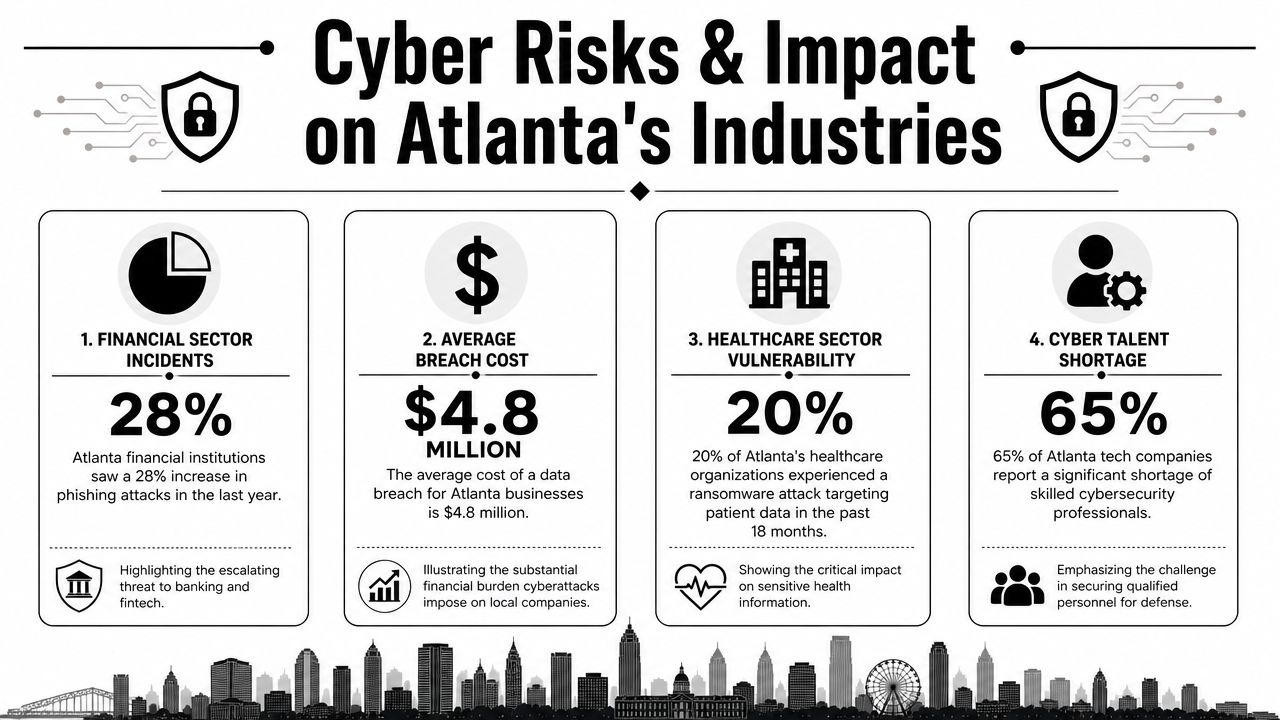
Cybersecurity in Atlanta is no longer just a software conversation. Atlanta-based organizations recorded losses surpassing $420 million in a recent year, a 40% increase, and 74% of breaches stemmed from human elements, according to this review of cybersecurity companies and risks in Atlanta. The same source notes that Atlanta more than tripled its data-center capacity in Q1 2025. Those facts should change how business leaders define cyber exposure.
Healthcare and research environments
Hospitals, clinics, and laboratories operate in a difficult middle ground. They're modernizing digitally, but many still hold years of sensitive data across mixed fleets of desktops, diagnostic devices, storage media, and specialized lab equipment. Human error remains a major weakness in any environment where many people touch systems and devices.
That's why cyber policy has to include physical asset controls. If a hospital carefully secures cloud access but retires a workstation or instrument without documented media sanitization, it leaves an avoidable gap in the chain.
Universities and school systems
Education environments face a different version of the same issue. Universities and school districts manage student records, research data, faculty devices, shared labs, and decentralized IT. Their challenge isn't just defending one perimeter. It's maintaining consistent security practices across departments with different budgets and hardware lifecycles.
Retired laptops, lab systems, and storage devices can create compliance and reputation problems long after they've left active service. For institutions dealing with automation, distributed equipment, and aging infrastructure, related Atlanta manufacturing tech and automation trends also offer a reminder that connected physical systems bring security obligations with them.
Data centers and enterprise IT teams
Atlanta's expanding data-center footprint raises the stakes for infrastructure operators, colocation providers, and enterprise IT departments. More digital infrastructure means more drives, more networking hardware, more spares, more failed components, and more refresh cycles. Every one of those physical assets sits somewhere on a chain that starts with deployment and ends with retirement.
For decision-makers, the lesson is simple:
- Cybersecurity includes asset disposition. A discarded server can expose data just as surely as a weak login policy can.
- Compliance depends on documentation. Auditors care about what happened to devices after use, not just how they were configured during use.
- Human factors extend beyond phishing. Mistakes also happen during moves, storage, resale, recycling, and decommissioning.
Security leaders should treat media sanitization and compliant e-waste handling as part of cyber risk management, not as an afterthought handled after the project closes.
Atlanta's role in cybersecurity innovation becomes more meaningful when you look at this full stack. The city isn't only producing software and services. It's operating in a threat environment that forces organizations to connect digital defense with physical control.
Actionable Recommendations for Local Organizations
Business leaders in Atlanta don't need another abstract message about cyber importance. They need a tighter operating model that reflects how the region functions.
Build around the local ecosystem
Start with institutions already shaping the market. Security leaders should maintain relationships with universities, workforce programs, and peer organizations in regulated sectors. The point isn't networking for its own sake. It's to improve access to talent, training, and implementation partners before a hiring need or incident makes those relationships urgent.
Expand the definition of cyber ownership
Many organizations still split responsibility too narrowly. Security owns alerts. Infrastructure owns hardware. Procurement owns retirement. Legal owns retention. That fragmentation creates avoidable risk.
A stronger model is to assign shared ownership for the full lifecycle of data-bearing assets, including:
- Acquisition controls: Know what enters the environment and where it's deployed.
- Use-phase governance: Track who has access, what data the asset touches, and what controls apply.
- Retirement procedures: Document wiping, shredding where required, transfer, recycling, and chain of custody.
Prioritize controls that survive real operations
The best cyber plans aren't the most ambitious on paper. They're the ones that still work during office moves, lab closures, mergers, hardware refreshes, and staffing changes.
For Atlanta organizations, that means focusing on a short list of actions:
- Review incident plans against physical assets. Include storage media, backup devices, lab systems, and decommissioned equipment.
- Map compliance obligations to disposal workflows. If an asset handled sensitive data, its retirement path should be documented from pickup through final disposition.
- Train staff beyond phishing awareness. Include device handling, storage, transfer approval, and end-of-life procedures.
- Audit vendors that touch hardware. Security posture can fail at the handoff point.
Atlanta's role in cybersecurity innovation offers a useful template for local organizations. The region's strength comes from connecting research, infrastructure, public support, and commercial execution. Companies should do the same internally. Digital controls and physical controls belong in one security strategy.
Organizations in Atlanta that need secure, compliant handling of retired lab equipment, computers, servers, and storage media can work with Scientific Equipment Disposal. S.E.D. serves hospitals, universities, corporations, and government agencies across the metro with pickup logistics, de-installation support, certified recycling, and data protection services including hard-drive wiping and media shredding, helping teams close the gap between cybersecurity policy and end-of-life asset reality.