8 Top Managed IT Services Trends in Atlanta for 2026

Your Atlanta-based hospital just upgraded its EHR system, a university lab is being decommissioned, or corporate is refreshing hundreds of laptops. Now the hard part starts. The old equipment, whether it's servers, centrifuges, storage arrays, or staff laptops with years of sensitive files, can't be treated like ordinary surplus.
That's one reason the top managed IT services trends in Atlanta are moving well beyond traditional break-fix work. Managed services now sit inside long-term operating models that commonly include 24/7 support, proactive maintenance, patching, endpoint management, vendor coordination, and strategic guidance, reflecting a broader market shift toward outsourced IT as a core operating expense rather than an optional add-on, according to managed services industry projections from Market.us.
For Atlanta organizations, that shift shows up in very practical ways. Hospitals need clean chain-of-custody documentation. Universities need coordinated lab shutdowns that don't leave regulated devices untracked. Corporate IT and facilities teams need a single plan for refresh, retirement, transport, data destruction, and sustainability reporting.
The biggest change is that buyers are starting to view managed IT as an asset lifecycle discipline, not just a support contract. That includes the last mile. Secure disposition, compliance evidence, and specialized equipment handling now affect risk just as much as network uptime does. The trends below reflect what's changing on the ground in Atlanta.
1. Secure Data Destruction and HIPAA-Compliant IT Asset Management
Atlanta healthcare and research buyers are asking a better question than “Do you recycle electronics?” They're asking how a provider proves that protected data was destroyed, when it happened, who handled the device, and what documentation survives an audit.
That's a major shift from older disposal projects where teams focused mostly on pickup and removal. In hospitals moving off legacy EHR infrastructure, the bigger risk often sits inside retired storage arrays, backup appliances, nursing station PCs, and forgotten drives in departmental closets. In university settings, the same problem shows up in research workstations tied to HIPAA or FERPA-regulated work.
What mature providers do differently
Strong providers build data destruction into the retirement workflow, not after the truck arrives. That means asset tagging, chain-of-custody tracking, documented sanitization or shredding, and certificates that match your internal inventory.
A practical starting point is to review a provider's secure data destruction process before you schedule pickup. If the process description is vague, your legal and compliance teams will end up filling the gaps later.
- Request documentation up front: Ask for sample certificates of destruction before the first project, not after a disposal event.
- Separate wiping from removal planning: Schedule sanitization before de-installation when equipment condition matters for redeployment, remarketing, or internal records.
- Track storage-bearing assets carefully: Include laptops, desktops, servers, SAN components, backup devices, and removable media in the same inventory.
- Verify certifications directly: If a provider mentions R2, e-Stewards, or ISO 14001, confirm the current status yourself.
Practical rule: If your asset list and the destruction paperwork can't be reconciled line by line, assume you have a compliance problem.
What doesn't work is treating data destruction like a commodity add-on. Generic “hard drive disposal” language is not enough for a hospital network, regulated lab, or corporate data center in Atlanta. Buyers need documented custody, documented destruction, and documented exceptions for every device that leaves the building.
2. Integrated E-Waste and Lab Equipment Decommissioning Services
A campus lab closure rarely involves only lab gear. It usually includes endpoint devices, local servers, printers, network switches, storage media, carts, monitors, and sometimes specialized instruments with embedded computing. That's why Atlanta organizations are increasingly looking for one decommissioning motion instead of separate vendors for IT, e-waste, and scientific equipment.
This is especially useful in university consolidations, satellite lab shutdowns, and corporate R&D reductions. Facilities teams need hallways cleared, power disconnected, freight paths mapped, and loading schedules coordinated. IT teams need records, serials, wipes, and custody. EH&S or lab leadership may need contamination review before anyone touches the equipment.
Why combined projects run better
When a provider can handle both electronics and scientific equipment, fewer handoffs create fewer mistakes. Your team doesn't spend the week coordinating one vendor for server racks and another for incubators, centrifuges, or fume hood-adjacent equipment.
For Atlanta-area projects with mixed surplus, it helps to use a partner that already handles electronics recycling in Atlanta and related equipment pickup. That simplifies scheduling and makes the site survey more realistic because the team is looking at the full room, not just the IT corner.
- Inventory early: Build one asset list for both IT and lab equipment well before the move date.
- Flag hazards first: Identify contamination risks, compressed gases, chemical residue, and temperature-sensitive equipment before removal day.
- Run a pre-site survey: Dock access, elevator limits, bench anchoring, and power disconnects can derail a project fast.
- Use one timeline: Facilities, IT, lab operations, and compliance should all be working from the same schedule.
The trade-off is that not every MSP is built for this. Some are strong on help desk and endpoint support but weak on physical decommissioning. Others can haul equipment but can't produce the audit trail a hospital or university needs. In Atlanta, the winning model is coordinated service across both domains, not a patchwork of subcontractors discovering the site as they go.
3. Sustainable Recycling and Circular Economy Compliance
Sustainability has moved from marketing language to procurement criteria. Atlanta universities, healthcare systems, and corporate headquarters are under pressure to show what happened to retired assets, where materials went, and whether downstream processing was handled responsibly.
That makes end-of-life reporting much more important than a simple pickup receipt. Buyers want recovery transparency, recycling discipline, and evidence that landfill avoidance wasn't just claimed but supported by process.

Sustainability is becoming part of the managed services conversation
This trend lines up with the broader MSP market's move toward more strategic service lines. In a wider market view, managed services are projected to grow from USD 460.59 billion in 2026 to USD 705.22 billion by 2031 at a CAGR of 8.9%, with North America holding 39.1% share in 2025, while growth is shifting toward managed cloud, managed security, managed detection and response, managed identity and access management, and managed SD-WAN/SASE, according to managed services market analysis from MarketsandMarkets. In practice, that means disposal and recycling partners are increasingly expected to support governance, reporting, and operational resilience rather than just hauling away old gear.
For organizations that report environmental progress, it's worth reviewing a provider's approach to sustainable laboratory practices and equipment recycling before signing a contract.
- Ask for downstream clarity: Collection is only the first step. You need to know how materials are processed after they leave your dock.
- Require asset-level reporting where possible: That makes internal sustainability reviews much easier.
- Add sustainability language to procurement: If it isn't in the contract, it usually disappears during execution.
- Match recycling to asset class: Laptops, servers, monitors, lab instruments, and batteries often need different handling paths.
What doesn't work is assuming every “green” claim means the same thing. The provider that can explain downstream controls, material segregation, and documentation will usually be the safer choice for Atlanta institutions with public-facing sustainability commitments.
4. On-Site Asset Inventory and Logistics Optimization
The fastest way to lose control of a decommissioning project is to rely on spreadsheets that nobody updates once movers, technicians, and facilities crews start working. Atlanta hospitals, campuses, and government sites are dealing with too many buildings, too many stakeholders, and too many asset types for that approach to hold up.
That's why on-site inventory capture is becoming a bigger part of managed IT and disposal engagements. Teams want barcode or QR workflows, scan-based handoff records, and live status visibility during pickups, relocations, and retirements.
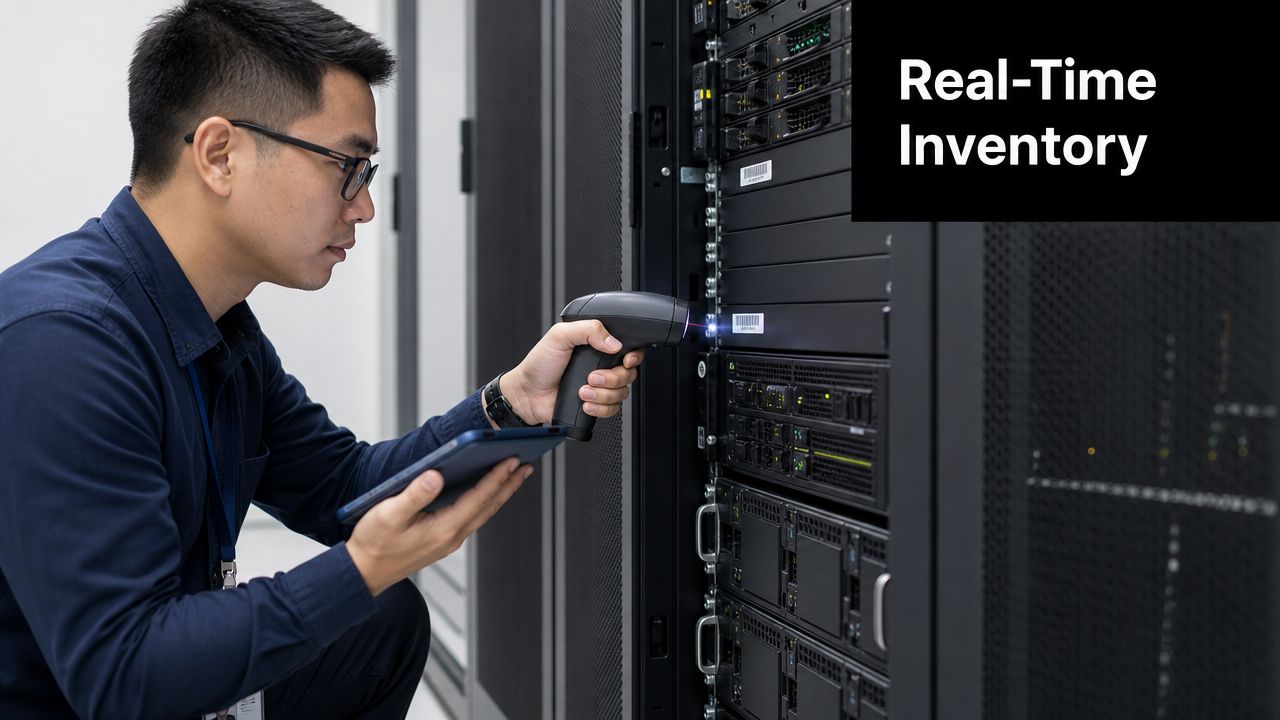
A corporate site decommissioning a server room may also have adjacent industrial or facilities equipment that needs specialized removal sequencing. In those cases, related services such as obsolete equipment removal support can help align physical logistics with IT disposition.
Where visibility actually helps
The point isn't to add technology for its own sake. The point is to reduce handoff errors, duplicate pickups, and last-minute arguments over what was removed from which room.
A well-designed QR code inventory management guide shows the operational logic clearly. Scannable labels help teams verify location, movement, and final disposition without relying on memory or paper forms.
Don't start with the whole enterprise. Pilot one department, one floor, or one shutdown project first, then expand the workflow that actually matches how your technicians work.
A few habits make this trend work better in practice:
- Connect the scan workflow to your existing records: If the project system can't map to your asset register or ERP, staff will create parallel lists.
- Limit dashboard access by role: Compliance, facilities, and IT don't all need the same view.
- Capture exceptions on site: Missing tags, locked cabinets, and unknown devices should be logged immediately.
- Use the data for future planning: Today's pickup records become next year's refresh forecast.
What fails is overengineering. If scanning takes too many clicks or requires perfect labeling to function, field teams will bypass it. Simplicity wins.
5. Compliance Documentation and Regulatory Reporting Automation
Most buyers don't struggle with disposal itself. They struggle with paperwork after the fact. Compliance teams need destruction records. Procurement needs proof of service. Legal may want chain-of-custody support. Audit staff want documentation in a format they can use without rebuilding the file.
That's why automation around certificates, logs, and reporting is gaining traction. It reduces manual chasing and standardizes what gets produced after each project.

Documentation quality now affects provider selection
One important gap in the Atlanta market is that many providers talk broadly about security and compliance but stop short of explaining how buyers should verify industry-specific controls in contracts and evidence packages. That gap matters because regulated organizations often need proof tied to frameworks such as HIPAA, CMMC, or PCI, not just generic security language. Sourcepass publicly advertises “Cybersecurity & Compliance (SOC, CMMC, HIPAA, PCI),” while broader Atlanta provider content often stays high-level, as noted in Atlanta managed IT services compliance commentary.
For disposition projects, buyers should ask to see a sample certificate of destruction and related records before they commit. If the sample is thin, the actual package probably will be too.
- Map your actual obligations first: HIPAA, FERPA, contract controls, grant requirements, and internal retention rules may all shape the documentation set.
- Test the workflow with legal and compliance: Don't assume the provider's template will satisfy your auditors.
- Review templates regularly: Regulatory expectations change, and stale forms create risk.
- Standardize naming and metadata: Searchable records save time during audits and incidents.
For teams trying to reduce manual handling of records, automation approaches for document processing can improve consistency, especially when vendors produce high volumes of certificates and pickup logs.
The weak version of automation is auto-generating polished PDFs from incomplete field data. The stronger version is structured capture at every handoff, then generating reports from that record. The output only matters if the inputs were controlled.
6. Specialized Handling for Biohazard and Contaminated Equipment Disposal
A biosafety cabinet isn't just oversized e-waste. A centrifuge from a clinical lab isn't just another asset tag on a list. In Atlanta healthcare and research settings, some equipment can't move until infection control, lab management, or EH&S verifies status and decontamination steps.
That's pushing disposal providers to develop more specialized removal capabilities. The standard IT asset pickup crew may be excellent with laptops and rack gear but still be the wrong team for contaminated lab equipment, pathology-adjacent devices, or equipment from microbiology spaces.
The operational difference is in the prep work
The provider should know what they're walking into before anyone unplugs a device. That means asking which room the equipment came from, what it was used for, whether it was decontaminated, what internal approvals are required, and how the loadout path will be controlled.
A typical Atlanta example is a hospital closing a small satellite lab or a university retiring equipment from a biosafety-related research suite. Facilities wants the room back. The department wants speed. Safety needs documentation. If those groups aren't aligned, removal stalls.
A contaminated-equipment project should start with a written status review from the client side. “Probably clean” is not a handling protocol.
The practical checks are straightforward:
- Run a pre-site assessment: Identify all equipment with possible contamination exposure before scheduling labor.
- Confirm technician training: Ask who will be on site and what safety training they hold.
- Coordinate with infection control or EH&S: They should approve the handling assumptions before removal day.
- Request decontamination records: Keep them with the project file, not buried in departmental email.
What doesn't work is assuming a disposal vendor will infer risk from the equipment type alone. Many devices look harmless once they've been unplugged. The hazard usually lives in the use history, not the appearance. Atlanta buyers in healthcare and research should treat that history as part of the asset record.
7. Vendor Consolidation and Single-Point-of-Contact Service Delivery
Many Atlanta organizations already know the pain of fragmented vendor management. One company handles help desk support. Another collects e-waste. A third wipes drives. A fourth is called in when a lab closes. The result is more scheduling conflicts, more invoice reconciliation, and more room for accountability gaps.
That's why vendor consolidation is becoming one of the more practical managed services trends. Buyers want a primary contact who can coordinate multiple service lines across IT support, asset retirement, lab decommissioning, logistics, and documentation.
Fewer vendors can reduce friction, but only if scope is explicit
Consolidation works best when the provider can deliver across the service chain. It fails when a prime contractor resells everything and your team still ends up chasing subcontractors on timing, paperwork, and site readiness.
The broader managed services market is also becoming more automation- and security-driven. One 2026 trends analysis says more than 50% of organizations were planning to incorporate AI and automation, and another industry source says MSP use can reduce overall IT costs by 20% to 30% while increasing productivity by 15% to 25%, with cybersecurity expanding at 18% annually through 2026 compared with 14% for the overall MSP market, according to Pax8 managed services trend reporting. In real buying decisions, that pushes clients toward providers who can unify operations instead of managing isolated tasks.
- Define service boundaries clearly: Spell out who handles de-installation, packing, data destruction, transport, recycling, and reporting.
- Set service levels by category: Your response expectations for endpoint support aren't the same as your expectations for lab decommissioning.
- Include exit language: Consolidation shouldn't trap you in a weak relationship.
- Review performance regularly: One master contract doesn't guarantee uniform quality.
The trade-off is concentration risk. One partner can simplify operations, but only if they're disciplined, transparent, and responsive across all the services you've bundled together. For many Atlanta buyers, the right answer isn't the fewest vendors. It's the fewest handoffs.
8. Predictive Asset Lifecycle Management and Strategic Planning Services
The most mature providers aren't waiting for clients to announce a crisis cleanup. They're helping plan refreshes, retirements, lab transitions, and facility moves before assets become a problem.
That's where managed IT starts to look more like portfolio management. A hospital system can map likely server retirements against application changes. A university can tie lab modernization plans to surplus forecasts. A corporate R&D site can estimate which equipment classes are approaching replacement and what disposition capacity will be needed.
Planning beats cleanup
This trend is getting stronger as providers invest more in AI-enabled operations. One 2026 industry analysis reports that 87% of MSPs plan to increase AI investments, with automation expected to reduce ticket volume by 40 to 60% and AI agents delivering 3x faster resolution times for common issues, according to DeskDay MSP automation trend analysis. For Atlanta buyers, the takeaway isn't just “use AI.” It's that providers now have better tools to spot recurring lifecycle patterns, support planning, and reduce operational drag.
If you're building a multi-year view of refresh and retirement, an asset lifecycle management guide is a useful framing tool for finance, facilities, and IT teams working from different assumptions.
The strongest lifecycle plans usually come from mixed teams. IT knows support reality, facilities knows site constraints, finance knows timing pressure, and operations knows what can't go offline.
A few planning habits matter more than fancy dashboards:
- Start with a clean baseline: If your current inventory is unreliable, your forecast will be too.
- Use historical disposition data: Past retirements often reveal hidden refresh cycles.
- Make assumptions visible: Budget timing, reuse policies, and growth plans should all be documented.
- Revisit the plan regularly: Asset strategies drift quickly when new programs, moves, or mergers hit.
What doesn't work is treating lifecycle planning as a one-time spreadsheet exercise. Atlanta organizations with mixed IT and lab environments need a living process that connects support, compliance, and end-of-life logistics.
8-Point Comparison of Managed IT Services Trends in Atlanta
| Service | 🔄 Implementation complexity | ⚡ Resource requirements | ⭐ Expected outcomes | 📊 Ideal use cases | 💡 Key advantages |
|---|---|---|---|---|---|
| Secure Data Destruction and HIPAA-Compliant IT Asset Management | High, certified sanitization, chain-of-custody processes | Certified technicians, wiping/shredding equipment, audit systems | Strong data risk mitigation & regulatory defensibility (⭐⭐⭐⭐⭐) | Hospitals, research labs, regulated data disposals | Eliminates legal liability; provides certificates of destruction |
| Integrated E-Waste and Lab Equipment Decommissioning Services | High, multi-disciplinary coordination and site surveys | Skilled deinstallation crews, logistics fleet, hazmat handling | Coordinated shutdowns with reduced downtime (⭐⭐⭐⭐) | Facility shutdowns, lab renovations, mixed-asset removals | Single engagement for mixed assets; simplifies scheduling |
| Sustainable Recycling and Circular Economy Compliance | Moderate, certification verification and downstream tracking | Certified recyclers (R2/e‑Stewards), reporting systems, refurbishment channels | Improved ESG metrics and material recovery (⭐⭐⭐⭐) | Organizations with sustainability/ESG reporting needs | Supports ESG reporting; enables refurbishment/resale pathways |
| On-Site Asset Inventory and Logistics Optimization | Moderate–High, tech integration and pilot deployment | RFID/barcode tools, cloud dashboards, staff training | Real-time visibility; lower logistics time and cost (⭐⭐⭐⭐) | Large hospitals, universities, multi-site consolidations | Audit-ready tracking; reduces manual spreadsheet work |
| Compliance Documentation and Regulatory Reporting Automation | Moderate, template customization and system integration | Automation software, API integrations, compliance input | Faster audits and consistent records (⭐⭐⭐⭐⭐) | Healthcare, education, government with heavy reporting | Automated certificates and audit trails; lowers compliance risk |
| Specialized Handling for Biohazard and Contaminated Equipment Disposal | High, decontamination protocols and strict safety regs | Hazmat‑certified staff, containment/transport, decontamination supplies | Mitigates biosafety risk; regulatory compliance (⭐⭐⭐⭐⭐) | Infectious disease labs, contaminated clinical equipment | Protects staff safety; provides decontamination verification |
| Vendor Consolidation and Single-Point-of-Contact Service Delivery | Low–Moderate, contract consolidation and SLA setup | Broad-capability provider, integrated reporting and account mgmt | Simplified vendor management; possible cost savings (⭐⭐⭐) | Organizations seeking admin simplification and unified billing | Reduces administrative overhead; coordinated scheduling (watch for lock‑in) |
| Predictive Asset Lifecycle Management and Strategic Planning Services | High, data collection, modeling, and cross-team alignment | Historical asset data, analytics tools, finance/IT collaboration | Proactive refresh planning and TCO reduction (⭐⭐⭐⭐) | Long-term modernization programs and multi-year budgeting | Identifies cost-saving opportunities; enables strategic forecasting |
Your Next Move Actionable Steps for Atlanta Organizations
The top managed IT services trends in Atlanta all point in the same direction. Buyers don't just need uptime anymore. They need controlled handoffs, better documentation, stronger security around retired assets, and a workable plan for equipment that spans IT, lab, and facilities operations.
That matters most in healthcare, research, education, and corporate environments where assets don't retire neatly. A single project may involve EHR-era servers, employee laptops, backup drives, test instruments, microscopes, incubators, and specialty devices that have to be evaluated for both data risk and physical handling requirements. If your process treats those as separate worlds, gaps will appear in the middle.
The practical next move is to audit your current disposition process from end to end. Look at who owns inventory accuracy, who signs off on decontamination status, who approves data destruction, who receives certificates, and where downstream recycling documentation is stored. Most organizations discover quickly that the process exists, but the ownership doesn't.
From there, tighten a few basics. Standardize asset tagging before refresh cycles begin. Build chain-of-custody requirements into SOWs and master service agreements. Ask providers for sample reporting before procurement approves them. Require site surveys for mixed IT and lab removals. Make legal, compliance, facilities, EH&S, and IT review the same workflow, not separate versions of it.
For Atlanta teams, local execution still matters. Metro-area hospitals and universities often need responsive pickup windows, technicians who understand regulated environments, and providers who can manage de-installation and logistics without creating friction for operations staff. National capability can help, but if a provider can't coordinate the work on site, the strategic pitch doesn't mean much.
The other smart move is to stop treating disposal as the final step. It should be part of lifecycle planning from the moment equipment is deployed. If you know what documentation, sanitization standard, recycling path, and removal method will apply at end of life, refresh projects get easier and audit exposure drops.
That's the fundamental shift behind today's managed services market. Atlanta organizations are moving away from reactive cleanup and toward managed asset lifecycle control. The providers that stand out aren't just fixing tickets. They're helping clients retire equipment securely, document it properly, and hand facilities back cleanly when the project is done.
If your team needs a partner that can handle secure data destruction, electronics recycling, and specialized lab equipment disposal in one coordinated process, Scientific Equipment Disposal is built for that job. S.E.D. supports Atlanta-area hospitals, universities, corporations, and government agencies with compliant pickup, de-installation, hard drive sanitization, and sustainable recycling for everything from servers and storage arrays to centrifuges, incubators, and other lab assets.