Atlanta Manufacturing Tech Trends and Automation Guide 2026

About 62% of metro Atlanta employment is at high or medium risk from automation over the next 20 years, according to the Atlanta Regional Commission. That statistic usually gets framed as a labor story. In practice, it's also an asset story.
Every time an Atlanta plant, lab, warehouse, or technical facility upgrades to smarter controls, adds connected sensors, or replaces fixed equipment with more flexible systems, it changes what “end of life” means. A surplus asset isn't just a steel cabinet, a retired PLC panel, or an old analyzer anymore. It may hold recipes, calibration records, user credentials, maintenance logs, network settings, or production history.
That shift matters for facility managers because automation decisions now reach well beyond throughput and uptime. They affect de-installation planning, environmental handling, chain of custody, and data destruction. A bad disposal process can erase the value of a smart upgrade by creating avoidable risk on the back end.
The New Reality for Atlanta's Industrial and Research Facilities
Automation is changing Atlanta facilities faster than many capital plans assume. On the ground, that shows up in warehouses, production lines, airports, and labs that are adding software-driven controls, kiosks, robotics, and connected equipment. For facility leaders, capital projects no longer end with installation and a long stable run. They now create a shorter path to retrofit, replacement, and eventual removal.
The main shift is practical. Equipment value increasingly sits in the controls, firmware, network connectivity, and analytics stack, not only in the frame, motor, or enclosure. A machine may still operate and still need to come out because it will not communicate with newer systems, cannot support the required sensor package, or leaves an open cybersecurity problem. Facilities adopting E & I Sales integrated systems run into this trade-off quickly. Better integration improves visibility and flexibility, but it also creates more points where older assets fall out of spec before they physically fail.
Why the problem shows up late
Most Atlanta plants and research sites budget carefully for purchase, validation, and startup. Removal planning often gets pushed to the end of the project. Trouble often starts at that stage.
A connected freezer, spectrometer, edge gateway, HMI terminal, vision system, or industrial PC can carry much more than residual material value. It may retain regulated data, process history, user credentials, calibration records, and local configuration files. In lab and healthcare-adjacent settings, disposal can also trigger decontamination steps, chain-of-custody requirements, and internal audit review.
Practical rule: If an asset had a login, a network connection, onboard storage, or process memory, treat decommissioning as both an operations task and a security task.
As a result, many Atlanta organizations are tightening shutdown, cleanout, and disposition procedures. They need removal vendors who understand what is attached to the equipment operationally, not just how to get it out of the building. For sites managing lab relocations, closures, or partial cleanouts, research facility equipment removal services are part of risk control.
What works on the ground
Facilities that handle this well set disposition requirements during upgrade planning, before the replacement unit arrives and before the old asset becomes dock inventory. That means asking a few direct questions early:
- What data does it hold: Confirm whether the asset stores files, logs, user accounts, recipes, device configurations, or other recoverable records.
- What safety condition applies: Verify whether lockout, decontamination, utility isolation, or specialized handling is required before removal.
- What proof will other teams need: Define the records required by finance, IT, EHS, compliance, and facilities after pickup and destruction.
Treating smart equipment like ordinary bulk waste creates avoidable risk. In an automated facility, decommissioning is part of the technology lifecycle, not an afterthought.
Understanding Atlanta's Key Manufacturing Automation Trends
Atlanta manufacturing tech trends and automation discussions often get reduced to a list of buzzwords. That's not useful on the plant floor. The core question is what these technologies change operationally, and what they force you to manage differently when assets age out.
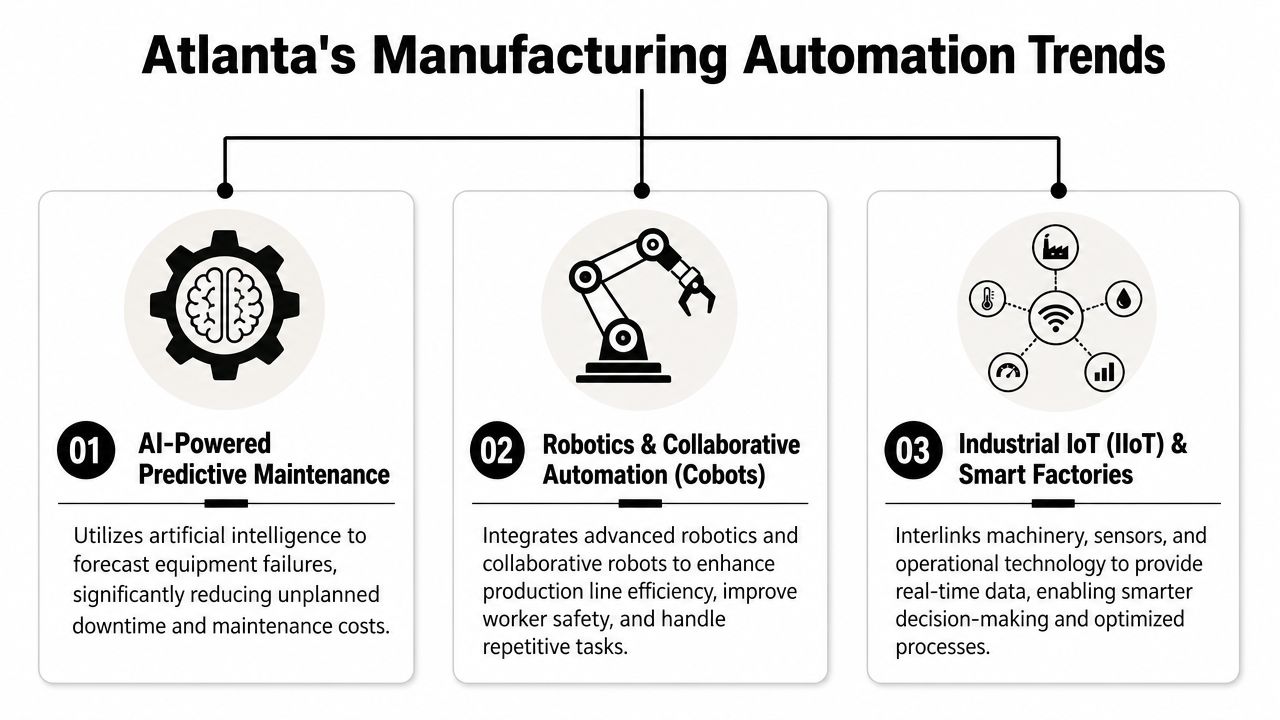
Georgia Tech points to a major shift toward flexible automation architectures that combine IIoT, AI, machine learning, and modular controls so systems can reconfigure faster and communicate across the operation in real time through smart manufacturing automation research. In plain language, plants are moving away from rigid islands of automation and toward systems that can be adjusted in software, expanded in modules, and monitored continuously.
Flexible automation changes the replacement math
Traditional fixed-line automation was expensive and slow to modify, but it often stayed in place for a long time because reconfiguration was painful. Flexible automation changes that decision. If a line can be adapted through software-defined controls, modular hardware, and connected devices, managers can justify targeted upgrades sooner.
That's one reason integrated architectures matter. Resources such as E & I Sales integrated systems are useful because they show how controls, instrumentation, and automation components increasingly have to work as one operating system instead of disconnected purchases.
For a facility manager, this creates a practical consequence. You'll likely retire components in smaller, more frequent waves. An HMI refresh may happen without a full line replacement. Vision hardware may be swapped before mechanical equipment wears out. Networked controllers may get removed because supportability changed, not because they failed.
Sensors and machine vision make equipment data-rich
Another major trend is the rise of sensor-rich machine vision and AI. Industry analysis describes sensors and vision systems as the foundation of “physical AI” in manufacturing in JR Automation's 2026 trends overview. That matters because vision-guided and sensor-heavy systems don't act like passive equipment. They perceive, classify, record, and adapt.
That creates better quality control and more responsive operations. It also means retired assets may contain:
- Inspection history: Images, defect records, and test outputs
- Process parameters: Thresholds, tolerance settings, and tuning values
- Security artifacts: Local credentials, certificates, and network details
A camera system on a line may be mechanically simple to remove and operationally sensitive to dispose of.
The labor bottleneck is real
Automation adoption isn't just a capex issue. It's a staffing issue. National manufacturing data cited in this manufacturing workforce discussion shows 65% of respondents rate their firms as upper-tier or cutting-edge in technology use, while 70% plan to increase training budgets. The takeaway is straightforward. Buying advanced equipment is easier than building the team that can maintain, secure, and retire it correctly.
That's one reason cleanup planning deserves more rigor. If you want a useful operational checklist for plant transitions, a guide to manufacturing equipment cleanout services is relevant because it focuses on the removal side that often gets missed when teams concentrate only on installation.
How Automation Accelerates Equipment and IT Asset Lifecycles
Georgia already has the industrial base to make this a current operating issue, not a future one. Companies using advanced manufacturing practices generated nearly $62 billion in total output in 2019, about 10% of Georgia's Gross State Product, according to Georgia Trend's coverage of high-tech makers. The same report describes a move toward Manufacturing 4.0, where software, robots, IoT, cloud computing, and AI operate together.
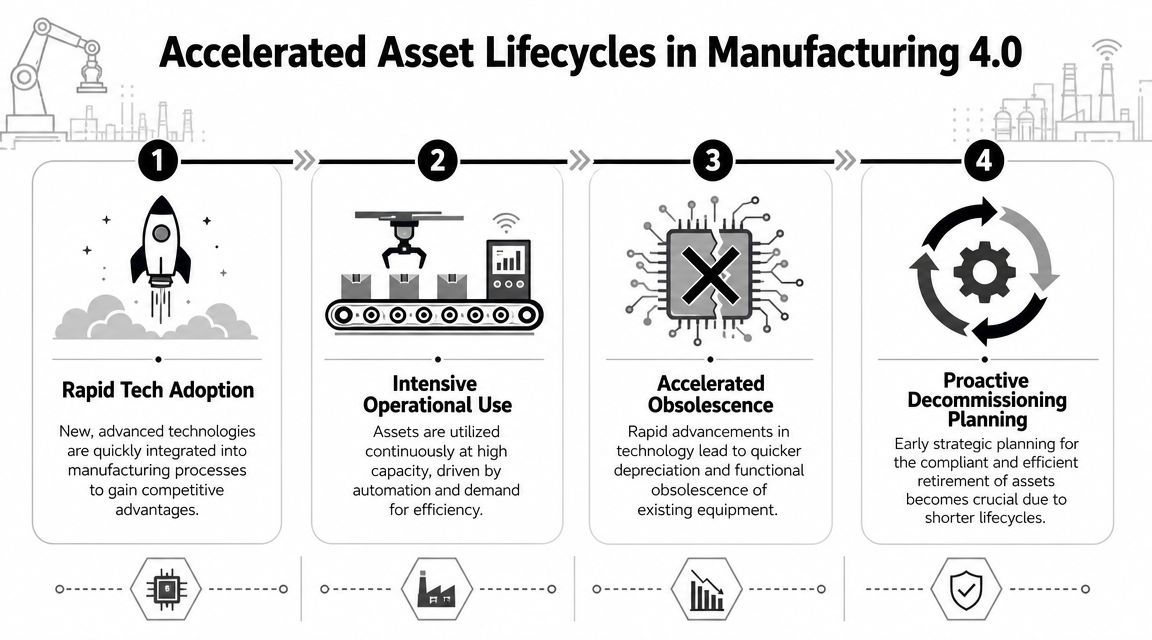
That combination changes asset lifespan in a very practical way. The value of a machine increasingly depends on its digital layer. When the software stack, security posture, connectivity, or sensor capability falls behind, the asset can become surplus even if the mechanical core still has usable life left.
Why working equipment still gets retired
Facility managers used to ask, “Is it broken?” Now the better question is, “Does it still fit the process?”
That's the same logic behind replacing a smartphone before the screen cracks. The old device may still power on, but it no longer supports the speed, security, or features you need. In manufacturing and lab operations, this happens with industrial PCs, embedded controllers, storage arrays, network switches, machine vision components, test equipment, and software-tied instruments.
A predictive maintenance rollout is a good example. Teams often start with the goal of reducing surprises, and operational resources like NILG.AI's guide to operational efficiency help explain why maintenance data has become central to decision-making. But once an operation depends on those insights, unsupported hardware, non-networked devices, or older edge components become strategic weak points. They may still run. They just can't keep up.
The old replacement cycle versus the new one
Here's the practical contrast:
| Asset environment | Typical retirement trigger | Main disposal concern |
|---|---|---|
| Older standalone equipment | Mechanical wear, repeated failure, parts scarcity | Physical removal and recycling |
| Connected automated equipment | Integration limits, software obsolescence, data risk, architecture changes | Secure decommissioning, data handling, documented chain of custody |
This is why Atlanta manufacturing tech trends and automation should be discussed alongside IT asset disposition. The line between “machine” and “device” keeps getting thinner.
What that means for planning
If your facility upgrades often, disposal can't sit at the bottom of a work order. It needs to be part of the capital project scope. That includes identifying what equipment contains media, what assets can be remarketed after sanitization, and what must be destroyed or recycled.
For mixed environments, where production systems and administrative infrastructure overlap, IT asset disposal becomes part of plant modernization. That's especially true when decommissioned equipment includes servers, workstations, HMIs, local data stores, or attached backup devices.
Uncovering Data Security and Compliance Risks in Modern Assets
The easiest disposal mistake is assuming the risk sits in the metal. In modern facilities, the risk usually sits in the memory.
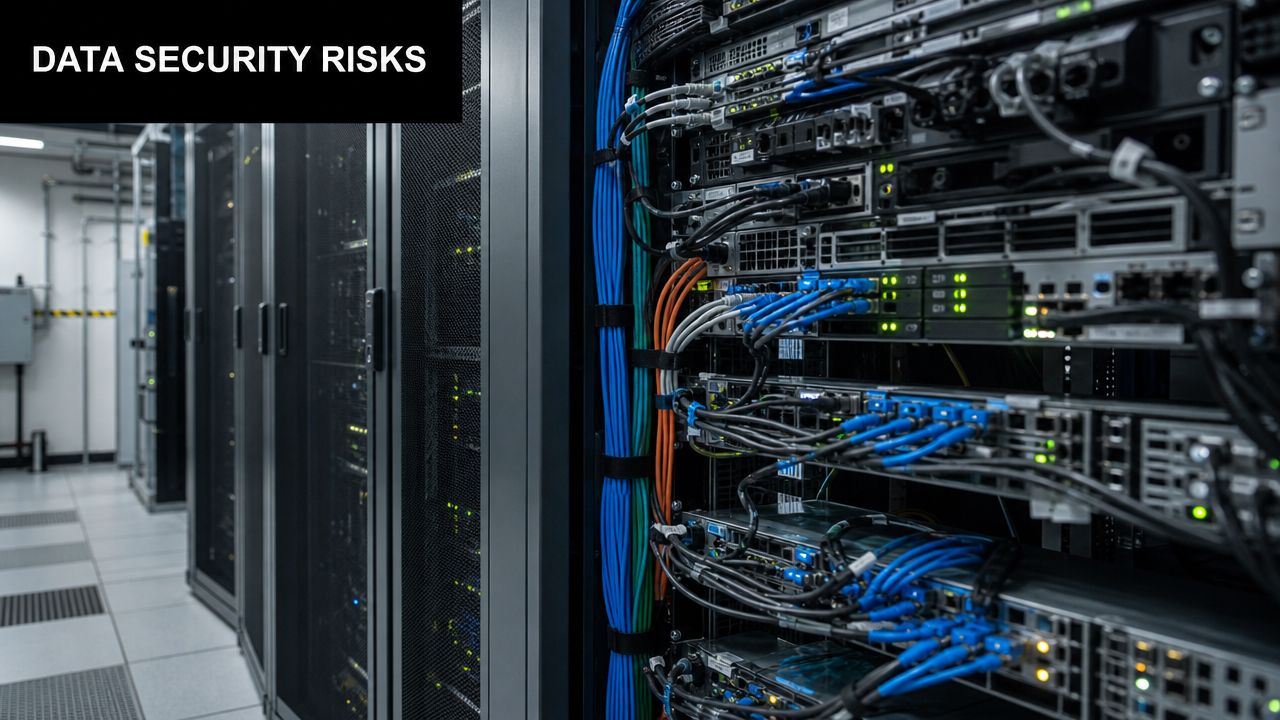
A networked analyzer, industrial workstation, programmable controller, server cabinet, barcode station, refrigeration monitor, or machine-vision appliance may store much more than is commonly expected. User accounts, production logs, maintenance records, recipes, calibration files, export reports, and network settings often remain on the device unless someone deliberately removes or sanitizes them.
The hidden data inside ordinary equipment
Hospitals, clinics, labs, and research facilities are subject to such exposure. Staff may think of a centrifuge, freezer, analyzer, or test station as lab equipment first. But many of these systems now include onboard computers, removable drives, USB-export capability, or connected service interfaces.
Common hidden data sources include:
- Embedded storage: SSDs, hard drives, flash memory, and controller memory
- Local exports: CSV files, PDFs, image captures, and user-generated reports
- Configuration data: IP settings, access credentials, service logs, and software licenses
- Operational records: Batch history, test results, maintenance logs, and alarm events
That's why decommissioning should sit close to IT, compliance, and EHS. A physically small asset can create a major incident if its storage leaves the site unmanaged.
Why compliance failures often start as process failures
Most disposal-related breaches don't happen because a team intended to cut corners. They happen because nobody clearly owned the handoff. Facilities assumes IT handled the data. IT assumes the equipment vendor removed the drive. Operations assumes the recycler knows what to look for.
If nobody is responsible for validating data destruction, then nobody is responsible.
For organizations trying to tighten governance around regulated systems and electronics disposal, IT compliance challenges for Atlanta companies is a useful operational reference because it frames disposal as a compliance workflow, not a hauling task.
Security controls need to extend to retirement
Cybersecurity conversations usually focus on active systems. But asset retirement is part of the same control environment. If a facility enforces access management, software patching, and network segmentation during use, it should apply equally serious controls at end of life.
That's why teams reviewing broader application and infrastructure risk often look at frameworks such as Cyber security for compliant software. The lesson carries over to physical asset retirement. The system is only secure if sensitive data is controlled from deployment through disposal.
A Strategic Plan for Compliant Asset Decommissioning
Good decommissioning isn't cleanup. It's a workflow. The strongest programs in Atlanta facilities use a repeatable sequence that covers operations, safety, data, logistics, and documentation without improvising at the dock door.
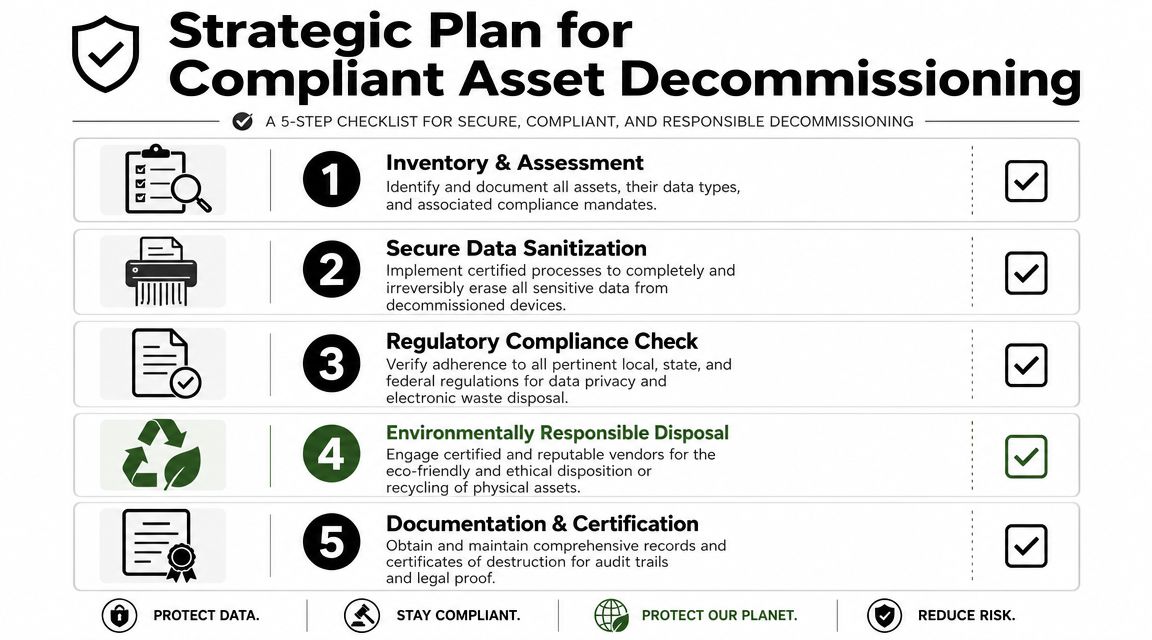
Step 1 inventory and triage
Start with a real asset list, not a rough count from memory. Include serial numbers when available, but also document where the asset sits, who owns it internally, whether it connects to a network, and whether it may contain regulated or proprietary data.
Separate equipment into practical categories:
- Low-risk physical assets: Benches, racks, passive housings, and non-electronic components
- Data-bearing devices: PCs, HMIs, servers, analyzers, smart instruments, and storage hardware
- Special handling items: Equipment requiring decontamination, lockout, rigging, or controlled access
This triage step prevents the most common failure in plant shutdowns. Teams don't confuse “heavy” with “high risk.” The riskiest item in a room may be a small controller or old workstation.
Step 2 verify decontamination status
In labs, clinical spaces, pilot plants, and technical environments, removal crews need to know whether equipment is safe to handle. If a centrifuge, hood, incubator, analyzer, or process device was exposed to hazardous or biological material, the condition must be documented before pickup.
That usually means a certificate or internal record confirming decontamination status. Without it, you create delays, safety exposure, and disputes about responsibility. This step also helps avoid accidental mixing of clean electronics with equipment that still needs controlled handling.
Field note: The faster removal job is usually the one with the best paperwork, not the one with the most labor.
Step 3 sanitize or destroy data properly
Not every device needs the same treatment. Some media can be sanitized and documented. Some should be physically destroyed because the hardware is obsolete, damaged, or too risky to redeploy.
A practical decision table helps:
| Asset type | Typical end-of-life action |
|---|---|
| Working laptops, desktops, and some instruments | Certified data wipe, then reuse, resale, or recycling |
| Failed drives, obsolete media, unsupported storage | Physical shredding or destruction |
| Embedded controllers and smart devices | Validate onboard memory, remove storage if present, then sanitize or destroy as appropriate |
This is one place where a specialized provider matters. For example, Scientific Equipment Disposal handles factory equipment decommissioning and also supports removal of electronics and data-bearing assets, which is the combination many mixed industrial sites need.
Step 4 coordinate logistics before shutdown day
A decommissioning plan falls apart quickly when nobody maps the physical move. Measure doorways. Confirm elevators. Identify loading routes. Schedule building access. Clarify who disconnects power, air, gas, water, exhaust, and data cabling. Decide what stays live until the last possible moment.
General junk removal vendors often struggle with the sequencing required for industrial and research removals. You may have to preserve adjacent operations, maintain clean pathways, isolate certain rooms, or split pickups across phases.
Use a short pre-removal checklist:
- Define scope clearly: What is being removed, what is staying, and what must be protected.
- Assign shutdown authority: Name the person who can approve disconnects and final release.
- Control access: Limit who can enter sensitive rooms or touch data-bearing assets.
- Stage documentation: Prepare labels, manifests, sanitization records, and photo logs before pickup starts.
Step 5 close the loop with documentation
If you can't prove what happened to an asset, you didn't finish the job. Final records should show what was removed, how data was handled, where materials went, and what certificates or manifests were issued.
That matters for internal audit, environmental reporting, lease turnover, and regulatory review. It also matters six months later when someone asks whether a retired analyzer still had a drive, or where a bank of old workstations ended up.
A defensible closeout package usually includes:
- Asset list reconciliation: What left the site versus what was planned
- Data disposition records: Wipe reports, destruction confirmations, or chain-of-custody logs
- Recycling and disposal documents: Vendor records showing responsible downstream handling
- Internal signoff: Confirmation from facilities, IT, compliance, or department owners
Teams that do this well aren't being bureaucratic. They're protecting the organization from the exact questions that show up after a move, audit, or incident review.
Choosing the Right Partner for Disposal in the Atlanta Metro
Facilities that add IIoT sensors, edge devices, vision systems, and connected controls also create a harder retirement problem. The outgoing equipment stream usually includes a mix of production hardware, lab instruments, network gear, drives, HMIs, and electronics that a general hauler is not set up to sort or document correctly.
In the Atlanta metro, the right disposal partner needs to work like an extension of operations, IT, and EHS. That means showing up ready to remove equipment from the point of use, identify data-bearing assets before they leave the building, and keep work moving around active production instead of turning a pickup into a plant disruption.
Vendor selection should stay grounded in site conditions. A provider may handle office electronics well and still struggle with a project that includes a lab cleanout, a controls cabinet tear-out, and retired equipment that cannot leave the site until decontamination is confirmed. The practical question is whether they can execute in your environment, with your shutdown constraints, your documentation standards, and your security requirements.
Useful vetting questions include:
- How do you identify data-bearing devices during pickup
- What documentation do you issue after sanitization, destruction, or recycling
- Can you support labs, factories, and IT rooms in the same project
- What de-installation work is included versus subcontracted
- How do you handle assets that require decontamination confirmation before removal
Ask one more question. Who owns the chain of custody from disconnect to final disposition? If the answer is vague, the risk usually lands back on your team.
This perspective is the right way to approach Atlanta manufacturing tech trends and automation. The value of a new system is only part of the story. The old system also has to leave the site safely, with data handled properly and records that hold up under audit, lease closeout, or an internal incident review.
If your facility in the Atlanta metro needs a practical path for retiring lab equipment, electronics, or mixed industrial assets, Scientific Equipment Disposal offers on-site removal, de-installation logistics, hard-drive sanitization, shredding for obsolete media, and certified recycling support for organizations that need a documented, compliant end-of-life process.