IT Compliance Challenges for Atlanta Companies: 2026 Guide

A lot of Atlanta teams are dealing with the same scene right now. A hospital is replacing nursing station PCs. A university is clearing out a lab renovation floor. A finance or healthcare office is moving aging servers out of a closet that turned into a mini data center years ago. The assets are finally leaving the building, and that's where the anxiety starts.
Not because anyone forgot about cybersecurity. Usually it's the opposite. The network is monitored, access controls are documented, and patching has an owner. But once devices are unplugged, boxed, staged in a hallway, handed to facilities, or picked up by a recycler, accountability often gets blurry. That blur is where compliance problems become operational problems.
For Atlanta organizations, that gap matters more than many leaders realize. The city has a dense mix of hospitals, research labs, universities, government offices, logistics operations, and cloud-heavy corporate environments. Those organizations don't just need secure systems. They need defensible end-of-life processes for laptops, servers, storage media, lab electronics, and retired network gear.
The High Stakes of IT Compliance in Atlanta
A facilities manager at a large Atlanta medical campus usually doesn't lose sleep over a surplus cart of monitors. What causes problems is the mixed lot behind it. A few thin clients. Several old workstations from an imaging department. Two storage units no one wants to claim. A desktop from a temp registration area that may have touched protected health information. The move order says "decommission." Compliance sees "risk transfer."
That distinction matters. An asset isn't harmless because it's powered off. If the device held regulated data, logged user access, cached patient or student information, or connected to a payment environment, the compliance duty doesn't disappear when it leaves the rack or desk. It changes form. The question stops being "is this system secured?" and becomes "who can prove what happened to it?"
Why disposal decisions get executive attention
The financial side is already enough to force the issue. A 2024 benchmark reported that the average compliance cost across industries worldwide was $5.47 million, while financial services averaged $30.9 million. The same benchmark said non-compliance costs businesses an average of $4,005,116 in lost revenue and that those costs are more than twice the cost of maintaining compliance (Hyperproof compliance benchmark).
That reality changes how smart teams think about retirement workflows. Disposal isn't a housekeeping line item. It's part of the control environment.
Practical rule: If your organization tracks an asset carefully while it's in service, it should be able to track that asset with the same discipline when it's retired.
For Atlanta companies trying to control both risk and cost, that often means tightening inventory records, documenting custody changes, and using specialized partners for regulated electronics handling rather than treating old equipment like generic scrap. Teams that are evaluating local options for Atlanta electronics recycling should be looking at audit trail quality as closely as pickup logistics.
What usually goes wrong
The problem isn't usually bad intent. It's fragmentation.
- IT owns the device record but not the loading dock.
- Facilities manages the move but not the data question.
- Procurement approved the vendor but didn't define destruction evidence requirements.
- Legal and compliance review policies but often aren't present when the truck arrives.
That is why so many organizations discover their disposal weakness only during an audit, an investigation, or an internal cleanup project. The risk isn't abstract. It's the simple fact that retired equipment passes through more hands, more locations, and often less structured oversight than live systems do.
Navigating the Regulatory Maze for Atlanta Industries
Atlanta companies rarely deal with a single rulebook. A healthcare provider might manage patient records, employee data, payment systems, and vendor-hosted platforms at the same time. A university may run medical research, student systems, grant-funded labs, and campus payment environments under one umbrella. A regional corporate office can end up with privacy obligations that extend beyond Georgia if it serves customers elsewhere.
That is why IT compliance challenges for Atlanta companies are often less about understanding one standard and more about reconciling several.
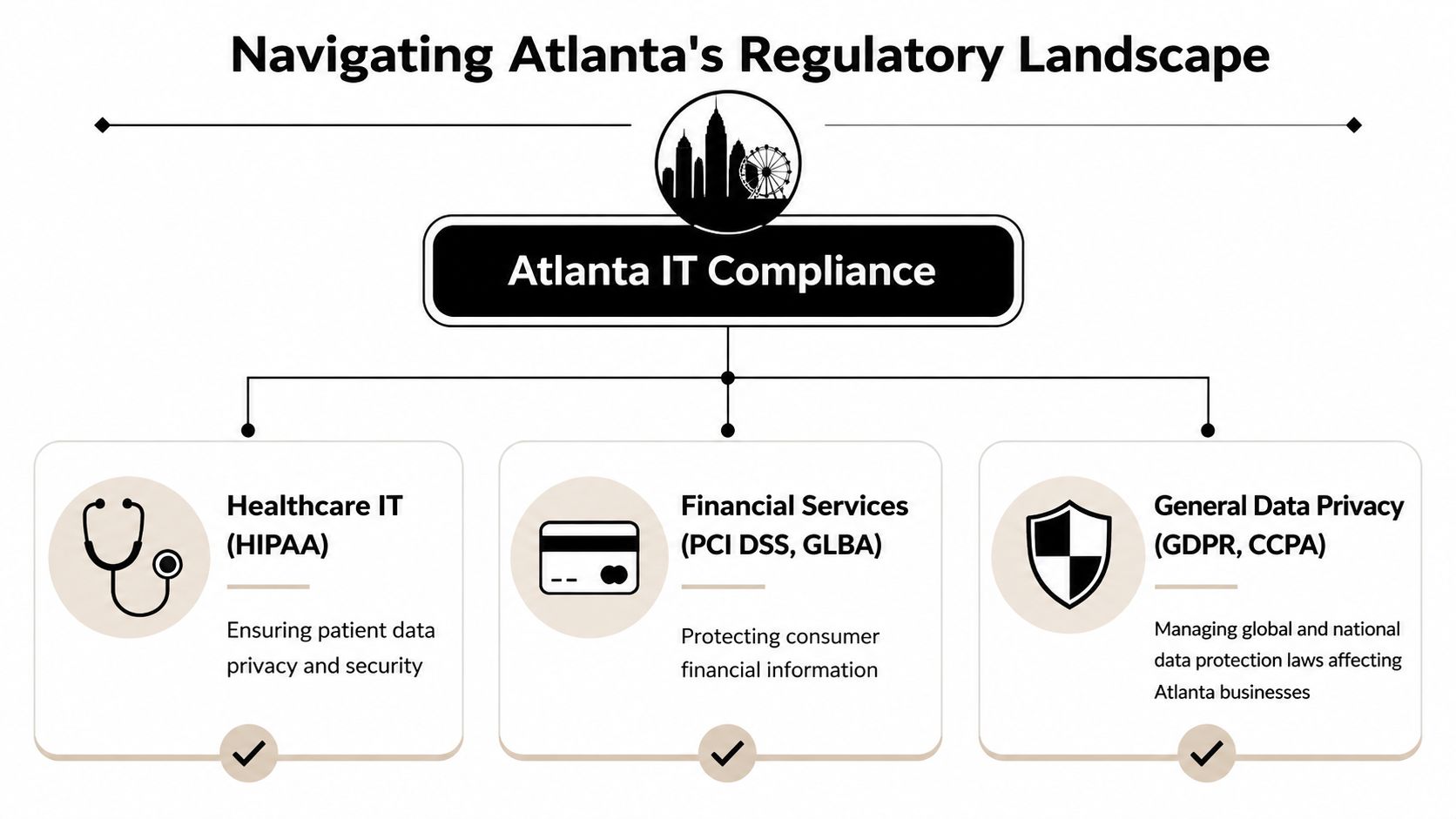
What the major frameworks mean in practice
HIPAA affects any environment handling protected health information. In daily operations, that usually translates into controls around access, authentication, audit logs, retention, and secure disposal of data-bearing devices.
PCI DSS applies where payment card data is stored, processed, or transmitted. Even organizations that don't think of themselves as payment-centric can have PCI exposure through billing desks, online portals, or departmental payment workflows.
GLBA matters to financial institutions and some organizations handling consumer financial information. It pushes teams toward stronger data safeguards, oversight, and documented control discipline.
GDPR can become relevant when Atlanta businesses serve global customers or process international personal data. Hyperproof identified GDPR as the most difficult framework for businesses to achieve compliance under, which is one reason cross-border privacy obligations tend to complicate local IT operations rather than sit neatly in a legal silo.
Stacked compliance is the real operating model
Atlanta organizations in regulated fields often face stacked compliance obligations, meaning a single asset may be governed by HIPAA, PCI DSS, and state privacy requirements at the same time. That forces separate control mappings for access, encryption, and logging across mixed IT and lab environments (Atlanta compliance best practices).
A retired workstation can illustrate the point better than any policy chart. If that device sat in a clinic that took payments and also accessed patient systems, disposal isn't just about wiping a hard drive. The organization has to think about data categories, evidence requirements, custody, and whether the vendor process aligns with each applicable framework.
The asset doesn't care which department bought it. Auditors do care which controls should have followed it.
This is also where documentation becomes a workload problem. Control evidence gets scattered across inventory systems, ticketing tools, asset tags, spreadsheets, and vendor emails. Teams trying to reduce that friction often look for ways to automate compliance document collection so records from IT, facilities, procurement, and external vendors don't have to be reconstructed manually during an audit.
Why disposal needs its own compliance lane
Many internal policies describe secure operations well but treat retirement as a footnote. That's not enough for healthcare and research environments. If you're handling medical devices, lab computers, storage media, or clinic workstations, the disposal workflow needs explicit ownership, approved methods, and required evidence. Organizations reviewing HIPAA-compliant medical equipment disposal services should verify that the process covers media sanitization, pickup controls, and post-disposal documentation, not just item removal.
Common Failure Points in IT Asset Disposition
Most disposal failures don't start with a dramatic breach. They start with a small shortcut. A closet becomes temporary storage. A spreadsheet becomes the inventory system. A vendor pickup gets scheduled before IT finishes media review. One retired server leaves the building with incomplete records, and now nobody can prove whether the drive was wiped, shredded, or merely transferred.
Those are the failure points that turn policy into exposure.
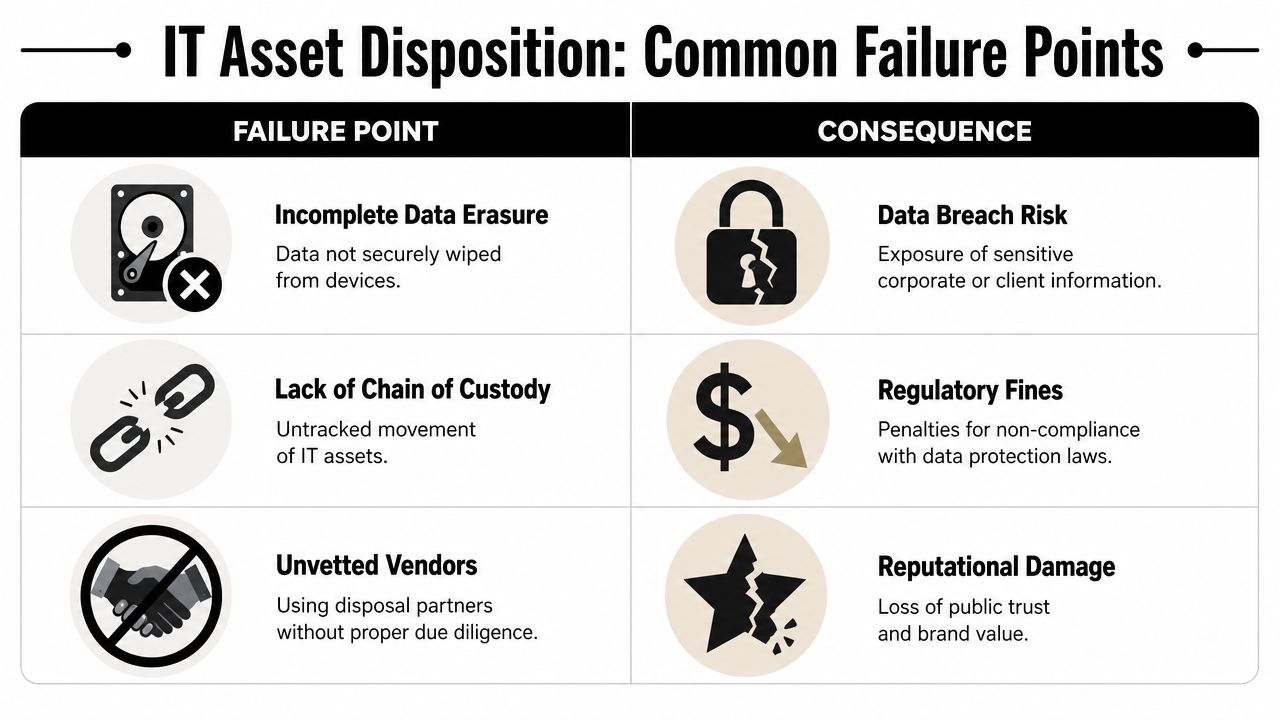
Incomplete data erasure
Cause comes first. Teams retire devices faster than they classify them. A desktop gets marked "obsolete" without confirming whether it contains a hard drive, solid-state storage, removable media, or cached application data. The asset then enters the recycling stream before sanitization is documented.
The effect is straightforward. The organization can't show that sensitive data was rendered inaccessible before disposal. Even if the vendor later confirms destruction, the internal record may still be too thin for a strong audit response.
Common warning signs include:
- Asset records without storage detail: If your inventory only says "PC" or "server," you don't know enough at retirement.
- Wipe decisions made at pickup time: Method selection should happen before transfer, not on the loading dock.
- No linkage between serial number and destruction evidence: If the certificate can't be matched back to the asset list, the proof is weaker than it looks.
Broken chain of custody
It is often during this process that many otherwise mature programs stumble. Equipment moves from user area to staging room, to surplus cage, to dock, to truck. Every handoff creates a chance for labeling errors, lost components, or undocumented substitution.
A chain of custody isn't just a signature line. It's a record of where the asset was, who handled it, and what happened next. Without that sequence, the organization ends up relying on assumptions.
If a device changed hands three times and only one transfer was documented, the missing two handoffs are your compliance problem.
This is one reason many teams bring structure into the process with a defined IT asset disposal workflow. The useful part isn't the phrase itself. It's the discipline behind it: serialized lists, pickup verification, custody logs, and evidence that follows the asset from removal through final disposition.
Unvetted disposal vendors
Vendor oversight is one of the clearest compliance weak spots in practice. In a 2024 survey, 61% of organizations reported a third-party data breach or incident in the last year, only 31% had coordinated third-party risk management deployed, 50% still used spreadsheets or other unintegrated tools to manage vendors, about 67% of third-party vendors were unmanaged because of resource constraints, and only 46% of companies took the necessary steps after identifying a risk (JumpCloud compliance statistics).
The operational lesson is simple. A disposal vendor is not "low risk" just because the assets are leaving your site.
A weak vendor process usually shows up in one of these ways:
| Failure point | What it looks like on the ground | Likely result |
|---|---|---|
| Poor due diligence | Procurement approves a recycler without confirming sanitization methods or reporting standards | Gaps in audit evidence |
| Spreadsheet-only tracking | Asset lists, pickup manifests, and destruction confirmations live in separate files | Reconciliation errors |
| No exception handling | Damaged drives, unlabeled devices, or mixed lab equipment are handled ad hoc | Inconsistent controls |
When disposal fails, it usually fails because teams treated retirement as logistics rather than a regulated transfer of risk.
Unique Compliance Pressures in the Atlanta Metro Area
Atlanta's compliance environment is more demanding than a generic national checklist suggests. The metro area combines major healthcare systems, universities, research operations, corporate headquarters, transportation networks, and public-sector institutions. That means more regulated data, more mixed-use technology environments, and more situations where old equipment isn't just old equipment.

Local risk is operational, not theoretical
Georgia ranked 11th nationally for cybercrime complaints in 2024, and Atlanta also has a competitive labor market with hundreds of local compliance roles, which puts resource-constrained organizations under pressure to maintain defensible controls (Atlanta cybersecurity and compliance pressure).
That affects disposal readiness in a very practical way. When compliance staffing is thin, end-of-life workflows are often the first thing to become informal. Teams focus on live incidents, user support, security tooling, and audit deadlines. Meanwhile, retired devices accumulate in departments, storage rooms, and labs because nobody owns the final mile.
Why Atlanta facilities feel this more sharply
The Atlanta metro has many environments where IT and facilities intersect constantly:
- Hospitals and clinics retire endpoints, carts, imaging-adjacent workstations, and mixed medical electronics.
- Universities and labs handle surplus research equipment alongside standard office hardware.
- Government and public agencies need stronger chain-of-custody discipline because internal scrutiny often extends beyond a single department.
- Corporate campuses and data-heavy offices may run hybrid estates with old on-prem gear and newer cloud-linked endpoints.
Each setting creates a different disposal profile. A research lab may care significantly about device provenance and grant-related records. A hospital may care most about media sanitization and physical pickup control. A finance office may focus on custody, audit evidence, and vendor review. The mistake is trying to run all of them through one generic surplus process.
The staffing reality behind the risk
Many Atlanta leaders know what good compliance looks like. The harder part is staffing it consistently. If your security engineer is also managing endpoint policy, vendor questionnaires, and offboarding reviews, retirement controls won't get the attention they need. If facilities is judged mainly on speed and space recovery, assets may move before IT signs off on data handling.
That is why local compliance problems often aren't caused by ignorance. They're caused by competing priorities in a high-pressure environment.
Closing the Governance Gap at Asset End-of-Life
The most overlooked issue in disposal isn't shredding versus wiping. It's ownership. Once an asset is unplugged, who is responsible for it? In many organizations, that answer changes by building, by department, or by whoever submitted the move ticket first. That inconsistency creates a governance gap.
A major compliance blind spot is accountability during asset disposal. Many guides explain controls for live systems but don't clearly assign responsibility for data sanitization and chain of custody once equipment leaves the facility. That is exactly where compliance often breaks down operationally (asset disposal governance gap).
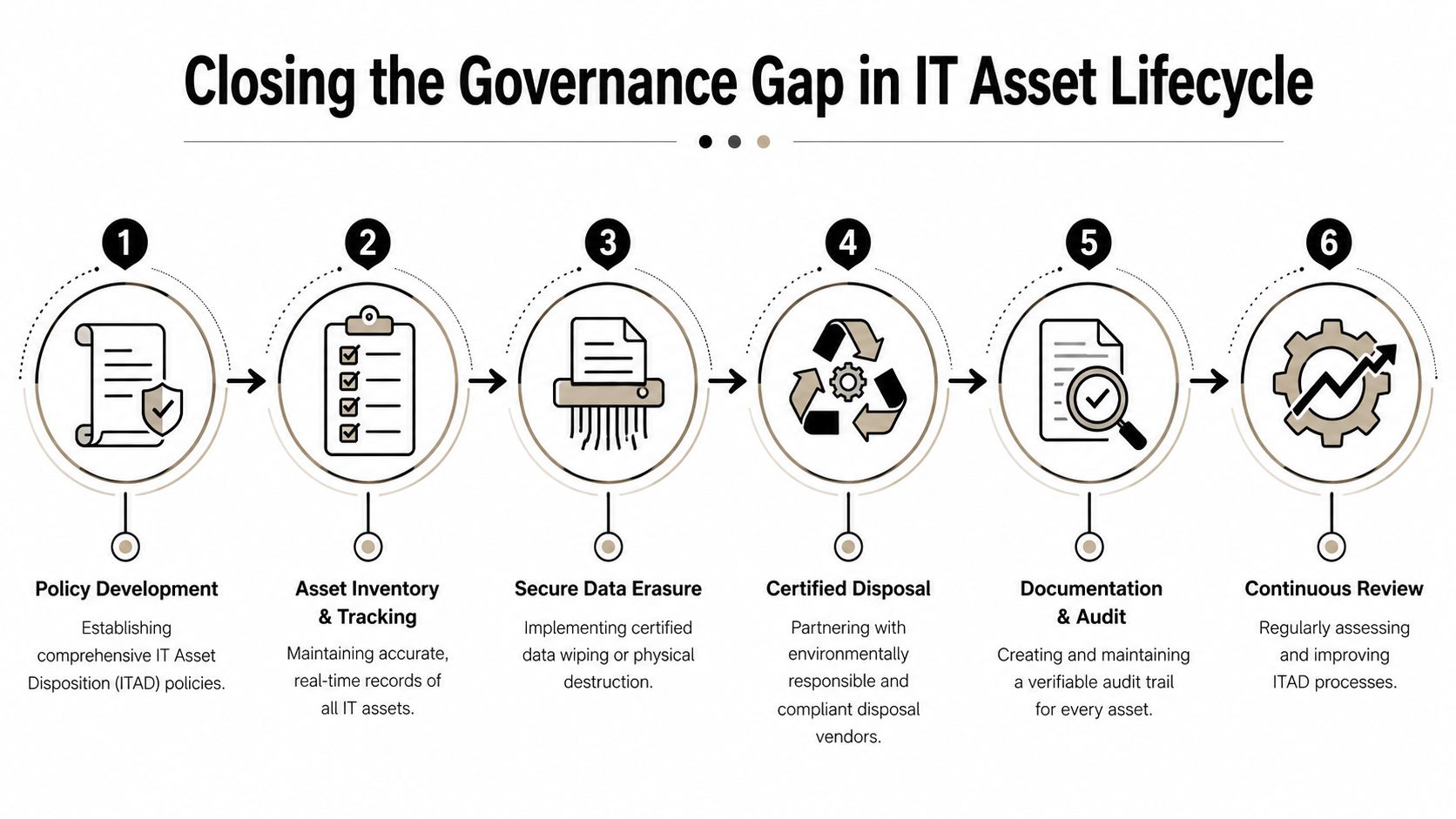
Disposal is a governance function
If a server is still in production, ownership is usually clear. IT operations, security, and business stakeholders know who has authority. But the moment that same server is retired, many organizations start treating it like excess property. That is the wrong model for regulated environments.
A better model is to treat retirement as the final controlled phase of the asset lifecycle. That means the policy should define:
- Who authorizes retirement
- Who verifies the data destruction method
- Who controls physical release
- Who reviews the final evidence package
Those are governance questions, not housekeeping tasks.
What a defensible handoff looks like
The handoff from active use to disposal should create records, not ambiguity. A clean process usually includes an asset list, custody transfer documentation, method selection for sanitization or destruction, and retained proof tied back to serial numbers or other identifiers.
One document matters more than many teams realize: the certificate of destruction. Not because a certificate solves every problem, but because it closes the record. It gives the organization a formal endpoint that can be matched against internal inventory, pickup records, and approved disposal instructions.
A certificate without prior custody records is incomplete. Custody records without final destruction evidence are also incomplete. You need both.
Where organizations need to tighten policy
Three policy upgrades usually produce the biggest improvement.
First, assign a single process owner even if multiple departments participate. Shared work is fine. Shared accountability isn't.
Second, define exception handling before exceptions happen. Unlabeled drives, broken devices, mixed lab equipment, and emergency cleanouts are where weak policies get exposed.
Third, require disposal evidence to be reviewable by someone outside the pickup workflow. If the same person schedules removal, releases the assets, and files the documentation, missed gaps tend to stay missed.
Mitigation Strategies for Compliant IT and Lab Disposal
Most organizations don't need a more complicated disposal policy. They need one that matches reality. That means deciding in advance which assets can be sanitized, which should be physically destroyed, what documentation is required, and how exceptions get escalated.
The best programs compare methods instead of assuming one answer fits everything. A reusable laptop with functional storage may be a candidate for certified wiping if policy allows. A failed drive from a regulated environment may need shredding because verification is more defensible than recovery attempts. A decommissioned lab system may require both data handling review and environmentally compliant recycling because the device isn't just a computer.
Choosing the right destruction method
The table below is the practical decision point many teams skip.
| Method | Description | Best For | Compliance Level |
|---|---|---|---|
| Software wiping | Logical sanitization of data-bearing devices using a documented wipe process | Functional drives and redeployable or recyclable equipment where reuse is allowed | Strong when the method is verified, documented, and tied to the asset record |
| Physical shredding | Destruction of media so the storage device is no longer usable | Failed drives, obsolete media, high-risk assets, and situations where reuse isn't appropriate | Very strong for final disposition when chain of custody and destruction records are maintained |
| Degaussing | Magnetic disruption of data on compatible media | Certain legacy magnetic media environments | Can be appropriate in specific environments, but teams need to verify media compatibility and documentation requirements |
| Hybrid process | Segregating assets so some are wiped and others are physically destroyed | Mixed pickups involving laptops, servers, arrays, and lab electronics | Often the most realistic option for large organizations with varied asset types |
What works and what doesn't
What works is matching the method to the asset, the data profile, and the audit expectation.
What doesn't work is deciding after pickup. It also doesn't work to assume every device with storage can be handled the same way. Solid-state media, failed drives, legacy systems, and equipment with uncertain provenance need different treatment.
A sound vendor process should answer questions like these clearly:
- How are assets identified at pickup? If devices enter the process as a bulk pile, evidence quality drops fast.
- How are failed or damaged drives handled? Often, internal assumptions prove flawed.
- What records come back after service? Pickup manifests, sanitization reports, destruction records, and final recycling confirmation all serve different purposes.
- How are nonstandard assets treated? Lab equipment, embedded systems, and storage attached to scientific instruments often fall outside normal desktop disposal routines.
Documentation is part of the control
For regulated organizations, documentation isn't administrative overhead. It's the proof that the process was executed as designed.
That is why many teams build a disposal packet for each event or project. It may include internal approval, inventory export, custody records, service confirmation, and final evidence from the disposal provider. Among Atlanta-area options, Scientific Equipment Disposal handles business electronics and lab asset pickups, offers drive wiping and shredding services, and supports de-installation logistics for organizations managing mixed IT and lab retirements.
Good disposal evidence should let a reviewer answer three questions quickly: what left, who handled it, and how was data rendered inaccessible?
The practical goal isn't perfection. It's a repeatable process that stands up when someone asks for records months later.
Building Your Defensible Disposal Program in Atlanta
A defensible disposal program starts before the cleanup project, office move, or lab closure. If your policy only becomes specific when a truck is scheduled, you're already late. The stronger approach is to define the workflow while assets are still active, then carry those controls through retirement.
Questions to ask a disposal vendor
Before you release anything, ask direct questions and expect direct answers.
- What evidence do you provide for each asset or media type? You want specifics on manifests, serial-level reporting, and final destruction records.
- How do you maintain chain of custody during pickup and transport? The answer should describe process, not marketing language.
- How do you handle failed, damaged, or unidentified media? Exceptions reveal program maturity.
- Can you support mixed loads of IT and lab equipment? Many Atlanta sites retire both at once.
- How do you coordinate with internal facilities and security teams? A good process works across departments, not just with the person who booked the pickup.
If your organization is building a broader retirement policy for recurring pickups, office consolidations, or surplus programs, it helps to review examples of corporate e-waste solutions that address logistics, data handling, and documentation together.
What your internal policy should include
A workable internal standard usually has five parts.
Defined ownership. One role owns the process, even when IT, facilities, procurement, and compliance all participate.
Asset classification at retirement. The policy should distinguish standard electronics from data-bearing devices, high-risk media, and specialized lab systems.
Approved handling methods. State when wiping is acceptable, when physical destruction is required, and who approves exceptions.
Required records. List the minimum evidence package your organization keeps for every disposal event.
Review and correction. After each major pickup or decommission, review gaps while the details are still fresh.
The organizations that handle IT compliance challenges for Atlanta companies best usually don't have the thickest policy binder. They have a process people can follow under deadline pressure, during renovations, and when multiple departments are involved.
A defensible disposal program protects more than data. It protects the organization's ability to prove that it handled risk responsibly when equipment left the building.
If your team needs a more reliable process for retiring IT and lab assets, Scientific Equipment Disposal supports Atlanta-area organizations with business electronics recycling, lab equipment disposition, drive wiping, shredding, pickup logistics, and documentation that fits regulated end-of-life workflows.