7 Top Internet Service Providers Atlanta 2026

A hospital in Midtown does not buy internet service the same way a small office does. If radiology images queue during peak hours, if a university research group loses time on cloud transfers, or if a data center cannot meet replication windows, the problem is not "slow internet." The problem is that the circuit, SLA, and failover design were wrong for the job.
That is the frame Atlanta institutions should use when comparing internet service providers Atlanta buyers rely on. Consumer plan pages highlight top-end download speeds. Institutional buyers need to verify how a provider handles dedicated access, packet loss, outage response, route diversity, install lead times, and support escalation. A hospital, campus, or colocation site should also separate shared broadband from DIA early, because the price difference is real and so is the operational difference.
Atlanta is a strong market for connectivity options. Fiber, cable, fixed wireless, and carrier-grade dedicated services are all available across many business corridors. The harder question is fit. A university branch clinic may need broadband plus LTE or 5G backup. A research campus may need symmetrical fiber with contract-backed uptime. A data center may need diverse entrances, cross-connect flexibility, and a provider that will commit to restoration terms in writing.
Procurement should start with an evaluation checklist, not a speed test. Confirm serviceability at the exact address. Review SLA terms for uptime, latency, packet loss, and mean time to repair. Ask whether bandwidth is best effort or dedicated. Validate failover options, including wireless backup and secondary wired carriers. Check who owns the local loop, who supports the handoff, and how tickets escalate after hours. Then compare contract length, construction risk, and the cost of adding capacity later.
Connectivity projects also create downstream infrastructure work. Router refreshes, firewall retirement, rack cleanup, and carrier handoff changes often sit in the same budget cycle. Teams planning cabling or plant changes should understand industrial fiber optic cable applications before locking in a design, and they should line up telecom maintenance and decommissioning support before the cutover date. That reduces surprises when legacy equipment has to come out fast and clean.
1. AT&T Fiber / AT&T Business Fiber
A hospital adding a new imaging wing, a university pushing research data to cloud storage, or a colocation tenant replicating workloads between sites usually runs into the same question fast. Is this address eligible for business fiber that can hold up under sustained upstream traffic, or is the provider conversation really about a best-effort service with good marketing?
AT&T belongs on the first review round for Atlanta institutions with heavy two-way traffic. The consumer side matters less here than the business path. What buyers need to verify is whether the building qualifies for AT&T Business Fiber, what handoff options are available, and how support changes once the circuit is under contract through the provider's Atlanta fiber page.
The operational fit is clear in environments where upload demand is constant. PACS imaging transfers, EHR backups, security video retention, research collaboration, and intersite replication all expose weak upstream capacity very quickly. Symmetrical fiber is the right starting point for those workloads.
Where AT&T works best
AT&T is a strong candidate for organizations that want fiber now and a workable path to more capacity later without changing access type. That matters for campus expansions, outpatient facilities, and data-heavy administrative hubs where traffic rarely stays flat for long.
The evaluation should stay focused on service terms, not just advertised speed:
- Symmetrical business fiber: A better fit than cable for sites with daily backup, replication, imaging, or large file movement in both directions.
- Useful for institutional traffic patterns: Hospitals, universities, and data center users often care more about stable upstream performance, jitter, and restoration handling than raw download numbers.
- Business procurement path: AT&T Business Fiber is the version to price when the requirement includes account management, formal quoting, and support that aligns with purchasing and IT operations.
- Possible failover role: In multi-carrier designs, AT&T can serve as either the primary wired circuit or the secondary path, depending on who already controls the local loop at the building.
A practical rule applies here. If a site spends the day uploading medical images, syncing storage, or replicating systems, test the SLA and support model before treating any broadband option as interchangeable.
The trade-off is address-level variability. Atlanta fiber availability can change by building, floor, and suite, especially in older multi-tenant properties. Institutional buyers should ask four direct questions early: Is service on-net or does it require construction, is the bandwidth dedicated or best effort, what restoration commitment is available in writing, and can the provider support a diverse secondary entrance if the site later adds failover.
This is also where internal coordination often breaks down. Carrier turn-up, firewall changes, rack work, and retirement of old voice or edge equipment tend to hit the same project window. Teams that expect overlap should line up telecom repair and transition support for network cutovers and keep the existing telecom maintenance services for multi-site transitions in scope before the install date is locked.
2. Xfinity (Comcast) / Comcast Business
A hospital opens a new outpatient site in Midtown, or a university leases overflow space before the semester starts. The WAN design is ready, but fiber construction will miss the opening date. Comcast Business often enters the conversation at that point because it can cover many Atlanta addresses and can usually be quoted quickly.
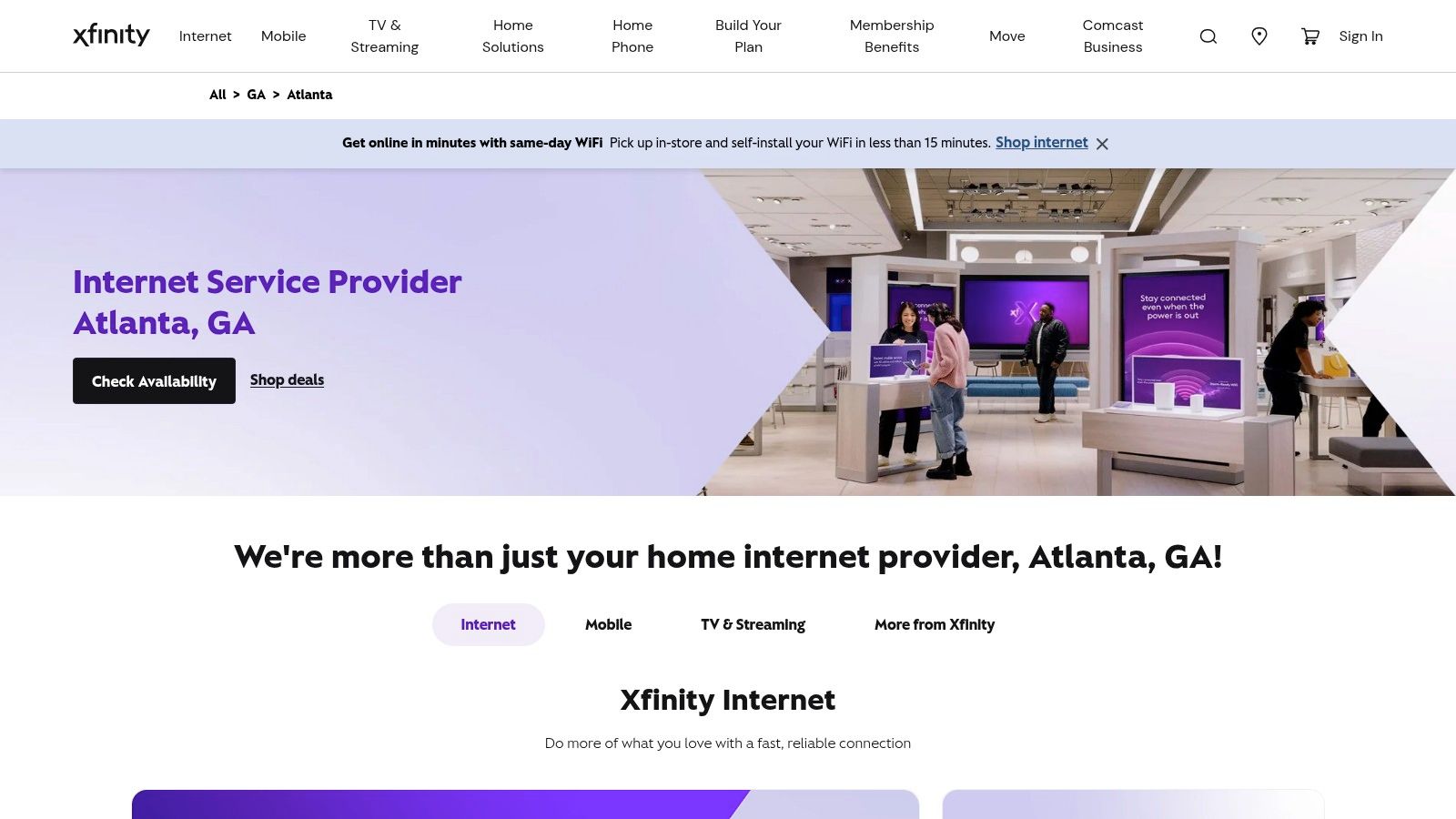
For institutional buyers, that does not make Comcast the automatic primary circuit. It makes Comcast a practical option for specific roles. Cable broadband can work well for administrative offices, satellite clinics, call centers, student services, and temporary sites that need business connectivity fast. It is less attractive for buildings that push large volumes of imaging data, run constant offsite replication, or need strict performance commitments written into the contract.
Where Comcast Business fits
Comcast Business is usually strongest in three scenarios.
First, it works for locations where deployment speed matters more than getting dedicated fiber on day one. Second, it fits sites with normal office traffic patterns and moderate upload demand. Third, it can serve as a secondary path in a failover design when the primary circuit comes from another carrier with a separate local access route.
That distinction matters in Atlanta. Hospitals, universities, and data-heavy facilities should separate broadband convenience from carrier-grade assurance. Ask Comcast Business the questions that determine whether the service belongs at the edge of the network or in a mission-critical role:
- Is the product shared broadband or a dedicated business service with contractual uptime and repair terms?
- What upstream performance should the site expect during peak utilization?
- Can Comcast deliver a physically diverse entrance if the building later adds a second carrier?
- How are trouble tickets escalated for business accounts that support clinical, academic, or operational systems?
- If the site needs failover, will Comcast be the primary path, the backup path, or only a temporary bridge until fiber is installed?
Comcast also has an advantage procurement teams care about. The buying process is familiar, and the local Xfinity Atlanta service page makes address qualification straightforward.
The trade-off is service class. Cable can support day-to-day business operations well, but it is still a best-effort platform unless you are buying a product with stronger business commitments. For a university lab, imaging center, or colocation environment, that difference affects outage planning, application performance, and how much risk the organization is accepting.
I would treat Comcast Business as a practical tool, not a blanket answer. It can solve immediate coverage problems, support branch operations, and fill the backup role effectively. For sites with strict uptime targets, formal SLAs, or heavy upstream traffic, validate the contract terms, restoration language, and failover design before you put it into production.
If the rollout also includes replacing legacy edge gear, voice circuits, or demarc hardware, plan the physical transition work early and line it up with business telecom repair and retirement support.
3. Google Fiber (GFiber)
A university satellite campus opens a new lab in Midtown. The network team needs high upstream capacity for research data, low administrative friction, and a service that can be installed without a long custom quoting cycle. If GFiber is lit in that building, it often makes the shortlist quickly.
Google Fiber stands out in Atlanta because the offer is relatively simple and the underlying service is fiber. For single sites that need strong upload performance, that combination can work well. The limitation is reach. GFiber is still a building-by-building opportunity, which matters a lot for hospital systems, higher education networks, and operators trying to standardize service across multiple addresses.

Where GFiber fits best
GFiber is usually strongest at sites that need business-grade bandwidth but do not need the contract structure of dedicated internet access. Good examples include outpatient facilities, academic departments, startup R&D spaces, administrative offices, and smaller technical teams moving large files to cloud platforms.
Its appeal is practical:
- Symmetrical fiber service: Upload-heavy workflows such as backups, imaging transfer, research collaboration, and cloud replication benefit from balanced speeds.
- Cleaner buying process: Teams that want to avoid complicated plan packaging often find GFiber easier to evaluate.
- Good alignment with modern internal networks: Multi-gig environments can make better use of fiber service than older LANs that bottleneck at lower speeds.
- Straightforward availability check: The first filter is always the Google Fiber Atlanta page.
Institutional buyers should still be careful about service class. For a medical office or academic department, GFiber may be fully adequate. For a hospital core site, major university hub, or data center workload, the central question is whether the service terms, escalation path, and restoration commitments match the business impact of an outage.
That is why I would not treat GFiber as a default standard across an Atlanta portfolio. I would treat it as a selective fit where the building is serviceable and the workload can tolerate broadband-style support boundaries. If a site runs clinical applications, sensitive research systems, or inter-campus traffic with hard uptime targets, compare GFiber directly against DIA options and require a documented failover design before approval.
A simple evaluation checklist helps:
- Does the location qualify today, not just the neighborhood?
- Is this for primary access, backup access, or a temporary service during construction?
- What SLA, if any, applies to the exact product being quoted?
- How will traffic fail over if the local fiber path is cut?
- Does the site need managed handoff, static addressing, or support coordination with internal telecom teams?
If the deployment includes replacing older edge hardware, demarc gear, or campus telecom components, line that work up early with local telecom system support services. That reduces cutover risk and keeps the provider turn-up from getting blocked by on-site infrastructure problems.
4. Verizon 5G Home Internet / 5G Business Internet
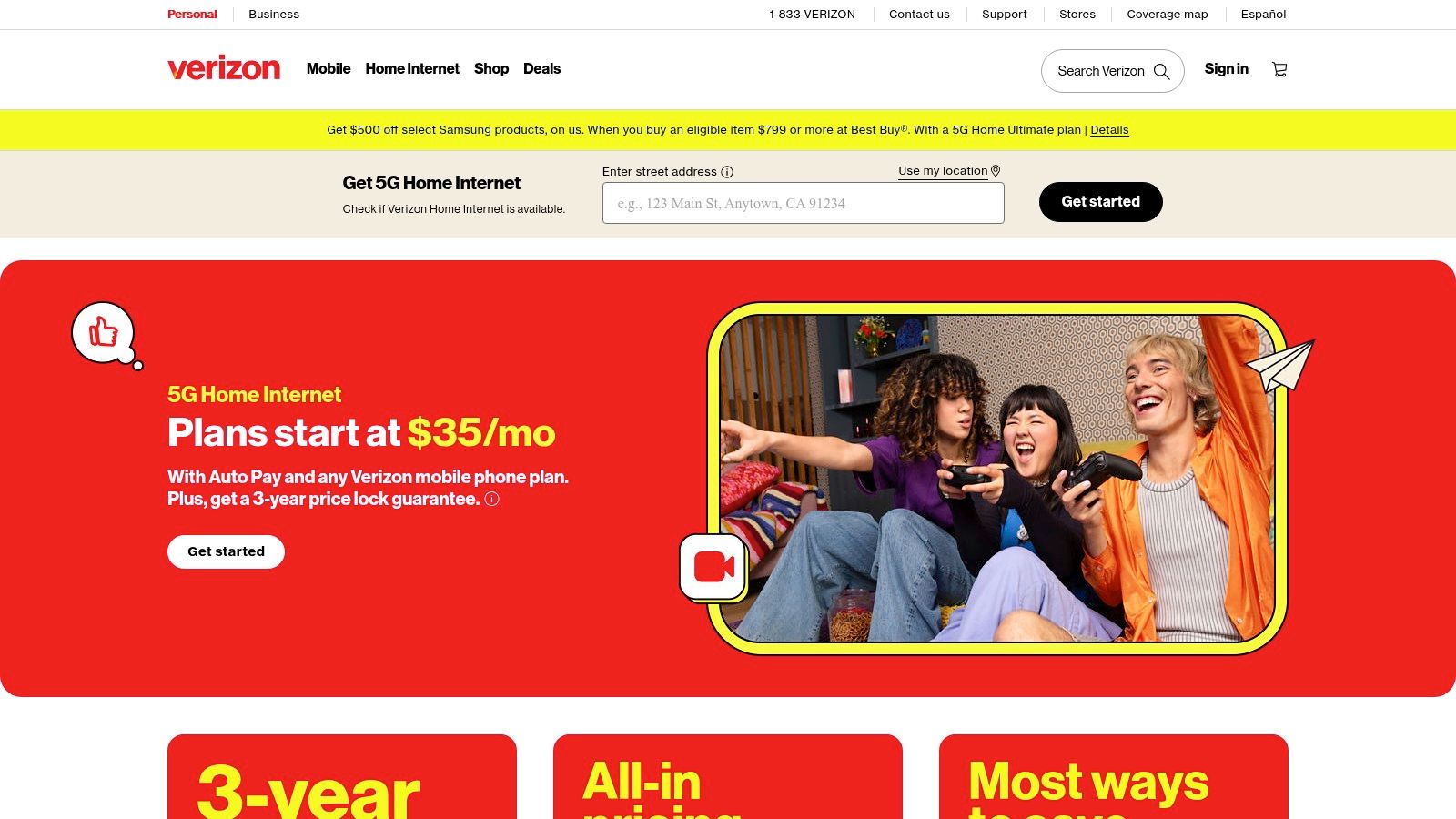
A hospital opens a temporary imaging suite while waiting on a carrier build. A university needs connectivity in leased swing space before the semester starts. A data center operator wants an out-of-band backup path that does not ride the same local fiber route as the primary circuit. Those are the kinds of Atlanta deployments where Verizon 5G starts to make sense.
Verizon's fixed wireless products are best treated as fast-turn connectivity, secondary access, or a bridge while a wired service is still in provisioning. For institutional buyers, the main question is not peak speed. It is whether the service can support the site's role, the failover design, and the operational consequences of a wireless last mile. Verizon's 5G internet platform is the starting point for product details, but the approval decision should come from site testing and risk tolerance.
Best use cases for Verizon
For Atlanta institutions, Verizon usually fits in three practical roles:
- Interim service during construction or carrier delays: Useful when a clinic, department, or support office must go live before fiber is delivered.
- Backup connectivity with physical path diversity: A wireless secondary can reduce the risk of a single conduit cut taking down both circuits.
- Temporary or flexible sites: Good for project offices, leased facilities, event operations, and other locations where long contract terms or build costs do not pencil out.
The trade-off is consistency. Wireless performance depends on signal quality, building materials, rooftop and window exposure, local congestion, and the exact placement of the receiving equipment. In a dense medical campus or a concrete-heavy university building, those variables matter more than the advertised speed tier.
That is why I would not approve Verizon 5G as the sole primary connection for a hospital core, major research environment, or data-intensive data center workflow without a documented test result and a fallback plan. For those sites, procurement teams should ask a tighter set of questions than they would for a small office broadband order.
A practical checklist helps:
- Has Verizon tested the exact suite, floor, or equipment location, not just the street address?
- Is this service intended for primary access, backup access, or short-term use during a wired build?
- What uptime commitment, support path, and restoration terms apply to the business product being quoted?
- How will traffic fail over, automatically or manually, if the wireless link degrades?
- Will the site need static IPs, firewall changes, external antenna work, or coordination with internal network teams?
If the project also includes replacing edge hardware, demarc equipment, or older campus telecom gear, line that up early with telecom system support for cutover coordination. That keeps the wireless turn-up from getting delayed by on-site infrastructure issues.
5. T-Mobile 5G Home Internet
T-Mobile's 5G Home Internet is the low-friction option in this lineup. For buyers who care about easy onboarding and fast activation, that matters. It's especially practical for small facilities, temporary locations, project offices, and backup circuits that don't need the procurement complexity of enterprise fiber.
This isn't the product I'd choose first for a mission-critical hospital core or data-intensive research environment. It is a product I'd consider when the requirement is fast, workable connectivity with minimal setup burden, especially if the location already performs well on T-Mobile's mobile network. The starting point is the provider's 5G home internet service page.
Where T-Mobile fits and where it doesn't
T-Mobile's value is operational simplicity. Self-install, gateway-based deployment, and straightforward service activation can help teams avoid the delays that come with more engineered wired builds.
That makes it a reasonable option for:
- Temporary and swing space: Good for offices, labs, or clinics in transition.
- Failover planning: Useful as a backup path when you want diversity from a wired primary.
- Lower-risk office traffic: Email, SaaS, web applications, and basic collaboration often fit well when local 5G conditions are strong.
The limits are just as important. Wireless performance can shift with congestion, interior building conditions, and RF characteristics that don't show up on marketing pages. If your workflows depend on tight latency, stable throughput, or formal support commitments, T-Mobile usually belongs in the backup conversation, not the main production one.
For internet service providers Atlanta buyers evaluating fixed wireless, this is the key distinction. Fast to deploy doesn't mean suitable for every facility class. T-Mobile is often a smart tactical service. It's rarely the final strategic answer for high-dependency institutions.
6. EarthLink (Fiber and 5G Home Internet)
A hospital annex, research lab, or temporary university site often needs service fast, but procurement still has to answer a harder question. Who owns the connection, who fixes it when it fails, and what service commitments apply once the circuit is live?
EarthLink is worth considering in Atlanta when the goal is to simplify sourcing across more than one access type. It offers fiber and wireless-branded options through a single sales channel, which can reduce procurement friction for smaller sites or secondary locations. That convenience matters. For institutional buyers, though, convenience is only part of the decision.
The bigger issue is service model clarity. EarthLink often acts as the customer-facing brand while the underlying access is delivered over another carrier's infrastructure. That can be perfectly workable for branch offices, swing space, and lower-risk administrative locations. It requires tighter diligence for hospitals, universities, and data centers that need clean escalation paths and clear SLA accountability.
The real trade-off with EarthLink
EarthLink fits buyers who want one commercial relationship and are comfortable validating the underlying network details before signing. The right use case is usually a site where deployment speed and buying simplicity matter more than owning a direct relationship with the last-mile carrier.
Its strengths are practical:
- Multi-access procurement: Fiber and wireless options can shorten early-stage vendor evaluation.
- Single front-end relationship: One sales and support entry point can help lean IT and procurement teams.
- Useful for secondary sites: A reasonable option for clinics, admin offices, temporary facilities, or backup connectivity.
- Direct service inquiry path: Availability and product mix are handled through the EarthLink internet service page.
The limits are just as important. If EarthLink is reselling or aggregating service, install intervals, dispatch control, and fault isolation may depend on the underlying carrier. That can slow decision-making during an outage unless responsibilities are spelled out in the contract and support workflow.
For institutional Atlanta buyers, the evaluation checklist should be concrete:
- Confirm last-mile ownership: Ask which carrier delivers the physical access at each address.
- Review the SLA in writing: Check uptime commitments, mean time to repair, credit structure, and support hours.
- Map the escalation path: Identify who opens tickets, who dispatches field technicians, and who owns coordination across providers.
- Test failover design: If EarthLink is a secondary path, verify that it is physically and logically diverse from the primary circuit.
- Match the service to site criticality: Use it differently for an admin office than for a clinical floor, campus core, or data center edge.
If the project also includes circuit turnover, demarc changes, or hardware removal, coordinated field support helps avoid delays during cutover. That is where telecom maintenance services in Atlanta can support a cleaner transition.
EarthLink can be a sensible option. Institutional teams just need to buy it with eyes open, especially when uptime, failover performance, and multi-party support accountability carry real operational risk.
7. Zayo – Dedicated Internet Access (DIA)
A hospital in Midtown, a university research network, and a colocated data center in Atlanta can all buy "internet," but they are not buying the same risk profile. Zayo belongs in the conversation when circuit failure, packet loss, or slow carrier escalation can disrupt clinical systems, campus operations, or customer-facing infrastructure.
Zayo is an enterprise carrier decision, not a consumer broadband comparison. For institutional buyers, the main question is whether a site needs dedicated access with enforceable service terms, predictable performance, and a support model built for high-impact outages.

Why DIA changes the buying process
Dedicated Internet Access shifts the evaluation from advertised download speed to service guarantees. Buyers need to examine committed bandwidth, latency expectations, mean time to repair, credit terms, and how faults are escalated when the circuit supports a core facility.
Zayo is often a fit when the requirement looks like this:
- Dedicated symmetrical capacity: Better for sustained utilization and predictable application performance than shared broadband.
- Enterprise network options: Dark fiber, Ethernet, and transport services support hospital campuses, university environments, and data-center interconnect needs through Zayo's network platform.
- Stronger accountability: DIA contracts usually provide clearer operating commitments than mass-market internet plans.
- Planned redundancy: Zayo is frequently evaluated as either a primary circuit for a critical site or one leg of a diverse failover design.
Institutional buyers in Atlanta should press beyond the quote and use a short evaluation checklist before signing:
- Confirm access method at each location: On-net buildings, near-net extensions, and construction requirements change both lead time and cost.
- Review the SLA line by line: Focus on uptime language, repair intervals, exclusions, and how service credits are calculated.
- Validate diversity claims: Ask whether primary and backup paths are physically separate, not just billed by different providers.
- Check routing and handoff details: Make sure the service matches firewall, BGP, and data-center cross-connect requirements.
- Match DIA only to sites that need it: A campus core, imaging center, or production data hall has different requirements than an admin office.
Many Atlanta ISP roundups miss that distinction. They compare monthly rates and top-line speeds, while institutional teams need to compare outage exposure, failover behavior, and carrier accountability. Hospitals, universities, and data centers should treat the SLA as part of the service itself.
The primary trade-off is straightforward. DIA usually means higher monthly cost, longer implementation intervals, and more procurement review. In return, buyers get a service model that is easier to defend for critical operations.
If the project includes circuit turn-up, demarc work, rack changes, or retirement of legacy telecom gear, telecom maintenance services in Atlanta can help coordinate field work with the network cutover.
Top 7 Atlanta ISPs: Comparison
| Provider | 🔄 Implementation complexity | ⚡ Resource requirements & speed | 📊 Expected outcomes | 💡 Ideal use cases | ⭐ Key advantages |
|---|---|---|---|---|---|
| AT&T Fiber / AT&T Business Fiber | Moderate, professional fiber install for some addresses; business quoting required | Fiber ONT/gateway; multi‑gig options (up to 5 Gbps where available); no caps | Symmetrical multi‑gig speeds, low latency, reliable uploads | Cloud backups, telemedicine, offices needing high upload symmetry | Strong metro coverage, multi‑gig availability, business bundles |
| Xfinity (Comcast) / Comcast Business | Low, typically fast install if serviceable | DOCSIS gateway; easily uses existing coax; business add‑ons (static IP, LTE backup) | High download speeds, asymmetric uploads (lower than fiber) | Sites needing fast turnup where fiber unavailable; businesses needing backup | Quick installs, broad coverage, business features (static IPs, 24/7 support) |
| Google Fiber (GFiber) | Low, simple install and transparent, no‑contract pricing where available | ONT/gateway included; posted pricing for 1G/2G; no data caps | Stable symmetrical 1–2 Gbps (predictable performance) | Heavy upload workflows, predictable billing needs | Clear pricing, strong customer experience, symmetrical speeds |
| Verizon 5G Home / 5G Business Internet | Very low, rapid deployment, little physical work; depends on signal | 5G gateway; minimal onsite wiring; quick activation | Variable: fast in strong 5G coverage; performance affected by congestion | Rapid deployment, temporary sites, failover for offices awaiting wired builds | Fast turnup, relocation flexibility, feasible primary or backup in strong signal areas |
| T‑Mobile 5G Home Internet | Very low, self‑install gateway; simple onboarding | Gateway included; no annual contract; five‑year price guarantee often advertised | Variable throughput tied to local 5G strength; may be inconsistent indoors | Cost‑sensitive sites, temporary deployments, basic failover | Easy self‑install, low friction, strong value where 5G is robust |
| EarthLink (Fiber & 5G options) | Moderate, reseller setup; availability and tech vary by address | Depends on underlying carrier (fiber or 5G); single vendor point of contact | Matches underlying network performance (fiber or fixed wireless) | Customers wanting one vendor for multiple last‑mile types and concierge support | One‑stop storefront, concierge sales/support, no caps on many plans |
| Zayo – Dedicated Internet Access (DIA) | High, quote‑based builds, longer lead times, formal onboarding | Dedicated fiber/DIA, CPE, SLAs, possible dark fiber; higher cost and contract terms | Guaranteed symmetrical bandwidth with SLAs, DDoS options, low latency | Hospitals, research campuses, multi‑site enterprises, regulated environments | Enterprise‑grade reliability, documented SLAs, scalable high‑capacity networking |
Finalizing Your Connectivity and Decommissioning Plan
The best internet service providers Atlanta organizations choose depend less on advertising and more on operational tolerance for risk. If your site can absorb occasional inconsistency, broadband and fixed wireless may be perfectly acceptable. If your site supports clinical workflows, research continuity, security-sensitive data, or multi-site backbone traffic, you need to evaluate fiber, DIA, and failover architecture much more carefully.
A practical buying process usually starts with four questions. What applications break first when latency rises or uploads slow down? How much downtime can the facility tolerate? Who owns escalation when service fails? And is this circuit a convenience service, an important service, or a mission-critical service? Those answers narrow the shortlist quickly.
For many institutions, the right answer isn't one provider. It's a primary and backup design. A hospital might choose fiber as the main circuit and wireless as failover. A university might standardize on one provider for broad campus coverage while using DIA for core data paths. A smaller clinic may decide that fast-turn cable or wireless is enough for the site's risk profile. The point is to match the circuit to the consequence of failure.
Procurement teams should also force clarity on details that don't appear in marketing copy. Ask whether bandwidth is dedicated or shared. Ask what support path exists after hours. Ask whether construction is required. Ask how the provider handles failover, static addressing, and handoff types. And ask for serviceability by exact address, not by neighborhood assumptions.
There's also a lifecycle issue that often gets missed. New connectivity projects usually trigger retirement of old firewalls, switches, routers, storage, servers, handsets, and other electronics. In lab and healthcare settings, those transitions can involve devices that still contain sensitive data or require controlled disposal. That means your connectivity plan and your decommissioning plan should be built together, not separately.
Scientific Equipment Disposal supports that second half of the project for Atlanta organizations. S.E.D. handles compliant, sustainable disposal of retired IT equipment, laboratory assets, and electronics across the metro. The company also provides free hard-drive wiping using DoD 5220.22-M 3-pass sanitization, with shredding available for obsolete or nonfunctional media, helping hospitals, universities, corporate IT teams, and government agencies close out projects securely.
A strong connectivity decision keeps the facility running. A strong disposal partner finishes the job responsibly.
If your Atlanta facility is upgrading internet service, consolidating sites, or retiring old network and lab equipment, Scientific Equipment Disposal can help complete the project cleanly. S.E.D. supports hospitals, universities, corporate IT teams, and public agencies with secure equipment pickup, de-installation, compliant data destruction, and sustainable electronics recycling across the metro area.