IT Asset Disposal Services in Suwanee Georgia

If you're responsible for retired computers, old lab workstations, storage arrays, or a server room cleanout in Suwanee, the problem usually doesn't start with recycling. It starts with a room.
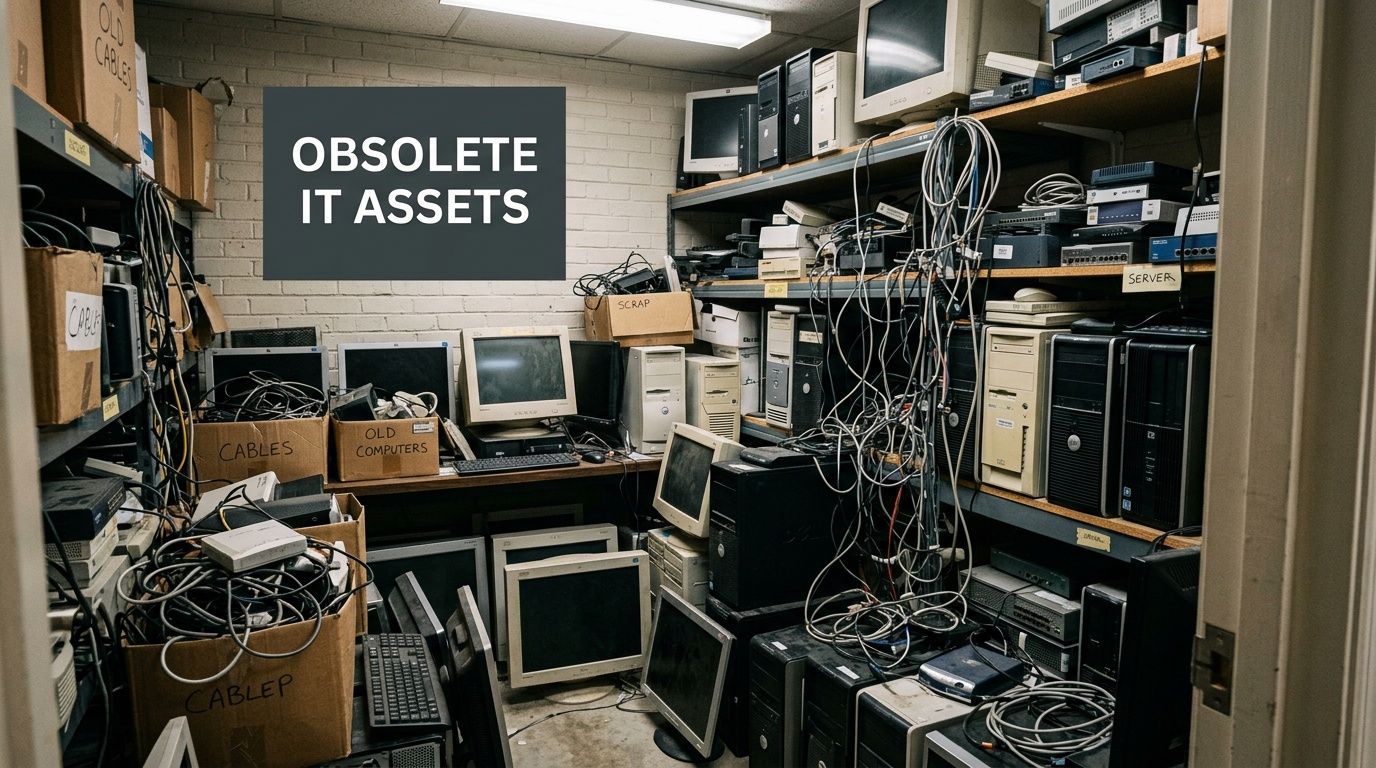
A storage closet fills up with decommissioned laptops. A back office has monitors stacked against the wall. The lab has outdated instruments with embedded drives no one wants to touch. The data center refresh is complete, but the old hardware is still sitting in racks because nobody wants to be the person who moves it without a documented chain of custody.
That hesitation is reasonable. Once an asset leaves your building, you're dealing with data risk, environmental handling, internal approvals, pickup logistics, and questions from compliance, facilities, and finance. In Gwinnett County, that mix shows up across healthcare groups, biotech operations, school systems, and growing corporate offices. The disposal job looks simple until you trace what can go wrong.
That's why IT Asset Disposal Services in Suwanee Georgia should be treated as an operational process, not a junk haul. A proper ITAD program handles pickup, inventory control, data destruction, value recovery when appropriate, and responsible recycling for what's left.
What to Do with Old IT Assets in Suwanee Georgia
A Suwanee IT refresh often feels finished right up to the moment the old equipment starts piling up. User accounts are closed, new machines are live, and then key questions hit. Who is signing off on data destruction, where do the retired assets wait, and which items still have recovery value instead of scrap value?
That is the point where a routine cleanup turns into an ITAD decision.
Desktops, laptops, switches, phones, servers, and lab-adjacent electronics all carry different risks. A physician group in Gwinnett may be worried about protected data on endpoint devices. A biotech operation off Satellite Boulevard may have specialized equipment with embedded storage and no clear internal owner for decommissioning. A private school or college department may need serial-level records for surplus control and public accountability. In each case, the disposal path needs to match the environment, not just the equipment list.
Why local businesses get stuck
The holdup usually comes from three operational gaps.
- Data uncertainty. Teams are not fully certain which assets still hold sensitive data, especially older desktops, copiers, network appliances, and specialized instruments.
- Removal workload. Internal staff rarely have the time or manpower to disconnect, sort, palletize, and stage equipment without disrupting daily operations.
- Documentation requirements. Facilities, compliance, finance, and IT all want different records, and the provider has to support all of them.
In Suwanee, those gaps show up in very specific ways. Healthcare offices need a disposal process that stands up to privacy scrutiny. Labs and manufacturers often have mixed loads that combine standard IT gear with niche electronics. School systems and training centers need orderly pickup windows and audit-ready reporting. Local experience matters because the challenge is rarely just recycling. It is coordinating the job inside an active building in metro Atlanta, with the right paperwork and the right handling steps.
What works
Treat retired equipment as a controlled disposition project from day one. Build an inventory that people can use. Separate assets into three lanes: devices with reuse value, devices that need verified data destruction, and equipment that has reached end of life. Then schedule pickup around site access, loading conditions, and whoever inside the organization needs to witness or approve release.
I give clients a simple rule. If your team cannot account for where the device came from, whether it stores data, and what should happen to it next, it should not leave the building yet.
That approach matters more in mixed environments, where a stack of office laptops may sit beside label printers, test equipment, AV hardware, or older medical peripherals. A provider offering electronics recycling services in Suwanee GA can help sort that material stream, but its key value lies in disciplined handling, clear records, and a pickup plan that fits how Suwanee businesses operate.
Understanding the Full ITAD Lifecycle from Pickup to Recycling
Most organizations understand disposal as a single event. Good ITAD work is closer to a reverse supply chain. The asset moves backward from productive use into controlled decommissioning, secure transport, data handling, possible recovery, and final recycling.
That structure matters because each stage solves a different problem. If one stage is weak, the whole chain gets shaky.
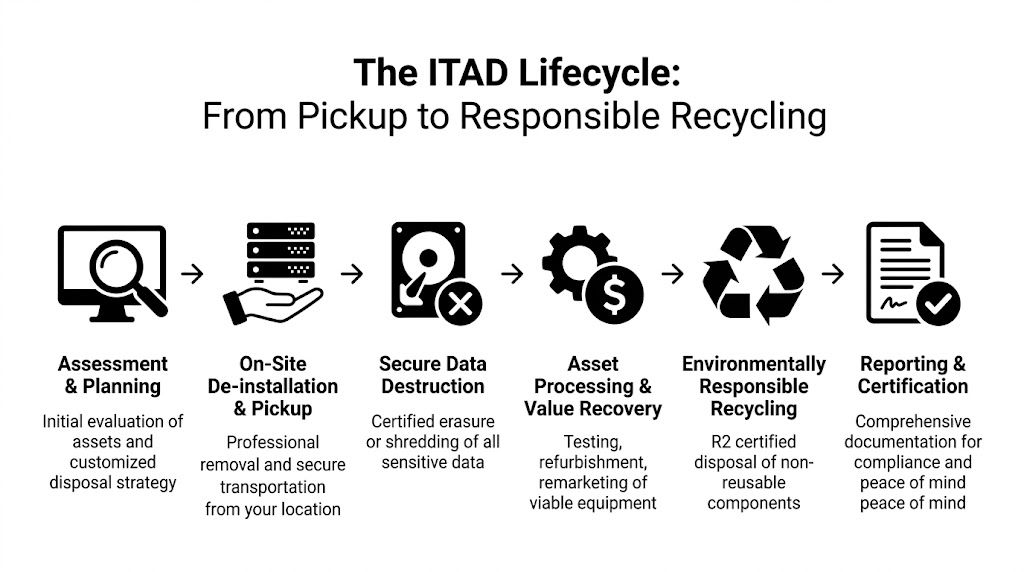
Assessment and planning
The first step is figuring out what you're dealing with. That means asset counts, device types, location constraints, data sensitivity, and timing.
A simple office cleanup is one thing. A hospital department move, school surplus event, or lab shutdown is another. In those jobs, the planning call usually needs to answer questions like these:
- Which items are still installed?
- Which items contain storage media?
- Which departments need serial-level records?
- What has to move after-hours or through restricted areas?
When providers skip this step, the project usually slips into confusion on pickup day.
De-installation and pickup
Physical removal is where many internal teams underestimate the workload. Pulling a few laptops from a closet is easy. Removing servers from racks, staging UPS units, disconnecting workstation clusters, or packing electronics from a research environment takes labor, sequencing, and care.
The best pickups are boring. The crew arrives with a list, tags assets, packs them securely, and clears the site without improvising. That's what you want.
Secure transport and receiving
Once assets are loaded, your exposure doesn't pause. Custody continues in transit and at intake. A serious provider logs the material, verifies what arrived, and reconciles pickup records against receiving records.
The handoff isn't the end of control. It's the point where documentation becomes more important.
If a vendor can't explain how transport, intake, and audit records connect, you have a gap.
Data destruction
This is the most scrutinized stage for good reason. Drives, SSDs, and embedded storage need a defined sanitization path. Functional media may be wiped and verified. Failed media or media designated for destruction should be physically destroyed.
The method should fit the media type and the compliance requirement. A provider's IT asset disposal process should make that clear before pickup, not after.
Value recovery and remarketing
Not every retired asset is scrap. Some equipment can be tested, refurbished, and remarketed. That's where a disciplined ITAD program can offset a portion of project cost rather than treating every item as waste.
But this only works when the provider can reliably sort what has residual value from what doesn't. Inflated promises here usually lead to disappointing settlements later. Conservative evaluation is better than optimistic guessing.
Recycling and final reporting
Non-reusable material moves into de-manufacturing and downstream recycling. Plastics, metals, and other recoverable materials are separated, and the unusable remainder is processed under compliant e-waste practices.
The last step is documentation. That often includes inventory reporting, destruction records, and certificates tied to the work performed. Without reporting, the project may be physically complete but still incomplete from an audit standpoint.
A full lifecycle approach is why IT Asset Disposal Services in Suwanee Georgia can support both local operations and larger regional rollouts. It gives IT, facilities, compliance, and finance a common process to work from instead of four separate assumptions about what "disposal" means.
Your Guide to Compliant Data Destruction in Georgia
For most organizations, old hardware isn't the primary problem. Residual data is.
A retired laptop in a closet is already a security issue. A hard drive that leaves your building without a documented sanitization method is a much larger one. In Georgia, that concern hits hardest for hospitals, clinics, labs, universities, government contractors, and any business holding regulated or confidential information.
The reason is simple. If the media still contains recoverable data, disposal hasn't happened. Storage has just changed locations.
When software wiping makes sense
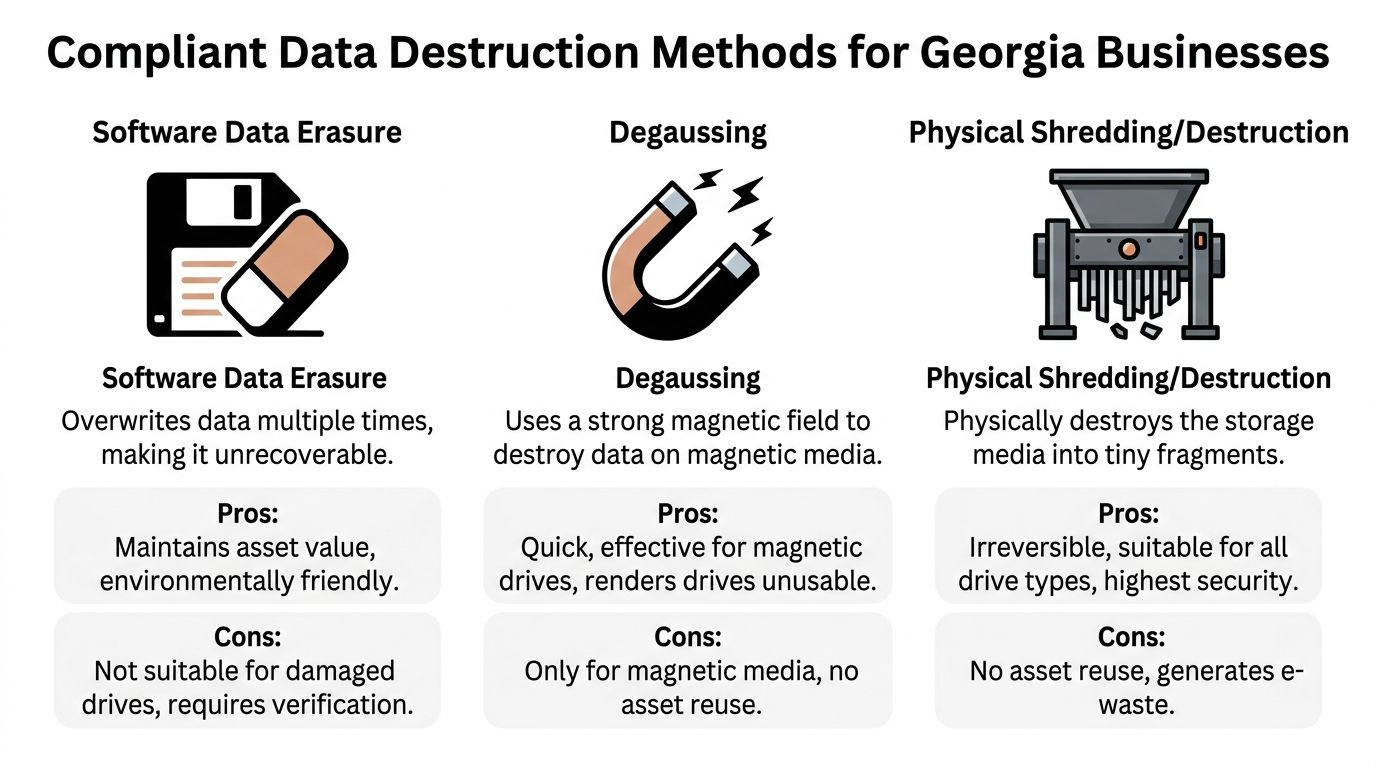
For working hard drives, software sanitization can be the right choice. One established method in Georgia ITAD work is DoD 5220.22-M 3-pass sanitization, which overwrites data three times to make it irrecoverable. According to Beyond Surplus on secure IT asset disposal in Georgia, this method is a cornerstone of secure ITAD, and it's often offered free by compliant providers.
Software wiping has two major advantages. It preserves the asset for possible reuse or remarketing, and it reduces unnecessary physical destruction. For organizations trying to recover value from usable desktops, laptops, or enterprise drives, that's a practical path.
But wiping only works when the media is functional and the process is verified. If a drive can't complete the wipe cycle or can't be read reliably, the plan has to change.
Where degaussing fits
Degaussing uses a strong magnetic field to disrupt magnetic media. In practical terms, it's a destruction method for magnetic storage, not a reuse method.
It can be effective in the right environment, but it's not universal. It doesn't apply to all media types, and once used, the drive is typically no longer suitable for resale or redeployment. That makes it less attractive when asset recovery matters.
For many businesses, degaussing also creates a documentation challenge. If the provider uses it, ask how the result is logged, how the media is tracked by serial, and how that event appears in your final reporting.
When physical shredding is the safer call
Physical destruction is usually the right answer for failed drives, damaged media, highly sensitive assets, and projects where reuse isn't worth the risk discussion.
The same Georgia source notes that for nonfunctional media, physical shredding to less than 2mm particles follows NAID AAA standards, with serialized certificates documenting asset serials, destruction date, and method. That matters in environments where audit trails and chain-of-custody records carry as much weight as the destruction event itself.
For highly regulated organizations, shredding is often the cleanest internal answer because it reduces ambiguity. There is no future question about remarketing, reallocation, or latent recoverability.
If your team is debating whether a questionable drive should be wiped or destroyed, the real issue is usually risk tolerance, not technology.
What Georgia buyers should ask for
The strongest data-destruction programs don't just perform a task. They create a record your organization can defend later.
Ask any provider these questions before the truck arrives:
- Which media will be wiped. Get clarity on HDDs, SSDs, failed drives, and embedded storage.
- How failed media is handled. A good answer should identify the fallback method.
- How verification is recorded. You want traceability, not a blanket statement.
- Whether the certificate is serialized. Asset-level detail matters more than a generic confirmation.
- Who maintains custody. If multiple subcontractors touch the load, your risk picture changes.
Why the stakes are high for healthcare and labs
For HIPAA-covered entities, the consequences of weak data handling can be severe. The same Georgia data destruction source states that the average cost of a single incident reached $10.1 million in 2023. That's why disposal projects involving patient systems, lab PCs, imaging workstations, or instrument controllers need more than casual assurances.
In healthcare and research settings, I've seen the riskiest devices overlooked because they don't look like typical IT assets. An analyzer workstation, a freezer controller with storage, or a retired nurse station terminal can carry just as much risk as a server.
A provider offering secure hard drive destruction in Suwanee GA should be able to talk through those edge cases clearly. If they only discuss office PCs and laptops, they may not understand your environment well enough.
On-Site De-Installation and Logistics for Metro Atlanta Businesses
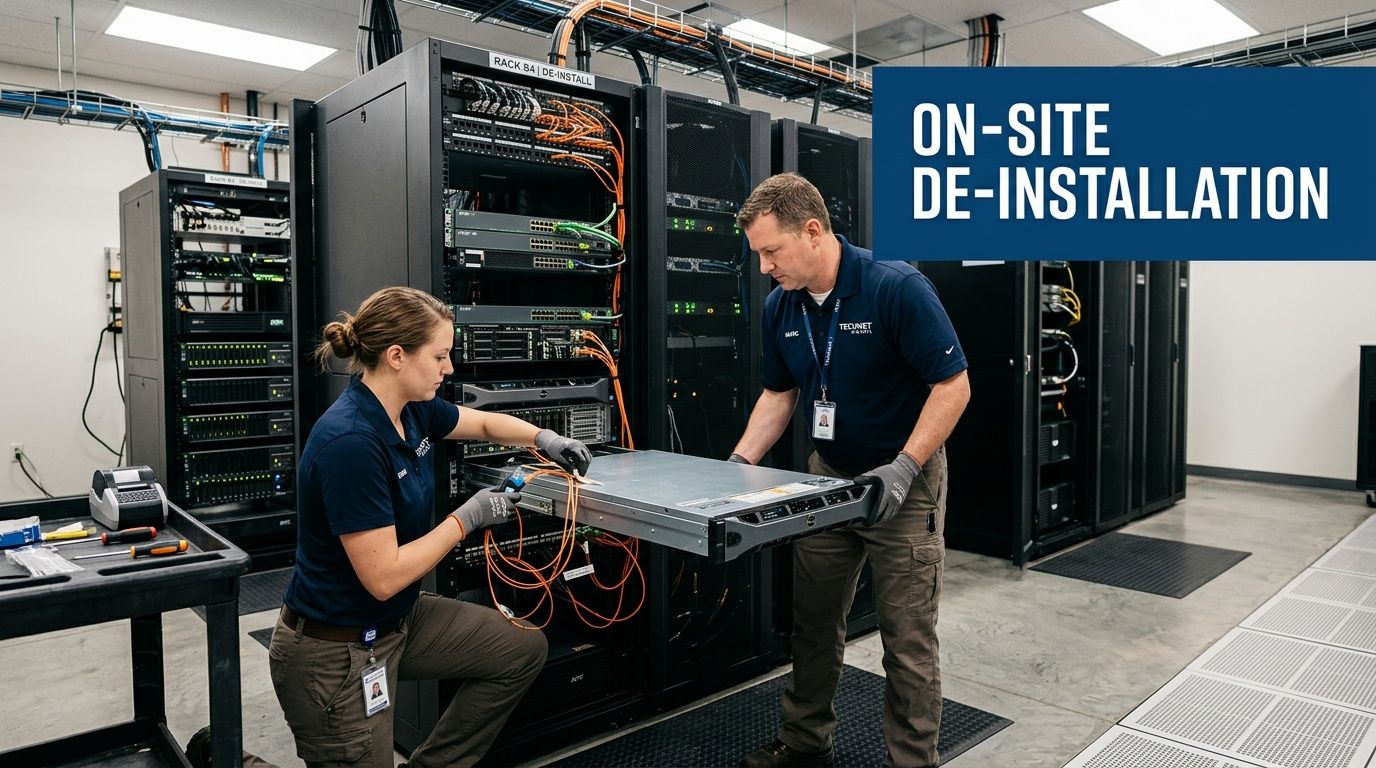
The logistics side of ITAD is where projects either stay controlled or drift into avoidable risk. In Suwanee and the broader Atlanta metro, many organizations don't just need a pickup. They need a team that can enter an active facility, remove equipment without disrupting operations, and keep a clean custody trail from the rack or desk to the truck.
That matters for healthcare campuses, school districts, labs, manufacturing sites, and offices with mixed equipment in multiple rooms. Once staff starts carrying loose devices through hallways without tagging, packing, or signoff, you've lost the discipline that makes the rest of the process defensible.
What good on-site work looks like
Professional de-installation should feel methodical. Equipment is identified, disconnected in the right sequence, packed by type, and staged for removal without mixing audited assets with miscellaneous scrap.
The basic signs of a disciplined crew include:
- Clear asset segregation. Data-bearing devices are handled separately from cables, peripherals, and non-sensitive material.
- Inventory control at the point of removal. Tagging and recording should happen before items disappear into carts or bins.
- Protective packing. Reusable equipment and sensitive electronics need more than loose stacking in the truck.
- Site coordination. Loading dock timing, elevator access, badge procedures, and department contacts should already be known.
Why chain of custody starts inside your building
Many buyers think chain of custody begins when the truck doors close. It starts earlier.
The chain starts when the asset is identified for disposition, removed from service, and transferred to the disposal team. If your provider uses subcontracted labor, borrowed vehicles, or loosely supervised day-of crews, that handoff can become the weakest point in the project.
A documented chain of custody should survive basic questions from legal, compliance, and internal audit without anyone guessing.
That usually means preferring providers that control their own pickup operations and can explain exactly how assets move from your room to their processing facility. If you're comparing vendors, ask them to walk you through the operational sequence, not just the paperwork. A practical overview of how the process works is useful, but the true measure is whether the field team adheres to it.
Special considerations for Atlanta-area facilities
Metro Atlanta businesses often have constraints that national call-center vendors underestimate. Tight parking, medical access corridors, school calendar restrictions, active labs, and phased office moves all affect how removal should be scheduled.
For local projects, these details matter more than polished marketing language:
| Facility type | Logistics issue | What to confirm |
|---|---|---|
| Hospital or clinic | Restricted patient areas | Who enters, when, and how assets are staged |
| University or school | Multi-building pickups | Whether inventory is handled by room, building, or department |
| Data center or server room | Rack de-installation | Whether the crew removes installed equipment safely |
| Lab or research site | Mixed asset types | Whether IT and lab electronics can be packed separately |
The best logistics plan is usually the least dramatic one. It respects your site, keeps assets controlled, and leaves no confusion about what was removed.
The Role of R2 Certification and Sustainable E-Waste Recycling
A Suwanee organization can do the hard part right. Drives are destroyed, inventory is signed off, the pickup is documented. Then the remaining equipment goes into an opaque recycling stream, and the disposal risk shifts from your server room to someone else's warehouse. That is why R2 matters.
What R2 certification tells you
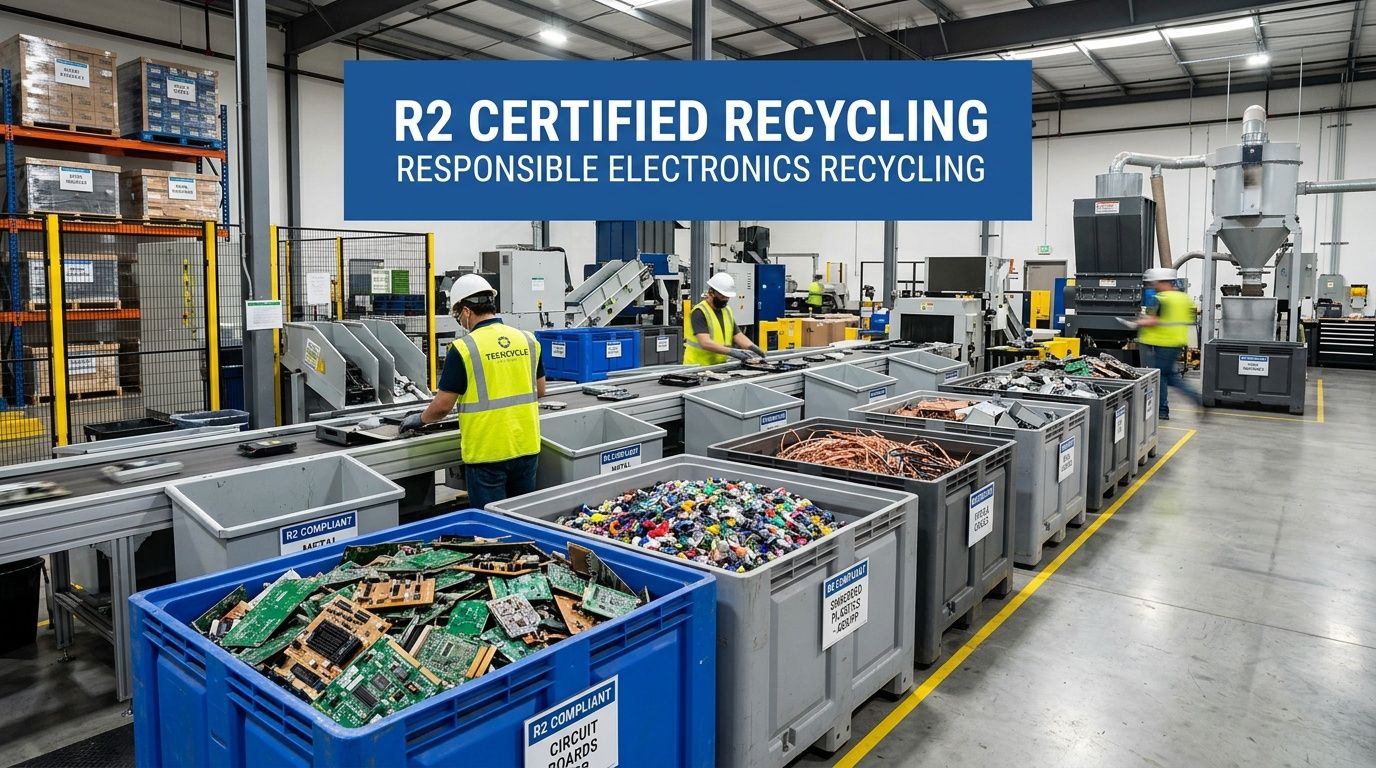
R2 stands for Responsible Recycling. For a facilities manager or IT director, the practical value is straightforward. It shows the recycler is operating under audited procedures for intake, tracking, testing, downstream vendor control, worker safety, and environmental handling.
That does not make every R2-certified provider equal. It does give you a better starting point than a general junk hauler, metal buyer, or office cleanout crew that happens to take electronics. In the Atlanta market, that distinction matters because retired assets from healthcare clinics, biotech labs, universities, and corporate offices often include a mix of reusable equipment, scrap material, batteries, and devices that need tighter handling than standard waste streams allow.
Suwanee businesses benefit from having access to local providers with established electronics processing operations. A qualified e-waste recycling company for metro Atlanta organizations should be able to explain its certifications, processing path, and downstream controls without resorting to vague sustainability language.
Where uncertified recycling creates risk
I see one mistake often. Teams focus on data destruction and assume the environmental side will sort itself out. It will not.
If a provider wipes or shreds drives correctly but sends the rest of the load through poorly controlled downstream vendors, your organization still carries reputational and compliance exposure. That is a real concern for Suwanee healthcare groups managing regulated devices, for biotech firms with specialized lab-adjacent electronics, and for schools that answer to public oversight.
Ask direct questions:
- How are non-reusable assets dismantled and separated by material type?
- Who receives commodities or residual components after initial processing?
- How are batteries, CRTs, and other higher-risk items handled?
- What documentation is available if your compliance team or board asks where the material went?
Clear answers usually reflect a controlled operation. Evasive answers usually reflect the opposite.
Sustainable recycling starts with sorting, not slogans
The strongest ITAD programs in North Fulton and Gwinnett do not treat every retired device the same. They sort first. Reusable systems are tested for remarketing or redeployment. True end-of-life equipment goes to material recovery. Hazardous or low-value residuals are processed through approved channels.
That order matters for both environmental performance and cost control. A laptop with resale value should not be shredded out of habit. A failed UPS battery should not be packed like ordinary scrap. A mixed pallet from a school, clinic, or lab needs triage before it becomes a recycling load.
For Suwanee organizations with ESG reporting, grant requirements, procurement standards, or board scrutiny, sustainable e-waste recycling is a documentation issue as much as an environmental one. The goal is simple. Know what left your site, know what could be reused, and know where the rest was processed.
How to Choose the Right ITAD Provider in the Suwanee Area
By the time you're comparing vendors, the main issues are already clear. You need secure data handling, reliable pickup logistics, defensible documentation, and a recycling path that won't create new problems later. The challenge is that many providers sound similar until you ask specific questions.
Buyers in Suwanee can save themselves a lot of trouble. Don't evaluate a provider by the homepage language. Instead, evaluate them by how well they answer operational questions tied to your actual asset mix.
Start with your environment, not the vendor pitch
A medical lab, a school district, and a corporate office can all ask for IT Asset Disposal Services in Suwanee Georgia, but the project scope isn't the same.
If you're in healthcare, focus on media handling, certificates, and site access controls. If you're in higher education, ask about multi-building pickups, surplus coordination, and inventory by department. If you're managing a biotech or research facility, ask whether the provider can handle mixed loads that include both IT gear and lab-adjacent electronics without turning the job into a sorting problem for your staff.
The right provider for your organization is the one that understands your environment without needing it explained three different ways.
Ask cost questions early
Many small and midsized organizations struggle here because pricing is often vague. One verified market gap is that buyers are frequently left guessing about asset recovery, disposal charges, and what remarketing may offset. According to Equip Recycling's IT asset disposition discussion, an important unanswered budgeting question involves value recovery models such as $0.20-$0.50/lb for resale-eligible servers and how that can offset disposal costs by 25-40%.
That doesn't mean every project will land in that range. It does mean you should ask vendors to explain the model in plain terms:
- What gets charged as a disposal item
- What may qualify for recovery
- When pickup is included
- How settlement reporting is delivered
- What destroys value unnecessarily
A provider that can't explain pricing logic usually won't explain settlement results clearly either.
Checklist for vetting providers in Georgia
Use this table in vendor calls and site visits.
| Area of Inquiry | Key Question to Ask | Why It Matters |
|---|---|---|
| Data destruction | How do you handle working drives, failed drives, SSDs, and embedded media? | You need the method to match the media and your compliance needs |
| Documentation | Do you provide serialized destruction records and final reporting tied to the inventory? | Generic certificates don't help much in an audit |
| Logistics | Do you use your own crews and vehicles for pickup and de-installation? | Fewer handoffs usually mean tighter custody |
| Site services | Can you remove installed servers, lab-adjacent electronics, or equipment in restricted areas? | Many providers only want dock-ready pallets |
| Value recovery | How do you determine what can be refurbished or remarketed? | Realistic recovery expectations matter for budgeting |
| Recycling standards | What certifications and downstream controls govern non-reusable assets? | Environmental risk doesn't end with pickup |
| Local coverage | How often do you service Suwanee and the Atlanta metro? | Local familiarity helps with scheduling and access constraints |
| Communication | Who owns the project from scheduling through final report delivery? | Diffuse responsibility causes delays and mistakes |
What separates a workable partner from a risky one
In practice, good providers are specific. They can tell you what happens to a failed SSD, who removes rack-mounted equipment, how a certificate is generated, and when you'll receive final records.
Weak providers rely on broad claims like "secure," "green," or "full service" without showing the mechanics. That's where projects go sideways. The vendor may still pick up the material, but your team is left chasing answers after the fact.
For Atlanta-area organizations with both IT assets and lab electronics, one local option is Scientific Equipment Disposal's e-waste recycling services. Based in the Norcross area, the company handles business-to-business electronics and lab equipment disposal, provides on-site de-installation and pickup through its own fleet, and offers DoD 5220.22-M 3-pass hard-drive wiping with shredding for obsolete or nonfunctional media. That kind of mixed-asset capability can be useful for hospitals, labs, universities, and research facilities that don't want separate disposal vendors for each category of equipment.
The local decision standard I recommend
If I were advising a facilities manager or IT director in Suwanee, I'd keep the final decision simple. Choose the provider that gives you confidence in five areas:
- They understand your asset mix.
- They can maintain custody from room to final processing.
- They can explain data destruction without hand-waving.
- They document the outcome in a way your organization can retain.
- They speak plainly about cost and recovery.
Everything else is secondary.
A disposal project should leave your building cleaner, your records stronger, and your risk lower. If a vendor can't make that feel straightforward during the quoting process, it probably won't feel straightforward on pickup day either.
If you're planning a server refresh, office cleanout, lab decommission, or secure electronics pickup in the Atlanta metro, Scientific Equipment Disposal is one business-focused option to review. The company serves Suwanee-area organizations with on-site pickup, de-installation, compliant data destruction, and responsible recycling for IT and laboratory assets.