Electronics Recycling Services in Suwanee GA: A B2B Guide

A lot of Suwanee-area organizations are dealing with the same scene right now. A back room holds retired desktops, a few old switches, dead UPS units, failed laptops, and maybe a lab bench with instruments nobody wants to move because no one is sure what data is still on them, who owns the assets, or what rules apply.
That pile is not just clutter. For a hospital department, university lab, or corporate IT team, it’s a mix of data exposure, chain-of-custody risk, and operational drag. Electronics Recycling Services in Suwanee GA matter most when the equipment is tied to patient records, research data, regulated workflows, or a facility shutdown schedule that won’t wait.
The Challenge of Surplus Electronics for Suwanee Businesses
In practice, the problem usually starts small. One server refresh leaves a few racks of old hardware. A lab replaces incubators and PCs attached to instruments. A clinic moves locations and keeps outdated workstations “for now.” Then “for now” becomes months, and the storage area turns into a compliance issue.
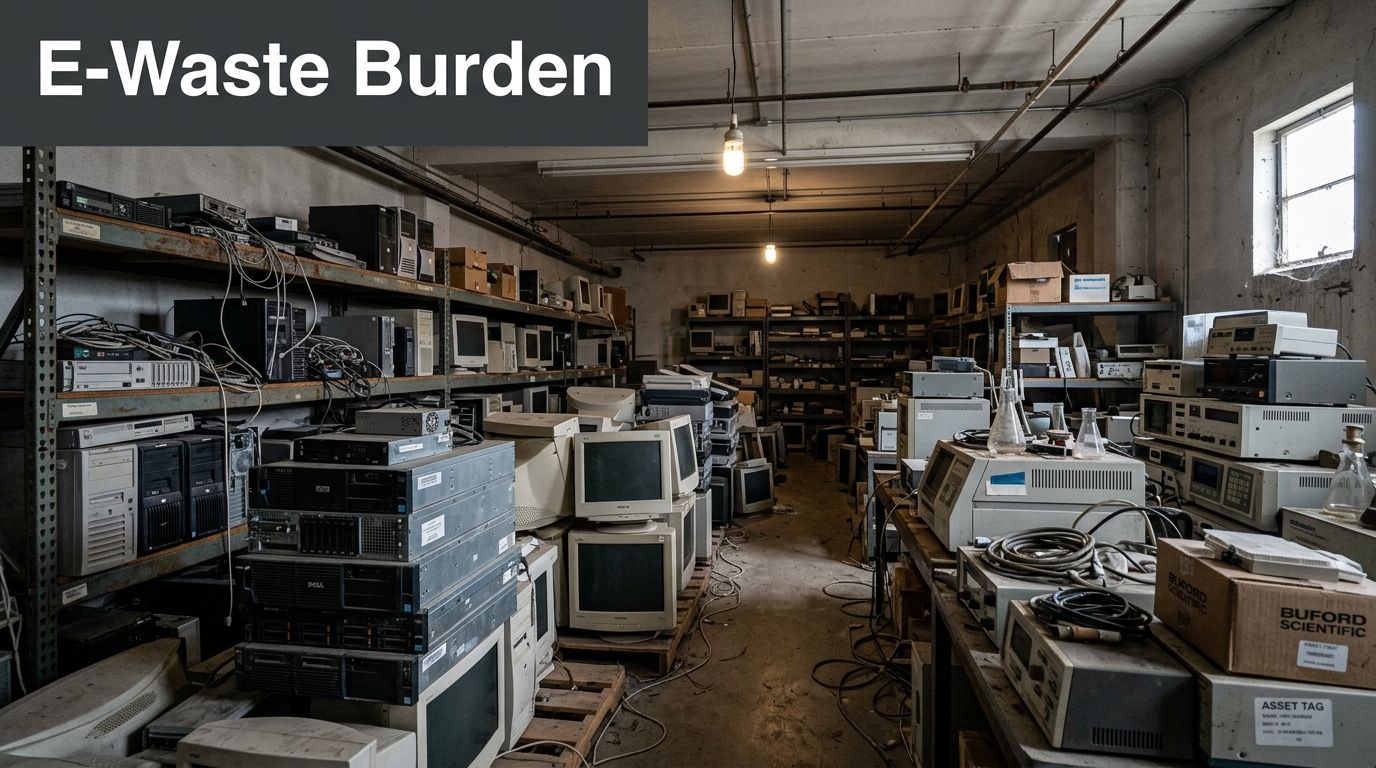
Suwanee’s local numbers show why this can’t be treated as a minor housekeeping task. Recycle Old Tech reports that Suwanee, Georgia, a small community with a population of just 216 residents, generates approximately 4,320 pounds of electronic waste annually, and only about 15% of this e-waste is properly recycled. That’s a striking mismatch between community size and disposal volume, and it reflects the business and institutional activity tied to the broader Gwinnett and Atlanta market.
Why business storage rooms become liability zones
The issue isn’t only volume. It’s the mixed nature of the inventory.
A typical B2B load in this area can include:
- Office IT gear like desktops, monitors, docking stations, printers, and phones
- Back-end infrastructure such as servers, storage arrays, network appliances, and backup media
- Specialized lab assets including analyzers, centrifuges, incubators, pipettes, and instrument-connected PCs
- Loose accessories like batteries, cables, external drives, and power supplies
When those items sit unprocessed, three things usually go wrong. Teams lose track of what still contains data. Facilities staff end up moving equipment without a clear chain of custody. And departments delay cleanouts because they assume disposal will be disruptive or expensive.
Practical rule: If you can’t identify what’s in storage, who approved retirement, and how data-bearing devices will be sanitized, the project isn’t ready for general junk removal.
Generic recycling advice falls short. A facility manager doesn’t need a reminder to “recycle responsibly.” They need a path for pickups, serial tracking, de-installation, and secure handling that works for a live business environment.
What actually works in Suwanee-area projects
The best outcomes usually come from treating surplus electronics like a managed asset disposition project, not a trash problem. That means building an inventory, separating data-bearing devices from non-data devices, confirming whether any lab equipment needs internal review, and scheduling removal around operations.
Organizations that need a broader county-level disposal option can also review business electronics recycling in Gwinnett County GA to compare service scope and planning considerations.
What doesn’t work is the common shortcut. Calling a hauler before IT, compliance, and facilities have aligned almost always creates rework. Someone then has to pull drives, document missing assets, or explain why regulated equipment left the building without a proper record.
What We Accept Lab Instruments IT Assets and More
Most organizations don’t need a recycler for one device category. They need one partner that can clear the whole room. That includes standard office electronics, infrastructure hardware, and the awkward specialized equipment that tends to stall a project because no one is sure whether it’s accepted.
In B2B disposal work, mixed loads are normal. A lab shutdown rarely produces only centrifuges. A data center refresh rarely produces only servers. You often get workstations, cables, rack gear, monitors, printers, small peripherals, and instrument-adjacent computers all in the same pickup.
Common equipment categories
For Suwanee businesses, the accepted scope usually starts with familiar IT assets:
- Computers and laptops used by staff, clinicians, researchers, and administrators
- Servers and storage hardware from closets, racks, and data rooms
- Networking equipment such as switches, routers, firewalls, and related accessories
- Displays and office electronics including monitors, phones, printers, scanners, and cables
Then it expands into the equipment categories that matter for hospitals, universities, and industrial facilities:
- Laboratory instruments such as centrifuges, incubators, analyzers, balances, and pipettes
- Medical-adjacent electronics that may store configuration or user data
- Test and measurement equipment used in research, quality control, or manufacturing support
- Facility support electronics from conference rooms, training spaces, and satellite offices
The practical question isn’t whether something plugs in. The practical question is whether the item contains regulated materials, sensitive data, reusable components, or handling requirements that make ordinary disposal inappropriate.
Comprehensive Accepted Items List
| Category | Accepted Items (Examples) |
|---|---|
| Office IT | Desktop computers, laptops, monitors, docking stations, keyboards, mice, printers, scanners |
| Data center hardware | Servers, blade systems, storage arrays, rack equipment, backup appliances, network switches |
| Mobile and telecom | Cell phones, office phones, tablets, handheld devices, chargers |
| Storage media | Hard drives, SSDs, external drives, tape-related hardware, removable media devices |
| Lab electronics | Instrument control PCs, analyzers, centrifuges, incubators, balances, pipettes |
| AV and facility electronics | Projectors, conference room systems, cables, power supplies, small accessories |
| Mixed business surplus | Carts of assorted electronics from moves, cleanouts, decommissions, and office closures |
A detailed accepted items list for business and lab equipment is useful when a department is sorting material before pickup.
What usually needs a closer review
Some items are easy to identify. Others need a short pre-pickup discussion.
Examples include:
- Instrument-connected computers that may look like ordinary PCs but store assay results, calibration files, or user records.
- Embedded storage in specialized equipment where data isn’t obvious from the exterior.
- Mixed lab loads that combine electronics with assets that may need prior decontamination by the generator.
- Damaged or partially disassembled hardware that requires different packing and transport handling.
Don’t assume an item is “just scrap” because it no longer powers on. Nonfunctional devices often create the highest chain-of-custody risk because teams stop treating them like information-bearing assets.
What works best is simple. Build the pickup around categories, not brand names. Separate data-bearing media, lab instruments, and general office electronics early. That gives the recycling team a cleaner receiving process and gives your internal stakeholders fewer surprises on pickup day.
Securing Your Data with Compliant Destruction Methods
For most B2B clients, this is the deciding issue. Recycling is important, but data destruction is the risk-control function. If a retired drive, server, or lab workstation leaves your facility without proper sanitization, the project has already failed.
That’s why “we wipe drives” isn’t enough. A serious provider should be able to explain the method, the handling steps for failed media, and the documentation you’ll receive afterward.
What compliant destruction looks like
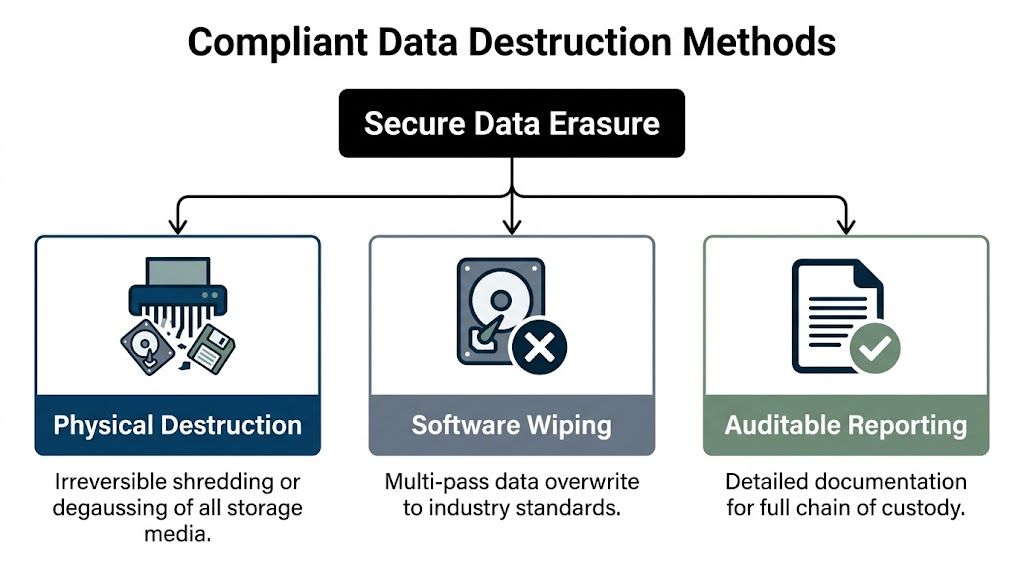
In the Suwanee market, stronger providers go beyond generic erasure language. Prime Asset Recovery’s Suwanee service page states that professional services deploy DoD 5220.22-M 3-pass sanitization followed by physical shredding for nonfunctional media, ensuring HIPAA-compliant data security. The same source says this multi-stage process causes irreversible magnetic domain realignment, rendering recovery impossible even with forensic tools, with a success rate of less than 0.01% per DoD tests.
That distinction matters. Working media and failed media should not be handled the same way.
A practical breakdown looks like this:
- Software wiping for functional drives where the device can still be addressed and sanitized
- Physical shredding for failed or obsolete media that can’t be reliably wiped
- Chain-of-custody records that show who handled the asset and when
- Final reporting that supports audits and internal signoff
Why HIPAA and similar rules change the standard
Healthcare, research, education, and government environments can’t rely on assumptions. If a workstation touched patient records, if a lab PC stored proprietary research, or if a server held archived user data, disposal becomes a records-protection exercise.
That’s why a secure data destruction process for retired IT assets should be reviewed before pickup is scheduled, not after the truck arrives.
What often goes wrong is familiar:
- A department removes devices but never confirms whether local data was stored.
- A vendor collects equipment in bulk with no clear separation between wiped and unwiped assets.
- Failed hard drives get tossed in general electronics gaylords because the team assumes “it’s broken anyway.”
- No one asks how certificates will align to internal asset lists.
A destroyed device is only part of the answer. Auditable handling is what turns destruction into compliance evidence.
Questions to ask before you release equipment
Ask direct, operational questions. Good vendors answer them without hesitation.
How are functional drives sanitized?
You want the exact method, not a vague assurance.What happens to nonfunctional media?
Failed drives, damaged SSDs, and broken storage devices shouldn’t stay in a mixed stream.How is chain of custody documented?
This matters for IT audits, privacy reviews, and internal accountability.Will the destruction record match our inventory?
If your team tracks serials or asset tags, the reporting should support that workflow.Can the provider handle lab and medical-adjacent equipment with embedded storage?
Many generic recyclers often become less reliable in this regard.
Some organizations overcomplicate this and chase perfect paperwork before they’ve sorted the equipment. Others do the opposite and release everything with almost no controls. The right middle ground is disciplined and practical: identify data-bearing assets, choose destruction methods based on media condition, and require reporting that your compliance team can actually use.
The On-Site De-Installation and Pickup Process
Most disposal projects succeed or fail on logistics, not intent. Teams usually know they need to clear surplus equipment. The sticking point is who disconnects it, who packs it, how assets move through a live building, and how to avoid disrupting staff, patients, students, or researchers.
The most effective Electronics Recycling Services in Suwanee GA use a structured pickup process. That process should feel predictable from the client side, especially when the load includes racks, bench instruments, or mixed-floor collections.
Step one through step three on site
A good project starts with a real inventory conversation. Not every device needs a serial captured in advance, but the provider should understand the categories, approximate volume, access conditions, and whether any items require de-installation.
Many facility teams already rely on local on-site services for business technology support. That same on-location mindset is important in disposal work because removal planning has to fit the building, loading access, and departmental schedule.
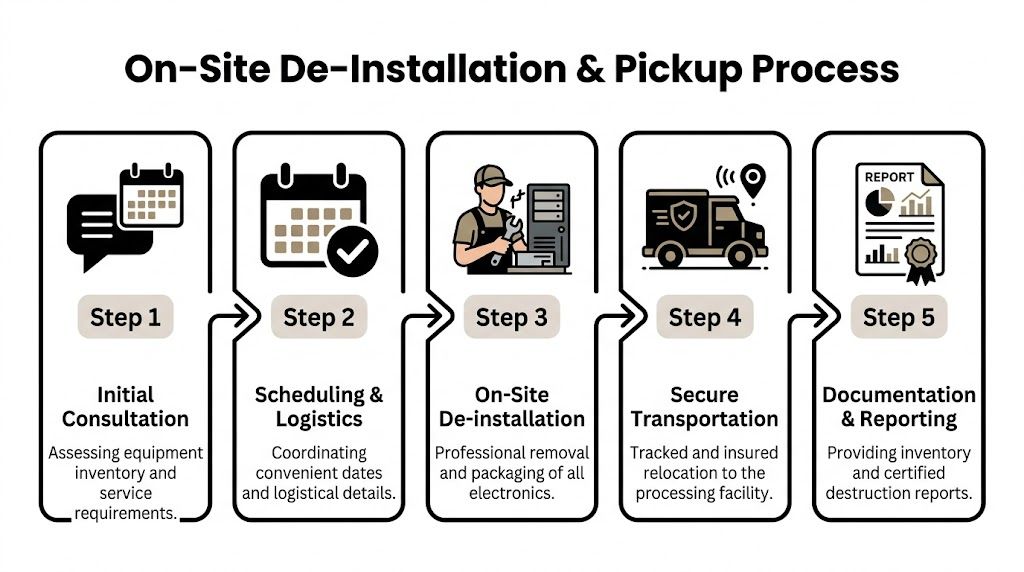
The first half of the process usually includes:
Initial consultation
The team reviews what’s being removed, where it sits, and whether the load includes drives, servers, or specialized instruments.Scheduling and access planning
This covers dock access, elevator use, staging areas, security procedures, and who needs to sign off internally.On-site de-installation
Technicians disconnect, consolidate, and prepare equipment for transport. That’s especially important when racks, under-bench systems, or older lab-adjacent computers are involved.
What works is assigning one internal point of contact. What doesn’t work is sending the recycler into a building with three separate department contacts, no dock instructions, and no clarity on which assets are approved to leave.
Step four and step five after removal
Once the equipment is packed and staged, secure transport becomes the next control point. This isn’t only about moving heavy hardware. It’s about preserving asset integrity and avoiding confusion between approved surplus and active equipment.
A clear electronics pickup and recycling workflow should show how material moves from your site to processing, what documentation is generated, and when the reporting is issued.
After the truck leaves, the final stages usually look like this:
- Secure transportation with controlled handling from site to processing facility
- Receiving and reconciliation so the provider can match the load to the pickup record
- Data destruction and recycling processing based on media condition and asset type
- Documentation and reports for your records
If your building is still operational, schedule pickup around the business day that creates the fewest handoffs. Fewer handoffs usually means fewer mistakes.
Trade-offs facilities should plan for
There’s no single pickup model that fits every site. A same-week purge is helpful when space is tight, but it may give your IT team less time to validate asset lists. A heavily documented pickup supports audits, but it also requires stronger internal coordination before the truck arrives.
Watch for these common trade-offs:
- Speed versus preparation
Fast removal is useful, but rushed projects are more likely to miss data-bearing devices. - Central staging versus room-by-room collection
Central staging is efficient. Room-by-room service reduces the burden on your staff. - Minimal inventory versus detailed asset capture
Broad category counts move faster. Detailed records improve traceability for sensitive loads.
The smoothest projects are rarely the most complicated. They’re the ones where facilities, IT, and department leadership agree on scope before anyone starts unplugging equipment.
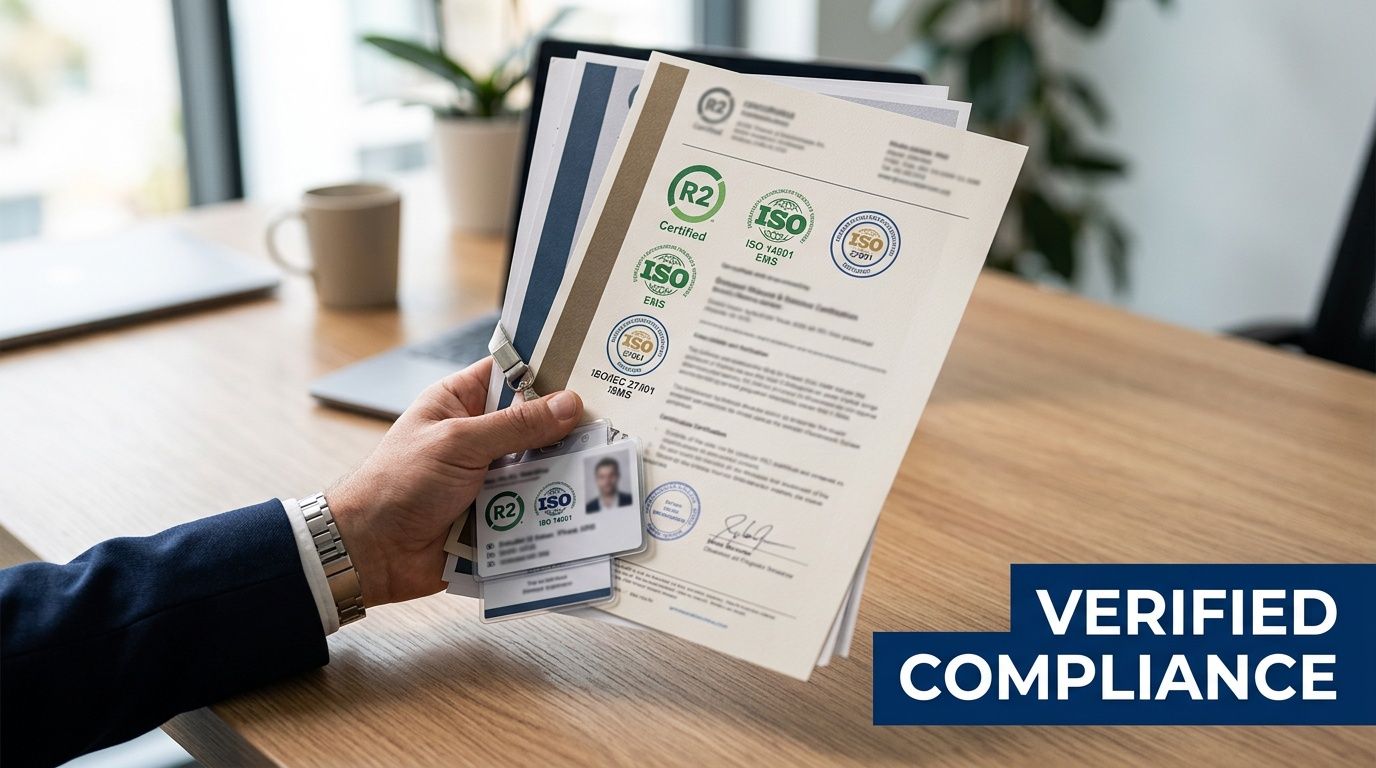
Why R2 and ISO Certifications Matter for Your Protection
Certifications matter because they turn claims into something you can verify. Any recycler can say they care about security or sustainability. Fewer can show third-party standards, documented procedures, and a downstream model that protects your organization after the equipment leaves your property.
For B2B clients, especially those in healthcare, higher education, and government-related environments, vendor certification is part of risk management. It’s not branding.
What R2 v3 and ISO tell you
Computer Recyclers USA states that leading recyclers hold R2 v3 and ISO certifications and maintain a zero-landfill policy, ensuring 100% of processed electronics are responsibly recycled or refurbished in alignment with EPA, RCRA, and HIPAA requirements. For a client, that means the provider is operating under a recognized framework rather than making broad promises about “green disposal.”
Here’s how that translates in practical terms:
| Certification or policy | What it signals to a business client |
|---|---|
| R2 v3 | Structured controls for responsible reuse, recycling, and downstream management |
| ISO certification | Documented management systems and process discipline |
| Zero-landfill policy | A clear commitment to keeping processed electronics out of landfill disposal streams |
| Certificates and reports | Evidence for audits, internal controls, and sustainability documentation |
A useful outside reference on the broader governance side is this overview of regulatory compliance risk management. It’s relevant because electronics disposition is often treated as an operations task when it’s really part of a larger compliance system.
How certifications help you vet a provider
A certified vendor still needs scrutiny. Certification should be the beginning of your review, not the end.
Ask for:
- Current certification status and the exact standards held
- A description of downstream handling for processed materials
- Documentation examples such as destruction or recycling certificates
- Scope clarity on whether they handle your asset types directly or broker them out
A reliable e-waste recycling company for regulated business assets should be able to explain its certifications in plain language.
The safest vendor is the one that can show process discipline before pickup day, during transport, and after final reporting. Any gap in that chain becomes your problem later.
What doesn’t work is choosing solely on convenience. A quick pickup has value, but not if your team can’t defend the vendor choice during an audit, legal review, or sustainability reporting cycle.
Understanding Pricing for E-Waste and Lab Equipment Disposal
Pricing gets simpler once you stop thinking of it as a flat disposal fee. In B2B recycling, cost depends on the shape of the project. Two loads can fill the same amount of floor space and still price very differently because the labor, handling, and data requirements aren’t the same.
The first driver is asset mix. Standard computers and servers are one category. Lab instruments with awkward footprints, partial disassembly needs, or uncertain internal storage are another. Mixed loads usually require more planning because the team has to sort by handling method, not just by item count.
What affects the quote most
The biggest cost variables are usually:
- Volume and density of equipment
A palletized server lot is easier to move than scattered electronics across multiple rooms. - De-installation complexity
Bench-connected systems, rack removals, and upper-floor pickups take more labor than dock-ready material. - Data destruction requirements
Media wiping, shredding, and matching reports to internal records add handling steps. - Condition of the assets
Working, reusable hardware is different from broken equipment, damaged units, or partial scrap. - Site logistics
Loading dock access, elevators, bad staging layouts, and narrow hallways all affect labor time.
Where clients can create or reduce cost
Preparation matters. If your team centralizes approved equipment, separates storage media, and confirms what needs de-installation, the provider can move faster and quote more accurately.
Organizations often lower friction by doing a few things before pickup:
- Create a simple room-by-room list of what’s leaving.
- Flag data-bearing devices so they don’t get mixed with low-risk peripherals.
- Identify anything oversized or sensitive before scheduling.
- Clarify who signs off on final removal.
The opposite approach usually increases cost. Unsorted closets, mixed active and inactive equipment, and unclear ownership force extra on-site decision-making.
Price matters, but scope clarity matters more. Most billing disputes in recycling projects come from vague assumptions about what the crew would handle on site.
Some pickups may be more favorable when the load contains high-value IT assets or reusable equipment. Others may carry charges when the material has low recovery value, difficult logistics, or extra destruction requirements. The only practical way to budget well is to define the scope realistically at the start.
Real-World Scenarios for Local Organizations
A hospital lab closes a satellite testing area after a workflow change. The room contains bench instruments, a few old towers controlling analyzers, label printers, and external drives no one has touched in years. The facilities team wants the space back quickly, but compliance won’t release anything until the data-bearing devices are identified. The right solution is a staged pickup with preapproved asset categories, separation of storage media, and reporting that lets the hospital prove sensitive devices were handled under a documented chain of custody.
A university clearing mixed academic assets
A university department has old faculty desktops in offices, retired lab PCs in a research area, and a student computer lab that was replaced over break. The challenge isn’t just volume. It’s ownership. Different departments approved the refreshes, and each one tracks assets differently.
What works in that setting is central coordination. One point of contact gathers the approved surplus list, the pickup team collects by building or floor, and the destruction documentation is organized so IT and administration can reconcile what left the campus. Generic junk-out service would create confusion here because the university needs proof, not just removal.
A corporate data center refresh
A local company replaces rack hardware in phases, which means old servers and storage arrays accumulate faster than the team can process them internally. Some units are still functional, some have failed drives, and some were already partially stripped for parts. The risk is mixing all of it into one outgoing stream without documenting which media was sanitized and which required physical destruction.
The better approach is to separate infrastructure by status before pickup day. Functional devices can move through a wipe workflow. Failed media can be designated for physical destruction. Transport and receiving records then support the company’s internal control process.
A clinic with a quiet storage problem
A clinic doesn’t look like a large e-waste producer until you open the locked back room. There are old laptops, monitors, a retired check-in station, and a few instrument-connected PCs that nobody wants to touch because they may still hold patient-related information. This is common in smaller healthcare environments where teams are busy and old equipment gets parked rather than processed.
The fix is usually straightforward once someone owns the project. Sort the clearly non-data peripherals first, isolate the systems with any chance of retained information, and schedule pickup only after the clinic has agreed on the sanitization standard and reporting it expects.
Frequently Asked Questions About Specialized Asset Disposal
The biggest unanswered questions in Suwanee usually involve sensitive lab and medical equipment, not ordinary office electronics. Reworx’s Suwanee page highlights this gap, noting that general advice on secure destruction is often too vague for B2B organizations handling HIPAA-governed assets or proprietary research data.
Do lab instruments need to be decontaminated before pickup
Yes, if the equipment was used in an environment where contamination is possible, your internal safety and compliance teams should determine decontamination requirements before release. Electronics recyclers handle disposition. They shouldn’t be expected to guess whether a device is safe to transport.
Can one pickup include office electronics and scientific equipment
Yes, mixed loads are common. That said, they should still be sorted by handling needs. A pallet of monitors, a rack server lot, and instrument-connected computers may all leave on the same truck, but they shouldn’t be treated as identical material.
What if a drive or device no longer works
Nonfunctional media is exactly where strong procedures matter most. If a device can’t be wiped reliably, it should move into a physical destruction workflow with documentation.
What records should a business ask for
Ask for pickup documentation, destruction reporting for applicable media, and recycling confirmation that matches the internal level of control your organization requires. If your team tracks asset tags or serials, say that up front.
Who should be involved internally before scheduling
At minimum, facilities and IT. For healthcare, research, or government environments, compliance, privacy, lab management, or records stakeholders may also need to review the project before any equipment leaves the building.
If your organization needs a practical partner for lab cleanouts, IT asset retirement, or secure electronics recycling in the Atlanta area, Scientific Equipment Disposal handles business-to-business pickups, de-installation, data destruction, and compliant recycling for everything from servers and storage arrays to centrifuges, incubators, and other specialized lab equipment.