Atlanta Electronics Recycling: A B2B Compliance Guide


You’re probably dealing with one of two situations right now. Either a storage room has turned into a graveyard of retired laptops, monitors, analyzers, and network gear, or a larger decommission is underway and every department is asking the same question at once: what has to be wiped, what can be reused, what needs special handling, and who signs off on it.
That’s where atlanta electronics recycling stops being a simple disposal task and becomes an operational project. For a business, hospital, university, or lab, the work isn’t just getting equipment out of the building. It’s controlling data exposure, documenting chain of custody, coordinating pickup, and making sure specialized assets don’t get treated like consumer junk.
Why Your Atlanta Business Needs a Strategic E-Waste Plan
Atlanta has become a serious center for electronics recycling because of its dense population, large business base, and constant turnover in IT and technical equipment. Nationally, the U.S. produces over 3.5 million tons of e-waste annually, and e-waste generation has more than doubled since 2000, according to EPA figures summarized in this Atlanta e-waste recycling overview. That scale matters when you’re planning disposition at the facility level, because it means generic solutions are built for volume, not for your internal compliance obligations.
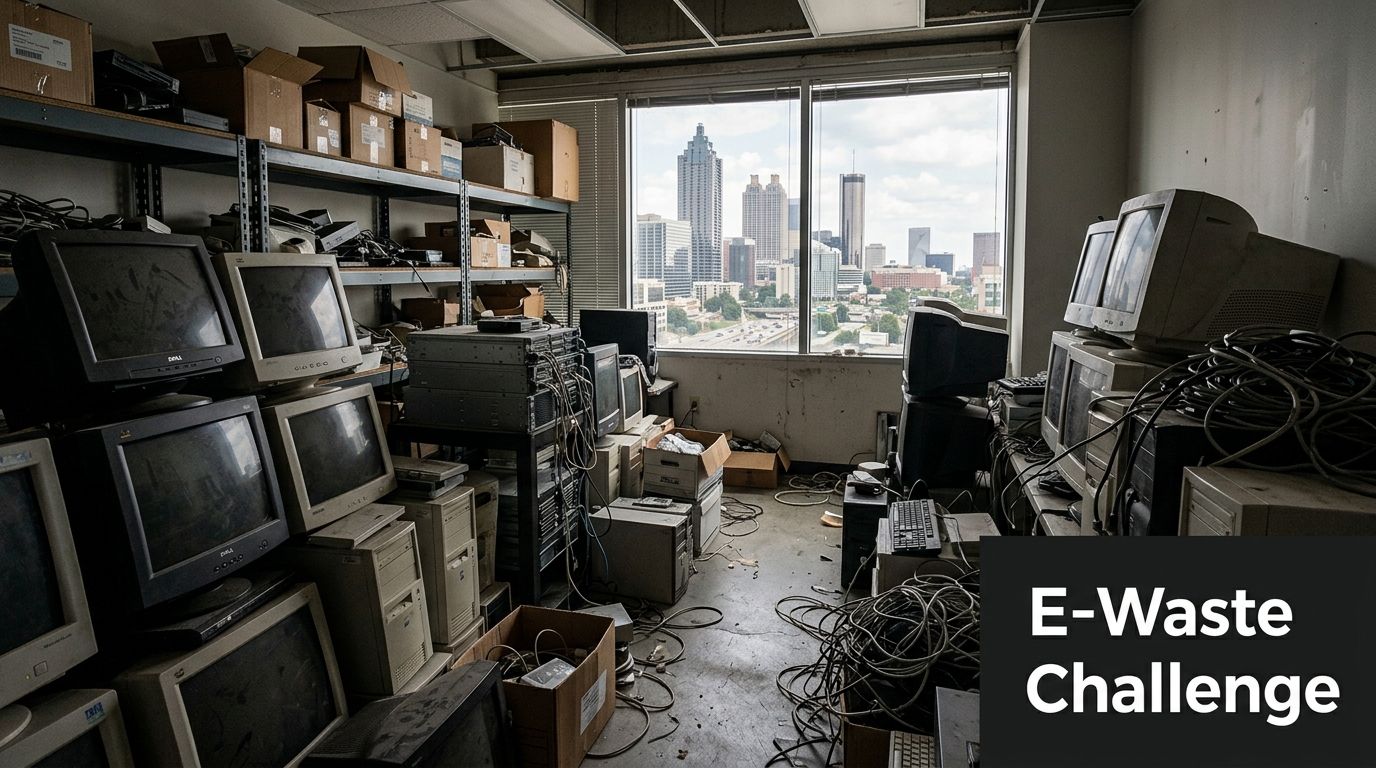
A consumer drop-off model works fine for an old keyboard or home printer. It doesn’t work well for a lab closure, a hospital refresh, or a data center cleanout. Those projects involve data-bearing assets, regulated records, chain-of-custody requirements, loading dock coordination, and equipment that may need de-installation before anyone can move it safely.
What goes wrong with a drop-off mindset
The biggest mistake I see in business e-waste planning is treating all electronics the same. They aren’t.
A broken LCD monitor with no storage media is one thing. A workstation tied to patient records is another. A centrifuge with embedded controls, a freezer with electronic components, or a server pulled from a research environment creates a different set of risks again.
Sources covering Atlanta specifically point to an overlooked question: how organizations ensure HIPAA-compliant data sanitization and chain-of-custody documentation for lab IT assets during facility shutdowns. That same review notes that public-facing guidance often references Georgia’s Solid Waste Management Act and EPA guidance without giving practical specifics on wiping standards or pickup models built for decommissions, which leaves businesses exposed during execution, as noted in this Atlanta business recycling gap analysis.
Practical rule: If your asset list includes hard drives, SSDs, lab computers, instruments with onboard storage, or retired servers, you don’t have a disposal problem. You have a records-handling problem with a logistics component.
Strategic asset disposition is different from disposal
A strategic plan starts by deciding what outcome each asset needs:
- Reuse or resale if the equipment still has useful life
- Certified recycling if material recovery is the best path
- Secure destruction if data risk or physical condition rules out remarketing
- Special handling if the item is a lab asset that needs decontamination or disassembly first
That shift changes everything. Instead of asking where to take old electronics, you start asking who can document each movement, sanitize storage media correctly, and process a mixed load that includes standard IT plus specialized equipment.
For Atlanta organizations, that usually means building a workflow before the first cart leaves the room. A useful starting point is reviewing local business-focused options for electronics recycling in Atlanta and then matching the service model to your facility type, volume, and compliance burden.
What works and what doesn’t
What works
- Assigning one internal owner for the disposition project
- Separating data-bearing from non-data-bearing assets early
- Requiring chain-of-custody records before pickup day
- Using a vendor that handles on-site logistics for mixed equipment loads
What doesn’t
- Letting departments self-sort without a master inventory
- Sending regulated or data-bearing assets into a consumer-style drop-off stream
- Assuming all “electronics recyclers” can handle lab instruments
- Waiting until move-out week to ask for certificates
Atlanta businesses usually don’t need more recycling options. They need a cleaner process.
The First Step to Compliant Disposal is Asset Inventory
Most failed decommissions start with the same sentence: “We think that’s everything.”
That’s not enough. If you can’t produce a defensible asset list, you can’t control data handling, pickup scope, value recovery, or final reporting. An inventory isn’t paperwork for its own sake. It’s the document that tells everyone what exists, where it is, and what must happen to it.
A practical inventory should cover office IT, embedded electronics inside lab equipment, loose storage media, networking hardware, and anything sitting in closets, under benches, or in departmental back rooms. Lab managers often count the obvious devices and miss the supporting hardware. IT teams often count the network stack and miss the instruments connected to it.
Build the inventory around handling decisions
The list shouldn’t just identify equipment. It should tell your team what each item needs next.
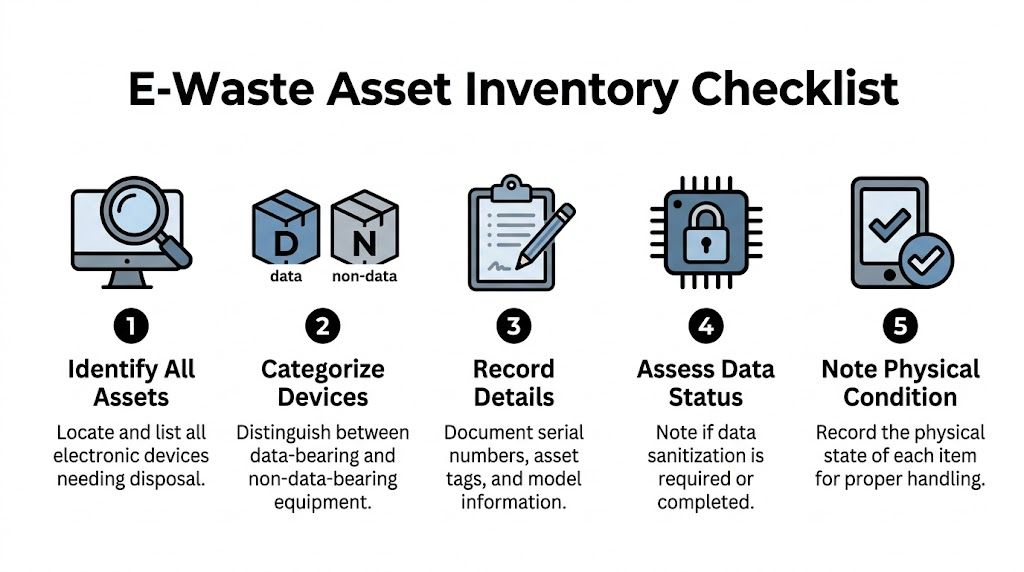
Use fields such as:
- Asset description. Laptop, server, switch, centrifuge, incubator, HPLC computer, freezer controller, external drive.
- Manufacturer and model. This helps determine reuse potential and service requirements.
- Serial number or asset tag. Essential for reconciliation and certificates.
- Department and location. Building, floor, room, closet, rack position, or lab bay.
- Data-bearing status. Yes, no, or unknown.
- Physical condition. Functional, damaged, incomplete, or ready for dismantling.
- Disposition path. Reuse, recycle, destroy, hold for review.
- Special notes. Needs decontamination, hard drive missing, bench-top pickup only, contains accessories.
If you already manage IT assets in a CMDB or spreadsheet, export what you have and then verify it physically. Never assume the system of record matches reality during a shutdown.
Use source-level segregation, not pile sorting
Atlanta recycling guidance for commercial operations points to a three-stage segregation methodology. First, sort items suitable for refurbishment. Second, identify equipment with recoverable material value such as gold, silver, and palladium. Third, route residual material to certified recycling pathways, as described in this Atlanta recycling contamination and segregation review.
That matters because mixed piles create mixed outcomes. A cart loaded with reusable laptops, dead power supplies, loose drives, and partly decommissioned lab controls slows everyone down and raises the chance of mistakes.
A better method is to separate by handling class at the point of collection:
- Data-bearing assets go into a locked or controlled stream.
- Potentially reusable equipment stays intact with serials visible.
- Commodity recycling gets grouped by broad material or device type.
- Lab equipment needing decon review is isolated until cleared.
Assets should be sorted where they sit, not after they hit the truck. That’s how you preserve chain of custody and avoid contaminating a reuse stream with problem items.
Don’t skip decontamination for lab equipment
A pure IT disposition process encounters difficulties within research, healthcare, and industrial environments. Before a recycler can responsibly remove many scientific assets, the generator has to confirm the equipment is safe to handle.
That usually means internal review of whether the unit contacted biological materials, chemicals, or other regulated substances. If it did, decontamination has to be completed and documented before pickup. A recycler can manage electronics and metals. It can’t responsibly guess what was used inside your incubator, hood, analyzer, or benchtop instrument.
A simple internal decision tree helps:
| Asset type | Primary concern | Required internal check |
|---|---|---|
| Desktop, laptop, server | Data exposure | Confirm storage media status |
| Printer, monitor, dock | Minimal data or none | Verify no embedded storage concerns |
| Lab instrument with PC/control module | Data plus equipment handling | Confirm storage and decon status |
| Fume hood, incubator, centrifuge | Physical handling and contamination | Document decontamination before release |
When teams need a disposal partner for mixed business equipment, it helps to review a service model built around IT asset disposal rather than just public drop-off acceptance lists.
The inventory should answer five questions
By the time your inventory is complete, you should be able to answer:
- What do we have?
- Which items contain data?
- Which items might have resale or reuse value?
- Which items require decontamination or special handling?
- Which items are ready for pickup now?
If any of those answers are still unclear, pickup day is too early.
Securing Your Data With Compliant Sanitization Methods
The highest-risk mistake in atlanta electronics recycling is assuming that removing equipment removes the risk. It doesn’t. Risk follows the data until you can prove the data was sanitized or destroyed.
For business projects, the core decision is usually between software-based sanitization and physical destruction. Both have a place. The right choice depends on the media type, the condition of the device, and whether preserving asset value matters.
When wiping makes sense
A structured wiping process is usually the preferred route when the storage media is functional and the device may be suitable for reuse or resale. In Atlanta market coverage, business recyclers are described as using standards such as DoD 5220.22-M 3-pass wiping and NIST-aligned methods to support secure disposition for organizations with compliance obligations.
Wiping works best when:
- The drive is readable and operational
- You want to preserve equipment value
- The asset may be redeployed internally or remarketed
- You need a verifiable process tied to specific serial numbers
For an IT manager, this is the path that keeps a usable laptop from becoming scrap. For a university or hospital, it can turn surplus equipment into a cleaner financial and reporting outcome without relaxing data controls.
When shredding is the better call
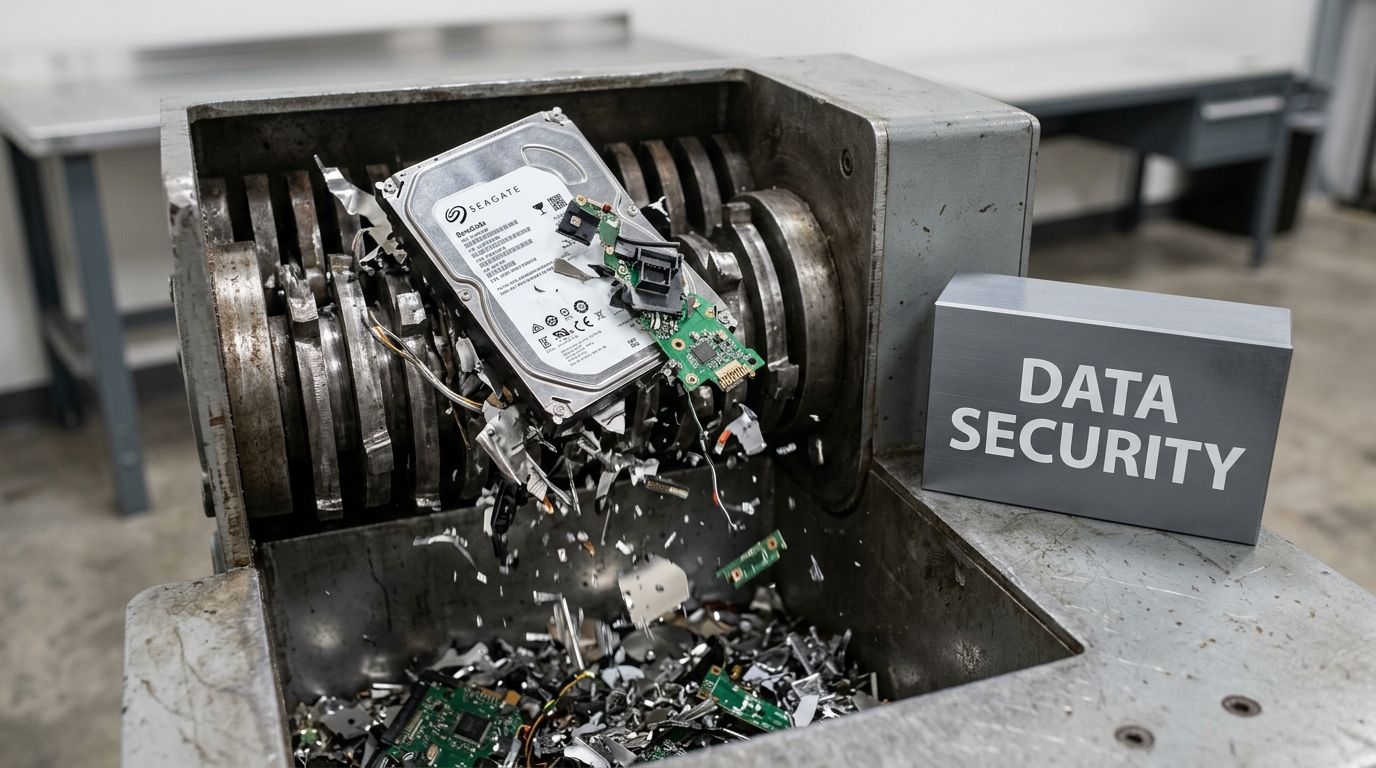
Physical shredding is the right answer when the media is failed, obsolete, damaged, or too sensitive to release back into any reuse channel. It’s also common when the organization wants a destruction-first policy for certain classes of drives, backup media, or retired storage from regulated environments.
Use shredding when:
- The drive can’t be wiped reliably
- The device is physically damaged
- The media belongs to a high-risk dataset
- The organization’s policy requires destruction
- There’s no economic reason to preserve the drive
That choice sounds simple, but it has a real trade-off. Shredding ends all downstream reuse of the media. Wiping protects data while preserving value if the device can remain in circulation.
The method matters less than the proof
A process isn’t compliant because someone says it is. It’s compliant when it is documented, traceable, and tied to the exact assets removed from your site.
That means the vendor should be able to tell you:
- which assets were received,
- which media was wiped,
- which media was shredded,
- when the work happened,
- and how those results map back to your inventory.
For organizations evaluating secure handling options, it’s worth reviewing a workflow centered on secure data destruction so the sanitization method is paired with reporting, not treated as a separate afterthought.
If a recycler talks about “erasing everything” but can’t show how each result ties to a serial number or pickup record, that’s a trust-based process. Auditors don’t accept trust-based processes.
The Emory example shows why certified handling changes the economics
At Emory University, a certified vendor process using NIST-compliant data destruction supported recovery of 64 tons of electronic waste annually, achieved 99.6% diversion from landfill, and generated $31,840 in revenue, according to Emory’s published account of the program in this electronic waste case study from Emory University.
That example matters for two reasons.
First, it shows that data security and material recovery do not have to be competing goals. Second, it proves that disciplined handling can convert a liability stream into something measurable for finance, sustainability, and audit teams.
What a certificate should include
The output of the sanitization process should be more than a generic statement. For legal and operational purposes, your documentation should identify the assets or media covered and the method used.
Look for these elements in a data destruction certificate or related report:
| Document element | Why it matters |
|---|---|
| Customer name and pickup reference | Connects the work to your project |
| Asset identifiers or media serials | Shows what was actually processed |
| Destruction or sanitization method | Distinguishes wiping from shredding |
| Date of service | Supports audit timelines |
| Authorized signatures or issuer details | Confirms accountability |
Some projects also need witness options, on-site service records, or a stronger chain-of-custody trail from room removal through final processing. That’s common in healthcare, research, finance, and government environments.
Choose the method that fits the asset. Demand the paperwork that proves it happened.
Managing Logistics From De-installation to Pickup
Most electronics recycling plans look organized on paper until someone has to move the equipment.
That’s where Atlanta business projects separate into two categories. In the first, a team is clearing a few pallets of standard office electronics from an accessible loading area. In the second, they’re dealing with server racks, under-bench instruments, incubators, boxed accessories with no labels, and departments that weren’t ready when the truck arrived. Most hospital, university, and lab decommissions fall into the second category.
A realistic pickup day for a lab or mixed-asset shutdown
The process usually starts before the truck shows up. The vendor and facility team confirm building access, dock restrictions, freight elevator rules, packing needs, and whether any items need de-installation. That last point gets missed all the time.
Research facilities often have equipment that can’t be unplugged and rolled away. A rack may need to be broken down. An analyzer may need accessories separated and labeled. A fume hood or large incubator may need a removal plan that accounts for dimensions, path of travel, and internal safety review.
Existing Atlanta content rarely addresses this issue directly. It also leaves a gap around a practical question many research facilities have: which providers handle on-site de-installation and certified disposal of non-IT lab assets without landfill risk? Standard drop-off programs often exclude those complex items, as discussed in this Atlanta lab equipment recycling content gap review.
Why self-managed transport breaks down
Self-hauling can work for a small load of clearly identified office devices. It usually breaks down when:
- assets are spread across multiple rooms or buildings,
- equipment is bulky or fragile,
- data-bearing items need controlled handling,
- there are mixed categories of IT and lab equipment,
- or your internal staff can’t stop normal operations to become a moving crew.
That’s why scheduled pickup matters. A business-facing recycler with fleet capacity can remove the burden from facilities, IT, and lab staff at the same time. Some organizations also use broader logistics planning resources to think through routing and handoff issues. If your team is mapping pickup windows or multi-site movement, this guide to e-commerce pickup and delivery is a useful operational reference because the same scheduling principles apply to chain-of-custody projects.
The hard part usually isn’t deciding to recycle the equipment. The hard part is getting the right people, carts, packing materials, access permissions, and truck space lined up on the same day.
What to confirm before pickup is scheduled
A clean pickup relies on boring details being settled early.
Use this pre-pickup checklist:
- Access conditions. Confirm dock hours, stair restrictions, security check-in, and elevator reservations.
- Packaging plan. Decide whether assets stay loose, get palletized, or need gaylords, carts, or protective wrapping.
- Ready status. Verify which lab units are decontaminated and released.
- Scope control. Match the physical pile to the approved inventory so surprise items don’t derail loading.
- Sign-off chain. Know who releases assets and who receives the service paperwork.
For Atlanta-area organizations that need a vendor to handle the pickup side rather than just receiving drop-offs, a service model with free electronics recycling pickup can make sense when the project involves business volumes, mixed equipment, and on-site coordination.
One vendor option that fits mixed decommissions
For example, Scientific Equipment Disposal handles on-site de-installation, packing, pickup, and logistics for business electronics and lab assets using its own box-truck fleet. That kind of model is useful when a project includes both standard IT equipment and scientific instruments, because the movement plan stays under one chain of custody instead of being split across unrelated providers.
The operational lesson is simple. If your pickup plan depends on your internal team improvising labor, packing, and transport around normal duties, the plan is underbuilt.
Your Atlanta Electronics Recycling Vendor Selection Checklist
Choosing an electronics recycler for a business project is not the same as choosing a place to unload old hardware. You’re selecting a vendor that will temporarily take control of your assets, your data risk, your environmental reporting, and part of your audit trail.
That decision deserves the same scrutiny you’d give any regulated service provider.
The non-negotiables
Start with the issues that can disqualify a vendor quickly. If the answers are vague, move on.
Can they document chain of custody?
You need more than a pickup receipt. The vendor should explain how assets are tracked from your site through processing.Can they handle data-bearing assets appropriately?
Ask whether they support both wiping and physical destruction, and how they decide which method applies.Can they process more than standard office electronics?
Many providers handle desktops and monitors but struggle with lab controls, scientific equipment, or mixed technical loads.Can they support on-site work?
If your project includes de-installation, packing, room-by-room removal, or dock coordination, that capability has to be explicit.
Ask about service model, not just certifications
Certifications matter, but service execution matters just as much. A certified downstream process won’t save a project that falls apart at the loading dock or loses track of serial numbers during removal.
Look for direct questions like these:
- Who performs the pickup, your staff or subcontractors?
- Can you reconcile the final report to my inventory?
- How do you handle unidentified drives found during removal?
- What happens to equipment that is incomplete, damaged, or missing tags?
- Do you accept specialized lab equipment, or only standard IT assets?
A vendor should be able to describe what happens when the project doesn’t go perfectly, because real decommissions never go perfectly.
Atlanta E-Waste Vendor Selection Checklist
| Evaluation Criterion | Why It Matters | Question to Ask Your Vendor |
|---|---|---|
| Chain of custody | Protects against lost assets and undocumented transfers | How do you track items from pickup through final processing? |
| Data sanitization options | Different media require different destruction methods | Do you offer both wiping and physical shredding, and how is each documented? |
| Inventory reconciliation | Prevents disputes and missing assets | Will your final report map back to our serial numbers or asset tags? |
| On-site de-installation | Critical for labs, server rooms, and bulky equipment | Can your team remove equipment from racks, benches, or restricted areas? |
| Mixed asset acceptance | Many projects include more than laptops and monitors | Which non-IT lab or scientific assets do you accept? |
| Decontamination requirements | Protects worker safety and project timing | What documentation do you require before taking lab equipment? |
| Logistics ownership | Reduces delays and chain-of-custody gaps | Do you use your own fleet, scheduled pickups, or third-party carriers? |
| Reporting and certificates | Needed for audits and internal closeout | What certificates and environmental reporting do you provide after service? |
| Material recovery process | Affects both sustainability and financial outcome | How do you identify reuse, recyclable commodities, and residual waste? |
| Regulatory familiarity | Important in healthcare, education, and government | What experience do you have with HIPAA-sensitive or institutionally regulated projects? |
Watch for soft red flags
Some warning signs don’t sound dramatic, but they usually lead to problems later.
A vendor may say “we recycle everything” without explaining downstream handling. Another may advertise free services broadly but avoid discussing data documentation, specialized equipment, or chain-of-custody controls. Some providers focus entirely on consumer convenience, which is fine for households but a mismatch for business decommissions.
Be careful with offers that sound frictionless if your project is complex. The more regulated your environment, the more you should expect a vendor to ask detailed questions back.
The best vendor is usually the clearest one
A strong recycler doesn’t rely on broad promises. They define accepted items, pickup conditions, documentation outputs, sanitization methods, and exceptions up front.
For atlanta electronics recycling in business environments, clarity is usually a better signal than marketing language. If a vendor can explain the whole chain, from room removal to certificate issuance, they’re giving you something you can manage internally. If they can’t, you’re being asked to absorb the uncertainty yourself.
Understanding Costs and Finalizing Your Compliance Documentation
By the end of a decommission, organizations often focus on two things. What did this cost, and can we prove it was done correctly?
Those questions are linked. Pricing depends on what the vendor has to do, and documentation proves whether the work matched the scope you approved.
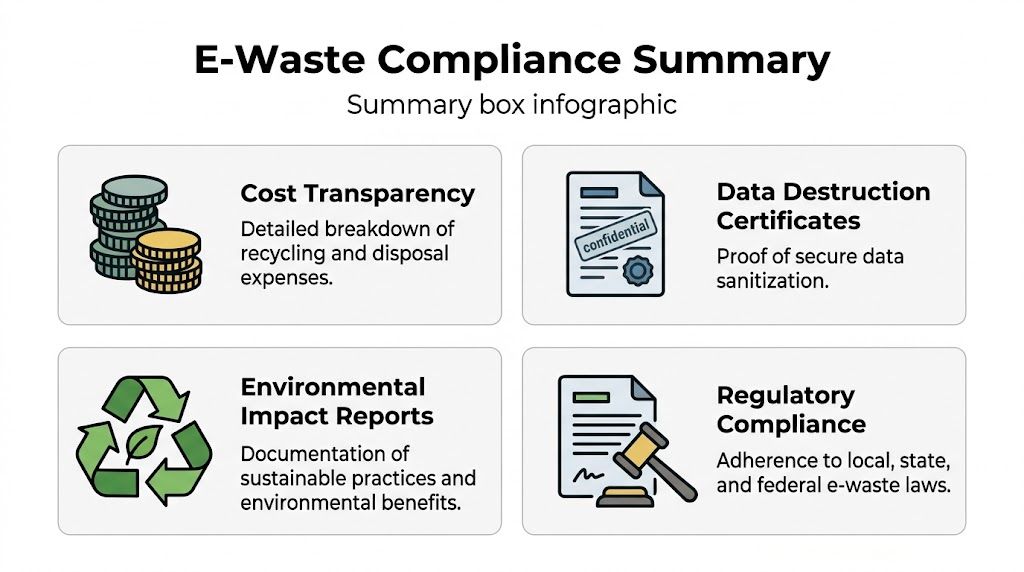
What actually drives cost
B2B electronics recycling pricing is rarely a flat per-item number across a whole project. Cost usually reflects the mix of work involved.
Common cost drivers include:
- Asset type. Standard office electronics are different from heavy, bulky, or specialized lab equipment.
- Volume and density. A full truckload of sorted assets is easier to process than scattered pickups across multiple rooms.
- Data destruction requirements. Wiping, shredding, witness options, and serialized reporting add process steps.
- Labor and logistics. De-installation, stair carries, packing, and palletizing all affect the service scope.
- Disposition path. Reusable assets, recyclable commodities, and residual handling don’t carry the same economics.
At the same time, there can be offsets. Global e-waste generation reached 53.6 million metric tons in 2019, with a formal recycling rate of 17.4%, and in the U.S. e-waste has doubled since 2000. Recovering valuable materials from that stream is part of what gives responsible processing its economic value, as summarized in this global and U.S. e-waste statistics review.
That doesn’t mean every project produces revenue. It does mean some loads contain equipment or commodities valuable enough to offset part of the service cost.
Ask for pricing tied to scope, not vague categories
The cleanest quotes usually break the work into service components rather than hiding everything inside a single recycling charge.
Ask for clarity on:
- pickup and transportation,
- on-site labor,
- de-installation,
- data destruction method,
- recycling versus resale handling,
- and any items that are excluded or billed separately.
This keeps the final invoice from drifting away from the operational reality of the project.
The two documents you need at closeout
Most business clients should expect final documentation in at least two categories.
Certificate of destruction
This document supports the secure destruction side of the project. It should identify what was destroyed, how, and when. If the project included media sanitization as well as physical destruction, the records should distinguish those results clearly.
Certificate of recycling
This document supports the environmental side of the project. It confirms that covered assets entered a documented recycling stream rather than informal disposal. Depending on the vendor, the package may also include diversion or downstream processing summaries.
If your team needs an example of what formal closeout paperwork is meant to support, review the role of a certificate of destruction in audit-ready asset disposition.
Good documentation does two jobs. It proves your organization protected data, and it proves the equipment left your control through a defensible environmental process.
What makes documentation audit-defensible
The paperwork should stand on its own months later, when the people involved may not remember the details.
A strong closeout file includes:
- your company or institution name,
- service date,
- pickup or project reference,
- item identifiers where applicable,
- destruction or recycling method,
- and issuer details tied to the service provider.
Keep those records with your project inventory, internal approvals, and any decontamination releases used for lab assets. That package becomes the compliance story of the project. Without it, you’re left with a truck memory and an invoice.
In practical terms, that’s the final test for atlanta electronics recycling on the business side. Not whether the room is empty, but whether the file is complete.
If your Atlanta facility is planning a lab shutdown, IT refresh, hospital cleanout, or mixed electronics pickup, Scientific Equipment Disposal can help you scope the project around inventory, secure data handling, pickup logistics, and final documentation so the equipment leaves the building with a defensible chain of custody.