7 Business Internet Providers Near Me (Atlanta 2026 Guide)


At 10:15 on a Tuesday, an Atlanta hospital clinic loses stable access to its cloud EHR, a university finance team cannot reach payroll systems, or a lab stalls while pushing imaging data offsite. In those moments, internet service stops being a line item and becomes an operations issue with compliance, downtime, and financial consequences attached.
That is the context for evaluating business internet providers near me in Atlanta. Speed and monthly cost still matter, but they are not enough for hospitals, labs, universities, and other organizations that cannot afford long outages or vague support commitments. Technical buyers need to know what happens under load, during failover, and at 2 a.m. when a circuit drops.
The questions that decide the purchase are usually operational. Do you need symmetrical bandwidth for backups, imaging, VoIP, and security systems? Is the provider offering a defined SLA or standard best-effort broadband terms? Can the site get static IPs, diverse paths, and escalation to competent support without wasting an hour in a general queue?
Sizing also gets mishandled. Smaller offices may run well on moderate business broadband. Clinical departments, research environments, and campus buildings often need more than raw throughput. They need predictable latency, cleaner upload capacity, documented uptime commitments, and a realistic backup design that supports security and compliance requirements.
I recommend separating convenience from infrastructure. A small administrative office may be fine with business fiber or even fixed wireless in the right conditions. A hospital department, lab, or university building usually needs a stricter standard: primary connectivity that fits the workload, secondary connectivity that survives a last-mile failure, and contract terms your team can defend during procurement and risk review.
This guide reviews Atlanta providers through that lens, then closes with a decision checklist for technical buyers who have to balance uptime, security, redundancy, and cost.
1. AT&T Business Fiber Atlanta
A medical office in Midtown loses its primary circuit at 10:40 a.m. The EHR stays reachable if failover works, phones keep routing, and card payments continue. If failover is vague or poorly tested, staff start documenting by hand and the outage becomes an operations problem, not just an ISP problem. That is why AT&T Business Fiber usually gets an early review for Atlanta healthcare, lab, and university sites.
AT&T sits in a useful middle tier. It can serve smaller clinical locations, department offices, administrative buildings, and some labs that need symmetrical bandwidth, static IP options, and business support without going straight to dedicated internet access. For many Atlanta buyers, that is the practical balance between cost and capability.
Where it fits best
AT&T is a good fit for sites with steady upstream traffic. Cloud backups, VoIP, remote access, security cameras, file sync, and large record transfers all benefit from symmetrical service. In environments with compliance obligations, static IPs also make firewall policy, VPN configuration, vendor access control, and audit documentation easier to manage.
The real value is operational clarity. AT&T's Business Fiber plans are easier to compare than many small-business offers, which helps when procurement is reviewing several Atlanta locations with different serviceability results.
Wireless backup on qualifying tiers is also worth checking carefully. It helps keep front-desk functions, payment processing, and basic cloud access alive during some last-mile failures. It does not replace a properly designed secondary circuit from a different carrier, and I would not treat it as sufficient protection for a hospital department, a production lab workflow, or a university site with strict uptime expectations.
Practical rule: If a location depends on cloud systems and pushes meaningful upload traffic, review upload performance, failover behavior, static IP needs, and support escalation before you compare headline speeds.
What works and what doesn't
What works:
- Clearer SMB packaging: Plan structure is easier to evaluate than many competing small-business fiber offers.
- Useful business features: Symmetrical service and static IP options cover many real operational needs.
- Reasonable continuity option: Wireless backup can reduce disruption for lower-risk sites.
- Good fit for multi-site planning: AT&T is often easier to standardize across office, clinic, and departmental footprints than smaller local providers.
What doesn't:
- Address-level qualification matters: Availability can change by building, suite, and construction status, especially in older properties and medical complexes.
- Failover has limits: Wireless backup supports continuity, but it is not carrier diversity and should not be treated as full redundancy.
- The right AT&T product depends on the site: Business Fiber works for many locations, but higher-risk environments may need a dedicated service with stronger SLA terms.
- Promotional pricing can obscure actual expenses: Buyers should check contract length, post-promo pricing, install charges, and hardware assumptions.
Bottom line on AT&T
AT&T is a practical primary connection for many Atlanta sites that need more discipline than cable broadband but do not need enterprise DIA at every address. For hospitals, labs, and universities, the key question is not whether AT&T offers fast fiber. It is whether the exact location qualifies for the right service level, with the right installation timeline, support path, and backup design to satisfy uptime and compliance requirements. Verify the suite, the handoff, the restoration terms, and the failover method before signing.
2. Comcast Business Xfinity footprint Atlanta
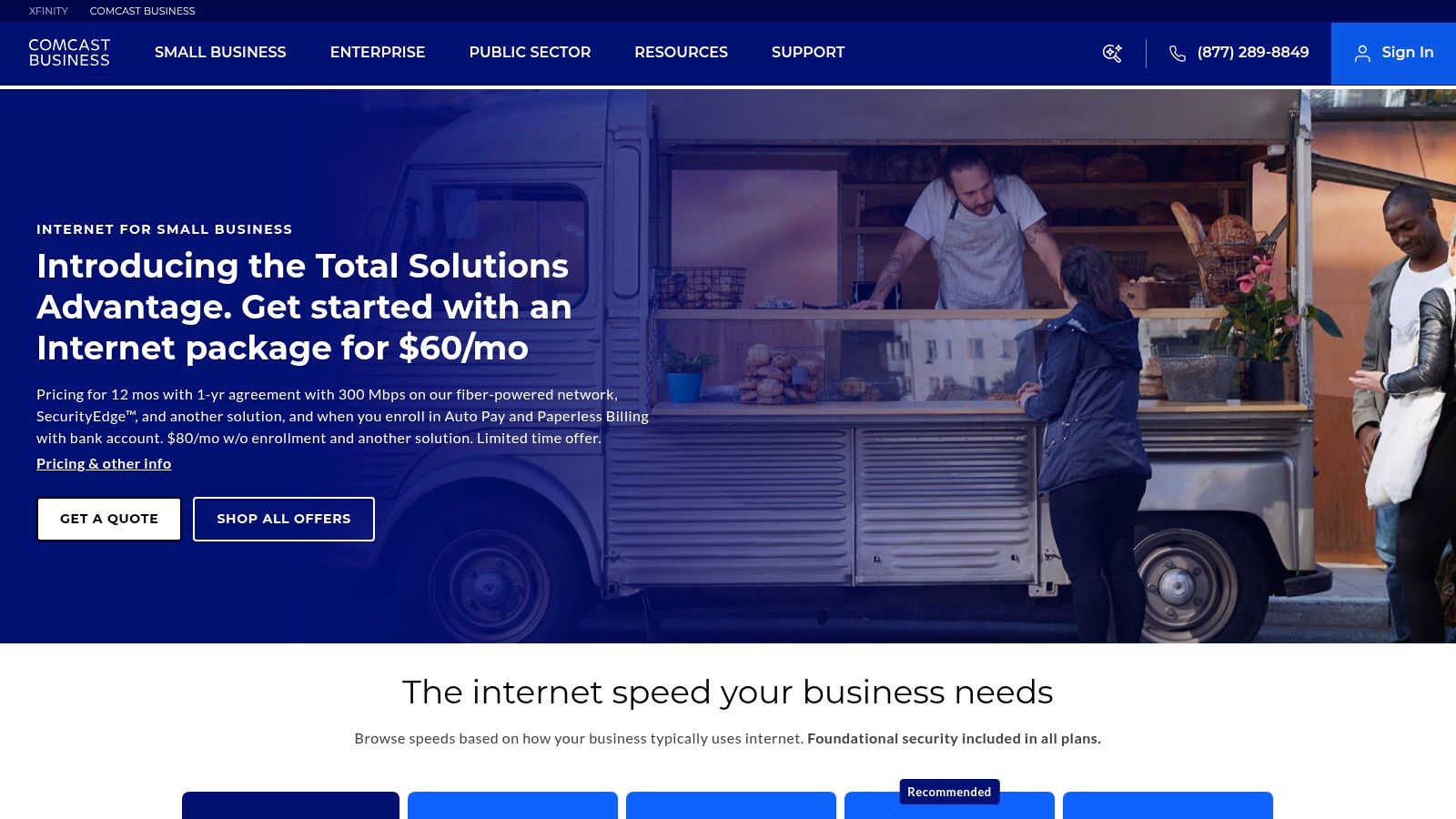
A lab opens a new testing suite in North Atlanta. The analyzers are online, staff is hired, and the go-live date is fixed. Fiber construction is still pending. In that situation, Comcast Business is often the provider that gets the site operational on time.
That is why Comcast stays on Atlanta shortlists. Its real advantage is footprint and deployment speed at ordinary commercial addresses, especially in buildings where enterprise fiber is unavailable, delayed, or priced outside the budget for that location. For small clinics, admin offices, call centers, and satellite university departments, that can be enough reason to buy.
The limitation is the service type. Standard Comcast Business internet is usually cable broadband, not dedicated fiber. For technical buyers in hospitals, research environments, and higher-ed networks, that difference matters less in a brochure than it does during backup windows, image transfers, VPN congestion, and incident response. Download performance may look fine. Upload consistency, latency under load, and restoration expectations are where the gap shows up.
I see buyers make the same mistake repeatedly. They assume a business-branded circuit carries the same operational assurances as DIA. It does not. Comcast does sell higher-tier services such as dedicated internet and Ethernet, but those should be evaluated as separate products with separate pricing, install timelines, and SLA terms.
Where Comcast fits well in Atlanta
Comcast is often a practical choice in these cases:
- Short deployment deadlines: New branch openings, temporary clinical space, relocations, or urgent turn-ups where waiting for fiber construction is not realistic.
- Standard business workloads: Web apps, VoIP, EMR access for lighter-use sites, general office traffic, and moderate cloud use.
- Secondary connectivity: A useful backup circuit when paired with a different carrier and access method.
- Multi-service procurement: One contract for internet, Wi-Fi, and some security services can simplify support for lean IT teams.
For lower-risk sites, that combination works.
For high-stakes Atlanta organizations, the evaluation has to go further. A hospital outpatient site, university research lab, or diagnostics office should ask whether the Comcast option at that address includes business continuity features that match the actual impact of downtime. If the site must maintain protected data access, support time-sensitive uploads, or meet internal uptime targets, standard coax broadband may be a stopgap or a backup path, not the final design.
The questions that matter before you sign
Ask these early:
- Is the quoted service standard cable broadband, fiber, DIA, or Ethernet?
- What SLA applies to the exact product being sold?
- What are the expected upload speeds and how do they perform during peak utilization?
- Is cellular backup included, optional, or assumed?
- Does the site need true carrier diversity instead of a single-vendor failover design?
- Who owns escalation when service affects clinical, lab, or campus operations?
Those questions usually clarify Comcast's role quickly. In many Atlanta buildings, Comcast is the fastest way to get a business online. In regulated or high-availability environments, it is often better used deliberately, either as a well-scoped primary connection for a lower-risk site or as part of a broader redundancy plan.
Bottom line on Comcast Business
Comcast earns consideration because it solves real deployment problems. That has value. But technical buyers should separate convenience from resilience. If the site supports healthcare workflows, research data movement, or university operations with little tolerance for interruption, verify the product class, SLA, upload profile, and failover design before treating Comcast Business as production-grade infrastructure.
3. Google Fiber Business GFiber Business
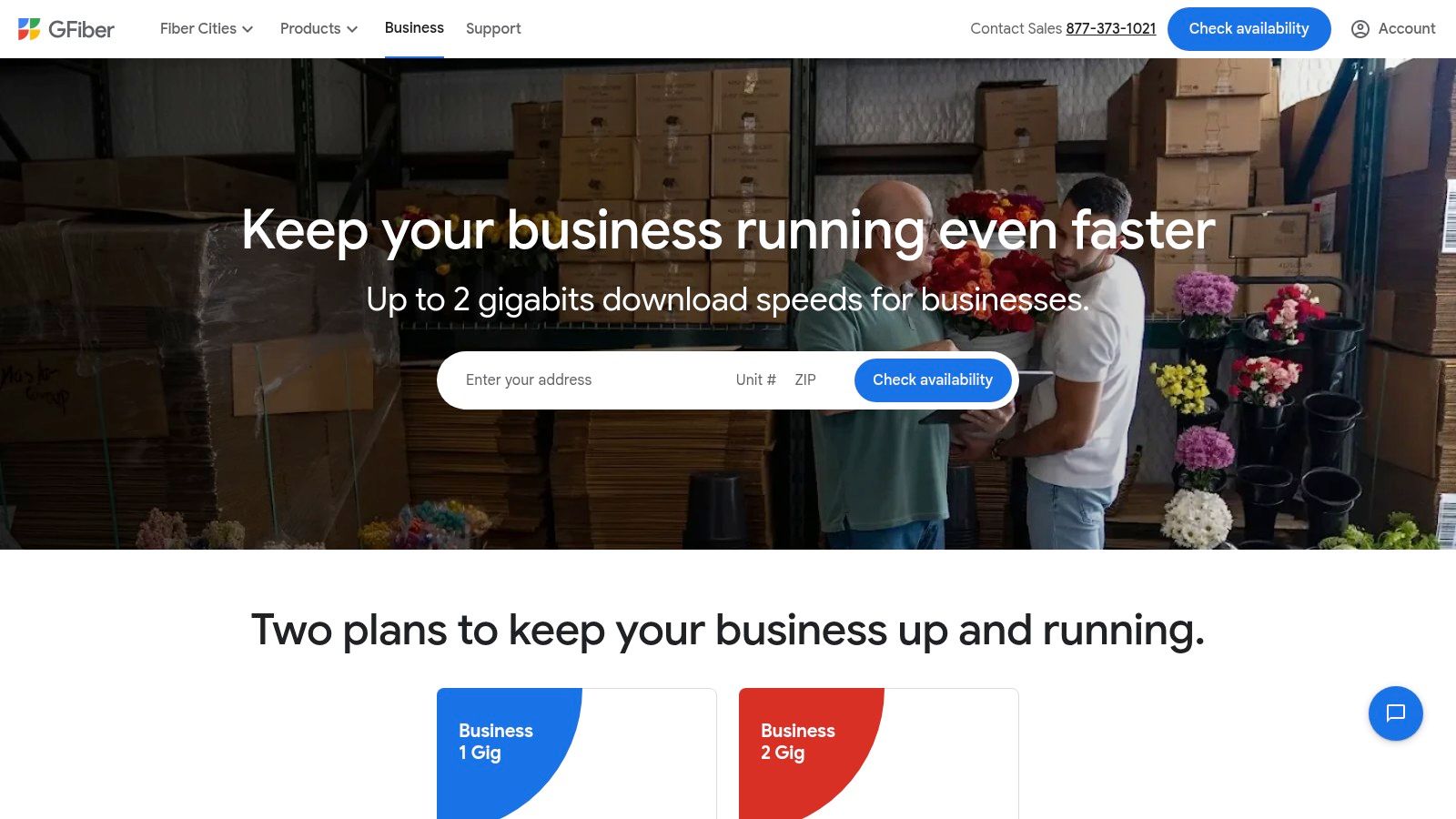
A lab in Midtown can live with very little procurement friction until the first large dataset has to leave the building before a reporting deadline. A university department can tolerate a simple internet plan until remote access, cloud backups, and camera uploads all compete for the same upstream capacity. That is the lane where GFiber Business makes sense. It gives Atlanta buyers a clean fiber option with symmetrical performance and fewer contract distractions than many larger providers.
That simplicity has real value. I usually see GFiber Business fit best at single sites that want solid fiber without a long carrier sales cycle. Research teams, administrative offices, outpatient clinics, and smaller academic buildings often care less about bundled extras and more about getting predictable upload and download performance for normal operations.
Why GFiber stands out
The main advantage is straightforward symmetrical service. For cloud storage, offsite backup, VoIP, VPN traffic, telemedicine sessions, large file transfer, and surveillance retention, upstream capacity affects daily work just as much as downstream speed. GFiber lines up well with those workloads.
The limiting factor is address eligibility. In Atlanta, one building may qualify and the next one may not. That makes GFiber less useful as a standard across a hospital network, lab portfolio, or distributed campus unless each location is checked early.
I recommend evaluating it as an access option, not as a full network strategy. For lower-risk sites, that can be enough. For environments with stricter uptime targets, security review, or audit requirements, buyers still need to inspect the SLA, static IP support, support path, failover design, and the provider's ability to fit into an existing firewall and monitoring stack.
Best use cases in Atlanta
GFiber Business tends to work well for:
- Single-site offices that need symmetrical fiber: Good for cloud applications, shared storage, and frequent upstream traffic.
- Smaller healthcare or academic locations: Useful where the site needs reliable business internet but not carrier-grade custom engineering.
- Teams that want simpler quoting and fewer bundled add-ons: Easier to compare against other access options during procurement.
- Sites that already have a separate backup plan: Stronger choice when redundancy is handled elsewhere instead of assumed from one circuit.
The provider's GFiber Business service page is still the first place to check because qualification decides the conversation. If the address is serviceable, it belongs on the shortlist. If not, move on quickly.
Where it falls short
GFiber Business is not usually the first choice for a hospital core, a primary lab uplink, or a university edge that carries high-consequence traffic without a second path. Those environments often need more than a clean fiber plan. They need documented recovery targets, clearer escalation structure, carrier diversity, and design options that support compliance and continuity planning.
Product simplicity can also become a constraint. It is attractive for branch offices and smaller facilities, but technical buyers should be careful about assuming a straightforward SMB fiber offering will meet enterprise requirements without additional controls around redundancy, security, and incident response.
Symmetrical fiber improves daily operations. It does not replace due diligence on SLA terms, failover design, and site-level risk.
Bottom line on GFiber Business
GFiber Business is a practical option for Atlanta organizations that want symmetrical fiber and a shorter path from quote to install. It is often a strong fit for smaller medical offices, research groups, and university departments that need better upstream performance without telecom complexity. For high-stakes environments, treat it as one piece of the design and verify address availability, SLA terms, and redundancy before making it a production dependency.
4. Verizon 5G Business Internet Fixed Wireless
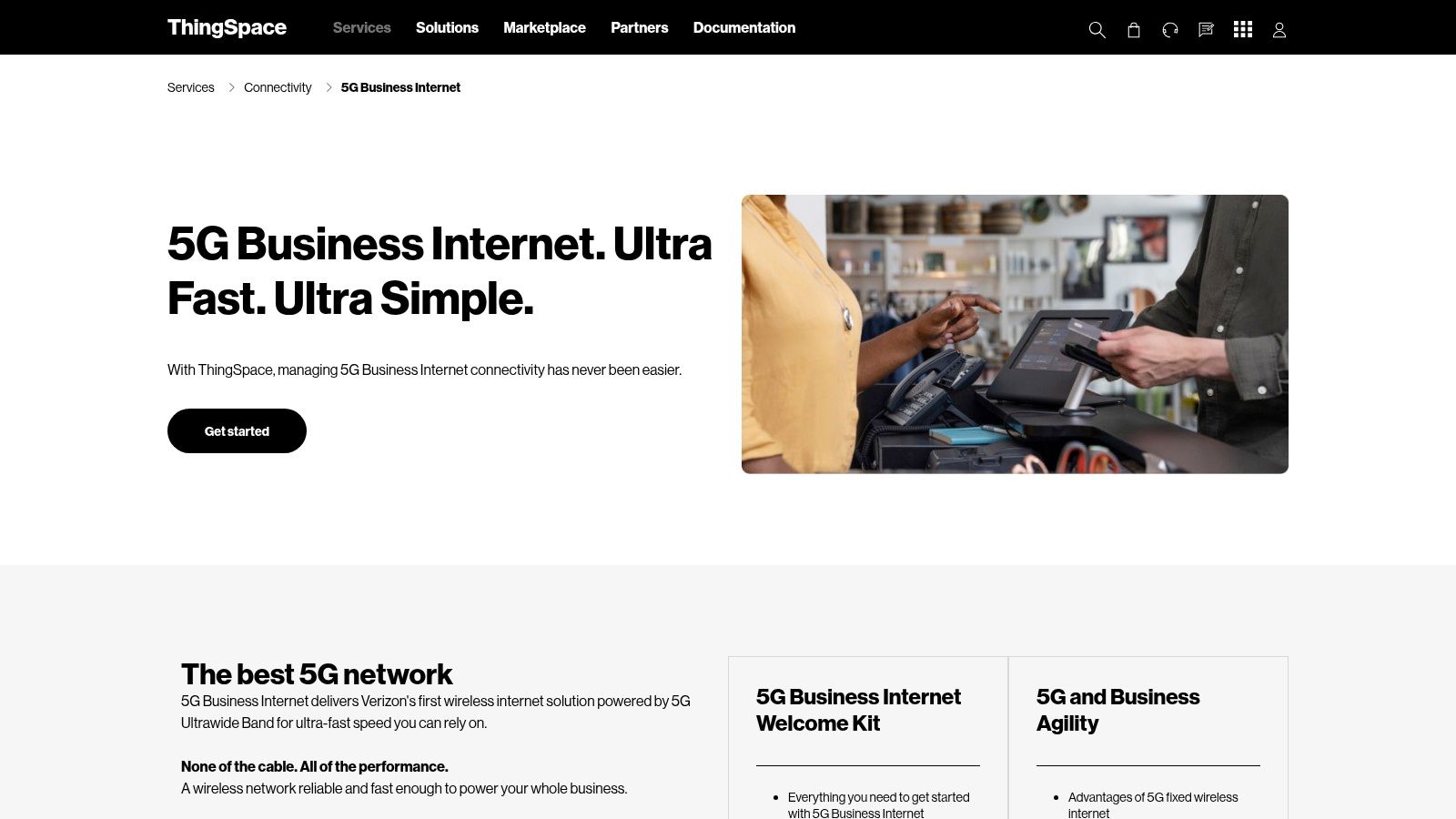
Verizon 5G Business Internet solves a different problem than wireline fiber. It's not usually my first recommendation for a hospital core, lab backbone, or university network edge that demands maximum predictability. It is, however, one of the most useful tools for getting a site online quickly or adding practical backup connectivity without waiting on construction.
That speed to deploy matters in Atlanta. Temporary clinical space, project offices, surge capacity, leased annexes, and fast-moving facility changes don't always have the luxury of waiting for trenching or landlord approvals.
Where fixed wireless earns its spot
Verizon's business fixed wireless service is strongest in three scenarios. First, interim connectivity while a primary wired circuit is still being built. Second, backup connectivity for sites that can tolerate some performance variance during failover. Third, hard-to-serve locations where wireline options are weak or delayed.
The professional outdoor receiver and Ethernet handoff make it more serious than consumer hotspot thinking. For IT teams, that matters because it can slot into a normal firewall and WAN design instead of forcing weird workarounds.
The Verizon 5G Business Internet platform is worth considering when the project schedule is tighter than the construction calendar.
The operational warning
Radio-based connectivity is location-sensitive. Building materials, roofline, local congestion, and RF conditions all affect real-world experience. A successful deployment at one Atlanta address tells you almost nothing about the next one.
That's why I treat Verizon 5G as a site-specific engineering decision, not a generic recommendation. It can perform very well in the right conditions. It can also disappoint buyers who expected fiber-like consistency from a wireless product.
A practical way to evaluate it:
- Use it as primary only when wired options are limited or timelines are impossible
- Use it as backup when business continuity matters more than perfect failover performance
- Test at the exact install location, not just the street address
- Confirm handoff, IP options, and support expectations before rollout
Good fit for Atlanta organizations
For hospitals and labs, Verizon 5G usually makes the most sense as backup transport for non-core operations or temporary service while permanent infrastructure is pending. For universities and distributed facilities teams, it's useful for swing space, field operations, and quick-turn sites where fiber lead times don't align with the project schedule.
Bottom line on Verizon 5G Business Internet
Verizon 5G Business Internet is a deployment tool first and a strategic primary circuit second. Used that way, it's valuable. Used as a direct substitute for dedicated fiber in high-stakes environments, it often creates the wrong expectations. In the right Atlanta scenario, though, a fast wireless turn-up can save a project timeline and give you breathing room to build the permanent network correctly.
5. T-Mobile Business Internet Fixed Wireless
A clinic opens a temporary Atlanta site in six days after a renovation delay. The EHR access, VoIP phones, guest Wi-Fi, and card processing all need to work on day one. In that situation, T-Mobile Business Internet earns attention because it can get a location online fast, without waiting through a full wireline install cycle.
That speed matters. So do the limits.
I recommend T-Mobile most often for temporary locations, lighter branch workloads, and secondary WAN circuits. For hospitals, labs, and universities, it usually fits best outside the core network. It can keep an admin office, trailer, testing site, or overflow space productive while the permanent circuit is still in progress.
What it does well
The main advantage is operational speed. Self-install and pro-install options reduce deployment time, and the hardware is easier to relocate than a fixed wired connection. That helps when a site is temporary, the move date is uncertain, or facilities teams need connectivity before construction and carrier scheduling are fully settled.
The T-Mobile Business Internet service also makes sense for organizations that do not want every small site to become a custom telecom project. For a distributed campus department, satellite office, storage facility, or field team, centralized purchasing and simpler support can be more useful than a long feature list.
It also fills a practical gap between wired broadband and true last-resort connectivity. Buyers who have already ruled out slow carrier construction often use T-Mobile as the fastest path to usable business service.
Where technical buyers need to be careful
T-Mobile is still fixed wireless. Performance changes by address, building construction, tower load, and time of day. That variability is manageable for some sites and unacceptable for others.
For Atlanta healthcare and research environments, the question is not just download speed. It is whether the circuit can support the actual operating pattern of the site. A registration office with web apps and phones can do well. A lab pushing large files, a clinic with constant upstream sync, or a department handling regulated traffic with strict uptime expectations usually needs a more controlled primary connection.
Support expectations also need to stay realistic. If your procurement standards require formal SLAs, clear packet-loss commitments, or architecture built around compliance audits and redundant handoffs, this product belongs lower in the stack. Use it as a tactical circuit, not the foundation of a high-stakes environment.
Field note: Fixed wireless works best when the failover plan is specific. Decide which systems must remain online, test those systems on the wireless path, and leave bulk traffic on the primary circuit.
Best use cases
- Temporary medical, academic, or admin space: Fast turn-up while permanent service is pending.
- Light-duty branch connectivity: Good for phones, web apps, basic cloud access, and point-of-sale.
- Secondary WAN path: Useful for continuity when the business can tolerate some performance variation during failover.
- Hard-to-serve or delayed locations: Helpful where cable or fiber construction timelines do not match the project deadline.
Bottom line on T-Mobile Business Internet
T-Mobile Business Internet is a deployment tool with clear boundaries. In Atlanta, that makes it useful for overflow clinics, project sites, university support buildings, and backup connectivity where speed of installation matters more than carrier-grade guarantees.
For technical buyers in hospitals, labs, and universities, the decision is straightforward. If the site needs documented uptime commitments, predictable upstream performance, security review confidence, and a clean compliance story, keep T-Mobile in a supporting role. If the goal is to get a site online quickly and keep lower-risk operations running, it can be a cost-effective option.
6. Lumen CenturyLink Dedicated Internet Access and Fiber+
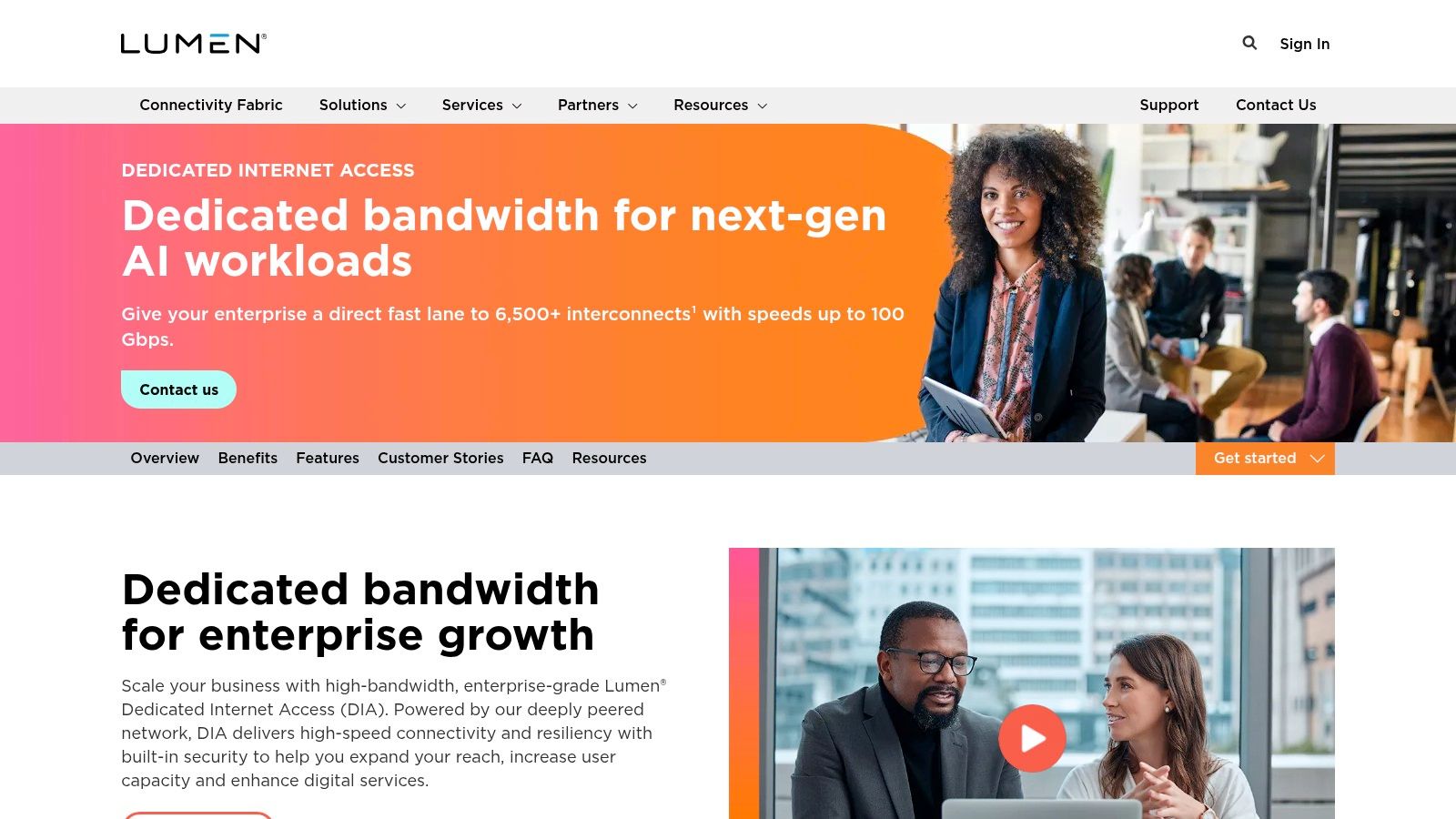
A lab loses its primary circuit during specimen uploads. A hospital department cannot wait for best-effort restoration. A university research group has grant-funded systems pushing data offsite on a schedule. Those are the cases where Lumen enters the discussion, because the buying criteria shift from monthly price to service guarantees, escalation paths, and architectural fit.
For Atlanta organizations with compliance exposure or uptime targets, Lumen is usually a question of product tier and building access. Dedicated Internet Access is built for stricter operational requirements. Fiber+ fits sites that want business-class fiber with better framing than standard broadband, but without the same service commitment profile.
Lumen's product split matters. Its Dedicated Internet Access and Fiber+ service information distinguishes between a higher-availability SLA on DIA and a lower availability commitment on Fiber+. For technical buyers, that difference affects risk planning, incident response expectations, and how comfortably the circuit will stand up in a security or compliance review.
Where Lumen fits best
I usually put Lumen in front of buyers who already know the circuit will support something important: EMR access, imaging transfers, research data movement, remote replication, VoIP across multiple departments, or cloud applications that cannot tolerate long recovery windows.
That does not mean every Atlanta site should buy DIA. It means the organization should match the product to the consequence of failure.
A billing office with moderate tolerance for disruption may be fine on Fiber+. A hospital clinic, testing facility, or university data center usually needs the cleaner SLA language, clearer accountability, and steadier performance profile that come with DIA.
Questions to settle before procurement
The biggest mistake is treating a Lumen quote like a commodity internet quote. It is an access design decision.
Ask these questions early:
- Is the address on-net, near-net, or dependent on new construction?
- Are you reviewing Dedicated Internet Access or Fiber ?
- What installation work falls on the landlord, building engineer, or customer IT team?
- Can the circuit be paired with a fully diverse secondary carrier path?
- How are outages handled if the fault sits between building infrastructure and the carrier demarc?
- What SLA terms, response commitments, and credit terms will procurement specifically receive in the order paperwork?
Those answers shape cost and schedule more than the advertised service name does. In Atlanta, two buildings a mile apart can have very different lead times and install economics.
Practical fit in Atlanta
Lumen makes the most sense where the organization needs a carrier that can support formal WAN planning instead of simple internet procurement. Hospitals, labs, and universities often need more than bandwidth. They need documentation for vendor review, a support model that stands up during an outage, and a circuit that fits a broader redundancy plan.
The trade-off is straightforward. Costs can climb quickly if the site is off-net or if the design calls for construction, diversity, or tighter service expectations. For low-risk offices, that premium may be hard to justify. For clinical operations, regulated research, and institutional environments with real downtime consequences, it often is justified.
Bottom line on Lumen
Lumen is a serious option for Atlanta buyers who need SLA-backed internet with clearer operational accountability than standard business broadband. Choose Fiber+ for lower-risk sites that still want business-class fiber. Choose DIA when uptime, escalation discipline, and audit-friendly service terms matter enough to warrant the extra spend.
7. Zayo Dedicated Internet Access Enterprise
At an Atlanta hospital, lab, or university, the internet circuit often carries far more than email and web traffic. It may be supporting imaging transfers, cloud research workloads, remote clinics, public-facing portals, and security controls that cannot tolerate congestion or vague outage ownership. That is the context where Zayo belongs on the shortlist.
Zayo is built for enterprises that treat connectivity as part of core infrastructure. In Atlanta, its metro fiber footprint can be attractive for organizations that care about fiber path options, carrier diversity, and clean handoffs into a broader WAN or data center design. Buyers who already ask about routing policy, DDoS exposure, cloud access, and failover behavior will usually get a more relevant conversation here than they will from a mass-market broadband sales process.
What separates Zayo from standard business broadband
The main difference is control.
Dedicated Internet Access gives the site a committed service built for predictable performance and formal service terms, rather than a shared broadband product that is good enough until a busy period, outage dispute, or security event exposes the limits. For technical buyers in healthcare and higher education, that difference shows up in procurement and operations. SLA language, escalation paths, demarc clarity, and design options matter as much as bandwidth.
The Zayo Dedicated Internet Access offering also stands out for buyers who want network-layer security options such as Shielded Internet Access. For public-facing institutions in Atlanta, especially those exposed to volumetric attacks or sensitive uptime requirements, integrated DDoS mitigation can reduce design complexity and shorten incident response.
Where Zayo fits best
Zayo makes the most sense when the site has requirements such as:
- Dedicated bandwidth with predictable performance: Useful for critical applications, large data transfers, and sites where congestion creates real operational risk.
- Carrier-grade design options: Important when the network team needs specific handoff, routing, or resiliency choices.
- Cloud and interconnection planning: A better fit for organizations with hybrid infrastructure and formal connectivity architecture.
- Security requirements tied to uptime: Relevant for hospitals, labs, and universities that cannot treat DDoS protection as an afterthought.
This is usually not a convenience purchase. It is an infrastructure decision.
Trade-offs buyers should expect
Zayo often comes with custom quoting, longer provisioning timelines, and a higher monthly cost than business fiber or fixed wireless. In some Atlanta buildings, the economics work well because the location is already near existing fiber. In others, construction, access work, or diversity requirements can change the project quickly.
That makes pre-sales diligence especially important. Ask whether the quote assumes existing building access, whether the path can be diversified in a meaningful way, and how outage responsibility is handled between the building entrance, customer equipment, and the carrier network. For regulated environments, also confirm whether the service terms and support process will hold up under vendor review, incident documentation, and internal compliance expectations.
Bottom line on Zayo
Zayo is one of the stronger Atlanta options for organizations that need enterprise internet with serious design discipline behind it. Smaller offices will often find it too expensive and too customized for their needs. For mission-critical healthcare, research, and university environments, that extra engineering can be the reason the circuit is worth buying.
Top 7 Business Internet Providers Comparison
| Solution | Implementation 🔄 (complexity) | Resource Requirements 💡 (what you need) | Expected Outcomes ⭐ (quality) | Ideal Use Cases 📊 | Key Advantages ⚡ (strengths) |
|---|---|---|---|---|---|
| AT&T Business Fiber (Atlanta) | 🔄 Moderate, fiber install & address verification required | 💡 On‑net fiber handoff, optional static IPs, support/managed add‑ons | ⭐ High, symmetrical 300 Mbps–5 Gbps; built‑in 5G failover on 1 Gbps+ | 📊 SMBs needing reliable symmetric broadband and resiliency | ⚡ Wide metro footprint, transparent pricing, 24/7 support |
| Comcast Business (Xfinity footprint – Atlanta) | 🔄 Low–Moderate, coax widely available; metro fiber/DIA custom builds | 💡 Coax or fiber handoff, bundle options (SecurityEdge), optional wireless backup | ⭐ Variable, broad availability; SLA/throughput depends on product (coax vs DIA) | 📊 Businesses needing broad coverage, bundled connectivity + security | ⚡ Extensive coverage, integrated vendor stack, multi‑year price locks |
| Google Fiber Business (GFiber Business) | 🔄 Low, simple install where neighborhood is served | 💡 On‑net fiber, advanced Wi‑Fi gear included, static IP option | ⭐ High, simple symmetric 1 Gbps or 2 Gbps with transparent pricing | 📊 Upload‑heavy SMBs (cloud backup, large transfers, camera offload) | ⚡ Predictable performance, clear pricing, strong uptime reputation |
| Verizon 5G Business Internet (Fixed Wireless) | 🔄 Low, fast turn‑up; professional outdoor receiver for best RF | 💡 Outdoor CPE, site RF line‑of‑sight considerations, optional public IPs | ⭐ Medium, fast deployment but throughput/latency vary with RF | 📊 Interim primary links, site backup, rapid deployments | ⚡ Very fast activation, LTE failover, wide cellular footprint |
| T‑Mobile Business Internet (Fixed Wireless) | 🔄 Very Low, self‑install or pro‑install, simple activation | 💡 Portable CPE, centralized management for multi‑site fleets | ⭐ Medium, cost‑effective but variable speeds/latency with signal | 📊 Temporary sites, small offices, low‑friction backups | ⚡ Portable hardware, simple billing, traffic prioritization options |
| Lumen (CenturyLink) – DIA and Fiber+ | 🔄 Moderate–High, on‑net fast; off‑net builds increase time/cost | 💡 Dedicated fiber circuits, enterprise support, formal SLA requirements | ⭐ Very High, symmetrical bandwidth with documented SLAs (99.99% option) | 📊 Compliance‑sensitive orgs, predictable performance needs | ⚡ Strong SLAs, flat on‑net pricing, scalable dedicated bandwidth |
| Zayo – Dedicated Internet Access (Enterprise) | 🔄 High, enterprise provisioning, route diversity and custom quotes | 💡 Tier‑1 backbone access, DDoS mitigation options, cloud on‑ramps | ⭐ Very High, uncontended, scalable throughput with enterprise SLAs | 📊 Large campuses, data‑heavy sites, mission‑critical operations | ⚡ Highly scalable, integrated security (DDoS), extensive peering and diversity |
Decision Checklist for Atlanta's Technical Buyers
At 2 a.m., a hospital imaging team cannot wait while procurement argues over whether "business class" internet was good enough. A research lab cannot pause an overnight run because the primary circuit failed and the backup rides the same path into the building. In Atlanta, those mistakes usually start earlier, when buyers compare download speed and monthly price but skip the operating details that determine whether a site stays up.
For hospitals, labs, universities, and enterprise IT teams, the right question is not "Which provider advertises the fastest plan?" The right question is whether the circuit supports compliance requirements, recovery targets, security controls, and the way the site works under failure.
Start with site criticality.
A university admin office, a remote clinic, a genomics lab, and a core hospital campus should not be bought the same way. Define the role of the location first. Then set the acceptable outage window, the data sensitivity level, and the operational impact of packet loss, latency, or extended repair. That framing usually narrows the provider list quickly.
The next filter is the service model. Shared broadband can be acceptable for low-risk locations, short-term occupancy, or a secondary connection. Core sites usually need a dedicated circuit with a written SLA, a documented repair process, and a support path that does not disappear into a general call queue. If the site supports patient care, regulated data, or time-sensitive research workloads, best-effort service should be a deliberate exception, not the default.
Traffic shape matters as much as raw bandwidth. Atlanta organizations often focus on downstream numbers and miss the upstream requirement until cloud backups drag, VPN users complain, or large file transfers start colliding with daily operations. Medical imaging, surveillance retention, remote collaboration, research datasets, and off-site replication all push buyers toward symmetrical services and predictable performance.
Then test the failure plan before signing the order form. Ask three direct questions. Is there true carrier diversity? Is there true physical path diversity into the building? Who owns escalation when the fault sits between the provider demarc, riser infrastructure, and landlord-controlled cabling? If those answers are vague, the resilience plan is weak no matter how good the proposal looks.
Security review should happen in parallel, not after install. Confirm static IP options, handoff type, firewall compatibility, DDoS protection where needed, remote-access design, and any constraints that affect segmentation or monitored traffic. For healthcare and research environments, provider fit is partly a network question and partly a control question.
Deployment is another place buyers get burned. Neighborhood coverage maps do not answer the question of whether your exact building and suite can be installed on the timeline you were promised. Verify the address, suite, MPOE, handoff, construction dependencies, and landlord approval process. Many Atlanta projects stall at that point because the service was "available" in theory but not ready for the actual premises.
Price needs the same discipline. A low headline rate tells you very little about the final operating cost for a serious site. Contract term, build charges, managed equipment, installation scope, support tier, public IP requirements, and failover design all change the number. For technical buyers, the useful comparison is total service model cost, not promo pricing.
Use this checklist during provider review:
- Classify the site: core campus, clinic, lab, branch, temporary space, or backup location
- Set outage tolerance: how long the site can operate before revenue, care delivery, research continuity, or compliance is affected
- Document traffic needs: upload-heavy workflows, VPN density, cloud reliance, voice, video, and large file movement
- Define security requirements: static IPs, segmentation, firewall support, DDoS protection, logging, and remote access
- Validate provider fit at the address level: building entry, suite serviceability, handoff type, install interval, and landlord dependencies
- Review the support model: business support versus enterprise support, escalation path, repair commitments, and account ownership
- Test redundancy design: separate carriers, separate entrances, separate paths, and wireless failover where appropriate
- Compare total cost: monthly recurring charges, non-recurring build costs, contract length, managed services, and upgrade path
Buy for the day something fails, not the day the circuit tests clean.
If your Atlanta organization is planning a lab closure, IT refresh, facility move, or secure equipment retirement, Scientific Equipment Disposal can help simplify the next step. S.E.D. supports hospitals, labs, universities, corporate IT teams, and government agencies with compliant pickup, de-installation, packing, logistics, and secure electronics disposal, including hard-drive wiping and shredding options that support HIPAA-focused workflows.