Sustainable Equipment in Lab Disposal Guide for Nationwide and Local Facilities

When you're upgrading, relocating, or closing down a lab, the question of what to do with all the leftover equipment quickly becomes a major headache. It’s not just a clean-up job. This is a high-stakes process tangled up in hazardous materials, sensitive data, and a mountain of environmental regulations, whether you're a single facility in Atlanta, GA or a multi-state organization.
Your Guide to Lab Equipment Disposal
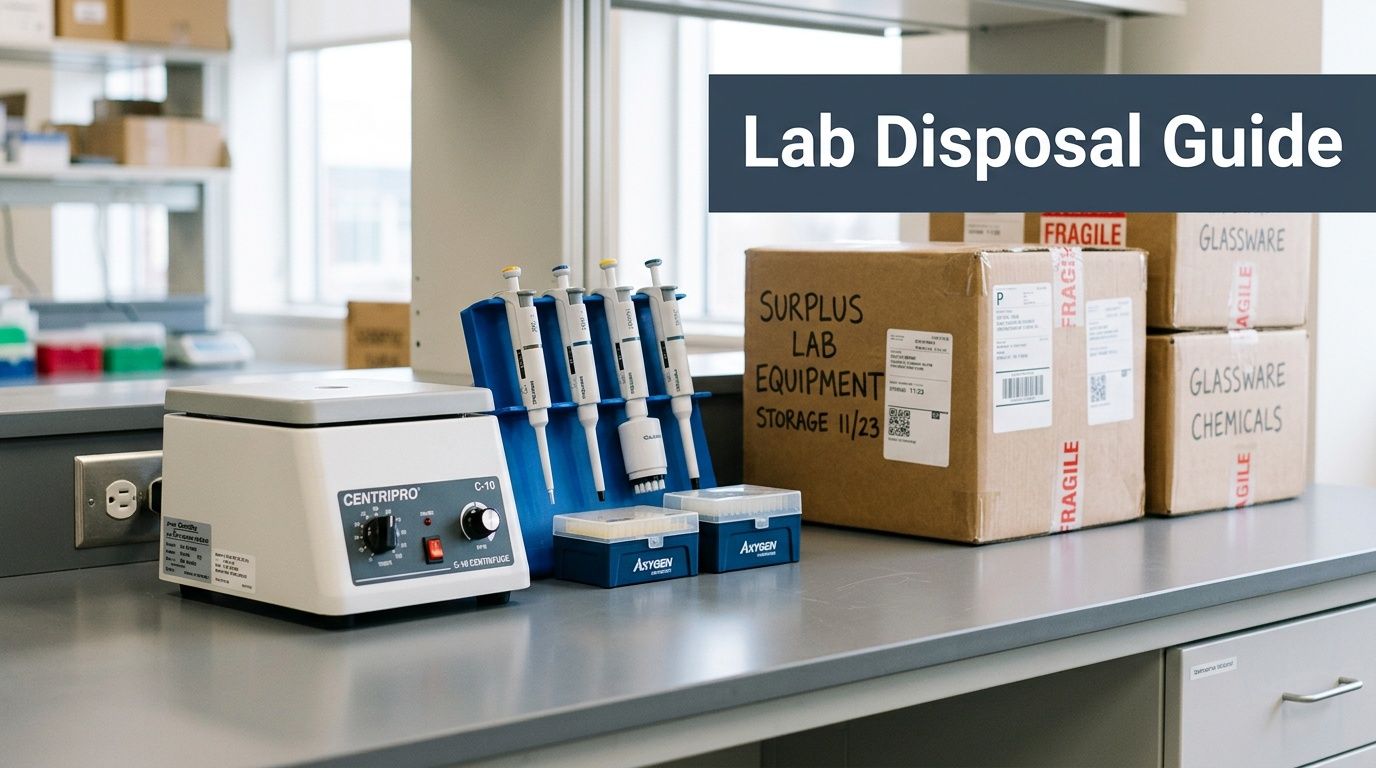
For facility managers, getting rid of old lab assets is a puzzle. And the wrong move can cost you. Simply tossing old equipment in lab settings is never an option—it can lead to staggering fines, a black eye for your reputation, and serious environmental damage.
Think of a retired analytical instrument. It's not just a hunk of metal and plastic; it's a container of risks. It might still hold trace chemicals, residual biological matter, or even a hard drive packed with protected health information (PHI).
Understanding the Scope of Lab Decommissioning
A successful lab decommissioning isn’t a one-size-fits-all project. Every lab is different, filled with a diverse mix of equipment, and each piece requires its own specific disposal plan. The real challenge is managing all of it securely and efficiently, whether you're a local lab in Georgia or a research institution with facilities across the United States.
This is especially true for hospitals, research universities, and large corporations—particularly those in major hubs like Atlanta or with facilities spread nationwide. These organizations are under immense pressure to follow strict rules while also protecting decades of priceless research and patient data. For a closer look at what we can handle, you can learn more about our comprehensive lab equipment disposal services.
At its core, successful lab decommissioning is a balancing act between three pillars: rock-solid regulatory compliance, total data security, and sustainable, eco-friendly practices. If one of these pillars wobbles, the whole effort can come crashing down.
The Role of Specialized Disposal Services
Trying to navigate this complex world on your own is a heavy lift for any organization. This is where a specialized disposal partner becomes your most valuable asset. A professional service brings the expertise needed to handle every type of equipment in lab decommissioning, from tiny pipettes and complex analytical instruments to the entire IT network that ran the place.
A key piece of this is understanding the best practices for the proper disposal of electronic waste, since almost every modern lab instrument has an electronic component. These principles are the foundation of a compliant and secure process.
A qualified provider gives you an all-in-one solution that covers:
- Inventory and Assessment: We figure out what can be resold for a return, what needs to be recycled, and what must be securely destroyed.
- Data Destruction: We guarantee that every bit of digital information is wiped clean using certified, auditable methods.
- Compliant Recycling: We ensure hazardous e-waste stays out of landfills and that valuable materials are recovered and reused.
By bringing in experts, facility directors and lab managers from Atlanta to San Francisco can rest easy knowing their decommissioning is handled securely, sustainably, and in full compliance with every rule in the book—from local city ordinances to federal mandates.
The Evolution of Modern Laboratory Equipment
To really get a handle on today's complex disposal challenges, it helps to see how we got here. The journey from simple 19th-century tools to the automated, data-heavy instruments now filling our labs explains why decommissioning is such a massive project. It’s the reason that surplus equipment in lab settings isn’t just junk—it’s a collection of specialized materials demanding expert handling.
Think about it: in the late 1800s, labs moved beyond basic glassware to precise instruments that fueled huge scientific leaps. The invention of the spectroscope around that time, for example, let scientists analyze substances with light, opening the door to entire new fields like astrophysics. You can find more on this shift at The Evolution of Laboratory Equipment.
From Glassware to Automated Instruments
This explosion of innovation created a kind of arms race. Every new discovery required more powerful, more specialized, and far more complex tools to push the boundaries even further.
- Early Innovations: Simple test tubes were soon joined by workhorses like centrifuges, which separate substances by density, and more powerful microscopes for deep biological and chemical analysis.
- The Electronic Age: By the mid-20th century, electronics entered the lab in a big way. pH meters, spectrophotometers, and early analytical machines started automating tasks that were once painstakingly done by hand.
This wasn't just about making things easier; it was about accelerating the pace of discovery itself. With better equipment, researchers could ask bigger questions and get answers faster than ever before.
The Data Revolution and Its Disposal Problem
The biggest change, however, has come from integrating powerful computers and software into nearly every piece of modern lab equipment. Today's instruments aren't just for running experiments—they are data-gathering powerhouses.
Automated liquid handlers and high-throughput sequencers can process thousands of samples a day, creating enormous volumes of digital information. While this boosted efficiency, it also created a brand-new set of problems when it's time to get rid of the hardware. For a deeper dive, check out our guide on what happens to old laboratory equipment after disposal.
Because of this rapid evolution, any surplus equipment in lab spaces today is a complicated mix of:
- Complex Electronics: Circuit boards, sensors, and entire computer systems that are classified as e-waste.
- Data Storage Media: Hard drives and flash memory that could be holding sensitive research findings or even patient data.
- Potentially Hazardous Materials: Lingering chemical residues or biological samples that must be carefully decontaminated.
Each one of these elements turns decommissioning into a specialized task. The path from a simple glass beaker to a data-heavy automated system is exactly what created the disposal headaches faced by labs in Atlanta and across the country, making professional services essential for safe, compliant, and secure asset management.
Navigating the Risks of Improper Equipment Disposal
Getting rid of old lab equipment seems simple, but it’s a minefield of risk. Tossing an old machine in the dumpster can expose your organization to hazardous material liabilities, devastating data breaches, and steep regulatory fines.
Even one mistake can have serious consequences for your finances, reputation, and legal standing. Think about an unsanitized hard drive from a lab analyzer—leaving that data unprotected is like scattering sensitive patient files across a public park. The risk is that severe.
The Dangers of Hazardous Materials
A lot of lab equipment contains materials that are flat-out dangerous to people and the environment. When these items are just thrown away, they can leak toxins into the soil and water, creating long-term contamination that can't be undone.
You'll find plenty of nasty stuff inside common lab instruments, including:
- Mercury: A powerful neurotoxin often found in thermometers, switches, and certain lamps.
- Lead: Used for radiation shielding in X-ray equipment and in the solder on older circuit boards.
- Cadmium: Commonly found in rechargeable batteries and other electronic components.
- Biological Residues: Any gear that handled infectious agents needs to be perfectly decontaminated to stop the spread of disease.
Failing to properly handle these materials isn't just about avoiding fines under environmental laws. It's a failure of corporate responsibility that causes environmental damage for generations.
The Critical Threat of Data Breaches
In modern labs, almost everything has a digital brain. Analyzers, sequencers, and even smart freezers store massive amounts of data—from proprietary research and intellectual property to Protected Health Information (PHI). If you don't permanently destroy this data, you’re asking for trouble.
The move to automated lab systems was great for reducing errors and speeding up work, but it also created a mountain of obsolete equipment. With an annual equipment turnover of 15-20%, major markets like the US produce an estimated 1.2 million tons of lab e-waste every year. In research hubs like Atlanta, improper disposal can lead to data breach rates as high as 25%. There's no substitute for professional data destruction.
Ensuring Data Destruction and Regulatory Compliance
To prevent a breach and meet strict standards like HIPAA, data can't just be deleted—it has to be made completely unrecoverable. This requires certified methods that go way beyond dragging a file to the trash bin.
Here are the two main ways we guarantee data security:
- DoD 5220.22-M 3-Pass Wiping: This is the gold standard for software-based data sanitization. It overwrites the hard drive three separate times, achieving 99.9% sanitization and making the original data practically impossible to get back.
- Physical Shredding: For drives that are broken or can't be wiped, this is the only solution. We shred the media into tiny, unrecognizable fragments, guaranteeing the data is gone forever.
For any organization, partnering with a vendor who provides certified data destruction is a must. It's the only way to get the paperwork you need to prove compliance and shield your institution from crippling legal and financial blowback. To learn more about meeting federal standards, read our guide on EPA-compliant laboratory equipment disposal.
A Step-by-Step Lab Decommissioning Checklist
Shutting down a lab can feel like a monumental task. We get it. But with a solid game plan, you can turn a chaotic cleanout into a straightforward, manageable project.
Breaking the process down into distinct phases takes the stress out of it and makes sure nothing gets missed. This checklist is your road map, guiding you from the first inventory count to the final compliance report. We've simplified the entire process of decommissioning equipment in lab facilities into four main phases. Each step naturally leads to the next, creating a workflow that cuts down on risk and saves time.
Phase 1: Inventory and Assessment
First things first: you need to know exactly what you have. Think of this as a detailed census of your entire lab. You can't make smart decisions about where your equipment should go if you don't have a complete inventory.
Go through your lab and document every single piece of equipment. Note its type, manufacturer, model number, and overall condition. Once you have this master list, it's time to sort everything into three main buckets:
- For Resale: These are your newer or high-value instruments. Selling them is a great way to recover some of your initial investment.
- For Recycling: This category is for obsolete or broken electronics that need to be handled by a certified e-waste recycler.
- For Disposal: These are the items at the true end of their life, requiring certified disposal because of the materials they contain.
Getting this initial sort right is crucial. It sets the stage for everything that follows, from decontamination to data security. To get a better sense of how this fits into the bigger picture, you can check out the full scope of our laboratory and equipment services.
Phase 2: Decontamination and Data Sanitization
With your inventory sorted, it's time to tackle the two biggest headaches in any lab decommission: hazardous materials and sensitive data. This isn't a step you can afford to skip.
Any piece of equipment that ever touched chemical or biological materials needs to be professionally decontaminated. This is a must-do to prevent any accidental exposure when the equipment is being handled or moved.
At the same time, any equipment in lab settings that stores data needs to be wiped clean. This is where a process like DoD 3-pass wiping comes in. It overwrites a hard drive's data three times, making the original information nearly impossible to recover. For labs dealing with HIPAA, this is an absolute cornerstone of protecting patient data.
What about drives that are too old or damaged to be wiped? Certified physical shredding is the only answer. This guarantees that even a dead piece of media can't become the source of a data breach.
Phase 3: Logistics and Removal
Once everything is inventoried, decontaminated, and sanitized, it's time to get it out the door. The logistics of removal can be tricky, especially if you need to avoid disrupting ongoing operations. This is where working with a disposal partner who has their own trucks makes a huge difference.
A team that manages its own logistics can schedule and execute the removal without a hitch. They handle all the heavy lifting—the de-installation, packing, and loading—so your people can stay focused on their real jobs. It makes for a fast, organized, and painless cleanout.
The infographic below highlights the risks you sidestep by following a careful process.
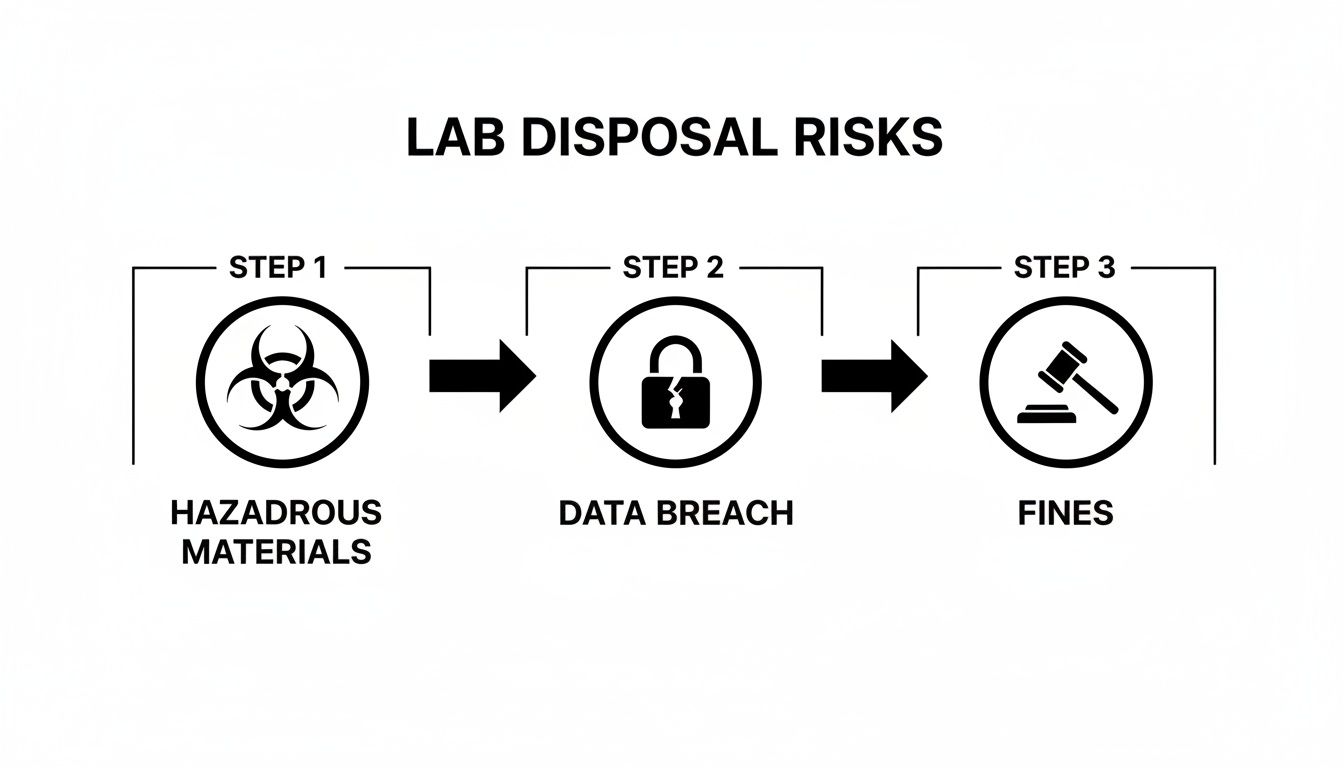
As you can see, one mistake with hazardous materials can easily lead to a data breach, which often results in steep regulatory fines and legal trouble.
Phase 4: Documentation and Compliance
The final phase is all about the paperwork. This isn't just red tape; it's your proof that you handled the decommissioning by the book. This audit trail is essential if regulators ever come knocking.
Your disposal partner should provide a complete documentation package, including:
- Certificates of Disposal: This confirms your assets were disposed of in an environmentally compliant way.
- Certificates of Data Destruction: This verifies that every data-bearing device was properly sanitized or physically destroyed, meeting standards like HIPAA.
- Complete Asset Reports: This report details the final outcome for every single item on your original inventory list.
This final package closes the loop on your project. It gives you documented proof that every piece of equipment in lab spaces was managed securely, sustainably, and legally.
Choosing the Right Lab Disposal Partner
When you're facing a lab cleanout, it’s tempting to just shop around for the cheapest quote. But picking a disposal partner based on price alone is a huge mistake. The real cost isn't what's on the invoice—it's buried in the risks of non-compliance, the hours your own team will waste, and the nightmare of a potential data breach.
Getting this decision right protects your entire organization. This is especially true for the hospitals, universities, and research companies we work with in the Atlanta metro area and across the country. You need a partner who understands both the local logistics and the nationwide compliance standards inside and out. They aren't just a hauler; they're a critical part of your risk management strategy.
In-House Disposal vs. Professional Service
We see it all the time: organizations try the DIY route, thinking they'll save a few bucks. It almost always backfires, creating massive headaches and hidden costs. Disposing of equipment in lab environments takes specialized know-how, the right tools, and certifications that most internal facilities teams simply don't have.
A professional service, on the other hand, brings expertise and security to the table. We turn a complex, risky project into a smooth, documented process.
Cost Analysis of Disposal Methods
Let's break down the true costs of a typical lab cleanout. The table below shows a side-by-side comparison of going it alone versus hiring a team of experts.
| Disposal Task | In-House (DIY) Approach | Professional Service (e.g., S.E.D.) |
|---|---|---|
| Labor & Logistics | High cost of staff hours for inventory, packing, and moving; risk of workplace injuries. | All-inclusive service with trained technicians and a dedicated fleet; no staff time wasted. |
| Data Destruction | Major risk of improper wiping; leaves you open to massive data breach fines and brand damage. | Guaranteed DoD-standard wiping and physical shredding, complete with Certificates of Destruction. |
| Compliance Risk | Extremely high risk of violating EPA, HIPAA, or other regulations, resulting in severe penalties. | Zero risk. We provide full documentation and adhere to R2v3/e-Stewards standards. |
| Environmental Impact | High chance of e-waste ending up in landfills, violating state laws and your own CSR goals. | Certified recycling ensures all materials are recovered and repurposed, with total transparency. |
As you can see, what looks like savings upfront with a DIY approach quickly gets eaten up by hidden expenses, massive liabilities, and a lot of wasted time.
Key Questions for Your Potential Partner
To find a partner you can actually trust, you need to ask the right questions. This isn't about haggling over price—it's about making sure they can protect you from serious legal and financial trouble. A legitimate provider will have clear, confident answers for every one of these.
A partner’s certifications are their credentials. An R2v3 or e-Stewards certification isn't just a logo; it's third-party proof that they follow the highest industry standards for environmental responsibility and data security.
Before you sign anything, make sure you ask:
- What certifications do you hold? You need to hear R2v3 or e-Stewards. These are the gold standards and guarantee responsible, compliant recycling.
- What are your specific data destruction protocols? They must offer auditable methods like DoD 5220.22-M wiping and physical shredding. Ask for a sample Certificate of Destruction.
- Can you provide a transparent, itemized quote? Avoid vague estimates. A good partner details all costs for logistics, labor, and recycling, so there are no surprises.
- Do you have your own fleet and trained crew for pickup? This is critical. Using third-party movers breaks the chain of custody and introduces risk. This is key for both our local Atlanta-area clients and nationwide projects.
With these answers in hand, you’ll be able to spot the difference between a real expert and just another guy with a truck. For a deeper dive, our guide on vetting vendors can teach you more about what separates the best from the rest. You can learn more about certified scientific equipment disposal providers here.
Making the right choice is the single most important step in a secure, compliant, and stress-free lab decommission.
Building a Sustainable Lab Asset Management Plan
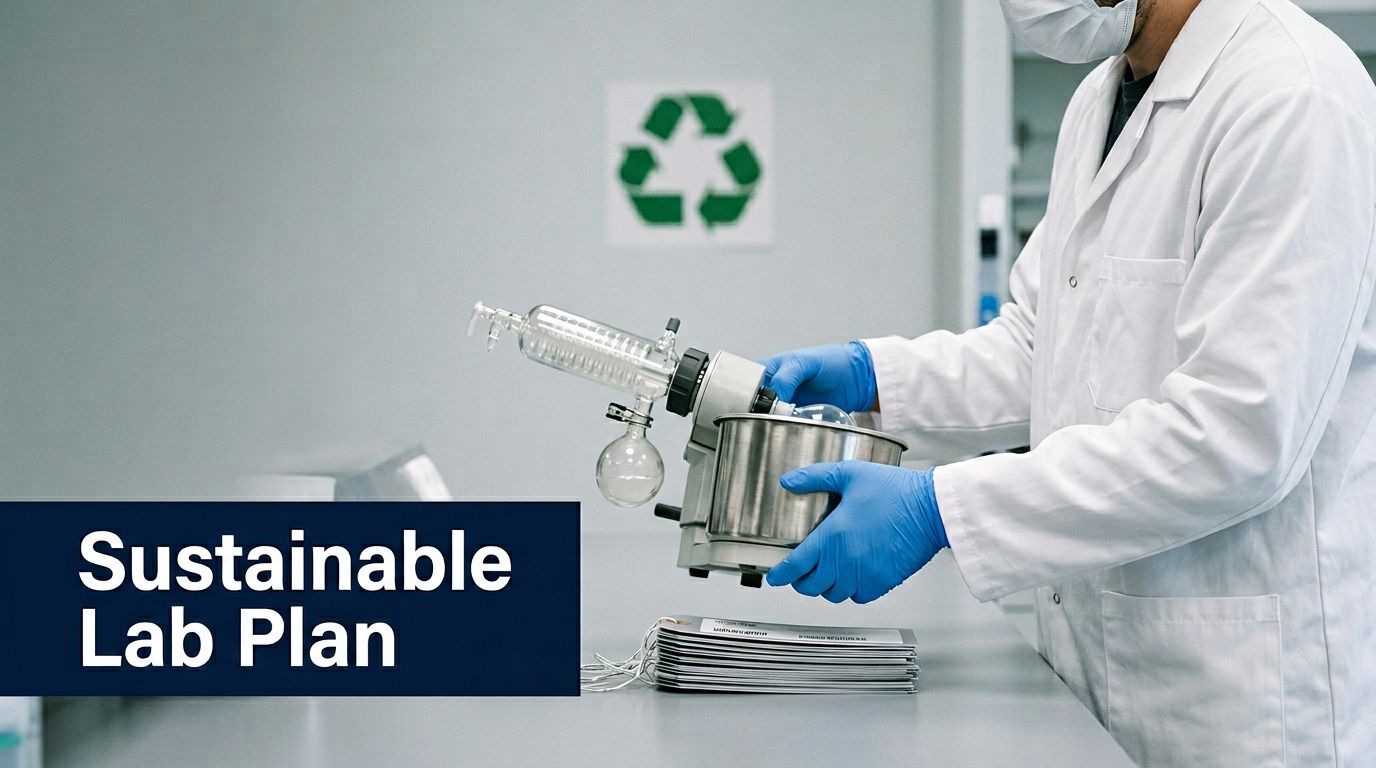
Smart disposal isn’t about a one-off cleanout. It’s about building a real, long-term plan for the entire lifecycle of your lab assets. You have to move away from the old "buy, use, toss" mentality and adopt a circular approach, where every piece of equipment in lab facilities is managed for its highest value and lowest waste. This isn't just good for the environment; it’s a powerful statement about your company's commitment to corporate social responsibility (CSR).
Thinking ahead is critical. The massive wave of electronic instrumentation that hit labs after WWII, especially by the mid-1960s, created the e-waste problem we’re dealing with today. Now, that aging gear contributes to 300,000 tons of surplus equipment every year. With most facilities planning major decommissions every 5-7 years, the volume of hazardous waste like mercury just keeps climbing. You can read the full research on lab equipment lifecycles and disposal here.
Creating a Circular Economy for Lab Assets
A circular economy in the lab simply means you’re always thinking about the "next life" for your equipment. Instead of letting valuable assets collect dust in a storage closet until they’re worthless, you build a system to regularly assess and manage them.
The first, most critical step is a thorough asset survey. You can't manage what you don't know you have. Cataloging everything you own lays the foundation for a solid plan and helps you make smart decisions about each item's future.
This approach creates a continuous loop of value:
- Redeployment: A functional instrument no longer needed in one department can be a perfect fit for another, saving you from buying new.
- Remarketing: High-value, working equipment can be sold to recover a portion of its initial cost, helping to fund your next upgrade.
- Responsible Recycling: When an asset is truly at the end of its life, a certified partner de-manufactures it. This ensures valuable materials are recovered and hazardous waste stays out of landfills.
Aligning Sustainability with Corporate Goals
Embracing sustainable disposal practices for equipment in lab settings is no longer just an environmental talking point—it's a sharp business move. It directly supports your CSR objectives and delivers real benefits that matter to stakeholders, employees, and your community.
By partnering with a certified recycling provider, organizations can massively reduce their environmental footprint. For example, S.E.D.'s processes recycle 92% of collected assets, cutting landfill contributions by over 80% and helping clients nail their green initiatives.
This kind of commitment sends a clear message. It shows your organization is dedicated to responsible operations, which boosts your reputation and makes you more attractive to top-tier talent and partners. On top of that, sustainable disposal has been shown to save 30-50% on costs compared to getting hit with non-compliance penalties.
Your Call to Action for a Greener Lab
Now is the time to act. For lab managers, IT directors, and facility operators in Atlanta and beyond, the path forward is clear. Don't wait for a failed audit, an emergency shutdown, or a sudden move to start thinking about your surplus equipment.
It's time to get proactive. A compliant, sustainable approach to managing the lifecycle of your equipment in lab facilities isn't just a chore—it’s a strategic advantage. By partnering with experts who can help you build and execute a responsible asset management plan, you turn a logistical headache into a win for your organization. You’ll secure your data, protect the environment, and strengthen your bottom line.
Answering Your Top Lab Disposal Questions
When it's time to clear out a lab, facility managers and IT pros have a lot on their plates. Disposing of old scientific and electronic assets can feel like a huge task, but getting straight answers makes the whole process manageable. Here are the practical answers to the questions we hear most often.
What Types of Equipment in a Lab Do You Handle?
We handle pretty much everything you'll find in a lab and its adjoining offices. This includes the small stuff on your benchtops—like pipettes, centrifuges, and microscopes—all the way up to large analytical instruments, incubators, and even fume hoods.
We also take all the IT assets that go with it, from computers and servers to data storage arrays. Our goal is to be your single point of contact so you don't have to juggle a half-dozen different vendors for different types of equipment in lab facilities. We coordinate it all.
How Do You Guarantee Our Sensitive Data Is Destroyed?
We take data security seriously and leave absolutely nothing to chance. For any functional hard drive, we start with a complimentary DoD 5220.22-M 3-pass data wipe. This is a government-standard process that overwrites the media three times, making data recovery next to impossible.
For drives that are already dead or when you need the highest level of security, we offer certified physical shredding. This combination ensures any sensitive research data or Protected Health Information (PHI) is completely destroyed, giving you the proof you need for HIPAA compliance.
This two-pronged approach gives you an auditable, secure paper trail, so you have documented proof that your confidential information is gone for good.
Do You Offer Pickup Services Outside of Atlanta?
Yes, we do. Our headquarters are in Norcross, GA, and we run our own fleet for fast pickups all over the Atlanta area. But we also provide nationwide service. We coordinate all the logistics for clients across the country, ensuring the same professional and secure process no matter where your facility is located.
Our team works with you to find a convenient time and ensure a quick turnaround. This flexibility is how we serve large corporations and national research institutions with the same care we give our local clients.
What Happens to Our Lab Equipment After Collection?
Our entire process is built around responsible and sustainable practices. Once we pick up your equipment, it's brought back to our secure facility for a full evaluation. From there, every asset is sorted for refurbishment, parts harvesting, or recycling.
- Refurbishment and Resale: Any usable equipment is tested, cleaned up, and prepared for a second life. This is the best way to recover value from your old assets.
- Parts Harvesting: For non-functional equipment, we salvage valuable components that can be used to repair other assets.
- Certified Recycling: Anything that can't be reused is de-manufactured down to its core materials—metals, plastics, and circuit boards—and sent to our certified downstream recycling partners.
We provide full documentation for your records, including certificates of disposal and recycling. You'll have an audit trail showing that every piece of equipment was handled responsibly.
Ready to make your lab cleanout simple, secure, and sustainable? Scientific Equipment Disposal offers expert handling for every kind of lab asset. Learn more about our services at Scientific Equipment Disposal and schedule your pickup today.