A Nationwide Guide to Business Electronics Recycling from Norcross, Georgia

For any business, whether in Norcross or across the country, letting old IT assets and lab equipment pile up in a storage room isn't just a space problem—it's a massive risk. You're dealing with data security, environmental rules, and your bottom line. Getting it wrong is expensive. That's where a certified partner like Scientific Equipment Disposal (S.E.D.) comes in, offering a clear, compliant e-waste recycling process from our strategic hub in Norcross, Georgia. We've put together this 2026 guide to give corporate IT departments, hospitals, universities, and government agencies across the Atlanta metro area and nationwide a practical roadmap.
Your No-Nonsense Guide to Business E-Waste Recycling in Norcross and Beyond
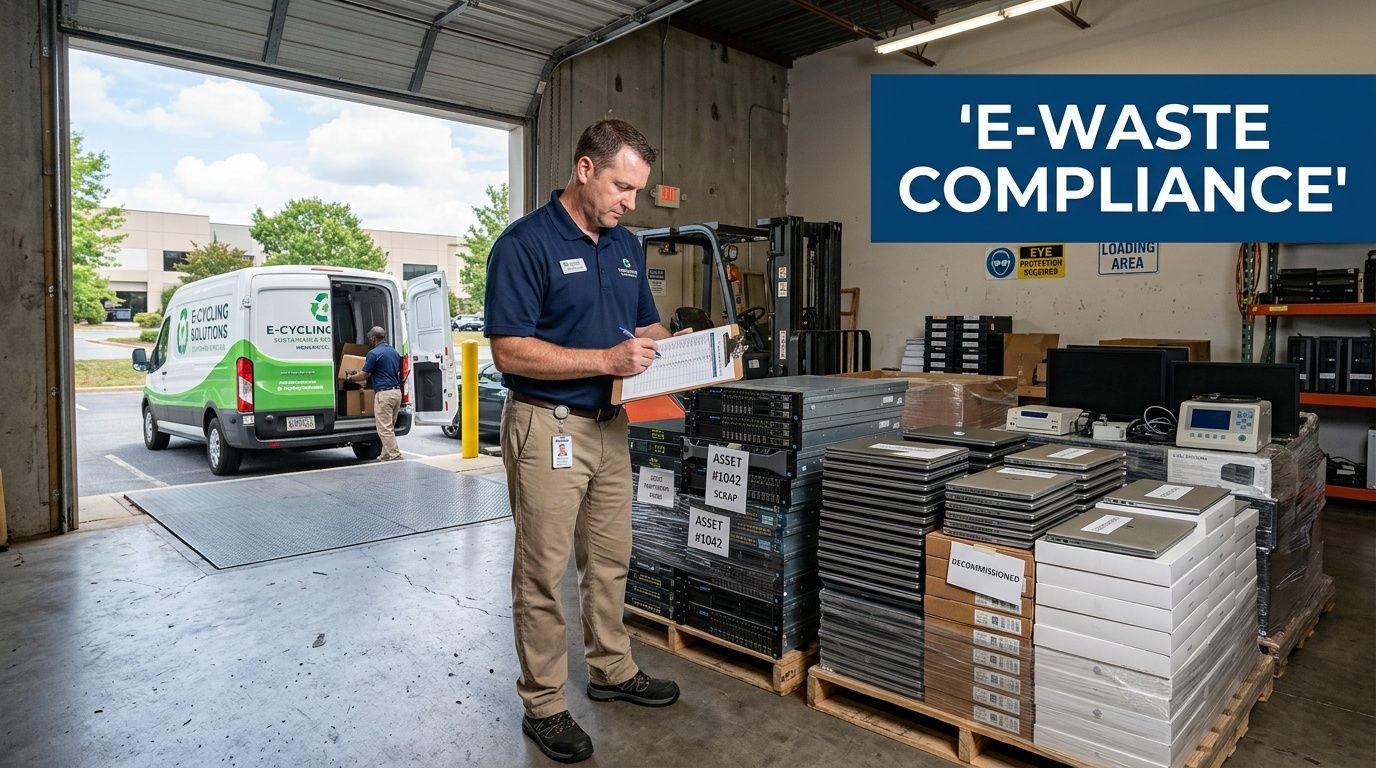
When those outdated electronics and lab instruments start gathering dust, they’re not just taking up space. For any organization, from a local Norcross business to a national enterprise, those devices are packed with sensitive data and materials that need professional handling. One wrong move—like dumping them in a standard dumpster—can lead to devastating data breaches, stiff environmental fines, and a hit to your reputation that's hard to recover from.
This is exactly why you need a plan for your business electronics recycling. It’s not about just getting old gear hauled away. It’s a strategic process that involves smart planning, ironclad data destruction, and documentation that proves you did everything by the book. From the first inventory count to the final Certificate of Destruction, every single step is critical for both local and nationwide compliance.
Why Businesses Everywhere Can't Afford to Ignore E-Waste
The sheer volume of electronic waste is hard to wrap your head around. Globally, we're on track to generate 62.4 million metric tons of it by 2027. What’s worse? Here in the U.S., only a fraction—around 15-20%—is actually recycled the right way. The rest ends up in landfills, leaching toxins like lead and mercury into the ground.
And here’s a local reality check that has national implications: Georgia doesn't have a statewide ban on businesses sending e-waste to landfills. That puts the responsibility squarely on companies, both in Norcross and those with operations here, to do the right thing. The good news is, you're not alone. There are at least 47 BBB-listed electronics recyclers serving the Atlanta region's 6 million residents, making it a major hub for responsible recycling across the Southeast.
A solid e-waste project isn't just about disposal. It's about protecting your data, meeting every regulatory standard, and hitting your own sustainability goals—including getting to zero-landfill, whether you have one site or one hundred.
Working with a specialist who understands both local logistics in Norcross and national compliance gives you a huge advantage. At S.E.D., we know different industries have different problems, no matter their location.
- Hospitals & Medical Labs: Your priority is HIPAA-compliant data destruction and getting documented proof of decontamination for every piece of lab equipment. No exceptions.
- Universities & Schools: You’re dealing with massive volumes and a huge variety of assets, from entire computer labs to specialized scientific research gear, often across multiple campuses.
- Corporate IT Departments: You're focused on destroying data on servers, laptops, and network hardware securely while trying to recover as much value as possible from assets nationwide.
- Government Agencies: You have to follow strict disposal rules and need a perfect, unbroken chain of custody for every item, regardless of its location.
Getting Started: The Basics of a Strong National Recycling Program
Before you pick up the phone, a little prep work goes a long way. A compliant recycling program is built on having a clear process, not just a vague goal to "get rid of stuff." Think of it as the final step in your asset management lifecycle. To make sure you’re covering all your bases, take a look at a good business guide to e-waste and recycling.
The rest of this guide will walk you through our proven process for planning and executing a flawless electronics and lab equipment recycling project, whether it's a single pickup in Norcross or a multi-state rollout. We'll cover everything from building an inventory and choosing the right data destruction method to understanding certifications and handling on-site logistics.
Quick Guide to Accepted and Restricted Items
One of the first questions we get is, "What can you take?" While we handle a huge range of equipment, some items require special handling due to hazardous materials. Here’s a quick reference to help you start sorting.
| Category | Typically Accepted Items by S.E.D. | Items Requiring Special Handling or Not Accepted |
|---|---|---|
| IT & Office Equipment | Computers, laptops, servers, monitors, printers, networking gear (routers, switches), phones, keyboards, mice, cables | CRT monitors (require special handling), large office copiers (check with us) |
| Laboratory Equipment | Centrifuges, incubators, shakers, PCR machines, spectrophotometers, analytical instruments, lab computers | Items containing radioactive materials, biohazards (must be decontaminated), mercury-containing devices, chemical waste |
| Medical Devices | EKG/ECG machines, ultrasound probes, defibrillators, anesthesia machines, patient monitors, medical carts | X-ray machines (require specialized disposal), items contaminated with biological waste (unless certified decontaminated) |
| Data Storage | Hard drives (HDD, SSD), backup tapes, flash drives, servers with storage arrays | All accepted, but require specific data destruction choices (wiping vs. shredding) |
| General Electronics | AV equipment, power supplies, uninterruptible power supplies (UPS), test and measurement tools | Batteries (especially leaking ones), items containing liquids, light bulbs |
This table is a great starting point, but if you have something that's not on this list, just ask. It’s always better to confirm than to make an assumption.
Handling old equipment the right way is a sign of a well-run, responsible organization. For more details on services across the wider region, check out our guide on e-waste recycling in Atlanta. By following a clear plan, you can turn a complex headache into a simple, secure process.
A successful electronics recycling project starts long before our truck ever pulls up to your facility, whether it's in Norcross or nationwide. Getting the preparation right is the single most important factor for a secure, smooth, and compliant disposal process. We've seen it time and time again—rushing this stage almost always leads to logistical headaches, surprise costs, and even security gaps.
A little groundwork on your end ensures everything goes off without a hitch. Think of it as the final, critical step in your equipment's lifecycle. The goal is to transform a cluttered storage room of forgotten assets into an organized, documented collection ready for secure transport and final disposition. This isn't just about tidying up; it's about maintaining control and accountability from start to finish.
Create a Detailed Asset Inventory
First things first: you can't protect what you don't know you have. The most critical action you can take is to create a detailed inventory list. It's time to walk through your facility—check the storage closets, data centers, labs, and individual offices—and document every single item slated for disposal.
A simple spreadsheet is all you need. The key isn't complexity; it's accuracy.
- Item Type: Get specific. Is it a Dell PowerEdge R740 server, a Thermo Scientific Sorvall centrifuge, or a pile of Cisco Catalyst switches?
- Serial Number or Asset Tag: This is non-negotiable. This unique ID is what we use for tracking and building an unbreakable, auditable chain of custody.
- Physical Condition: Make a quick note. Is it working, dead on arrival, or physically damaged? This can impact any potential resale value.
- Data-Bearing Status: This is crucial. Does it have a hard drive, SSD, or some other form of memory? Mark every single device that could possibly hold data.
This inventory becomes your master document. It's what you'll use to get a firm, accurate quote, and it's what our team will use to verify everything on pickup day. A solid list prevents scope creep and makes sure we're all on the same page from day one.
Sort and Stage for an Efficient Pickup
With your inventory locked down, it's time to physically organize the equipment. This is the point where a project either becomes a breeze or a chaotic mess. The whole point is to make the on-site removal as fast and non-disruptive to your local operations as possible, regardless of your location.
Start by sorting your assets into logical groups. This simple act of organization will dramatically speed things up when our truck arrives.
Practical Sorting Categories:
- Data-Bearing IT Gear: Group all laptops, desktops, servers, and loose hard drives together. These are your highest-security items and need to be handled accordingly.
- Non-Data General Electronics: This is your pile of monitors, keyboards, mice, printers, and tangled cables. They don't pose a data risk but absolutely require proper recycling.
- Laboratory & Scientific Instruments: Keep specialized equipment like centrifuges, incubators, and analytical machines separate. This is especially important if they require decontamination or special handling.
Once sorted, consolidate everything into one secure, easily accessible spot. A ground-floor loading dock, a cleared-out storage room, or a designated corner of a warehouse are perfect. Try to avoid staging assets in active hallways, cramped offices, or anywhere that requires navigating multiple flights of stairs without an elevator.
By consolidating and staging your equipment ahead of time, you can cut the on-site time for the pickup crew by as much as 50%. This means less disruption to your daily operations and a more efficient process overall.
Special Notes for Lab and Medical Gear
For the hospitals, research labs, and universities in Norcross, Georgia and across the United States, there's a vital extra step: decontamination documentation. Any piece of equipment that has ever been used in a lab or clinical setting must be certified as clean before it can leave your facility.
Your organization's Environmental Health & Safety (EHS) officer should oversee this. A signed and dated Certificate of Decontamination must be physically attached to each and every piece of decontaminated equipment. Without this paperwork, recycling partners cannot legally or safely handle the assets. This is an absolute, non-negotiable requirement to ensure the safety of our team and yours.
To ensure your business electronics are handled responsibly throughout their lifecycle, from acquisition to secure disposal, it's vital to implement robust IT asset management best practices. This holistic view helps you track, manage, and ultimately retire assets in a way that is secure and compliant. For those particularly concerned with the data on these devices, you can learn more about how to completely and securely clean a hard drive in our detailed guide. A well-managed asset is much simpler to process at the end of its life, reinforcing the need for good practices from day one.
Choosing Between DoD Wiping and Physical Shredding
When you're handling business electronics recycling in Norcross or anywhere else, data security is everything. Just dragging files to the trash won't cut it—that data is surprisingly easy to get back. For true, permanent data destruction, you’re looking at two certified methods: software-based wiping and physical shredding. The right call depends on your gear's age, your own internal security rules, and what you're hoping to get back financially.
This isn’t a step you can afford to gloss over. If you're in healthcare, finance, or government, a data breach can mean more than just a headache. We're talking about crippling fines, legal nightmares, and a reputation that's hard to rebuild. So, picking a destruction method isn't just an IT task; it’s a core part of managing your business's risk on a national scale.
Understanding DoD-Compliant Data Wiping
DoD-compliant wiping is a software process that overwrites every bit of data on a hard drive, making the original information impossible to recover. The standard most people recognize is DoD 5220.22-M, which runs a 3-pass sanitization process. Think of it as painting over a wall three times with different colors—by the end, you can't see the original color at all. The software does the same thing, writing new patterns of ones and zeros over the drive, three separate times.
This method is perfect for newer, working IT assets like servers, laptops, and workstations. Why? Because it completely sanitizes the drive while keeping the hardware intact. That means the device can be safely refurbished, tested, and resold, which lets your business recover some of its original investment. It’s a smart move: your data is verifiably gone, and you generate value from equipment you no longer need.
This flowchart shows how a good asset preparation strategy helps you decide the best end-of-life plan for your equipment.
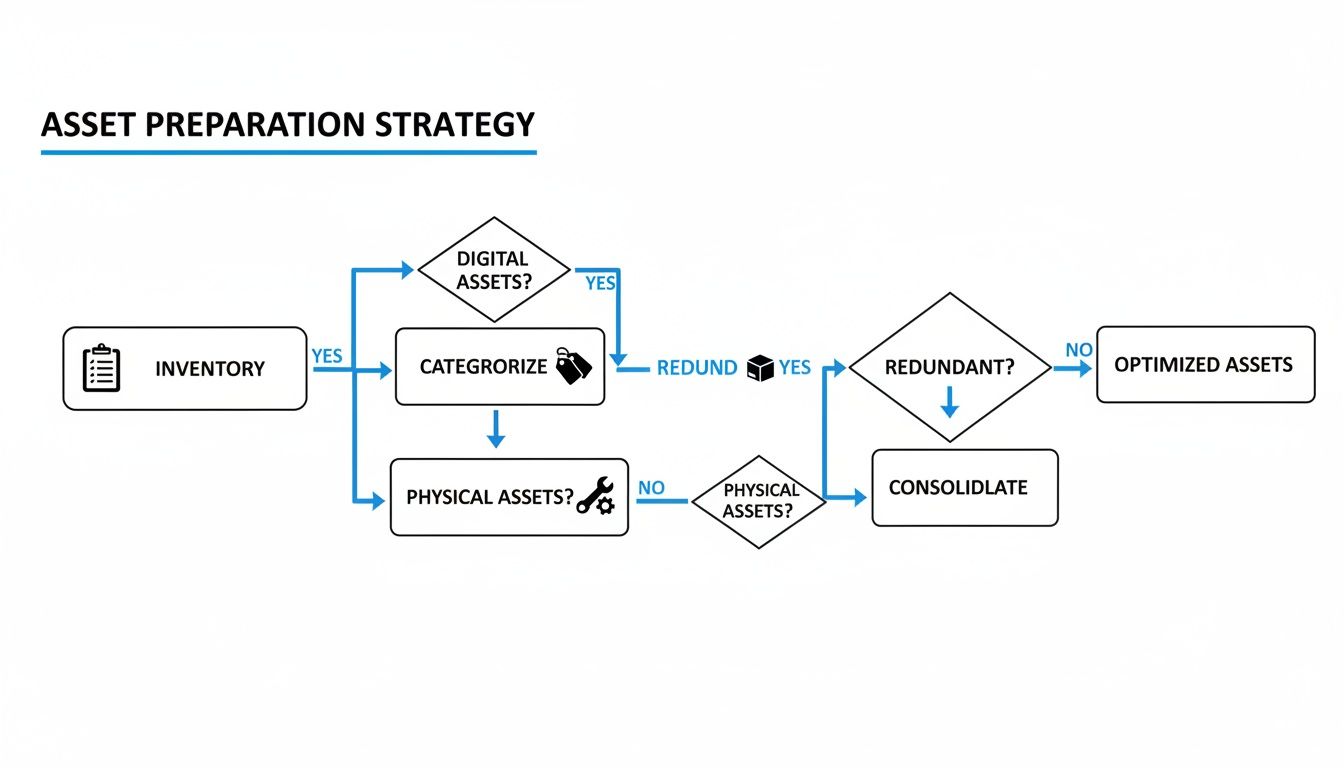
By taking inventory, categorizing your gear, and consolidating it, you can quickly sort out which assets are good candidates for wiping and resale versus those that need to be physically destroyed.
When Physical Shredding Is the Only Answer
While data wiping is fantastic for getting value back, it’s not a one-size-fits-all solution. Physical shredding is the most final form of data destruction there is. It turns a hard drive or other storage media into a pile of tiny, shredded metal pieces. No recovery is possible.
There are a few times when shredding is the only way to go:
- Non-Functional or Damaged Drives: If a hard drive won't spin up or has been dropped, wiping software can't even run on it. Shredding is the only way to be 100% sure the data is destroyed.
- End-of-Life Media: This is for all that old tech collecting dust—backup tapes, floppy disks, or ancient hard drives that have zero resale value.
- Strict Company Policies: We work with many companies, especially in finance and defense, that have a blanket policy: all data-bearing devices get shredded, no exceptions.
- Solid-State Drives (SSDs): The way SSDs store data can make software wiping less reliable. While secure erase functions have improved, many compliance officers still sleep better at night knowing their SSDs were physically shredded.
The choice isn't about which method is "better." It's about what’s appropriate for the asset in front of you. A hybrid approach—wiping viable assets and shredding everything else—is usually the best way to balance total security with financial return.
A trusted recycling partner offering nationwide services from its Norcross facility should provide both. At S.E.D., our team can look at your inventory and help you map out the best path for each asset. We provide a serialized Certificate of Data Destruction for every single drive, whether it’s wiped or shredded. To get a deeper look at the nuts and bolts of data security, check out our guide on secure hard drive recycling. This ensures your sensitive information never leaves your facility intact and gives you total peace of mind.
What to Expect During the On-Site Pickup
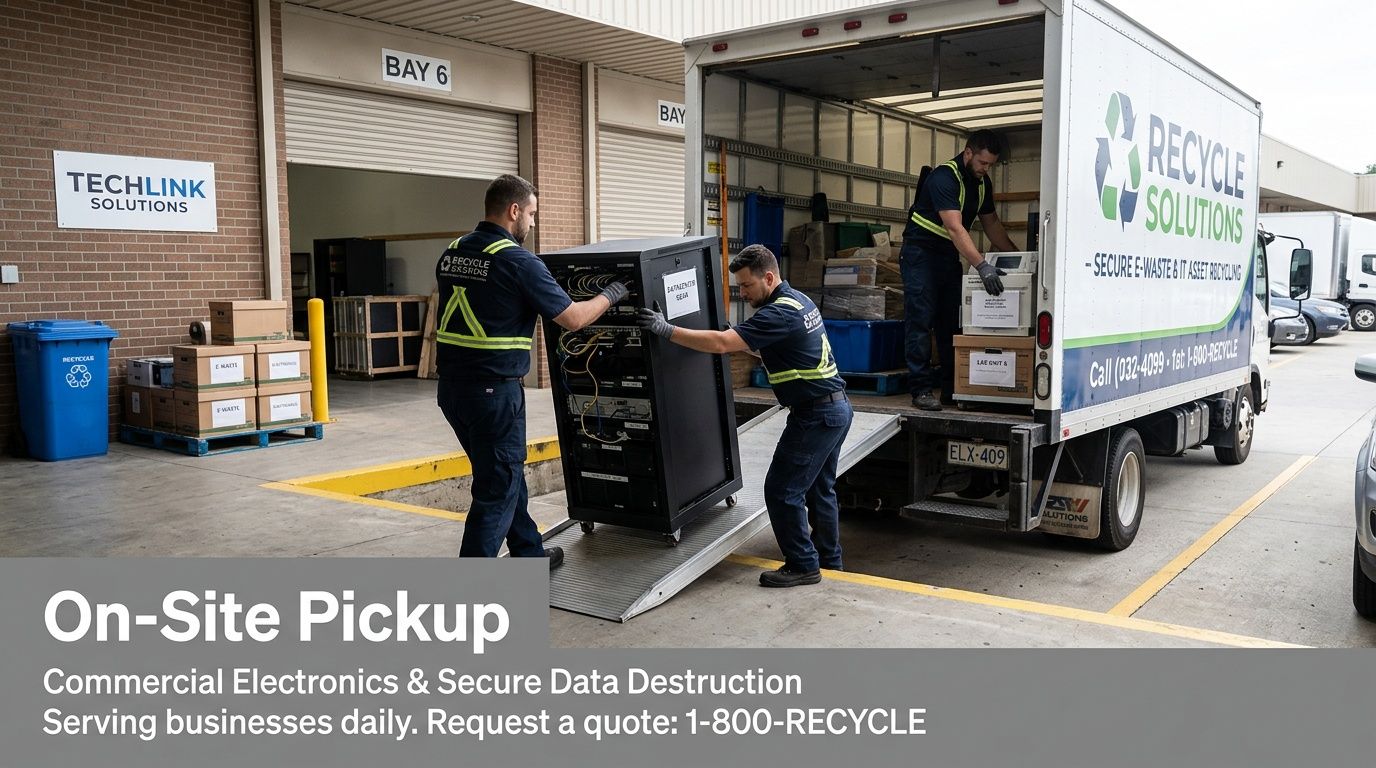
After you’ve done all the hard work—the planning, the inventorying, the sorting—pickup day is when it all comes together. For the Norcross facility managers and national IT leads we work with, this is often the most critical part of the whole process. A smooth, professional on-site experience is what really separates a true recycling partner from a basic hauling service.
Our goal at S.E.D. is simple: make the pickup as quiet and non-disruptive as possible. From the moment our uniformed team arrives in a company-owned box truck, every single step is geared toward security and efficiency. We get it. You have a business to run, and our job is to get our work done without getting in the way of yours, whether you're in Georgia or anywhere else in the US.
Arrival and Initial Walk-Through
When our truck pulls up on the scheduled day, the crew will check in with your designated point person right on time. The very first thing we do is a quick walk-through. Our team lead will go over the inventory list with you, looking at the actual staged assets to make sure everything lines up with the original quote.
This is a crucial checkpoint. It’s our way of ensuring there are no last-minute surprises and that we’re all on the same page about exactly what’s being removed. This is also the perfect time to point out any quirks of your facility—a tricky loading dock, a sensitive lab area we need to avoid, or a specific freight elevator we need to use.
The Art of De-installation and Removal
Many of our projects, especially full data center decommissioning or lab cleanouts, are more complex than just hauling away pallets. It often involves carefully de-installing equipment that's still bolted down, plumbed in, or racked. This is where an experienced national logistics team really shines.
- Data Center Projects: Our technicians are pros at disconnecting servers, switches, and storage arrays from racks. They work methodically, un-cabling and pulling gear without disturbing adjacent live systems—a must-have skill in shared data center environments across the country.
- Laboratory Scenarios: Getting bulky lab instruments out of your building is a whole different ballgame. We know how to safely maneuver huge, heavy, and often fragile machines like mass spectrometers or large-scale centrifuges out of tight spaces without leaving a single scratch on your facility.
A professional crew doesn't just show up with a dolly. They arrive with the right tools, equipment (like pallet jacks and lift gates), and most importantly, the experience to handle complex removals safely and efficiently, no matter the location.
This part of the job is all about precision and care. We treat your facility with respect, making sure floors, walls, and doorways are protected as we move equipment. It’s this thoughtful approach that minimizes disruptions and lets you get on with your day. You can find out more about scheduling by exploring our options for a free business electronics pickup in Gwinnett County.
Secure Packing and Loading Procedures
Once the assets are de-installed, we securely pack them for transport. This isn't just a matter of tossing things onto a truck; it’s an organized process designed to maintain the chain of custody we established with your inventory.
Loading Best Practices:
- Serialized Verification: As items are loaded, our team checks them against the inventory list, often using scanners to capture serial numbers and your asset tags.
- Secure Containment: For high-security items like hard drives and servers, we often place them in locked, sealed containers before they even leave your building.
- Strategic Loading: The truck is loaded with a plan. Heavier, bulkier equipment is secured first, and more sensitive electronics are packed to prevent any damage during transit.
This systematic approach is the foundation of a secure business electronics recycling process, whether you're here in Norcross or anywhere else. It guarantees that every single item that leaves your facility is accounted for and protected all the way to our processing center. Before we drive away, the truck is sealed, adding a final, tamper-evident layer of security for your valuable assets.
Why Certifications and Chain of Custody Matter for National Compliance
Once your old equipment is loaded onto a truck and driven away, how do you really know what happens next? Simply trusting your vendor isn't enough—you need undeniable proof. This is where certifications and chain-of-custody documentation become the most critical parts of your business electronics recycling in Norcross, Georgia, and for any national operation.
This paper trail is your shield. For any organization, but especially those in healthcare, finance, or government, it transforms a simple pickup into a legally defensible, compliant process. It proves you acted responsibly. Without it, you're leaving your organization exposed to serious risk.
The Gold Standard of Recycling Certifications
Not all recyclers are created equal. The most reliable way to separate a top-tier partner from a basic hauler is by checking their certifications. These aren't just badges for a website; they are hard-earned proof that a third-party auditor has rigorously inspected every part of their operation, from data security to environmental handling.
In our industry, two certifications are the ones that truly count for nationwide trust:
R2 (Responsible Recycling): The R2 standard sets a high bar for environmental protection, worker safety, and data security. An R2-certified recycler is required to track all materials through the entire recycling stream, ensuring nothing is illegally dumped or exported.
e-Stewards: This is widely considered the most stringent certification out there. It’s known for its incredibly strict rules, including an absolute ban on exporting hazardous e-waste to developing countries.
When you work with a recycler holding these credentials, you're plugging into a system of accountability. It’s your assurance that your assets will be managed according to the highest global standards.
Unpacking the Chain of Custody
The chain of custody is the documented, chronological trail of your assets from the moment they leave your facility—whether in Norcross, GA or anywhere in the US—to their final disposition. A weak or broken chain is a massive liability. A strong, unbroken one is your proof of compliance.
Your project isn't truly complete until you have the final paperwork in hand. A verbal promise means nothing in an audit. The Certificate of Recycling and Data Destruction is your legal evidence that the job was done right.
Think of it as tracking a critical package—every single handoff is recorded. This ensures no device gets lost, stolen, or mishandled along the way. Here in the Atlanta metro area, the scale of this work is massive. Local leader Prime Asset Recovery, for example, has recovered over $50 million in assets, collected over 7,500 pounds of e-waste, and recycled more than 3,700 servers, showing just how important these certified operations are for the region and beyond. You can learn more about the local e-waste landscape at PrimeAssetRecovery.com.
Key Documents You Must Receive
After the pickup, your job isn't done. You should expect a comprehensive documentation package from your recycling partner. If you have to chase them for it, or if they can't provide it, that's a major red flag. This package is your official record for any audit.
First, you'll get a Bill of Lading on pickup day. This is the initial receipt confirming what was taken, the date, and where it's headed. It’s the first link in the chain.
Next comes the Serialized Inventory Report. This detailed report should match the inventory you created before the pickup. It lists every single asset by type, make, model, and serial number, confirming exactly what was received at the recycling facility.
Finally, and most importantly, is the Certificate of Recycling and Data Destruction. This is the one document you can't go without. It legally certifies that your assets were recycled in compliance with all environmental laws and that all data was verifiably destroyed. The certificate should be serialized, signed, and specify the destruction methods used (e.g., DoD 5220.22-M wiping, physical shredding).
For anyone needing to prove compliance with regulations like HIPAA or Sarbanes-Oxley, this document is non-negotiable. To better understand this crucial document, check out our guide on the importance of a Certificate of Destruction. Holding onto these records isn't just a good idea—it's a fundamental practice that protects your organization for years to come.
Answering Your Questions About E-Waste Services in Norcross and Nationwide
When it's time to clear out old equipment, a lot of questions pop up, especially around compliance, logistics, and cost. We get calls every day from project managers and facility directors trying to get a handle on their disposal projects. Here are the answers to the questions we hear most often, based on our years of experience serving clients from our Norcross, Georgia headquarters.
The first thing everyone wants to know is, "What's this going to cost me?" The real answer is: it depends entirely on your inventory. If you're recycling newer IT hardware like recent-model servers or laptops, the service could be free. We might even be able to offer a return on your assets through remarketing.
On the other hand, for a mixed bag of older electronics, specialized lab equipment, or anything without resale value, there will be a cost. This fee covers the secure logistics, our team's labor, and the certified recycling process. The only way to know for sure is to get a custom quote based on what you have.
Do You Handle Nationwide Pickups?
Absolutely. While we're headquartered here in Norcross, Georgia, many of our clients are national corporations, university systems, or healthcare networks. We manage nationwide logistics all the time for large-scale projects like multi-site office cleanouts or complete data center decommissioning.
We act as your single point of contact, coordinating secure pickups across the country. This ensures every one of your facilities gets the same high standard of service, data security, and environmental compliance. Our Norcross hub is a key part of this, supporting local jobs while connecting to the national recycling market. This has become critical as U.S. e-waste exports fell by 30% after 2020 regulations, boosting domestic recycling from major processors like ERI, which handles 300 million pounds a year at its local facility. You can discover more insights about Norcross e-waste processing at PrimeAssetRecovery.com.
Having a single, trusted partner for a nationwide project is a game-changer. You don't have to vet multiple vendors or worry about inconsistent security protocols from one site to the next. It just gets done right, everywhere.
How Far in Advance Should I Schedule a Pickup?
Good planning is what makes a project go smoothly. The amount of lead time you'll need really comes down to the scope of your project.
If you just have a few pallets of equipment ready to go, we can usually get you on the schedule within 1-2 weeks. That’s plenty of time for a straightforward pickup in the Norcross area or the greater Atlanta region.
For more complex jobs or nationwide projects, you'll want to give us more notice.
- Office or Lab Decommissioning: For a full cleanout, reaching out 30-60 days ahead is ideal.
- Data Center Decommissioning: These are massive undertakings. We recommend a 60-90 day planning window to ensure everything is coordinated perfectly.
Giving us that extra time allows our team to perform site assessments, provide detailed quotes, and line up all the necessary resources without getting in the way of your day-to-day operations.
If you’re ready to tackle your surplus electronics and lab equipment, Scientific Equipment Disposal is here to help. We provide secure, compliant, and sustainable solutions for businesses in Norcross, across Georgia, and nationwide. Visit us at https://www.scientificequipmentdisposal.com to get started.