Electronics Recycling in Peachtree Corners GA for Labs & IT

A facility manager in Peachtree Corners usually gets pulled into electronics recycling when something else is already going wrong. A lab is closing. A clinic is replacing diagnostic equipment. An office renovation exposes a room full of old towers, monitors, switches, and storage media nobody wants to claim. The assignment sounds simple until critical questions arise.
Can the hard drives be wiped or do they need to be shredded? Who disconnects the centrifuge, incubator, or server rack? What happens if a device still has patient information, research data, or employee records on it? Which recycler can handle standard IT gear and specialized lab assets without breaking chain of custody?
Most local guidance on Electronics Recycling in Peachtree Corners GA does not answer those questions. It focuses on common office electronics and consumer-style drop-off categories. That helps with laptops and printers. It does not help much when you are clearing a research room, retiring a medical analyzer, or trying to document compliant disposal for internal audit.
The Recycling Gap for Peachtree Corners Businesses and Labs
The biggest misconception in this market is that any e-waste provider can handle a lab cleanout or regulated medical asset disposition. In practice, that assumption creates delays, compliance gaps, and unnecessary risk.
Local content around electronics recycling in Peachtree Corners largely centers on computers, laptops, servers, and office electronics. It does not address specialized equipment such as pipettes, centrifuges, incubators, fume hoods, and medical devices, even though hospitals, clinics, universities, and research facilities in the Atlanta metro need to retire those assets responsibly, as noted in this overview of Peachtree Corners electronics recycling coverage.
Where general recycling options fall short
A standard recycler may be perfectly adequate for a pallet of office PCs. That is a different job from removing bio-exposed equipment, handling precision instruments, or documenting media destruction tied to internal compliance policies.
The gap usually shows up in four places:
- Asset type mismatch: General programs are built for office electronics, not laboratory and medical equipment.
- Logistics limits: Many organizations need on-site deinstallation, staged pickup, packing, and controlled transport.
- Compliance exposure: Devices may contain PHI, PII, research data, or embedded storage that cannot be treated like ordinary scrap.
- Documentation gaps: Facility teams often need auditable records, not just a truck receipt.
What this means for Peachtree Corners organizations
If you manage a hospital department, university lab, corporate office, or research site, the disposal problem is not just recycling. It is asset disposition. That includes planning, identification, removal, data handling, downstream processing, and final documentation.
Practical takeaway: If a recycler only talks about what they accept, but not how they handle chain of custody, embedded media, deinstallation, or regulated equipment, they are probably set up for general e-waste, not facility-grade disposition.
Teams dealing with surplus lab or IT equipment often benefit from reviewing broader guidance on managing e-waste before scheduling removal. It helps separate a simple pickup from a project that requires compliance controls.
Introducing S.E.D.'s Asset Disposition Solution
The right model for this work is not a drop-off event and not a bulk junk haul. It is a controlled process that starts before pickup and ends only when the paperwork is complete.
One option in the Atlanta market is Scientific Equipment Disposal IT asset disposition services, which combine electronics recycling, lab equipment handling, data security, and logistics in one workflow. That matters because most failure points in disposition happen between those functions, not inside any one of them.
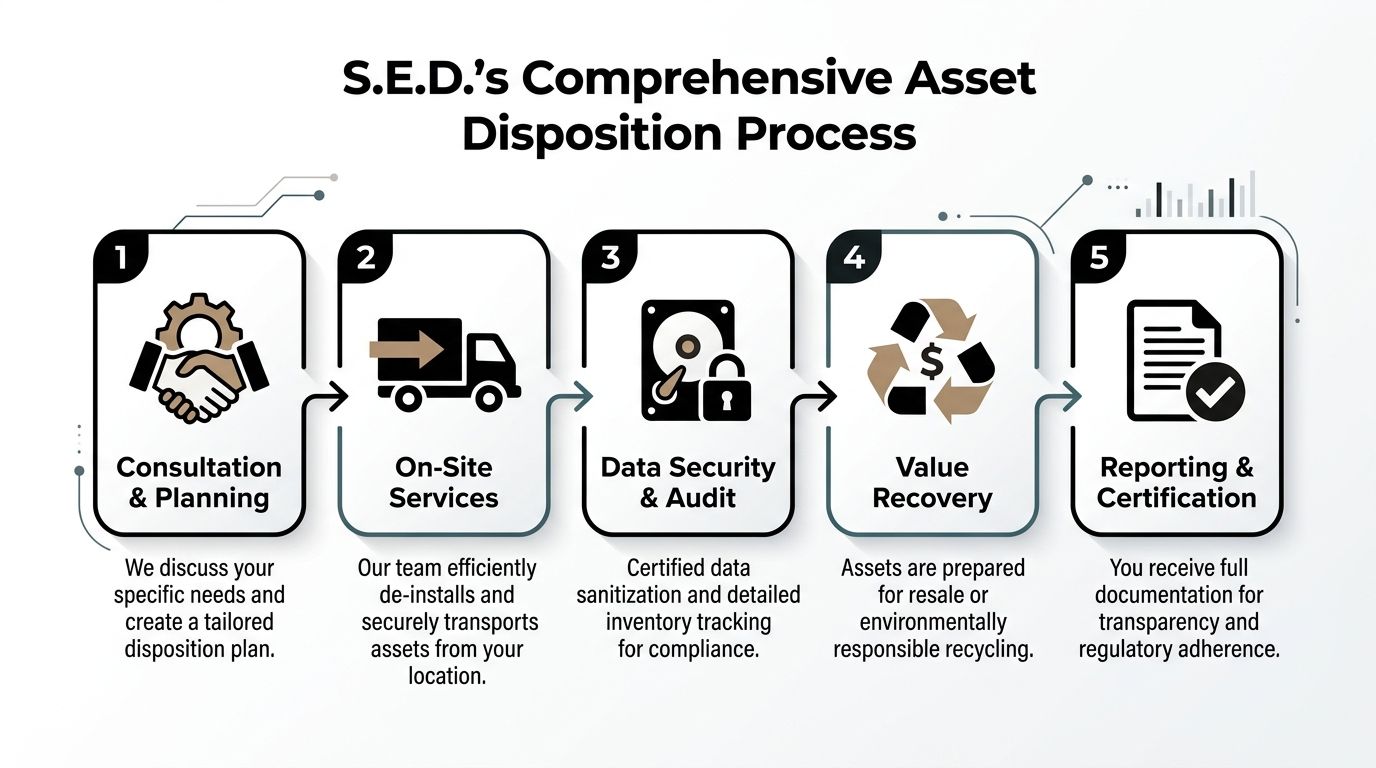
A full disposition process works in sequence
A workable project usually follows five stages.
Consultation and planning
The facility identifies what is leaving, what must stay online until cutover, and what may require special handling. At this stage, teams flag hard drives, research instruments, medical devices, or anything with contamination concerns.On-site services
Equipment is disconnected, removed, packed, and loaded according to its condition and destination. Some items can move as whole units. Others need partial breakdown before transport.Data security and audit
Storage media is identified early so nobody discovers after pickup that an analyzer, workstation, or server still contained sensitive data. Inventory tracking supports internal review and final records.Value recovery or recycling
Reusable assets may move into resale channels when appropriate. End-of-life material moves into certified recycling streams.Reporting and certification
The job is not finished when the truck leaves. Facility managers need clear documentation for disposal records, compliance files, and internal accountability.
Why integrated handling matters
When these steps are split across multiple vendors, small mistakes become expensive ones. A loading crew may not understand embedded storage. An IT recycler may not want to touch lab equipment. A general hauler may remove assets quickly but leave the compliance team without the records they need.
An integrated process avoids that fragmentation. It gives the facility manager one operating plan, one pickup sequence, and one documentation trail.
What works and what does not
What works
- Coordinated pickup windows tied to shutdown schedules
- Early review of data-bearing devices
- Clear separation between reusable assets and scrap streams
- Written records at the end of the job
What does not
- Last-minute cleanouts with no inventory review
- Sending mixed lab and IT assets to a general recycler without screening
- Letting internal staff improvise deinstallation of heavy or sensitive equipment
- Assuming all media can be treated the same way
Ensuring Ironclad Data Security and Regulatory Compliance
Data destruction is where many disposal plans either become defensible or fall apart. A surprising amount of equipment outside the data center can still store sensitive information. Lab analyzers, imaging workstations, older medical devices, standalone PCs attached to instruments, and removable drives all need to be assessed before disposal.
Why three-pass sanitization matters
In the Peachtree Corners area, organizations handling drive destruction commonly use DoD 5220.22-M 3-pass sanitization, which overwrites data three times with alternating patterns before physical destruction. That approach is described in this Peachtree Corners recycling reference. The same source notes that this method provides documented, auditable protection for organizations handling PHI and exceeds HIPAA's baseline requirement for secure deletion.
That matters for two reasons.
First, a facility cannot rely on assumptions about what was deleted previously. Staff turnover, device age, and undocumented workflows create too many unknowns. Second, healthcare and research organizations often need an audit-ready process, not just a statement that a drive was "cleared."
Wiping versus shredding
Not every storage device should be handled the same way. The right method depends on media type, condition, age, and the organization's internal risk standard.
A practical decision framework looks like this:
| Media condition or context | Preferred handling approach |
|---|---|
| Functional magnetic drive with reuse or remarketing potential | DoD 5220.22-M 3-pass sanitization |
| Obsolete, failed, or unreliable media | Physical shredding |
| Equipment with uncertain storage history | Escalate for review before release |
| Legacy instrument with embedded storage | Identify media first, then choose wipe or destruction path |
Where teams make avoidable mistakes
The common errors are operational, not theoretical.
- Assuming office devices are the only data risk: Lab workstations, attached instruments, and specialty systems often get overlooked.
- Treating every drive as reusable: Some media is too old, too damaged, or too uncertain to justify wiping.
- Breaking chain of custody: If devices move around internally before pickup, documentation gets weaker.
- Waiting until load-out day to identify storage: By then, technicians are working against time instead of following a clean protocol.
Compliance tip: The most defensible approach is to decide the destruction method before removal starts, not while assets are already on a truck.
HIPAA, internal audit, and defensible records
HIPAA requires secure deletion, but internal compliance teams usually need more than a broad standard. They need evidence that the organization used a consistent method, tracked what left the site, and can show what happened afterward.
That is why certificates matter. A proper destruction record supports legal, regulatory, and insurance conversations if disposal decisions are ever questioned. It also protects the facility manager. When a storage device is discovered months later in a dispute, undocumented disposal is hard to defend.
Organizations looking at regional service options often compare workflows such as secure data destruction in Norcross GA to verify whether the provider addresses both sanitization and final disposition.
The practical standard to hold vendors against
Ask direct questions.
- What sanitization method do you use for magnetic media?
- When do you switch from wiping to shredding?
- How do you handle embedded storage in specialty equipment?
- What certificate do you issue after destruction?
- Can you maintain chain of custody from pickup through processing?
If the answers stay vague, the risk is yours, not theirs.
Streamlining Logistics with On-Site Deinstallation and Pickup
Most difficult recycling jobs are difficult because of logistics, not because of recycling itself. The challenge is getting equipment out of active space without damaging the building, interrupting operations, or leaving your staff to figure out how to move heavy and awkward assets.

What a typical on-site removal looks like
A well-run pickup starts before anyone arrives on site. The facility confirms access points, dock conditions, elevator use, asset locations, and any building rules. That sounds basic, but it prevents the usual delays.
On service day, the crew moves in a controlled order. Office electronics near exits may go first. Heavier devices, bench equipment, or server components follow once pathways are clear. Equipment that needs special packing gets staged separately.
For many Peachtree Corners projects, the sequence looks like this:
- Site arrival and check-in: Building access, safety requirements, and staging areas are confirmed.
- Asset verification: The crew matches what is present against the planned scope.
- Deinstallation: Items are disconnected and removed with attention to racks, bench mounts, or attached peripherals.
- Packing and load-out: Sensitive equipment is protected for transport. Loose accessories are consolidated.
- Transport to processing: Assets move under documented custody rather than ad hoc hauling.
Why internal staff should not carry this burden
Facility teams already have enough to manage during renovations, consolidations, and shutdowns. Asking your own staff to disconnect old servers, move analyzers, or sort mixed electronics usually creates three problems.
First, the work takes longer than expected. Second, internal staff may not know which components contain storage or regulated material. Third, ad hoc removal increases the chance that inventory records stop matching what left the site.
A coordinated pickup process is especially useful for businesses scheduling free business electronics pickup in Gwinnett County GA because the operational details matter more than the pickup label. Free collection only helps if the service model fits the asset type and compliance needs.
Practical logistics decisions that reduce friction
Not every removal should happen in one sweep. In active facilities, phased pickups often work better than one large cleanout.
Consider these planning choices:
| Situation | Better approach |
|---|---|
| Active office with limited disruption tolerance | After-hours or phased pickup |
| Lab shutdown with mixed bench equipment | Room-by-room staging and removal |
| Data room closure | Pre-identified media handling before rack removal |
| Shared medical space | Coordinate with department leads and infection-control requirements |
Field advice: If an item is heavy, calibrated, fragile, or connected to a workflow nobody fully remembers, tag it for review before move day. That single step prevents many avoidable mistakes.
The Journey of Your Recycled Equipment and Its Benefits
Once assets leave your site, the next question is fair: what happens to them?
For Electronics Recycling in Peachtree Corners GA, the responsible answer is not "it gets recycled." That phrase is too broad to be useful. Different assets move through different paths depending on condition, material content, and whether they contain components that can be reused or must be isolated.
Material recovery and hazard control
Facilities serving the region use multi-stage material recovery to extract valuable metals such as gold, silver, and platinum while isolating hazardous substances including lead, mercury, and cadmium, as described in this Peachtree Corners recycling overview. The same source notes that certified recyclers operating under R2 or e-Stewards maintain segregated processing to prevent cross-contamination and comply with Georgia recycling laws.
That is the environmental side. The business side matters too. Segregated processing and documented downstream handling reduce long-term liability exposure. For hospitals, universities, and corporate IT departments, that is often just as important as the sustainability benefit.
What equipment commonly enters the stream
A mixed disposition project can include standard office electronics, infrastructure hardware, and specialized lab items in the same pickup.
Here is a practical partial list.
| Laboratory & Scientific Equipment | IT & Office Electronics |
|---|---|
| Pipettes | Desktop computers |
| Centrifuges | Laptops |
| Incubators | Servers |
| Fume hoods | Storage arrays |
| Analytical instruments | Network switches |
| Medical devices | Monitors |
| Lab workstations | Printers |
| Benchtop electronics | Hard drives and related media |
What happens after collection
Some equipment can be evaluated for reuse. Other items are dismantled so boards, metals, plastics, and specialized components can move into appropriate downstream channels. Hazard-bearing parts are separated instead of mixed into general scrap.
This distinction matters for older lab equipment. A fume hood component, diagnostic device, or legacy instrument may contain materials that require specialized handling. Treating that equipment like ordinary office scrap is not just inefficient. It can create regulatory problems.
Why this supports ESG and internal reporting
A facility manager may not write the ESG report, but the disposition process feeds it. Procurement, sustainability, legal, and compliance teams all care about whether retired assets were handled through documented channels.
Useful questions include:
- Was the equipment reused, recycled, or destroyed?
- Were hazardous materials isolated through certified downstream handling?
- Was processing segregated to avoid contamination of material streams?
- Can the organization document where the assets went after pickup?
For a broader explanation of downstream processing and reuse decisions, this discussion of what happens to old laboratory equipment after disposal gives facility teams a useful operational lens.
Key takeaway: Responsible recycling is not just about diversion from landfill. It is about traceability, hazard control, and matching each asset to the correct downstream path.
Real-World Examples in the Peachtree Corners Area
The value of a specialized process is easiest to see in actual operating situations. The details vary by facility, but the pattern is consistent. The harder the asset mix, the more important planning, chain of custody, and removal discipline become.

Hospital lab decommission
A hospital department in the Atlanta metro retires a small lab footprint during a workflow change. The room contains aging analyzers, attached PCs, monitors, and loose storage media in desk drawers.
The primary challenge is not the volume. It is the mix of medical equipment and data-bearing devices. The project requires early identification of storage, separation of regulated material, and a clear destruction record after pickup. A generic recycler could remove the hardware, but that would not solve the hospital's documentation problem.
University science department cleanout
A university science department accumulates surplus instruments over years. Some items are obsolete. Some still have parts value. Others are incomplete because accessories migrated to other rooms.
The obstacle here is coordination. Faculty, facilities, and department administrators often have different views on what is discard, what is surplus, and what might be reused internally. A disciplined pickup plan helps by grouping assets room by room, validating what is leaving, and keeping the final inventory aligned with the physical load-out.
Corporate data room closure in Technology Park
An office in Technology Park shuts down an on-site server room after moving systems elsewhere. The racks, servers, storage arrays, UPS-related electronics, and loose drives all need removal.
Disposal plans often get too narrow at this stage. The IT team focuses on drives. Facilities focuses on rack removal. Procurement wants records for retired assets. The right process coordinates all of it so media handling decisions happen before deinstallation, not after the room is half-empty.
What these examples have in common
Across these scenarios, the winning approach is similar:
- Early scoping: Know what is in the room.
- Functional separation: Keep data handling, removal, and recycling decisions connected.
- Documentation discipline: Match inventory to pickup and final certificates.
- Asset-specific handling: Do not force lab, office, and data room equipment into one generic workflow.
These are ordinary situations for Peachtree Corners businesses. The risk comes from treating them like ordinary recycling.
Schedule Your Compliant Asset Disposition in Peachtree Corners
If you are dealing with surplus lab equipment, retired IT assets, or a mixed cleanout, the first step is simple. Build the scope before anything moves.
Start with a practical list of what you have, where it sits, and whether any item may contain sensitive data or require special handling. Include servers, workstations tied to instruments, loose drives, bench equipment, and anything your team is unsure about. Uncertainty is useful information at this stage.
A good quote request usually includes:
- Site details: Building access, loading constraints, stairs, elevators, and preferred pickup windows
- Asset categories: Lab equipment, office electronics, servers, storage, and peripherals
- Data concerns: Any device that may contain PHI, PII, research data, or embedded storage
- Project timing: Renovation deadlines, shutdown dates, lease turnover, or department schedules
The right disposition process should leave you with fewer open questions, not more. You should know how the assets will be removed, how data-bearing media will be handled, what recycling path fits the material, and what documentation you will receive at the end.
For Electronics Recycling in Peachtree Corners GA, that is the standard to hold any provider against.
Frequently Asked Questions About Specialized Recycling
Do you accept only large institutional jobs
No. Small businesses, clinics, private labs, schools, and larger organizations can all need specialized recycling. The deciding factor is not company size. It is the nature of the assets, the pickup requirements, and whether the job needs documented handling.
What if equipment was used in a lab or clinical setting
That should be disclosed at the start. Bio-exposed or contamination-sensitive equipment requires review before removal. Facility managers should identify anything with exposure concerns, attached waste components, or uncertain decontamination status so the pickup plan matches the actual condition of the assets.
Can you handle both lab equipment and office electronics in one project
Yes, if the project is scoped correctly. Mixed loads are common. The key is to separate asset categories operationally so data-bearing devices, standard e-waste, reusable equipment, and specialized lab items each follow the correct path.
How should we prepare for pickup day
A short preparation list helps:
- Tag questionable items: If staff are unsure whether a device stores data, flag it.
- Separate accessories where possible: Power supplies, cables, trays, and attachments are easier to process when grouped.
- Protect records: Keep internal asset lists, serial references, or department notes available for reconciliation.
- Confirm access: Reserve docks, elevators, and building access in advance.
Do all hard drives get wiped
Not always. Functional media may be sanitized. Obsolete, failed, or unreliable media may be physically destroyed instead. The correct method depends on condition, media type, and your organization's compliance posture.
How is pricing usually handled
Pricing varies by asset type, handling difficulty, logistics complexity, and whether the equipment has reuse value or requires specialized processing. A simple office pickup and a lab decommission are very different jobs. The most accurate pricing comes from a list of assets plus a quick discussion of site conditions.
How long does the process take
Turnaround depends on project scope, building access, scheduling constraints, and the condition of the equipment. Small pickups can move quickly. Larger cleanouts, medical environments, and data-heavy projects usually require more coordination because the planning work protects the final outcome.
What paperwork should we expect at the end
Most organizations want some combination of inventory confirmation, data destruction records where applicable, and a final recycling or destruction certificate. If your internal compliance team has specific requirements, raise them before pickup so the documentation aligns with your process.
If you need a practical path for retiring lab equipment, servers, office electronics, or mixed assets, contact Scientific Equipment Disposal. Share your asset list, site details, and any data-security concerns, and the team can help you map the next steps for compliant disposition in Peachtree Corners and across the Atlanta metro.