Electronics Recycling Services in Grayson GA for Labs & IT

A common Grayson scenario looks like this. IT has finished a refresh, a lab is clearing out a room before renovation, or a clinic has carts of retired devices waiting in a back hallway. The equipment isn’t just clutter. It may hold protected data, regulated records, internal research, or government information that can’t leave the building without controls.
That’s where many organizations get into trouble. A pickup truck and a vague promise to “recycle everything” don’t solve chain of custody, data sanitization, or downstream accountability. If drives, storage media, or embedded systems leave your site without documentation, the risk shifts to your team.
Your Guide to Secure Electronics Disposal in Grayson GA
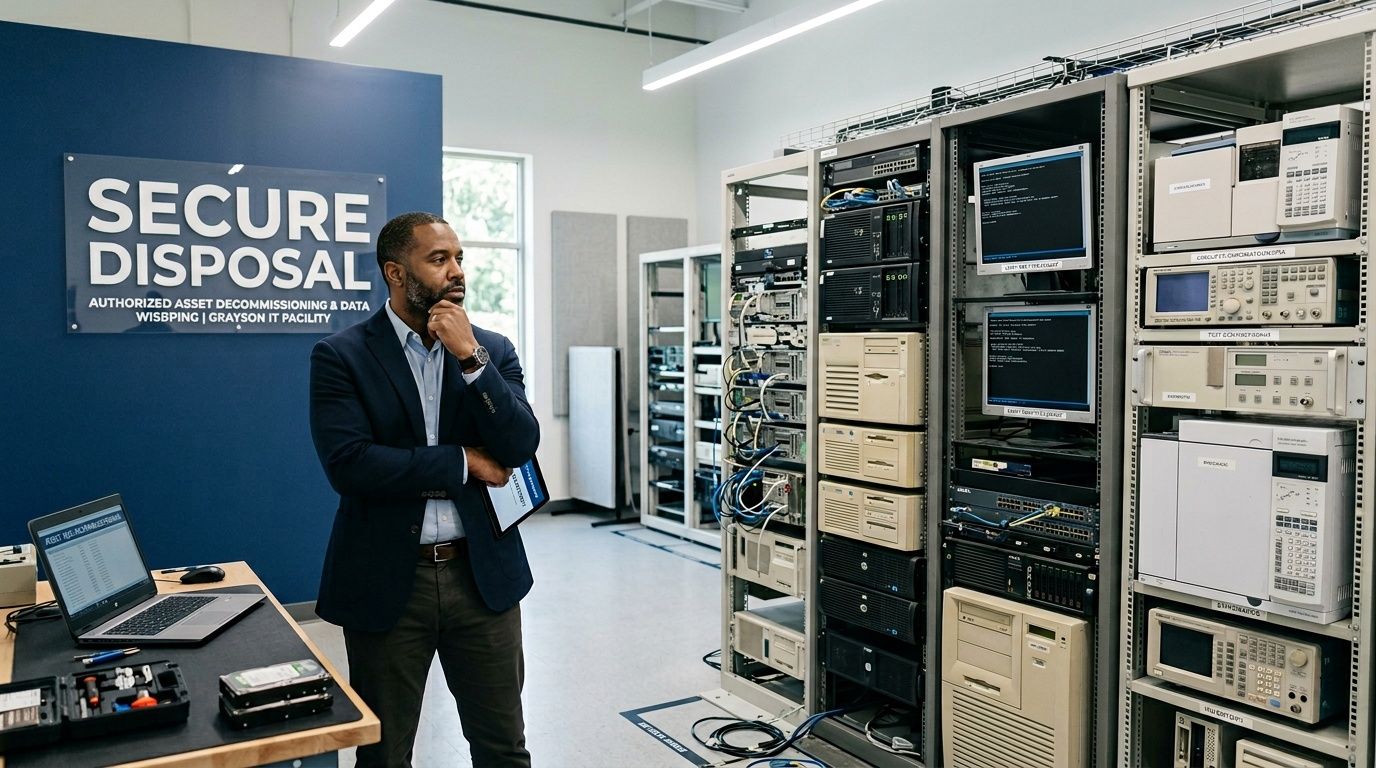
A facilities lead in Grayson usually knows the operational problem before they know the disposal plan. There are old desktop towers under benches, decommissioned laptops in a locked office, broken printers in a loading area, and maybe a retired analyzer or imaging workstation nobody wants to touch because it might still store user credentials or patient-related information.
The disposal issue is bigger than floor space. In the U.S., only 15% to 20% of electronic waste is properly recycled annually, leaving 80-85% at risk of landfill disposal or improper handling, according to electronics recycling data for U.S. e-waste recovery. For Grayson organizations, that matters for two reasons. First, uncontrolled disposal can expose sensitive data. Second, it can send hazardous material into the wrong waste stream.
What facility managers usually miss
The hardest part isn’t identifying obsolete equipment. It’s separating three different tasks that often get bundled together poorly:
- Asset removal: Getting equipment out without disrupting operations or damaging the site
- Data destruction: Verifying that hard drives, servers, and embedded media are sanitized or destroyed appropriately
- Recycling accountability: Making sure downstream handling is documented and environmentally responsible
A generic junk hauler may help with the first task. Regulated organizations need all three.
Practical rule: If a vendor can’t explain how they document custody from pickup through final processing, they’re not offering a compliance-grade disposition program.
For organizations comparing business electronics recycling options in Gwinnett County, the useful benchmark isn’t “Do they take electronics?” It’s whether they can manage decommissioning in a way that stands up to an internal audit, a privacy review, or a legal hold process.
What works in practice
The strongest Electronics Recycling Services in Grayson GA start with inventory control and end with written records. That means serialized tracking where possible, separation of reusable assets from scrap, secure handling of media-bearing devices, and a documented path for everything that leaves the site.
What doesn’t work is informal cleanup. Loose loading, unlabeled gaylords, mixed scrap, and verbal assurances create gaps that are hard to defend later. If your team handles healthcare systems, university research devices, municipal hardware, or corporate network gear, disposal should be treated as an extension of your compliance program, not a housekeeping task.
Comprehensive E-Waste Services for Lab and IT Assets
Most Grayson organizations don’t have just one waste stream. They have a mix of retired lab hardware, network gear, user devices, office electronics, and odd specialty items that accumulated over years. The practical question isn’t whether something is “electronic.” It’s whether it can be safely removed, properly categorized, and routed to the right disposition path.
What belongs in a compliant electronics recycling program
For lab environments, the disposal list often includes more than computers. Instruments may contain circuit boards, displays, internal storage, power supplies, and hazardous components that require more careful handling than standard office surplus.
IT rooms have a different profile. The challenge there is density, cable sprawl, rack-mounted hardware, and the fact that storage media may be spread across servers, appliances, workstations, copiers, and backup devices rather than sitting in one obvious pile.
Here’s a working reference for the kinds of assets that typically fit a consolidated service model.
Accepted Equipment by Category
| Laboratory & Scientific | IT & Data Center | Medical & Office |
|---|---|---|
| Centrifuges | Desktop computers | Patient monitors |
| Incubators | Laptops | Printers |
| Spectrophotometers | Servers | Scanners |
| Microscopes with digital components | Storage arrays | Copiers |
| Analytical instruments | Network switches | Televisions |
| Lab workstations | Routers | Projectors |
| Powered benches and controllers | Keyboards | Cell phones |
| Electronic balances | Mice | Monitors |
| Fume hood control components | Cables | Plotters |
Why categorization matters
A mixed load should never be treated as a single commodity. Functional laptops may need testing and remarketing review. Dead hard drives may need shredding. Lab instruments with embedded boards may require a different intake process than standard e-waste. Monitors, printers, and telecom gear need their own downstream handling because their material profiles aren’t the same.
That’s why broad acceptance lists are useful only if they’re paired with a process. A good provider doesn’t just say yes to everything. They identify what has data, what has resale potential, what needs labor to remove, and what must be recycled as scrap.
Some of the most time-consuming pickups are not the heaviest ones. They’re the loads where devices came from multiple departments, labels are inconsistent, and nobody knows which units still contain drives.
Items that often require extra planning
These assets usually need more coordination before pickup:
- Rack-mounted equipment: Removal takes sequencing, especially when shared power or networking is still live.
- Lab instruments with service history: Some units need review before disconnecting accessories, probes, or peripheral modules.
- Copiers and multifunction devices: Teams often forget these may store internal data.
- Closet cleanouts with mixed media: Loose drives, backup tapes, and accessories shouldn’t be boxed without separation.
If your inventory spans benches, offices, server rooms, and storage cages, it helps to work from a provider that already handles laboratory equipment recycling and disposal solutions. The advantage isn’t just convenience. It reduces the chance that a lab asset gets mishandled because someone treated it like generic office scrap.
The S.E.D. On-Site Service Workflow Explained
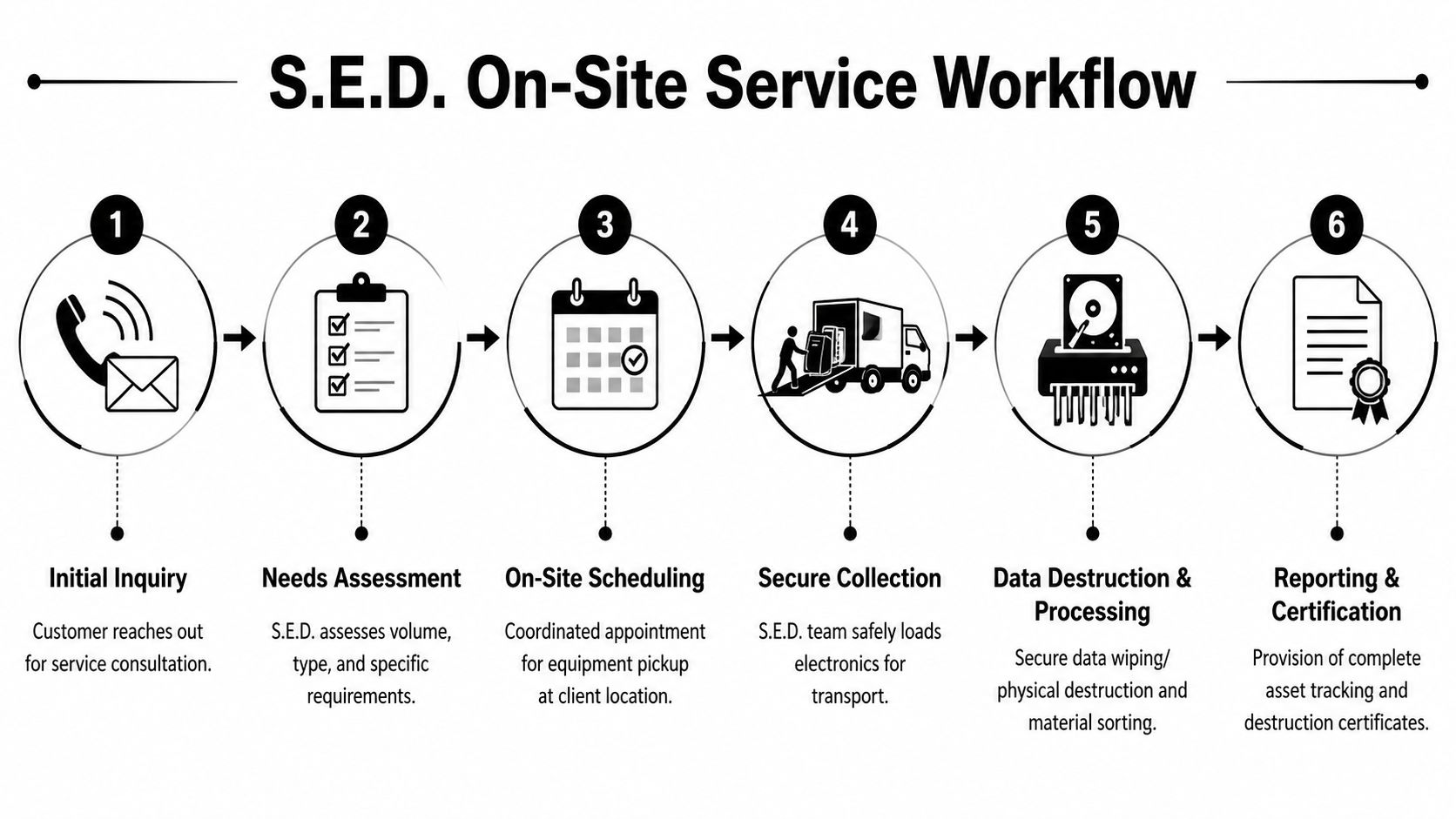
The difference between a smooth disposition project and a chaotic one usually comes down to workflow. On-site electronics recycling should feel controlled from the first call through final reporting. If your team has to improvise packing, escort loaders through sensitive areas, or sort devices on the dock, the process is already off track.
Step one starts before pickup day
Good projects begin with a real intake conversation. The provider needs to know what types of devices are involved, whether de-installation is required, which departments are participating, and whether any of the assets contain regulated data. For Grayson facilities, building access and loading constraints matter too. A clinic with tight patient traffic needs a different pickup plan than a warehouse office or university lab wing.
Teams should identify any special handling needs, such as server racks, instruments attached to benches, or equipment staged across multiple floors.
What an efficient pickup actually looks like
On-site service should move in a clear sequence, not as a general cleanout. The workflow typically works best in this order:
Assessment and scheduling
A service window is set based on asset type, labor needs, and site restrictions.Arrival and site confirmation
The crew confirms scope, pickup zones, and any areas requiring escorted access.De-installation and collection
Fixed or awkward equipment is disconnected, packed, and moved safely.Inventory and segregation
Devices are grouped by category, especially where data-bearing assets need separate control.Secure transport
Equipment is loaded for controlled movement to the processing location.Final processing and reporting
The organization receives disposition records, including data destruction documentation when applicable.
Where projects usually fail
The weak spots are predictable. Staff often underestimate how much labor it takes to remove equipment from active spaces. Internal teams box devices without labeling them. Someone mixes obvious scrap with units that still have internal storage. Then pickup becomes a sorting exercise on the client’s premises, which is the wrong place to discover uncertainty.
A secure workflow removes decision-making from the loading dock. By pickup day, the provider should already know what’s coming, how it will be handled, and what documentation the client expects at closeout.
Another common problem is interruption. Facilities teams still need hallways open, labs accessible, and business operations moving. That’s why white-glove service matters. Professional crews plan around elevators, security checkpoints, dock access, and occupancy constraints instead of treating the site like a demolition zone.
Why chain of custody starts on your floor
For regulated organizations, the chain of custody doesn’t begin at a warehouse. It begins where the asset sits when your employee hands it over. That means collection procedures, packaging discipline, and transport controls all matter.
A provider with a structured electronics recycling workflow and pickup process gives facility managers something more useful than a pickup promise. They give predictability. That’s what reduces friction with compliance, legal, IT, and operations teams during a decommissioning or office cleanout.
Achieving Full Compliance with Certified Data Destruction
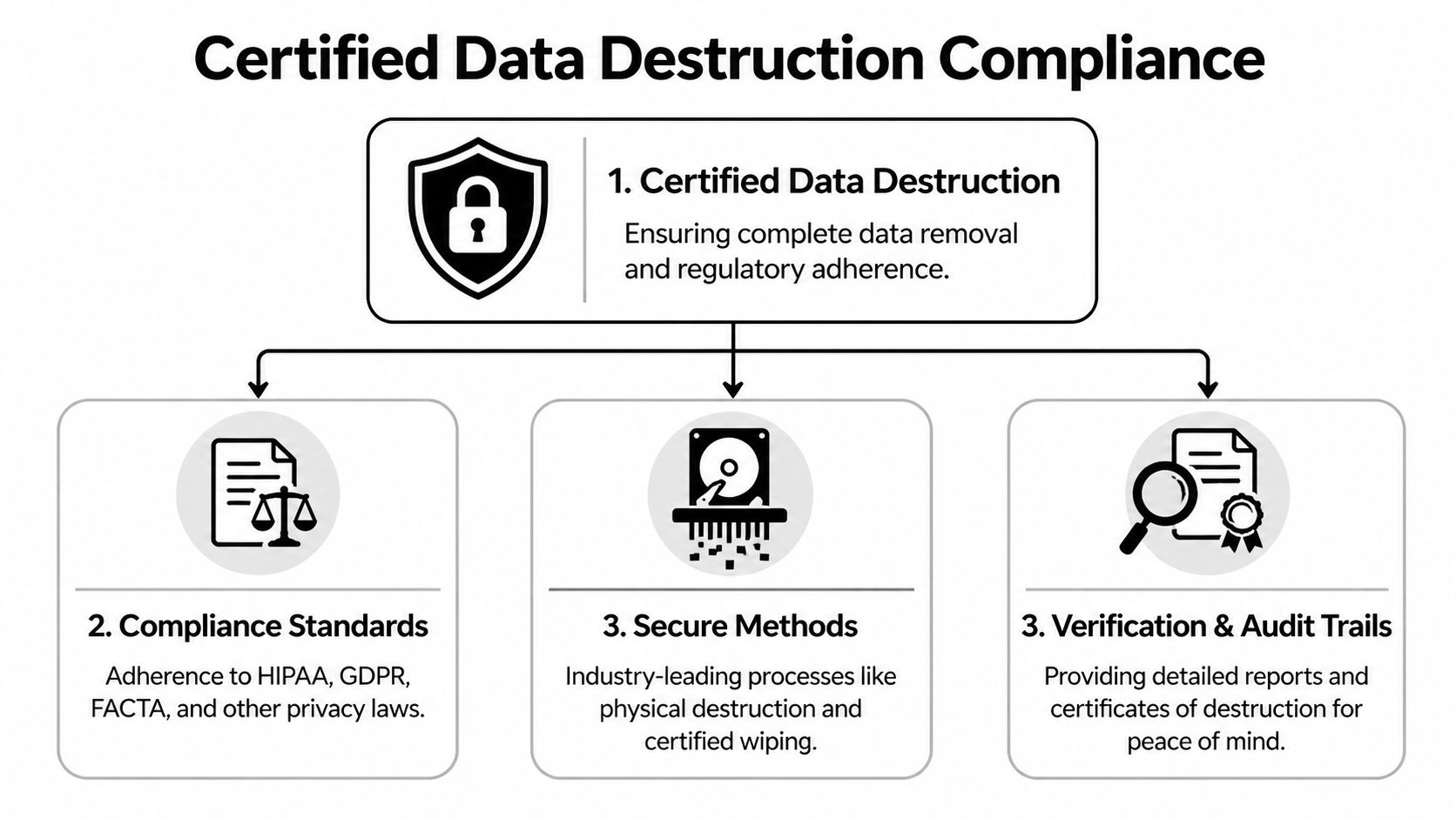
For hospitals, research groups, school systems, and public agencies in Grayson, the core issue isn’t whether electronics can be recycled. It’s whether data can be proven destroyed. If that proof doesn’t exist, the job isn’t finished.
What DoD-compliant wiping means in practice
S.E.D. aligns with DoD 5220.22-M standards, a 3-pass overwriting method that makes data over 99.9% irretrievable, according to Georgia-area data destruction guidance on DoD wiping and breach exposure. That same source notes that up to 42% of data breaches can be tied to improperly disposed of e-waste.
For IT leads, that matters because “deleted” isn’t sanitized. Reformatting isn’t sanitized either. A compliant wipe overwrites the drive in a structured way designed to prevent practical recovery. For functioning magnetic media, that’s often the right path when you need secure erasure with documentation.
For non-functional media, overwrite methods may not be possible. In those cases, physical destruction becomes the correct control. If a drive won’t spin, won’t mount, or fails verification, it shouldn’t sit in a gray area. It should be destroyed under a documented process.
Where regulated organizations get exposed
The devices that cause problems aren’t always obvious servers. Exposure often comes from:
- Retired workstations: Staff assume they were wiped during offboarding, but nobody verified it.
- Copiers and multifunction devices: Internal storage gets overlooked during office cleanouts.
- Lab-adjacent systems: Instruments, controllers, and connected PCs may hold user data, logs, or exported files.
- Loose media: Drives in desk drawers and network closets bypass normal retirement procedures.
A strong electronics disposition plan maps data risk by device category before pickup begins. That’s especially important for environments subject to HIPAA, HITECH, Gramm-Leach-Bliley, internal privacy policies, or government records handling rules.
Documentation is the control, not an afterthought
Teams sometimes focus on the destruction method and forget the evidence. Auditors and compliance officers need to see that the device was identified, transferred, sanitized or destroyed, and recorded. If any of those links are missing, the organization is relying on trust instead of proof.
That’s why chain-of-custody records and Certificates of Data Destruction matter. They create a defensible trail from your facility to final processing. Without that trail, even a properly destroyed drive can become a documentation problem.
If your policy requires secure disposal, your records should show who released the asset, how it was handled, and what destruction method was applied.
Security planning has to extend beyond disposal
Data destruction is one layer of defense, not the entire strategy. Most IT leaders in regulated environments also review backup retention, offsite recovery, endpoint retirement procedures, and ransomware resilience at the same time they review disposition controls. For teams tightening that broader posture, ARPHost's ransomware defense guide is a useful companion resource because it addresses the backup side of the same risk equation.
The practical goal is simple. No retired device should become the weak point that undermines a stronger production security program.
What a compliant service should provide
When evaluating secure data destruction services for electronics and media, ask for specifics, not slogans. The provider should be able to explain:
- Sanitization method: When wiping is used and when shredding is required
- Verification: How they confirm completion of the process
- Tracking: How assets are logged from release through final disposition
- Reporting: What certificates and audit documentation you receive
- Exception handling: What happens when media is damaged, locked, or non-functional
That level of clarity is what separates compliant IT asset disposition from bulk hauling. In Grayson, where many organizations operate under healthcare, education, research, and government obligations, professional data destruction isn’t an upgrade. It’s the baseline.
The Environmental Impact of Responsible E-Waste Recycling
Responsible recycling is easy to reduce to a slogan, but facility managers need to know what happens after pickup. “Zero landfill” only means something if the downstream process is disciplined, traceable, and built around material recovery rather than disposal by convenience.
What zero-landfill should mean
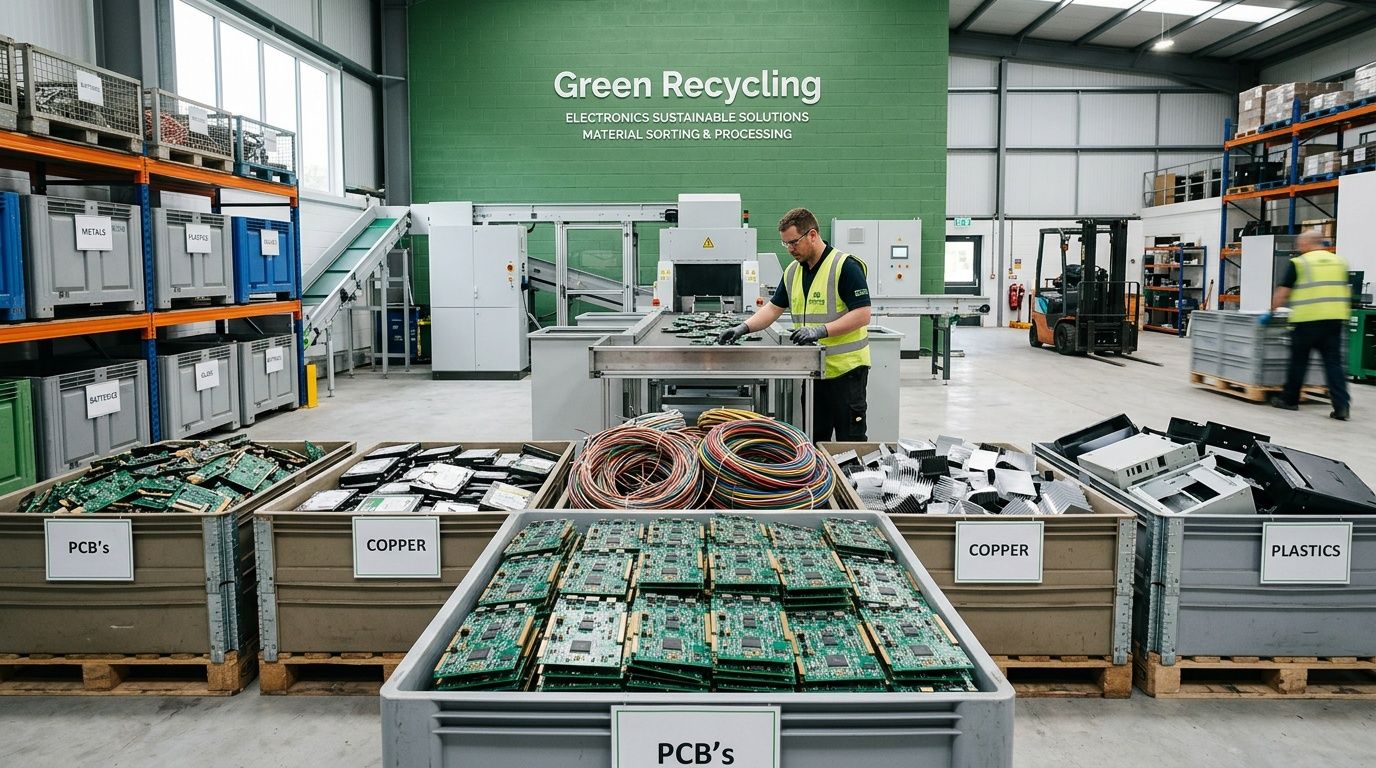
S.E.D.'s zero-landfill policies, carried out through R2/RIOS certified partners, can achieve 98-100% material diversion rates, according to Grayson recycling center guidance on downstream diversion and toxic leakage prevention. That same source says 1.5 million tons of toxic substances leach from improperly disposed e-waste annually based on UN data.
Those figures matter because electronics contain more than recoverable metal. They can also contain hazardous components that shouldn’t enter ordinary trash streams. If a provider doesn’t discuss downstream standards, they’re skipping the environmental part that counts.
What responsible processors do differently
Certified downstream processors separate equipment into material streams that can be handled safely and reused where appropriate. In practice, that means:
- Metals recovery: Ferrous and non-ferrous components are extracted for reuse in manufacturing supply chains
- Plastic segregation: Housing materials are sorted rather than dumped as mixed waste
- Hazard management: Components needing controlled treatment are kept out of general disposal channels
- Value recovery review: Reusable equipment or parts are evaluated before scrap processing
This matters for ESG reporting and internal sustainability goals, but it also matters for simple operational integrity. If your organization says it recycles responsibly, you should be able to show what “responsibly” means.
Environmental compliance isn’t just about what leaves your building. It’s about where each category of material goes next.
Why downstream visibility matters for Grayson organizations
Hospitals, universities, and research facilities often have sustainability commitments that run parallel to privacy obligations. Disposal vendors need to support both. A documented recycling chain helps teams answer internal questions from compliance, procurement, and sustainability staff without relying on broad assurances.
That’s also why smaller asset categories deserve attention. Phones, tablets, and office devices can slip into consumer resale channels or informal trade-ins when they should be handled through a governed business process. For teams comparing resale routes for handheld devices, this expert iPhone selling comparison is a useful example of how varied secondary-market pathways can be, and why controlled disposition standards still matter.
Electronics Recycling Services in Grayson GA should solve two problems at once. They should protect data and keep recoverable materials in the proper recycling system. If either side is missing, the service is incomplete.
Evaluating Costs and Scheduling Your Service
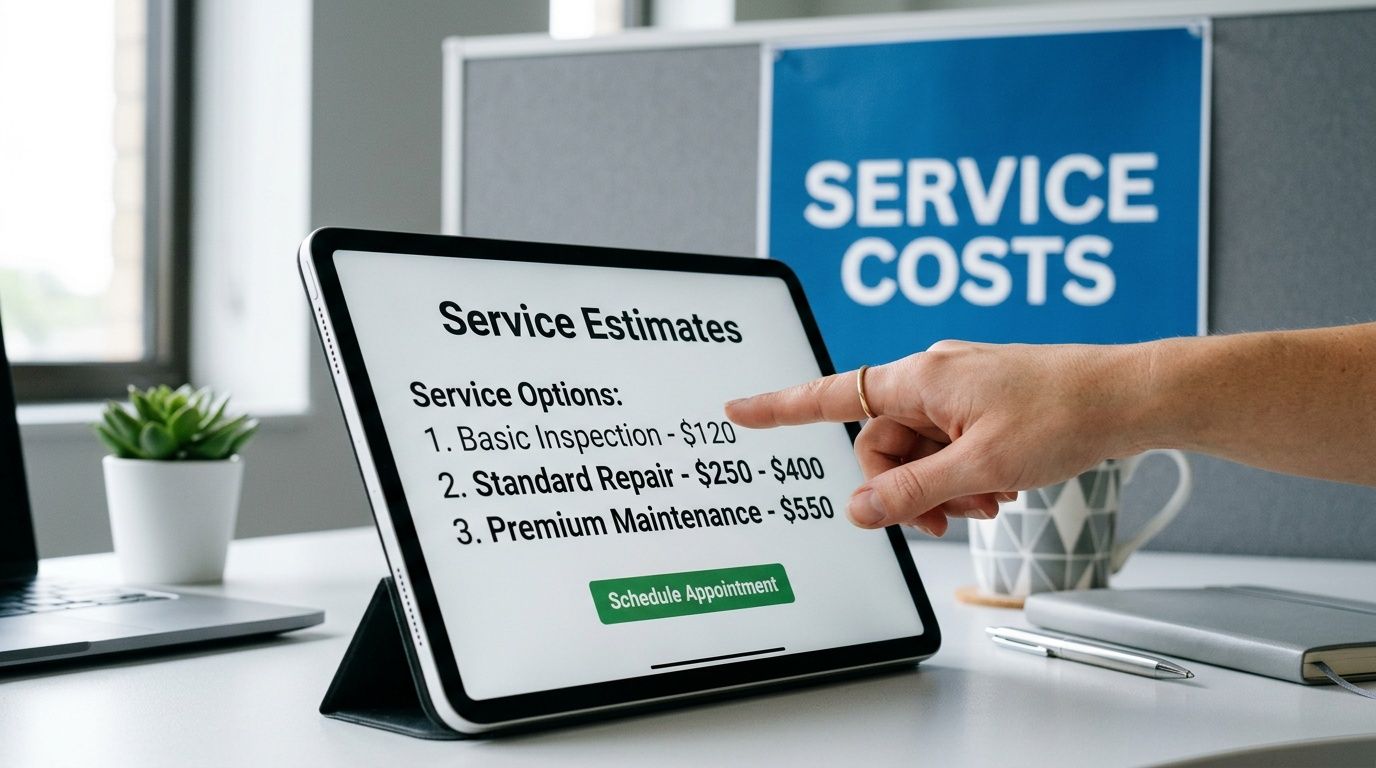
Pricing for electronics recycling isn’t mysterious, but it does depend on scope. The cheapest option on paper can become the most expensive one operationally if your staff ends up doing de-installation, packing, inventory work, or follow-up documentation themselves.
What actually affects service cost
For Grayson businesses, schools, clinics, and labs, cost usually moves based on a few practical factors:
- Volume of equipment: A small office refresh is priced differently from a multi-room decommissioning.
- Asset mix: Monitors and cables are straightforward. Rack gear, lab instruments, and mixed media loads take more handling.
- Labor intensity: Pickup from a dock is simpler than removal from benches, closets, or upper floors.
- Data destruction requirements: Projects with documented media handling involve more controlled workflow.
- Scheduling complexity: Tight windows, active facilities, and special access requirements affect planning.
Some loads may qualify for free pickup depending on business volume and asset type. Others may have value recovery potential if equipment is newer, functional, and suitable for remarketing. In practice, organizations save money when they separate reusable assets from obvious scrap early instead of treating everything as waste.
A useful local benchmark
Public-sector contracting gives a realistic picture of how substantial compliant electronics disposition can be. Gwinnett County’s 2025 RFP RP017-25, issued on September 17, 2025, targets Electronics Recycling and Value Recovery Services at an estimated $500,000 to $2,000,000, with proposals due by October 10, 2025, and potential duration through December 31, 2030. It specifies secure pickup of surplus electronics from the Gwinnett County IT Warehouse at 455 Grayson Highway, Suite 200, Lawrenceville, GA 30046-7171 in a service area tied directly to Grayson operations, as shown in the Gwinnett County electronics recycling contract opportunity listing.
That matters because it confirms what experienced facility managers already know. Secure pickup, value recovery, and compliant processing are not side tasks. They’re budgeted operational services with real scope.
How to make scheduling easier
The most efficient projects usually follow a simple preparation checklist:
Create a rough asset list
You don’t need a perfect spreadsheet, but broad categories help with quoting.Flag data-bearing devices early
Servers, laptops, desktops, copiers, and loose drives shouldn’t be an afterthought.Note access conditions
Elevators, loading docks, after-hours entry, and security procedures all affect timing.Separate reusable from damaged equipment when possible
This helps with value recovery review and faster triage.Decide what paperwork your team needs
Some organizations need recycling records only. Others require destruction certificates and item-level tracking.
For organizations seeking free business electronics pickup in Gwinnett County, it helps to start with photos, an item summary, and any special removal notes. That shortens the quote cycle and reduces surprises on service day.
A lot of organizations first pay attention to these details after reading broader overviews like the quiet crisis of e-waste. The local takeaway is more practical. If you schedule properly, sort intelligently, and choose a provider with both logistics and documentation controls, your disposal project becomes routine instead of disruptive.
Frequently Asked Questions for Grayson Area Organizations
Teams usually ask the same final questions once they get serious about scheduling service. The answers below reflect the issues that come up most often in healthcare, education, research, corporate IT, and government settings around Grayson.
FAQ for Electronics Recycling in Grayson, GA
| Question | Answer |
|---|---|
| Do you only handle computers and monitors? | No. A compliant business recycling program usually covers a much wider range of assets, including servers, network equipment, printers, copiers, phones, lab-adjacent electronics, and many types of powered scientific equipment. |
| What if our equipment is spread across multiple departments? | That’s normal. Multi-department pickups are common, but they go better when the provider knows in advance which rooms, floors, or buildings are involved. A rough staging plan helps avoid confusion on pickup day. |
| Can equipment be removed from active clinical or lab spaces? | Yes, if the project is planned around building access, safety, and occupancy requirements. Controlled removal is especially important in spaces where staff activity can’t be interrupted. |
| Do all devices need to be working? | No. Functional status affects the disposition path, but non-working electronics can still be collected for recycling or destruction. Damaged media often requires physical destruction rather than wiping. |
| What about hard drives inside desktops, servers, and copiers? | Those should be identified as data-bearing assets before pickup. The provider should explain whether the media will be wiped, shredded, or otherwise handled under a documented destruction process. |
| Do we need to box everything ourselves? | Not always. On-site service can include packing and collection support, which is often safer for mixed loads, fragile devices, or heavy equipment. |
| Can you help with lab decommissions, not just IT refreshes? | Yes. Lab cleanouts usually involve a different asset mix and often need more coordination than office pickups. The key is working with a provider familiar with both electronics and scientific equipment handling. |
| What documentation should we ask for? | Ask for chain-of-custody records, recycling documentation, and data destruction certificates when media is involved. Your compliance team may also want itemized tracking for certain categories of equipment. |
| Is it better to store old electronics until we have a large load? | Not necessarily. Delayed removal can create storage, security, and accountability issues, especially for devices with data. If retired equipment is piling up in offices or back rooms, it’s usually better to formalize disposition sooner. |
| What should we do before the pickup team arrives? | Identify the pickup contact, confirm access instructions, flag sensitive devices, and make sure your internal stakeholders agree on what is leaving the site. Clear ownership reduces last-minute delays. |
Questions worth asking before you approve a vendor
Some vendor interviews reveal the gap between hauling and compliant disposition very quickly. Ask these before signing anything:
How do you handle failed or unreadable drives?
A serious provider should have a defined destruction path, not a vague answer.What does your chain of custody look like from our floor to final processing?
This tells you whether they operate a controlled workflow.What paperwork do we receive at the end?
If they can’t describe the documentation package clearly, expect trouble later.Can you manage de-installation and packing on-site?
This matters when your internal team doesn’t have the labor or technical bandwidth.
The right vendor conversation sounds operational, not promotional. You should hear process details, exception handling, and documentation terms, not just “we recycle electronics.”
When to schedule sooner instead of later
You shouldn’t wait if any of these conditions apply:
- Devices contain sensitive data and are sitting unsecured
- A renovation or move is approaching
- Your server room or storage space is becoming congested
- A compliance review is coming up
- Multiple departments are each holding small piles of retired equipment
In those situations, delay usually increases risk and administrative effort. Early scheduling gives your team time to inventory assets, involve compliance, and avoid a rushed cleanout.
If your organization needs a practical, compliant path for electronics and lab asset disposition, Scientific Equipment Disposal helps Grayson-area teams manage pickups, de-installation, secure data destruction, and responsible recycling with business-focused service.