Electronics Recycling in Gwinnett County GA for Businesses & Nationwide ITAD Services

For any business, figuring out electronics recycling in Gwinnett County, GA for businesses is more than just a chore. It's a fundamental part of running a modern, responsible company, whether you operate locally in Georgia or have facilities across the United States. Getting it right simplifies compliance, protects your sensitive data, and shows your customers you’re serious about sustainability.
Why Smart E-Waste Recycling Matters for Gwinnett Businesses and Beyond

Let's face it, old technology piles up fast. Whether you're upgrading office PCs and servers in Lawrenceville or decommissioning an entire data center in another state, the sheer volume of electronic waste (e-waste) is a real headache. For companies in Gwinnett County and nationwide, this isn't just a storage problem—it's a legal, environmental, and data security responsibility.
The good news? The local infrastructure in the Atlanta metro area is strong, and national IT Asset Disposition (ITAD) providers can extend that same level of service anywhere. Gwinnett County has put effort into building clear, sustainable pathways for businesses to dispose of old assets correctly. This local focus means you have access to certified partners who know the regional compliance rules, while a nationwide partner ensures consistent, secure service across all your locations.
The Strategic Value of Professional E-Waste Management
Partnering with a specialized recycler is the smartest move you can make. It turns a complicated headache into a simple, streamlined process. Instead of tying up your own team trying to figure out confusing regulations and disposal methods, you can hand the whole thing over to experts. This isn't just about convenience; it's about comprehensive, auditable peace of mind for your entire organization.
Here’s what a professional service brings to the table:
- Data Security: Certified recyclers provide documented proof that your data has been destroyed. This is your best defense against a devastating data breach and keeps you compliant with privacy laws like HIPAA, whether in Georgia or California.
- Environmental Responsibility: A "zero-landfill" policy is non-negotiable. It ensures hazardous materials stay out of our environment while valuable commodities are recovered for manufacturing, supporting a circular economy.
- Regulatory Compliance: The experts are always up-to-date on local, state, and federal e-waste laws. They provide all the paperwork you need, like a Certificate of Destruction, to prove you’ve done everything by the book, no matter where your facility is located.
Turning an e-waste problem into a business opportunity starts with recognizing its strategic importance. Responsible recycling protects your data, your brand, and your community, making it a non-negotiable part of modern corporate governance.
To get a better handle on your strategy, it's helpful to break down the key factors.
Key Considerations for Gwinnett Business E-Waste Recycling
This table sums up the essential points every business—in Gwinnett or nationwide—should think about when creating an e-waste plan.
| Factor | Why It Matters | Recommended Action |
|---|---|---|
| Data Security | A single data breach can lead to massive fines, reputational damage, and loss of customer trust. | Work only with recyclers who provide certified data destruction, either through wiping or physical shredding, compliant with NIST standards. |
| Local Compliance | Gwinnett County and Georgia have specific rules. Non-compliance can result in penalties. | Choose a partner familiar with Gwinnett's regulations and who provides a Certificate of Destruction. For nationwide needs, ensure your partner understands multi-state regulations. |
| Environmental Impact | Improper disposal harms the local environment and reflects poorly on your brand. | Insist on a recycler with a strict "zero-landfill" policy and R2 or e-Stewards certification. |
| Logistics & Cost | The process of de-installation, pickup, and transportation can disrupt business operations and incur hidden costs. | Get a clear quote that covers all services, including on-site pickup nationwide, and ask about potential value recovery from reusable assets. |
Considering these factors upfront will save you time, money, and potential headaches down the road.
You can see the county's commitment in action. Gwinnett recently put out a multi-year contract opportunity (RP017-25) for electronics recycling, valued between $500,000 and $2,000,000. This initiative is designed to handle surplus tech from businesses, hospitals, and government offices across the Atlanta metro area.
This guide will give you a practical roadmap for electronics recycling in Gwinnett County GA for businesses and beyond. From taking inventory to choosing the right partner, you'll get the insights you need to handle your e-waste securely and efficiently. This is a critical process for companies all over the region, and you can learn more about our dedicated recycling services in Atlanta GA and our nationwide capabilities.
Nail Down Your E-Waste Inventory First
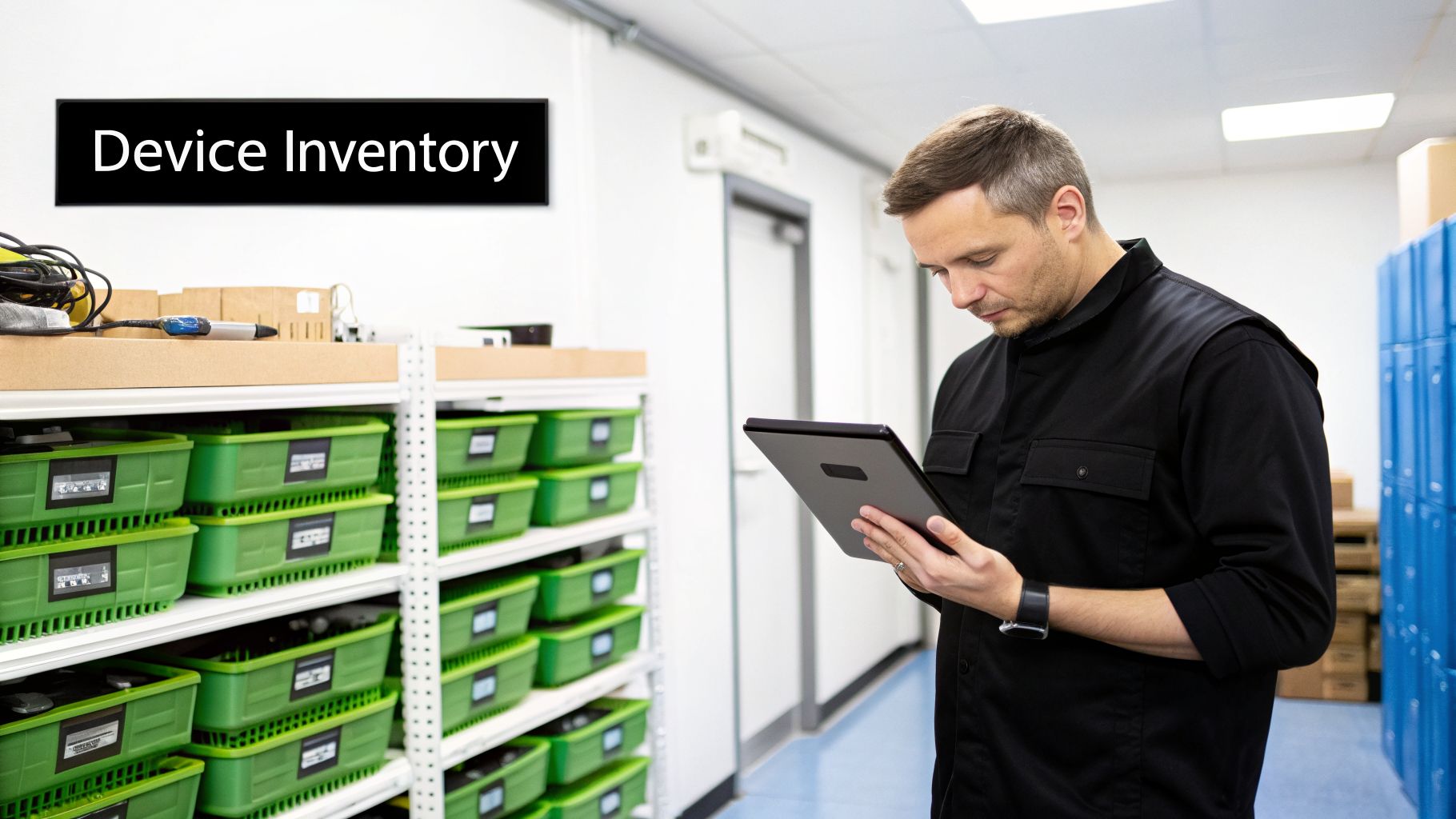
Before you can get a quote or schedule a pickup for your old electronics, you have to know exactly what you’re getting rid of. A good inventory is more than just a headcount; it's the bedrock for accurate pricing, regulatory compliance, and a smooth removal process for your Gwinnett County business or any other corporate location.
Trying to recycle without a detailed list is like shipping freight without a manifest. A simple tally of "50 computers" won't cut it. The details are what separate a quick, efficient pickup from a logistical nightmare.
Start With Broad Categories
The best way to start is by sorting the mess into logical groups. This gets you organized and helps you grasp the full scope of the job.
For a typical office upgrade in a place like Norcross, you'd likely end up with piles of:
- Core IT Hardware: Servers, desktop towers (CPUs), laptops, and networking equipment like switches and routers.
- User Peripherals: This is all the stuff that connects to a computer—keyboards, mice, monitors (make a note if they are old CRTs or newer LCDs), and docking stations.
- Miscellaneous Electronics: A catch-all for old office phones, printers, scanners, projectors, and the inevitable bins of tangled power cords and cables.
This first pass turns a chaotic storage room into a handful of manageable asset groups. From here, you can dig into the details.
Drill Down Into Asset Specifics
Once your items are sorted, it’s time to log them. A simple spreadsheet works great for this, though more specialized IT Inventory Management Software Solutions can help streamline the work.
Your inventory needs more than just the item name. To get an accurate quote and ensure compliance, track these details:
- Item Type: Be specific, like "Dell Latitude Laptop" or "HP LaserJet Printer."
- Asset Tag/Serial Number: This is crucial for internal tracking and proof of disposal.
- Condition: Is it working, non-working, or just for parts?
- Data-Bearing? A simple "Yes" or "No" flags any device that needs data destruction.
- Special Handling Notes: Document any hazards. Think swollen laptop batteries or the lead glass in old CRT monitors.
This level of detail is non-negotiable. A recycler sees "10 laptops" on a list and gives you a generic price. But if they see "10 laptops, 5 with swollen batteries," they know to bring special fire-retardant containers and follow specific safety protocols. It ensures they show up prepared.
A solid inventory is your most powerful tool. It lets you get precise, actionable quotes and guarantees every asset—especially those holding sensitive data—is accounted for the second it leaves your building.
Tailor the Inventory to Your Business
The type of business you run completely changes what your e-waste pile looks like. A healthcare provider’s inventory is worlds away from a corporate headquarters.
Just look at these two common Gwinnett County scenarios:
- Scenario A: A Gwinnett Medical Clinic: A clinic in Lawrenceville is decommissioning a small diagnostics lab. Their inventory won't just list computers; it will include centrifuges, patient monitors, and analytical instruments. All of these may need proof of decontamination before a recycler can even touch them.
- Scenario B: An Alpharetta Tech Company: A software firm doing a hardware refresh will have piles of servers, high-end workstations, and dozens of monitors. Their inventory will focus heavily on asset tag tracking to make sure every single hard drive is identified for certified data destruction.
Knowing your specific asset types helps you have a much more productive conversation with a recycling partner. For a closer look at different industries, check out our guide on managing e-waste.
Finally, after the list is made, get all the equipment into one secure, accessible area. Staging the e-waste ahead of time makes the physical pickup infinitely faster and safer for everyone involved.
Navigating Local and Federal Compliance Laws
Getting compliance right isn’t just about dodging fines. It's about protecting your company's data, its reputation, and the local Gwinnett environment. For any business getting rid of old electronics, the rules can feel like a tangled mess of local Gwinnett County ordinances, state laws, and overarching federal regulations.
But make no mistake: handling it correctly is a non-negotiable part of disposing of your assets today.
Your legal responsibility doesn't just stop when the pickup truck leaves your facility. It follows every single asset all the way to its final, documented destruction. This is what we in the industry call “cradle-to-grave” liability, and it’s a concept you absolutely have to understand when managing e-waste.
The Foundation of E-Waste Compliance
The main federal law you need to know is the Resource Conservation and Recovery Act (RCRA). It's managed by the U.S. Environmental Protection Agency (EPA) and governs all hazardous waste. Many electronics, especially older CRT monitors and lab equipment, are packed with materials like lead, mercury, and cadmium, which can put them squarely in the hazardous waste category.
Just tossing these items into a commercial dumpster can trigger some serious penalties. This is why working with a recycler who guarantees a "zero-landfill" policy isn't just a green initiative—it's a fundamental compliance move. It ensures your equipment is broken down for commodity recovery, not just buried.
On top of the federal rules, Gwinnett County has its own standards. The county’s recycling programs are supported by certified vendors that take more than 20 different categories of e-waste, from old servers to specialized medical devices. The county's upcoming 2025 multi-year contract is even stricter, requiring secure transport to processing facilities within a 150-mile radius. You can dig into the specifics in the county's official electronics recycling overview.
Why R2v3 and e-Stewards Certifications Are Essential
When you’re looking for a recycling partner, two certifications should be non-negotiable: R2v3 (Sustainable Electronics Reuse & Recycling) and e-Stewards. These aren't just logos for a website; they are tough, third-party-audited standards that prove a recycler operates legally and ethically across the country.
- R2v3 Certified Recyclers: This certification demands a fully documented chain of custody, verified data security practices, and responsible management of any hazardous materials all the way downstream.
- e-Stewards Certified Recyclers: Often seen as the gold standard, e-Stewards includes a strict ban on exporting hazardous electronic waste to developing nations, where it often ends up being processed in unsafe conditions.
Choosing a partner without one of these certifications is a huge gamble. You're exposing your business to data breach risks, environmental fines, and brand damage if your assets end up on the news. These certifications are your only real assurance that a recycler is audited and held accountable.
Compliance in Action: Practical Scenarios
The rules don't apply the same way to everyone. Your industry and the type of equipment you have dictates the specific compliance steps you need to take. A deep dive into professional IT asset disposal services will clarify exactly what your business requires.
Let's look at two different Gwinnett County businesses:
A Medical Clinic in Lawrenceville: This clinic is bound by RCRA for the hardware and the Health Insurance Portability and Accountability Act (HIPAA) for the data. Every single device that might have touched patient data—from a front-desk computer to an old EKG machine—is a potential liability. For them, compliance absolutely requires a Certificate of Data Destruction that meets HIPAA’s tough standards, proving all Protected Health Information (PHI) was completely destroyed.
An Industrial Plant in Norcross: This facility is retiring old control systems from its production line. There's no personal data here, but the systems may contain valuable intellectual property or hazardous components like mercury switches. Their compliance focus is two-fold: ensuring those hazardous materials are handled according to EPA and OSHA rules, and confirming their proprietary programming is wiped clean.
In both of these cases, a certified recycler provides the critical paperwork that proves you did everything right. Documents like Certificates of Recycling and Data Destruction are your official, audit-ready records. This is what closes the loop on your "cradle-to-grave" responsibility.
Ensuring Total Data Destruction for Your IT Assets
When you’re getting rid of old IT equipment in Gwinnett County or anywhere else, the hardware itself is rarely the biggest risk. It's the sensitive data lurking on old hard drives, servers, and even office printers that can truly come back to haunt you. A single forgotten drive could easily lead to a catastrophic data breach, destroying customer trust and landing you with massive regulatory fines.
Let's be clear: simply deleting files or running a factory reset is nowhere near enough. Data can be recovered from wiped devices with surprising ease, leaving your business completely exposed. Real data security demands professional, verifiable methods that render information permanently unrecoverable. This isn't just a best practice; it's a critical step in responsible IT asset management.
The right method for destroying data really depends on the device, your industry's compliance rules, and your own comfort level with risk. We generally see it boil down to three industry-standard approaches.
Data Wiping Versus Degaussing
Data wiping, often called sanitization, uses specialized software to overwrite a hard drive's entire surface with random characters. This process essentially buries the original data, making it practically impossible to get back.
- DoD 5220.22-M: This is a common 3-pass sanitization method where data is overwritten three times. It’s a solid standard that works for most corporate needs.
- NIST 800-88: A more current and detailed standard from the National Institute of Standards and Technology. It provides flexible guidelines like "Clear," "Purge," and "Destroy" to match different security requirements.
Degaussing takes a totally different path. It's used for magnetic media like older hard drives and backup tapes. A powerful magnet, the degausser, scrambles the drive's magnetic field, instantly obliterating all data. The catch? Degaussing is useless on Solid-State Drives (SSDs), which store data electronically, not magnetically.
Choosing between them is a key decision. Wiping keeps the hard drive intact for potential reuse and resale, which can recover some value. Degaussing makes it a paperweight. For a closer look at the options, you can explore our secure data destruction services.
This decision tree gives you a quick visual guide for navigating e-waste compliance, from securing data to picking the right recycler.
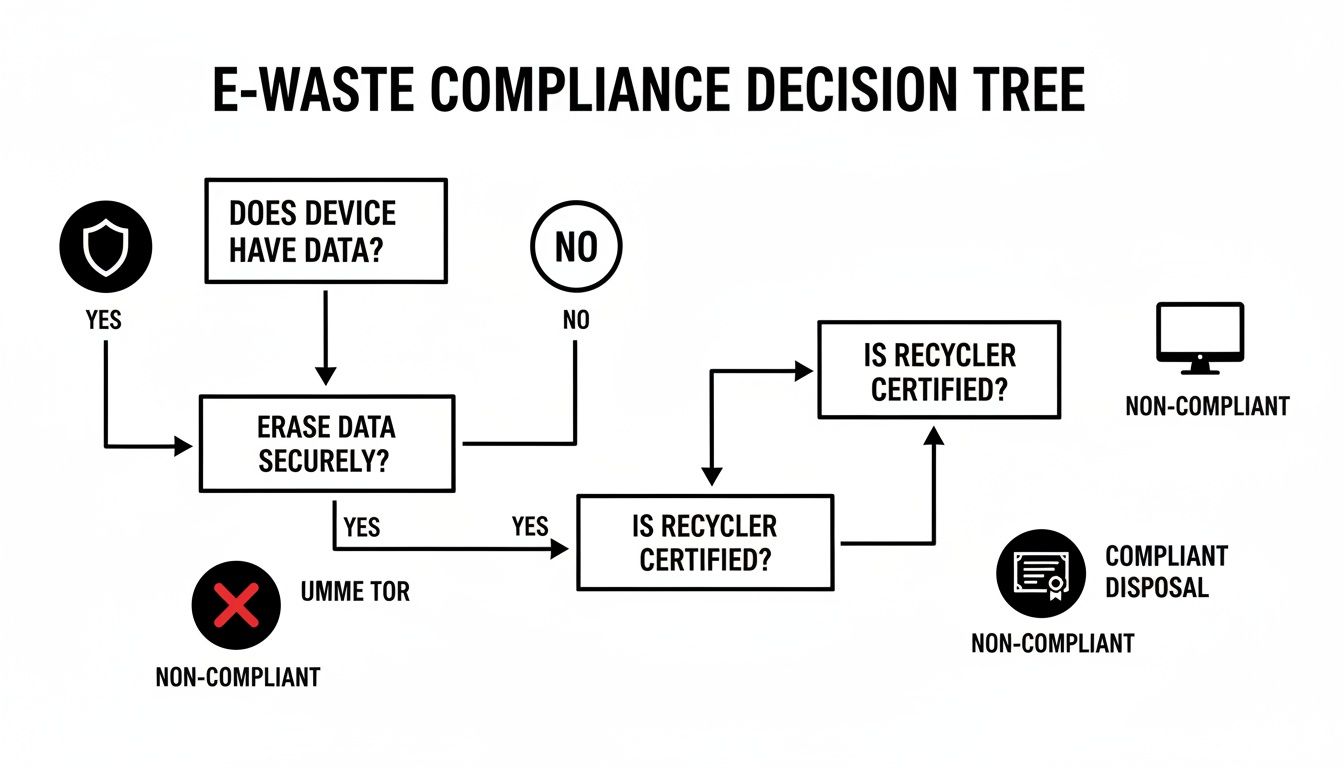
As you can see, two things stand out: whether there's data on the device and whether your recycler is certified. Get those two things right, and you're well on your way.
When Physical Shredding is the Only Answer
For absolute, undeniable security, nothing beats physical destruction. Shredding involves industrial machinery that literally pulverizes hard drives, SSDs, and other media into tiny, mangled pieces of metal and plastic. There’s simply no coming back from that.
This is the go-to method for any business handling extremely sensitive information, especially those governed by:
- HIPAA: Protecting patient health information (PHI).
- FACTA: Safeguarding consumer financial data.
- PCI-DSS: Securing credit cardholder information.
Many certified recyclers even offer on-site shredding. A mobile shredding truck comes right to your Gwinnett County facility or any location nationwide, letting you watch the destruction with your own eyes. It offers total peace of mind and completely removes any chain-of-custody risks.
The single most important piece of paper you’ll get from this process is the Certificate of Data Destruction. This is your legal, audit-ready proof that you’ve met your compliance obligations. It must list the serial numbers of the destroyed devices and the method used.
Vetting a Recycler's Data Destruction Capabilities
When you hire a recycler, you're handing over your company's digital keys. It's absolutely crucial to ask the right questions and verify their security protocols. Smart companies know how to prevent data breaches by managing IT asset risks long before they become a problem.
Before you sign any contract, get straight answers to these questions:
- What data destruction standards do you follow? They should be able to name NIST 800-88 or DoD 5220.22-M without hesitation.
- Do you offer on-site shredding? It's a clear sign they are serious about high-security services.
- Can I get a detailed Certificate of Data Destruction? Insist on a certificate that is itemized by serial number. Accountability is everything.
- What does your chain of custody look like? Your assets need to be transported in locked, secure vehicles and tracked from your door to final disposition.
Choosing a partner for electronics recycling in Gwinnett County GA for businesses means finding someone who takes your data security as seriously as you do. Anything less is a gamble you can't afford to take.
How to Choose a Certified E-Waste Recycling Partner
Picking the right partner is the most important decision you'll make in your entire e-waste strategy. It's not just about getting rid of old gear. The wrong choice can lead to data breaches, steep compliance fines, and environmental headaches—all of which come straight back to your business, whether it's one office or one hundred.
A great partner, on the other hand, makes the whole process smooth, secure, and worry-free.
Finding the best fit for your electronics recycling in Gwinnett County GA for businesses and nationwide ITAD needs is more than just comparing price quotes. You’re not just hiring a hauling service. You're trusting a vendor with your company's sensitive data, its reputation, and its legal standing across multiple jurisdictions.
Look for Active R2v3 or e-Stewards Certifications
The first and most important filter for any potential partner is their certifications. If a recycler doesn’t hold an active R2v3 (Sustainable Electronics Reuse & Recycling) or e-Stewards certification, they shouldn't even make your list.
These certifications are your only real proof that a company follows the highest industry standards for:
- Data Security: They are required to follow strict, audited protocols for completely destroying data.
- Environmental Responsibility: They are banned from illegally dumping e-waste or exporting hazardous materials to developing countries.
- Worker Safety: Their facilities must meet tough health and safety requirements.
Any recycler claiming to be "compliant" or "eco-friendly" without these third-party audited credentials is just using marketing buzzwords. Verifiable certification is the only proof that matters.
Verify Their Chain of Custody and Insurance
A transparent, fully documented chain of custody is non-negotiable. This process tracks your assets from the moment they leave your facility until they are completely processed. You absolutely need to know where your equipment is at all times.
Ask a potential partner to walk you through their process. It should include:
- Secure Logistics: Do they use their own fleet of locked, GPS-tracked vehicles? Can they manage secure freight for nationwide pickups?
- Serialized Tracking: Can they track every asset by its serial number from pickup to final destruction? This is critical for creating an audit-proof paper trail.
- Secure Facilities: Are their processing facilities access-controlled with 24/7 surveillance?
Just as important is their insurance. A reputable recycler will carry significant pollution liability and errors and omissions insurance. This protects your business if something goes wrong. Don't hesitate to ask for a copy of their insurance certificate.
The amount of electronic waste is growing fast, making a certified partner more critical than ever. Georgia generated 21,000 tons of e-waste back in 2014, with that number expected to hit 52,000 tonnes by 2027. This surge shows why responsible management is so important. Local providers like Reworx Recycling, which boasts a 99.9% landfill diversion rate, prove that certified vendors are the key to handling this volume responsibly. You can read more about the impact of Georgia's growing e-waste challenge.
Prioritize Providers with In-House, Nationwide Services
While many small recyclers exist, a partner with both a strong local presence and nationwide capabilities offers the best of both worlds. A company that runs its own fleet, like Scientific Equipment Disposal, can offer flexible scheduling and fast service for Gwinnett-area pickups.
They know the ins and outs of navigating the Atlanta metro area—from dealing with building management in a downtown high-rise to getting access to an industrial park in Norcross. A provider with a national footprint can then replicate that same secure, compliant service for your offices in Texas, New York, or anywhere else.
Look for a partner that offers a full range of on-site services, including:
- De-installation: Safely disconnecting and removing servers, networking racks, and complex lab equipment.
- Packing and Palletizing: Properly prepping all assets for secure transport, locally or cross-country.
- On-site Hard Drive Shredding: This gives you the ultimate peace of mind for data security, available at any of your locations.
Having these services in-house reduces business disruption and closes the security gaps that pop up when you have multiple subcontractors on the job. To get a better feel for what's involved, check out our guide on selecting the right electronic waste recycling company.
Schedule the Pickup and Prep Your Team
Once you've picked your partner, the final piece is coordinating the pickup itself. Any professional recycler will guide you through this, but a little prep on your end will make sure everything goes smoothly.
First, assign a single point of contact on your team to work with the recycler. This person should coordinate with your building's management to reserve loading dock access and service elevators if they're needed.
Finally, communicate the plan to your staff. Make sure everyone knows when the pickup is happening and that the designated e-waste area is off-limits to anyone not involved. A bit of planning on pickup day ensures a fast, efficient, and secure handoff.
Got Questions About Business E-Waste? We've Got Answers.
Dealing with old business electronics in Gwinnett County isn't as simple as just hauling it away. It’s a process wrapped up in data security, legal compliance, and your bottom line. Over the years, we've heard it all, so we’ve put together answers to the questions we get asked most often by businesses just like yours, both locally and nationwide.
What Happens to My Electronics After You Pick Them Up?
The moment we load your e-waste at your Gwinnett County site or any other facility, the chain of custody begins. Your assets are transported in our own secure, GPS-tracked vehicles directly to our certified processing facility. There are no mysterious third-party handoffs. No guesswork.
First, we triage everything. Any device that could possibly hold data—think servers, computers, and hard drives—is immediately pulled aside for secure data destruction. Depending on what you’ve requested, this means either a multi-pass software wipe that meets NIST 800-88 standards or complete physical shredding into tiny, irrecoverable pieces.
From there, our technicians manually dismantle every single item. This isn't a mindless, shred-it-all operation. We take the time to carefully break everything down into clean commodity streams:
- Plastics from keyboards and equipment casings
- Metals like aluminum, steel, and copper
- Precious metals recovered from circuit boards
- Glass from old monitor screens
These separated materials are then funneled to our network of fully vetted and audited downstream partners who specialize in refining. This ensures those raw materials actually make it back into the manufacturing supply chain, closing the loop and helping us stick to our strict zero-landfill goal.
Is There Any Equipment You Can't Take?
Our mission is to be your single call for virtually all business and lab electronics, anywhere in the country. We handle an enormous range of equipment, from standard IT assets like servers and network gear to highly specialized scientific instruments like centrifuges and spectrophotometers.
That said, for safety and regulatory reasons, a few things are off-limits. We cannot accept:
- Equipment containing radioactive materials
- Items with uncertified biological hazards
- Large household appliances like refrigerators or AC units, as the coolants require a different disposal process we don't handle.
- Loose batteries that aren't inside an electronic device. These have their own dedicated recycling channels.
If you're unsure about a specific piece of gear, just ask. A quick call to our team can clear things up fast. We'd much rather confirm your inventory list upfront to guarantee a smooth, compliant pickup day.
The most crucial documentation you will receive is your Certificate of Recycling and, for data-bearing assets, a Certificate of Data Destruction. These are your audit-ready records that legally prove you met all compliance standards, closing the loop on your liability.
How Do You Determine the Cost for E-Waste Recycling?
The pricing for professional e-waste recycling isn't a simple flat fee; it's a dynamic calculation. Several factors play into the final quote, and we're always fully transparent about how we get to that number.
Some electronics actually have recoverable value. Newer servers, high-end networking switches, or valuable lab instruments can often be refurbished or have their components reclaimed. In these situations, the value we get back can significantly offset—or even completely cover—the cost of recycling. Sometimes, it even results in a rebate we pay back to you.
On the other hand, some items are inherently costly to process safely and correctly. The usual suspects include:
- CRT Monitors: The leaded glass inside requires very specialized (and expensive) handling.
- LCD/LED Monitors: These contain small amounts of mercury in their backlights.
- UPS Batteries: They're heavy and contain hazardous materials.
- Large Copiers & Printers: These are a complex mix of low-value plastics, metals, and electronics.
The final price also includes the logistics. Things like on-site de-installation services, navigating stairs or multiple floors, and the specific data destruction method you need (on-site shredding, for instance) will be factored into your itemized quote. Our goal is to make sure you see exactly what you're paying for before you agree to anything.
What Documents Prove We Followed the Rules?
Proper documentation is your ultimate protection. It’s the official proof that you fulfilled your "cradle-to-grave" responsibility for every asset you got rid of. Simply handing your equipment to a recycler isn't enough—you need the paper trail to back it up.
Once the job is done, every client receives a full documentation package. It always includes two key documents:
- A Certificate of Recycling: This lists the equipment we processed and certifies that it was managed and recycled in line with all environmental laws and our zero-landfill policy.
- A Certificate of Data Destruction: For any device with storage media, this is the most critical document. It details every single serialized drive that we wiped or physically shredded, certifying that your data was destroyed according to standards like NIST 800-88.
This paperwork is your official, audit-ready record. It proves your due diligence and is your best defense against potential fines or legal issues related to data privacy or environmental regulations.
Navigating the complexities of electronics recycling in Gwinnett County GA for businesses, and for corporations nationwide, is simpler with a trusted partner. At Scientific Equipment Disposal, we provide secure, compliant, and transparent e-waste solutions tailored for corporations, healthcare facilities, and research labs across the United States.
Contact us today to schedule your pickup and ensure your assets are handled responsibly.