Atlanta Real Estate Tech: PropTech Growth Insights


Atlanta real estate feels fast right now. New construction, new tenants, new research space, new software platforms, new expectations. If you manage a specialized property in that environment, the pressure is different from the headlines.
You might be running an older medical office, a university science building, a clinic with imaging equipment, or a lab suite that has been modified in layers over time. Everyone around you is talking about smart buildings, automation, digital leasing, and portfolio visibility. Meanwhile, you're trying to figure out what happens to legacy freezers, decommissioned centrifuges, access-control hardware, retired servers, and rooms that require more than a standard office move to empty.
That gap matters. True value in Atlanta real estate tech and PropTech growth insights isn't in buzzwords. It's in knowing how digital systems affect the practical work on the ground, especially when a property includes regulated equipment, sensitive data, and specialized infrastructure.
Atlanta Is Booming But What About Your Building
An Atlanta facilities director sees the same thing everyone else sees. Cranes. Redevelopment. More tech tenants. More competition for space. More executive pressure to modernize.
But the pertinent question usually shows up in a much less glamorous setting. It happens in a mechanical room, a pathology lab, an old server closet, or a research wing scheduled for renovation. The building isn't a clean slate. It has years of installed systems, patched controls, obsolete devices, and equipment that can't be unplugged and left at the loading dock.
For managers in that position, PropTech isn't just about adding dashboards. It's about deciding what stays, what gets integrated, what creates risk, and what must be removed before a property can change hands, support a retrofit, or welcome a new occupant.
The Atlanta reality on the ground
In practice, many specialized properties sit between generations. They may use newer work order software and digital access systems while still housing old lab instruments, refrigeration units, nurse-call infrastructure, or data-bearing devices that require controlled handling. Teams often start by reviewing software options, and resources like Lighthouse recommends these apps can help sort through property management tools that fit different operating models.
The harder part is physical and compliance-driven. A smart tenant experience platform doesn't solve what to do with retired analyzers, deinstalled fume hoods, or old connectivity hardware tied to a partial renovation. That local infrastructure layer matters too, especially in a market where connectivity expectations keep rising across property types, which is why Atlanta operators also watch broader digital utility issues like internet service providers in Atlanta.
Buildings don't become smarter just because you add software. They become harder to manage if old assets, old data, and old compliance obligations are still sitting in place.
That is where many Atlanta owners and managers get stuck. The city is moving forward quickly. Their building may still be carrying ten years of deferred decisions.
Understanding PropTech Beyond The Hype
PropTech is easiest to understand when you stop treating it like a category label and start treating it like a building operating system. At its best, it connects information from the property, the occupants, the service vendors, and the ownership team so decisions happen faster and with less guesswork.
For commercial and institutional properties, PropTech usually means four practical layers:
- Operational systems such as building automation, maintenance platforms, and sensor networks
- Analytics tools that turn utility, occupancy, and asset data into usable decisions
- Transaction platforms that support leasing, documentation, and portfolio workflows
- Sustainability tools that help owners monitor performance and reporting obligations
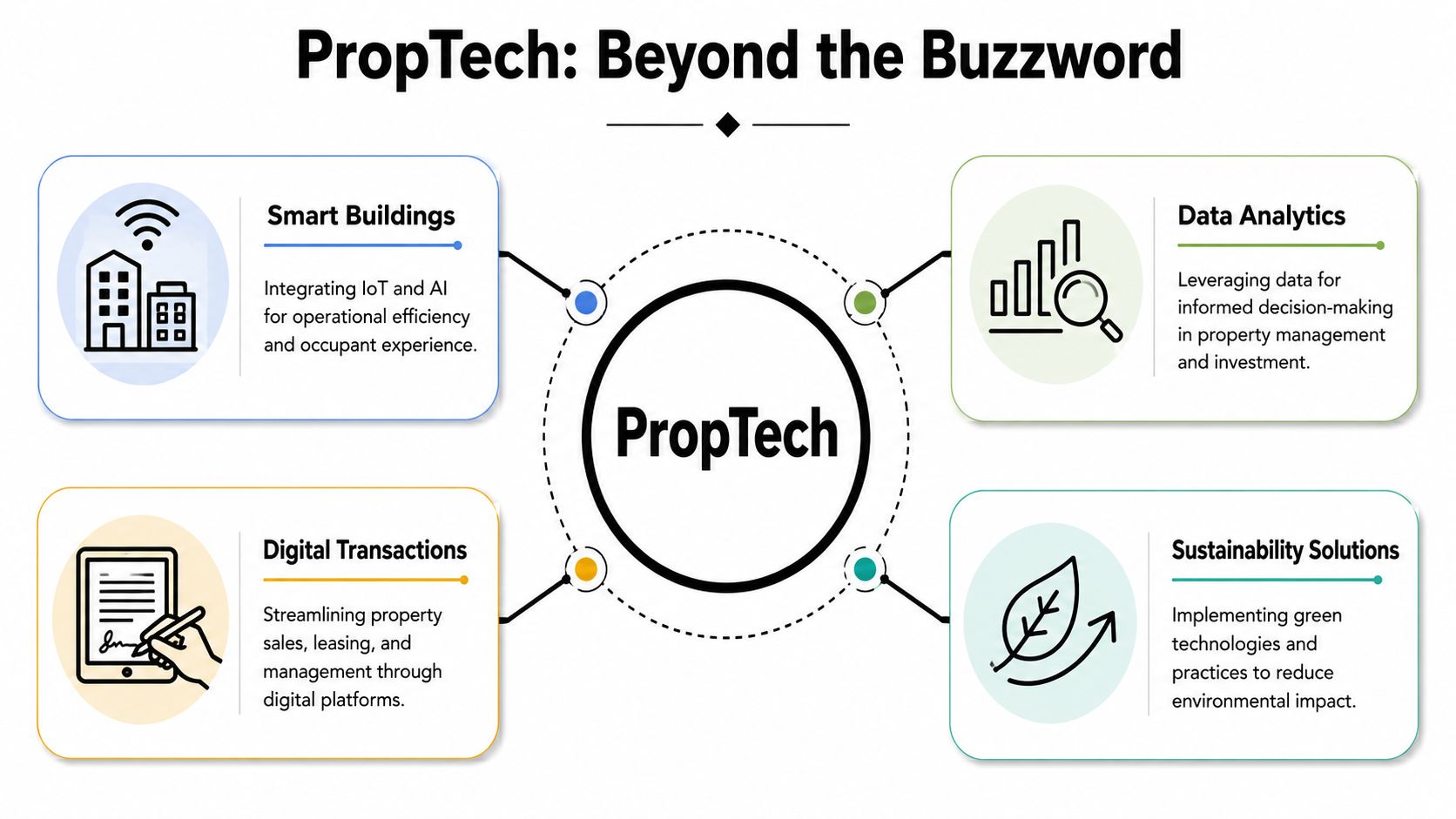
Think of it as the building's central nervous system
A standard office building might use PropTech to track HVAC runtime, manage visitor access, route service tickets, and monitor energy consumption. A hospital or research facility uses the same idea, but the applications are more critical. The system isn't only watching comfort and occupancy. It may also support temperature-sensitive spaces, restricted rooms, air-handling dependencies, and compliance records.
That's one reason the market keeps expanding. The global PropTech market is projected to grow from $44.59 billion in 2026 to $104.57 billion by 2034 at an 11.20% CAGR, and cloud-native platforms are moving into larger deployments because of scalability and easier data access, according to Fortune Business Insights on the PropTech market.
What works and what doesn't
What works is integration around actual operations. Sensor data tied to maintenance planning can help teams identify failures earlier. A connected work order system can reduce confusion between engineering, compliance, and vendor management. Portfolio reporting can give ownership a clearer view of risk across multiple sites.
What doesn't work is buying disconnected tools because they demo well.
A flashy occupancy dashboard has limited value if the facilities team still tracks critical assets in spreadsheets. A new platform won't fix weak decommission planning. And cloud access doesn't remove the need to think carefully about data retention, device retirement, and who owns information produced by old instruments and edge hardware.
A related issue shows up in vendor strategy. Many Atlanta organizations are also evaluating external support models for IT and operations, which is why broader business planning topics such as IT outsourcing trends among Atlanta businesses often overlap with PropTech decisions.
A practical test
Use this short test before calling any platform a PropTech success:
| Question | Why it matters |
|---|---|
| Does it reduce manual work for site staff? | If not, adoption usually drops. |
| Does it connect to existing building and asset workflows? | Standalone tools create parallel processes. |
| Does it account for end-of-life equipment and data? | Specialized sites carry hidden risk after installation. |
Practical rule: If a tool improves reporting for headquarters but creates more manual cleanup for the building team, it isn't operationally mature yet.
How PropTech Is Reshaping Atlanta Commercial Real Estate
Atlanta's growth creates the kind of operating environment where digital real estate tools stop being optional and start becoming baseline infrastructure. More leasing activity, more tenant movement, more investment, and more redevelopment all increase the need for cleaner workflows and faster building decisions.
One Atlanta outlook projects 13.5% growth in home sales, 2.0% economic growth, and more than 56,700 new jobs in 2025, while the same market review notes that North America accounted for 55.7% of global PropTech revenue in 2022 and is projected to grow from $16.2 billion to $52 billion by 2030, as described in this PropTech and real estate growth analysis. For Atlanta operators, that means more demand for systems that help properties lease, operate, and transition efficiently.
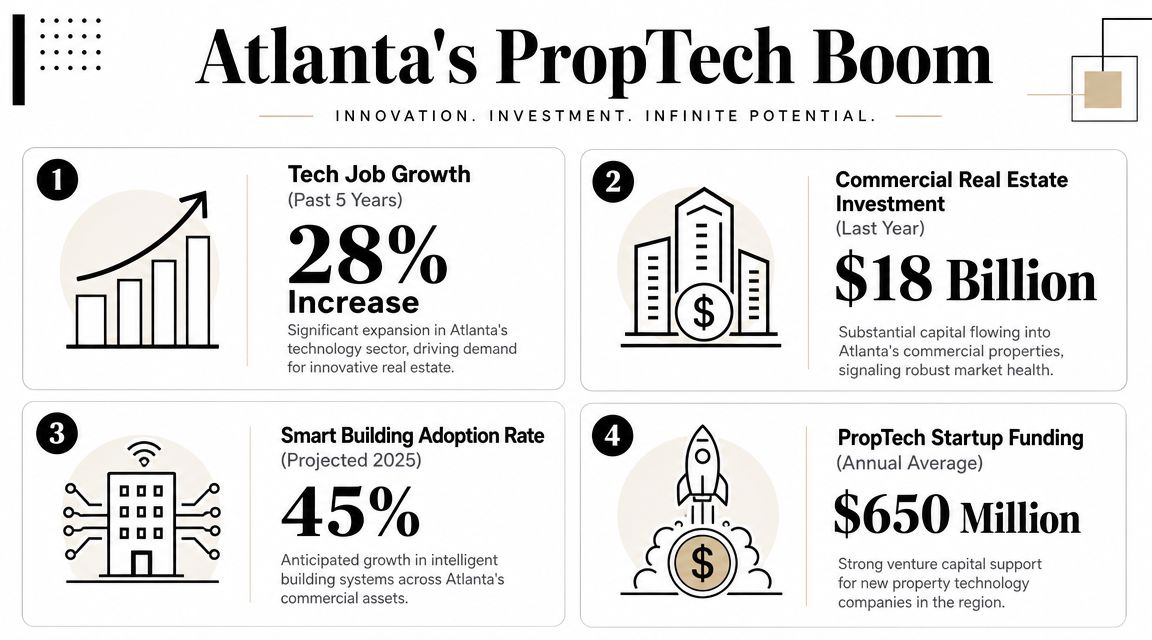
Why local owners are paying attention
In a growing metro, managers don't just compete on rent. They compete on responsiveness, uptime, security, tenant experience, and readiness for change. A property that can support digital access control, better maintenance visibility, and faster turnover is easier to position in the market.
That's especially true for commercial properties with multiple systems and a larger operating footprint. Security planning is part of that mix. Even though every building needs a site-specific approach, operational teams can still benefit from reviewing broader frameworks around commercial property security systems when evaluating how access control, surveillance, and monitoring fit into a wider PropTech strategy.
The shift isn't only about new towers
Some owners assume PropTech mostly benefits newly built assets. In Atlanta, that's too narrow. Existing commercial stock is also under pressure to perform better. That includes logistics facilities, mixed-use assets, institutional buildings, and older commercial space that needs stronger operating visibility without a full teardown.
A lot of this comes down to deployment discipline:
- Portfolio visibility: Owners want one view of maintenance, occupancy, and vendor activity.
- Tenant expectations: Occupants expect digital responsiveness, not paper-heavy building processes.
- Building adaptability: Properties need to support retrofits, new users, and phased transitions.
- Operations under strain: More assets and more activity expose weak handoffs quickly.
That broader local context also shows up in related sectors. As Atlanta expands as a distribution and innovation center, property teams are dealing with more complex operational demands tied to Atlanta logistics tech growth and IT needs.
In Atlanta, PropTech matters because the market is moving faster than many buildings were designed to handle.
The Unique PropTech Challenge For Labs And Medical Facilities
Most PropTech content is written for standard commercial buildings. Labs, hospitals, clinics, and research properties don't behave like standard office space.
These facilities contain assets that are expensive, specialized, regulated, and often data-bearing. They also depend on infrastructure that can't be treated casually. A tenant improvement project in a lab suite can involve utility isolation, ventilation review, chain-of-custody concerns, hazardous handling protocols, and disposal decisions that affect compliance long after the contractor leaves.
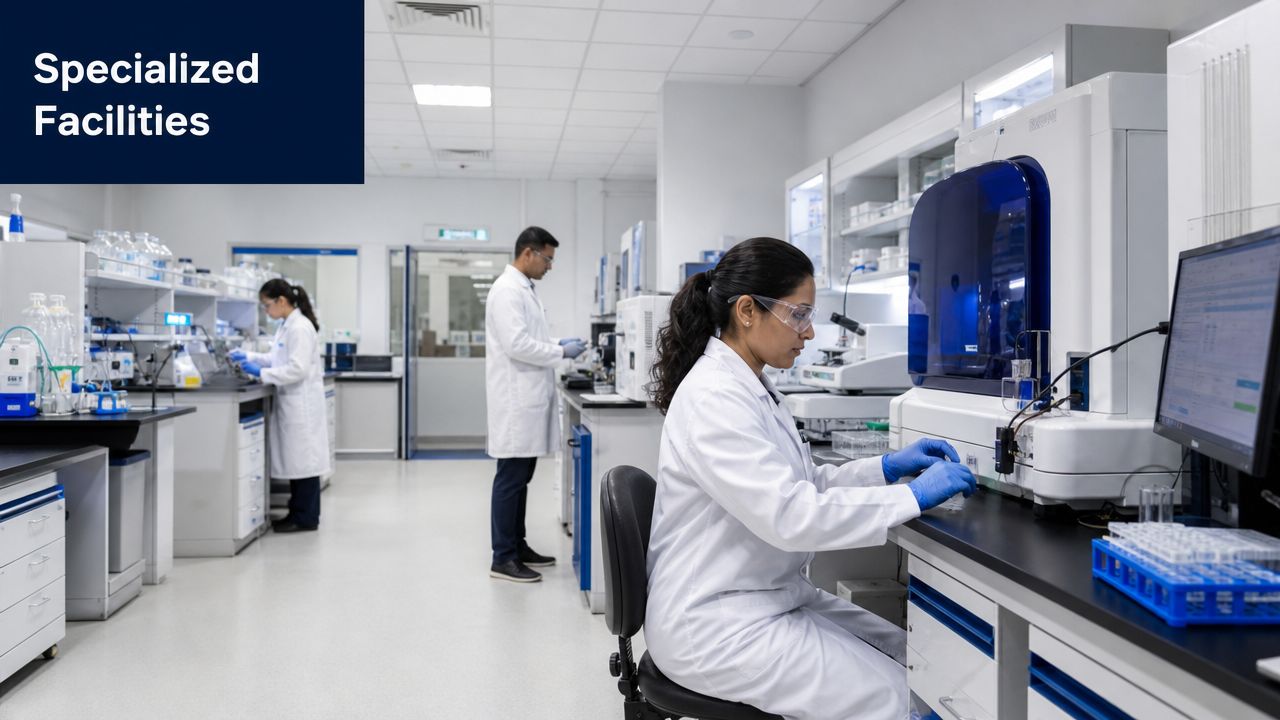
Why standard smart-building logic falls short
A normal smart-building deployment asks questions like these: Is the HVAC performing? Are occupants comfortable? Can the owner reduce energy waste? Those matter in specialized facilities too, but they don't go far enough.
A lab-heavy property forces a second set of questions:
- What equipment contains storage media or embedded data?
- Which devices require documented deinstallation?
- What environmental controls must remain active until final removal?
- Which assets can be reused, recycled, or destroyed under policy?
- Who signs off that the space is clean, secure, and ready for the next phase?
Commercial real estate is forecast to hold 57% of the PropTech market share in 2026, and North America is expected to lead regionally with 38.6%, with stronger demand for IoT and analytics driven by asset complexity, according to Coherent Market Insights' PropTech market overview. Labs and medical facilities sit on the sharp end of that complexity.
Compliance is attached to the equipment lifecycle
In these buildings, equipment isn't just a procurement issue. It affects real estate operations from occupancy through shutdown. A freezer, biosafety cabinet, imaging device, incubator, or server rack may tie directly into room classification, airflow planning, records retention, and data security expectations.
Facility teams also need to watch for hidden dependencies. Ventilation is a good example. If a suite includes cryogenic or highly controlled lab functions, shutdown sequencing matters. General building modernization doesn't replace engineering judgment, and technical references on best practices for cryogenic lab ventilation can be useful when teams are evaluating removal timing and environmental safety controls.
The disposal issue starts earlier than most teams think
Many project teams treat disposition as the last task. In specialized properties, that's usually a mistake. Once a renovation or closure is announced, the inventory should already be under review. That includes obvious lab instruments and less obvious assets like control panels, local PCs, embedded storage, UPS units, and small devices tucked into casework.
A more disciplined approach starts with a facility-by-facility asset view, especially when dealing with lab equipment and lab shutdown planning. Without that visibility, owners risk delays, incomplete removals, and security gaps that don't appear on a standard construction checklist.
The hardest part of a lab move isn't installing the next system. It's closing out the last one without leaving behind compliance problems.
Opportunities And Risks For Institutional Asset Holders
Institutional owners don't need another reminder that buildings are getting more digital. They need a clearer view of where value is created and where risk slips in.
The opportunity in PropTech is straightforward. Better operating visibility can support stronger tenant retention, cleaner reporting, and more predictable property performance. For specialized assets, it can also make repositioning easier because future users inherit a site with fewer unknowns.
The risk is just as real. If an owner modernizes the front end of operations but ignores decommissioning and disposition, the portfolio can carry hidden liabilities. These usually don't look dramatic at first. They show up as project delays, missing records, unsecured drives, unclear chain of custody, or a space that appears vacant but isn't operationally cleared.
Where owners gain leverage
The most durable gains usually come from discipline, not novelty.
| Area | Strong practice | Weak practice |
|---|---|---|
| Asset turnover | Tie equipment retirement to property planning | Treat removal as a vendor afterthought |
| Data security | Verify wiping or destruction before release | Assume old devices don't hold useful data |
| ESG reporting | Keep disposition records and recycling documentation | Count only front-end building upgrades |
| Leasing readiness | Coordinate shutdown with next-use planning | Wait for vacancy before auditing leftover assets |
For boards, REIT managers, university systems, and healthcare networks, those details affect more than site operations. They influence transaction readiness and reputational exposure.
Why the issue is becoming strategic
PropTech's sustained growth, with forecasts placing the market at $139.21 billion by 2033 from $51.70 billion in 2026, points to a longer structural transition in real estate operations that owners need to address to stay competitive, based on the Atlanta regional review discussing tech and PropTech growth.
That structural transition changes the standard of care. Once a portfolio depends on connected systems, digital logs, smart controls, and specialized equipment, owners can't separate technology strategy from asset retirement strategy.
A better owner mindset
Owners get better outcomes when they ask operational questions early:
- What will this installation require at end of life
- Which records will we need when this suite turns over
- Who controls device-level data sanitization
- How fast can we return a regulated space to marketable condition
Those aren't side questions. They're part of asset management now.
A building upgrade creates value only if the owner can also unwind the old environment cleanly, securely, and on schedule.
A Playbook For Compliant Equipment Disposition In PropTech Projects
When a property is being renovated, sold, consolidated, or repurposed, equipment disposition should be built into the project schedule from the start. If it isn't, the building team usually ends up carrying the problem at the worst possible time.
A practical playbook keeps the work manageable.
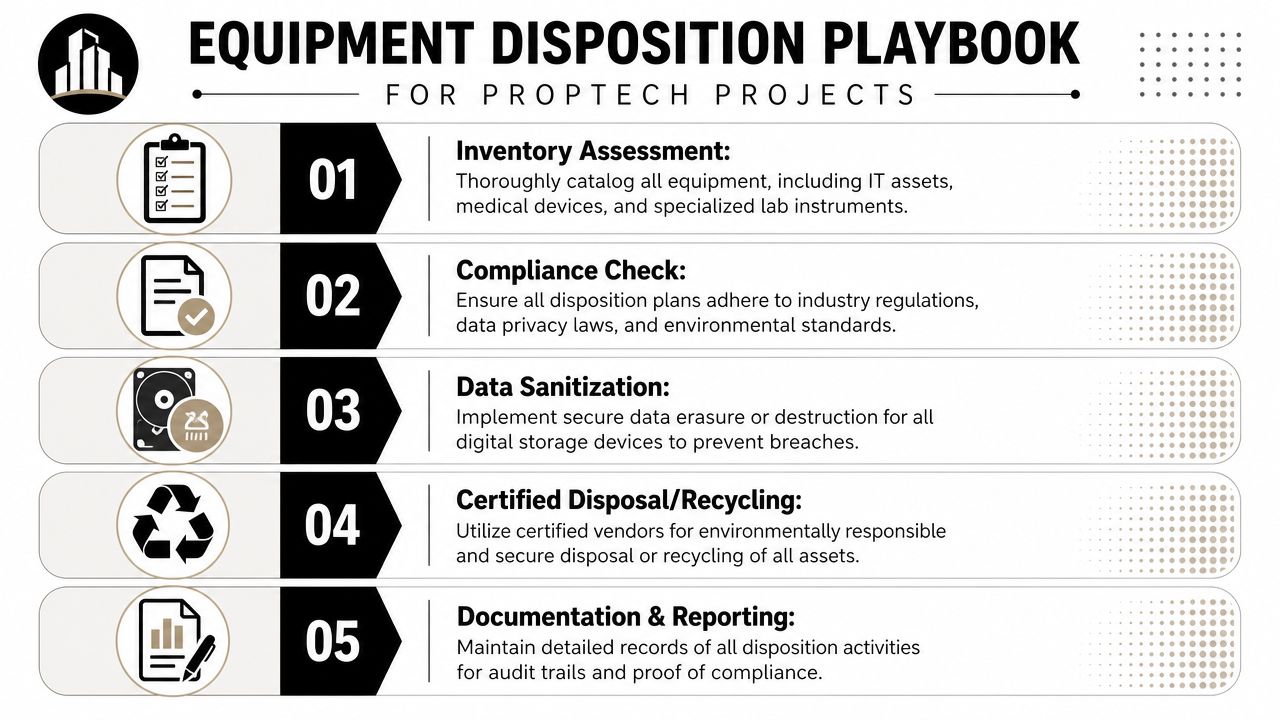
Start with an early inventory
Don't wait until demolition mobilizes. Walk the site early and catalog what is there.
That means more than listing large instruments. Include bench devices, refrigerators, freezers, networking gear, local control stations, attached monitors, rack equipment, old backup media, and any device that may contain data or regulated components.
A simple inventory should note:
- Asset type: Lab instrument, medical device, IT hardware, building control component
- Physical status: Active, idle, broken, partially disconnected
- Data risk: Storage media, firmware logs, network history, local user data
- Removal conditions: Requires vendor deinstall, utility isolation, special packaging, or environmental controls
Vet the disposition partner like a risk vendor
A disposal company working in a specialized property shouldn't be treated like a junk hauler. The team needs to understand chain of custody, packing, deinstallation, data destruction, and documentation.
That review should cover the basics:
- Data handling capability for drives, embedded storage, and obsolete media
- Experience with regulated environments such as labs, clinics, universities, and research sites
- Logistics capacity for on-site pickup, coordinated removal, and scheduling around project constraints
- Reporting discipline so ownership has proof of what happened to each class of asset
For more specialized environments, a compliance-centered approach to industrial equipment disposal is often closer to what the site needs than a generic recycling service.
Tie disposition to the master project schedule
The removal timeline has to align with facilities shutdown, IT signoff, construction access, and any landlord or occupant obligations. If one of those groups works from a different schedule, the project stalls.
A useful sequence looks like this:
| Phase | What needs to happen |
|---|---|
| Pre-shutdown | Inventory, ownership review, removal approvals |
| Controlled shutdown | Utility coordination, IT signoff, data handling steps |
| Physical removal | Packing, deinstallation, pickup, transport |
| Post-removal closeout | Certificates, audit file, space release confirmation |
Keep documentation like you'll need it later
Because you probably will. During audits, disputes, internal reviews, or ESG reporting, memory isn't enough.
Keep records for asset lists, pickup dates, data destruction or sanitization, recycling outcomes, chain of custody, and any exceptions. If a room changes users or a campus facility is repurposed months later, those files become part of the building's operational history.
Good disposition records do two jobs. They protect the organization today, and they keep the next project from starting blind.
The Future Of Atlanta Real Estate Is Smarter End To End
Atlanta's growth is creating more demand for digital real estate systems, but the underlying shift is bigger than software adoption. Smart buildings now sit inside a full asset lifecycle that includes procurement, operations, retrofit, shutdown, and final disposition.
For standard office assets, that lifecycle is already becoming more visible. For hospitals, labs, universities, and technical facilities, it has always been there. What's changing is that owners can no longer afford to leave the end-of-life portion unmanaged while focusing only on front-end technology.
Atlanta real estate tech and PropTech growth insights matter most when they help operators make better site-level decisions. That means knowing when analytics are useful, when automation helps, when old equipment creates drag, and when a property can't be considered ready until devices, records, and regulated assets have been handled properly.
The strongest portfolios won't just be digitally connected. They'll be operationally complete.
That includes a few habits that separate mature operators from reactive ones:
- They plan decommissioning early instead of treating it as cleanup.
- They connect facilities, IT, compliance, and project teams before the move begins.
- They document asset disposition so the property has a clean audit trail.
- They treat old equipment as a real estate issue because it affects timing, risk, and asset value.
A building isn't fully modern just because it runs on better software. It also needs a disciplined path for retiring the equipment, electronics, and specialized infrastructure that no longer fit the next use.
If you're planning a lab shutdown, medical facility update, campus renovation, or IT-heavy property transition in metro Atlanta, Scientific Equipment Disposal helps organizations handle the overlooked final step. Their team supports secure, sustainable removal of laboratory equipment, electronics, and data-bearing assets with on-site logistics, compliant recycling, and documentation that fits regulated environments.