2026 IT Outsourcing Trends Among Atlanta Businesses

Seventy-six percent of businesses were already outsourcing IT functions in Deloitte's 2024 survey, and cost savings dropped from 70% in 2020 to 34% in 2024 as a primary driver, while meeting customer demands rose to 35% according to Prialto's summary of Deloitte's 2024 outsourcing survey. That one shift changes how Atlanta companies should think about outsourcing.
In Atlanta, the conversation usually stops at managed help desks, cloud support, cybersecurity, and staffing coverage. It shouldn't. Every outsourced device, server, storage array, lab workstation, and retired network appliance eventually reaches end of life. That's where the clean PowerPoint version of outsourcing often breaks down.
Hospitals, universities, research labs, and enterprise IT teams across metro Atlanta now operate as vendors touch critical systems throughout the hardware lifecycle. Procurement gets outsourced. Monitoring gets outsourced. Patching gets outsourced. Sometimes even rack-and-stack work gets outsourced. But decommissioning often lands in a gray area, and that gray area is where compliance risk grows.
The Evolution of IT Outsourcing in Atlanta
Atlanta's outsourcing decisions now reach far beyond the help desk. For local hospitals, universities, and enterprise data centers, the bigger operational change is how many outside parties now touch hardware before it is finally retired.
Earlier in the article, the broader market data established that outsourcing is now standard practice. In Atlanta, that trend shows up in a more specific way. Managed service providers handle infrastructure, security firms monitor endpoints, staffing partners support migrations, and cloud vendors influence on-prem equipment refresh cycles. Each added handoff changes who controls devices, who documents asset movement, and who is accountable when decommissioning starts.
Many executives still search for the familiar benefits of outsourcing IT when they start evaluating vendors. That is a reasonable starting point. The more important question is what happens at the end of the hardware lifecycle, especially when the company retiring the equipment is not the same company that configured, monitored, stored, or maintained it.
Why the Atlanta context matters
Atlanta has a high concentration of regulated and equipment-heavy organizations. A hospital may retire nursing station PCs, imaging workstations, and storage media that once touched protected health information. A university lab may dispose of instrument-connected systems, faculty endpoints, and research storage with grant or student data still present. A colocation or enterprise data center may cycle out racks of servers under a contract where operational responsibility was shared across internal teams and outside vendors.
That creates a practical problem. Outsourcing spreads operational work across more parties, but disposition still requires one clear chain of custody.
I see this gap often in hardware lifecycle planning. Service scopes are usually defined in detail for deployment, monitoring, patching, and incident response. Decommissioning is often addressed with a few vague lines in a master services agreement, or left to the client to sort out after the refresh is complete. That is where Atlanta organizations pick up avoidable risk, especially if they cannot show who approved asset release, who performed data destruction, and who maintained records for audit purposes.
Local staffing volatility has also pushed companies to rely on outside support for transition work, infrastructure maintenance, and project execution. That pattern is visible in recent Atlanta tech layoffs and hiring trends. When internal teams are thin, end-of-life controls tend to slip unless a company assigns ownership for inventory reconciliation, sanitization standards, pickup procedures, and downstream disposition reporting.
In practice, the evolution of outsourcing in Atlanta is not only about who runs IT. It is also about who carries risk when managed hardware leaves the rack, the lab, or the clinical floor.
Why Atlanta Businesses Now Prioritize Capability Over Cost
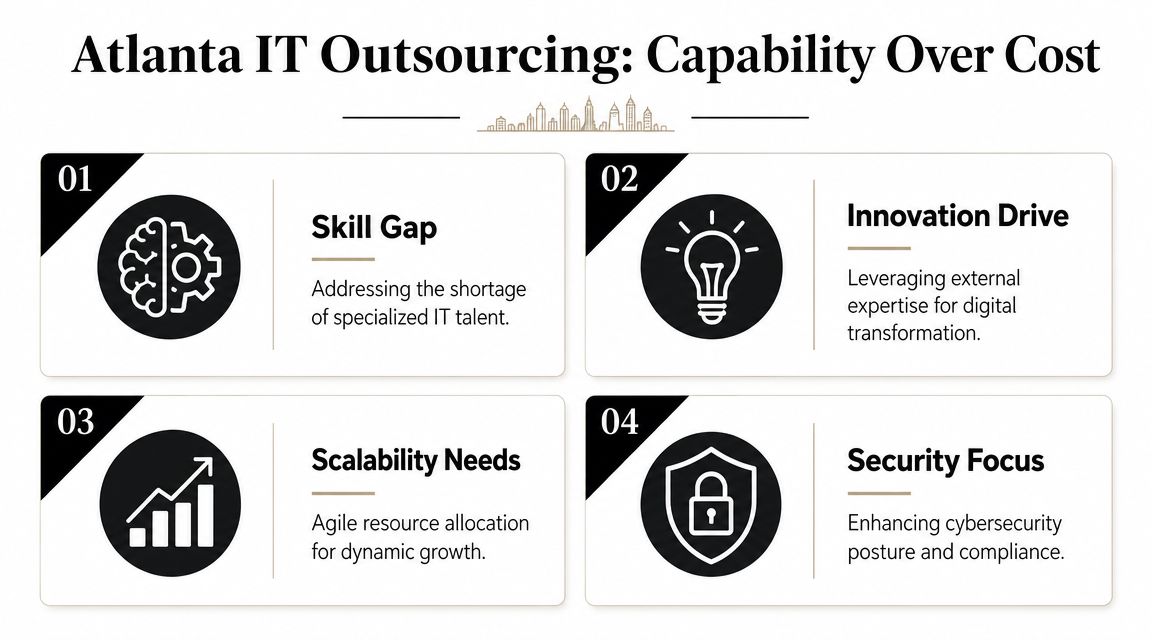
The strongest outsourcing trend in Atlanta is simple. Companies are buying specialized outcomes instead of generic labor.
Global demand reflects that shift. IT outsourcing revenue is projected to hit US$777.70 billion by 2028, 83% of IT leaders consider outsourcing cybersecurity due to skills shortages, and 90% of enterprises see cloud computing as a critical enabler of their outsourcing strategy, according to ConnectBit's IT outsourcing statistics roundup. Those figures line up with what Atlanta organizations deal with every day: security tooling that keeps getting more complex, cloud estates that need constant governance, and infrastructure teams that can't cover every specialty internally.
Cybersecurity has become too layered for generalist teams
A modern security program isn't one firewall and an antivirus dashboard. It's identity controls, endpoint protection, logging, alert review, backup validation, incident response coordination, vendor access controls, email security, patch discipline, and evidence for audits.
That's why many internal teams outsource specific security functions even when they keep strategic leadership in-house. In practice, Atlanta hospitals and research groups often need outside support because their environments combine regulated data, legacy systems, remote access, and nonstop uptime requirements. A small internal team can be strong and still not have enough depth for all of that.
Cloud operations need continuous expertise
Cloud projects don't end at migration. They turn into ongoing work: permissions, storage policies, backup design, cost monitoring, performance tuning, and policy enforcement across hybrid environments.
For Atlanta businesses with branch locations, labs, clinics, or mixed on-prem and cloud workloads, outsourcing often fills that operations gap. A company may own the architecture decisions but rely on an outside provider for day-to-day execution. The same dynamic shows up in telecom and connectivity environments, where infrastructure complexity keeps widening. That's one reason many firms also look closely at providers with broader operational coverage, including managed telecom support options in Atlanta.
Skills shortages are operational, not theoretical
This trend isn't abstract. It shows up when nobody on staff wants to own storage lifecycle planning, when security alerts pile up after hours, or when a VMware, Azure, M365, or network specialist is hard to hire and harder to retain.
Here's what usually works in Atlanta:
- Outsource narrow specialties first: Security operations, cloud administration, backup oversight, and after-hours monitoring are common starting points.
- Keep business context internal: Internal leaders should still own risk tolerance, data classification, and approval authority.
- Define asset ownership early: If the vendor deploys, manages, or replaces hardware, the contract should also address retirement and disposition.
Outsourcing works best when the provider supplies technical depth and the client retains governance. Problems start when both sides assume the other owns the end-of-life process.
Comparing IT Outsourcing Models for Local Companies
Atlanta companies don't all need the same outsourcing model. A university with a capable central IT group has different needs than a regional healthcare provider with lean staffing, and both differ from a company operating a private data center.
The strongest demand is moving toward managed services tied to outcomes rather than raw labor coverage. A 2026 outsourcing review says 46% of businesses already outsource technology services and 42% are considering it within 12 months, as discussed in Auxis' review of outsourcing trends for 2026 and beyond. For Atlanta buyers, that usually narrows to three practical models.
Project-based outsourcing
This is the lightest model. You bring in a provider for a migration, a cabling refresh, an Office 365 rollout, a security assessment, or a hardware refresh program.
Project work fits companies that want expertise without giving up operational control. The risk is fragmentation. One vendor installs, another monitors, an internal team handles support, and nobody owns retirement when devices age out.
Co-managed IT
Co-managed IT works well when the internal team is competent but stretched. The provider handles selected functions such as patching, endpoint management, backup oversight, SIEM review, or after-hours response, while the client keeps architecture, compliance, and user relationships close.
This model often performs best in compliance-heavy environments because internal staff still understand the institution's risk profile, exceptions, and asset inventory. External specialists add depth where coverage is weak.
For security teams trying to standardize evidence and communication across internal and external contributors, resources on streamlining outsourced security reporting can help frame what good reporting discipline should look like.
Fully managed services
Fully managed service agreements shift most operational responsibility to the provider. That can include help desk, endpoint administration, network oversight, procurement coordination, security stack management, and infrastructure maintenance.
The upside is coverage and simplicity. The downside is dependency. If the contract is vague, clients may discover too late that disposal logistics, media destruction, or inventory reconciliation were never included.
IT outsourcing models compared
| Model | Best For | Internal Control | Typical Cost Structure |
|---|---|---|---|
| Project-based | One-time migrations, audits, deployments, refreshes | High | Scoped project fee |
| Co-managed IT | Organizations with an internal IT team that needs specialist augmentation | Medium to high | Recurring fee for defined service areas |
| Fully managed services | Lean internal teams that want broad operational coverage | Lower | Recurring monthly agreement tied to service scope |
Where the model affects hardware lifecycle risk
The contract model shapes who notices aging hardware, who approves retirement, and who documents what happened next.
- Project-based gaps: Hardware may be deployed without a retirement plan.
- Co-managed clarity: Roles can be cleaner if both sides document who handles inventory, sanitization approval, and release for disposal.
- Fully managed blind spots: Clients sometimes assume the provider's ownership extends all the way through certified disposition. It often doesn't unless the agreement says so.
If your organization is evaluating service scope alongside connectivity, site support, and infrastructure accountability, it helps to compare those trade-offs with other regional managed telecom services, because the same control-versus-coverage issue shows up there too.
How Key Atlanta Sectors Leverage Outsourcing

Atlanta's outsourcing market makes more sense when you look at sector behavior instead of generic vendor claims. Hospitals, universities, and enterprise operators outsource for different reasons, but they all face the same issue at the end: managed hardware still becomes retired hardware.
For regulated sectors, the trend is toward hybrid delivery models where vendors must prove compliance with standards like ISO 27001 and SOC 2, and buyers increasingly prioritize industry-specific expertise and demonstrable control over data privacy, according to ConnectMKD's review of IT outsourcing trends.
Hospital systems
A hospital rarely outsources everything. More often, it outsources selectively: endpoint monitoring, identity administration, cloud support, after-hours security coverage, or specific application management around EHR-adjacent systems.
That hybrid model can work well because the hospital keeps policy authority while outside teams handle specialist functions. The weak point appears during refresh cycles. Clinical workstations, nursing station devices, retired storage media, and old backup infrastructure may hold sensitive data even after they leave production. If the operations vendor and the internal compliance team haven't assigned disposition responsibility, risk follows the device.
Universities and research environments
Universities in Atlanta often operate mixed environments. Central IT supports broad systems, while departments and labs maintain their own equipment, workstations, storage, and specialized devices connected to instruments.
That creates a decentralized outsourcing pattern. A department may use one managed vendor for cloud administration, another for network support, and internal staff for research computing. When equipment gets retired, the chain of custody can become blurry fast, especially if sponsored research, student data, or controlled datasets sit on old machines.
In higher education, the challenge usually isn't a lack of technical knowledge. It's a lack of centralized ownership over retirement decisions.
Corporate data centers and enterprise IT teams
Corporate operators outsource to protect uptime, strengthen disaster recovery posture, and get access to around-the-clock operations coverage. In many cases, outside providers also support physical infrastructure moves, hardware swaps, and lifecycle planning.
That's useful until decommissioning starts. A vendor may remove assets from racks and mark them as retired, but that status alone doesn't prove secure sanitization, final destruction, or compliant recycling. For enterprise teams, the important question isn't whether a provider can uninstall equipment. It's whether the provider can produce reliable evidence of what happened to each asset after removal.
The local lesson
Across all three sectors, the best outsourcing relationships share one trait: the buyer doesn't evaluate only technical delivery. The buyer also checks whether the provider can operate safely inside a regulated environment and hand off end-of-life assets without ambiguity.
The Hidden Risk Data Security in IT Asset Disposition
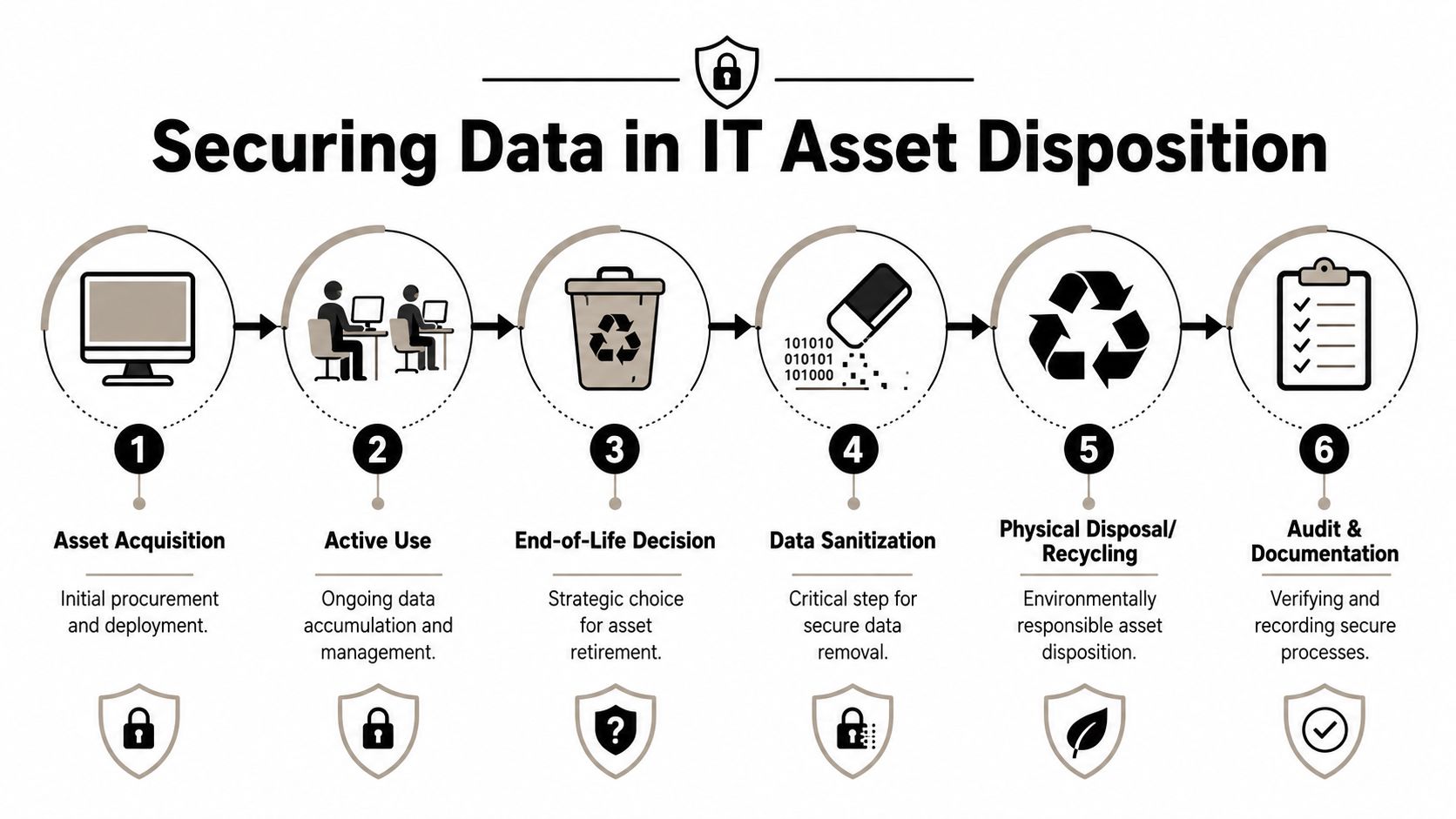
This is the part many Atlanta outsourcing discussions miss. Managed infrastructure still leaves behind physical assets, and physical assets still hold data.
Servers don't become harmless when they're powered off. Laptops don't become low risk because they were replaced during a refresh. Lab computers, storage appliances, backup devices, and network gear can all contain information that matters to regulators, litigators, auditors, and attackers.
Where responsibility gaps appear
The most common failure isn't malicious behavior. It's assumption.
The client assumes the MSP handles end-of-life because the MSP managed the environment. The MSP assumes the client owns disposal because the hardware belongs to the client. Facilities staff just want the old equipment out of the room. Procurement closes the refresh ticket. Then retired assets sit in a closet, move to a loading dock, or leave the site without documented sanitization.
That's a governance problem, not just a recycling problem.
Why decommissioning is a security event
When hardware leaves service, several risks converge at once:
- Data exposure: Drives and embedded storage may still hold patient data, research files, credentials, or archived communications.
- Compliance failure: Regulated organizations need evidence that sensitive media was handled correctly.
- Inventory mismatch: If asset records don't match what was removed, audits become difficult.
- Chain-of-custody breakdown: Once equipment moves without tracking, you can't prove where it went or what happened to it.
A proper retirement workflow needs documented asset identification, approved sanitization method, transport controls, final disposition records, and retained audit evidence. Anything less leaves room for argument later.
Field reality: If your outsourcing contract is detailed on onboarding, patching, and SLAs but vague on retired hardware, you don't have a complete risk program.
What secure disposition should include
For Atlanta organizations, secure disposition should be treated as the final control in the IT lifecycle.
That means deciding whether media will be wiped, shredded, or both based on condition and risk; documenting chain of custody from removal to final processing; and keeping records that can stand up to internal review. For organizations that need a framework for this final step, it helps to review what thorough secure data destruction involves before assets leave the building.
The practical takeaway is blunt. Outsourcing can reduce operational strain, but it can also multiply handoffs. Every extra handoff increases the need for clear end-of-life controls.
Vetting Partners for a Secure Hardware Lifecycle
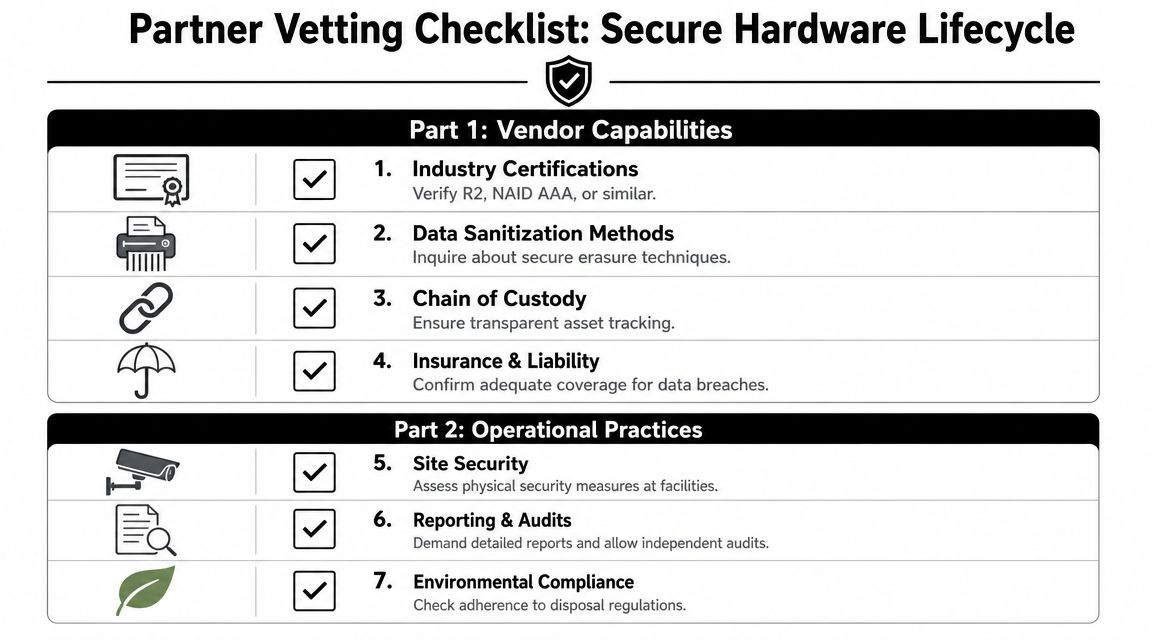
A strong vendor review process has to cover two separate relationships. First, the IT service provider. Second, the company handling retired hardware and media. Buyers often lump those together, but they shouldn't. One runs systems. The other closes the lifecycle.
The contract structure matters more than many firms realize. A key gap in local coverage is the trade-off between break-fix, co-managed, and fully managed arrangements, and whether co-managed IT may outperform full outsourcing in compliance-heavy environments depending on internal capability and uptime needs, as noted by True IT Pros' discussion of outsourcing choices in Atlanta.
Questions for the IT service provider
Start with the provider that manages your environment. Ask questions that force operational clarity.
- Who owns retirement decisions: Is it the client, the MSP, procurement, facilities, or a joint process?
- What happens during hardware refreshes: Does the provider only uninstall and replace, or also inventory removed assets and prepare them for secure disposition?
- How is data-bearing equipment flagged: The answer should cover servers, laptops, SAN gear, backup devices, copiers with storage, and instrument-attached computers.
- What records are produced: You want serial-level or asset-level traceability, not a vague pickup confirmation.
If the provider can't answer those questions clearly, they probably haven't operationalized the end-of-life stage.
Questions for the ITAD partner
The ITAD review should go deeper. This isn't just about hauling e-waste.
What sanitization methods are available
Ask when the partner uses logical erasure, physical destruction, or both. The answer should match the condition of the media and the client's compliance posture.How is chain of custody documented
Good partners track assets from pickup through final processing and can provide defensible records.What happens on site
If your environment includes labs, data centers, or secure areas, ask about de-installation, packing, staging, and transport logistics.What reporting do you receive
You should expect detailed disposition reporting, not a generic weight ticket.How is environmental compliance handled
The recycler should be able to explain downstream handling and responsible material management.
Choose partners that make it easy to prove what happened, not just easy to remove clutter.
A practical review standard
Use this simple rule. If a vendor proposal covers uptime, patching, alerts, and procurement but says little about retired assets, ask for an addendum before signing.
That review should also include the downstream handling side. For Atlanta organizations comparing recyclers and disposition vendors, it helps to benchmark providers against established e-waste disposal company criteria, especially when your environment includes regulated data or specialized equipment.
Building a Future-Ready IT Strategy for Atlanta
The most important lesson in IT outsourcing trends among Atlanta businesses isn't that outsourcing has grown. It's that outsourcing now reaches deeper into core operations, which means risk management has to reach deeper too.
That shift shows up in capability-driven buying, sector-specific delivery models, and more reliance on external specialists for security, cloud operations, and infrastructure support. But the strategy is incomplete if it ends at system performance. Hardware retirement, media sanitization, chain of custody, and disposition records belong in the same conversation as SLAs and service coverage.
A lot of IT leaders are comfortable evaluating firewalls, endpoint tools, backup design, and cloud architecture. Fewer apply the same scrutiny to what happens when assets are removed from service. That's where disciplined lifecycle management becomes a competitive advantage. It protects data, simplifies audits, reduces confusion during refreshes, and keeps old equipment from turning into a legal or reputational problem.
Even seemingly small hardware choices can affect long-term management and replacement planning. That's one reason practical procurement references, such as a USB Wi-Fi adapter buyer's guide, can be useful reminders that device selection and device retirement are connected parts of the same lifecycle.
Atlanta organizations that build future-ready IT programs treat outsourcing as an end-to-end operating model. They choose providers for technical depth, define responsibility in writing, and close the loop with secure, documented disposition.
If your organization needs a compliant way to retire computers, servers, storage media, lab systems, or mixed e-waste in the Atlanta area, Scientific Equipment Disposal helps hospitals, universities, corporate IT teams, and government agencies manage secure pickup, de-installation, data sanitization, and responsible recycling with documentation that supports audit and compliance needs.