Atlanta Logistics Tech Growth and IT Needs: A 2026 Guide


Georgia's logistics sector generated a $107 billion economic impact in 2023, nearly double 2010 levels, according to Georgia Trend's report on the state's logistics boom. That sounds like a business headline. In practice, it's an operations story.
In Atlanta, growth in freight, warehousing, transportation software, and digital infrastructure changes what local institutions have to manage every day. Hospitals have tighter delivery dependencies. Universities run more connected labs and data-heavy research environments. Data center operators and enterprise IT teams inherit more hardware, more risk, and more end-of-life decisions.
The part many organizations miss is this: Atlanta logistics tech growth and IT needs are now tightly linked. When a region becomes faster, denser, and more automated, every facility inside that ecosystem has to respond. Networks have to handle more traffic. Systems have to track more assets. Security teams have to protect more endpoints. Facilities teams have to remove more obsolete equipment without disrupting live operations.
That's especially true for local organizations dealing with lab shutdowns, IT refreshes, building consolidations, and changing staffing patterns. If you've followed Atlanta tech layoffs and hiring trends, you've already seen how quickly asset footprints can change when hiring plans, real estate use, or service models shift.
Atlanta's New Reality A Guide for Local Institutions
Atlanta's logistics expansion doesn't stay inside distribution centers. It reaches loading docks at hospitals, research buildings on university campuses, regional data rooms, and surplus storage areas that no one has cleaned out in years.
A facility manager might experience this as a simple problem. More deliveries. More devices. Less room. An IT director sees the same trend differently. More endpoints. More integration work. More retired hardware with regulated data still sitting on drives. Both are dealing with the same local economic change.
Where local pressure shows up first
Hospitals and clinics usually feel it in supply continuity and compliance. They depend on reliable movement of medical supplies, replacement devices, carts, scanners, and back-office equipment. When operations speed up, the weak points show fast. Manual inventory work breaks first. Then disposal workflows break. Then chain-of-custody questions surface.
Universities and labs see a different pattern. Research spaces accumulate specialized instruments, aging workstations, networked storage, and departmental equipment that doesn't fit ordinary IT disposition processes. During renovations, grant transitions, or lab closures, the hardest work often isn't buying new gear. It's removing the old equipment safely and documenting what happened to it.
Practical rule: If your facility upgrades technology faster than it retires technology, backlog becomes a security issue, not just a storage issue.
That's the operating reality behind Atlanta's growth. Local institutions don't just need more technology. They need cleaner lifecycle control.
What good planning actually looks like
The strongest operators usually do three things early:
- Map critical assets so IT, facilities, compliance, and department leaders are working from the same inventory.
- Separate live operations from decommissioning work instead of trying to handle both with the same team and timetable.
- Treat data-bearing equipment differently from ordinary surplus furniture or scrap, because the risk profile isn't the same.
Organizations that skip those steps tend to create avoidable problems. Equipment sits too long. Pickup schedules conflict with active operations. Drives are forgotten inside retired devices. Nobody has clean records when audit questions arrive.
Understanding the Engine Behind Atlanta's Growth
Atlanta's logistics expansion is being built as much on servers, fiber, and connected systems as on loading docks and truck bays. Georgia's logistics technology ecosystem report notes that the sector grew by more than $4 billion after refining its industry definition, and Atlanta's industrial market had 14 million square feet under construction in Q3 2025, keeping the metro among the top ten U.S. markets for new industrial supply, with much of that pipeline tied to data center projects from QTS, Microsoft, and Meta, as detailed in the Georgia logistics technology ecosystem report.
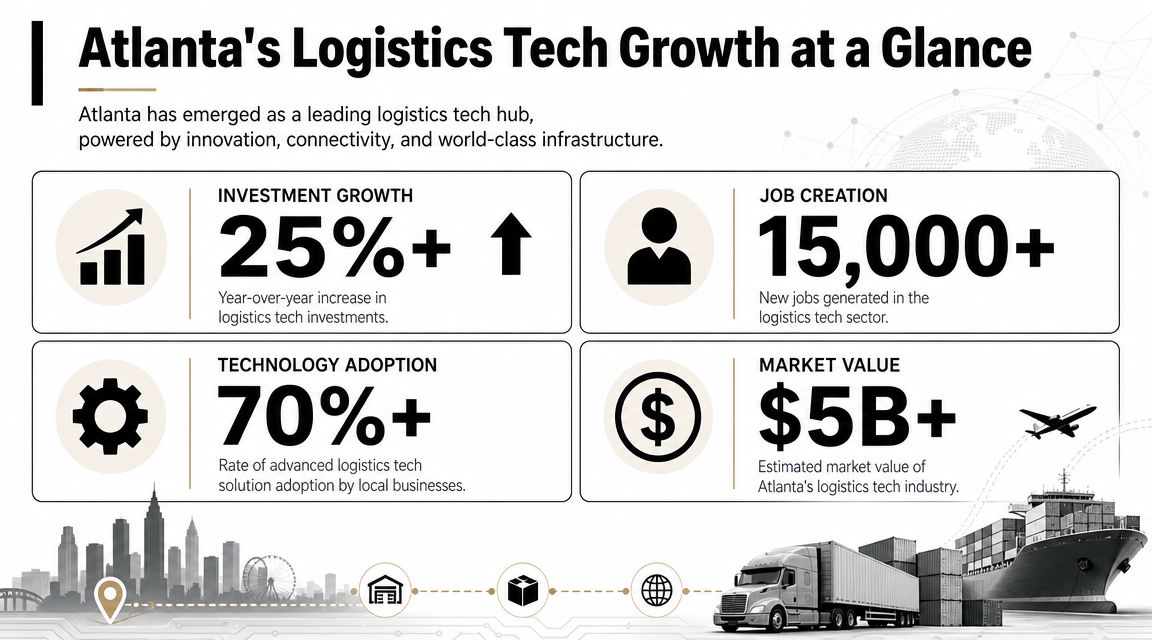
Growth now includes digital infrastructure
That shift matters because Atlanta's industrial buildout no longer stops at storage and transportation capacity. New facilities are being designed around warehouse management platforms, telematics, access control, surveillance, environmental monitoring, handheld devices, and tighter system integration across sites. In practice, the region is adding more places where physical operations and digital operations depend on each other minute by minute.
Data center development raises the bar further. These sites run on strict uptime targets, controlled access, documented equipment handling, and formal end-of-life procedures for media-bearing hardware. Local hospitals, labs, and universities feel that pressure even if they do not operate a warehouse or transportation fleet, because they hire from the same labor pool, rely on many of the same service vendors, and face similar expectations around availability, audit readiness, and incident response.
I see this disconnect often. Leadership reads about Atlanta's economic growth as a market story. Facility and IT teams experience it as more tickets, denser equipment rooms, tighter change windows, and less tolerance for downtime.
The market is rewarding speed and visibility
The operational model is changing too. Freight, warehousing, and fleet operators are investing in tools that reduce handoff delays, improve shipment visibility, and tighten coordination between software and field activity. A complete guide for trucking fleets shows the kind of system pressure that starts in transportation and then spreads outward to campuses, labs, and hospitals that depend on timely deliveries, vendor access, and clean chain-of-custody records.
For local institutions, that pressure usually shows up in four ways:
- Real-time status expectations for deliveries, service calls, and equipment moves
- Lower tolerance for system lag in dispatch, receiving, inventory, and facilities coordination
- More integration work between older institutional systems and newer vendor platforms
- More scrutiny on who owns devices, who can access them, and when they leave service
That last point is where the macro trend meets the daily work. If a university research department retires instruments without documented data handling, or a hospital replaces networked devices faster than it clears old inventory, the problem is no longer just storage space. It becomes an IT control issue with compliance consequences.
Teams trying to close that gap often revisit IT outsourcing trends among Atlanta businesses because deployment capacity, support coverage, and decommissioning discipline rarely scale at the same pace as purchasing.
Fast growth rewards institutions that plan for maintenance, access control, and retirement at the same time they plan for acquisition.
The Ripple Effect New IT and Infrastructure Demands
Once the local market speeds up, internal IT environments have to keep up. The pressure doesn't arrive as a single large event. It shows up as a steady stream of operational changes that strain networks, storage, support teams, and physical space.
A 2025 logistics-tech survey found that 58% of vendors reported year-over-year sales growth of 10% or more, and 91% said they serve supply chain, logistics, or transportation customers, which points to a broad push toward scalable IT systems, as reported in Inbound Logistics market research on supply chain and logistics technology.
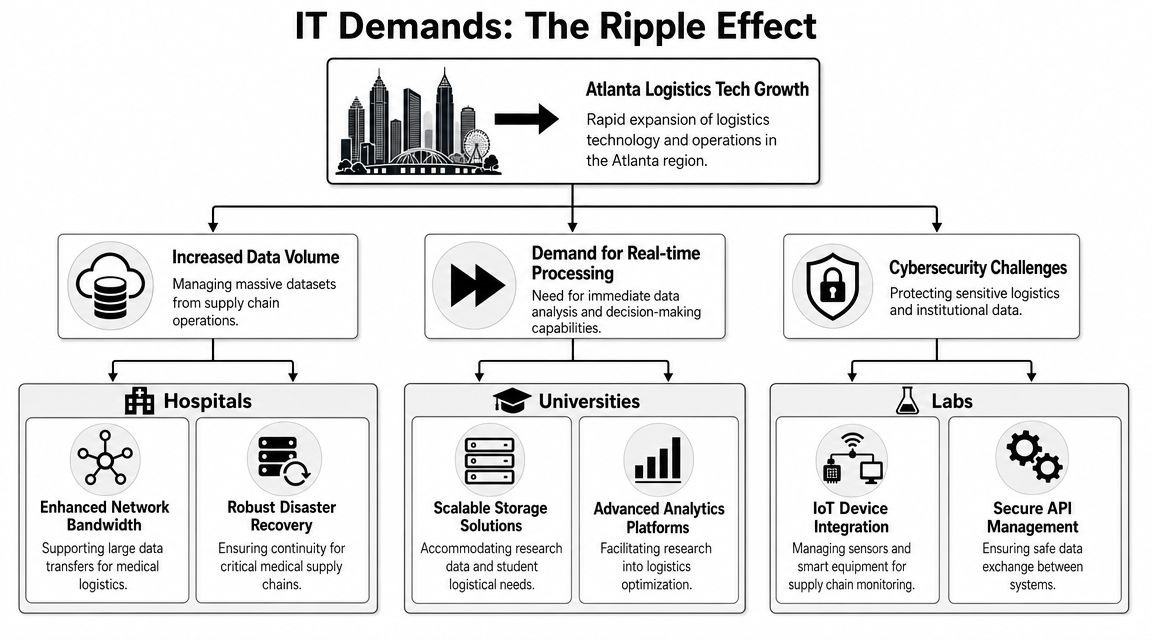
What hospitals, universities, and labs need first
For hospitals, the immediate issue is usually reliability. Supply teams need systems that can track incoming materials and support tight handoffs across departments. IT teams need resilient connectivity, clean failover planning, and enough capacity to support logistics-related applications without degrading clinical operations.
Universities usually need flexibility more than uniformity. Different schools, departments, and labs buy technology at different times and under different funding models. That creates mixed environments where central IT has to support modern cloud tools alongside older hardware, department-owned devices, and specialized research systems.
Labs tend to run into edge-case problems. Instruments may depend on older operating systems. Devices may generate data in odd formats. Network segmentation may be necessary for safety, validation, or vendor support reasons. These aren't theoretical issues. They shape what can be upgraded, what can be integrated, and what has to be retired carefully.
The infrastructure trade-offs that matter
Leaders usually face a choice between quick fixes and durable architecture.
| Pressure point | Quick fix that often fails | Better long-term response |
|---|---|---|
| Network congestion | Add bandwidth without redesigning traffic priorities | Review application dependencies, segmentation, and failover paths |
| Storage growth | Keep buying more storage with no retention policy | Define retention, archive rules, and disposal triggers |
| Asset sprawl | Track devices in spreadsheets across departments | Use centralized inventory with ownership and status controls |
| Fleet or field visibility | Bolt on point tools | Integrate telematics, dispatch, and service data where possible |
For transportation-heavy organizations, a practical outside reference is this complete guide for trucking fleets, which shows how software decisions connect driver tracking, maintenance, and dispatch. The same principle applies inside hospitals, campuses, and lab networks. Tools work best when they share data instead of creating another isolated workflow.
A second issue is connectivity itself. Regional growth often exposes old assumptions about uptime and carrier diversity. Facilities that once treated internet service as a commodity now need to think harder about redundancy, failover, and building-level resilience. That's why many Atlanta organizations are reassessing local carrier options and infrastructure constraints through resources on internet service providers in Atlanta.
- Don't overspend on hardware first. A weak process wrapped in newer equipment is still a weak process.
- Don't centralize everything blindly. Some labs and medical environments need controlled exceptions.
- Do standardize retirement triggers. If no one knows when a device is out of service, it will linger.
Navigating Data Security in a High-Velocity Environment
High-volume operations create a bigger attack surface. More systems connect to more vendors, more mobile devices enter the workflow, and more equipment leaves service before anyone has verified what data still sits on it.
That matters most in hospitals, universities, and research environments because the consequences go beyond downtime. A retired workstation may still hold patient records, research files, credential caches, saved browser sessions, or exported reports. An old storage array pulled during a refresh may still contain years of institutional data.
Why old security habits stop working
Many organizations still treat disposition as a facilities problem. They move retired equipment into a closet, cage, trailer, or storage room and assume they'll deal with it later. In a slower environment, that was sloppy but common. In a faster environment, it becomes a liability.
Security breaks at handoff points. A device leaves production. Ownership becomes unclear. The asset isn't removed from records. No one confirms whether data was wiped. Pickup gets delayed. The hardware sits in a semi-controlled area. That chain creates risk even before final disposal happens.
Protecting data means controlling the last mile of the asset lifecycle, not just the first mile of deployment.
Middle-mile logistics operators have similar visibility and custody issues, which is why this guide for 2026 middle-mile operators is useful beyond transportation teams. It highlights a simple truth. If you can't see where critical assets are and who controls them, security weakens quickly.
Security controls that hold up in practice
What works is usually straightforward, but it has to be disciplined:
- Maintain chain of custody from decommissioning through final disposition.
- Identify data-bearing devices early instead of discovering them during loading.
- Separate reusable equipment from destruction streams so teams don't improvise decisions onsite.
- Require documented data destruction for drives, servers, laptops, and storage media.
- Coordinate with compliance teams before removal day when protected or regulated data may be involved.
Organizations that need a formal process often start by tightening their standards for secure data destruction. That's usually the point where security, IT, legal, and facilities finally align. Not because the topic is new, but because the cost of informal handling has become harder to ignore.
The Hidden Challenge of the Equipment Lifecycle
Every upgrade creates a second project. Someone has to remove what the new system replaced.
That sounds manageable until the equipment is spread across a hospital campus, a research building, a server room, and an offsite storage area. Then the arduous work begins. Cabinets are still live. Lab benches hold instruments no one has tagged clearly. Drives sit inside devices that facilities assumed were just scrap. Pickup can't interrupt active operations. Elevator access is limited. Loading docks are shared.
Why decommissioning gets harder as operations modernize
The newer the environment, the more mixed the retirement stream tends to be. You're not just removing old desktops. You may be handling network switches, rack servers, UPS units, access-control hardware, test equipment, analyzers, centrifuges, monitors, storage arrays, and department-owned devices purchased outside central standards.
A common failure pattern looks like this:
- IT defines the refresh but not the physical removal sequence.
- Facilities schedules the move without full visibility into data-bearing assets.
- Departments add last-minute items that were never inventoried.
- Compliance asks for records after the equipment is already gone.
None of that is unusual. It's what happens when institutions treat end-of-life handling as an afterthought.
The operational pain points no one budgets for
The cost isn't only financial. It's schedule risk and operational drag.
A delayed decommission can block a remodel. A forgotten server can delay lease turnover. An untagged lab instrument can create safety questions. A box of loose drives can trigger a compliance scramble. In hospitals and research settings, these situations don't stay small for long because multiple stakeholders need answers fast.
The institutions that handle this well treat equipment retirement as a managed workflow. They define who approves removal, who validates data handling, who documents transfer, and who closes the loop in the asset record.
Actionable Solutions for Secure Asset Disposition
Atlanta's logistics growth is putting more equipment into service, more often, across hospitals, labs, and universities. The result is simple. Retirement projects now happen under tighter timelines, with more stakeholders, and with less room for mistakes.
That changes how asset disposition should be handled. A pickup at the end is only one step. The main work starts when equipment is approved for removal and ends when the asset record, chain of custody, and data destruction record all match.
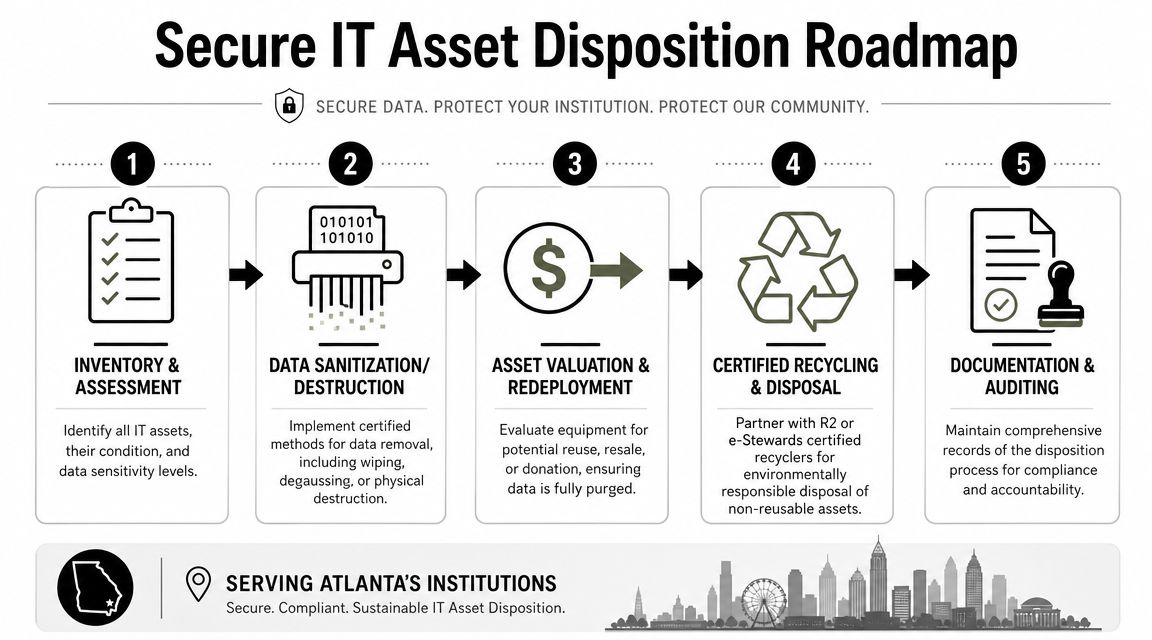
A practical roadmap that works
Start with internal control points. Vendor selection matters, but sequence matters more.
Inventory before removal
Create a location-based list that captures asset type, serial number, owner, condition, and data risk. In healthcare and research settings, this step often surfaces items that were never entered cleanly into central records, such as department-purchased workstations, embedded drives inside instruments, and storage media sitting in drawers or carts.Classify the disposition path
Separate assets by what should happen next. Reuse, resale, recycling, and physical destruction should not be decided at the loading dock. A clear classification step reduces onsite confusion and prevents a reusable device, regulated component, or data-bearing drive from ending up in the wrong stream.Plan removal as an operating event
De-installation affects active space. Set labor requirements, access windows, packaging needs, elevator use, dock timing, and any shutdown or escort requirements in advance. In labs and hospitals, that planning often matters more than the resale value of the equipment.Define data handling and proof requirements
Each asset category should have an approved sanitization or destruction method before removal starts. The record should show what method was used, who handled it, and what evidence supports closure.Reconcile records after pickup
Close the loop in the CMMS, asset system, lease file, or departmental inventory. If records stay open after equipment leaves the building, audit problems usually show up later, when the people involved are harder to track down.
What to require from a disposition partner
Facilities teams do not need broad promises. They need a provider that can execute under real site conditions.
A useful screening checklist includes:
- Project coordination on site so packing, staging, pickup, and transfer follow one documented plan
- Defined media handling procedures for servers, laptops, drives, arrays, and other data-bearing devices
- Audit-ready documentation that stands up to internal review and external compliance requests
- Experience with specialty and lab equipment when removal involves decontamination, chain of custody, or careful disassembly
- Proper downstream recycling practices for equipment that cannot enter ordinary waste streams
Some Atlanta institutions use IT asset disposal services for coordinated electronics and lab equipment removal when they need one vendor to manage pickup, data destruction, and final disposition records as part of the same job. That model is useful for a practical reason. It reduces handoffs between IT, facilities, environmental health and safety, and compliance.
I have seen the opposite approach cause delays. One vendor removes equipment, another handles drives, and internal staff try to reconstruct records afterward. That setup looks cheaper until a missing serial number, unverified drive, or incomplete transfer document turns a routine cleanup into an audit response.
Field note: The best disposition process is the one a facilities supervisor, IT manager, and compliance lead can all run without making judgment calls in the hallway during pickup.
What fails in practice
A few habits create repeat problems in fast-moving facilities:
- Holding equipment “temporarily” in back rooms. Storage becomes backlog, and backlog becomes lost custody.
- Building the inventory during pickup. Teams miss devices and misclassify assets when the truck is already waiting.
- Using one disposal path for every department. A clinic, research lab, classroom, and server room do not retire equipment the same way.
- Leaving ownership unclear. If no one owns the handoff from shutdown to final disposition, the risk sits between teams.
Future-Proofing Your Facility's IT Strategy
The strongest IT strategies in Atlanta now include the full asset lifecycle. Procurement gets attention. Deployment gets attention. Security gets attention. Retirement often gets pushed to the side until a move, closure, audit request, or renovation forces the issue.
That approach no longer fits the region's pace. Local institutions are operating inside a denser, more connected economy. Systems are changing faster. Infrastructure is more interdependent. The cost of unmanaged legacy equipment keeps rising, even when it's hidden in a back room.
Build lifecycle thinking into everyday operations
Future-proofing doesn't mean predicting every technology shift. It means building routines that hold up when change happens.
A durable internal model usually includes:
- Acquisition standards that define ownership and expected service life
- Operational controls for maintenance, patching, and inventory accuracy
- Security procedures for data-bearing equipment throughout use and retirement
- Disposition rules that trigger action before obsolete equipment piles up
That gives organizations an advantage. Hospitals can protect care delivery without storing retired hardware indefinitely. Universities can support research turnover without losing control of equipment trails. Labs can modernize without turning every shutdown into a custom cleanup project.
A competitive advantage most teams overlook
A clean retirement process isn't glamorous, but it improves speed everywhere else. Renovations move faster. IT refreshes create less friction. Audit responses get easier. Security teams spend less time chasing old assets. Facilities teams recover space that operations can use.
That's the practical takeaway from Atlanta logistics tech growth and IT needs. Local growth rewards institutions that can move quickly, document clearly, and retire equipment without creating a second problem.
If your organization is planning a lab closure, data center cleanout, hospital equipment refresh, or campus-wide electronics pickup, Scientific Equipment Disposal can support the logistics side of that work with business-focused recycling, lab equipment removal, secure data handling, and coordinated pickup across the Atlanta metro.