Secure Recycling Electronics Atlanta: B2B Services

If you're clearing a server room, closing a lab, replacing clinical devices, or cycling out classroom technology, the hard part usually isn't deciding that old equipment has to go. It's figuring out how to move it out of the building without creating a data exposure, a chain-of-custody gap, or a disposal problem someone has to explain later.
That’s where most searches for recycling electronics Atlanta go sideways. Consumer advice is everywhere. Business guidance is not. A drop-off event might work for a broken keyboard or an old TV. It doesn't solve a hospital storage array, a university centrifuge with embedded electronics, or a government office that needs documented destruction and traceable handling from pickup through downstream processing.
Atlanta organizations usually need more than recycling. They need a controlled asset disposition process that covers inventory, de-installation, transport, data destruction, environmental handling, and final reporting. If any one of those steps is weak, the whole project gets risky.
Beyond the Blue Bin Compliance and Data Security for Atlanta Businesses
The residential mindset around e-waste is simple. Find a drop-off site, unload the gear, and move on. That mindset fails in a business environment because the equipment often contains regulated data, licensed software, internal records, or components that require controlled handling.
For a facility manager or IT director, electronics disposal is a risk management function. That applies whether the asset is a server, desktop, network switch, access control panel, lab analyzer, incubator, or medical workstation. A device doesn't stop being a compliance issue just because it's old.

In 2022, the world generated a record 62 million tonnes of electronic waste, and only 22.3% was properly recycled, according to Atlanta Computer Recycling’s summary of global e-waste data. For Atlanta hospitals, universities, and corporations, that isn't just an environmental headline. It's a practical warning that a large share of electronic material still moves through weak or informal disposal channels.
Consumer recycling and business disposal aren't the same job
A consumer drop-off program usually answers one question: will someone take this item? A business has to answer a different set of questions:
- What data sits on the device: Hard drives are obvious, but embedded storage in lab and medical equipment is where teams get caught off guard.
- Who handled the asset at each step: If nobody can document custody, audit defense gets weak fast.
- How was the item transported: Vehicles, packaging, and handling procedures matter.
- What happened downstream: You need more than a verbal assurance that the material was “recycled.”
Healthcare and research environments add another layer. HIPAA doesn't care that a device was headed for disposal. If protected data is still present, the obligation remains. The same goes for university research systems, public sector records, and corporate devices tied to finance, HR, legal, or security operations.
Practical rule: If the device ever touched regulated data, assume disposal requires documentation, not just removal.
Standards matter more than marketing terms
A recycler saying “we wipe drives” isn't enough. Ask what standard they follow. DoD 5220.22-M and NIST 800-88 are the kinds of details that separate a controlled process from a vague promise. For many organizations, the right answer won't be in-house wiping at all. It will be managed destruction with certificates and a defensible record.
That’s why many Atlanta organizations look for a provider that can support secure data destruction procedures as part of the recycling workflow rather than treating data handling as a side service.
Transportation can create compliance problems before recycling even starts
A lot of disposal risk appears before the asset reaches the processing floor. Loose loading, unsealed transport, and improvised packing can turn a routine pickup into a damaged-equipment claim or a security incident. If batteries or other regulated materials are involved, transportation requirements become more technical. Teams that manage mixed loads of electronics, power systems, or lab devices should understand the basics of DOT hazmat regulations before scheduling removal.
What works in practice is boring in the best way. Scheduled pickup. Documented asset list. Secure handling. Standardized sanitization. Clear certificates. Downstream accountability.
What doesn't work is the common shortcut: putting business assets into a consumer channel and assuming the recycler will “take care of it.” If your organization can't show how data was destroyed and how assets were handled, you don't have a disposal program. You have a hope-based process.
Your Pre-Pickup E-Waste Inventory and Prep Guide
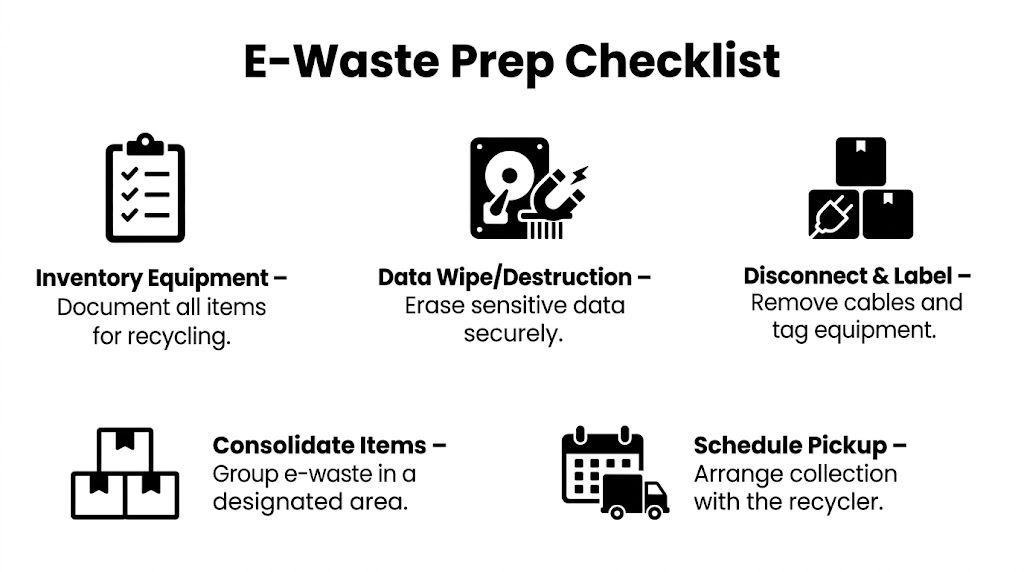
Most pickup problems start before the truck arrives. Assets are scattered. Nobody knows which drives were wiped. Lab managers have one spreadsheet. IT has another. Facilities has a corner full of gear that “might be going too.”
A clean project starts with a usable inventory. Not a perfect one. A usable one.
Build an inventory that supports chain of custody
For recycling electronics Atlanta projects, the inventory should do two jobs. It should tell the recycler what’s being removed, and it should tell your organization what left the building.
Include the basics:
- Asset identity: Device type, manufacturer, model, and any internal asset tag.
- Location details: Building, floor, room, lab number, closet, or rack position.
- Data status: Unknown, wiped in-house, requires on-site destruction, or non-functional media.
- Condition: Working, non-working, damaged, incomplete, or ready for parts recovery.
- Special handling notes: Biohazard concern, chemical residue concern, battery present, wall-mounted, under-bench, or network-connected.
That level of detail helps the recycler stage labor correctly and helps your team verify removal afterward. It also prevents the common B2B mistake of mixing routine IT surplus with specialty equipment that needs different handling.
A major gap in most guides is the lack of direction for specialized lab and medical devices. Georgia labs have seen a 15% year-over-year increase in regulated medical waste, according to Georgia Tech support content discussing electronics recycling gaps, and that matters because items like pipettes, centrifuges, and incubators don't fit the assumptions behind consumer-focused e-waste programs.
Decide what to wipe in-house and what to leave alone
Teams often overreach. If you have a mature internal sanitization process, your staff may handle some laptops, desktops, or removable drives before pickup. If you don't, forcing an in-house wipe program usually creates gaps in documentation and consistency.
Use a simple decision approach:
- Standard endpoints with clear ownership can often be prepared internally if your process is documented.
- Servers, storage arrays, failed drives, and mixed media are usually better handled through certified destruction.
- Lab equipment with embedded memory should not be guessed at. Treat unknown storage as a data-bearing asset until proven otherwise.
For organizations that want a practical reference on IT-related recycling workflows, this guide to recycling computer waste is a useful baseline.
Don’t let “it’s just a piece of lab equipment” become the reason sensitive data leaves your control.
Physically prep the area before pickup day
Once the inventory is built, shift to floor-level prep. In this phase, small actions save hours on pickup day.
- Disconnect with purpose: Remove network connections, power, and accessories only if your team can do it safely and without creating confusion about what belongs to which asset.
- Label anything unusual: A note like “contains sample residue” or “drive to shred” is more useful than a color sticker nobody explains.
- Consolidate by category: Group desktops together, servers together, and lab devices separately from general IT.
- Flag access issues early: Freight elevator restrictions, loading dock windows, badging requirements, and after-hours access should be settled before the crew arrives.
Prep specialized lab equipment differently
Pipettes, centrifuges, incubators, and similar devices shouldn't be treated like office electronics. They may carry residue, internal components that break easily, or decommissioning needs that facilities staff aren't equipped to improvise on the fly.
For those items, your prep list should include:
- Residue review: Confirm whether the item is clean and cleared for handling.
- Accessory check: Trays, rotors, probes, and removable inserts should be identified so they don't disappear.
- Stability assessment: Bulky or delicate units may need de-installation support instead of a hand-carry removal.
- Documentation handoff: If your EH&S or lab operations team has clearance paperwork, keep it ready for the pickup crew.
A good inventory makes the pickup faster. A disciplined prep process makes it safer. Both matter more than most organizations expect.
Coordinating Secure De-Installation and On-Site Pickup
On pickup day, the difference between a professional service and a basic hauler shows up immediately. You see it in how the crew checks in, how they verify the asset list, how they move through restricted areas, and how they handle equipment that isn’t sitting neatly on a pallet by the loading dock.
That matters because transport is one of the easiest places for a project to go wrong. Industry data cited by Green Atlanta’s guide to electronics waste disposal notes that skipping professional on-site de-installation can cause 10-15% equipment damage, and weak data controls before transport contribute to compliance failures. Secure collection via box trucks is a critical first step.
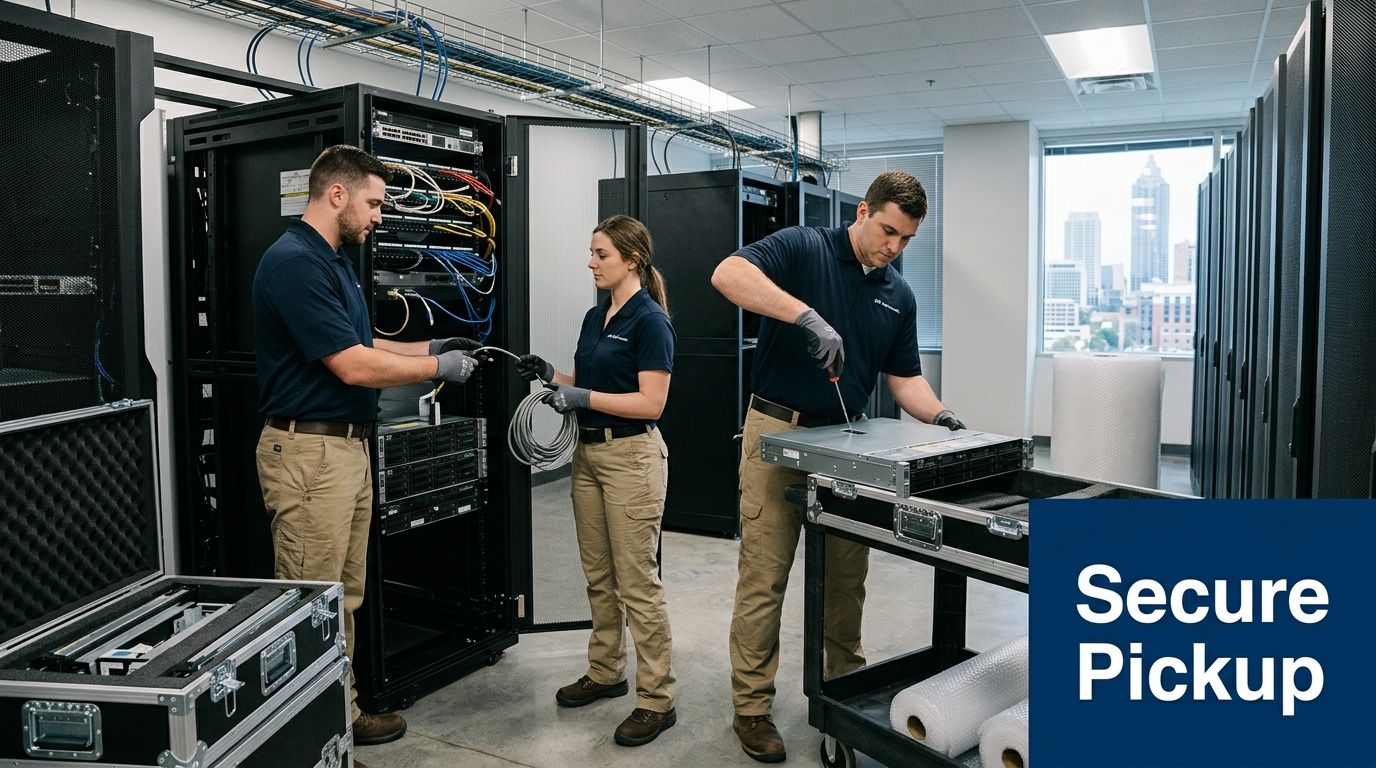
What a well-run pickup usually looks like
A strong crew doesn't start by grabbing equipment. They start by reconciling the scope. That means confirming which rooms are included, what requires serial tracking, what needs destruction, and what should be kept separate because of condition or handling requirements.
Then the work splits into practical streams:
- Rack and server removal: Cables are disconnected systematically, not ripped out. Drives and storage devices are tracked carefully.
- Office IT collection: Workstations, monitors, docks, and peripherals are grouped for efficient loading.
- Lab equipment removal: Benchtop and floor units are assessed for access, stability, and any special handling notes from your staff.
- Media control: Drives marked for shredding or controlled destruction don't get mixed into generic load bins.
This is why many organizations use a provider that offers full IT asset disposal support rather than arranging separate vendors for pickup, destruction, and recycling.
The details that actually protect you
A professional pickup looks less dramatic than one might anticipate. That's good. The process should be controlled, repetitive, and easy to audit.
Look for these behaviors on site:
- Asset verification before movement: The crew checks against your list or builds one as they remove.
- Segregated packing: Reuse candidates, destruction items, and specialty assets aren't all tossed together.
- Secure truck loading: Equipment goes into a dedicated vehicle, not a mixed general freight run.
- Visible chain of custody: Your staff knows who accepted the load and what documentation follows.
If a vendor can’t explain what happens between your hallway and their processing floor, they’re asking you to trust a blind spot.
Why de-installation isn't just labor
De-installation gets treated as muscle work. It isn't. It’s a control point.
A server removed without proper sequence can lose identifiers, accessories, or media. A centrifuge moved without prep can be damaged before it ever reaches the truck. A wall-mounted device can leave behind hardware, cables, or exposed infrastructure that your facilities team then has to sort out later.
The strongest pickup crews coordinate with three people on the client side: one IT contact, one facilities contact, and one department owner for specialty assets. That keeps decisions moving when there’s a question about access, identification, or disposition.
Box trucks beat improvisation
For B2B electronics recycling, dedicated box-truck pickup isn't just a convenience. It solves several operational problems at once. It reduces handling changes, gives the crew control over staging, and keeps the load in a managed environment from departure to receiving.
That’s a big difference from the “pallet it and hope” approach. When organizations improvise with general shipping methods, they usually save paperwork up front and create headaches later. Missing accessories, broken units, unclear custody, and delayed reporting all start there.
The Recycling Journey From Your Facility to Recovery
Many buyers only see two moments in the recycling process. Pickup day and the final certificate. Everything in between feels like a black box. If you're responsible for compliance, that black box should bother you.
A credible recycler can explain, in plain language, what happens after your load reaches the facility and why each step matters.
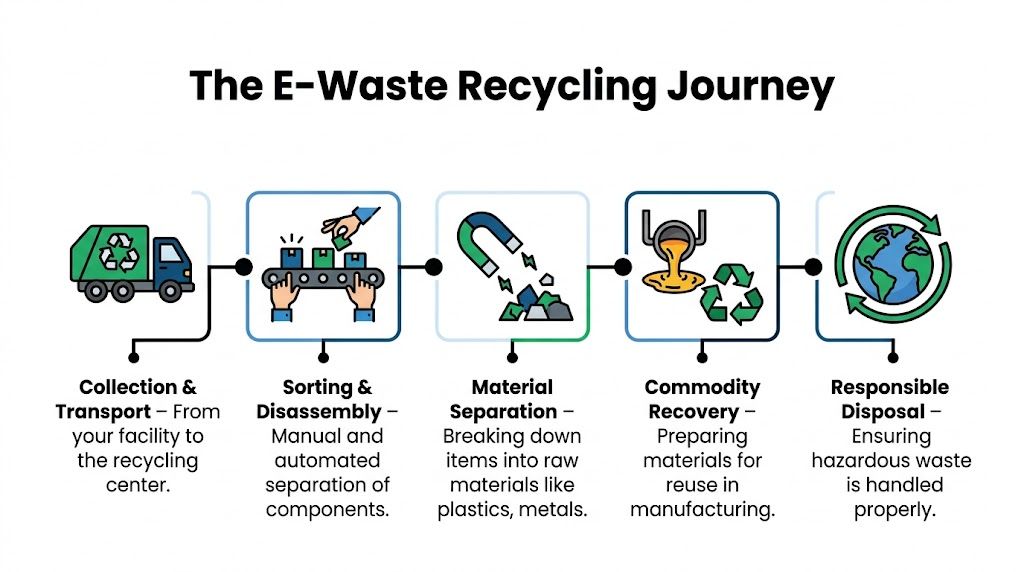
Within an R2/RIOS certified facility, pre-processing can achieve 98% hazardous material diversion. After data destruction, assets are shredded into small particles, where magnetic separators and related systems recover up to 95% of ferrous and non-ferrous metals, with overall recycling efficiency at 85-90%, according to this explanation of what happens to recycled electronics.
Receiving and sortation
Once the load arrives, the first job isn't shredding. It's intake and separation. Assets are reviewed by category and condition so the facility can decide what may be reused, what must be dismantled, and what requires direct destruction.
That sortation step matters for two reasons. First, data-bearing items need controlled handling from the start. Second, specialty devices often contain mixed materials or assemblies that shouldn't go into a generic stream.
Data destruction comes before material recovery
This point gets missed constantly. Data security is not the final step. It happens early.
For servers, storage hardware, computers, and similar assets, sanitization or physical destruction should occur before broad mechanical processing. That sequence protects your organization and preserves a clean audit path. It also prevents a bad habit seen in lower-tier operations, where devices sit too long in staging with unclear status.
A good downstream explanation should tell you:
- Which items are wiped
- Which items are shredded
- How media destruction is documented
- When serial tracking stops and commodity tracking begins
For labs and technical environments, this overview of what happens to old laboratory equipment after disposal is helpful because it frames recycling as a sequence of controlled decisions, not one generic outcome.
Dismantling, shredding, and separation
After secure data handling, reusable components may be removed manually. That can include parts worth refurbishing or materials that need separate processing. Then non-reusable equipment moves into mechanical size reduction and material separation.
The recovery line usually works by separating material streams, not by preserving the original device. Metals, plastics, boards, glass, and hazardous fractions each need their own path.
A recycler that can explain downstream separation clearly usually runs a cleaner operation upstream too.
Here’s the practical version of the process:
| Stage | What happens | Why it matters |
|---|---|---|
| Intake | Assets are received, logged, and categorized | Confirms custody and directs proper handling |
| Data handling | Media is sanitized or destroyed | Reduces breach and audit risk |
| Manual dismantling | Components are removed selectively | Supports reuse and cleaner material streams |
| Mechanical processing | Remaining material is shredded and sorted | Enables efficient recovery |
| Final downstream routing | Commodities and hazardous fractions go to approved outlets | Supports landfill diversion and compliance |
Recovery is the point, not just removal
A professional recycler's service goes beyond equipment removal from your building. The core value is what happens after removal. Recovered metals and separated material streams re-enter manufacturing channels, while hazardous components are diverted into controlled processing.
That’s why downstream transparency matters so much in B2B recycling electronics Atlanta projects. If a vendor can't describe recovery and final handling, you're not evaluating a recycling partner. You're evaluating a pickup service.
Vetting Atlanta E-Waste Partners Questions to Ask Before You Commit
Most vendors sound similar in the first call. They recycle electronics. They pick up equipment. They handle data. They work with businesses. None of that is enough to make a decision.
For regulated organizations, vendor selection should feel closer to procurement due diligence than general waste contracting. If your team needs a useful frame for that process, this explanation of the true meaning of due diligence is a good reminder that due diligence is about verification, not assumptions.
The most important issue to test is data security. Many recyclers offer generic “wiping,” but details matter. In Georgia, 18% of healthcare breaches are linked to improper e-waste disposal, according to Equip Recycling’s discussion of Atlanta electronics recycling and security questions. If you're managing PHI, research records, student data, or government information, that’s the wrong place to accept vague answers.
Ask these questions before you sign anything
Start with direct, operational questions. Not marketing questions.
- What data sanitization standard do you follow? Ask whether they use DoD 5220.22-M, NIST 800-88, physical shredding, or a mix based on asset condition.
- Can you document chain of custody from pickup through destruction? If the answer is loose, the process probably is too.
- Do you issue destruction certificates tied to serials or asset identifiers? Generic batch certificates may not meet your audit needs.
- How do you handle failed or inaccessible media? “We wipe everything” is not an answer if a drive is dead.
- What happens with embedded storage in specialty equipment? This is where healthcare and research organizations need specificity.
- Which downstream vendors receive the material? A serious recycler should be able to explain downstream control.
- Do you perform on-site de-installation? If not, your team may be absorbing more risk than you realize.
- What insurance and incident procedures do you carry? Ask for specifics, not just “yes, we're insured.”
One practical option for organizations comparing service models is to review how a specialized e-waste recycling company describes pickup, destruction, and handling scope, then compare that level of detail with other Atlanta vendors.
Certifications are useful only if you know what they mean
A badge on a website is a starting point. It is not proof of fit by itself.
| Certification | Primary Focus | What It Guarantees |
|---|---|---|
| R2 | Responsible electronics recycling operations | A structured framework for handling, downstream control, and environmental and data-sensitive processes |
| e-Stewards | Electronics recycling with strict downstream expectations | Strong emphasis on responsible handling and prohibited export practices |
| NAID AAA | Secure information destruction | A documented standard for destruction processes and security controls |
Use certifications to narrow the field, then verify how the vendor applies them in your exact environment. A hospital with mixed media and retired diagnostic equipment has different needs from an office with laptops and monitors. A university chemistry lab has different handling issues from a law firm storage closet.
What works and what doesn't
What works is a vendor that answers operational questions directly, gives examples of documentation, and can describe exceptions. Exceptions are where real competence shows up. Failed drives, embedded firmware, mixed loads, battery issues, and lab residue concerns are normal in this work.
What doesn't work is the smooth sales call that avoids specifics. Watch for these warning signs:
- They use broad terms only: “Certified,” “compliant,” and “secure” with no process detail.
- They don't separate business and consumer services: That usually signals a one-size-fits-all workflow.
- They rush past chain of custody: If they can't map the handoff points, don't assume they have them under control.
- They minimize specialty equipment issues: Lab and medical devices are not just bulky electronics.
The right question isn't “Do you recycle electronics?” It’s “Can you prove, step by step, how you protect our organization while doing it?”
For Atlanta buyers, the strongest partners tend to be the ones that make their process easy to inspect. If the process is hard to inspect before pickup, it will be even harder to defend after pickup.
E-Waste Recycling Costs and Scheduling in Metro Atlanta
Cost is where many projects stall. Not because disposal is always expensive, but because buyers often expect one flat model and find out the market doesn’t work that way.
In metro Atlanta, pricing usually depends on the mix of assets, handling complexity, service scope, and whether any equipment has resale or parts-recovery value. That means two projects with the same number of items can be priced very differently if one is a simple office cleanout and the other includes servers, failed media, and lab equipment that needs de-installation.
The pricing models you’re likely to see
Some pickups are structured around value recovery. If the load contains desirable IT assets, a recycler may offset part of the service cost through refurbishment or material recovery. In some cases, that can reduce or eliminate pickup charges.
Other projects are priced around labor and handling. That usually applies when the load includes low-value scrap, specialty equipment, physical destruction needs, difficult site access, or items that require extra sorting and documentation.
Here’s the practical breakdown:
- Free pickup scenarios: More common when you have standard business IT with enough recoverable value to support collection.
- Per-item or handling fees: Common for monitors, mixed peripherals, obsolete devices, or equipment that takes more labor to process.
- Project-based quotes: Typical for lab closures, data center decommissions, healthcare equipment turnover, or multi-room cleanouts.
- Data destruction add-ons or bundled services: Some vendors package wiping, shredding, packing, and logistics together. Others break them out.
What to send when requesting a quote
The fastest way to get an accurate quote is to act like you're briefing an operations team, not making a casual inquiry.
Include:
- A rough asset list: Counts or categories are fine if you don't have a full inventory yet.
- Photos of the staging area and unusual equipment: Especially important for lab devices and rack systems.
- Site details: Elevator access, dock access, stairs, security check-in, and pickup time windows.
- Service requirements: On-site de-installation, data destruction, serial reporting, certificates, or packing support.
- Any handling concerns: Residue-cleared lab equipment, dead batteries, damaged units, or oversized items.
Scheduling is easier when the scope is honest
Most scheduling delays come from incomplete information. A team expects a routine electronics pickup. The recycler arrives and finds half the load is still connected, access wasn't arranged, or the “few lab items” turn out to be a room full of specialty equipment.
A smoother scheduling sequence usually looks like this:
- Initial request with asset summary
- Vendor review and follow-up questions
- Scope confirmation, sometimes with photos or site details
- Quote approval
- Pickup date confirmation
- On-site service and post-pickup documentation
If your project involves multiple departments, appoint one internal owner. That person doesn't have to know every technical detail. They just need the authority to consolidate information and make decisions quickly.
Budget for the whole outcome, not just the truck
This is the trade-off many buyers miss. The lowest pickup price can become the highest internal cost if your staff spends extra time disconnecting equipment, building missing lists, chasing documentation, or fixing mistakes after the load is gone.
For B2B recycling electronics Atlanta work, the smarter comparison is total project burden. How much labor are you offloading? How much risk are you reducing? How clean will the reporting be when procurement, compliance, IT, or leadership asks for records later?
The cheapest line item isn't always the least expensive decision.
Frequently Asked Questions About Atlanta Electronics Recycling
Some of the most useful questions come up after the project plan is mostly clear. They’re less about theory and more about edge cases, internal policy, and what to expect once you start calling vendors.
| Question | Answer |
|---|---|
| Can we get money back for old electronics? | Sometimes. Standard business IT in decent condition may have resale or parts value that offsets service costs. Older, damaged, incomplete, or specialty equipment is less likely to generate recovery value. Ask vendors to separate value-bearing assets from pure recycling items in the quote. |
| Can one pickup include both IT equipment and lab equipment? | Yes, but only if the recycler is equipped for both categories. That’s a key distinction. Many firms handle computers and servers well but get vague when the load includes centrifuges, incubators, fume hoods, or other technical devices. |
| Should employees add personal electronics to a business pickup? | Only if the recycler allows it and your organization approves it. Mixing employee items with business assets can create inventory confusion, ownership disputes, and chain-of-custody gaps. Keep business and personal material separate unless the pickup is specifically structured for both. |
| Is in-house wiping enough before recycling? | It can be for some assets if your process is documented, consistent, and auditable. For failed drives, unknown media, storage arrays, and regulated environments, many organizations prefer managed destruction or certified sanitization through the recycler. |
| What certifications should matter most? | Match the certification to the risk. If data destruction is central, ask about secure destruction standards and documentation. If downstream environmental handling is central, ask about electronics recycling certifications and how they govern vendor controls. |
| Do we need serial-level reporting for every project? | Not always. But hospitals, universities, government agencies, and larger corporate IT teams often do. If auditability matters, ask for serial capture or asset-level reporting before the pickup is scheduled. |
| How early should we plan a large cleanout? | Earlier than most teams think. Multi-room office clears, lab closures, and data center projects usually involve more internal coordination than the recycling itself. Start when the project is still being discussed, not when the room has to be empty. |
| What’s the biggest mistake buyers make? | Treating electronics recycling like junk removal. Once data, compliance, or specialty equipment enters the picture, the right benchmark is controlled asset disposition, not basic hauling. |
The organizations that handle these projects best usually do one thing consistently. They decide early that disposal records matter. That changes how they inventory assets, choose vendors, and schedule the work.
If you’re planning a lab cleanout, server decommission, or mixed electronics pickup in metro Atlanta, Scientific Equipment Disposal handles B2B recycling and disposal for laboratory equipment, computers, servers, and related electronics with on-site pickup, de-installation support, and data destruction options designed for healthcare, education, corporate, and government environments.