Electronics Recycling Services in Snellville GA: Electronics

A lot of disposal problems in Snellville start the same way. A storage room fills with retired laptops, a closet holds old analyzers nobody wants to touch, and a server rack sits half-decommissioned because no one wants to create a chain-of-custody mistake on the way out.
For facility managers, lab supervisors, and IT directors, that backlog isn’t just clutter. It’s a mix of regulated equipment, data-bearing assets, heavy hardware, and materials that require the right downstream handling. Electronics Recycling Services in Snellville GA only work when the provider can deal with both ordinary office devices and the specialized equipment that healthcare, biotech, research, and industrial sites use.
Navigating Electronics Disposal in Snellville
Snellville does have useful local recycling infrastructure. The city’s recycling center at 2531 Marigold Road accepts electronics along with other recyclables, and residents with city service also have curbside options for certain electronics through special blue bags and annual recycling enrollment listed by the city on its Snellville recycling information page.
That helps households. It doesn’t solve the commercial problem.
A clinic upgrading diagnostic stations, a school science department clearing benches, or a lab retiring incubators and centrifuges needs a different disposal path. Those projects usually involve asset tracking, physical removal from occupied spaces, secure transport, and data handling that general municipal programs aren’t built for.
Where local services help and where they stop
The first decision is simple. Separate resident drop-off convenience from business-grade asset disposition.
Use local municipal options when the job is small, residential, and uncomplicated. Bring in a specialized provider when any of these conditions apply:
- Data-bearing devices are involved. Desktops, laptops, servers, storage arrays, and lab systems with embedded drives need documented sanitization or destruction.
- The equipment is large or installed. Benchtop analyzers, freezers, server racks, and mounted devices often require de-installation before pickup.
- Your site is regulated. Hospitals, labs, universities, and corporate IT teams usually need paperwork, traceability, and controlled handling.
- You need value recovery, not just removal. Non-specialized channels often underperform on material recovery. The city’s recycling page notes that only a small percentage of gold in e-waste is typically recovered through non-specialized channels, which is one reason certified processing matters for commercial streams.
A practical sorting method
Before you schedule anything, break the project into three groups:
- Standard IT equipment such as monitors, towers, docking stations, switches, printers, and peripherals.
- Lab and scientific equipment such as pipettes, centrifuges, incubators, analyzers, and fume hoods.
- Mixed-risk items with drives, embedded memory, labels, patient data, research data, or proprietary configurations.
Practical rule: If an item plugs in, stores data, contains specialty components, or came from a controlled environment, don’t treat it like ordinary junk.
That’s where a regional provider with experience across Atlanta becomes useful. Teams planning multi-room removals or specialized pickups in Gwinnett County usually need a partner familiar with both electronics and lab assets, not a one-size-fits-all hauler. For local coverage details, see these recycling services in Atlanta, Georgia.
Why Professional E-Waste Management Is Non-Negotiable
Improper e-waste handling creates three separate failures at once. You lose control of data, you lose control of regulated material, and you lose control of downstream recovery.
That’s why experienced operators treat retired electronics the way a hospital treats contaminated instruments. You don’t toss them in a box and hope the next stop handles them correctly. You control the chain, document the handoff, and use a process built for risk.
The hidden cost of the wrong outlet
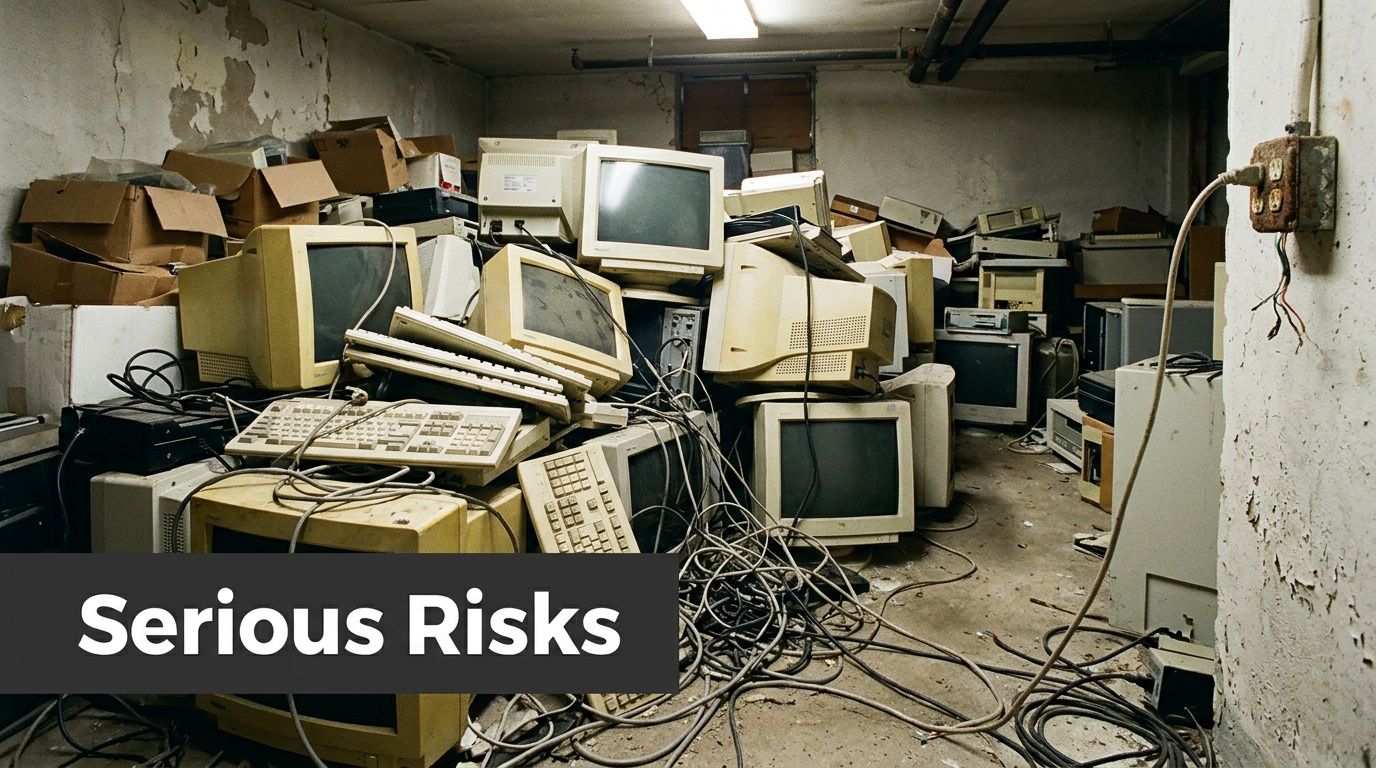
When organizations treat electronics recycling as a simple haul-away job, problems show up later. Hard drives are missed. Asset tags don’t match pickup records. A decommissioned instrument still contains storage media. A downstream vendor shreds broadly but can’t explain what happened to recoverable materials.
Those aren’t small operational mistakes. They’re governance failures.
A qualified electronics recycler should be able to tell you, in plain language, what happens after pickup. If the answer is vague, stop there. Start with a provider that focuses on electronic waste recycling services and can explain handling by asset type, not by truckload.
Recovery matters too
Individuals and organizations often focus on disposal risk. They should. But material recovery is another major reason to avoid informal channels.
According to Reworx on recycling center processing in Snellville, inefficient e-waste processing leads to only 10 to 15% of gold being recovered, while certified R2 facilities can recover up to 95% of gold from printed circuit boards. The practical takeaway is straightforward. A weak downstream process doesn’t just create environmental exposure. It leaves recoverable value behind and increases the chance that toxic materials such as lead are mishandled.
What works and what doesn’t
Here’s the trade-off many organizations face:
| Approach | What usually works | What breaks down |
|---|---|---|
| General junk removal | Clearing space quickly | Weak documentation, poor asset separation, unclear downstream handling |
| Municipal or residential recycling | Small household drop-offs | Not designed for commercial inventory control, de-installation, or regulated equipment |
| Specialized commercial e-waste partner | Controlled pickup, documentation, sorting, data handling, downstream recovery | Requires planning and inventory discipline |
Treat e-waste disposition as a risk-control function. Once you do that, the buying decision gets easier.
The S.E.D. Process Deconstructed Logistics and De-installation
Most difficult projects aren’t difficult because of recycling. They’re difficult because of movement. The challenge is getting equipment out of active spaces without damaging walls, interrupting staff, mixing asset groups, or breaking the custody trail.
That’s why successful electronics recycling projects in Snellville are run like logistics projects first and recycling projects second.

Start with the inventory, not the truck
The cleanest projects begin with a site review. That doesn’t need to be complicated, but it does need to be specific.
A good intake process identifies:
- Installed equipment that needs tools, disconnection steps, or special lifting
- Data-bearing assets that require segregation from the start
- Lab devices that need different packing and handling than office electronics
- Access constraints such as elevators, loading docks, stairwells, narrow doors, and occupied corridors
That early planning is where projects stay efficient. Teams that skip it usually create delays on pickup day.
For organizations handling research spaces or shutdowns, it helps to review what a structured lab equipment decommissioning service looks like before scheduling.
The handoff has to be operationally clean
Once the asset list is clear, scheduling becomes much easier. Pickup windows can be aligned with clinic downtime, school breaks, lab closures, or after-hours IT work. That reduces interruption and makes it easier to separate what’s leaving from what’s staying.
From there, the removal sequence usually follows a predictable order:
- Loose and boxed electronics first. This clears floor space and reduces congestion.
- Peripherals and network gear next. These are easy to miss if they stay connected to furniture or racks.
- De-installation of fixed or heavy assets. Server hardware, benchtop lab systems, and mounted devices come out after pathways are open.
- Final sweep and count reconciliation. Missing cords, docked laptops, spare drives, or under-bench devices get caught.
A good pickup crew doesn’t just load equipment. They notice the switch under the table, the backup drive in the drawer, and the analyzer module still sitting on a side cart.
Why dedicated transport matters
Transport is where many otherwise solid projects get sloppy. Assets are loaded without meaningful separation, mixed with unrelated waste streams, or moved by crews who weren’t part of the original assessment.
That’s one reason logistics discipline matters so much in this field. If you work in operations, this broader discussion of logistics and shipping efficiency is a useful lens for understanding why routing, staging, and handoff quality affect every downstream result.
For electronics and lab equipment, the practical standard is simple:
| Stage | What good handling looks like |
|---|---|
| On-site staging | Assets grouped by type, fragility, and data risk |
| Packing | Protection matched to item weight, shape, and sensitivity |
| Vehicle loading | Stable placement, clean segregation, efficient sequence for unload |
| Receiving | Inventory check against pickup records before processing begins |
When this chain is managed well, clients don’t have to babysit the project. The work gets done with less disruption, fewer surprises, and a much lower chance of custody gaps.
Ensuring Full Compliance and Data Security in Snellville
Deleting files isn’t data destruction. Reformatting a drive isn’t data destruction either. If a device held patient records, student information, proprietary research, financial files, or internal emails, the standard has to be much higher.
That’s where many disposal programs fail. They focus on outbound logistics and forget that the hard drive is the liability.
What secure sanitization means
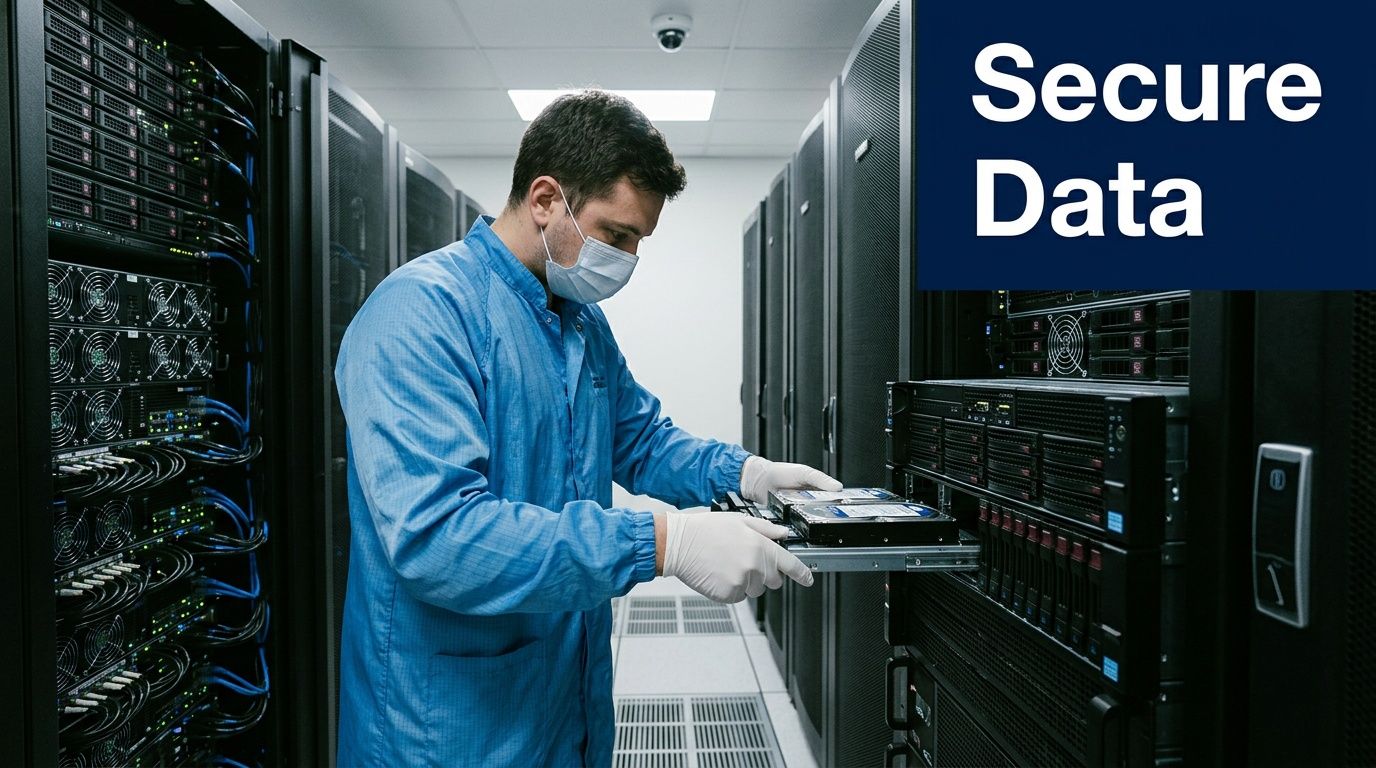
For functioning hard drives, a defensible program uses a recognized overwrite process rather than a simple delete command. A practical benchmark is DoD 5220.22-M 3-pass wiping, which overwrites the drive multiple times.
Montclair Crew’s Georgia electronics recycling page states that S.E.D.'s free DoD 5220.22-M 3-pass wiping standard achieves 99.99%+ data eradication on hard drives, making recovery computationally infeasible. The same source notes that a single-pass wipe is 500x less effective in entropy randomization, and that breach costs can average $10 million per incident in sensitive environments such as healthcare and corporate IT. See the full discussion on Georgia electronics recycling and data sanitization.
That distinction matters in real operations. A file delete only changes what the user sees. Proper sanitization addresses the underlying media.
When wiping is not enough
Some assets can’t be sanitized through software. The drive may be damaged, locked, obsolete, or embedded in equipment that’s no longer operational.
In those cases, physical destruction is the right path.
A strong compliance workflow usually applies this decision logic:
- Working hard drives get documented overwrite sanitization.
- Failed or unreadable drives move to physical shredding.
- Embedded media in retired equipment gets identified during intake, not after the device is already in the processing stream.
Field note: The highest-risk drive in a decommission isn’t always in the server room. It’s often inside a forgotten workstation, analyzer, copier, or instrument controller.
Matching the method to the regulation
HIPAA gets the most attention in Snellville-area healthcare and lab settings, but the underlying principle is broader. If your organization has a duty to protect information, the disposal method has to be auditable.
That means your vendor should provide more than a pickup receipt. They should be able to support a process that includes:
- Asset identification before removal
- Clear disposition paths for each media type
- Certificates or supporting records for sanitization or destruction
- Downstream accountability instead of vague statements about recycling
The practical test is easy. Ask what happens to a failed drive pulled from a retired analyzer. If the answer is fuzzy, the compliance program is weak.
Teams that need a closer view of disposal controls can review secure data destruction services and compare that standard against their own internal policies.
E-Waste Disposition for Snellville's Core Industries
Different facilities produce different waste streams. A hospital doesn’t retire assets the same way a university does. A data center doesn’t approach decommissioning like a lab renovation.
The disposal plan has to match the environment.
Hospital wing decommission
A hospital closes part of a wing during renovation. The outgoing equipment includes patient monitors, workstations on wheels, desktop PCs at nursing stations, small printers, and a few older analytical devices from a support lab.
The difficult part isn’t loading the equipment. It’s separating the assets correctly.
Patient-facing devices and computers may hold protected information. Lab-adjacent devices may contain embedded storage or require controlled teardown. Some units can leave quickly. Others need a documented path before anyone disconnects them.
A workable approach looks like this:
- Clinical devices and IT assets are inventoried separately.
- Data-bearing items are flagged before pickup.
- Removal is staged around live hospital operations, not the vendor’s convenience.
- Final records align with internal compliance review.
What doesn’t work is combining everything into one undifferentiated scrap load. That may clear space, but it creates avoidable audit questions later.
University lab refresh
A science department replaces aging equipment over the summer. The outgoing set includes old computer workstations, incubators, centrifuges, benchtop instruments, and peripheral electronics from several labs.
This kind of project usually has two operational pressures. First, the school wants the rooms cleared on a tight schedule. Second, the faculty and facilities teams need confidence that useful instruments, sensitive electronics, and true end-of-life items aren’t all treated the same way.
The best handling plan is selective and room-specific.
Some devices need de-installation. Others need removal and sorting. Computer stations must be checked for local data. Shared equipment often has accessories in adjacent cabinets, which get missed unless the crew works from a room-by-room list.
Universities benefit from a disposal partner that understands both bench equipment and campus IT. If the provider only knows one side, the project drags.
Corporate data center refresh
A metro Atlanta company retires old servers, storage arrays, switches, and rack accessories during an infrastructure refresh. The organization isn’t worried about whether the team can lift the hardware. It’s worried about whether every data-bearing asset is tracked, removed, sanitized, and documented.
Process discipline matters most here.
The project usually runs best when the team works rack by rack, reconciles serials or internal asset IDs during removal, and separates reusable components from media that needs immediate destruction handling. Loading speed matters, but accuracy matters more.
A practical decision matrix for these projects looks like this:
| Organization type | Main risk | Best operational focus |
|---|---|---|
| Hospital or clinic | Patient data and regulated devices | Segregation, custody, compliant records |
| University or school lab | Mixed inventory and timing pressure | Room-by-room inventory, de-installation, scheduling |
| Data center or corporate IT | Data exposure and asset tracking | Media control, documentation, rack-level accuracy |
Electronics Recycling Services in Snellville GA work best when the provider understands the asset mix behind the request. “Computers and equipment” sounds simple until the truck arrives and half the job turns out to be specialized hardware.
Accepted Items and Understanding Project Costs
A Snellville facility manager might start with a simple request: remove old desktops, a few printers, and some surplus monitors. Then the walk-through reveals two centrifuges in storage, an analyzer in a back lab, a UPS unit in the server room, and equipment that still needs to be disconnected before anything can leave the building. That change in scope is common, especially in healthcare, biotech, and research environments where standard IT assets and specialized lab equipment sit side by side.
That mixed inventory is what generic e-waste vendors often miss.

Commonly accepted categories
For planning, sort assets by handling requirements instead of by manufacturer. That gives operations, facilities, and IT a clearer picture of what the pickup involves.
- Office and IT equipment including desktops, laptops, monitors, servers, storage arrays, network gear, printers, copiers, phones, and accessories
- Scientific and laboratory equipment such as pipettes, centrifuges, incubators, analyzers, balances, microscopes, and similar bench equipment
- Facility support electronics including AV gear, test equipment, UPS units, and miscellaneous powered devices
- Mixed decommission inventory from shutdowns, remodels, relocations, and room clear-outs
For a broader item-by-item reference, review the accepted items page for electronics and lab equipment disposal.
What drives project cost
Project cost usually comes down to labor hours, site conditions, packaging needs, and the amount of control required during removal. A pallet of staged monitors is straightforward. A multi-room pickup with servers, bench instruments, and fragile accessories takes more coordination and more time.
The main cost factors usually include:
- Volume and equipment mix. Uniform loads move faster than mixed inventories spread across offices, labs, and storage areas.
- De-installation work. Equipment that is mounted, network-connected, plumbed, or built into benches requires technician time before loading starts.
- Building access. Stairs, elevators, restricted corridors, occupied clinical areas, and limited loading access all affect crew size and schedule length.
- Data-bearing assets. Drives, servers, copiers, and instruments with embedded storage require tighter chain-of-custody controls and stronger documentation.
- Packing and protection. Standard office electronics can often be palletized quickly. Sensitive lab devices may need careful wrapping, segregation, or specialized handling.
A good quote should explain those variables in plain language. If it does not account for de-installation, access limits, or data-bearing equipment, the number may look attractive at first and change once the crew reaches the site.
If you want a useful general primer on why hauling and removal quotes vary, this article on how junk removal pricing is determined gives a solid operational overview. Electronics and laboratory equipment projects follow the same operational logic, but they also add custody, compliance, and breakage-risk considerations that ordinary cleanouts usually do not.
The best quote is the one that clearly defines labor, handling scope, data controls, and downstream disposition.
Schedule Your Secure Electronics Recycling in Snellville
If your team is managing retired computers, servers, monitors, lab instruments, or mixed facility equipment, the safest move is to treat the project as both a logistics job and a compliance job.
That’s especially true in healthcare, education, research, and corporate IT. You need a provider that can remove equipment cleanly, account for data-bearing assets, and handle specialized lab devices without creating delays for your staff.
For organizations that need Electronics Recycling Services in Snellville GA, the next step is simple. Build an inventory, identify any data-bearing equipment, and request a project review before anything leaves the site. A short planning call usually prevents the mistakes that cost the most later.
Scientific Equipment Disposal helps Snellville-area organizations remove and recycle electronics, servers, and laboratory equipment with secure data destruction, de-installation support, and coordinated pickup across the Atlanta metro. If you need a compliant path for surplus IT assets, lab instruments, or a full facility cleanout, contact Scientific Equipment Disposal for a no-obligation consultation.