Secure Data Destruction in Norcross GA: The 2026 Guide for Local and Nationwide Compliance

Let's be blunt: tossing old hard drives and lab equipment from your Norcross facility into a dumpster is a recipe for disaster. For the healthcare, biotech, and research firms that power our local economy, secure data destruction isn't just an IT chore—it's a critical defense against catastrophic data breaches and staggering regulatory fines. Whether your business operates solely in Georgia or has a national footprint, the principles of secure disposal are universal and non-negotiable.
Getting this wrong can have devastating consequences. That's why partnering with a certified expert for secure data destruction in Norcross GA is the only way to manage these high-stakes risks effectively across all your locations.
Why Data Destruction in Norcross Is So Critical for All Businesses
Think about every retiring server, outdated piece of lab equipment, or forgotten desktop in your Norcross or greater Atlanta facility. They aren't just hardware. They're vaults, packed with your organization's most sensitive data—patient PHI, proprietary research, and confidential financial records.
This isn't some far-fetched scenario. We’ve seen it happen. A single discarded hard drive, improperly handled, can unravel years of work, shatter public trust, and trigger crippling financial penalties. For the key industries that define our local economy, and for national corporations with branches here, the stakes have never been higher.
The Real-World Financial Fallout
The financial fallout from a data breach is brutal. In 2026, breaches traced back to improper asset disposal cost companies an average of $4.88 million globally. For the healthcare sector, that number explodes to $10.93 million per incident. In a major business hub like Norcross, where clinics, labs, and corporations are constantly cycling through IT assets, that statistic is a serious warning for any company, regardless of its size or scope.
These aren't just abstract numbers. The costs break down into very real problems:
- Regulatory Fines: HIPAA non-compliance alone can lead to fines that stretch into the millions, affecting any healthcare provider in the U.S.
- Legal Fees: Defending your organization against lawsuits is a long, expensive fight.
- Reputational Damage: Losing the trust of your patients, clients, and partners can be more damaging than any fine, impacting your brand nationwide.
- Remediation Costs: The expenses for credit monitoring, PR campaigns, and internal investigations add up fast.
A quick wipe or reformat simply doesn't cut it. Professional data destruction is the only way to ensure information is gone for good, giving you a verifiable, audit-proof defense against potential breaches for all your business locations.
Why Norcross and Atlanta Businesses Are Prime Targets
The unique mix of industries here in the Atlanta area creates a distinct risk profile. A biotech firm in Technology Park has sequencers holding priceless intellectual property. A hospital in Gwinnett County has thousands of patient records spread across countless devices. Even a small clinic is sitting on billing information and health histories that are a goldmine for criminals.
The data you manage isn't just a file; it's a legal and ethical responsibility. A complete data security management plan must account for your old equipment at every office, from Georgia to California.
This is where a partner for secure data destruction in Norcross, GA with national capabilities makes all the difference. A provider who knows the regional business landscape but also understands nationwide logistics can handle these specific challenges. You get more than just a service; you get localized expertise, secure logistics built for the Atlanta metro and beyond, and the peace of mind that comes from knowing your data is handled with certified precision everywhere.
Destruction is key, but it’s part of a bigger picture. To learn about the entire lifecycle, check out our guide to Norcross computer recycling. This is about more than just clearing out old junk—it's about protecting your organization’s future.
Understanding Your Data Destruction Options
So, you've got a stack of old IT assets ready for retirement from your Norcross facility. Getting them out the door is one thing, but making sure the sensitive data on them is gone for good? That's a whole different challenge. You'll hear terms like 'wiping,' 'shredding,' and 'degaussing' thrown around, and it can get confusing fast.
Let's cut through the noise. We've handled data destruction for countless labs and businesses in the Atlanta area and across the country, and it really comes down to two main paths: software-based sanitization and good old-fashioned physical destruction. Choosing the right one isn't about picking the most complicated-sounding term; it's about matching the right technique to your specific hardware and risk level.
This isn't a niche problem anymore. The secure data destruction market has exploded into a $3.72 billion industry, and it's on track to hit $5.64 billion by 2029. A huge driver of that growth is right here in our backyard—sectors like healthcare and R&D that are producing a mountain of electronic waste. Just think, U.S. healthcare facilities alone generate over 5.9 million tons of waste annually, and a lot of that has HIPAA-protected data locked inside.
Software-Based Data Sanitization Explained
This is what we in the industry often call "data wiping." It’s a sophisticated process where we use specialized software to overwrite every single sector of a hard drive or SSD with random, meaningless data. This is far more permanent than just hitting 'delete' or reformatting a drive, which often leaves your old files recoverable with the right tools. A professional wipe makes the original information completely irretrievable.
We don't just guess at this. The process is governed by strict standards to ensure it's forensically sound. The two big ones you'll hear about are:
- NIST 800-88: These are the guidelines from the National Institute of Standards and Technology. The "Purge" method is the gold standard here, designed to thwart even advanced, lab-level data recovery attempts. This is a key standard for federal compliance.
- DoD 5220.22-M: A long-time benchmark from the Department of Defense, this standard involves a 3-pass overwrite process to thoroughly scramble the data.
Data wiping is the perfect choice for functional, newer devices you might want to resell, donate, or redeploy within your organization. It completely secures the data while preserving the hardware's value—a win for your budget and the environment. We get into the nitty-gritty of this process in our guide on how to wipe a hard drive completely.
The Finality of Physical Destruction
Sometimes, software just can't get the job done, or your internal security policy demands a "no-mercy" approach. That's when we turn to physical destruction. This is exactly what it sounds like: we shred, crush, or pulverize the device until the platters, chips, and circuits are nothing but a pile of fragments. There's zero chance of data recovery because the media simply doesn't exist anymore.
We always recommend physical shredding for:
- Damaged or Non-Functional Drives: If a drive won't even power on, you can't run wiping software on it. Shredding is the only surefire way to destroy the data inside.
- Outdated Media: Got a box of old magnetic tapes, Zip disks, or CDs? Shredding is the most efficient and secure way to handle them.
- Maximum Security Needs: For assets holding top-secret research, intellectual property, or other mission-critical data, many organizations choose shredding to eliminate every conceivable risk.
To make the choice clearer, here’s a quick comparison of how these two methods stack up for the assets we typically see from Norcross businesses.
Data Wiping vs. Physical Shredding: Which Is Right for You?
| Feature | Data Wiping (e.g., DoD 3-Pass) | Physical Shredding |
|---|---|---|
| Best For | Functional, modern hard drives & SSDs | Damaged/failed drives, old media, highest security needs |
| Asset Reuse | Yes. Preserves the hardware for resale, donation, or redeployment. | No. The device is completely destroyed. |
| Environmental Impact | More sustainable, promotes a circular economy. | Less sustainable, but metals are recycled after shredding. |
| Verification | A digital certificate is generated confirming 100% data overwrite. | A Certificate of Destruction is issued, often with video/photo proof. |
| Compliance | Meets NIST 800-88, DoD, HIPAA, and other regulatory requirements. | Meets all major compliance standards for data destruction. |
| Typical Scenario | Wiping a batch of 3-year-old laptops for employee resale. | Shredding drives from a decommissioned research server with sensitive data. |
Ultimately, the best approach might not be just one or the other.
For many of the labs and companies we work with in Norcross and across the U.S., the best strategy is a hybrid one. You might use data wiping for your fleet of three-year-old laptops being prepared for resale, but choose to physically shred the drives from a decommissioned research server.
Understanding these options empowers you to have a productive conversation with a provider like S.E.D. It ensures you’re not just asking for secure data destruction in Norcross, GA, but specifying the exact level of security your valuable assets demand, no matter where they are located.
Your Playbook for Compliant Asset Disposition
Turning data destruction theory into action requires a clear, practical plan. When it's time to execute a compliant asset disposition project for your Norcross facility—whether it's a bustling lab or a corporate office—it all comes down to a methodical process. This isn't just about hauling away old equipment; it's about managing risk at every single turn, from the initial inventory all the way to the final certificate of destruction.
Let's walk through how to manage this from start to finish. Think of this less as a rigid manual and more as a playbook straight from the field, packed with insights from our years of managing complex projects right here in the Atlanta metro area and for national clients. We’ll focus on the non-negotiables that make your project completely audit-proof.
Building Your Asset Inventory
First things first: you have to know exactly what you have. A detailed asset inventory is the bedrock of your entire disposition project. This means going way beyond just counting laptops and servers. You need to hunt down every single device that could possibly be storing data.
From our experience working with Norcross-area businesses, we know sensitive information loves to hide in the most unexpected places. You have to think beyond the obvious data center hardware.
- Office Equipment: Modern printers, copiers, and scanners have internal hard drives that keep a copy of every document they've touched.
- Networking Gear: Your firewalls and routers often hold configuration details, access logs, and other critical network information.
- Specialized Lab Instruments: Many modern scientific instruments, from DNA sequencers to mass spectrometers, contain embedded computers and internal storage holding priceless research data.
- Mobile Devices: Don't forget about company-issued phones and tablets. They're treasure troves of emails, contacts, and proprietary files.
As you build your inventory, make sure to log the device type, manufacturer, model, and serial number. This granular detail is absolutely crucial for tracking each asset through the entire destruction process.
Classifying Data and Choosing Your Method
Not all data is created equal, and your disposition strategy needs to reflect that. Once your inventory is complete, the next move is to classify the sensitivity of the data on each device. This decision directly dictates which destruction method is appropriate.
For any organization handling sensitive health information, understanding the specific mandates for data disposal is non-negotiable. Your process must meet the strict requirements for HIPAA Compliance. This classification step is what aligns your actions with legal standards and your own internal governance policies.
A Pro Tip from the Field: We almost always recommend a tiered approach. An asset with low-risk operational data might be perfectly fine with a certified software wipe, which also preserves the hardware for potential resale. But for a device that held patient records or your company’s crown-jewel IP, physical shredding is often the only choice for total peace of mind.
This visual shows the two primary paths for ensuring data is gone for good.
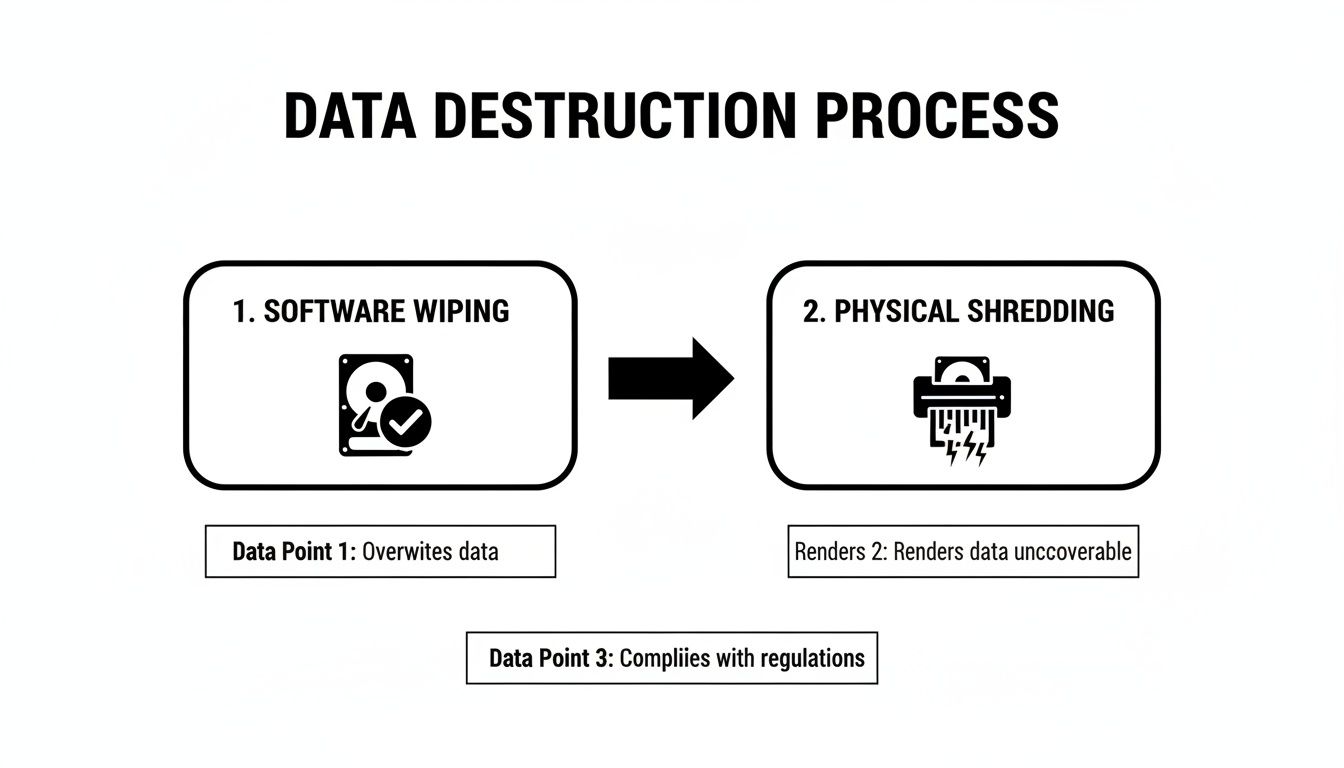
The flow is simple: data is either wiped clean through software, or the device itself is physically destroyed. Both roads lead to a secure, documented disposition.
Mastering On-Site Logistics and Chain of Custody
The second your assets leave your direct control, the chain of custody begins. This is, without a doubt, the most critical phase for compliance. A documented, unbroken chain of custody is your legal proof that you handled everything responsibly. One weak link here can completely undermine your entire project.
When you're working with a disposal partner for secure data destruction in Norcross, GA, here’s what you need to demand for on-site logistics:
- Scheduled & Secure Pickup: Your vendor must arrive at a pre-scheduled time with vetted, uniformed employees. The use of locked, GPS-tracked vehicles isn't a bonus; it's a must.
- Asset Verification: Before anything gets loaded, the vendor's team should verify the assets against your inventory list. They should be scanning serial numbers to kick off the digital tracking process right then and there.
- Secure Transport: Assets must be loaded into secure, sealed containers or directly onto the truck. There should be zero stops between your facility and the secure destruction plant.
Bigger jobs, like a full lab decommissioning in Technology Park or an office cleanout in Midtown Atlanta, demand even tighter coordination. A partner with a national logistics network can coordinate pickups from multiple sites, consolidating them for efficient and secure processing. Your disposal partner should really act as a project manager, working with your team to guarantee minimal disruption while keeping security at its absolute maximum.
At S.E.D., our teams handle this every single day. We provide the on-site de-installation, packing, and logistics that make the whole process feel seamless. To see more on how we manage the entire lifecycle of retiring hardware, check out our guide on IT asset disposal. Following this playbook turns a daunting compliance task into a manageable, secure, and documented success.
Finding a Data Destruction Partner You Can Trust
When it's time to dispose of old assets, the biggest mistake we see companies make is choosing a vendor based on the lowest price. It’s tempting, I get it. But a "deal" from the wrong partner often becomes an expensive, long-term mistake, especially for any lab or business here in the Norcross area or with national operations.
This isn't a small slip-up; it's a huge liability. You could easily end up with a "scrap guy" who promises to haul everything away but has no real process for protecting your data. This leaves you completely exposed to breaches and regulatory fines, with zero documentation to prove you did your due diligence. Let’s walk through how to tell a true professional from a risky operator.
Vetting Certifications and Insurance
The first thing you should look at is proof of professional certification. These aren't just fancy logos for a website; they are hard-earned credentials showing a third-party auditor has inspected the vendor's entire operation—from their security to their processes—and confirmed they meet strict national standards.
When you're evaluating a partner for secure data destruction in Norcross, GA, you need to see these credentials:
- R2v3 (Responsible Recycling): This is the global benchmark for environmental safety, worker protection, and data security. It ensures the vendor handles the entire lifecycle of your assets responsibly.
- NAID AAA Certification: This is the absolute gold standard for data destruction. A NAID AAA certified vendor is subject to surprise, unannounced audits of their facility security, hiring practices, and destruction methods.
After you see the certs, ask for their proof of insurance. Any legitimate vendor will have robust liability insurance that includes a specific policy for data breaches. This is your safety net, protecting you if something ever goes wrong.
If a vendor hesitates to show you their R2v3 or NAID AAA certificate, or gets cagey about their insurance policy, that's a major red flag. Real pros are proud of these credentials because they are the foundation of client trust.
Probing Questions for Potential Vendors
Once you've confirmed their certifications, it's time to dig a little deeper. The way they answer these questions will tell you everything you need to know about how they really operate. Don't be shy—your security depends on it.
- Employee Screening: "Tell me about your employee screening. Do you perform background checks and drug tests on everyone who will handle our assets?"
- Facility Security: "What does security look like at your facility? Do you have monitored alarms, 24/7 video surveillance, and strict access controls?"
- National Capabilities: "Can you handle pickups from our other offices in different states? What does your national logistics network look like?"
- Downstream Partners: "What happens to the shredded material? Can you show me documentation for your downstream recycling partners to prove they are also certified?"
- Chain of Custody: "Walk me through your chain of custody from the moment you pick up at our Norcross lab to the final Certificate of Destruction. How is every single step tracked?"
A transparent, confident partner will have immediate, clear answers. This is more critical than ever. By 2026, an estimated 75 billion IoT devices will be in use, and e-waste is projected to grow by 20% each year. A recent Deloitte survey found 78% of executives now see data sanitization as a top ITAD priority, a huge jump from just 55% in 2020, all driven by standards like NIST 800-88.
Distinguishing a Professional from a 'Scrap Guy'
The difference between a certified e-waste recycling company and a basic scrap dealer is night and day. A professional partner like S.E.D. provides a secure, compliant, and fully documented service, whether you are in Norcross or need service nationwide. A scrap guy is just hunting for metal value, often leaving your sensitive data completely exposed.
Here’s what that looks like in the real world:
| Feature | Certified E-Waste Partner (like S.E.D.) | 'Scrap Guy' |
|---|---|---|
| Primary Goal | Secure, compliant, and documented data destruction and recycling. | Extracting commodity value from metals. |
| Data Security | Offers certified data wiping and physical shredding with full documentation. | None. Hard drives are usually ignored or sold as part of the scrap. |
| Compliance | Holds R2v3 and/or NAID AAA certifications. Provides a Certificate of Destruction. | No certifications. No legally defensible paperwork. |
| Process | Secure, GPS-tracked trucks and a monitored, access-controlled facility. | Open-air transport in a pickup truck, unsecured storage. |
| Liability | Assumes liability for your assets and is backed by data breach insurance. | You keep all the liability for any data breaches. |
Choosing the right partner is really about mitigating risk. When you ask the tough questions and demand proof of certification, you’re not just hiring a vendor—you’re protecting your organization and ensuring your asset disposition project is a success.
Finalizing Your Project with Audit-Proof Documentation
Think the job is done once the truck pulls away from your Norcross facility? Think again. The most critical phase for your compliance and legal protection is just getting started.
The project isn't truly finished until you have the official, audit-proof paperwork in your hands. This documentation is your ultimate safeguard, closing the loop and proving every single asset was handled correctly. Without it, your careful planning means very little in the eyes of an auditor.
The Power of the Certificate of Destruction
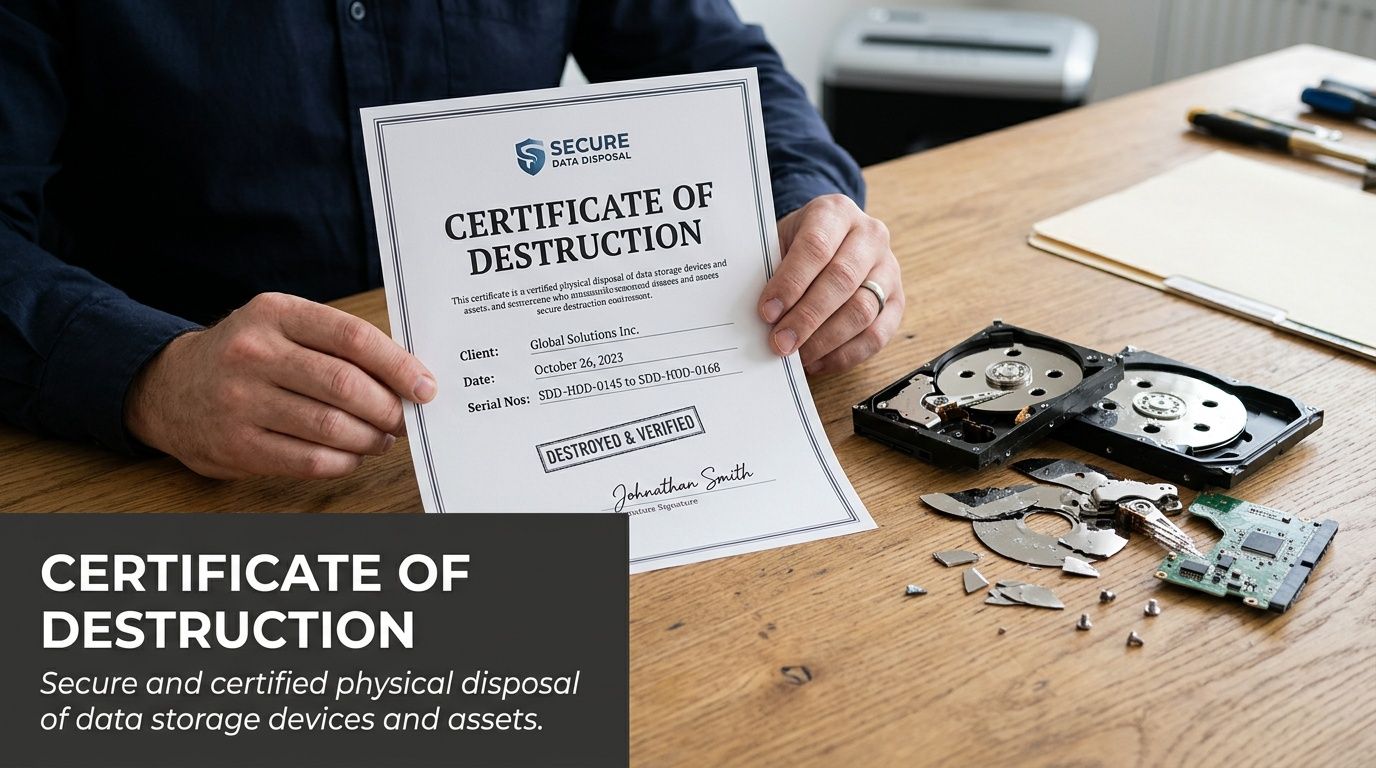
The cornerstone of your project's final records is the Certificate of Destruction (CoD). This isn't just a receipt—it's a legally binding document that serves as your ironclad proof of compliance.
It attests that your data-bearing assets were destroyed in a compliant, irreversible manner. Should a HIPAA audit or data breach investigation ever happen, a detailed CoD is your first and best line of defense. This single piece of paper can be what stands between your organization and potential seven-figure fines.
A Certificate of Destruction is your tangible proof of compliance. It transforms your responsible actions into a documented, verifiable record, ensuring that your efforts to secure data are recognized and legally defensible.
This document validates the entire chain of custody, from the moment we accept your assets to their final destruction.
What Makes a Certificate Valid
Not all certificates are created equal. A vague, one-line receipt from a non-certified vendor simply won't hold up under scrutiny. To be considered valid and audit-proof, a CoD from a partner specializing in secure data destruction in Norcross, GA must contain specific, non-negotiable details.
A legitimate certificate from S.E.D. will always include:
- A Unique Serialized Number: This allows the service to be tracked and verified.
- Your Organization's Information: Clearly naming your company as the customer.
- The Vendor's Certified Information: Our name, address, and certification details (like NAID AAA).
- Acceptance of Custody Date: The exact date we took possession of your assets.
- Itemized Asset List: This is crucial. It lists the serial numbers of every hard drive or asset we destroyed, matching the inventory you created.
- Method of Destruction: The certificate specifies exactly how the data was destroyed (e.g., "Physical Shredding" or "NIST 800-88 Compliant Wipe").
- Witness Signature: The signature of an authorized employee from our destruction team.
Anything less is a red flag. To see exactly what a proper document looks like, you can review a sample Certificate of Destruction and get familiar with the fields and required information.
Managing and Storing Your Records
Receiving the CoD is a major milestone, but your responsibility doesn't end there. Don't just file it away and forget it. These are critical business records you might need to produce years down the line.
We recommend these best practices for managing your data destruction records:
- Create a Digital Archive: Scan all certificates, asset inventories, and related communications. Store them in a secure, backed-up digital location where they can be easily found.
- Establish a Retention Policy: Your industry might have specific requirements, but keeping destruction records for at least three to five years is a solid baseline for most.
- Link to Asset Management: Tie the Certificate of Destruction back to your internal asset management system. This allows you to pull up the disposal record for any retired device just by looking up its serial number.
By diligently managing these records, you ensure that your secure data destruction in Norcross GA project is fully defensible for years to come.
Common Questions on Data Destruction in Georgia
When it comes to data destruction, there are a handful of questions we hear from nearly every business in Norcross and the greater Atlanta area. These are the real-world, practical concerns that pop up during a project.
Let's get right to the straightforward answers you need.
What Types of Equipment Require Secure Data Destruction?
The easy answer is anything that stores data. Everyone knows about computer hard drives (HDDs), solid-state drives (SSDs), servers, and backup tapes. The real risk, though, lies in the equipment everyone forgets.
We’ve seen it happen time and again at labs and offices right here in Norcross—data hides in the most unexpected places. You can't afford to overlook these:
- Office printers and copiers almost always have internal hard drives.
- Network gear like firewalls and routers store sensitive configurations.
- Company mobile phones and tablets are packed with data.
- Modern lab equipment often has embedded computers and internal storage.
Here’s a good rule of thumb: if it’s an electronic device made in the last 15 years, you should assume it holds data. Your best bet is to have it assessed by a specialist in secure data destruction in Norcross GA.
Is Data Wiping Enough or Do I Need to Shred My Drives?
This is a great question, and the answer really comes down to your internal security policies and the hardware you have.
For newer, functional drives, a certified multi-pass wipe that meets NIST or DoD standards is usually enough to satisfy compliance rules, including HIPAA. The big win here is that the hardware can often be reused or resold, which is a much greener approach.
But sometimes, physical destruction is the only way to go.
For older drives, damaged media, or any non-functional equipment, physical shredding is the only way to be 100% certain the data is gone forever. We also have many clients who choose to shred their most sensitive data drives—no matter their condition—just for that absolute, verifiable peace of mind.
A good partner will work with you to check your inventory and develop a smart strategy, mixing and matching methods to balance security needs, cost, and your sustainability goals.
How Is Pricing for Data Destruction in the Atlanta Area Determined?
Pricing for secure data destruction services in the Atlanta market usually depends on a few things: the total volume of your equipment, the method you choose (wiping vs. shredding), and the logistics, like whether we come to you or you bring it to us.
Some local vendors might charge per drive or by the pound. While that sounds simple, it's not always the most efficient. Often, a better strategy is to bundle your data destruction with a larger IT asset disposal or e-waste recycling project. This cuts down on separate logistics costs and wraps everything into one coordinated job. For national projects, a vendor may offer consolidated pricing that accounts for pickups in multiple states, providing significant value over hiring separate local vendors.
Always demand a detailed, itemized quote so there are no surprises or hidden fees later on.
What Is a Chain of Custody and Why Does It Matter?
A chain of custody is your official paper trail. It’s the documented, chronological record showing who had possession of your assets from the second they leave your facility until they are confirmed to be destroyed. This isn't just paperwork—it's your legal proof that you did your due diligence.
If you ever face a regulatory audit or a data breach investigation, a missing or incomplete chain of custody is a huge red flag. It shows a breakdown in your security process and leaves your company completely exposed. A professional service uses secure, GPS-tracked transport, vetted staff, and digital tracking to maintain this unbroken chain, all leading to the final Certificate of Destruction.
Ready to ensure your organization’s data is destroyed with certified, audit-proof precision? The team at Scientific Equipment Disposal provides comprehensive, compliant solutions for businesses throughout the Norcross and greater Atlanta area, with the capability to manage projects nationwide. We simplify the entire process, from secure logistics to final documentation.
Get a quote and protect your data today by visiting https://www.scientificequipmentdisposal.com.