A Practical Guide to Corporate Ewaste Solutions for Local and Nationwide Businesses

Let’s be honest: staring down a room full of outdated servers or retired lab equipment can feel like a massive headache. But a smart corporate ewaste solution can turn that logistical nightmare into a strategic win. We're talking about locking down data security, staying compliant with environmental regs, and even clawing back some value from old gear—whether you're in Atlanta, GA, or managing assets across the country.
This isn't just about hauling junk away. It’s about building a secure, sustainable, and forward-thinking plan for your end-of-life assets, with solutions available nationwide.
Building Your E-waste Disposal Framework

Too many organizations treat electronic waste as just another task for the facilities department to handle. That’s a mistake. For businesses in tightly regulated fields like healthcare or finance—or any company operating in a major hub like Atlanta where compliance is king—a proactive plan is non-negotiable. This holds true for companies nationwide who need a consistent disposal strategy across all their locations.
The goal here is to stop thinking reactively, like you’re just cleaning up a mess. Instead, you need to build a deliberate, repeatable asset disposition strategy. This guide will walk you through it, step-by-step.
The Core Components of a Successful Plan
At its heart, a solid e-waste framework rests on a few critical pillars. Get these wrong, and you're opening yourself up to data breaches, steep environmental fines, and missed chances to recover asset value. Nail them, and every step you take will be secure and compliant.
Your game plan has to cover these four bases:
- Asset Assessment: You need to know exactly what you have. That means everything from standard office IT equipment to highly specialized lab instruments at all your sites.
- Partner Vetting: It's crucial to choose a certified and properly insured disposal partner who understands the specific demands of your equipment and can service all your locations, from a single site in Atlanta to a network of offices nationwide.
- Data Security: This is non-negotiable. You need a verifiable process for either sanitizing or physically destroying data on every single hard drive, server, and storage device.
- Compliance and Reporting: You must maintain a clear chain of custody and get proper documentation for every single asset you dispose of. No exceptions.
A fundamental component of building your corporate e-waste disposal framework is to prioritize effective methods for E Waste Recycling. This ensures that materials are responsibly recovered rather than sent to landfills, aligning with both environmental goals and regulatory requirements.
Why a Proactive Framework Matters
Just calling up a junk removal service and calling it a day is not a corporate e-waste solution. The risks are simply too high. Imagine an old company hard drive with employee data turning up somewhere it shouldn’t, or proprietary lab equipment being found in a landfill. The damage to your reputation—and your bottom line—can be severe.
A well-defined framework is your shield. It creates a defensible, repeatable process that turns a potentially chaotic cleanout into a structured, professional operation.
This is especially critical for organizations managing complex inventories, like hospitals dealing with sensitive medical devices or data centers decommissioning entire racks of servers across the U.S. A structured approach is the only way to manage the risk. You can learn more about how to structure the broader process by reading our guide on IT asset disposal at https://www.scientificequipmentdisposal.com/it-asset-disposal/. This foundational plan is what separates truly responsible organizations from those leaving themselves wide open to trouble.
Auditing Your E-waste Risks and Opportunities
Before you can even think about finding the right e-waste partner, you need a crystal-clear picture of what you actually have. Simply guessing the number of old computers in a storage closet isn’t going to cut it. A thorough internal audit is the absolute foundation of a legally defensible and cost-effective disposal strategy, whether for a single office or a national corporation.
This means creating a precise inventory of every single electronic asset slated for retirement. I know it sounds like a lot of work, but skipping this step is like trying to navigate a minefield blindfolded—you're bound to run into serious trouble.
Cataloging Every Asset, Big and Small
The first move is a physical or digital walkthrough to get eyes on everything. This isn't just about counting laptops and monitors. You have to think bigger. A university lab right here in Atlanta, for example, might have specialized gear like centrifuges, spectrophotometers, or PCR machines, and each one has its own specific disposal rules.
A corporate data center, whether in Georgia or California, is another beast entirely. It's so much more than just servers. Your inventory needs to include:
- Standard IT Gear: Desktops, laptops, monitors, printers, and all the peripherals.
- Networking Equipment: Servers, routers, switches, and storage arrays.
- Specialized Assets: Medical devices (like infusion pumps), lab instruments (think chromatographs), or industrial controllers.
- Miscellaneous Electronics: Office phones, projectors, and even those old, heavy power backup systems collecting dust.
Document everything. I mean everything. Get the make, model, and serial number for each item. This granular data is non-negotiable for proper tracking and reporting down the line.
Classifying Assets by Risk and Value
Once you have your master list, the real work begins. Not all e-waste is created equal. You need to sort each item based on three critical factors: data sensitivity, environmental hazard, and potential resale value. This analysis is where you'll uncover both hidden risks and opportunities for cost recovery.
Let's say a tech firm in Alpharetta, GA, does this. They might find that 20% of their retired laptops are recent models with a decent resale value. Great. But they also contain sensitive R&D data, making https://www.scientificequipmentdisposal.com/secure-data-destruction/ an absolute top priority. How you classify an asset dictates its entire path, from your facility to its final destination.
Think of your audit as an intelligence-gathering mission. You're not just counting junk; you're identifying potential data bombs, environmental liabilities, and hidden cash that can offset your disposal costs. A thorough audit gives you the power to make informed decisions.
Identifying Environmental and Safety Hazards
Some electronics pose a direct physical risk if you handle them the wrong way. A critical part of any e-waste audit is flagging these potential dangers. For instance, countless devices, from laptops to medical carts, contain lithium-ion batteries. Knowing the top risk management best practices for lithium-ion fire safety is essential for preventing thermal runaway during storage and transport.
Your audit has to call out any item containing hazardous materials.
Common Hazards to Document
| Hazard Type | Associated Equipment | Why It Matters |
|---|---|---|
| Data Security Risk | Hard Drives, Servers, Smartphones | Contains proprietary, customer, or employee data (PII, PHI). |
| Environmental Toxin | Old CRT Monitors, Lab Instruments | May contain lead, mercury, or cadmium, requiring special handling. |
| Physical Hazard | Devices with Lithium-ion Batteries | Poses a significant fire risk if damaged or stored improperly. |
Documenting for a Rock-Solid Foundation
The final output here should be a comprehensive spreadsheet or asset management report. This document is far more than an inventory list; it's the bedrock of your entire e-waste policy. It's what will tell you which assets can be remarketed, which demand certified data destruction, and which need specialized recycling.
I saw an Atlanta-based hospital do this during a facility-wide cleanout. They used their audit to segregate HIPAA-sensitive patient monitors from non-sensitive administrative PCs. That simple act of classification let them apply stringent data destruction protocols only where necessary while fast-tracking other items for standard recycling. It saved them a ton of time and money.
With this detailed audit in hand, you’re finally ready to evaluate vendors and build a disposal plan that actually fits your specific risks and opportunities.
Choosing The Right E-Waste Disposal Partner
Picking an e-waste vendor is probably the single most important decision you'll make in this entire process. A great partner acts as a shield, protecting your organization from legal headaches, financial penalties, and serious reputational damage. A bad one? They can multiply those risks overnight, turning a routine equipment refresh into a full-blown compliance nightmare.
This isn't just about finding someone with a truck to haul away old gear. It's about finding a true partner who provides secure, responsible, and fully defensible corporate e-waste solutions, whether you need local service in Atlanta or a nationwide pickup program. Let's get past the sales pitches and dig into what really matters when you're vetting a provider.
This decision tree gives you a visual for the first steps of an e-waste audit, from taking inventory to weighing data risks against potential resale value.
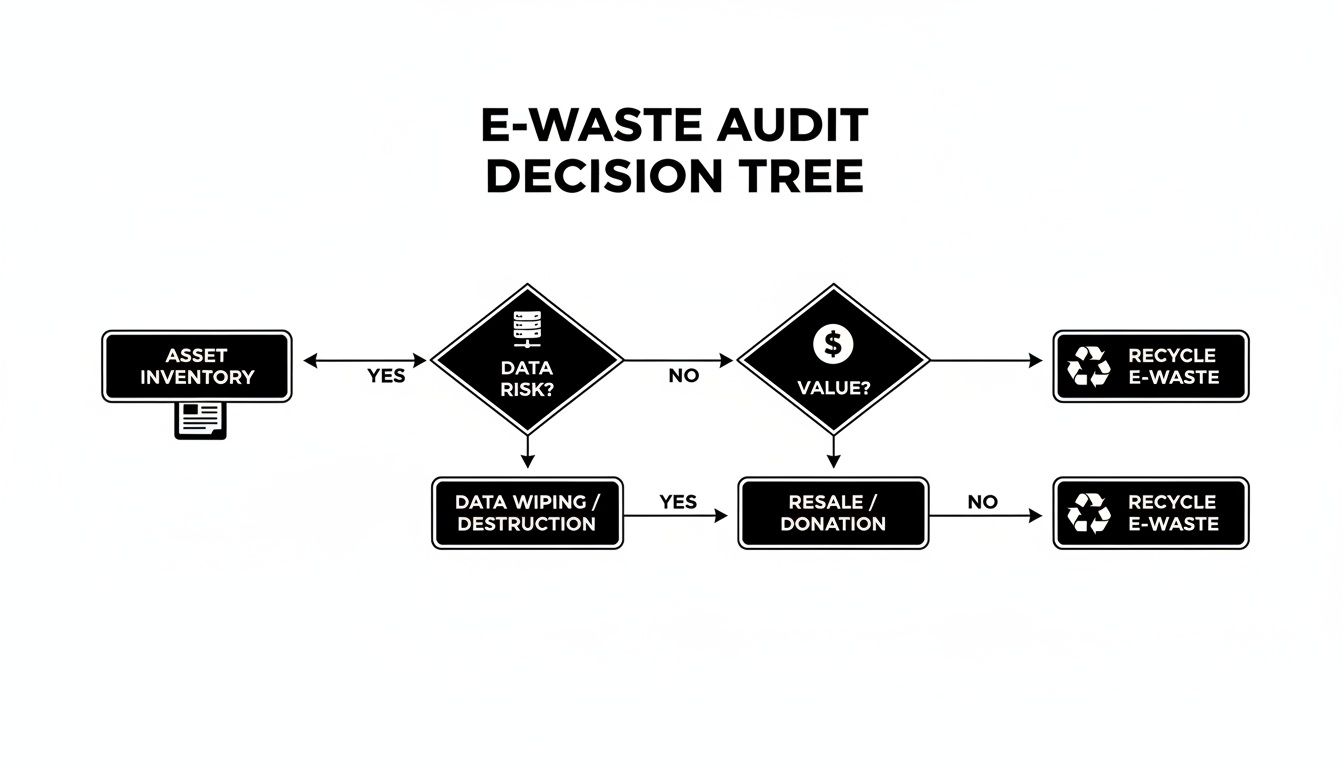
As the chart shows, figuring out what has sensitive data and what might have some life left in it is a crucial first move. That single decision determines the entire path your equipment will take.
Non-Negotiable Certifications to Demand
Look, anyone with a box truck can call themselves a recycler. Certifications are your only real proof that a vendor follows strict industry standards for both environmental safety and data security. Without them, you're just taking their word for it, and that’s a massive gamble.
You need to demand proof of two key certifications:
- R2v3 (Responsible Recycling): This is the leading global standard. It means the vendor has been audited on everything from environmental protection and worker safety to how they manage the entire recycling chain.
- e-Stewards: This one is known for being even tougher, with an absolute ban on exporting hazardous e-waste to developing nations. It's the gold standard for responsible disposal.
If a potential vendor doesn't have at least one of these, it's a hard pass. The risk of your equipment ending up in an overseas landfill or being improperly handled is just too high. The global picture is pretty grim—only 22.3% of e-waste was properly recycled in 2022, and that number is expected to drop as we generate more and more electronic junk. You can see the full breakdown in the latest Global E-waste Monitor report.
Verifying Data Destruction and Chain of Custody
This is where the rubber meets the road. A good vendor can prove, without a doubt, that your data has been completely destroyed. You need to ask direct, pointed questions and get concrete evidence of their process. This is no time for vague promises.
Don't be shy. Ask them straight up:
- "What’s your process for data sanitization?" They should immediately talk about using DoD 5220.22-M compliant multi-pass wiping for any drives that could be reused.
- "How do you deal with failed or old hard drives?" For drives that are dead or too old for wiping, the only acceptable answer is physical shredding. Period.
- "Can I see a sample serialized Certificate of Destruction?" This is your legal proof. It should be an itemized report, listing every single data-bearing device by its serial number, confirming it was either wiped or physically destroyed.
A vendor’s chain-of-custody process has to be airtight. From the second their team touches an asset at your facility to its final recycling or destruction, there must be a clear, documented, and unbroken trail. Ask to see their reporting—it should tell the full story.
To help you stay organized during the vetting process, here’s a quick checklist you can use to compare potential partners.
Key Vendor Evaluation Checklist
Use this checklist to compare e-waste disposal partners and ensure you select a provider that meets your security, compliance, and logistical needs.
| Criteria | What to Look For | Why It Matters |
|---|---|---|
| Certifications | R2v3 and/or e-Stewards certification. | Verifies adherence to the highest industry standards for environmental responsibility and data security. Non-negotiable. |
| Data Destruction | DoD 5220.22-M compliant wiping for reusable drives; physical shredding for failed/obsolete drives. | Ensures complete and permanent erasure of sensitive data, protecting you from breaches and meeting compliance mandates. |
| Reporting | Serialized Certificates of Destruction and detailed chain-of-custody documentation. | Provides an auditable, legally defensible record that every asset was handled properly from start to finish. |
| Logistics | In-house fleet and trained, badged employees (not third-party contractors) with national coverage. | Gives you direct accountability, faster response times, and confidence that professionals are handling your equipment. |
| Insurance | Proof of liability and data breach insurance. | Protects your organization financially in the unlikely event of a data breach or accident during transport or processing. |
| Local Presence | A physical processing facility you can visit, ideally near major hubs like Atlanta. | A local facility means better service and transparency. A national network means consistent service everywhere. |
| Asset Value Recovery | A clear process for evaluating, testing, and remarketing viable equipment with a transparent profit-sharing model. | Can help offset the costs of disposal and ensures you get fair market value for any reusable assets. |
Taking the time to run through this list will quickly separate the serious, professional outfits from the ones that could land you in hot water.
The Advantage of a Local Atlanta Partner with a Nationwide Reach
For any business in the Atlanta metro area, working with a local provider offers some serious advantages that a national broker just can’t replicate. An e-waste recycling company that owns its own trucks and employs its own team gives you a level of control and flexibility that’s hard to beat. When that same partner also has a nationwide service network, you get the best of both worlds.
Imagine you're decommissioning a lab at a university in Decatur or clearing out a data center in Norcross. A local partner can deliver:
- Faster Turnaround Times: They can get a truck to you quickly without having to coordinate with third-party freight carriers.
- On-Site Expertise: Their own trained technicians can handle complex jobs, like de-installing heavy server racks or sensitive lab equipment, making sure it's done safely and correctly.
- Direct Accountability: When the people picking up your assets work for the company you hired, there's no finger-pointing. Communication is direct, and you have a single point of contact.
This direct control over logistics just makes the whole process smoother. You get the peace of mind that comes from knowing exactly who is handling your sensitive assets from the moment they leave your door.
Planning Your Equipment Decommissioning and Pickup
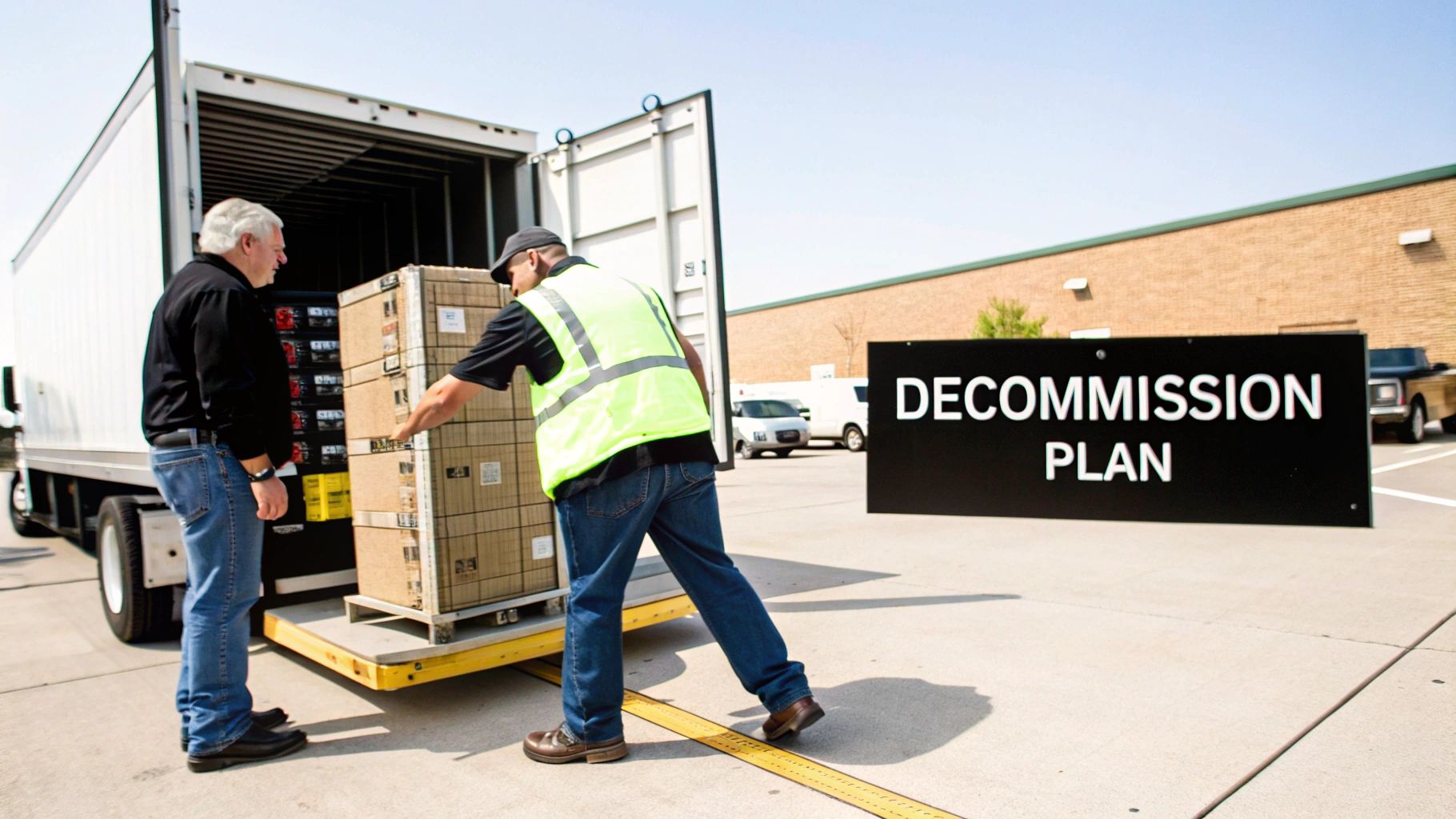
You can have the best vendor and the most detailed audit in the world, but if the actual pickup day is chaos, none of it matters. The success of your entire corporate ewaste solution really boils down to how smoothly things run on the ground. This is the practical playbook for IT and facilities managers who are on the hook for getting assets out the door with minimal disruption.
It doesn't matter if you're coordinating a full data center teardown in Atlanta, clearing out labs across a university campus in Texas, or just handling a routine IT refresh nationwide. A solid decommissioning plan is what turns a logistical nightmare into a predictable, orderly process.
Crafting Your Decommissioning Blueprint
First things first: you need to map out the entire project. This is about more than just booking a truck; it’s about seeing the bottlenecks before they happen and getting all your internal teams on the same page. A good plan should be a shared document that spells out roles, timelines, and expectations for everyone.
Think about a hospital in downtown Atlanta decommissioning an entire wing. They have to think beyond just the IT gear. They're coordinating with facilities to clear hallways, booking elevator time, and figuring out how to safely move bulky medical equipment from the upper floors. One missed detail here can bring operations to a halt and rack up serious costs.
Your blueprint should nail down a few key things:
- A Clear Timeline: Set hard dates for when equipment gets disconnected, staged, and is ready for pickup. No ambiguity.
- Defined Roles: Who’s unplugging servers? Who has the clipboard on pickup day to check off the inventory list? Assign specific names to tasks.
- Staging Areas: Designate a secure, easy-to-access spot where all the assets can be gathered before the vendor shows up.
- Communication Plan: Make sure everyone from department heads to building security knows what’s happening and when.
Navigating Complex Logistical Challenges
Not every pickup is a simple affair. Clearing out a single-story office park is one thing, but pulling sensitive equipment out of a high-rise or a bustling research facility is a completely different ballgame. This is where you see the real value of a professional partner who brings their own team and fleet to the table.
Take that university lab cleanout. The world generated a staggering 62 million tonnes of e-waste in 2022, an 82% jump from 2010. According to the latest report on rising e-waste generation, this problem is growing 2.6 million tonnes every year, far outpacing recycling efforts. For a university trying to offload centrifuges, servers, and fume hoods, this isn't just junk—it's complex equipment that needs specialized handling to stay out of a landfill.
Your vendor should be a logistics partner, not just a pickup service. When a provider shows up with their own experienced, badged team and their own trucks, it simplifies everything from packing and de-installation to secure, documented transport.
The Vendor's Role on Pickup Day
A top-tier vendor doesn’t just arrive with a truck and a dolly. Their team should be prepared to execute the plan you built together, bringing the right tools and people for your specific job. They're there to do the heavy lifting—both literally and figuratively.
For a company with offices nationwide, a trusted partner who can manage pickups across different sites brings consistency and peace of mind. For a local Atlanta business, having a vendor with a nearby facility means more flexibility and faster turnaround times.
Here’s what a professional crew will handle on-site:
- Verify the Inventory: They'll check the assets against your audit list, making sure every single serialized item is accounted for before it leaves your control.
- Handle Secure Packing: Their team knows how to properly pack and palletize sensitive electronics to prevent damage in transit.
- Provide On-Site De-installation: For bigger jobs like server rooms, they can de-rack equipment themselves, freeing up your IT team for more important work.
- Ensure Secure Loading: Assets are loaded into a secure, GPS-tracked vehicle, which is critical for maintaining the chain of custody from your dock to their facility.
This hands-on support is what makes the difference. Having a partner manage these details lets your team stay focused on their real jobs, ensuring the whole process is seamless. You can learn more about how this works and see if you qualify for free service with our guide to scheduling an electronic recycling pickup.
The job isn't truly done just because the truck has pulled away from your loading dock.
In fact, what happens next is arguably the most critical part of your entire e-waste strategy. The final paper trail—the certificates, reports, and internal records—is your ultimate proof of compliance and due diligence. This is where you close the loop, protecting your organization from future liability and finding smart ways to manage your budget.
For many facilities managers and IT directors, the pickup feels like the finish line. I’ve been there. But really, it’s just the start of the final, most important leg of the race. Proper documentation is your shield in an audit and your proof of a job well done.
The Anatomy of an Ironclad Paper Trail
After your assets are processed, your e-waste partner must provide detailed documentation that confirms the final disposition of every single item. Vague, summary-level reports are a massive red flag. You need granular, legally defensible proof that can stand up to scrutiny from any auditor or regulatory body.
Two documents are absolutely non-negotiable:
- Certificate of Destruction (COD): This is for any data-bearing device. It has to be serialized, meaning it lists every single hard drive by its unique serial number and confirms its data was either sanitized using DoD-compliant methods or physically destroyed.
- Certificate of Recycling (COR): This document covers everything else. It confirms the equipment was responsibly dismantled and all materials were sent to certified downstream processors—not a landfill.
These documents are far more than just receipts; they're your legal alibi. You can see exactly what a proper one looks like by checking out our sample Certificate of Destruction form. A well-documented certificate shifts liability from your organization to your vendor, but only if it’s accurate and complete.
Building Your Internal Record-Keeping System
Your vendor's reports are crucial, but they should feed directly into your own internal system. This creates a complete, closed-loop record that tracks an asset’s entire lifecycle, from the day it was purchased to its final, documented destruction.
An auditor for HIPAA or a financial regulation won't just ask for your vendor's COD. They’ll want to see how it matches up with your internal asset management records. Your system should be able to connect the serial number on that certificate straight back to the asset tag assigned to that laptop or server when it first came online.
Think of it like this: your internal audit creates the "birth certificate" for a retiring asset, and the vendor's documentation is its "death certificate." A complete file connects the two, leaving no gaps or unanswered questions about where that piece of equipment—and its data—went.
Turning E-Waste from an Expense to a Value Stream
Now, let's talk about the bottom line. Secure disposal and recycling services often have fees, but a transparent and capable partner can help significantly offset—or even eliminate—these costs. The key is asset value recovery. Not all of your old equipment is junk; some of it still has real market value.
A good partner has a system for testing and grading retired assets to see what can be refurbished and resold. They should offer a transparent profit-sharing model, giving you a clear percentage of the revenue generated from your equipment. This turns a line-item expense into a value-driven operation.
This financial piece is often overlooked, but it's incredibly significant. For instance, the 62 million tonnes of e-waste generated in 2022 contained metals worth an astounding $91 billion, including valuable materials like copper, iron, and gold.
Shockingly, only a fraction of this was recovered, leaving $62 billion in resources either buried in landfills or otherwise lost. As highlighted by new data on the value of e-waste, this shows the immense recoverable value just waiting in obsolete equipment. For Atlanta-area hospitals and corporations nationwide, a certified partner can maximize this recovery, turning old assets into a direct offset against disposal fees. This approach makes your e-waste program not just compliant, but financially smart.
Answering Your Top Questions About Corporate E-Waste
Even when you have a solid plan, questions are bound to pop up. Let's be honest, navigating the world of corporate e-waste solutions can feel like a minefield, especially when you’re trying to juggle compliance, data security, and the bottom line.
We get calls all the time from IT directors, facilities managers, and business owners across the Atlanta area and from national companies asking the same kinds of questions. So, let’s cut through the jargon and get you some clear, straightforward answers to help you build an e-waste program that actually works.
What Is the Difference Between E-waste Recycling and ITAD?
This is a big one, and the confusion is understandable. While e-waste recycling and IT Asset Disposition (ITAD) are definitely related, they aren't the same thing. Think of it as the difference between just throwing something away versus managing its entire retirement from service.
E-waste recycling is really about one thing: material recovery. Its job is to take electronics that are well and truly dead, safely break them down into raw commodities like plastic, glass, and metal, and keep hazardous materials out of our landfills. This is the last stop on the train for gear with zero functional or financial value left.
ITAD, on the other hand, is a much bigger, more strategic game. A real ITAD partner approaches your equipment with a value-first mindset.
- Data Destruction: Their absolute first priority is the secure, verifiable, and permanent destruction of all sensitive data on your devices. No exceptions.
- Remarketing and Refurbishment: They’ll then assess which assets can be repaired, upgraded, and resold. The goal here is to squeeze every last drop of value out of your old tech, putting money back in your pocket.
- Responsible Recycling: For anything that can't be reused, they manage a compliant and fully documented recycling process.
A complete corporate e-waste solution needs both. It should start with ITAD principles to lock down data security and recover value, then funnel the rest into certified e-waste recycling. This way, nothing gets wasted—not your data's integrity, and not your asset's potential value.
How Do We Guarantee Data Security on Retired Devices?
This is the question that should keep managers up at night. A simple promise that data has been destroyed just doesn't cut it. You need hard, verifiable proof. The only way to truly guarantee data security is to work with a certified vendor who provides a legally defensible, auditable process from the moment they touch your equipment.
Look for a vendor whose process includes two non-negotiable methods for handling anything that stores data. For drives that are still functional and could be reused, they must use DoD 5220.22-M compliant data wiping software. This isn't just a simple delete; it's a multi-pass process that overwrites the entire drive with random data, making the original information impossible to recover.
For any hard drives that have failed, are too old, or held extremely sensitive information, the only answer is physical shredding. The drive is fed into an industrial shredder that turns it into tiny, mangled pieces of metal. There’s no coming back from that.
Always, always insist on receiving a serialized Certificate of Destruction. This document should list every single drive by its serial number and specify exactly which destruction method was used. This is your proof of compliance and your shield against liability, especially for regulations like HIPAA.
Are There Costs for Corporate E-waste Recycling?
The short answer is: it depends. The economics of this industry are all about commodity values, labor costs, and whether your old assets can be resold. Be wary of any vendor offering "free" services without explaining how they make it work.
Often, a free pickup is only possible if your load is packed with high-value IT assets—think newer laptops, servers, and networking gear that have a strong resale market. The revenue from remarketing those items is enough to cover the vendor's costs for everything else.
But let's be real, most corporate cleanouts include a lot of stuff that actually costs money to recycle properly. This includes things like:
- Old CRT monitors (the big, bulky ones) that contain leaded glass.
- Low-value peripherals like keyboards, mice, and tangled bins of cables.
- Specialized lab or industrial equipment that requires careful manual disassembly.
The best partners are transparent. They'll give you an itemized breakdown, clearly explaining any fees for the costly items while also showing you the potential value they can recover from your other assets. With this approach, you can build a smart, cost-effective program where the value from your remarketed equipment can seriously offset, or even completely cover, your recycling costs.
How Should We Handle Specialized Lab or Medical Equipment?
This is where you absolutely cannot afford to hire a generalist. Disposing of specialized equipment from a hospital, a university lab, or an R&D facility requires a vendor who knows exactly what they're dealing with. Things like centrifuges, mass spectrometers, or patient monitoring systems are not your average IT assets.
These devices can contain unique electronics, proprietary software, and even residual biological or chemical hazards if they haven't been properly decontaminated. When you’re vetting a potential partner, ask them point-blank if they have direct experience with the specific types of scientific or medical instruments you need to get rid of.
A qualified vendor will understand the unique challenges, from de-installing equipment in a sensitive cleanroom environment to ensuring it's transported compliantly. They should be able to show you case studies or give you references from other organizations in your field. Choosing a specialist for this kind of work is the only way to ensure your unique equipment is handled safely, securely, and in line with every environmental and health regulation on the books.
Ready to build a secure, compliant, and cost-effective e-waste program for your organization? The team at Scientific Equipment Disposal specializes in handling everything from corporate IT assets to sensitive laboratory and medical equipment. We provide transparent, certified solutions for businesses throughout the Atlanta metro area and nationwide.
Schedule your free consultation and discover a better e-waste solution today.