Choosing a Laboratory Moving Company You Can Trust

A successful laboratory moving company is much more than just a logistics provider. They’re a strategic partner, responsible for safeguarding millions of dollars in sensitive equipment and, more importantly, irreplaceable research. Moving a lab is a high-stakes operation that demands meticulous planning and specialized handling, whether you're moving across town in a major hub like Boston or coordinating a complex nationwide transfer from California to New York.
Your Blueprint for a Successful Lab Relocation
Let’s be clear: relocating a laboratory is nothing like a standard office move. This process is far more complex than just boxing up supplies and hauling furniture. It requires a strategic, precisely executed plan to protect high-value assets, maintain research continuity, and keep your staff safe. An unplanned move can be catastrophic, leading to equipment damage, lost data, and months of operational downtime. The only way to succeed is to treat the relocation like a formal project with clear phases, dedicated leadership, and constant communication, whether your move is local or nationwide.
The financial and operational risks are huge. A single piece of analytical equipment can be worth hundreds of thousands of dollars, and the data it holds is often priceless. This reality is reflected in the growing global laboratory equipment market, which is projected to hit USD 59.93 billion by 2031. Hospitals and clinics are driving much of this growth, holding a dominant 46.15% market share in 2025 and underscoring the sheer volume of critical assets that need expert handling.
Building a Realistic Relocation Timeline
The single biggest mistake I see organizations make is underestimating the time required. A rushed timeline is a recipe for disaster, leading to overlooked details and costly errors. For a smooth transition, your planning needs to start long before the first box is even packed.
A well-structured timeline generally breaks down into these key phases:
- 6–9 Months Out: This is where it all begins. Start defining the scope of the move, hash out a preliminary budget, and begin the process of vetting potential laboratory moving company partners, both local specialists and nationwide providers.
- 4–6 Months Out: Time to assemble your internal move team. Assign specific roles and responsibilities to each member. You should also finalize your choice of moving partner and start drafting a detailed master move plan with them.
- 2–3 Months Out: Conduct a wall-to-wall inventory of every asset, chemical, and biological sample. Make the tough calls now: what gets moved, what gets disposed of, and what can be recycled?
- 1 Month Out: Finalize the move schedule, confirm all decontamination procedures are in place, and communicate the plan clearly to everyone, from the principal investigators down to the facilities crew.
- Move Week: Boots on the ground. Execute the physical move according to the plan. Your key team members need to be on-site at both the old and new locations to oversee everything.
Assembling Your Internal Move Team
No laboratory moving company, no matter how good they are, can work in a vacuum. A successful move hinges on a dedicated internal team acting as the central nervous system for the entire project. This team is the bridge between your staff and the movers, making sure everyone is aligned and speaking the same language.
Key Takeaway: Your internal move team must be cross-functional. Bring in people from lab management, research staff, facilities, IT, and—critically—Environmental Health and Safety (EHS). This diversity of perspectives ensures all the important bases are covered from day one.
This simple diagram helps visualize the core phases of a well-organized lab relocation, breaking the massive project down into three manageable stages.
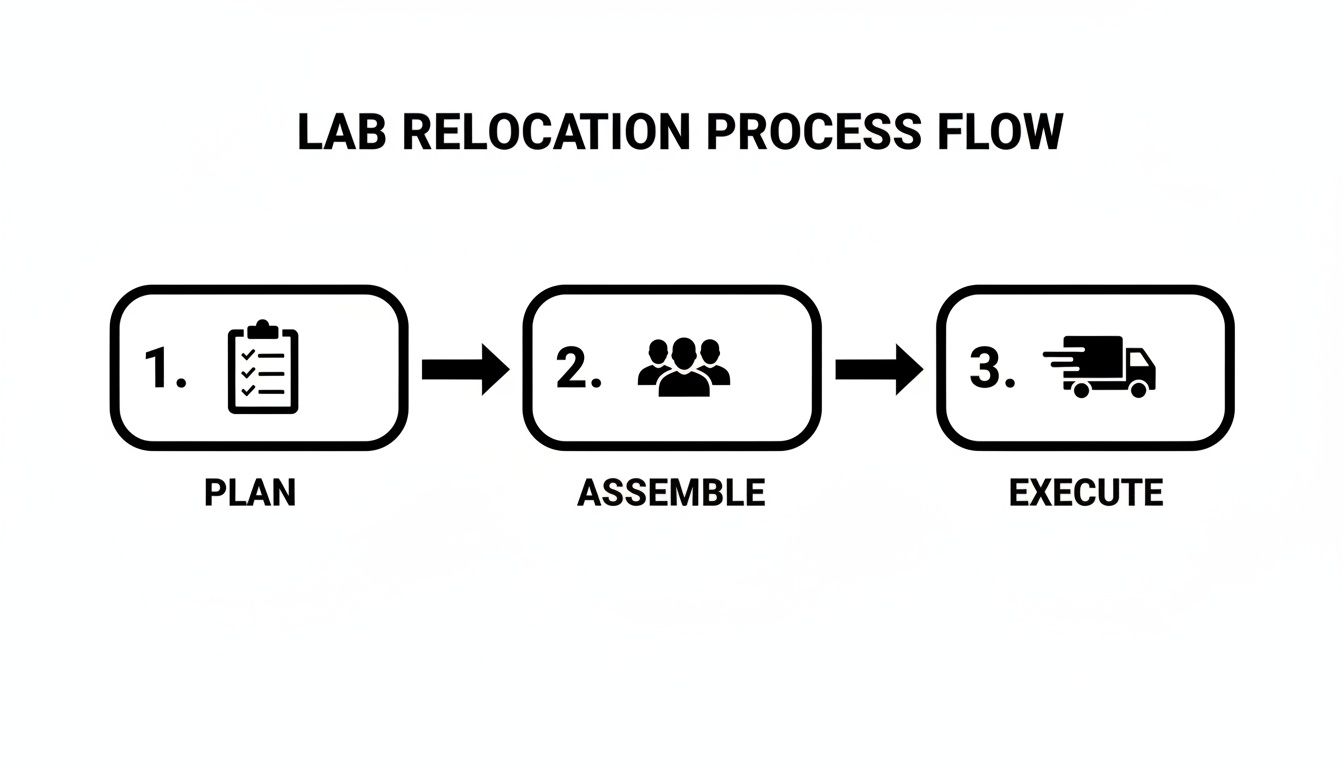
Thinking about the move as a distinct process of planning, assembling your resources, and then executing the plan helps clarify priorities and keeps your team from getting overwhelmed. Once the move is complete, this team will also be responsible for managing the decommissioning of the old space, which often means bringing in specialists for equipment disposal. If you’re curious about that side of things, you might want to explore our guide on how the scientific equipment disposal process works.
Navigating Compliance and Biosafety in Your Move
Moving a laboratory is about much more than just packing boxes and loading trucks. One wrong move with compliance or biosafety can bring the entire project to a grinding halt, not to mention the risk of safety incidents and serious fines.
Your laboratory moving company can't just be a logistics provider; they have to be your compliance partner. They should be intimately familiar with the maze of regulations from agencies like OSHA, the EPA, and the DOT, guiding you every step of the way across any state line.
Mastering Equipment Decontamination and Documentation
This is where the rubber really meets the road. Before any equipment—from a tabletop centrifuge to a floor-model mass spectrometer—is packed, it has to be professionally decontaminated. This is non-negotiable.
Your moving partner will require signed documentation for every single asset, certifying it’s free from biological, chemical, and radiological hazards. If you can't provide this proof, they will refuse to transport the equipment. Period. Imagine your multi-million dollar relocation screeching to a halt because of missing paperwork. I’ve seen it happen.
Think of the documentation as a passport for each piece of equipment. Every item needs a signed "Equipment Decontamination Form" that details:
- The decontamination methods used (e.g., chemical wipe, autoclaving).
- The specific cleaning agents applied.
- The date and signature of the lab personnel who performed the work.
Your internal EHS team should lead the decontamination process, but your mover needs to audit the paperwork meticulously. Without it, the chain of custody is broken, and serious liability issues pop up instantly. For any sensitive materials or controlled substances, using certified tamper evident packaging is another layer of security that ensures nothing has been compromised during transit.
Understanding Biosafety Levels and Transport Protocols
The biosafety level (BSL) of your lab completely changes the rules of the game. Moving a BSL-1 facility is worlds apart from relocating a BSL-3 lab, and the protocols are not interchangeable.
- BSL-1 & BSL-2: These moves still demand careful handling and proper labeling to prevent any spills. Documentation remains critical, but the transport requirements are more straightforward.
- BSL-3 & BSL-4: High-containment labs are a whole different animal. These projects often require special permits, sealed and climate-controlled vehicles, and sometimes even coordination with public safety officials. Frankly, only a handful of moving companies nationwide have the expertise and clearance for this kind of work.
A common mistake is assuming any company with "lab mover" in their name can handle all biosafety levels. You have to verify their specific experience. Ask for case studies or references from labs with a BSL designation that matches yours. Don't take their word for it—confirm their competency.
This is why a thorough risk assessment is one of the first things you should do. Your team needs to identify every potential hazard, from a chemical spill on a highway in Texas to a data breach from an unsecured instrument in a local facility. This assessment should also outline clear strategies to mitigate each risk. A great way to boost your team's awareness is by reviewing the common laboratory hazard signs and their meanings so everyone is on the same page about potential dangers.
Ultimately, getting compliance right isn't about checking boxes. It’s about ensuring the safety of your team, the moving crew, and the public. A truly qualified moving partner understands this and shares that responsibility, helping you manage the paperwork and navigate transport regulations so your relocation is safe, secure, and fully compliant from beginning to end.
Taming the Beast: Your Asset Inventory and De-Installation Plan
A successful lab move boils down to one simple truth: you can't move what you haven't tracked. Getting a handle on your asset inventory is the first, most critical step. It prevents the inevitable chaos, creates clear accountability, and gives your laboratory moving company the real scope of the job. This isn't just about counting beakers; it’s a full-blown strategic audit of every single piece of equipment you own.
The process starts with a complete, wall-to-wall catalog. For every item, you need to know its make, model, serial number, current condition, and its final destination—is it being moved, recycled, or disposed of? You can manage this with modern inventory software or even a well-organized spreadsheet, but a solid tagging system is non-negotiable. Using color-coded labels or barcodes is the only way to physically keep track of everything once the boxes start moving.
Don’t Let Amateurs Touch Your Complex Machinery
Once your inventory is locked down, the really delicate work begins: de-installation. Let me be clear—this is not a job for general movers or your internal facilities crew. Your high-value scientific instruments require an expert’s touch to be safely disconnected, taken apart, and prepped for their journey. One wrong move here can lead to six-figure damage, voided warranties, and brutal project delays.
I’ve seen it happen time and time again with equipment like:
- Analytical Instruments: A mass spectrometer or HPLC system isn't something you just unplug. A certified technician knows the manufacturer-specific protocols for shutting them down, locking down sensitive gantries, draining fluid lines, and protecting the delicate optics inside.
- Fume Hoods & Biosafety Cabinets: These are critical safety systems, not just furniture. Proper de-installation means safely disconnecting complex ductwork and electrical systems, all while making sure any residual hazardous materials are fully contained.
- Ultra-Low Temperature Freezers: Moving a -80°C freezer is a high-stakes operation. You need a bulletproof plan to either transfer priceless samples to a backup unit or use a generator-powered truck to maintain temperature in transit. One mistake could wipe out years of research.
This kind of specialized work is why the laboratory equipment services market is booming. In fact, North America held a 40.2% global share of this market in 2024, and the entire sector is projected to hit USD 35.4 billion by 2030. This explosive growth just underscores how critical professional de-installation and transport have become for any serious lab move.
Protecting Your Data and Dealing with Surplus Gear
Today's lab instruments are more than just hardware; many of them, from sequencers to plate readers, have internal hard drives packed with sensitive data. It could be research data, patient information, or proprietary formulas. Protecting this information during a move is just as important as protecting the physical machine itself.
If the equipment is coming with you, make sure your moving partner can guarantee a secure chain of custody from start to finish. But for any assets you're getting rid of, data security is not optional.
Expert Tip: Don't ever assume that just "deleting" files is good enough. To comply with regulations like HIPAA, you need concrete proof of data destruction. Insist on either DoD 5220.22-M standard data wiping for drives you might reuse or physical shredding for anything obsolete. Always, always get a Certificate of Data Destruction for your records.
This leads to the final big decision: what to do with all the surplus assets? Not everything is going to make the cut for the new facility. A clear disposition plan is vital for staying efficient and sustainable. I recommend using a simple matrix to categorize each item and decide on the right course of action.
Before you start, it’s helpful to understand what’s involved in professional scientific equipment disposal services. A good plan doesn't just clear out your old space—it ensures you handle e-waste responsibly and maybe even recover some value from old gear.
To help you make these calls, here is a simple decision matrix. It's a great tool for quickly sorting through your surplus inventory and making a consistent, defensible choice for every piece of equipment.
Asset Disposition Decision Matrix
| Asset Condition | Age of Equipment | Data Security Risk | Recommended Action | Example |
|---|---|---|---|---|
| Excellent | 0-3 years | Low to High | Resell or Redeploy | 2-year-old PCR machine |
| Good | 4-7 years | Low to High | Resell, Donate, or Recycle | 5-year-old centrifuge |
| Fair | 8-10 years | Low | Recycle or Donate | 9-year-old lab incubator |
| Poor/Broken | 10+ years | Low | Certified E-Waste Recycling | Broken 12-year-old shaker |
| Any Condition | Any Age | High (Contains PHI/IP) | Data Wipe & Resell/Recycle | Sequencer with patient data |
This framework removes the guesswork. By applying these criteria, your team can move quickly and confidently, ensuring every asset is handled appropriately, securely, and in compliance with all regulations.
How to Select the Right Laboratory Moving Partner
Choosing your moving vendor is easily the most critical decision you'll make for your lab relocation. Let's be clear: a standard commercial mover just won't cut it. You absolutely need a specialized laboratory moving company that comes with the right experience, equipment, and documented protocols.
This one choice directly impacts the safety of your assets, the continuity of your research, and your project's bottom line. The right partner becomes an extension of your own team, navigating you through the tricky compliance and logistical hurdles. The wrong one? That path leads to damaged equipment, catastrophic data loss, and downtime that's as long as it is expensive. Your vetting process has to be thorough, deliberate, and laser-focused on finding a team whose skills perfectly match your lab's specific needs.
Distinguishing Local Experts From Nationwide Providers
One of the first things to figure out is the scope of your move. Are you going across town or across the country? This will determine whether you need a mover with deep local roots or one with a broad national footprint. Both have their own distinct advantages.
Local Laboratory Movers: A company with a strong local presence in a research hub like Atlanta, San Diego, or Raleigh-Durham offers priceless knowledge of regional traffic patterns, building access quirks, and local disposal regulations. They often provide more personalized, hands-on project management for moves within the city or state.
Nationwide Laboratory Movers: For cross-country relocations, a national provider is non-negotiable. They already have the logistics networks, regulatory knowledge that spans state lines, and resources to manage complex, long-haul projects without a hitch. They are simply better equipped to handle the headaches of multi-state compliance and coordinated transport.
The key is to match the vendor's core strength to your project's geography. A local specialist is probably perfect for moving a university lab to a new campus nearby, while a biotech firm relocating its headquarters from one coast to another absolutely needs a nationwide operator.
Vetting Potential Partners: A Checklist for Success
Once you have a shortlist of potential movers, it's time to dig into the nitty-gritty details. Vague promises are a huge red flag; you need concrete answers and verifiable proof of their expertise. Use the following questions as a guide during your interviews.
A truly professional laboratory moving company will welcome detailed questions. If a vendor gets evasive or just gives you generic, canned answers, consider it a warning sign. Their transparency during the vetting process is a strong indicator of how they'll communicate during the actual move.
This is especially critical given the sheer volume of assets in circulation. The global market for laboratory equipment is valued at USD 72.38 billion in 2024 and is only expected to grow. This means more surplus and in-use equipment requires expert handling. This growth, particularly in North America, creates high demand for specialized movers who can manage both local and cross-continental relocations. You can discover more about lab equipment market trends at Market Research Future.
Use this checklist to give your conversations some structure and compare potential partners on an even playing field. A mover that can confidently address these points is far more likely to be a reliable partner.
Vendor Vetting Checklist
When you're interviewing potential movers, you need a consistent way to evaluate them. The table below outlines the key areas to probe and what a great answer should sound like. A solid partner will have no trouble providing detailed, specific responses to these questions.
| Evaluation Category | Key Questions to Ask | Ideal Answer / What to Look For |
|---|---|---|
| Experience & Specialization | "Can you provide case studies for moves similar to ours (e.g., BSL-2, biotech, university)?" | They should readily provide relevant examples and references from similar organizations without hesitation. |
| Insurance & Liability | "What are your liability limits, and can you provide a Certificate of Insurance?" | Look for coverage specifically for high-value scientific equipment, not just standard cargo insurance. The limits should match your asset value. |
| Equipment & Fleet | "Do you own and operate air-ride, climate-controlled trucks? What other specialized equipment do you use?" | They should own their specialized fleet. Reliance on rentals can introduce risk. Mention of custom crating and anti-static materials is a plus. |
| Employee Training | "What specific training do your employees receive for handling hazardous materials and sensitive equipment?" | They should detail ongoing training programs covering DOT HazMat regulations, proper packing techniques, and equipment-specific protocols. |
At the end of the day, selecting the right partner is all about mitigating risk. The time you invest in asking tough questions upfront will pay dividends later, ensuring your valuable assets are protected and your relocation is a success. This decision also impacts how you handle leftover assets; for more on that, check out our guide on selecting an e-waste recycling company.
Winding Down The Project: Validation and Decommissioning
Just because the moving trucks have pulled away doesn’t mean the project is over. In fact, some of the most critical work is just beginning. Once your equipment is in its new home, the validation phase kicks off. This is where you and your moving partner double-check that every single instrument is re-installed and functioning exactly as it should before your team can safely get back to work.
At the same time, you have to officially close out your old facility. This is more than just a final walkthrough; it’s a formal process of final decontamination sweeps, disposing of any remaining assets, and getting the right compliance paperwork signed off. This final chapter is all about diligence—ensuring a smooth start in your new lab and a clean, responsible exit from the old one.
Re-Installation, Calibration, and Final Validation
Your moving partner's work isn't finished until your equipment is not just in place, but fully operational and proven to be accurate. The re-installation has to be just as careful as the de-installation, following the manufacturer’s specs to the letter.
Once everything is powered up, the real work of calibration begins. Highly sensitive instruments—from mass spectrometers to specialized incubators—need professional calibration to confirm they're producing reliable data. It's a common temptation to rush this part, but I’ve seen firsthand how skipping proper validation can put months of future research at risk.
Expert Tip: Don't start from scratch. Create a post-move validation checklist for your most critical assets. This document should detail the specific performance tests each piece of equipment has to pass before it’s cleared for use. Get your lab staff and even the equipment manufacturers involved to set these criteria.
This process is your safety net. It catches any subtle issues or misalignments from the move and gets them fixed immediately, saving you from costly errors and headaches down the road.
Post-Move Inventory and Damage Inspection
With equipment back online, it’s time for a final inventory check. Pull out that master asset list you built during the planning phase and physically verify that every tagged item has made it to its new spot. This isn't just about making sure nothing is missing; it’s your best tool for spotting anything that got misplaced in the shuffle.
As you go, give every piece of equipment a thorough visual inspection. Note any dings, scratches, or other signs of physical damage, no matter how small. A reputable mover will have a straightforward claims process. Make sure you document everything with photos and detailed notes to back up your claim.
A solid post-move inspection always covers:
- Inventory Verification: Matching every item against your original, tagged list.
- Damage Assessment: A close look at casings, screens, and components for any transit-related damage.
- Functionality Checks: Powering on every device to confirm it completes basic functions.
- Finalize Paperwork: Signing off on all chain of custody forms and bills of lading for your records.
Decommissioning the Old Facility Responsibly
Leaving your old lab in a compliant, safe state is non-negotiable. This usually means a final, documented decontamination sweep of all surfaces, fume hoods, and biosafety cabinets. You'll need to get a formal clearance certificate from your EHS team or a third-party validator to prove the space is safe for whoever moves in next.
A huge part of this is proper hazmat waste management for any leftover chemicals or biologicals. For any equipment that didn't make the move, responsible e-waste disposition is a must. Working with a certified recycler ensures these assets don't end up in a landfill.
This is also the last checkpoint for data security. If you’re disposing of any devices that stored data, getting a certificate of destruction is your proof that sensitive information has been permanently wiped, protecting your organization from liability. To get a better handle on this document, you can learn more about what a Certificate of Destruction entails and why it’s a must-have for your project files.
Your Lab Relocation Questions, Answered
Even the most buttoned-up relocation plan will have loose ends. Moving a lab is a massive undertaking, and it's only natural for questions to pop up along the way. We get it.
Here are some of the most common questions we hear from lab managers, PIs, and facilities directors, along with some straight-shooting answers based on our experience in the field.
How Far in Advance Should I Start Planning a Lab Move?
This is probably the most critical question, and the answer depends entirely on the scale of your move.
For a standard local lab relocation, you need to start the conversation at least 6 to 9 months before you want the trucks to show up. That’s the minimum time needed to properly inventory everything, vet your moving partners, perform risk assessments, and get all your stakeholders on the same page.
If you're looking at a nationwide move—like relocating a BSL-3 facility or moving an entire research campus—you need to push that timeline out to 12 to 18 months. Seriously. Rushing the planning phase is the single biggest cause of expensive mistakes, damaged equipment, and painful operational downtime. Give your team (and your movers) the time they need to get it right.
What Is the Biggest Hidden Cost in a Laboratory Move?
It's not the specialized crates or the hazardous waste disposal, though those can certainly add up. The single biggest, and most underestimated, cost of any lab move is operational downtime.
Every single day your lab isn't generating data, running tests, or moving research forward, you're losing money and momentum.
The real cost of a move isn’t what’s on the invoice from your relocation partner. It’s the value of the research and work that isn’t getting done while you’re offline. A well-executed move is an investment in minimizing that downtime.
A few other surprise costs to watch out for:
- Instrument Recalibration: Many of your most sensitive instruments will need to be professionally recalibrated and re-certified after a move. This isn't cheap.
- Emergency Rentals: If a critical piece of equipment gets damaged in transit, you might be forced to rent a replacement just to keep your projects from grinding to a halt.
- Compliance Fines: One wrong move with e-waste or hazardous materials can lead to some eye-watering fines from regulatory bodies.
Can My Own Staff Pack Our Laboratory Equipment?
We hear this a lot, usually from folks trying to find ways to trim the budget. While it seems like a good idea on the surface, letting untrained staff pack sensitive, high-value lab equipment is a huge gamble. Your team members are experts in their scientific fields, not in logistics and specialized transport.
A professional lab moving team knows exactly how to:
- Properly brace delicate optics and lock down internal components to protect against vibration damage.
- Use anti-static wraps and packaging for sensitive electronics.
- Follow the often-tricky manufacturer guidelines for de-installing and prepping equipment for a move.
Here's the kicker: using your own staff often voids your equipment warranties. For your most critical and expensive assets, this is a risk you just can't afford. Leave it to the pros.
How Is Data Security Handled for Lab Equipment?
Any reputable lab moving company will have a rock-solid process for this. For any equipment that’s just being moved from point A to point B, they'll maintain a strict and documented chain of custody. This ensures no unauthorized hands ever get near your assets.
The process is even more rigorous for equipment that's being retired and disposed of. Your disposal partner should provide certified data destruction services that meet or exceed industry standards. This usually involves one of two methods:
- DoD 5220.22-M 3-pass data wiping to completely sanitize hard drives and make data unrecoverable.
- Physical shredding for older media or drives that are no longer functional.
Whatever you do, make sure you get a Certificate of Data Destruction when the job is done. This is your official proof that sensitive research data or PHI has been permanently destroyed, protecting your organization from future liability.
Planning a lab decommissioning or dealing with surplus equipment requires a partner who understands the complexities of asset disposition. Scientific Equipment Disposal specializes in the compliant and sustainable recycling of laboratory equipment and electronics throughout the Atlanta metro area. From on-site de-installation to certified data destruction, we provide a secure, streamlined solution for your facility.
Learn more about our services at https://www.scientificequipmentdisposal.com.