Your Nationwide Guide to Recycling X Ray Films


Recycling X-ray films is a critical process, and it goes way beyond just clearing out old storage closets. It’s about securely destroying sensitive patient data, recovering valuable silver, and doing your part for the environment. This isn’t just a cleanup task; it’s a matter of legal compliance and environmental responsibility.
For facilities across the nation sitting on stockpiles of old radiographic films, partnering with a certified recycler is the only real solution.
Why Compliant X-ray Film Recycling Is Essential
Let's be clear: managing outdated X-ray films is much more than a storage issue. It’s a significant liability for any healthcare or industrial facility. Leaving these films in a forgotten corner or, even worse, tossing them in the regular trash, is asking for serious trouble. This process is a non-negotiable part of responsible facility management.
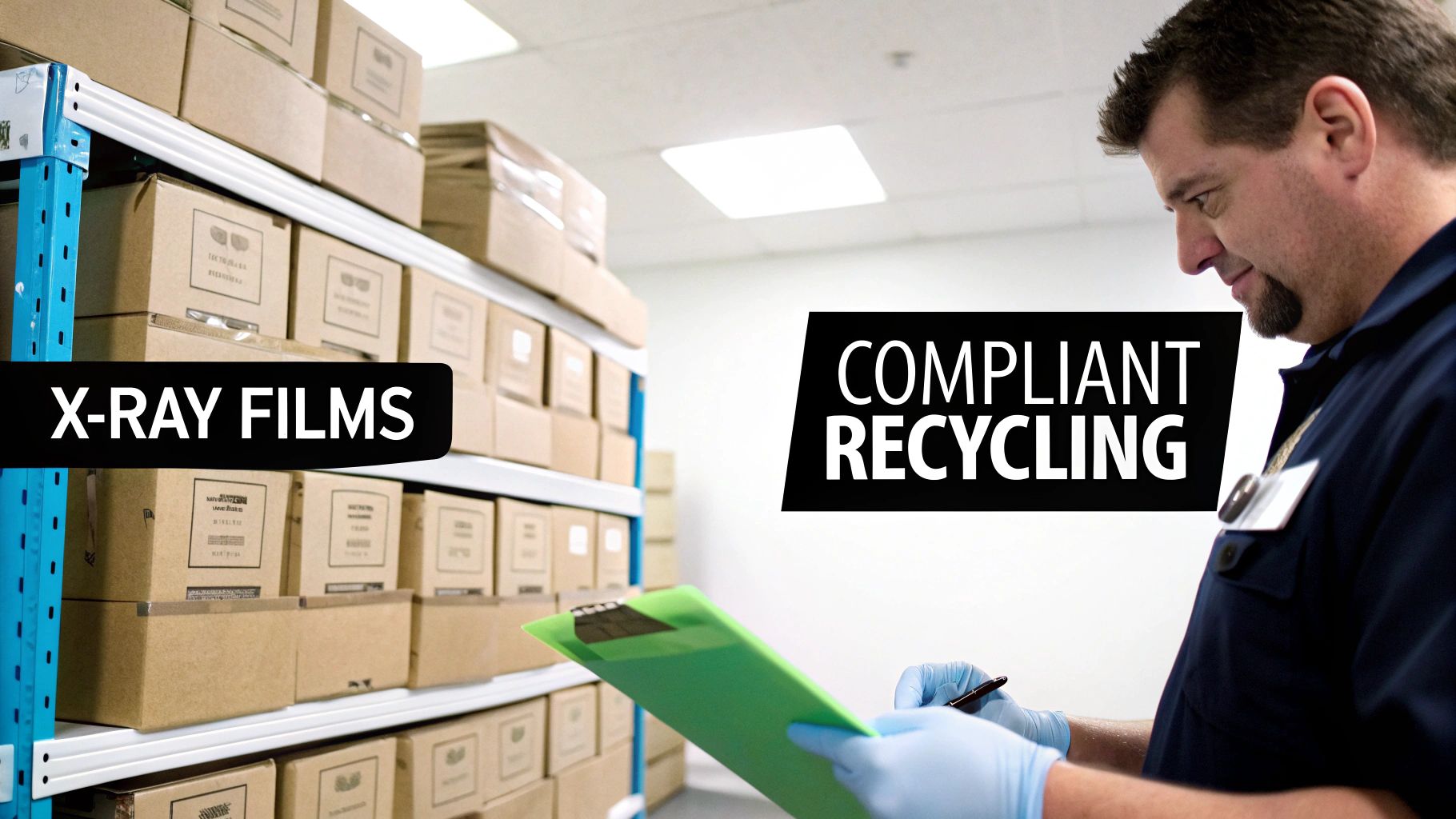
Environmental and Legal Risks
The real danger here is what the films are made of. Each sheet is coated with silver, a heavy metal that can easily leach into soil and groundwater if it ends up in a landfill. This kind of contamination is a direct threat to local ecosystems.
But the environmental fallout is only half the story. Every single X-ray film containing patient information is protected under the Health Insurance Portability and Accountability Act (HIPAA). A single lost or improperly discarded film is a data breach, plain and simple. That can trigger audits and lead to crippling fines that can hit thousands of dollars per violation. For facilities nationwide—from major hospitals in Atlanta to small dental clinics in rural communities—those risks are just too high to ignore.
The Value Hiding in Your Archives
The good news? This liability holds hidden value. The global X-ray film recycling market is a $250 million industry annually, driven by environmental regulations and the simple fact that vast archives of legacy films still need to be dealt with. Even with the shift to digital imaging, those old files aren't just going to disappear.
By partnering with a professional recycler, you can turn a potential hazard into a valuable resource. The silver recovered from the films is reintroduced into the manufacturing supply chain, supporting a circular economy.
This process really is a win-win-win:
- You stay HIPAA Compliant: Secure destruction of Protected Health Information (PHI) is guaranteed. You'll get a certificate of destruction to prove it.
- You protect the environment: You’re actively preventing silver and other chemicals from polluting local land and water sources.
- You reinforce your commitment to sustainability: It’s a tangible way to demonstrate responsible waste management and resource conservation.
When you think about it, compliant X-ray film recycling is a vital part of a bigger picture. It integrates directly into a larger commitment to sustainability in facility management. This approach doesn't just mitigate risk; it strengthens your organization's reputation for security and environmental stewardship.
Preparing Your Films for a Secure and Efficient Pickup
Getting your old X-ray films ready for recycling is more involved than just piling them in a corner. A little prep work upfront doesn't just make the pickup smoother—it's a critical step in maintaining your facility's security and compliance. The goal here is to create a solid, organized system that protects patient data from the moment a film is pulled from the archives until it's securely on its way.
Think of this as the first, and most important, link in your chain of custody. A disorganized mess can cause delays, drive up costs, and even create serious HIPAA compliance vulnerabilities. A successful pickup really starts long before the truck ever pulls up.
Take Stock and Sort Your Film Archive
Before you even think about boxing things up, you need to know what you have. Not all films are the same, and their composition directly affects the silver recovery yield—which is how recyclers determine their value.
It's a good idea to sort your collection into three main buckets:
- Medical X-Rays: These are the bread and butter of most facilities and have a standard silver content.
- Dental X-Rays: They're smaller and often have a different silver concentration than their medical counterparts.
- NDT (Non-Destructive Testing) Films: If you have these from industrial settings, they can contain a much higher percentage of silver.
Separating these out helps the recycler give you a far more accurate quote and makes their job easier. A clear inventory also gives you a realistic idea of the volume you're dealing with, which is key for scheduling and figuring out where to store it all.
Why You Absolutely Should Separate Films from Jackets
One of the single most impactful things you can do is pull the films out of their paper jackets, manila envelopes, and any other attached paperwork. I know it's a chore, but this one step drastically cuts down on the labor needed at the recycling facility, which can often lead to better terms for you.
When paper is mixed in, it adds a ton of weight and bulk. It also complicates the shredding and chemical washing process, slowing the whole operation down. Trust me, recyclers always prefer to receive "clean" film collections.
Pro Tip: Make this less of a headache by setting up a dedicated workstation. Get two large bins—one for the films, one for the paper jackets. An assembly-line approach makes the sorting go surprisingly fast. And don't forget: any paper with Protected Health Information (PHI) must be properly shredded to stay HIPAA compliant.
Secure Packaging and Staging for Pickup
Once you've got the films separated, they need to be packaged securely. Your top priority is protecting the sensitive patient information on them and making sure nothing gets spilled or damaged in transit. Heavy-duty cardboard boxes or durable plastic totes are your best bet.
Seal every container well with packing tape. A common mistake is overfilling the boxes—try to keep the weight manageable, somewhere around 30-40 pounds. This prevents back injuries and makes them much easier to move around.
Finally, these containers need to be moved to a secure, access-controlled area while they wait for pickup. This isn't optional; it's a core part of HIPAA compliance. A locked supply closet, a caged-off section of a warehouse, or any room where access is logged and monitored will work.
Carefully managing your old films ensures a secure and efficient disposal process. Of course, facilities often have other outdated equipment to deal with, too. You can find out more about handling broader e-waste with our guide on free electronic recycling pickups.
Maintaining a Bulletproof Chain of Custody
When you hand over your X-ray films for recycling, the physical items might be gone, but the responsibility for the Protected Health Information (PHI) on them stays firmly with you until they are completely destroyed. This is why a detailed chain of custody is your single most important tool in this process. It’s not just a stack of papers; it’s your legal, defensible proof that you managed that sensitive patient data properly from the moment it left your hands.
Think of it as a chronological paper trail. It documents every single person who handled the films, where they were stored, and precisely when they were transferred. If you ever face a HIPAA audit, this documentation is your first and best defense. Without it, you’re leaving your facility wide open to some serious legal and financial headaches.
This simple guide breaks down the essential prep work for a secure handover.
Each of these steps—separating the film types, packaging them correctly, and keeping them in a locked area—is a critical link. Get these right, and you've built an unbroken chain of custody before your recycling partner even arrives at your door.
Key Documents for a Verifiable Audit Trail
To make sure your chain of custody is solid, a few key documents are absolutely non-negotiable. Each one plays a specific role, and together they create a complete, verifiable record of the entire disposal journey.
Getting the paperwork right is crucial for a compliant chain of custody. Here’s a quick rundown of the essential documents you’ll need to track.
Essential Documentation for Compliant Film Recycling
| Document Type | Purpose | Who Provides It |
|---|---|---|
| Initial Inventory Log | Details the containers being transferred (box counts, estimated weights) to confirm what was handed over. | Your Facility |
| Signed Transfer Form | Officially transfers legal responsibility for the materials when signed by your rep and the recycler's driver. | Recycling Partner |
| Bill of Lading | Tracks the shipment from your facility to the recycling plant if a third-party freight carrier is involved. | Freight Carrier |
| Certificate of Destruction | The final, critical proof that your films and the PHI they contained have been permanently and compliantly destroyed. | Recycling Partner |
This set of documents proves you followed a secure, compliant process from start to finish. Always hold onto these records for at least six years, just as HIPAA requires.
Nationwide Consistency and Local Accountability
Managing film disposal is a challenge for facilities everywhere, but the best solutions often combine national standards with local presence. The global X-ray film recycling market shows major regional differences, with North America and Europe accounting for over 60% of the market share due to strong recycling programs. This highlights the importance of partnering with a certified provider who understands both federal regulations and local logistics, whether you're in a dense urban center or a remote area.
To keep your process consistent and defensible, using a good standard operating procedure template can make a world of difference for maintaining accurate records. Proper documentation is what protects your organization and ensures all that sensitive data is handled with the care it demands. You can learn more about how we handle secure data destruction and our commitment to compliance.
How Silver Recovery Turns Waste into a Resource
So, what actually happens to all those old X-ray films after they leave your facility? They don’t just get shredded and tossed. Instead, they kick off a fascinating process that turns a potential HIPAA liability into a surprisingly valuable commodity, feeding directly into a sustainable, circular economy.
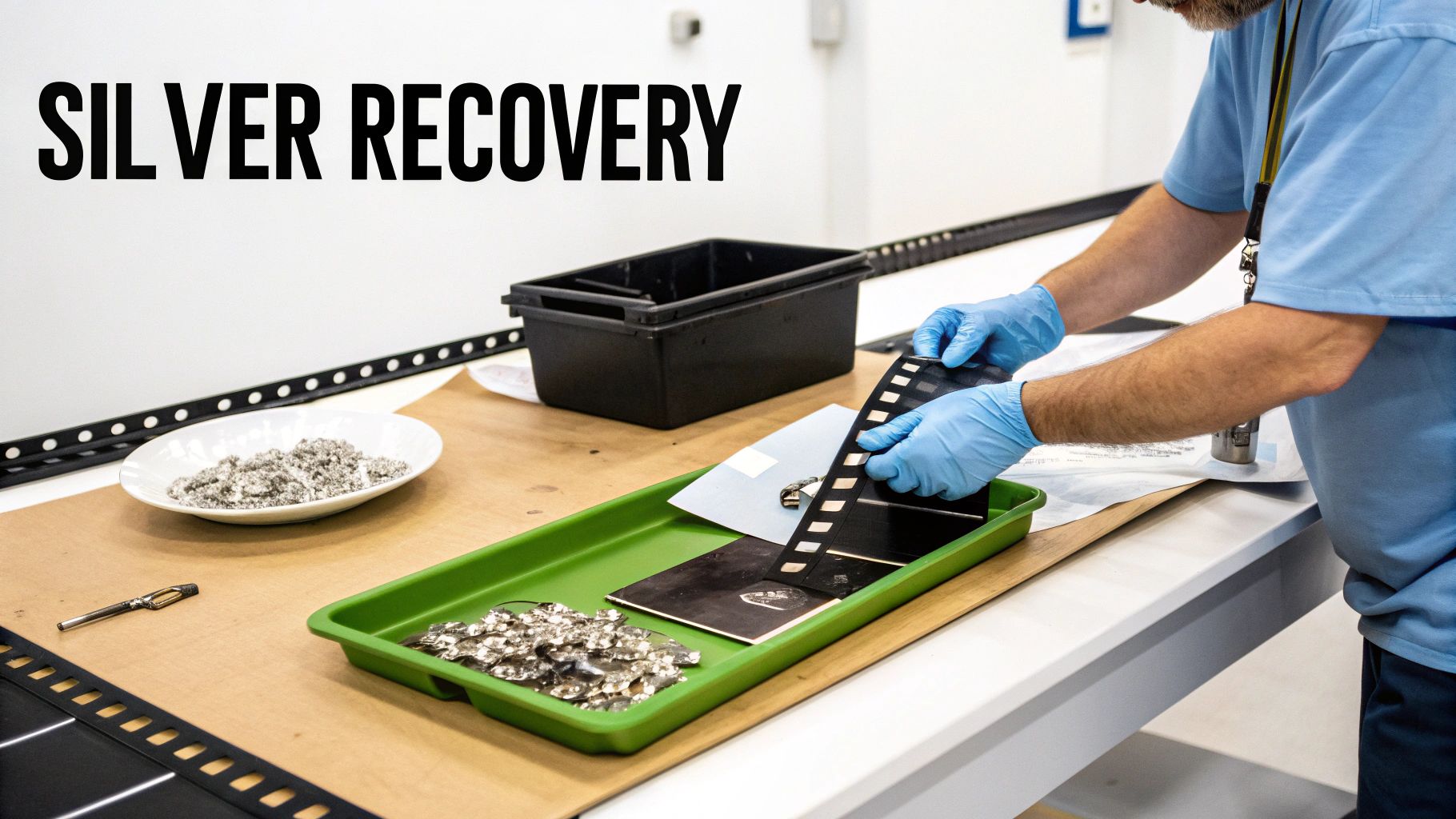
This whole operation hinges on silver recovery, a specialized method for pulling the precious metal straight out of the film's plastic base. It’s a common myth that the amount of silver is trivial. The reality? Silver can account for nearly 2% of an X-ray film's total weight. That’s a significant concentration, making recovery both profitable and environmentally essential.
The Extraction Process Explained
Once the films hit a certified recycling facility, their journey from medical record to raw material truly begins. Technicians there use advanced techniques to separate the valuable silver from the plastic it's bonded to.
One of the main methods is a chemical wash. The films are shredded and then submerged in a carefully balanced solution that dissolves the silver halides—those tiny crystals that form the image—without touching the plastic film itself. This effectively leaches the silver into the solution, where it can be recovered and refined into pure metallic silver.
The outcome gives you two distinct materials:
- Recovered Silver: This high-purity silver gets sent right back into the global supply chain, ready for use in new products.
- Clean Plastic: With the silver gone, the plastic base can be recycled separately and is often used to create new industrial materials.
Fueling a Sustainable Supply Chain
The silver recovered by recycling x ray films is anything but insignificant. In fact, this process is a critical artery for the global economy, supplying between 18-20% of the world's precious metal needs. With silver demand jumping from 25,700 metric tons in 2016 to 30,500 metric tons in 2021, this source is more important than ever, especially since traditional mining is both expensive and incredibly hard on the environment. You can dig into more data on how silver recovery from photographic waste is a green alternative to see the full impact.
By recycling your facility’s old films, you are directly contributing to the manufacturing of new electronics, jewelry, and medical components. This reduces the global reliance on destructive mining practices and conserves natural resources.
For facility managers nationwide, this reframes the entire task. What used to be a disposal headache tangled up in strict HIPAA rules is now a proactive step toward sustainability. You’re not just clearing out waste; you're converting a potentially hazardous material into a vital resource, closing the loop in a genuinely circular economy. If you want to dive deeper, check out our guide on professional silver recovery services.
Finding the Right Recycling Partner Near You
This is probably the most important decision you'll make in the entire process. Picking the right recycling vendor isn't just about getting rid of old films; it's about safeguarding your facility from massive compliance headaches. A top-tier partner is an extension of your risk management team, ensuring everything is handled by the book. A bad one? They can expose you to some serious HIPAA and environmental liabilities.
For any healthcare or lab manager, whether in Atlanta, Houston, or Los Angeles, doing your homework here is non-negotiable. You're not just hiring a hauler; you're entrusting a company with a mountain of Protected Health Information (PHI). The best partners for recycling x ray films understand this and put security above everything else.
Vetting a Vendor: What to Ask Before You Sign Anything
Before you even think about signing a contract, you need to grill potential vendors with some tough questions. Their answers (or lack thereof) will tell you everything you need to know about their operation and whether they're professional or just a guy with a truck.
Don't be afraid to dig deep. Here’s what you absolutely must ask:
- Are you NAID AAA Certified? This certification is the gold standard for secure data destruction. If they don't have it, it’s a major red flag about their commitment to proper security protocols.
- Do you use your own GPS-tracked trucks for pickups? You want a vendor that controls the entire chain of custody. If they outsource transportation to a third-party shipper, that’s a weak link you can’t afford.
- Will I receive a detailed Certificate of Destruction? This is your official proof that the PHI has been compliantly destroyed. It needs to clearly state the what, when, and how of the destruction process.
- How do you handle the paper jackets and other records? X-rays don't travel alone. A truly compliant recycler will have a secure shredding process for all the associated paperwork that contains PHI.
Full-Service Security vs. The Risks of Mail-In Programs
Out in the market, you'll see two main models: full-service providers who come to you and mail-in programs that ask you to ship your films. Mail-in services might look easy, especially for smaller batches, but they introduce a huge gap in your chain of custody. The second you hand those boxes to a common carrier, you've lost direct control and accountability.
A full-service provider, particularly one with a strong local or regional presence, manages everything from start to finish. Their own background-checked employees show up in company-owned vehicles, securely load your materials, and drive them directly back to their facility. This creates a solid, defensible chain of custody—something that's invaluable if you ever face a HIPAA audit.
Your partner's logistics are a direct reflection of their security posture. A vendor who owns their fleet and manages their own transport is investing in a closed-loop system designed to protect your data at every step.
How Does the Pricing Work?
Finally, you need to get a handle on the pricing. The value of your X-ray films is tied directly to the global silver market, which means it's always fluctuating. What you pay (or get paid) can change depending on market conditions.
Generally, you'll run into one of these three situations:
- You get paid: If silver prices are high and you have a large volume of "clean" film (already separated from paper jackets), the recycler might actually cut you a check.
- The service is free: For many facilities with a moderate amount of film, the value of the recovered silver is enough to cover the recycler's cost for pickup, labor, and destruction. It ends up being a wash—a no-cost service for you.
- You pay a fee: If you have a small batch, the films are heavily mixed with paper, or silver prices are in a slump, you'll likely have to pay a fee to cover the processing costs.
A transparent partner will walk you through these variables from the start so there are no surprises. You can learn more about how we handle professional and compliant recycling services for facilities in Atlanta, GA and get a clear idea of what to expect.
Your Top X-Ray Film Recycling Questions, Answered
Even with a solid plan, you're bound to have questions when setting up a film recycling program. I get it. Facility managers I talk to across the country often bring up the same concerns around cost, compliance, and the nitty-gritty logistics of getting it done right.
Let's cut through the noise. Here are the straightforward answers to the questions we hear most often from hospitals, labs, and private clinics nationwide.
How Much Is This Going to Cost Me?
This is always the first question, and the honest answer is: it depends. The final cost—or even a potential payout—is tied directly to two things: the current market price of silver and the condition of your film.
When it's all said and done, it usually shakes out in one of three ways:
- You get a check. If silver prices are high and your films are "clean" (already pulled from their paper jackets), the value of the recovered silver can be more than enough to cover our costs. In that case, we send you a payment.
- The service is a wash. More often than not, the silver value covers all the labor, transport, and certified destruction fees. Your facility gets a compliant, secure service at no cost. It’s a budget-neutral win.
- You pay a service fee. If the silver market is down, you have a pretty small batch of film, or it’s all still buried in paper jackets, you'll likely see a service fee to cover our operational costs.
What Happens to All the Paper Jackets and Patient Records?
This is a big one. Any paper that comes with your X-ray films—jackets, folders, patient charts—is loaded with Protected Health Information (PHI). A reputable recycling partner will never just toss it. These materials are handled as confidential documents and are securely shredded to meet strict HIPAA standards.
The secure destruction of all associated paperwork isn't optional; it's a critical part of the service. Your final Certificate of Destruction should cover both the films and any paper records we collected, giving you a complete, defensible audit trail.
Can We Get Rid of Other Medical Waste at the Same Time?
Great question. Many facilities see a film pickup as a chance to clear out other clutter. While we specialize in silver recovery from X-ray film, we absolutely offer broader e-waste and equipment disposal services. It never hurts to ask your vendor what else they can take off your hands.
For instance, you might be able to bundle the disposal of:
- Old, outdated lab equipment
- Retired computers, servers, and monitors
- Lead aprons and other protective gear
Consolidating these services with one trusted, local partner can save you a world of logistical headaches, especially if you're doing a full-scale lab cleanout or decommissioning a facility. It simplifies vendor management and ensures every sensitive item is handled with the same high standard of security and compliance.
Ready to clear out your old film archives the right way? Scientific Equipment Disposal offers secure, compliant, and sustainable recycling solutions for facilities nationwide. We handle everything from on-site pickup to certified destruction, turning your disposal liability into a manageable, secure process. Learn more and schedule your pickup at https://www.scientificequipmentdisposal.com.