IT Equipment Disposal in Peachtree Corners Georgia

The room usually looks harmless at first. A few retired laptops on a shelf. Old rack servers pulled during an upgrade. A printer no one wants to move. Then you open the storage closet behind the lab, or the back room near facilities, and realize the problem is not clutter. It is regulated equipment, data-bearing media, and a chain-of-custody issue waiting to go wrong.
This describes IT Equipment Disposal in Peachtree Corners Georgia for hospitals, clinics, universities, government offices, and companies with significant compliance exposure. A broken monitor is not just scrap. A failed SSD is not just trash. A decommissioned server from a medical office or research environment can carry patient records, financial data, credentials, internal documents, or system logs long after the device stopped being useful.
Local businesses often start by searching for electronics recycling or junk pickup. That is where mistakes begin. Generic recycling advice rarely addresses documented sanitization standards, auditable destruction records, or coordinated removal for large-volume decommissions. If you are managing a move, a renovation, a lab shutdown, or a data center refresh, disposal is part of your risk program. It is not an afterthought.
Navigating IT Asset Disposal in Peachtree Corners
A facility manager in Peachtree Corners usually calls when a deadline is already close. Lease turnover is coming. The IT refresh is done. The lab has surplus analyzers, workstations, and network gear stacked in a staging room. Someone asks whether the equipment can just be recycled.
That question sounds simple. It is not.
In healthcare and medical IT disposal, the biggest failures happen before anything leaves the building. A 2025 EPA report noted that 60% of e-waste incidents involve improper data destruction in medical IT disposal, and Georgia saw a 15% increase in healthcare fines for non-compliance last year, as cited by Montclair Crew’s Peachtree Corners page. That matters because many local service pages mention privacy in broad terms but do not say how drives are sanitized, what standard is used, or what proof the client receives.
Why generic recycling advice falls short
A desktop from an accounting office is one thing. A batch of nursing station PCs, retired imaging workstations, or storage arrays from a clinic is another.
The trade-off is straightforward:
- Fast disposal without documentation creates audit exposure.
- Cheap hauling without asset tracking breaks chain of custody.
- General recycling without media-specific sanitization leaves recoverable data behind.
- Drop-off models shift labor and liability back to your staff.
For many organizations, the hidden cost is internal time. Someone has to identify what holds data, decide what can be reused, disconnect equipment, coordinate removal, and preserve records for compliance.
What a compliant project actually looks like
A proper IT asset disposition process starts with inventory, then separates environmental handling from data handling. Those are related, but they are not the same job.
A workable process includes:
- Asset identification for computers, servers, monitors, printers, networking gear, and lab-adjacent electronics
- Data-bearing review so HDDs, SSDs, backup media, and embedded storage are not mixed with non-sensitive scrap
- Pickup planning that fits building access, loading dock rules, elevator limits, and shutdown timelines
- End documentation showing what was removed and how media was sanitized or destroyed
If you need a local reference point for business electronics recycling, this page on electronics recycling in Peachtree Corners GA reflects the kind of service scope organizations typically need when disposal involves more than a few office devices.
Practical takeaway: If your assets ever held protected health information, student records, financial data, credentials, or internal research files, do not evaluate vendors as if this were ordinary junk removal.
Understanding Georgia's E-Waste and Disposal Regulations
The first legal mistake many organizations make is treating old electronics like general solid waste. In Georgia, that approach can violate disposal rules before data security is even considered.
What Georgia law prohibits
Under the Georgia Computer Equipment Disposal and Recycling Act, businesses cannot landfill certain electronics, including computers and printers. The reason is environmental, not administrative.
According to Beyond Surplus on compliant electronics recycling in Georgia, a single ton of landfilled electronics can release up to 6.5 lbs of lead, and those materials fall under hazardous waste concerns recognized through the EPA’s Resource Conservation and Recovery Act, or RCRA. In practical terms for Peachtree Corners, that means improper disposal is not just sloppy. It creates a direct contamination risk for local groundwater and aquifers in Gwinnett County.
Why certified recycling matters
Once disposal moves into a compliant stream, the recycler’s role changes from hauler to regulated downstream manager. That is why certification matters.
The same Georgia compliance reference notes that certified recyclers must achieve 95-99% material recovery rates. That standard matters because old electronics contain recoverable metals and hazardous components that need controlled processing, not landfill disposal.
Here is the operational difference:
| Disposal path | What it means for your organization |
|---|---|
| General trash or unmanaged hauling | High environmental risk, no defensible recovery process |
| Basic recycling pickup | Better than trash, but may still leave documentation and downstream handling gaps |
| Certified electronics recycling | Structured processing, hazardous component control, and documented material recovery |
The rule facility managers should follow
If an item plugs in, stores power, contains a screen, or was part of your IT environment, treat it as a regulated disposition decision until proven otherwise.
That includes:
- Desktop computers and laptops
- Servers and storage hardware
- Monitors and printers
- Network switches and telecom gear
- Battery-backed devices and UPS units
- Lab-adjacent electronics with embedded boards or displays
Environmental compliance is separate from privacy compliance
A common internal misunderstanding is that wiping a hard drive solves the whole disposal issue. It does not.
A drive can be sanitized correctly and the chassis can still be mishandled environmentally. A monitor can contain no sensitive data and still require compliant recycling. You need both sides covered.
For organizations trying to sort out broader governance obligations, this overview of compliance and IT regulation is useful because it frames environmental handling as part of a larger business risk picture, not just a facilities task.
What works in practice
The safest approach is to build disposal into your formal asset retirement workflow. Facilities, IT, compliance, and department managers should agree on three things before pickup is scheduled:
- Which assets are leaving
- Which ones contain regulated or confidential data
- Which recycler will document compliant downstream handling
Organizations in metro Atlanta often use specialized providers for this reason. If you need a service category built around compliant processing rather than casual drop-off, e-waste recycling in Atlanta is the type of offering to look for.
Key point: Environmental disposal law does not care whether your equipment still works. If the asset falls into a covered electronics category, landfill disposal is the wrong path.
Data Sanitization and Destruction Your Top Priority
When equipment leaves your site, the most serious risk is usually not the metal, plastic, or boards. It is the data.
A retired server can still contain patient records, archived email, billing exports, VPN credentials, network diagrams, and internal research files. If the storage media was not sanitized correctly, disposal becomes a data breach pathway.
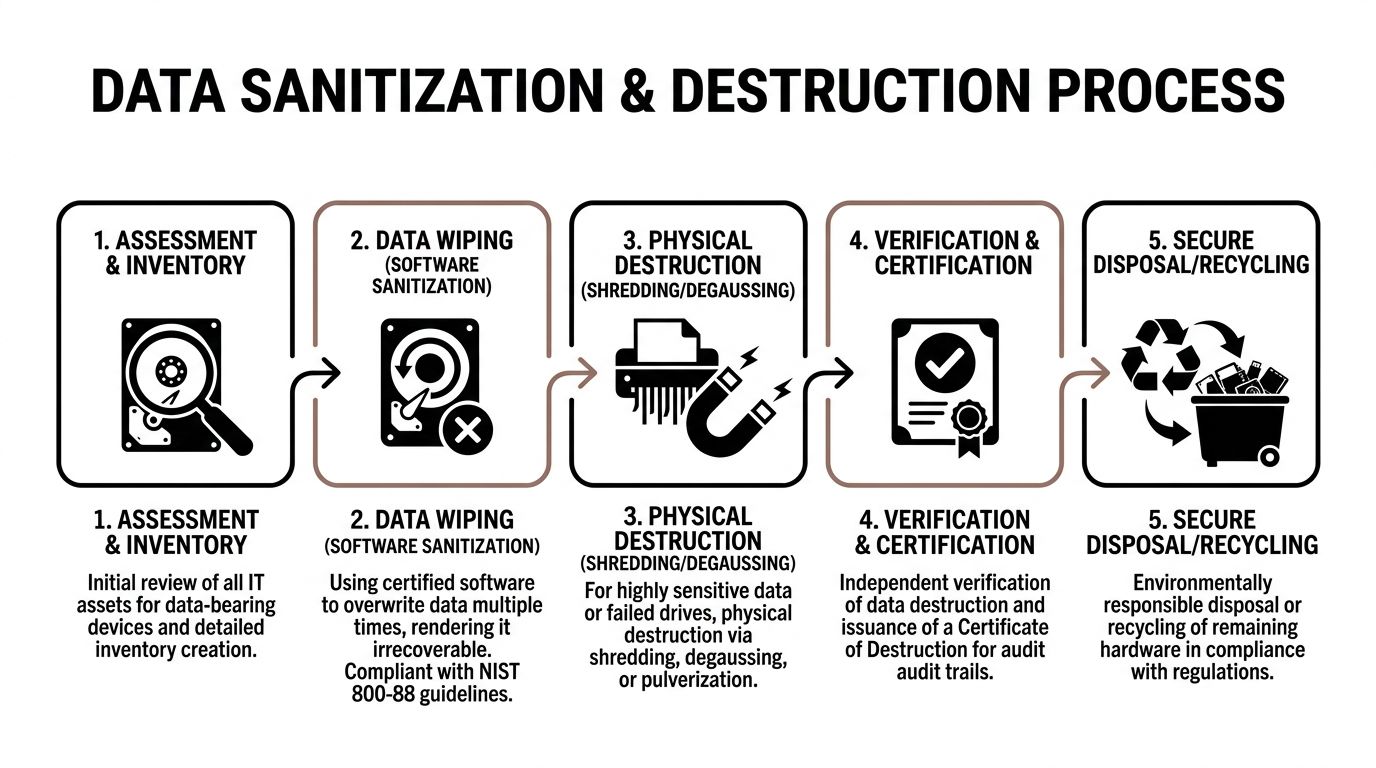
Wiping and shredding are different controls
Think of data wiping as preparing reusable equipment for lawful reassignment or resale. Think of physical destruction as removing any realistic chance of data recovery when reuse is not appropriate.
That distinction matters because different media behave differently.
Why old methods fail on modern storage
According to Data Destruction’s Georgia enterprise compliance guide, data on improperly wiped drives can be 70-90% recoverable. That is why broad claims like “we erase everything” are not enough.
The same source states that for HIPAA-covered entities, fines can reach up to $1.5M annually per violation category, and that NIST 800-88 compliant shredding to <2mm particles ensures data is unrecoverable, which is especially important for modern SSDs that resist older wiping and degaussing methods.
A few practical points matter here:
- Traditional HDDs can often be sanitized for reuse with a documented overwrite process when the drive is functional and the use case allows it.
- SSDs are different. Wear leveling and controller behavior can leave residual data outside the reach of older overwrite assumptions.
- Failed media should not be trusted for software-only sanitization because you cannot verify a full overwrite on a device that no longer functions properly.
What standard to ask for
The baseline standard to ask about is NIST SP 800-88. That is the framework most compliance teams look for when they need a defensible sanitization method tied to media type.
For reusable HDDs, many organizations still ask vendors about DoD 5220.22-M 3-pass sanitization as an operational method, especially where the vendor documents the overwrite and verification process. For SSDs and highly sensitive media, destruction is often the cleaner answer.
Here is a simple comparison:
| Media type | Usually suitable method | Not a reliable assumption |
|---|---|---|
| Working HDD | Documented software sanitization for reuse, if policy allows | Assuming “quick format” removed the data |
| Failed HDD | Physical destruction | Trying to verify a wipe on an unreadable drive |
| Working SSD | Media-specific sanitization or destruction based on policy | Treating it like an HDD |
| Failed SSD | Shredding to compliant particle size | Degaussing as a universal fix |
Recovery risk is not theoretical
Many managers underestimate what can be recovered from drives that were “deleted” or casually overwritten. That is where outside perspective helps. If you want to understand how much skilled technicians can still extract from damaged or partially sanitized storage, a page on professional SSD data recovery is a useful reminder that modern recovery work is complex. In other words, disposal planning should assume adversaries and investigators have better tools than your average user.
The records you need after destruction
A compliant process does not end when the drive is wiped or shredded. It ends when your organization receives records it can use in an audit, investigation, or internal review.
That usually means:
- An asset inventory with serial numbers or other identifiers
- A stated sanitization or destruction method
- Chain-of-custody documentation
- A Certificate of Destruction, especially for regulated environments
If your project includes hard drives, SSDs, backup devices, or server media, secure data destruction should be part of the vendor discussion before any pickup is approved.
Tip: If a vendor cannot explain how they handle HDDs versus SSDs, stop there. Media-specific handling is basic competence, not an advanced feature.
What to Expect From an On-Site Disposal Service
The best on-site projects feel controlled from the first call to the last signature. That matters because most disposal failures happen in handoffs. Equipment is moved without labels. A drive gets mixed into a gaylord of scrap. Nobody can later prove which serial numbers left the building.
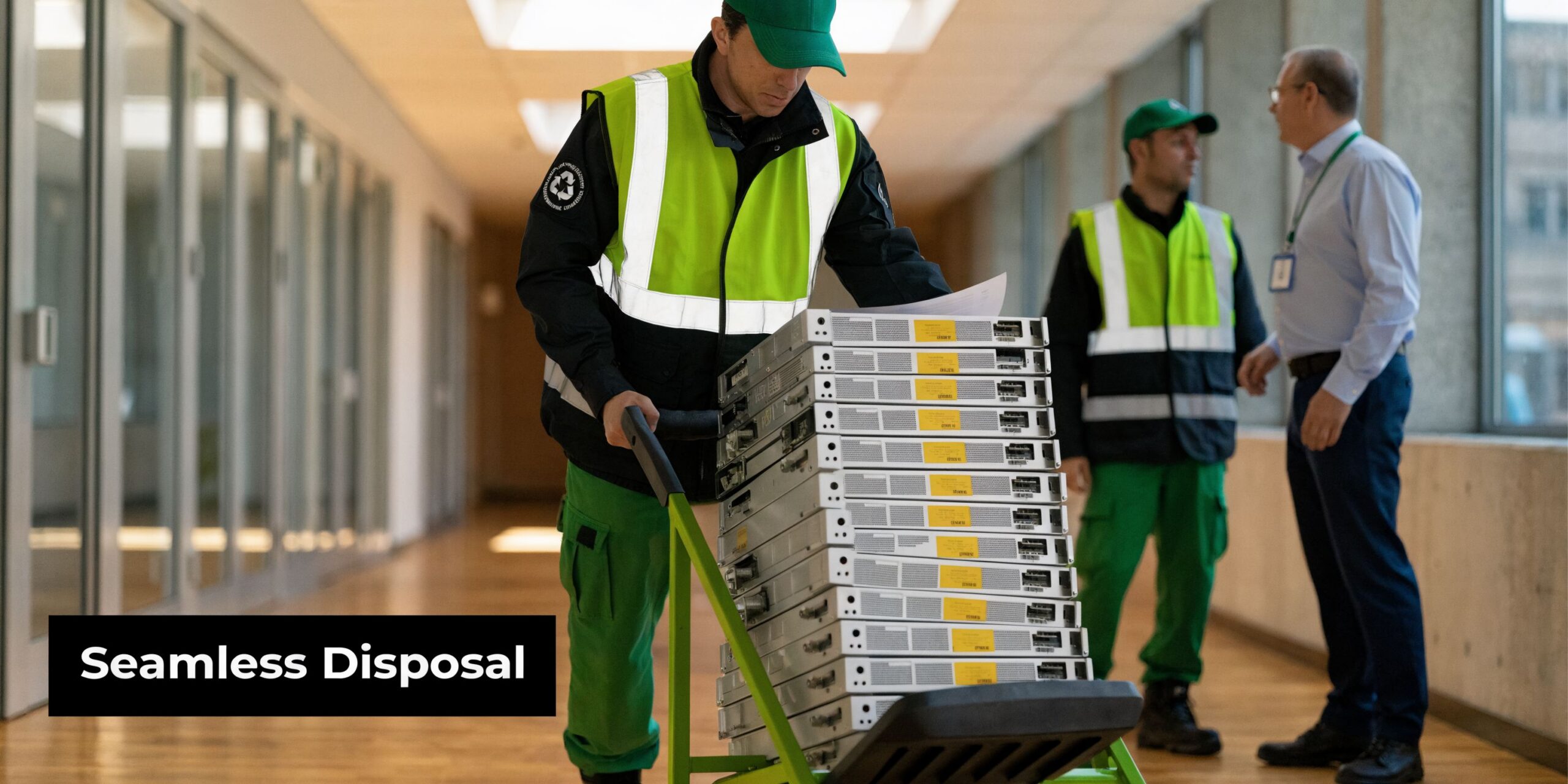
A professional on-site service prevents that by making removal a managed event, not an improvised pickup.
The job starts before the truck arrives
For a hospital wing cleanup, office consolidation, or lab shutdown, the service should begin with a clear scope review. The vendor needs to know what types of assets are involved, whether data-bearing media is present, whether the site has loading dock restrictions, and whether any items require deinstallation.
Here, generic drop-off advice breaks down. In Gwinnett County, corporate lab closures have risen, and for these decommissions logistics are a primary barrier. The same local Peachtree Corners recycling source notes that an on-site service with its own box-truck fleet can provide turnarounds often under 48 hours, which basic drop-off options cannot match, according to Beyond Surplus on Peachtree Corners electronics recycling.
What a well-run pickup day looks like
On pickup day, a good crew does not load everything visible. They verify the scope, check the staged assets, and separate data-bearing items from standard electronics where needed.
A typical sequence looks like this:
Arrival and site check-in
Building access, dock rules, freight elevator use, and point of contact are confirmed.Inventory confirmation
The team compares staged items against your list and flags discrepancies before loading.Handling by asset type
Servers, desktops, monitors, loose drives, and sensitive media are packaged and segregated appropriately.Chain of custody creation
The transfer is documented at the moment custody changes hands, not later from memory.Load-out and departure
The team clears the area, confirms what remains, and closes the pickup with documentation.
What separates a specialist from a hauler
The biggest operational difference is control.
A specialist plans around your facility. They account for narrow hallways, restricted rooms, deinstallation needs, and mixed inventories that include lab devices and IT hardware in the same project. A hauler focuses on volume out the door.
For projects involving drives and server media in particular, many facilities want a provider that can pair pickup logistics with documented destruction services such as secure hard drive destruction in Gwinnett County Georgia.
What works: staged pickups, preapproved asset lists, and one designated site contact.
What does not: asking three departments to “set aside whatever is old” and hoping the truck team sorts it out on arrival.
Where clients usually lose time
Most delays come from internal confusion, not transportation.
The common bottlenecks are:
- Unlabeled devices with unknown ownership
- Disconnected inventories between IT and facilities
- Items still in production use that were mistakenly added to pickup
- Lab equipment lacking decontamination paperwork
- No clear staging area
When those issues are handled in advance, the pickup becomes routine. When they are not, even a simple office clear-out turns into a chain-of-custody problem.
Your IT Equipment Disposal Preparation Checklist
A smooth pickup starts with your internal prep. Most project delays come from preventable gaps in asset identification, access, and paperwork.
Use this checklist before the disposal team arrives.
Build the inventory before you move anything
Do not start by carrying equipment into a pile. Start with a record.
Include:
- Asset type such as server, laptop, monitor, switch, printer, analyzer workstation, or UPS
- Serial number or service tag if present
- Physical location such as room number, floor, closet, lab bay, or data room rack
- Data-bearing status so drives, backup units, and embedded storage are identified up front
- Condition note such as working, nonfunctional, damaged, or incomplete
If an item has no visible serial number, note that before pickup. Do not wait until the truck is on site.
Separate high-risk items from routine electronics
Keep obvious data-bearing media together. That includes loose hard drives, SSDs, backup tapes, failed laptops, and servers that still contain internal storage.
This avoids two common mistakes. First, media does not get mixed into general recycling. Second, your inventory can match the destruction record later.
Tip: Put loose drives in a clearly marked container and assign one employee to verify that count before handoff.
Disconnect and stage equipment safely
Before pickup day, have your team:
- Shut systems down properly
- Disconnect power and network cables
- Remove equipment from production workflows
- Clear a staging area that is secure and accessible
- Check hallways, elevators, and dock access
Do not leave critical devices under desks across multiple departments if the job is supposed to finish in one visit. Central staging saves time and reduces missed assets.
Prepare special paperwork for lab and medical environments
If your project includes laboratory devices or equipment that may have been exposed to biological or chemical materials, your vendor may require a Certificate of Decontamination before removal.
That is not red tape. It protects transport crews, warehouse staff, and downstream processors. Facilities that skip this step often end up delaying their own pickup.
Assign one point of control
Large organizations often create confusion by assigning disposal to a committee. One person should own the operational side of the pickup.
That person should be able to answer:
| Question | Why it matters |
|---|---|
| What is leaving today | Prevents accidental removal of active assets |
| Which items contain data | Preserves chain of custody for media |
| Where can the crew access the load | Avoids delays at docks and secure corridors |
| What paperwork is required | Ensures records are completed before departure |
Confirm the final handoff process
Before the truck arrives, ask the vendor what document you will sign and what documents you will receive afterward. You want clarity on pickup records, destruction records where applicable, and any exceptions for items not accepted or not ready.
The goal is simple. When the load leaves your property, there should be no uncertainty about what left, who took custody, and how sensitive media will be handled.
Accepted Items and Common Cost Structures
The first practical question most organizations ask is whether a vendor will take everything in one project. The second is how pricing works.
Those two questions are linked. Mixed loads are common in Peachtree Corners, especially during office consolidations, medical upgrades, and lab decommissions. A single pickup may include standard office electronics, rack equipment, and scientific hardware in the same truck.
Commonly accepted IT and electronics items
Most business-focused disposal providers accept the core categories below:
- Computers and laptops
- Servers, blades, and storage arrays
- Hard drives and SSDs
- Monitors, printers, and multifunction devices
- Networking hardware such as switches, routers, and firewalls
- Telecom equipment and accessories
- Battery backups and related IT peripherals
Lab and research equipment often included
Specialized providers may also take lab-adjacent or scientific assets, including:
- Centrifuges
- Incubators
- Pipettes
- Analyzers
- Fume hoods
- Benchtop electronics and instrument controllers
Because acceptance varies by item condition, contamination status, and material composition, it helps to review a vendor’s accepted items list before scheduling.
Why cost structures vary
Disposal is not priced like ordinary freight. The economics depend on a few real factors:
Commodity value
Some equipment has recoverable value through reuse or material recovery. Newer servers, usable networking gear, and certain enterprise components may offset pickup costs.
Processing burden
Older, broken, incomplete, or low-value equipment may require more labor to dismantle than it returns in downstream value. That shifts the project toward a service fee.
Hazardous or hard-to-handle categories
Items with screens, batteries, or specialized components can cost more to process because the recycler has to manage them under tighter handling requirements.
Data destruction requirements
If the project includes tracked media destruction, serialized inventory work, or extra documentation, the labor profile changes. That affects price even when the equipment itself has little resale value.
The pricing models clients usually see
A realistic cost conversation typically falls into one of these structures:
| Pricing model | When it usually applies |
|---|---|
| Free pickup for qualifying loads | Bulk volumes with enough recovery value to support transportation and processing |
| Service fee | Mixed or low-value loads, complex building access, deinstallation, or intensive documentation |
| Asset buyback or credit | Newer, functional enterprise equipment with resale value |
| Hybrid structure | Some value-bearing equipment offsets part of the service cost |
What works when budgeting a decommission
Ask for pricing based on the actual project scope, not a generic “electronics recycling” estimate.
A solid request for quote should identify:
- Approximate asset categories
- Whether drives need wiping or shredding
- Whether deinstallation is required
- Pickup constraints such as stairs, elevators, or loading windows
- Any lab equipment requiring special handling
That level of detail protects both sides. It reduces surprise charges, and it prevents the vendor from under-scoping a complicated removal.
Practical takeaway: The cheapest quote is often based on the least detailed understanding of your job. In IT asset disposition, vague pricing usually means vague responsibility.
Your Next Steps and Frequently Asked Questions
Most disposal decisions stall at the same point. The organization agrees the equipment needs to go, but no one wants to approve the wrong vendor or create an audit problem.
These are the questions that usually matter at that stage.
Which certifications should I ask about
For electronics recycling, ask whether the vendor uses certified downstream processes aligned with standards such as R2v3 or e-Stewards. For data-bearing assets, ask how they document sanitization under NIST SP 800-88 and whether they issue a Certificate of Destruction when media is destroyed.
Do not settle for vague language like “we take privacy seriously.” Ask what happens to a failed SSD, how the method is recorded, and what paperwork your organization receives.
Can one vendor handle both IT equipment and lab assets
Sometimes yes, but you should verify scope in advance.
Many disposal companies can handle office electronics. Fewer can coordinate mixed loads that include servers, workstations, incubators, centrifuges, and lab support equipment in one project. If your facility is shutting down a department instead of just removing surplus desktops, you need a vendor that understands both categories operationally.
One Atlanta-area option that handles both laboratory equipment and electronics is Scientific Equipment Disposal, which provides on-site pickup, deinstallation logistics, DoD 5220.22-M 3-pass wiping for applicable drives, and shredding for obsolete or nonfunctional media.
What if equipment may have biological or chemical residue
Do not move it into the same stream as ordinary electronics until your internal team confirms decontamination requirements.
For lab equipment, most responsible vendors will require client confirmation that the item has been decontaminated before removal. That protects transport crews and downstream processing staff. If your department cannot document safe status, resolve that issue before you schedule pickup.
How quickly can a large decommission be scheduled
Scheduling depends on scope, building access, and whether the equipment is already staged. In practice, projects move faster when the asset list is prepared, one site contact is assigned, and data-bearing devices are already identified.
Urgent jobs are possible, but rushed jobs without internal prep are where mistakes happen. Speed is useful only when the chain of custody stays intact.
What should I do right now if my storage room is full
Start with four actions:
- Freeze informal disposal so no department starts dropping equipment at random recyclers.
- Build a basic inventory with item type, location, and data-bearing status.
- Separate loose media from general electronics.
- Request a scope review from a qualified ITAD or electronics recycling provider.
That is the cleanest path to a compliant project.
The core concern in Peachtree Corners is not whether your organization can find someone to haul away old electronics. You can. The issue is whether the process will stand up to compliance review, protect sensitive data, and remove equipment without disrupting your facility.
For healthcare groups, universities, government offices, research environments, and companies running large IT refreshes, professional IT asset disposition is part of operational risk control. It protects your records, your staff, and your organization’s ability to prove what happened after the equipment left the building.
If you are planning IT Equipment Disposal in Peachtree Corners Georgia, the next step should be a scoped assessment, not a guess.
If you need a practical review of surplus lab equipment, servers, computers, storage media, or a full facility decommission, contact Scientific Equipment Disposal for a no-obligation assessment or to schedule a pickup.