Certificate of Destruction Explained A Guide for Businesses Nationwide

A certificate of destruction is your official, legally binding proof that assets packed with sensitive data have been completely and securely destroyed. Think of it as a death certificate for your data; it’s the final word, confirming that confidential information on old hard drives, servers, or lab equipment is gone for good and totally irrecoverable. Whether you're a local business or a national enterprise, this document is a critical component of your data security strategy.
What Exactly Is a Certificate of Destruction
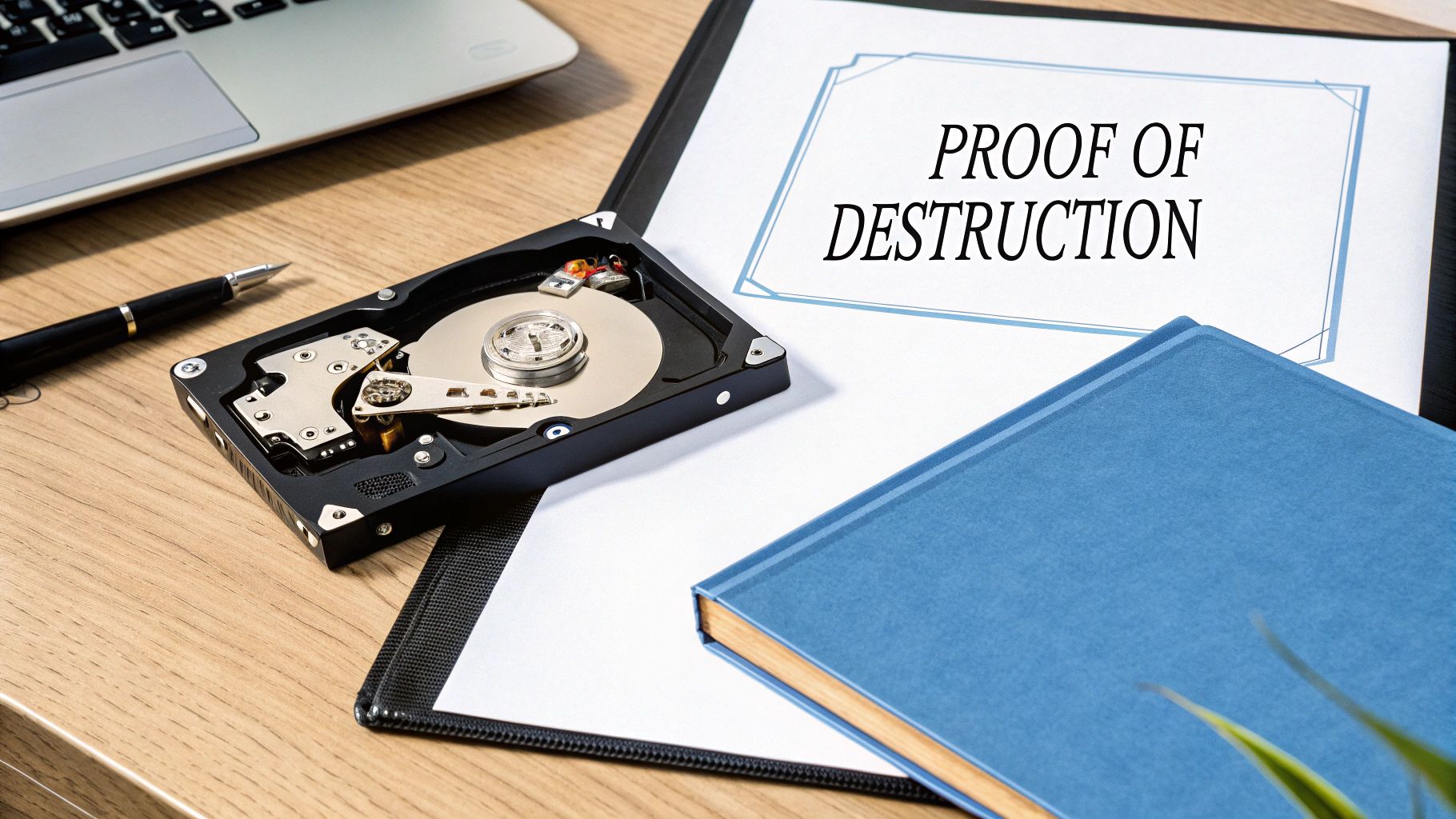
When your organization retires old computers, servers, or scientific instruments, just deleting files or reformatting a disk is a huge gamble. Hidden data can often be pulled back from the brink with the right tools, leaving your business wide open to major risks. A Certificate of Destruction (CoD) is the formal document you get from a professional IT asset disposition (ITAD) vendor after they have physically destroyed the storage media.
This piece of paper is so much more than a simple receipt. It’s a cornerstone of your risk management and data governance strategy, giving you a verifiable, auditable record that you’ve done your part. For any organization, from a hospital in Houston to a tech firm in Silicon Valley, or a government agency in Washington D.C., this certificate isn't just nice to have—it's non-negotiable for modern data security.
The Core Purpose of Certified Documentation
At its heart, the main job of a certificate of destruction is to transfer liability. Once that certificate is in your hands, it proves your responsibility for the data ended the moment it was securely destroyed. This is absolutely critical for any business, anywhere in the U.S., handling sensitive information, including:
- Patient or Customer Data: Protected health information (PHI), names, addresses, and other personally identifiable information (PII).
- Employee Records: Social Security numbers, payroll details, and private HR files.
- Intellectual Property: Trade secrets, proprietary research data, and confidential business plans.
Without this official proof, your organization is still on the hook for some serious consequences. We're talking steep regulatory fines, potential lawsuits, and the kind of damage to your brand's reputation that's nearly impossible to fix if a data breach is traced back to equipment you threw away carelessly. You can explore more about this topic in our guide to secure data destruction services.
A Certificate of Destruction provides verifiable peace of mind. It is the final, essential step in the IT equipment lifecycle, confirming your data is gone for good and your business is protected from future liability.
Ultimately, this document is your shield. It stands between you and a devastating data breach, protecting your compliance status, your finances, and your public reputation. It transforms a potential liability—an old piece of hardware—into a closed-loop security measure, ensuring your end-of-life assets don't become the source of your next big crisis.
Your Shield Against Costly Compliance Penalties
Think of a certificate of destruction as your frontline defense in the complicated world of data regulations. This single document is the bridge between your responsible disposal actions and major compliance frameworks like HIPAA, GDPR, and a whole host of other federal and state privacy laws. It’s the official, signed-off record proving you did everything right to protect sensitive information.
Without this proof, your organization is left wide open to crippling fines, disruptive legal battles, and the kind of reputational damage that takes years to fix. A certificate transforms what could be a massive liability—old, data-filled equipment—into a secure, closed-loop process. It's your protection whether you're a local Atlanta clinic, a financial firm in New York, or a national corporation with offices coast to coast.
Navigating the Regulatory Minefield
Picture a financial institution in Chicago decommissioning servers that once held thousands of customer accounts. Or a research facility in Boston retiring lab instruments containing priceless proprietary study data. In either case, just wiping the drives isn't good enough for an auditor. They need undeniable, documented proof of destruction.
This is exactly what a certificate of destruction delivers. It acts as your official testimony during an audit, showing a methodical and compliant data handling process from the moment the equipment left your facility. This document isn't just bureaucratic paperwork; it’s a core piece of your data governance strategy.
This absolute need for verifiable proof is why the market is growing so fast. The global data destruction services market, pushed by the demand for certificates, jumped from USD 9.23 billion in 2023 to USD 10.50 billion the next year. That surge is a direct reflection of tightening regulations that now require auditable proof to stop data breaches and the harsh penalties that follow.
The High Stakes of Non-Compliance
Failing to produce a valid certificate of destruction can have staggering consequences. The penalties are intentionally severe to make sure organizations take data protection seriously. Let's look at the real-world impact across the country.
- Healthcare (HIPAA): A hospital that gets rid of diagnostic equipment without certifying the destruction of patient data could be looking at fines up to $1.5 million per violation category, per year.
- Finance (FACTA/GLBA): A bank that doesn’t properly destroy records with consumer financial information is exposed to civil penalties and class-action lawsuits.
- General Business (State Laws): Laws like the California Consumer Privacy Act (CCPA) or the Colorado Privacy Act (CPA) bring heavy fines for data breaches caused by negligence, and that includes improper hardware disposal.
The certificate of destruction acts as a crucial record, ensuring adherence to these data protection regulations and demonstrating robust contract compliance with any third-party service agreements you have. It confirms you’ve upheld your end of the security bargain.
Beyond the fines, the operational chaos from an investigation and the long-term brand damage can be even more costly. A data breach from an improperly discarded computer tells your customers you're careless with their information, shattering trust that might never be rebuilt.
This is why certified disposal is so critical. The process, which ends with a detailed certificate, effectively transfers the risk and liability away from your organization. It creates a clear, documented endpoint for your data's lifecycle, which we cover in our guide to secure hard disk disposal. Investing in a professional destruction service isn't just an expense; it's an insurance policy against a catastrophic compliance failure. It ensures that when your equipment’s life is over, the sensitive data it held doesn't come back to haunt you.
Anatomy of a Legally Sound Certificate
This detail is the hallmark of a professional and trustworthy e-waste partner. You can learn more about how a certified e-waste recycling company handles documentation to protect its clients.
Method of Destruction: A Key Detail for Compliance
Finally, a legitimate certificate must clearly spell out the exact method of destruction used. This detail is absolutely vital, especially since different regulations demand specific levels of data sanitization. Vague terms like “disposed of” are useless and a major compliance red flag.
The document should specify the technique, such as:
- Physical Shredding: Often includes the final particle size (e.g., "shredded to 2mm particles") to prove it meets certain government or industry standards.
- Degaussing: Confirms the use of powerful magnets to completely erase data from magnetic media like hard drives and tapes.
- Multi-Pass Wipe: Details the software standard used, like DoD 5220.22-M, for sanitizing data on drives that might be reused.
This level of specificity is more important than ever. The hard disk destruction equipment market, valued at USD 1.76 billion, is expected to climb to USD 2.56 billion by 2032. This growth is fueled by global cybersecurity mandates that require certified, verifiable destruction methods.
When your Certificate of Destruction includes all these core elements, it’s no longer just a piece of paper. It’s an undeniable record of your commitment to data security and regulatory compliance.
Common Misconceptions and Costly Mistakes
When it comes to data destruction, what you don't know can absolutely hurt you. A lot of organizations, both local and national, are running on some pretty dangerous assumptions, leaving themselves wide open to massive risks. Let's clear the air on these myths and help you sidestep the procedural mistakes that can make all your compliance efforts worthless.
One of the biggest and most hazardous myths is that just hitting 'delete' or doing a standard format on a hard drive is good enough. That’s just plain wrong. A basic file deletion only removes the pointer to the data. The actual information is still sitting there, often easy to recover with off-the-shelf software.
Certified data sanitization, on the other hand, is a deliberate, provable process. It requires using specific methods to overwrite, degauss (magnetically erase), or physically shred the storage media. This makes data recovery impossible, and a certificate of destruction is the only real proof that this final, irreversible step was done right.
Vague Certificates and Uncertified Vendors
Another costly mistake is getting tangled up with a non-certified vendor or, worse, accepting a vague, flimsy certificate. A piece of paper that just says "items recycled" or "hard drives disposed of" gives you zero legal cover. It doesn't create the auditable trail you absolutely need to prove compliance.
Picture this: a healthcare provider in Atlanta is retiring an old server. They call a local electronics recycler who hands them a "Certificate of Recycling." A year later, an audit uncovers a patient data breach traced back to that exact server—which was refurbished and sold, not destroyed.
That "Certificate of Recycling" is useless as a defense. It documents an environmental action, not a data security one. Without a proper Certificate of Destruction that lists the server's serial number and the date it was shredded, that provider is on the hook for HIPAA violations and crippling fines.
This kind of scenario plays out more often than you'd think, and it really drives home the consequences of picking the wrong partner. A legitimate certificate is your proof of due diligence, but only if it’s detailed, serialized, and comes from a qualified vendor with nationwide service capabilities.
The Dangers of Incomplete Documentation
Failing to get any certificate at all? That’s probably the most dangerous oversight. The world generated a jaw-dropping 53.6 million metric tonnes of e-waste in a recent year, creating a massive minefield of security risks. What's truly alarming is a survey that found 82% of IT directors are deeply worried about security risks from hardware disposal, yet 12% of those who erased data never even got a certificate to prove it. For more on this, check out this detailed study on e-waste management. This leaves them completely exposed to fines, breach liabilities, and reputational ruin under rules like HIPAA.
These aren't just minor administrative slip-ups; they are critical failures in your company's security. They can render your compliance program useless and swing the door wide open for a data security disaster. Understanding the difference between a simple delete and certified sanitization is the first step. If you're curious about the technical side, you might find our guide on how to properly wipe a hard drive helpful.
How Our Process Guarantees Compliance
Knowing what a certificate of destruction is in theory is one thing. Seeing it in action and knowing your compliance is locked down is what really brings peace of mind. Our entire process was built from the ground up to be transparent, secure, and compliant for everyone from local Atlanta labs to national research facilities.
We’ve engineered a system that leaves no room for error. Every single step is documented and completely verifiable, whether you need services in one city or across the United States.
It all starts with secure on-site logistics. Our trained team and dedicated fleet handle everything, from de-installing bulky machinery to carefully packing and transporting your retired assets. This kicks off an unbreakable chain of custody that we meticulously track from your door to ours.
Tailored Destruction for Total Data Security
We know that not all data-bearing equipment is created equal. That's why we don't use a one-size-fits-all approach. Our destruction methods are precisely matched to the type of media, ensuring total data security while championing sustainable practices whenever we can.
For assets that can be securely reused, like certain server hard drives, we use a multi-pass data wiping method. This process follows the strict DoD 5220.22-M standard, overwriting every bit of the drive multiple times to make the original data impossible to recover.
But for hardware that's old, damaged, or held highly sensitive information, physical destruction is the only way to be 100% certain. Our industrial shredders pulverize hard drives, SSDs, and other media into tiny, mangled fragments. This is an irreversible process that doesn't just erase the data—it physically obliterates it, giving you the ultimate level of security. You can get more details on how our asset disposal process works.
We are committed to providing a fully documented, seamless service that directly supports HIPAA compliance for healthcare providers, protects sensitive corporate data, and ensures sustainable e-waste management. We are a trusted national partner in asset disposal.
The Final Step: A Certificate You Can Trust
The entire secure destruction process leads up to one final, critical document: your Certificate of Destruction. After every single asset is processed according to our strict protocols, our team performs a final verification. We reconcile the initial serialized inventory list against our destruction records to ensure a perfect one-to-one match.
Only after that final check do we issue a comprehensive certificate. It contains all the essential details you need for any legal or regulatory challenge, including:
- A Unique Certificate ID for easy tracking and auditing.
- A Complete Serialized List of every asset that was destroyed.
- The Precise Date and Location where the destruction occurred.
- The Specific Destruction Method Used (e.g., "shredded" or "DoD 3-pass wipe").
- An Authorized Signature from our team, formally transferring all liability to us.
This infographic helps show the journey from common data destruction myths to the compliant reality.
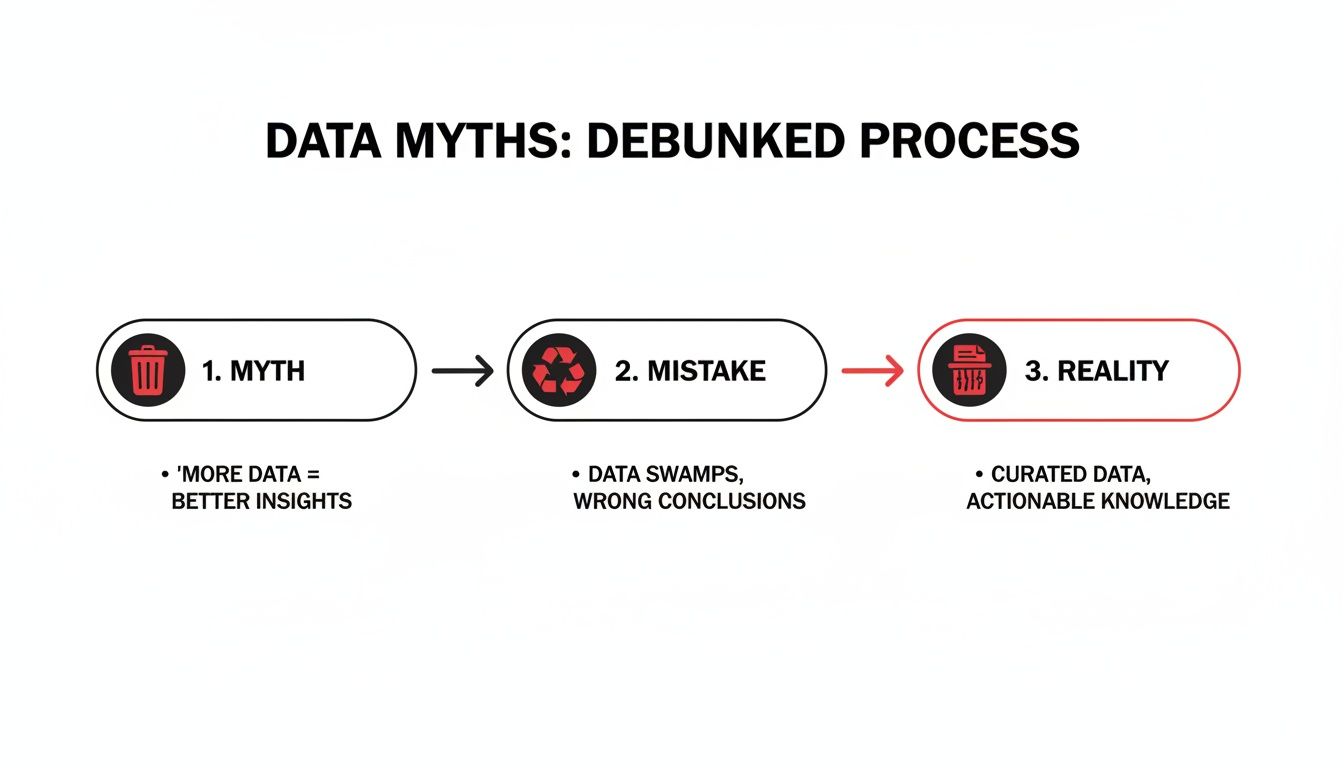
As the visual shows, simply deleting files or recycling equipment without certified data sanitization opens you up to massive risk. Only a verified, documented destruction process provides true security.
This final document isn't just a receipt. It's your permanent record of due diligence and your absolute proof of compliance.
Answering Your Questions About Data Destruction
Even after you understand the process, a few practical questions always pop up when it's time to build a real-world data destruction plan. We get these all the time from businesses across the country, so let's clear up the most common points to help you handle compliance, logistics, and record-keeping like a pro.
How Long Should We Keep a Certificate of Destruction?
Forever. That's the simple answer.
While certain rules like HIPAA set a minimum retention period of six years, the smart move is to keep your Certificates of Destruction indefinitely. Think of it as the permanent, unchangeable receipt that proves you did the right thing. A data breach claim or a compliance audit can happen years after the equipment is long gone, and that certificate is your rock-solid proof that you were responsible.
The best way to manage this is to store them digitally. A secure, backed-up, and searchable digital archive means you can pull up the exact proof you need for any audit or legal question in minutes. This isn't just paperwork—it's a critical part of your long-term risk management strategy.
What Is the Difference Between On-Site and Off-Site Destruction?
This choice really comes down to your organization's security posture and day-to-day logistics. Both methods are extremely secure when you use a certified vendor, but they offer different types of oversight. We offer both on-site and off-site solutions nationwide.
- On-Site Destruction: We bring the shredding or data wiping equipment right to your facility, whether you're in Atlanta, Los Angeles, or anywhere in between. This lets you watch the entire process with your own eyes, which gives you the highest possible level of security assurance and instant confirmation.
- Off-Site Destruction: This involves securely transporting your assets in GPS-tracked vehicles from your location to our specialized, secure facility. You don't see the destruction happen in person, but the certificate of destruction includes a much more detailed chain-of-custody log to track every single asset from your door to its final moments.
We can walk you through which option makes the most sense for your security protocols, workflow, and budget. Either way, you get a fully compliant result.
A robust Certificate of Destruction is your ultimate proof of compliance, regardless of whether the process happens on-site or off-site. The key is the verifiable, serialized documentation that proves every asset was accounted for and properly destroyed.
Does the Certificate Also Cover Environmental Compliance?
A standard certificate of destruction is laser-focused on data security—it confirms that sensitive information was wiped or shredded beyond any chance of recovery. However, a truly professional e-waste partner provides a more complete picture.
A top-tier certificate will also include a statement confirming that all the leftover e-waste was recycled according to EPA guidelines and state laws, from California to Florida. This dual verification is huge. It gives you the paperwork you need for your company's environmental, social, and governance (ESG) reports and sustainability goals. To make sure you’ve covered both data security and environmental responsibility, always work with an R2 or e-Stewards certified vendor.
Do We Need a Certificate for Lab or Medical Equipment?
Yes, absolutely. This is a big one that people often miss.
Modern lab and medical equipment—from DNA sequencers and diagnostic machines to simple automated handlers—are packed with hard drives, flash memory, and other data storage. This hardware often holds massive amounts of protected health information (PHI), proprietary research, and operational data, putting it squarely under HIPAA and other privacy laws.
When you retire this kind of specialized equipment, getting a certificate of destruction is non-negotiable. The certificate has to specifically confirm that those internal data components were sanitized or physically destroyed. A simple recycling receipt won't cut it and leaves a massive compliance hole. For any hospital in Texas, a research lab in North Carolina, or a clinic anywhere in the United States, certified destruction is a must to protect data, no matter where it was stored.
Ready to implement a secure, compliant, and sustainable disposal plan for your laboratory or IT assets? Scientific Equipment Disposal provides certified data destruction services nationwide, with detailed Certificates of Destruction to guarantee your peace of mind. Contact us today to schedule your secure pickup.