Vetted Telecom Repair Services Near Me


A network closet goes down, a business phone system starts dropping calls, or a switch fails during operating hours. The first reaction is usually the same. Someone opens a browser and types telecom repair services near me.
Then the frustration starts. Search results fill with cracked-screen phone shops, tablet repair counters, and consumer electronics storefronts. Those businesses may be useful for a damaged iPhone, but they aren't built for a hospital's telecom rack, a university's aging PBX hardware, or a corporate office trying to keep uptime intact while protecting stored data and maintaining chain of custody.
For organizations, repair isn't just about getting a device working again. It's about response time, service scope, documentation, security handling, replacement planning, and what happens if the equipment can't be returned to production. That's where the gap between a retail repair search and a qualified B2B telecom partner becomes obvious.
Why Your Business Needs More Than a Local Repair Shop
A branch office loses dial tone at 10:15 a.m. The first local result looks promising until you realize the provider mainly fixes cracked screens and battery issues. That mismatch costs time, and for a business environment, time usually means missed calls, service disruption, and internal escalation.
A company searching telecom repair services near me is usually dealing with equipment that sits inside a larger operating system. A failing VoIP controller, a UPS interface fault, or damaged rack-mounted telecom hardware affects more than one device. The provider has to diagnose the issue in place, understand what the equipment connects to, and leave a record of what was tested, removed, replaced, or taken out of service.

That is why business buyers need to separate consumer repair from operational support.
Retail repair shops are built around quick-turn, standardized devices. B2B telecom service providers work inside environments where uptime windows are tight, access may be controlled, and retired equipment can create security and compliance problems if it is handled casually. In practice, repair often turns into a larger asset decision. A board may be fixable, but the chassis may be near end of life. A failed unit may also contain storage, configuration data, or labeled network information that cannot leave the site without controls.
For Atlanta-area organizations, that broader lifecycle is easier to manage when repair is tied to a provider that also understands telecom maintenance support in Atlanta as part of ongoing operations rather than as a one-time service call.
What makes B2B telecom support different
The service model changes once telecom equipment supports a business, lab, campus, or healthcare facility.
Key differences usually include:
- On-site capability: Many systems stay in racks, closets, labs, or secured rooms and need to be serviced where they are installed.
- System awareness: A failed component may affect call routing, security systems, network connectivity, or building communications.
- Work documentation: Facilities, IT, and procurement teams often need service notes, serial tracking, and records for anything removed from inventory.
- Security controls: Devices may hold credentials, configuration files, call records, or storage media that require controlled handling.
- Defined escalation: If repair is not economical, the provider should be able to support replacement planning, de-installation, and disposition without confusion.
I usually apply a simple screen here. If a vendor's site focuses on walk-in traffic, phones, tablets, and gaming consoles, it is not set up for enterprise telecom infrastructure.
The scale of consumer repair skews search results
Search visibility favors consumer intent. That is one reason local results often bury the firms that handle business telecom systems, field service, and asset retirement. Strong effective local SEO for businesses can improve discoverability, but buyers still need to judge fit based on service scope, not map placement.
A local listing is only a starting point. Business telecom environments need providers who can work within maintenance windows, coordinate with facilities and IT, protect data-bearing equipment, and support the next step if the hardware should be replaced instead of repaired.
Refining Your Search to Find B2B Telecom Specialists
Most poor vendor matches begin with a vague query. If you search telecom repair services near me, Google often assumes you mean consumer electronics. That's why a better search starts with your environment, not the word "repair."
The problem is especially clear in public search results. Listings for "repair services near me" focus almost entirely on consumer electronics like iPhones and laptops, while institutional and laboratory equipment needs are absent, as shown in this consumer-focused repair listing example from uBreakiFix. For hospitals, universities, and research facilities, that creates a real information gap because compliance, on-site logistics, and hazardous material handling aren't part of the retail model.

Search for the environment, not the symptom
A better query usually includes one of these modifiers:
- Business function: "business VoIP support Atlanta"
- Infrastructure type: "data center hardware maintenance"
- Scope of service: "on-site telecom equipment repair"
- Buyer type: "enterprise network support"
- Lifecycle need: "telecom de-installation and recycling"
- Industry context: "hospital telecom vendor" or "university network hardware support"
That shift matters because serious B2B providers tend to describe their work using terms like managed services, field service, hardware maintenance, infrastructure support, decommissioning, or IT asset disposition. Retail shops rarely do.
Compare the language on the page
One quick filter is to scan the service pages and navigation labels. The difference becomes obvious fast.
| Search result type | Typical language | Likely fit |
|---|---|---|
| Consumer repair shop | screen repair, battery replacement, tablet repair, walk-ins welcome | Low |
| B2B telecom provider | field service, on-site support, vendor maintenance, network equipment, SLA | High |
| Asset disposition specialist | de-installation, data destruction, logistics, recycling, chain of custody | High for end-of-life needs |
If the website doesn't mention server rooms, network gear, business phones, structured cabling, hardware maintenance, or enterprise support, keep moving.
Build a shortlist that reflects real operating needs
A strong shortlist usually blends local coverage with broader capability. Local presence matters for dispatch and site access. Broader operational maturity matters for process, reporting, and escalation.
Use more than search alone:
- Peer referrals: Ask your MSP, facilities lead, or procurement team who they've trusted on multi-site jobs.
- Industry associations: Vendors that serve healthcare, higher education, and corporate IT often appear in niche directories before they rank well in local results.
- Website signals: Look for service request workflows, support channels, and evidence they understand business continuity.
If your team is also trying to improve how your service pages and local listings surface for specialized buyers, this resource on effective local SEO for businesses is useful because it explains how intent changes search visibility.
For equipment that may cross from repair evaluation into disposal planning, procurement teams should also understand what a qualified downstream partner looks like. This guide on choosing an electronic waste recycling company helps with that side of the vendor screen.
Good B2B searches sound narrower, not broader. The more precisely you describe the system, the better the results tend to get.
Critical Questions to Vet Potential Service Providers
A provider can rank well for "telecom repair services near me" and still be a poor fit for a business site, lab, or institution. The real test is whether they can work inside your operating, security, and documentation requirements without creating new risk.
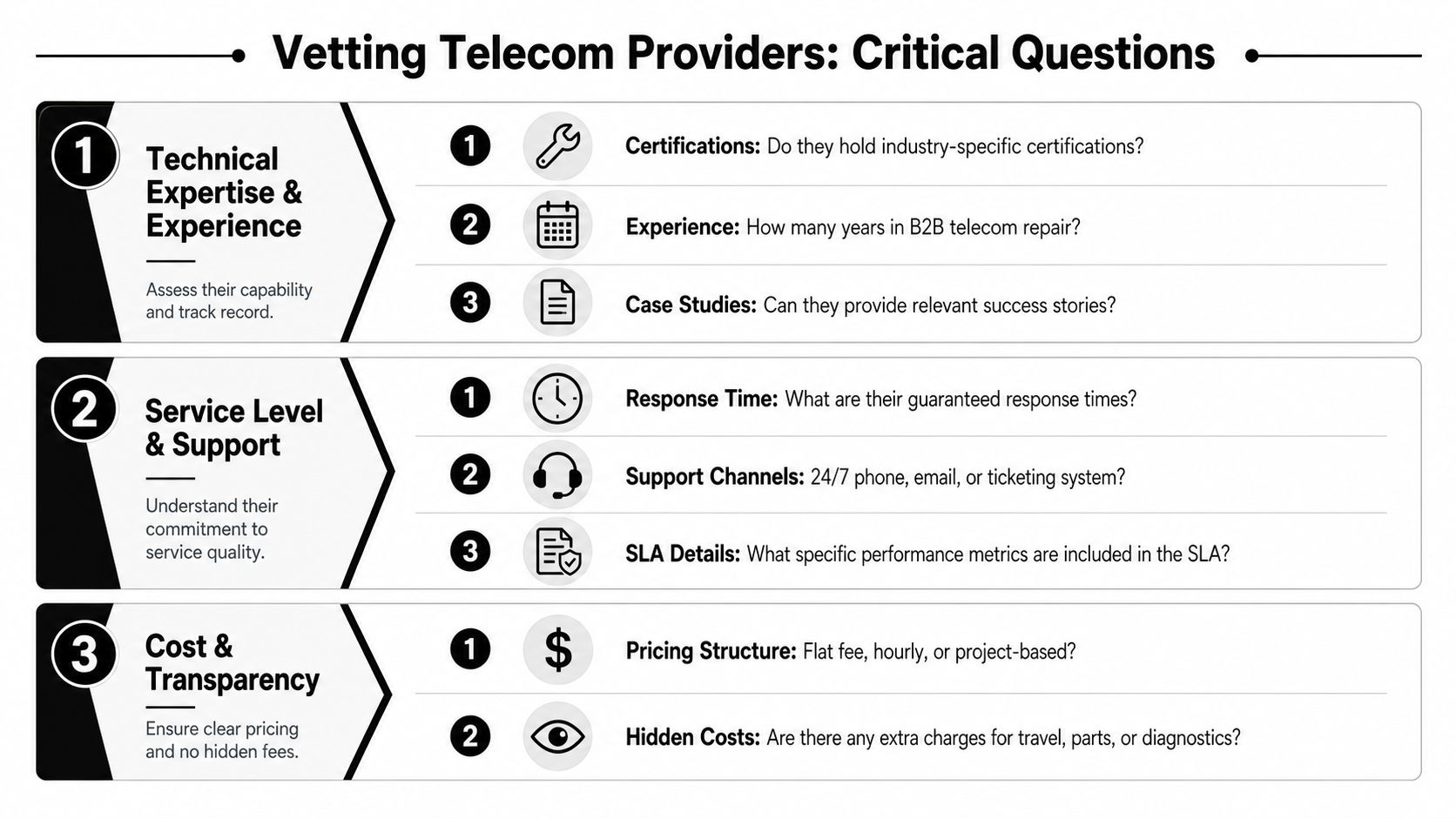
A good vetting call should tell you three things quickly. Can they service the equipment you run. Can they document the work to your standards. Can they handle the point where repair turns into replacement, return, or disposal.
Technical fit
Start with the assets, not the marketing copy. Enterprise telecom environments often mix legacy PBX, VoIP endpoints, switches, wireless gear, rack-mounted hardware, paging systems, and specialty interfaces. A shop that replaces cracked phone screens is solving a different problem.
Ask specific questions such as:
- Which manufacturers and product lines do you service regularly?
- Do you support field service, depot repair, or both?
- Can you isolate whether the fault sits in the device, cabling, power, or adjacent network hardware?
- Do you issue a written assessment when repair is not economical or technically sound?
Good providers answer with boundaries. They should be able to say what they support, what they exclude, and when they recommend replacement instead of extending the life of a failing unit.
Technician credentials and escalation
Certifications matter, but process matters more. I look for evidence that the provider has a repeatable way to diagnose faults, escalate complex cases, and protect the customer's environment while they work.
Use questions like these:
- Who performs the work. Direct employees, subcontractors, or both?
- What training do technicians receive for commercial or regulated environments?
- Who reviews cases that may require replacement instead of repair?
- What happens when the first technician cannot resolve the issue on-site?
The quality gap usually shows up here. A serious B2B provider can explain dispatch, triage, escalation, approvals, and closeout documentation in plain language. If your IT team is already tightening vendor oversight across service categories, this guide to Houston managed IT is a useful reference point for what contract discipline should look like.
SLA and operating expectations
Service issues often start with undefined terms. One side says "priority." The other side means "we will call you back today." Business buyers need tighter language than that.
Ask for clear answers on:
- Response time and when the clock starts
- Hours of coverage, including after-hours and weekend support
- Remote triage before dispatch
- Parts sourcing responsibilities
- Site access constraints, escorts, shutdown windows, or permit requirements
A capable vendor will also explain how they handle multi-site accounts, repeat failures, and temporary workarounds. That matters because the fastest repair is not always the lowest-risk repair. In some settings, a loaner, staged replacement, or scheduled cutover is the better call.
Security and chain of custody
Consumer-style repair searches often prove inadequate for business buyers. Telecom equipment can store credentials, logs, configurations, voicemail data, and removable or embedded media. If a device leaves the premises, chain of custody has to be documented from pickup through return, destruction, or downstream transfer.
Ask direct questions:
- What data-bearing components may exist in this equipment class?
- Do you record serial numbers, asset tags, and custody transfers at pickup and return?
- How do you handle failed drives, flash modules, or embedded storage during bench repair?
- What records do you provide if media is destroyed instead of returned?
Organizations that require formal proof should confirm the provider can issue documentation that matches internal policy. Before approving off-site service, review what a certificate of destruction should include so there is no ambiguity later.
Insurance, warranty, and accountability
Repairs touch uptime, security, and asset value. Accountability has to be clear before work begins.
Use this short screen:
- What insurance do you carry for on-site commercial work?
- Is labor covered by a written warranty?
- Are replacement parts new, refurbished, or customer-supplied, and how are they warranted?
- Who is responsible if a repair attempt causes additional failure or data handling issues?
Mature providers do not dodge these questions. They answer them because business clients ask for them every day.
How to Compare Quotes and Identify Red Flags
Two quotes can show the same total and represent very different levels of risk. One may include diagnosis, travel, handling, documentation, and post-repair validation. The other may be a vague labor estimate with exclusions buried in the fine print.
That's why quote review isn't an accounting exercise. It's a scope exercise.

Read the quote in layers
Start at the top, but don't stop at the total. Look for itemization and sequence.
A strong quote usually clarifies:
| Quote element | What you want to see | Why it matters |
|---|---|---|
| Scope | Specific equipment and location | Prevents scope drift |
| Labor | On-site, bench, after-hours, project labor | Makes comparisons fair |
| Parts | Included, excluded, or estimated | Helps avoid surprise approvals |
| Travel | Trip charge or mileage policy | Common hidden cost |
| Deliverables | Testing, reporting, serial tracking, disposal handling | Shows operational maturity |
If one quote includes validation, asset tracking, and removal of failed equipment while another doesn't, they aren't comparable yet.
Look for hidden operational assumptions
Most bad surprises come from work the buyer assumed was included. Access restrictions, escorts, parking, lift requirements, shutdown windows, rack extraction, and packing are all examples.
Ask the vendor to answer these in writing:
- What exactly is included in the base price?
- What triggers additional labor?
- Who owns removed parts and failed units?
- Will you package retired equipment or leave it on-site?
- Is documentation included after completion?
One useful habit is to request a revised version of the quote after the site walk. That forces both sides to align around real conditions instead of generic assumptions.
Red flags that usually predict trouble
Some warning signs show up before the work begins.
- Vague scope language: "Repair telecom equipment as needed" isn't enough for approval.
- No mention of data handling: If the quote ignores storage media or configuration data, the provider may be ignoring the risk.
- Pressure to sign quickly: Urgency can be real, but pressure without detail is a bad sign.
- No documentation commitment: If they won't define what you'll receive afterward, expect gaps.
- Reference avoidance: A provider serving enterprise clients should be able to discuss relevant experience, even if client names are limited.
If a quote is cheap because it omits logistics, documentation, or security handling, it isn't cheap. You're just buying the missing work later.
The need for careful review becomes even more important as the technician pipeline tightens. The BLS projects 23,200 annual openings for telecommunications technicians while overall employment is expected to decline by 3 percent by 2034, according to the BLS outlook. Buyers should assume qualified providers will be selective, structured, and clear about scope.
Teams that negotiate service contracts frequently may also benefit from this guide to Houston managed IT, especially for its practical framing around contract review and service accountability.
When failed equipment is likely to leave service entirely, quote comparison should include what happens next. That often means planning for secure downstream handling such as computer disposal services, not just repair labor.
Connecting Repair with Compliant Equipment Disposal
A disciplined telecom repair process doesn't end when the technician says, "This unit isn't worth fixing." That's the moment asset management starts.
In business environments, failed telecom hardware often sits in a corner far too long. Old switches stay on a shelf. Retired PBX components remain in a storage room. Dead servers keep their drives. Nobody wants to throw out equipment incorrectly, so it lingers. That delay creates security, space, and compliance problems.
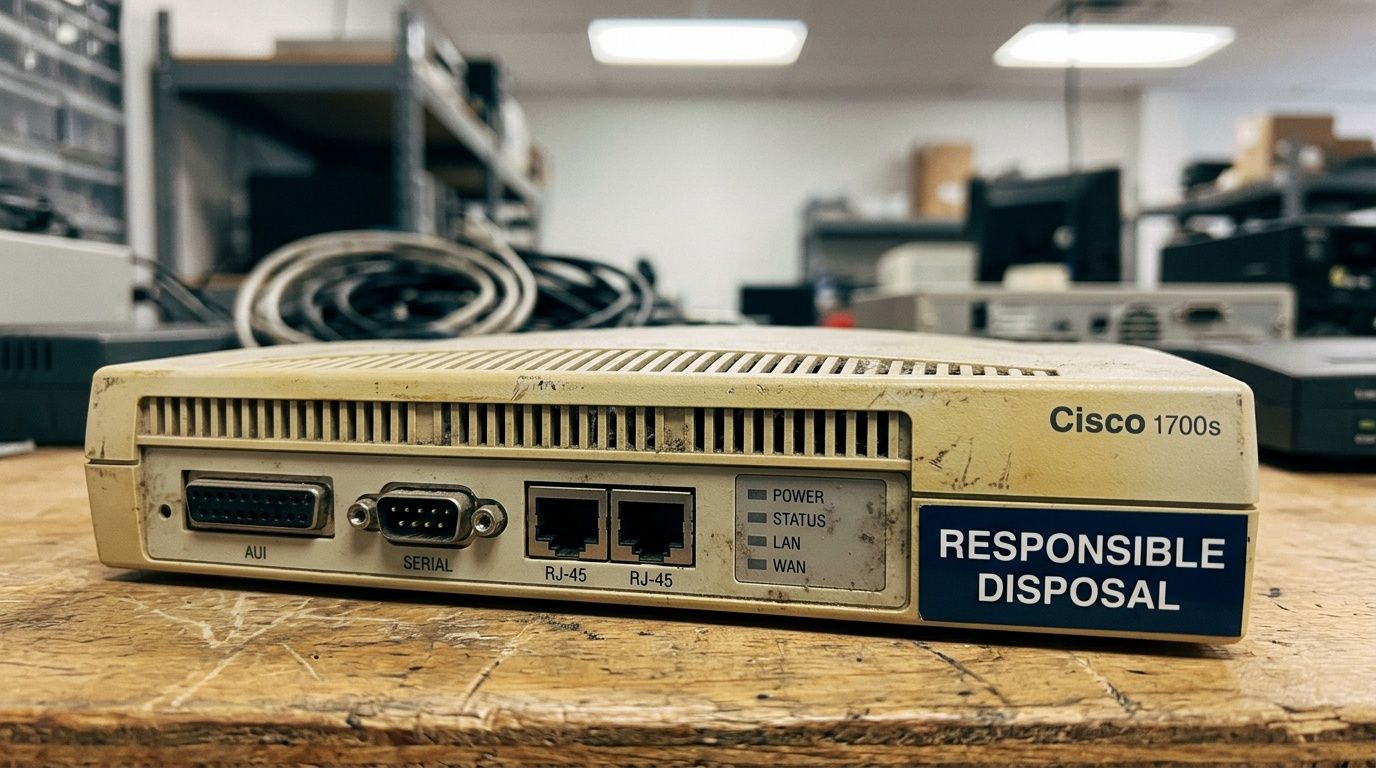
Use a repair-or-retire decision screen
The right question isn't only whether a unit can be repaired. It's whether it should return to service.
A practical screen includes:
- Operational fit: Will the repaired unit still support the environment you're running now?
- Security posture: Does the hardware create avoidable risk because of age, unsupported status, or embedded data?
- Parts reality: Are replacement parts dependable enough for continued use?
- Lifecycle alignment: Will this repair buy meaningful time, or just postpone an inevitable replacement?
Many organizations find they require a provider ecosystem, not a single vendor. One partner may diagnose and remove equipment. Another may handle secure destruction, recycling, and documentation.
End-of-life obligations are part of the telecom conversation
The consumer repair market shows how large electronics turnover has become. The global cell phone repair industry was a $210 billion market by 2023, driven by more than 6.8 billion smartphone users, according to REWA's industry summary. For organizations, that same turnover creates a quieter challenge. End-of-life hardware has to be managed properly.
Telecom gear can contain drives, flash media, configuration backups, or associated systems that store sensitive information. If a device leaves your site without a documented process for sanitization or destruction, you've shifted risk instead of reducing it.
What compliant follow-through looks like
A sound post-repair workflow usually includes these actions:
- Identify data-bearing components before anything is removed from the rack or room.
- Separate reuse candidates from scrap so valuable equipment isn't mixed with nonfunctional units.
- Document serials and disposition path for chain-of-custody continuity.
- Sanitize or destroy media according to your internal requirements.
- Use a qualified recycling channel for electronics and related equipment.
Some organizations require specific sanitization standards for retired storage. Where applicable, processes such as DoD 5220.22-M compliant hard-drive sanitization may be part of the disposal workflow, particularly when IT, telecom, and regulated data overlap.
Repair decisions should always trigger a second question. If this asset doesn't go back into production, who is responsible for its secure exit?
For buyers trying to connect break-fix support with a formal end-of-life process, IT asset disposition planning is often the missing piece. It turns a reactive repair event into a controlled asset transition.
Building Your Long-Term Telecom Asset Management Plan
Searching for telecom repair services near me is usually a symptom of a larger problem. The organization doesn't just need a technician. It needs a repeatable way to handle telecom assets from deployment through retirement.
That plan should live across IT, facilities, procurement, and compliance. If those groups only meet when something breaks, decisions get rushed. Vendors get chosen on availability instead of fit. Old hardware piles up because nobody owns the final step.
What a workable plan includes
A durable telecom asset plan usually has four parts:
- Approved repair vendors: Pre-vetted by equipment type, response model, and site coverage
- Decision criteria: Clear thresholds for when to repair, replace, or remove from service
- Documentation workflow: Records for serials, service actions, storage media, and disposition
- End-of-life pathway: A defined process for sanitization, pickup, recycling, and certificates when needed
This approach lowers friction during an incident. Staff don't have to rebuild the vendor list every time a switch fails or a legacy phone system goes unstable.
Why the long view works better
Reactive buying usually costs more in soft ways than direct ones. Downtime stretches because approvals are slower. Security questions come up too late. Equipment sits untagged in storage because nobody knows whether it can be reused, sold, wiped, or recycled.
A long-term approach fixes that. It gives your team a shortlist of repair partners, a standard vetting script, a quote review method, and a disposal route for hardware that doesn't belong back in service.
The best repair outcome isn't just a successful fix. It's a controlled decision, documented properly, with no confusion about what happens next.
If your organization manages telecom closets, server-adjacent equipment, business phone hardware, or mixed electronic assets across multiple departments, now is the time to formalize that process. Build the list before the next outage. Define your approval path before the next emergency. Decide how retired equipment leaves the building before it starts collecting dust.
If your team needs a compliant way to remove retired telecom, IT, or laboratory equipment after repair decisions are made, Scientific Equipment Disposal provides business-to-business pickup, de-installation, secure data handling, and responsible recycling support for organizations throughout the Atlanta area.