Secure Computer Recycling Company in Lilburn Georgia

A lot of Lilburn organizations have the same problem hiding in plain sight. It sits in a storage room, under a bench in a lab, or stacked in the corner of an IT closet. Old desktops, retired laptops, decommissioned servers, monitors, docking stations, and loose hard drives keep piling up because nobody wants to make the wrong disposal call.
The hesitation is reasonable. Once equipment leaves your building, the issue isn’t just recycling. It’s chain of custody, data exposure, internal policy, and whether your team can prove it handled the assets correctly if legal, compliance, or leadership asks questions later. A general cleanup mindset usually fails here because business electronics don’t behave like cardboard, scrap metal, or office furniture.
Lilburn, Georgia is served by various recycling operations, including full-service scrap yards and electronics recycling centers like the one at 105 Arcado Road Southwest, and those providers help process the global e-waste stream that totals 50 to 60 million tons annually worldwide. But for organizations handling patient records, research data, student data, financial records, or regulated internal files, the standard for disposal is much higher than “someone took it away.”
That’s why the right process starts with risk control, not sustainability slogans. If you’re evaluating a computer recycling service for business electronics, the practical questions are straightforward. Who handles the pickup? How is data destroyed? What documentation do you receive? Can the recycler support a lab cleanout, office refresh, or multi-site decommission without creating operational drag for your staff?
Introduction
If you’re searching for a Computer Recycling Company in Lilburn Georgia, you’re probably not starting from zero. You already have the equipment. You already know it can’t stay where it is. The main challenge is choosing a path that protects your organization instead of creating a second problem after pickup day.
In practice, I’ve seen teams underestimate the risk in “obsolete” devices. A broken desktop still has a drive. A dead server can still hold regulated data. A surplus lab workstation may still sit inside a workflow tied to HIPAA, internal retention rules, or grant-funded recordkeeping. Disposal gets delayed because nobody wants to sign off without confidence.
That’s where many organizations make a costly mistake. They compare business-grade electronics disposition to household recycling or scrap drop-off. Those options may be fine for low-risk material, but they don’t solve documentation, secure handling, or proof of destruction.
What businesses in Lilburn are actually trying to solve
Most organizations aren’t just trying to clear floor space. They’re trying to solve several problems at once:
- Data liability: Old endpoints and storage media can expose records long after the equipment stops working.
- Operational friction: Internal teams lose time when they have to sort, move, palletize, and haul assets themselves.
- Compliance pressure: Healthcare, education, research, and government environments need a defensible process.
- Sustainability expectations: Leadership wants landfill diversion and responsible downstream handling, but not at the expense of security.
Old hardware becomes risky the moment no one clearly owns it.
A reliable local recycler can help. A true IT asset disposition partner does more. The difference shows up in how they handle pickups, media sanitization, inventory control, and post-service reporting.
Why this decision matters more than it looks
Electronics disposal tends to get delegated late. Facilities may think it’s an IT issue. IT may assume facilities is coordinating removal. Department managers may hold equipment for “just in case” spares. That’s how old devices stay in limbo for months.
The organizations that handle this well use a documented process and a recycler that understands regulated assets, not just commodity scrap. That approach lowers internal confusion and gives procurement, compliance, and IT a shared standard for disposition.
Why Proper Computer Recycling Is Critical for Lilburn Businesses
For a business, clinic, school, or lab, improper electronics disposal creates three immediate categories of risk. Data exposure, compliance gaps, and avoidable environmental harm. The mistake is treating those as separate issues. In real operations, they’re linked.
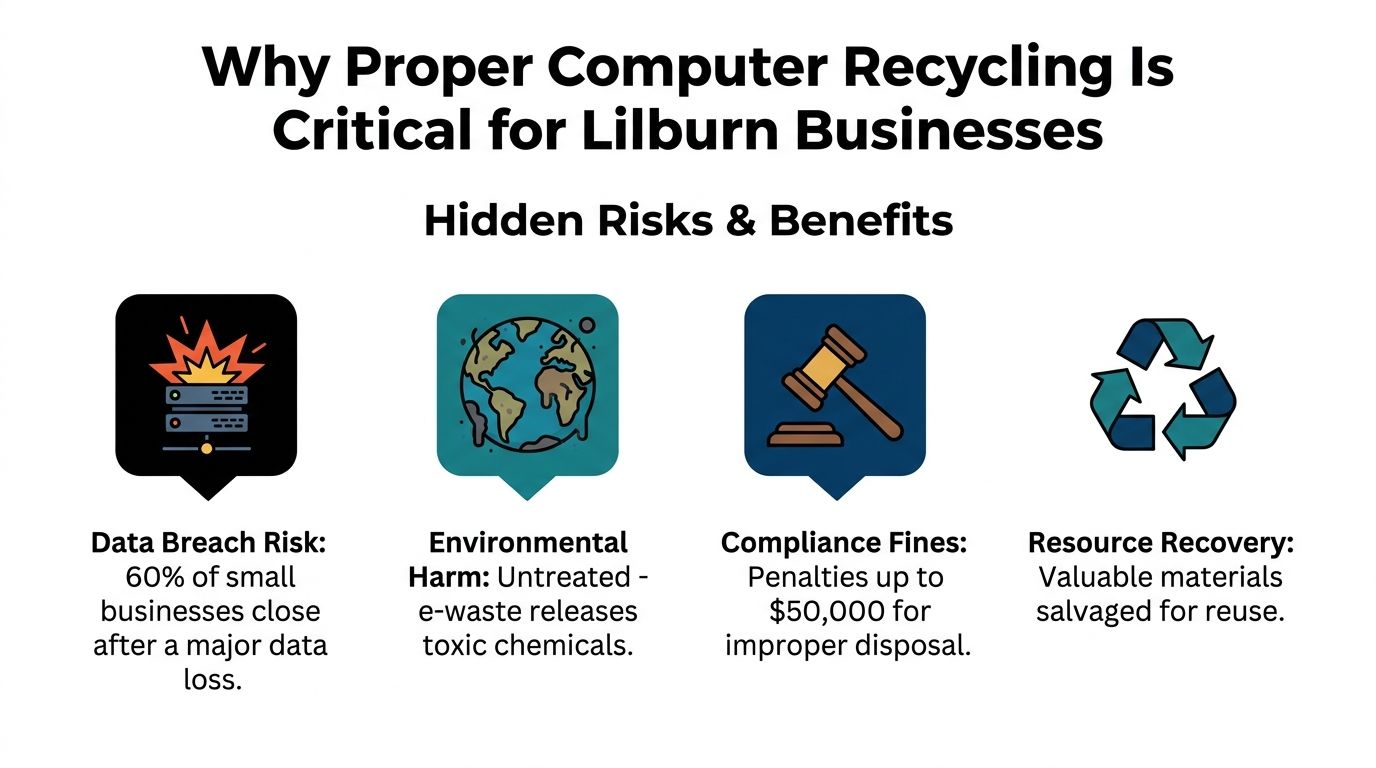
An old hard drive is the digital version of an open filing cabinet left on the curb. If your organization wouldn’t put printed patient files, employee records, or financial reports in a dumpster, it shouldn’t move retired electronics without a documented data-destruction process either.
Data risk doesn’t disappear when equipment is outdated
A common operational failure is assuming obsolete equals safe. It doesn’t. Age has nothing to do with whether a device still holds recoverable information. If a computer reached end of life in your environment, that only means it’s no longer useful to your team. It says nothing about what remains on the storage media.
For Lilburn businesses, this matters most in environments where users rotate quickly, systems are reimaged often, or departments manage devices independently. Those conditions create blind spots. Drives get missed. Specialty systems linger in side rooms. Small batches of equipment leave without the same controls applied to a major refresh.
Compliance problems usually start as process problems
Most non-compliance isn’t dramatic. It starts with informal handling. Someone approves a pickup without asset tracking. A department drops devices at a recycler without involving IT. A shutdown project prioritizes speed over chain of custody. The risk compounds because there’s no auditable record showing who released what, when it was received, and how data-bearing devices were treated.
That’s especially important in healthcare and adjacent sectors where HIPAA concerns follow the device, not the team’s good intentions.
Practical rule: If your recycler can’t explain its handling process in plain language, your auditor won’t be able to defend it either.
Recycling protects resources as well as reputations
There’s also a hard environmental argument for doing this properly. Producing a single desktop computer requires 48 pounds of chemicals, 1 ton of water, and over 530 pounds of fossil fuels, which is why responsible recycling matters for organizations trying to conserve materials and reduce landfill waste, as noted by Reworx’s Lilburn recycling center overview.
That fact changes the discussion inside large organizations. Retired equipment isn’t just clutter. It’s a concentration of recoverable materials and embedded resource cost. Sending it through a professional recycler supports sustainability goals without asking your staff to improvise logistics.
What works and what usually fails
The strongest disposal programs share a few traits:
| Approach | What happens in practice |
|---|---|
| Centralized handoff | IT, facilities, and compliance use one approved disposition path |
| Secure pickup | Assets move through controlled transport instead of ad hoc hauling |
| Media-specific handling | Drives, servers, and specialty equipment get the right destruction method |
| Auditable records | The organization can prove what left and how it was processed |
What fails is just as predictable.
- Informal cleanouts: Someone wants the room cleared fast, so controls get skipped.
- Scrap-first thinking: Metal recovery becomes the priority instead of data risk.
- No paperwork: Weeks later, nobody can confirm what happened to a batch.
- Department-level decisions: Different teams use different disposal methods, and the organization loses consistency.
Key Services of a Top-Tier Computer Recycling Company
Not every recycler offers the same level of protection. If you’re vetting a Computer Recycling Company in Lilburn Georgia, the core question is whether the vendor behaves like a secure ITAD partner or a bulk material handler. That distinction affects every step after pickup.
Data destruction has to be explicit
The first service to verify is media sanitization. If the vendor’s answer is vague, stop there. You need to know whether drives are wiped, shredded, or both, and under what circumstances each method is used.
Scientific Equipment Disposal uses the DoD 5220.22-M 3-pass sanitization method, which overwrites data three times to make it unrecoverable by forensic software, a critical safeguard when data breaches cost U.S. organizations an average of $4.45 million. That’s the kind of concrete method you want a recycler to name directly.
For practical evaluation, ask questions like these:
- What wipe standard do you use: A real process has a defined method, not a generic promise.
- When do you shred media instead: Nonfunctional or obsolete drives often need physical destruction.
- Can you separate data-bearing assets from general electronics: That prevents drives from getting lost in mixed loads.
If a vendor says “we destroy everything securely” but can’t describe how, assume the process is weak.
Logistics matter more than most buyers expect
A recycling project breaks down when the pickup model is sloppy. Businesses often focus on the end result and ignore the transfer stage. That’s a mistake. The chain of custody starts at your site, not at the vendor’s dock.
Strong vendors typically offer coordinated pickup, loading support, and handling that reduces the burden on your internal team. In lab and medical environments, that can also mean de-installation support for equipment that isn’t easy or safe to move without planning.
Here’s what usually separates an operationally sound provider from a frustrating one:
| Service area | What good looks like |
|---|---|
| Scheduling | Clear appointment windows and a named point of contact |
| Pickup handling | Staff who know how to move mixed IT and lab assets |
| On-site work | Ability to remove equipment from rooms, benches, racks, or closets |
| Segregation | Data-bearing devices identified before transport |
| Documentation | Inventory records and destruction paperwork tied to the pickup |
If your project includes servers, storage arrays, lab computers, or mixed research equipment, it helps to review an IT asset disposal program built for business environments before you compare vendors.
Reporting is what turns a pickup into a defensible process
A recycler’s paperwork tells you how mature the operation really is. You need enough reporting to satisfy internal stakeholders who weren’t present at pickup. That usually includes receiving confirmation, asset lists where appropriate, and destruction documentation for media.
What doesn’t work is relying on email assurances or generic receipts. Those don’t help much when compliance, legal, procurement, or leadership asks for proof.
Breadth of accepted equipment is a real advantage
A narrow recycler can force your team into multiple disposal streams. One company takes desktops. Another takes scrap metal. A third handles specialty devices. That sounds manageable until a facility shutdown or decommission turns into a coordination mess.
The better option is a partner that can handle computers, laptops, servers, peripherals, and related equipment in one controlled workflow. For hospitals, labs, and universities, that consolidation reduces internal labor and lowers the chance that sensitive devices fall outside the approved process.
Understanding E-Waste Certifications and Compliance Standards
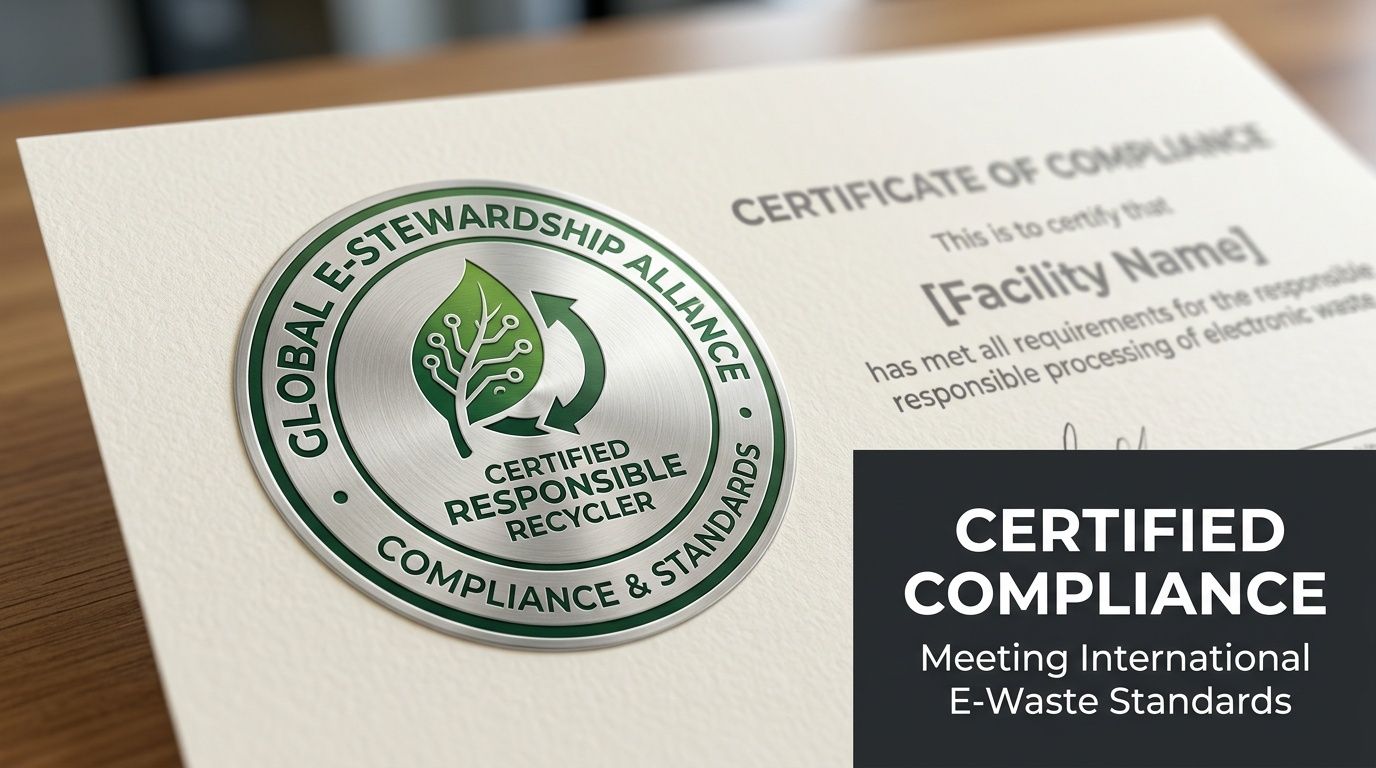
Certifications matter because they answer a basic business question. Who checked this recycler’s process besides the recycler itself? If the only assurance you receive is the vendor’s own marketing language, you’re still carrying most of the risk.
What certification means in practical terms
In day-to-day operations, certifications are useful because they force process discipline. They usually touch the areas buyers care about most: documented handling, downstream accountability, and data security procedures that can stand up to review.
For regulated organizations, that external validation matters. Hospitals need disposal practices that support HIPAA obligations. Government agencies need a documented path for retired assets. Universities need consistency across departments that don’t always operate the same way.
A certification doesn’t replace vendor due diligence. It gives you a stronger starting point.
How compliance teams should think about it
Compliance and IT often talk past each other during disposal planning. IT focuses on functionality and media. Compliance focuses on recordkeeping and risk. Certifications help because they create a shared language around controls.
A useful way to evaluate a certified recycler is to ask whether the certification supports these internal needs:
- Policy alignment: Does the vendor’s process fit your retention, release, and destruction workflow?
- Audit readiness: Can you obtain records your team can file and retrieve later?
- Downstream confidence: Does the recycler have documented handling beyond the initial pickup?
- Security controls: Are data-bearing assets treated differently from low-risk material?
For teams refining internal vendor standards, this overview of data security and compliance standards is a helpful companion resource because it frames security controls in business terms rather than technical jargon.
Certifications are valuable when they reduce your need to “trust us” and increase your ability to verify.
Documentation is where compliance becomes real
The most useful document after a recycling event is the one that closes the loop. You need something your records team can store, your compliance lead can reference, and your management team can understand without reconstructing the whole project from email threads.
That’s why a certificate of destruction for retired electronics and media matters. It converts an operational event into auditable evidence. Without that step, even a well-run pickup can become hard to defend months later.
What Happens to Your Old Equipment The Recycling Process Explained
Once assets leave your building, trust depends on transparency. Clients usually don’t need a lecture on metallurgy or disassembly techniques. They want to know what happens between pickup and final disposition, and whether the process protects the organization at each step.
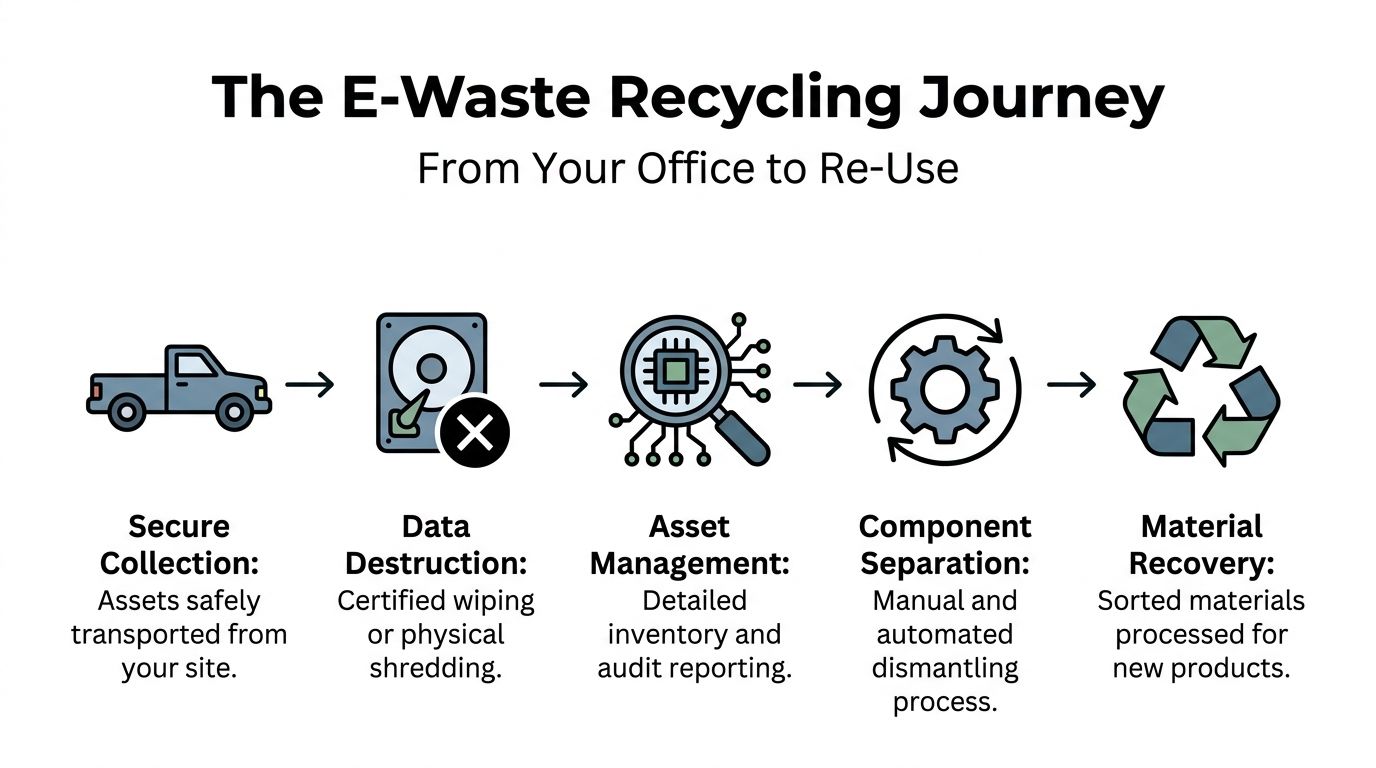
From your site to intake
A well-run job starts before the truck arrives. The client and recycler typically confirm the asset categories, access constraints, pickup point, and any special handling for drives, servers, or lab systems. That prep work sounds small, but it prevents confusion at the loading stage.
At pickup, the best crews don’t treat everything as one undifferentiated pile. They identify data-bearing devices, separate fragile or specialty assets, and move material in a way that preserves the client’s inventory and security expectations.
What the facility does first
When the load reaches the receiving facility, the first important action is triage. Some items need immediate media handling. Others move to sorting, dismantling, or materials recovery based on type and condition.
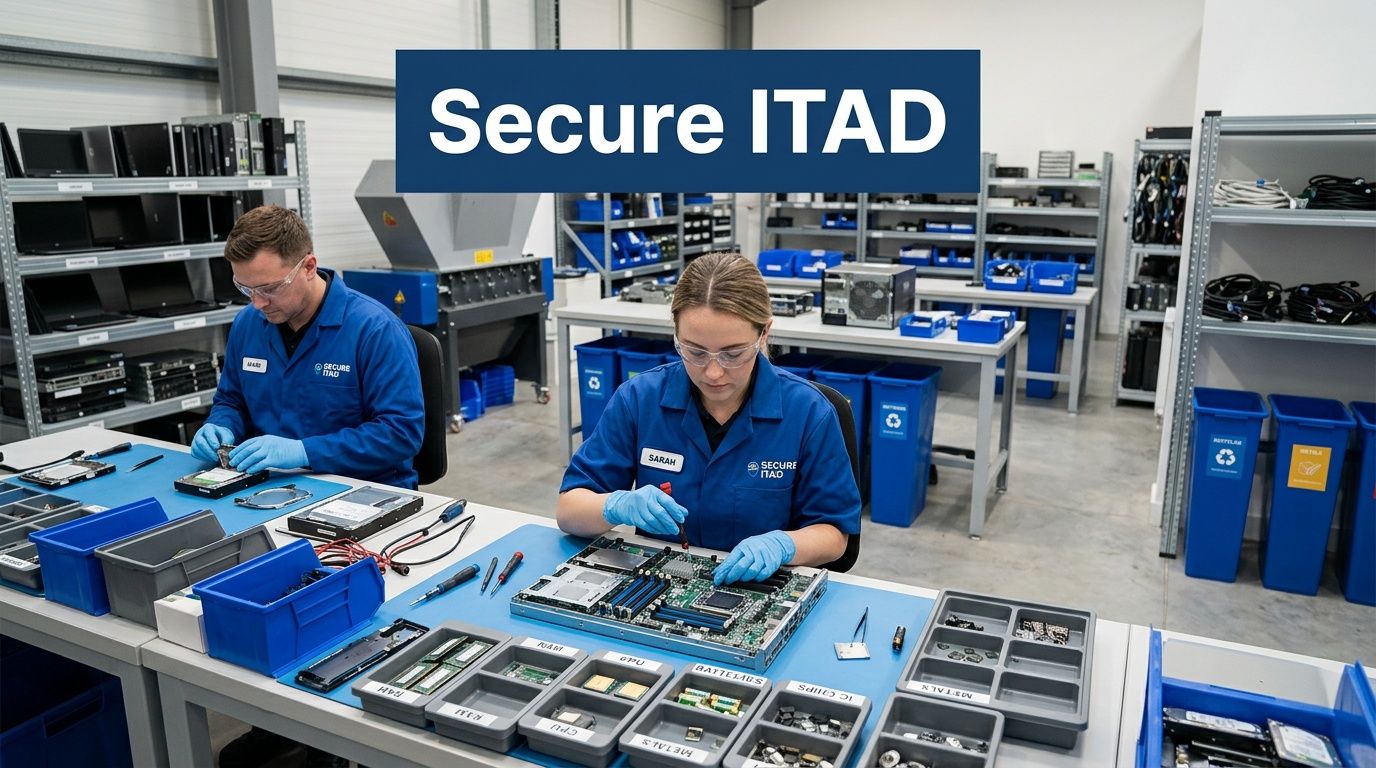
A typical flow looks like this:
Receiving and verification
The shipment is logged so the recycler can reconcile what arrived.Segregation of data-bearing devices
Computers, servers, and storage media are separated from low-risk peripherals.Media sanitization or destruction
Functional drives may be wiped under a defined process. Damaged or obsolete drives may be shredded.Dismantling and sorting
Equipment is broken down into material streams such as boards, metals, plastics, and power components.Downstream processing
Recovered materials move through approved channels for recycling and reuse.
A general junk-haul model falls short. A professional recycler follows a repeatable sequence. That sequence is what makes the work defensible.
Why material separation matters
The public usually thinks “recycling” means the whole device gets processed at once. In reality, responsible electronics recycling is a separation exercise. Boards, drives, wiring, metal chassis, plastics, and components don’t all move through the same path.
That separation protects both security and recovery value. It also supports cleaner downstream handling because the recycler isn’t forcing mixed material into the wrong stream.
The more mixed and unsorted the load stays, the less confidence you should have in the outcome.
Where clients should expect visibility
Clients don’t need to watch every internal step, but they should expect evidence that the process happened as promised. That includes intake records, destruction documentation where appropriate, and clarity about what asset classes were handled.
If you want a fuller picture of how retired systems move through a secure disposition workflow, this guide to computer waste recycling for business equipment is a useful reference.
Choosing the Right Partner in the Atlanta Metro Area
By the time organizations compare vendors, they already know the stakes. The harder part is turning those concerns into a usable selection process. A practical evaluation should test whether the recycler can protect data, reduce internal workload, and support your compliance position without forcing your staff to manage every detail.

Questions worth asking before you schedule anything
When I vet a recycler, I don’t start with price. I start with process. Low pricing can hide weak controls, vague reporting, or a pickup model that shifts labor back onto the client.
Ask direct questions such as:
- How do you handle hard drives and other storage media
- What documentation do you provide after pickup
- Do you perform on-site pickup with your own crews and vehicles
- Can you support office, lab, server room, or mixed-asset decommissions
- How do you manage downstream recycling after initial intake
- What does chain of custody look like from pickup to final processing
The quality of the answers matters as much as the answers themselves. Clear, operational language usually signals a mature process. Evasive or overly polished language usually signals gaps.
Match the vendor to the asset mix
A lot of Atlanta-area organizations don’t just have computers. They have monitors, network gear, peripherals, storage media, and sometimes lab equipment sitting in the same retirement queue. That’s common in hospitals, universities, and research facilities where technology stacks overlap.
If your recycler can only handle one slice of that inventory, your internal team has to coordinate the rest. That increases administrative drag and raises the odds of inconsistent disposal methods across departments.
A broader e-waste recycling company for business and institutional assets often simplifies the project because your team can move more categories through one managed workflow.
A short decision filter that works
Use this if you need to narrow the field quickly:
| Priority | Strong partner | Weak partner |
|---|---|---|
| Security | Names the wipe or destruction method | Uses generic promises |
| Logistics | Handles pickup and site coordination clearly | Expects the client to do most prep |
| Documentation | Provides usable records after service | Offers minimal paperwork |
| Asset range | Accepts mixed business electronics | Only handles narrow categories |
| Compliance fit | Understands regulated environments | Treats all loads like basic scrap |
Choose the recycler that makes your internal sign-off easier, not the one that makes the initial quote look simpler.
Conclusion Secure Your Assets and Reputation with Scientific Equipment Disposal
For organizations in Lilburn and the broader Atlanta metro, computer recycling isn’t a side task. It’s a business control. The wrong choice can expose data, weaken your compliance posture, and create avoidable operational friction for teams already managing refreshes, moves, closures, and decommissions.
The right choice is usually easy to recognize. The recycler has a defined data-destruction process, a clear pickup and handling model, and documentation your organization can retain. It can support regulated environments without forcing your staff to improvise. It treats retired electronics as controlled assets, not just unwanted material.
That mindset lines up with broader principles of effective risk security management. Good risk management isn’t only about prevention inside your walls. It also covers what happens when equipment leaves them.
If you need a partner for computer recycling, IT asset disposition, or mixed lab and electronics decommissioning in the Atlanta area, Scientific Equipment Disposal fits the profile that serious organizations should look for. The company supports business-to-business pickups, secure media handling, and documented disposal workflows designed for hospitals, universities, government agencies, labs, and corporate IT teams.
The practical next step is simple. Gather your asset categories, note any data-bearing devices or compliance requirements, and request a conversation before the backlog grows. A documented disposition plan now is far easier than explaining an informal one later.
Scientific Equipment Disposal helps Atlanta-area organizations dispose of computers, servers, storage media, and laboratory equipment with a process built around secure handling, responsible recycling, and compliance-focused documentation. If you need a reliable path for a one-time cleanout, a recurring pickup program, or a facility decommission, contact Scientific Equipment Disposal to discuss your equipment, logistics, and documentation requirements.