Electronics Recycling in Atlanta: Secure & Compliant

A lot of Atlanta organizations reach the same point at once. The storage room is full, the lab is replacing aging instruments, IT has a stack of retired drives, and facilities wants the area cleared before the next move, renovation, or shutdown. What looks like junk usually isn't junk. It’s a mix of regulated assets, embedded data, hazardous components, and equipment that has to leave the building through a documented process.
That’s why electronics recycling in atlanta means something very different for a hospital administrator than it does for a homeowner dropping off an old printer. In regulated environments, the hard part isn’t finding someone who will take equipment. The hard part is finding a workflow that protects patient data, preserves chain of custody, handles decontamination correctly, and gives your team the paperwork to survive an audit.
Beyond the Blue Bin Why Atlanta Businesses Need an E-Waste Strategy
A lab manager usually sees the problem before finance does. It starts with a few obsolete centrifuges in a corner, then old desktops under benches, then a server closet full of retired hardware no one wants to touch because no one wants to own the risk. Hospital departments, research facilities, and enterprise IT teams often inherit years of deferred disposal in one project.
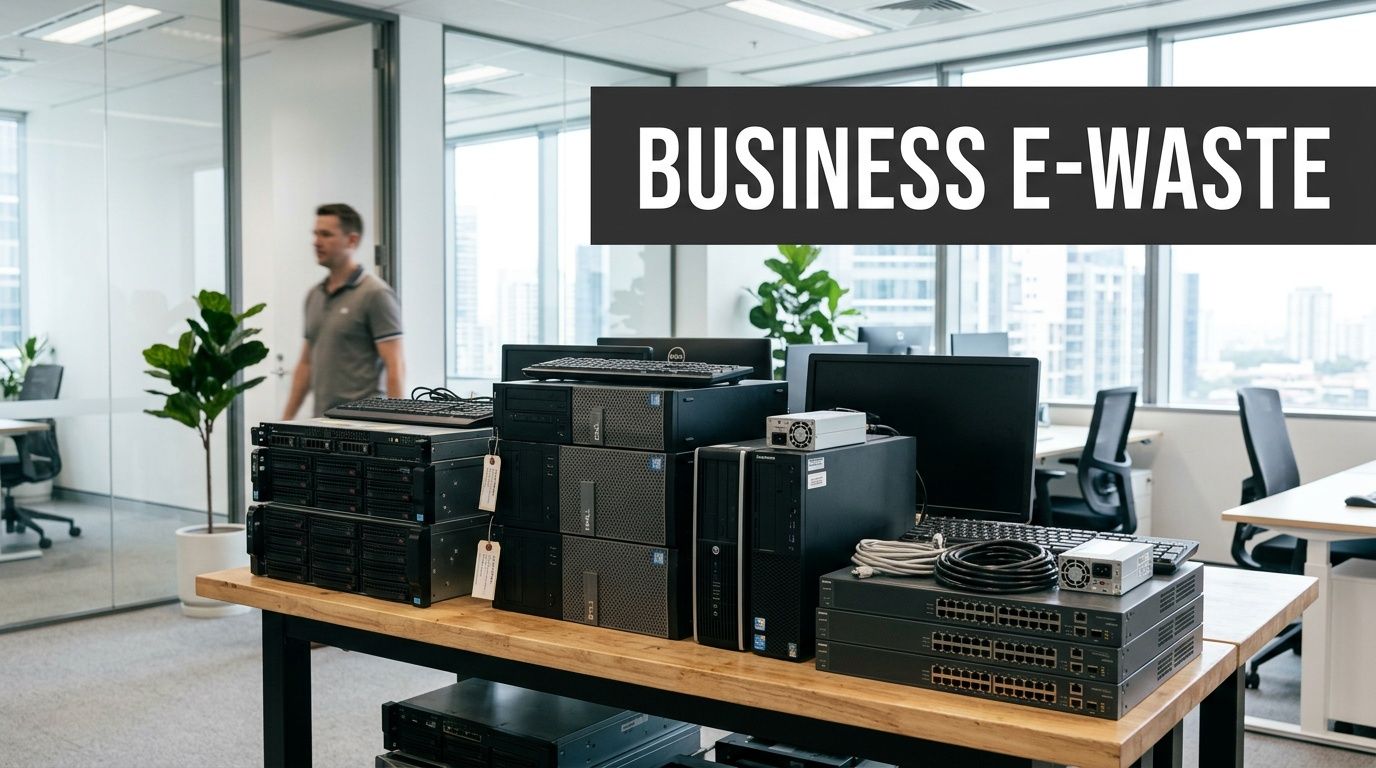
That hesitation is justified. The United States generates over 3.5 million tons of e-waste annually, and it’s the fastest-growing segment of municipal solid waste. At the global level, the e-waste recycling rate is only approximately 17.4%, which means most of those materials don’t move through a proper recovery stream (Reworx Recycling on Atlanta e-waste recycling). For Atlanta businesses, that scale matters because it explains why casual disposal keeps failing. The volume is too high, the materials are too sensitive, and the stakes are too uneven.
What business e-waste actually contains
Consumer advice tends to reduce e-waste to “old electronics.” Business assets are different.
- Data-bearing devices: servers, NAS units, medical workstations, embedded control systems, imaging computers
- Hazardous components: legacy solder, batteries, mercury-containing parts, and other regulated materials
- Institutional records: device serials, asset tags, purchase history, and chain-of-custody requirements
- Mixed-value inventories: some items should be recycled, others should be refurbished, and some need destruction
A desktop from an accounting office and a decommissioned analyzer from a clinical lab don’t belong in the same decision tree. The second item may involve decontamination, internal storage, proprietary software, and facilities coordination before anyone even wheels it out.
Practical rule: If an asset once held sensitive data, touched regulated material, or was part of a validated workflow, treat disposal as a compliance project, not a cleanup task.
What doesn’t work
The most common failure points are operational, not theoretical. Teams rely on ad hoc pickups, mix office electronics with lab equipment, or assume a general recycler can sort out the details later. That approach creates blind spots around data destruction, downstream handling, and proof of disposition.
For organizations that need a local process built around regulated asset handling, Atlanta electronics recycling support for business and lab equipment is usually the right starting point. The key is building a repeatable strategy before the next renovation, equipment refresh, or department closure forces the issue.
Decoding Compliance for Data Security and Regulations in Georgia
Compliance failures usually happen at handoff points. Someone removes a device from service, another team moves it to storage, and months later a recycler picks it up with incomplete records. By then, no one can say who had custody, whether the drive was wiped, or whether the equipment needed special handling.
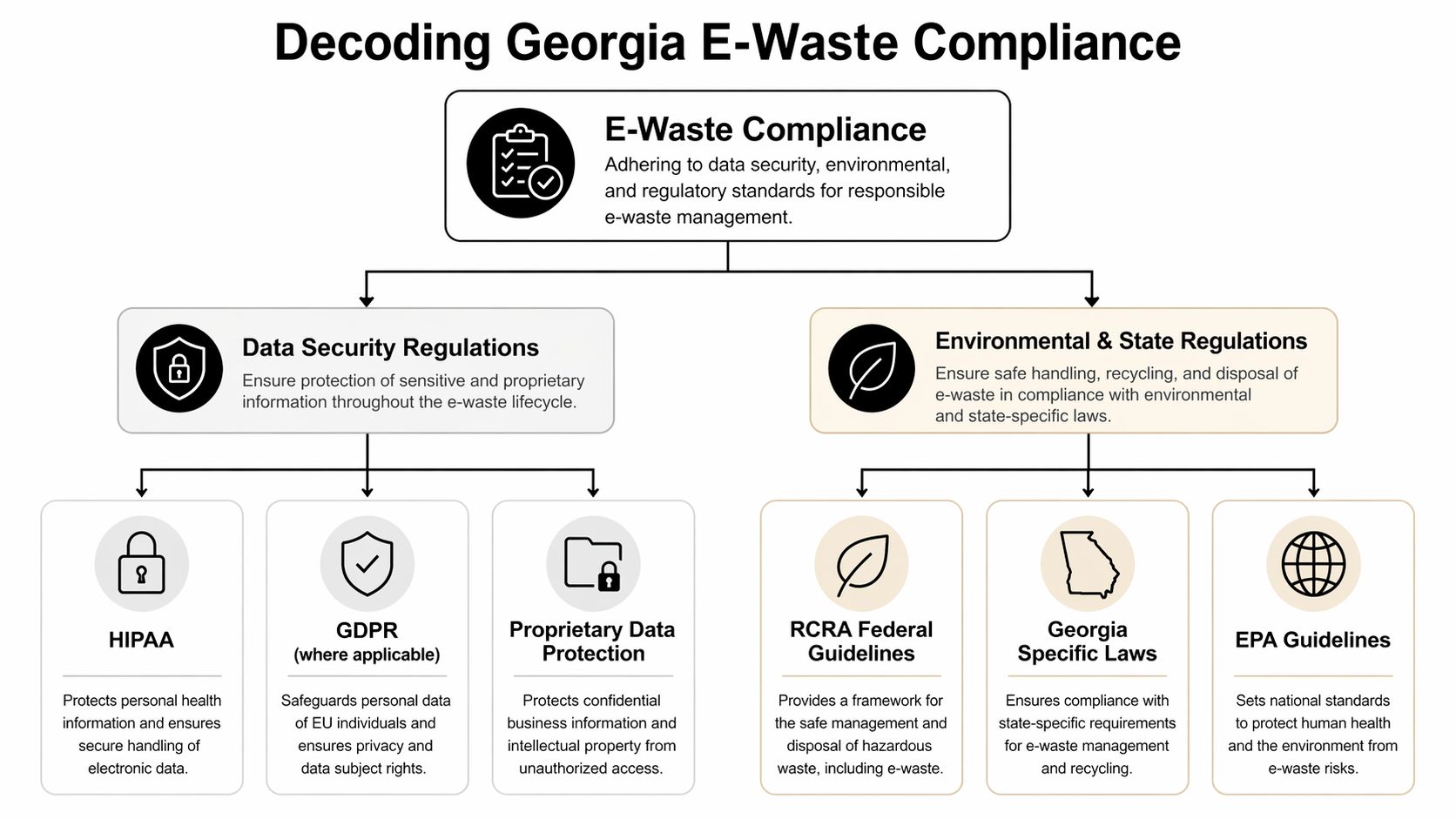
That’s why the compliance side of electronics recycling in atlanta starts with a simple question: what standard applies to this asset, and how will you prove it was met?
The standards that matter in practice
Atlanta organizations in healthcare, government, and finance often work across overlapping requirements. NIST 800-88, HIPAA, and DOD 5220.22-M all shape disposition decisions. In operational terms, DOD 5220.22-M with three overwrite passes is widely treated as the gold standard for laboratory and medical equipment sanitization, and a single breach tied to improperly destroyed media can exceed $1M in fines and damages (STS Electronic Recycling on Atlanta electronics recycling compliance).
Here’s the plain-English version:
| Standard | What it means during disposition | Why teams care |
|---|---|---|
| HIPAA | Protect any device that may contain protected health information | Patient privacy failures become legal and reputational problems |
| NIST 800-88 | Follow recognized media sanitization guidance for information-bearing devices | Gives IT and compliance teams a defensible framework |
| DOD 5220.22-M | Use a three-pass overwrite process with verification when media can still be sanitized | Sets a higher bar for sensitive medical and lab environments |
Wiping versus shredding
Here, many projects go off course. Teams assume wiping is always enough. It isn’t.
If a drive is functional and supports verified sanitization, wiping can be the right path. If the media is damaged, too old, mechanically failed, or can’t be reliably processed, physical shredding becomes mandatory. The decision isn’t philosophical. It’s technical.
A nonfunctional drive is not a “maybe wipe later” asset. It is a destruction candidate.
A sound workflow separates these two paths early so nothing sits in limbo. That’s also why many organizations ask for secure data destruction services for regulated equipment before they discuss recycling value or pickup timing.
Chain of custody is the legal memory of the project
Think of chain of custody as the documented history of each asset from the moment it leaves service to the moment it’s sanitized, shredded, recycled, or remarketed. If that history breaks, your evidence breaks with it.
A good chain-of-custody record usually includes:
- Asset identification: serial number, asset tag, device type, and location
- Transfer records: who released the device, who received it, and when
- Processing status: wiped, shredded, decontaminated, dismantled, or sent for downstream recovery
- Final documentation: certificate of destruction or equivalent disposition record
That record matters beyond recycling. IT and compliance leaders who already use formal risk review processes often benefit from pairing disposal planning with an information security risk assessment, especially when legacy devices are scattered across multiple departments or sites.
The paperwork that actually protects you
Certificates of Destruction are often treated like administrative extras. They’re not. In regulated environments, they’re evidence that the disposition method matched the asset risk.
What works is serial-number-level documentation, clear custody records, and a documented exception path for failed media. What doesn’t work is an invoice that says “miscellaneous electronics removed.” That might close a purchase order, but it won’t answer an auditor, privacy officer, or general counsel.
The Lifecycle of a Recycled Asset From Pickup to Recovery
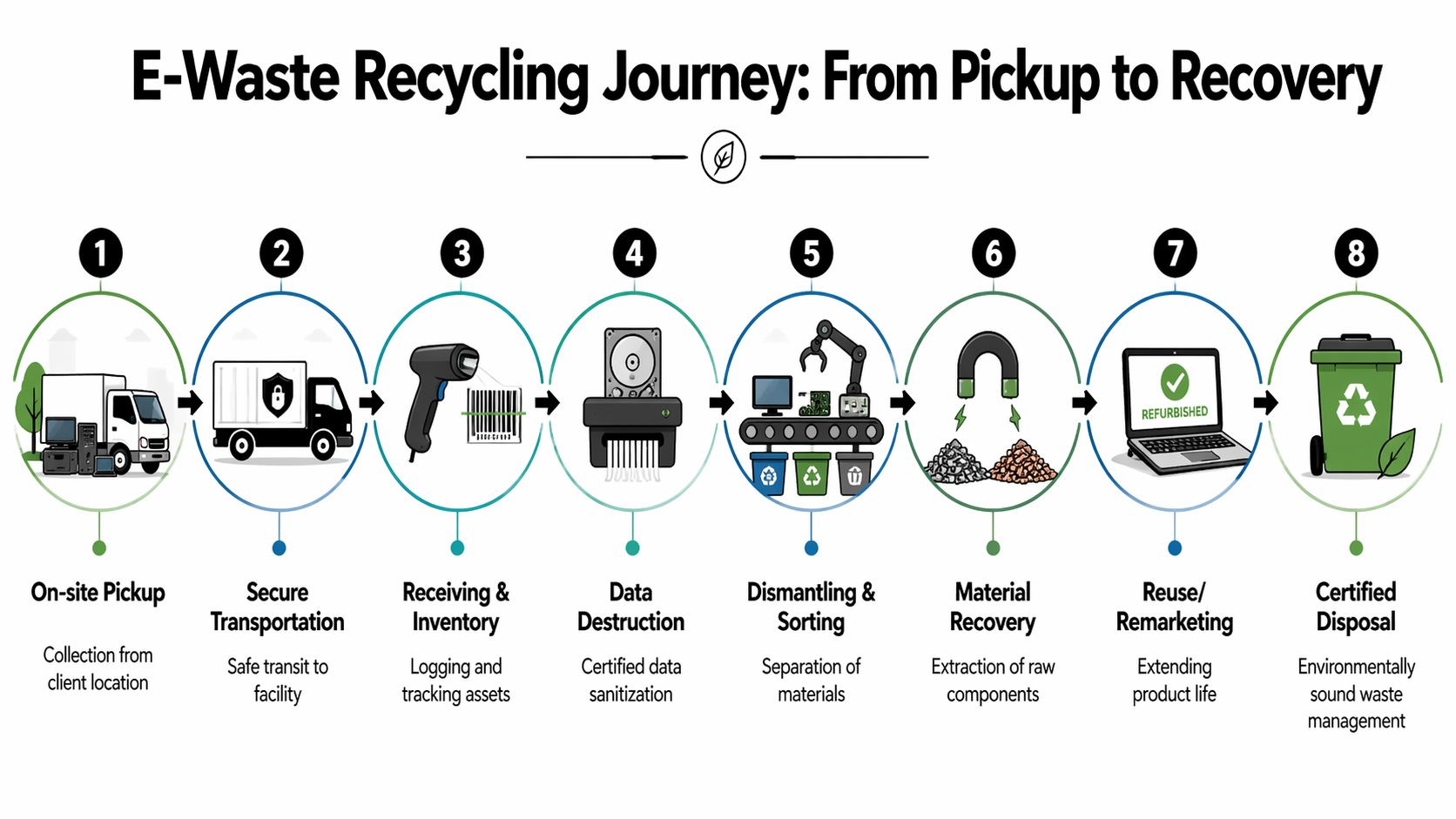
Most clients don’t need a theory lesson. They need to know what happens after the truck leaves their dock. The answer should be clear, traceable, and boring in the best possible way. Every asset should move through the same disciplined sequence without improvisation.
What the job looks like on the ground
A typical project starts on site. Equipment is identified, packed, labeled, and removed according to the building’s access rules and the client’s internal release process. In lab environments, this stage usually involves more coordination than people expect because benches, casework, elevators, loading docks, and de-installation sequencing all affect the pickup window.
Once equipment is loaded, transport security matters. Mixed loads should never become mystery loads. If the recycler can’t tell you how assets are tracked from the pickup point forward, that’s a red flag.
The eight operational checkpoints
Pickup scheduling
Facilities, IT, lab operations, and security all need the same date and scope. Last-minute changes create missing records.On-site de-installation
Large analyzers, incubators, storage arrays, and rack equipment often need hands-on removal, not just loading.Secure transportation
Sealed movement and controlled custody reduce the chance of asset substitution, loss, or undocumented transfers.Receiving and inventory
Assets are checked in against manifests and identified at the serial-number level where required.Triage
Some items go to sanitization, some to shredding, some to dismantling, and some to refurbishment review.Data destruction
Functional media is wiped. Failed or obsolete media is shredded.Material recovery
Metals, plastics, and other components are separated for downstream processing.Final documentation
The client receives records showing what was processed and how.
Recovery value and environmental outcome
Only 15-20% of e-waste is recycled globally, which is why certified processing matters. Facilities with large-scale capability, including 600,000 sq ft processing operations, can support serial-number-specific tracking and recover materials such as copper and gold, process plastics into granules, and reuse glass in formalized workflows that support zero-landfill commitments (All Green Recycling on Atlanta recycling workflows).
That matters for hospitals and research organizations because recovery isn’t just environmental. It affects residual value, sustainability reporting, and internal approval for future refresh cycles. A refurbishment-first decision can be sensible when equipment is functional and compliant to release. The secondary market is a real part of the disposition chain for many device classes, and categories like refurbished iPhones illustrate how extending device life can reduce waste when assets are suitable for reuse.
The best recycling project often starts with a reuse decision, not a shredder decision.
For teams comparing vendors, a clear walkthrough of how regulated pickup, tracking, and disposition works should be essential. If the process can’t be explained from dock pickup to final certificate, it probably can’t be audited either.
Accepted Items for IT and Laboratory E-Waste Disposal
The fastest way to derail a pickup is to assume all electronics are handled the same way. They aren’t. Office IT is usually straightforward. Lab and medical equipment often isn’t, especially if it contacted chemicals, biological material, or controlled samples.
Accepted equipment for recycling
| Asset Category | Examples |
|---|---|
| General Corporate IT | Desktop computers, laptops, servers, storage arrays, monitors, docking stations, keyboards, mice, printers, copiers, telecom equipment, networking gear, switches, routers |
| Data-Bearing Devices | Hard drives, solid-state drives, backup devices, server appliances, workstations, thin clients, medical computers with embedded storage |
| Lab Benchtop Equipment | Pipettes, centrifuges, incubators, shakers, mixers, balances, hot plates, small analyzers |
| Clinical and Research Equipment | Imaging workstations, analyzers, diagnostic support devices, laboratory computers, specialty electronics attached to instruments |
| Facility and Support Equipment | Fume hoods, biosafety cabinets, power supplies, control panels, instrument accessories, carts, cables, and related electronic components |
The critical pre-pickup requirement for lab equipment
For lab assets, the first question isn’t “Will you take it?” It’s “Has it been cleared for handling?”
Equipment that has been exposed to biological agents, chemicals, or hazardous residues typically needs a Certificate of Decontamination or equivalent internal release documentation before a removal crew should touch it. That protects your staff, the transport team, the processor, and anyone involved in downstream dismantling.
A few practical examples:
- Incubators and benchtop devices: often require confirmation that biological residue has been removed
- Fume hoods and related systems: may need facility-specific shutdown, cleaning, and hazard sign-off
- Medical and research instruments with embedded PCs: require both decontamination review and data review
What to sort before pickup
Before scheduling removal, separate assets into three internal groups:
- Ready for release: clean, cleared, and documented
- Needs review: uncertain contamination status, unknown data status, or incomplete ownership records
- Needs special handling: oversized equipment, fixed installations, or devices tied to building systems
That sorting step saves time and prevents a crew from arriving only to find that half the load can’t legally leave the site.
For organizations disposing of mixed lab and IT inventories, accepted items for scientific and electronic equipment recycling can help teams confirm scope before they issue internal approvals or prepare dock manifests.
How to Choose a Compliant Vendor in Atlanta
A vendor’s website can sound impressive while telling you very little about actual risk control. The right question isn’t whether a company “does e-waste.” The right question is whether it can manage your asset class, your documentation burden, and your facility constraints without creating new exposure.

Why consumer-style recycling guidance falls short
A lot of Atlanta recycling content is built around consumer drop-offs. That leaves a real guidance gap for hospitals and universities dealing with specialized lab equipment and regulated electronics. General providers may offer free pickups for standard IT gear, but they often don’t address the lab-specific expertise and certified processes needed for integrated electronics and higher-risk assets, which creates compliance risk under Georgia’s Solid Waste Management Act (Equip Recycling on the Atlanta electronics recycling gap for specialized assets).
That gap shows up in vendor selection. A recycler might be perfectly competent at taking old desktops and still be the wrong choice for a shutdown involving analyzers, incubators, imaging workstations, and failed storage media.
The vendor scorecard that matters
Use these criteria when you screen providers.
- Certification fit: Ask about R2v3, e-Stewards, and NAID AAA where applicable. The point isn’t logo collection. The point is whether their controls match your risk profile.
- Data destruction capability: Can they support both software wiping and physical shredding? If not, they’ll struggle with mixed-condition media.
- On-site logistics: Ask who performs de-installation, packing, and removal. A vendor that only wants curbside-ready pallets won’t help much in an active hospital or lab.
- Documentation depth: Require serial-level tracking when the asset class calls for it, plus final destruction or disposition records.
- Downstream transparency: They should be able to describe where materials go after first processing.
- Lab-specific handling: If your inventory includes decontamination requirements, they need a process for verifying release before pickup.
Questions worth asking in the first call
Some questions reveal more than a sales deck ever will.
| Ask this | Good answer sounds like |
|---|---|
| How do you handle failed hard drives? | Clear separation between wiping and shredding |
| What do you require before removing lab equipment? | Decontamination documentation and site coordination |
| Do you track by serial number? | Yes, when asset type and client requirements call for it |
| Who performs pickup and de-installation? | Identified personnel and a defined custody process |
| What happens downstream? | Specific material routing, not vague recycling language |
If a vendor answers every question with “it depends” and never names a process, assume the process doesn’t exist.
One Atlanta-area option in this category is an electronic recycling center focused on business and regulated equipment. However, the key consideration is specialization. For labs, clinics, universities, and government sites, a generalist recycler is often cheaper only on paper. The missing controls show up later.
Your Practical Lab and IT Decommissioning Checklist
The cleanest projects start before the pickup request goes out. Most delays aren’t caused by the recycler. They’re caused by internal uncertainty around ownership, data, access, and release status.
Pre-project checklist
Build the asset list
Walk the site. Record device type, location, asset tag, and serial number where needed. Don’t rely only on procurement records because retired equipment often sits outside current systems.Mark data-bearing devices
Flag anything with internal storage. That includes obvious items like servers and less obvious ones like medical workstations, analyzers with embedded computers, and test equipment with memory.Separate reuse candidates from end-of-life assets
Some devices belong in a refurbishment review. Others are clearly beyond service life and should move directly into destruction or recycling workflows.Confirm decontamination status
For lab and medical equipment, obtain internal sign-off before scheduling removal. If contamination status is uncertain, stop there and resolve it first.Coordinate stakeholders
IT, facilities, lab operations, EHS, compliance, and security should all know what is leaving, when, and under whose authorization.Review building logistics
Check dock access, elevator limits, badging requirements, freight paths, and any shutdown windows. Oversized equipment often fails here, not in recycling.
Day-of-pickup controls
A little discipline on pickup day prevents weeks of cleanup later.
- Use a release owner: one person on site should approve each lot before it leaves
- Match assets to the manifest: don’t let substitute items get added informally
- Photograph specialty equipment if needed: useful for condition records and internal closeout files
- Keep restricted items separated: especially anything still under review for data or contamination
Closeout after the truck leaves
At this stage, many teams relax too early. Don’t.
- Reconcile the manifest against internal inventory
- Collect and file destruction or disposition records
- Document exceptions, such as assets held back for failed decontamination or ownership questions
- Update internal asset systems so retired devices don’t remain open in inventory
A decommissioning project is complete when records are reconciled, not when the room is empty.
If you run this checklist every time, the process gets easier. More important, it becomes defensible. That’s what internal audit, legal, and compliance teams need when they review how your organization handles retired lab and IT assets.
Partner with S.E.D. for Secure Disposal in Atlanta
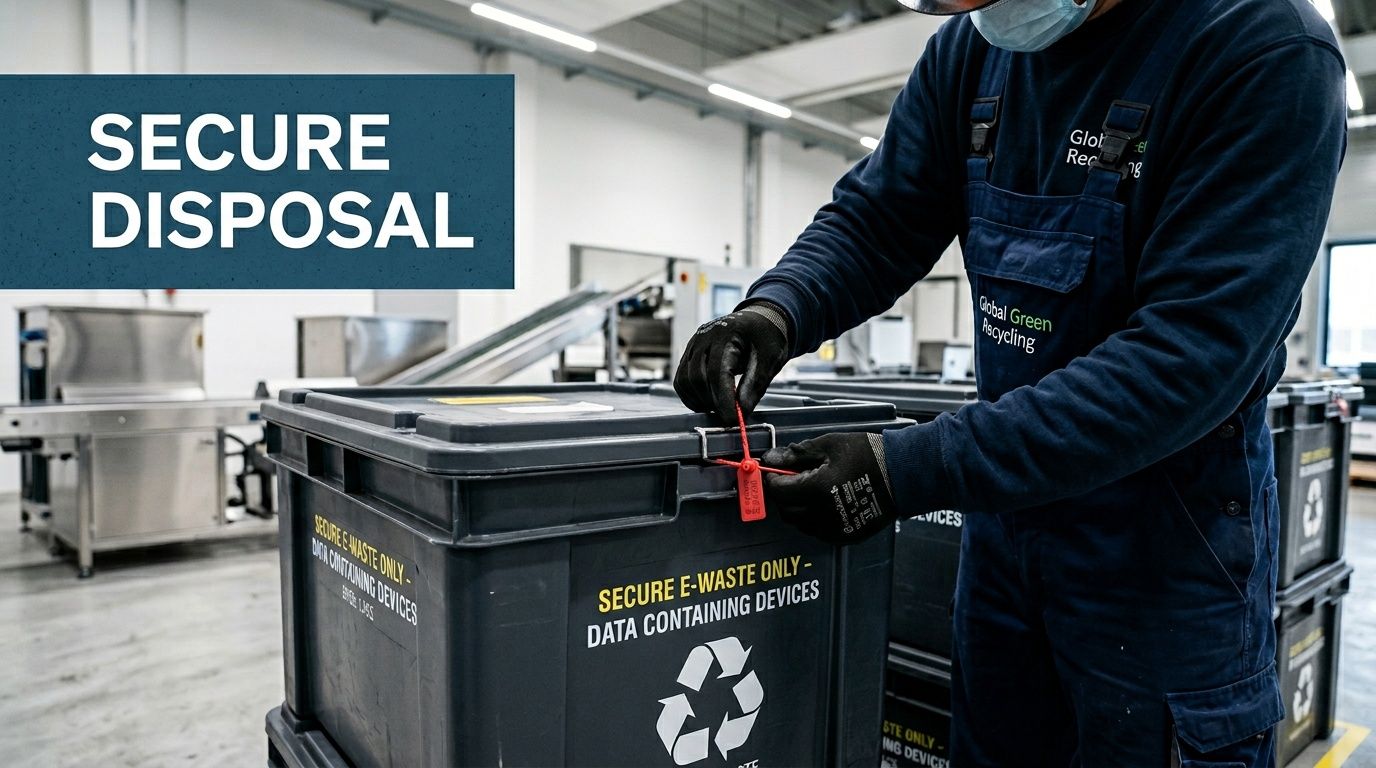
Atlanta has built a strong recycling ecosystem. The city has achieved recovery rates of up to 98% of electronic components through advanced processing, supported by certified facilities and accessible collection infrastructure (Beyond Surplus on Atlanta recycling innovation). For regulated organizations, that local infrastructure only matters if the front end of the process is handled correctly. Pickup, de-installation, data destruction, decontamination review, and documentation still determine whether the project is merely convenient or is compliant.
Where specialized handling changes the outcome
A downtown hospital shutting down a research wing doesn’t need generic haul-away service. It needs a team that can sequence pickup around clinical operations, identify data-bearing devices inside mixed equipment, and hold the line on documentation.
A university clearing a biology lab faces a different problem. The challenge isn’t volume alone. It’s deciding which items need decontamination sign-off, which electronics can move into recycling, and which assets should be held for departmental review before release.
A North Fulton company retiring rack equipment usually cares about two things first. Was every drive sanitized or shredded correctly, and can procurement close the asset record with confidence afterward?
Those are the jobs where process matters more than slogans. We handle lab equipment and electronics as a coordinated disposition project, using our own box-truck fleet for on-site pickup, de-installation, packing, and logistics. That’s often the difference between a smooth closeout and a stalled one.
What organizations usually need most
Across healthcare, research, government, and enterprise IT, the recurring needs are consistent:
- A single operational plan: instead of separate vendors for lab assets, IT gear, and removal logistics
- Clear data handling: with a defined path for wiping versus shredding
- Facility-aware pickup: crews that understand active campuses, loading limits, and shutdown scheduling
- Audit-ready records: because internal review rarely ends on pickup day
When organizations search for electronics recycling in atlanta, many are really searching for certainty. They want fewer assumptions, fewer handoffs, and fewer unresolved risks sitting in storage rooms.
If you’re planning a lab cleanout, data center refresh, department move, or facility shutdown, contact Scientific Equipment Disposal. We’ll help you map the inventory, identify data and decontamination requirements, coordinate pickup logistics, and move the project through a documented recycling and destruction process that fits regulated operations.