Your Guide to Secure X-ray Film Recycling Nationwide

Getting rid of old x-ray films isn't just about making space in a storage closet; it's a critical task for any facility that handles them. For healthcare providers, research labs, and even industrial operations, these films are a perfect storm of data liability, environmental hazards, and wasted financial assets. The only way to correctly handle all three issues is through professional x-ray film recycling, whether you're in a major city like Atlanta or a smaller town anywhere in the U.S.
Why You Can't Just Throw X-Ray Film Away
Those boxes of old x-ray films gathering dust are far from harmless. First off, they're loaded with sensitive Protected Health Information (PHI), which means their disposal falls under strict legal regulations nationwide. But it's not just about the data. The films themselves are coated with silver, a heavy metal that makes them hazardous waste according to the Environmental Protection Agency (EPA).
Simply tossing them in the dumpster is a non-starter and can bring on some serious penalties. This is why professional recycling isn't just an option—it's a fundamental business function that protects your organization from multiple angles, no matter your location.
The Triple Threat of Improper Disposal
Letting that film archive sit unmanaged, or worse, disposing of it incorrectly, opens your organization up to some pretty significant risks. Every stack of old films is a problem with three distinct heads, and a certified recycling program is designed to tackle all of them. Whether you need a local pickup or a coordinated nationwide service, the stakes are always the same.
Data Liability and HIPAA: Under the Health Insurance Portability and Accountability Act (HIPAA), you are legally on the hook for protecting patient information, even if it’s on film from decades ago. A data breach from improper disposal can lead to fines hitting millions of dollars and do permanent damage to your reputation.
Environmental Hazard and EPA Rules: The silver on those films is a pollutant. The Resource Conservation and Recovery Act (RCRA) dictates how it must be handled, making it illegal to dump these films in a landfill. Getting this wrong can result in hefty fines for environmental violations. This is a key difference between medical films and other waste streams, a topic we touch on in our guide to electronic waste recycling.
Wasted Financial Assets: Here's the silver lining—literally. The same silver that makes the film hazardous also makes it valuable. Instead of paying a company to destroy the films, a professional recycling partner recovers that silver. In many cases, the value of the silver can offset or even completely cover the cost of the service.
Partnering with a certified recycler turns a compliance nightmare into a secure, straightforward, and potentially profitable process. It’s the only way to be certain every single sheet of film is managed according to all federal, state, and local laws across the country.
Ultimately, a professional recycling program acts as your shield against these threats. It gives you a documented, auditable paper trail from the moment the films leave your facility to their final destruction, providing total peace of mind that your organization is protected.
Preparing Your X-ray Films for Secure Pickup
Once you've decided on a professional x-ray film recycling program, the next move is getting your materials ready for a secure and efficient pickup. A bit of organization on the front end saves a ton of headaches later. It guarantees a smooth handover that won’t disrupt your daily operations, whether you're a single clinic in a local community or a sprawling healthcare system with facilities nationwide.
The first thing to tackle is identifying and sorting the different kinds of films you have. It's common for facilities to build up a real mix of materials over the years, and each type has its own quirks.
- Standard Medical X-rays: These are your everyday films—chest, bone, and mammogram films.
- Dental X-rays: Usually smaller and sometimes still in their little cardboard mounts. It’s best to keep these together.
- NDT (Non-Destructive Testing) Films: You'll see these in industrial settings. They're typically larger and denser than medical films.
- Veterinary Films: Basically the same as medical films, just with animal patient information.
Separating these out isn't just about being tidy. It helps your recycling partner give you a more accurate quote and plan the right logistics for pickup and processing, whether it's a local job or a cross-country project.
Staging Films for a Secure Handover
Where you store the films before they're picked up is a huge deal for staying compliant and avoiding a data breach. We’ve seen it happen: boxes of sensitive records left in an open hallway or an unlocked closet. That’s a massive security risk and an unnecessary liability.
Instead, find a secure, access-controlled area for staging. This could be a locked office, a monitored storage room, or a dedicated corner of a secure warehouse. The idea is to create a controlled environment where the chain of custody starts long before the truck ever shows up. Taking this step shows you're serious about protecting the sensitive information on every single film.
This flowchart shows how unmanaged films start as a liability, become a hazard, and are ultimately turned into a recoverable asset through proper recycling.
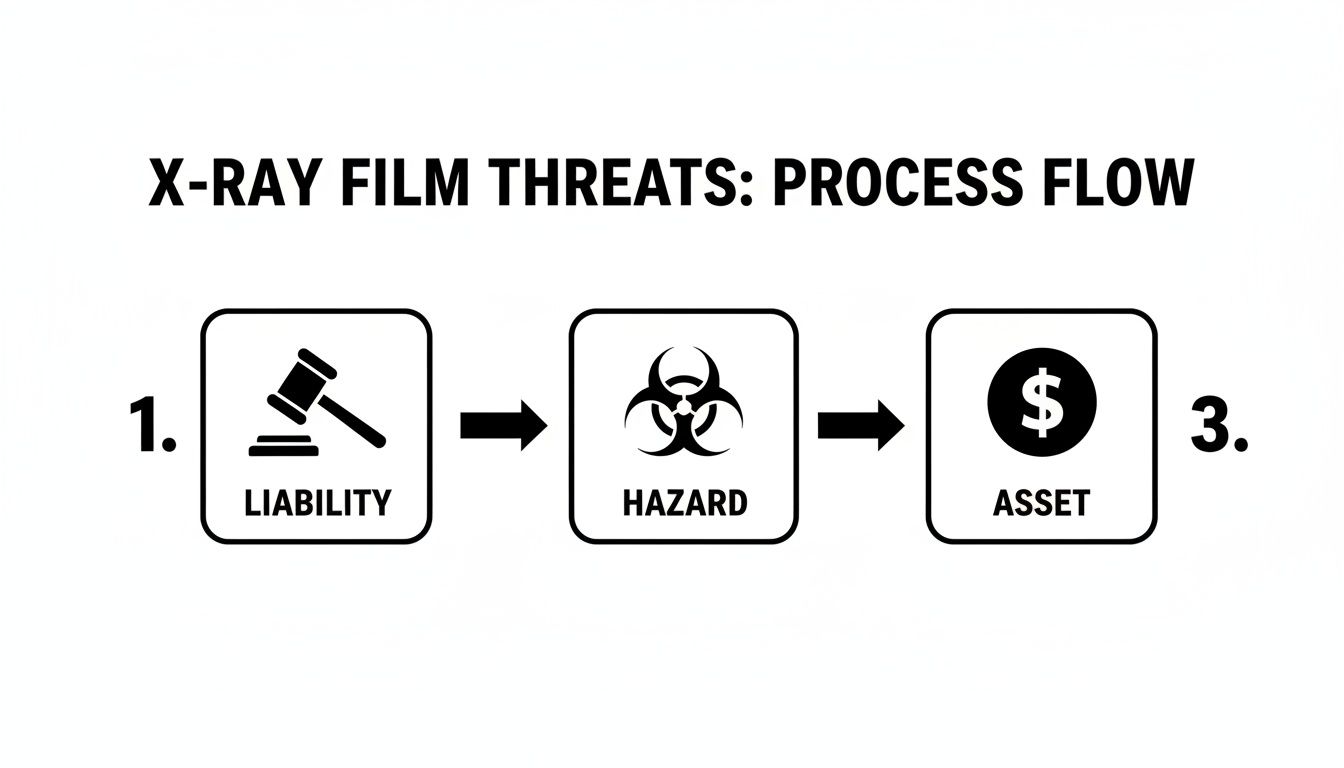
As you can see, solid preparation is the first step in neutralizing those risks and unlocking the financial value hiding in your film archive.
Insider Tips for Maximizing Your Return
Good prep isn't just about security—it’s also about making the process as financially smart as possible. There are two simple actions you can take that directly impact your costs and potential rebate.
1. Separate Films from Paper Jackets
Most films are kept in paper envelopes or jackets, which often have patient notes on them. Recyclers will take them as-is, but those jackets add a surprising amount of weight and bulk. Since most x-ray film recycling services quote by the pound, you’re essentially paying to dispose of paper.
By having staff or a temp pull the films from their jackets, you can cut your total weight by up to 50%. This one move can dramatically lower your processing costs and increases the material's purity, which often leads to a better silver recovery payout.
2. Accurately Estimate Your Volume
A good estimate helps your recycling partner send the right size truck and the right number of people for the job. Guessing can cause logistical nightmares, like a truck that's too small or a crew that isn't ready for the real scope of the work. This is true for both local and nationwide x-ray film recycling projects.
Here’s a practical way to get a rough idea of your volume:
| Container Type | Approximate Weight (with film) |
|---|---|
| Standard Banker's Box | 25-35 lbs |
| Large Filing Cabinet | 150-200 lbs per drawer |
| 4-Shelf Storage Unit | 800-1,000 lbs |
Use these numbers to get a ballpark figure. Any reputable recycler will help you refine this estimate to make sure you get a transparent and accurate quote for the project. Proper prep isn't just about logistics; it’s a strategic move that boosts security and your financial return. In the same way, planning for other specialized assets is just as critical; you can learn more by checking out our guide to arranging for a free electronics recycling pickup.
Navigating HIPAA and Environmental Compliance
When you're dealing with old x-ray films, compliance isn't just a box to check—it's a legal minefield. Getting it wrong means navigating two major federal regulations: the Health Insurance Portability and Accountability Act (HIPAA) for patient privacy and the Resource Conservation and Recovery Act (RCRA) for environmental safety. A misstep with either can lead to some truly staggering penalties, which are enforced nationwide.
This goes way beyond avoiding fines. It's about protecting your organization, your patients, and your community. Let’s break down what these complex rules actually mean for you in practical terms.
Your HIPAA Responsibilities: The Covered Entity and Business Associate
Under HIPAA, if you're a healthcare provider, clearinghouse, or health plan, you're a "covered entity." This title makes you legally responsible for safeguarding the Protected Health Information (PHI) on every single x-ray film, no matter how old it is. That responsibility doesn't just disappear when the films are hauled away.
This is where your recycling partner becomes critical. They must act as your "business associate," which is HIPAA's term for a vendor that handles PHI on your behalf. To make this relationship official and compliant, you absolutely must have a signed Business Associate Agreement (BAA) in place before a single film leaves your possession.
A BAA is a legally binding contract that clearly defines the recycler's obligation to protect your patient data. Think of it as your proof that you’ve done your due diligence. Without it, you're essentially handing over unsecured PHI—a direct violation that can bring severe consequences.
The Certificate of Destruction: Your Ultimate Proof of Compliance
Once the recycling is done, your partner has one more job: providing you with a Certificate of Destruction. This document is your final, non-negotiable proof that the PHI on those films was securely and permanently destroyed according to HIPAA standards.
Picture a HIPAA audit. When the auditor asks for proof of how you disposed of old patient records, this certificate is your definitive answer. It details:
- What was destroyed: The type and approximate volume of material.
- When it was destroyed: The exact date of the final destruction.
- How it was destroyed: The method used to make the data completely irretrievable.
- Who destroyed it: Confirmation from your certified business associate.
This certificate is your shield. It officially transfers liability for that data from your organization to the recycler and closes the loop on your compliance duties for that batch of records. Without it, you have no verifiable proof of proper disposal.
For a closer look at the details, you can review the components of a Certificate of Destruction form.
Understanding Environmental Regulations and RCRA
Beyond the data privacy aspect, there’s the environmental angle. The Environmental Protection Agency (EPA) classifies old x-ray films as hazardous waste. Why? Because the silver emulsion is a heavy metal, and under RCRA, it cannot be dumped in a standard landfill where it can leach into soil and groundwater.
This simple fact has huge implications. Just tossing old films in the dumpster isn't just irresponsible—it's flat-out illegal. The global X-ray film recycling market is valued at a massive $250 million annually, driven largely by these strict regulations. Businesses that ignore RCRA rules can face fines up to $50,000 per violation, making professional recycling an absolute must.
This is exactly why certified recycling is the only compliant path forward. Professional recyclers use a specific chemical process to wash the film, safely separating the silver for recovery. What's left is a clean PET plastic base that can be recycled. This process neutralizes the environmental hazard and ensures your facility meets its RCRA obligations.
Part of managing all this effectively involves using tools like a HIPAA risk assessment template to spot and fix any potential vulnerabilities in your process. A compliant recycling program is your best defense against both data breach lawsuits and environmental penalties, turning a major liability into a secure, managed process.
How to Choose a Certified Recycling Partner
Picking the right partner for your x-ray film recycling is easily the most critical decision you'll make in this whole process. It's a choice that has a direct line to your organization's data security, environmental compliance, and even your bottom line. Simply going with the lowest bidder without doing your homework can expose you to huge risks, whether you need a local or nationwide service.
This isn't just about hiring another vendor. It's about finding a partner you can trust, one with proven expertise. The right recycler becomes an extension of your compliance team, making sure every single step is handled securely and with total transparency.
Non-Negotiable Certifications and Insurance
Before you even think about looking at a price quote, there are a couple of credentials any potential partner absolutely must have. If a company can't show you these, walk away immediately. It's that simple.
First up is the NAID AAA Certification. This certification, issued by the International Secure Information Governance & Management Association (i-SIGMA), is the undisputed gold standard for secure data destruction. It means the recycler has passed intense, unannounced audits covering everything from their hiring process to their operational security and destruction methods. It’s your third-party guarantee that they know how to handle sensitive information the right way.
Second is having the right insurance. Ask for proof of both data breach insurance and pollution liability insurance. Data breach coverage is your safety net if patient information is ever compromised, while pollution liability protects against any environmental mishaps. Any legitimate, professional recycler will have no problem providing their certificates of insurance.
Without NAID AAA Certification and proper insurance, you’re taking on a massive, unnecessary risk. These credentials aren’t optional—they are the absolute baseline for any company you should even consider for your local or nationwide x-ray film recycling needs.
Critical Questions to Ask Every Vendor
Once you’ve confirmed those basics, it's time to dig in with some tougher questions. How a vendor answers these will tell you everything you need to know about their process, transparency, and accountability.
- Do you handle the entire recycling process yourselves, or do you subcontract any of it? This is a huge one. Subcontracting adds more hands to the process, creating more links in the chain of custody and increasing your risk.
- Can you walk me through your chain of custody, from the moment you pick up the film to its final destruction? They should be able to clearly describe a secure, documented process for every single step.
- What kind of truck will you use for pickup? You want to hear about company-owned, locked box trucks operated by uniformed, background-checked employees—not unmarked vans or random third-party couriers.
- Is the actual destruction and silver recovery done at your own facility? A direct provider who controls the entire process from start to finish offers far greater security and accountability.
Their responses will quickly help you separate the true professionals from the brokers who are just coordinating the logistics for someone else.
Comparing X-ray Film Recycling Providers
It's important to understand the difference between a direct provider and a national broker, as it has major implications for your security and peace of mind. A direct provider runs its own show—its own trucks, its own secure facility, and its own trained team. This gives you a single, accountable point of contact and complete oversight. A broker, on the other hand, typically hires other local companies to do the actual work.
The table below breaks down the key differences to help you decide what's right for your organization.
| Feature | National Recycling Broker | Local Direct Provider |
|---|---|---|
| Chain of Custody | Often involves multiple subcontractors, creating more risk points. | A single, unbroken chain from your door to final destruction. |
| Accountability | Can get complicated and diluted across multiple companies if an issue comes up. | One company is fully accountable for the entire process, period. |
| Scheduling | May have less flexibility, as they depend on a third party's availability. | Offers faster, more flexible scheduling with their own dedicated fleet and crew. |
| Security | Security standards can vary widely depending on the subcontractor they hire for the job. | Consistent, verifiable security protocols you can count on (like NAID AAA). |
While a broker might seem convenient by covering a wide area, a direct provider delivers security and control that's second to none. For any facility dealing with sensitive materials, working directly with an established electronic waste recycling company that owns and operates its own assets is almost always the smarter, safer choice.
The Hidden Economics of Silver Recovery
For most organizations, dealing with old x-ray films feels like just another expense on the budget. But that mindset misses a huge financial opportunity hiding in those heavy, dusty archives. Your old films aren’t just a storage headache; they're a potential source of revenue.
The value is locked inside the film's emulsion layer, which contains silver halide crystals. A specialized x-ray film recycling process uses a chemical wash to safely strip this silver away from the clear PET plastic base. That reclaimed silver gets refined, and its value is tied directly to the current market price of silver. Suddenly, what you thought was waste becomes a real asset.
Turning Costs into Rebates
The financial return you can get from silver recovery can be surprisingly large, especially for facilities with huge volumes of film. Think about a major hospital system clearing out a decade's worth of records—that could easily be several tons of film. The value of the silver recovered from that pile is often more than enough to cover the entire cost of the pickup, secure data destruction, and recycling service.
In many high-volume projects, it goes even further. When the silver's value is greater than the service fees, you get a check back. This completely flips the script, turning a compliance-driven expense into a revenue-generating activity that actually helps your bottom line.
A well-managed recycling program doesn't just eliminate a disposal cost; it creates a new revenue stream. The key is partnering with a transparent recycler who connects your rebate directly to the silver market.
Understanding Payment Models
When you start getting quotes, you'll see a few different pricing structures. It's critical to understand them so you can compare apples to apples and see the true financial potential locked in your film archive.
Here are the most common models you'll run into:
- Per-Pound Rate: The recycler gives you a flat rate for every pound of film. It's simple and predictable, but it might not account for spikes in the silver market, meaning you could be leaving money on the table.
- Revenue Sharing: This is a much more transparent approach. The recycler processes the film, sells the silver, and then shares a percentage of the money with you after their service fees are deducted. This model ties your return directly to the market value.
- Cost-Offset Model: Here, the value of the recovered silver is first used to pay for the service. If there’s any money left over after that, it's sent back to you as a rebate.
The recovery process isolates valuable materials, and a professional operation understands the handling requirements, like those detailed in a Silver Powder SDS. This attention to detail is a sign you're working with a true expert.
The Financial Impact in Practice
Silver recovery from x-ray films is a game-changer. Research shows that every ton of x-ray film can yield a significant amount of pure silver. For medical facilities and labs, this means real savings. The value of recycled silver can offset disposal costs that might otherwise hit $500 per ton. A professional recycler handles the pickup seamlessly, so you avoid the headaches of hazardous waste shipping.
At the end of the day, the economic benefit of x-ray film recycling is clear. It’s a smart move that balances fiscal responsibility with environmental and data security compliance. To learn more about how this works, you can read about our professional silver recovery services.
Your X-ray Film Recycling Questions, Answered
When you're looking at a mountain of old x-ray films, a few practical questions always come up. Getting clear answers is the first step to moving forward with a smart, compliant recycling program. Here are the straight-up answers to the most common questions we hear from facilities just like yours, both locally and across the U.S.
Can We Recycle X-ray Films with the Paper Jackets Still On?
Yes, you absolutely can. Any professional recycler worth their salt will take them as-is.
However, this is one of those decisions that directly hits your bottom line. Leaving the paper jackets on adds a ton of weight to the material you’re sending off. Since most services are priced by the pound, you end up paying to haul and process paper. If you have your team separate the film from the jackets beforehand, you can slash the total weight by as much as 50%.
That one move lowers your service bill and almost always boosts your silver recovery payout. It’s a win-win.
A Quick Tip from the Field: If you're dealing with a large volume, think about bringing in a temp or two for a day. The labor cost is often a fraction of what you'll save on the final recycling invoice.
What Types of Film Are Accepted for Recycling?
The short answer is: pretty much all of them. If it's a radiographic film, it contains silver that can be recovered. This holds true whether you're a hospital with decades of records, a local dental office, or an industrial NDT firm anywhere in the country.
We regularly process a wide variety of films, including:
- Medical X-ray Films: This is the big one, covering everything from standard chest x-rays to mammograms, MRIs, and CT scans.
- Dental X-ray Films: Both the small intraoral films and the larger panoramic ones are perfect for recycling.
- NDT (Non-Destructive Testing) Films: These films, used in industrial settings to check welds and structural integrity, are also rich in silver.
- Veterinary X-ray Films: Films from animal hospitals and clinics are handled with the same secure process as medical films containing human PHI.
No matter the source, the core silver extraction process is the same, making sure hazardous materials are managed correctly and valuable resources are put back into circulation.
How Is Our Data Kept Secure During Transit and Processing?
This is probably the most critical question you can ask, and you should be asking it. A reputable recycling partner doesn’t just promise security; they live it through a documented, auditable chain of custody.
Here’s what that actually looks like in practice:
- Secure Collection: The process starts with uniformed, background-checked employees arriving in a company-owned, locked box truck. Your films are never handed off to a third party.
- GPS-Tracked Transport: That truck is tracked by GPS from the moment it leaves your facility until it arrives at the secure recycling plant. No detours, no unauthorized stops.
- Controlled Facility Access: The plant itself is a fortress. We’re talking controlled access, 24/7 surveillance, and strict visitor protocols.
- NAID AAA Certified Destruction: The destruction process adheres to the stringent standards of NAID AAA Certification, which guarantees that all Protected Health Information (PHI) is made completely unrecoverable.
This end-to-end control is precisely why working directly with a certified recycler, not a broker who just subcontracts the work, is the only way to truly protect your sensitive data.
Why Is X-ray Film Recycling Still a Growing Industry?
It seems counterintuitive, right? Digital imaging is king. While it’s true that the digital shift has cut new X-ray film production by 70-80% in developed countries since 2000, the recycling industry is booming because of the massive stockpiles of legacy films sitting in storage rooms worldwide.
This has fueled a powerful $250 million annual industry, with forecasts showing it could hit $700 million by 2033. The value isn’t just in the silver; it’s in the expert service of managing huge purges and helping facilities dodge EPA fines that can run an average of $37,500 per day. You can discover more insights about the X-ray film recycling market and see the projections for yourself.
How Much Will It Cost and Can We Get Paid?
The cost isn't a simple flat rate. It’s a dynamic figure based on a few key variables:
- Total Weight: How much film do you have?
- Service Level: Does our crew need to do the packing and removal from your file rooms, or is it ready to go?
- Current Silver Market Price: This is the biggest factor and changes daily.
A transparent partner will give you a quote that breaks all of this down. For larger volumes, it’s very common for the value of the recovered silver to exceed the service fees. When that happens, the project doesn't cost you a dime. Instead, you get a rebate check, turning a compliance headache into a welcome source of revenue.
Ready to transform your old x-ray films from a liability into an asset? Scientific Equipment Disposal provides secure, compliant, and profitable x-ray film recycling services for organizations nationwide, including the Atlanta metro area. We manage the entire process with our own fleet and certified facility, ensuring your data is protected and you receive the maximum financial return.
Contact us today to get a transparent quote and schedule your secure pickup.