What is electronic waste recycling: Essential insights for responsible disposal

So, what exactly is electronic waste recycling?
It’s the process of taking old, discarded electronics and carefully breaking them down to recover the valuable materials inside, all while making sure the hazardous bits are handled safely. Think of it less like simple disposal and more like a critical game plan for managing resources, protecting sensitive data, and keeping our environment clean. From local businesses in Georgia to nationwide corporations, it turns obsolete gear from a liability into a stream of reusable materials.
Unlocking Value from Obsolete Electronics
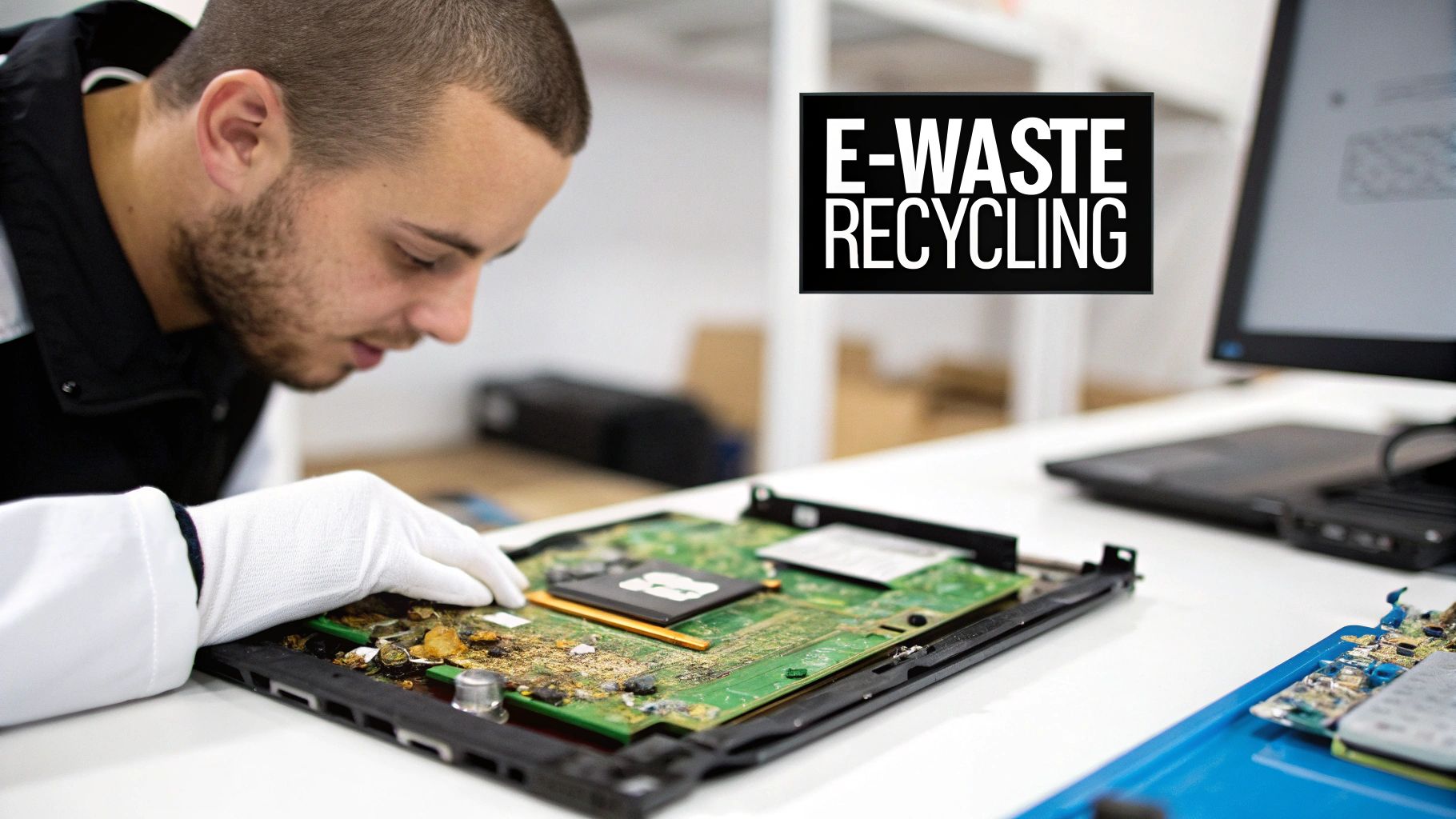
You can think of e-waste recycling not as a landfill operation, but as a modern-day urban mine. Tucked away inside your facility’s old servers, outdated lab instruments, and retired office computers are precious metals like gold, copper, and palladium, just waiting to be reclaimed. The entire process is about meticulously disassembling these devices to separate those raw materials so they can be used again in new products.
This is a world away from traditional trash disposal. Instead of letting potentially toxic materials like lead and mercury seep into the ground, a certified recycling process guarantees every single component is managed responsibly. It’s this two-pronged approach—recovering value while neutralizing harm—that makes e-waste recycling absolutely essential for any modern organization, whether operating locally or across the United States.
Why It Matters for Your Organization
For any business, hospital, or university, getting a handle on electronic waste recycling is the first real step toward building a responsible asset disposition strategy. This isn't just about clearing out old equipment; it's about shielding your organization from some very real and significant risks.
A proper recycling program directly tackles several key operational headaches:
- Data Security: It guarantees that any sensitive information left on hard drives or other storage media is wiped clean and permanently destroyed before the device is ever processed.
- Environmental Compliance: It keeps hazardous materials out of landfills, helping you stay on the right side of local, state, and federal environmental regulations. No one wants the EPA knocking on their door.
- Resource Management: By recovering valuable materials, it cuts down on the need for destructive new mining and feeds back into a more sustainable, circular supply chain.
The core idea of e-waste recycling is simple: turning a liability into an asset. Equipment that once posed data and environmental risks becomes a source of valuable, reusable materials, supporting both your bottom line and your sustainability goals.
Beyond Disposal—A Nationwide Imperative
Whether you’re a hospital in Atlanta managing sensitive patient data or a data center in Austin decommissioning entire server racks, the need for a secure and compliant recycling process is no longer optional. Across the nation, simply tossing old electronics is not a viable—or legal—choice for most businesses anymore.
Embracing a certified recycling process is a smart strategy for managing risk, protecting your reputation, and unlocking the hidden value in your old assets. As we’ll explore, a structured approach to your organization’s IT equipment recycling isn't just good practice—it's smart business on both a local and national scale.
The Growing Challenge of Global E-Waste
To really get why electronic waste recycling is so important, you first have to understand the sheer scale of the problem. Every year, our world generates a mountain of discarded electronics, from old office computers to retired laboratory equipment. This isn't just a local issue for businesses in one city; it’s a national and global headache with serious consequences.
Think about a line of dump trucks stretching halfway around the globe. That’s a rough picture of the e-waste we produce every single year. This tidal wave of old tech is fueled by constant innovation and shorter product lifecycles, leaving companies nationwide with a steady stream of equipment that needs to be managed the right way.
The High Cost of Doing Nothing
When organizations don't have a solid e-waste plan, they get hit with a one-two punch. First, there's the environmental damage. Old electronics are packed with hazardous materials like lead, mercury, and cadmium. If those devices end up in a landfill, these toxins can seep into the soil and groundwater, causing real, long-term harm to local ecosystems.
Second, there's the staggering economic loss. Tossing out old equipment is literally like throwing away money. Those same devices contain valuable, recoverable resources—gold, silver, copper, and palladium—that could be put right back into the manufacturing supply chain. Ignoring this "urban mine" of materials is not just wasteful; it increases our reliance on destructive new mining operations.
E-waste is a strange paradox. On one hand, it's a source of hazardous materials that threaten our environment. On the other, it's a rich reserve of valuable resources just waiting to be reclaimed.
A Global Crisis, by the Numbers
The statistics paint a pretty stark picture. Globally, we generated a record 62 billion kilograms of electronic waste in a single recent year—that's an 82% jump since 2010. The pile is growing five times faster than our recycling efforts can keep up.
Even worse, only 22.3% of this e-waste was properly collected and recycled. That means an estimated $62 billion worth of recoverable natural resources were lost, dumped in landfills or disposed of improperly. The trend isn't getting any better, either. Projections show global e-waste hitting 82 million metric tons by 2030 while formal recycling rates are expected to slip to just 20%. You can learn more about the scale of this e-waste crisis and its projected growth.
Why This Matters for Your Organization
This global mess has a direct impact on how hospitals, universities, and corporate facilities across the U.S. have to manage their old equipment. The massive gap between the waste we create and the amount we responsibly recycle means every piece of improperly disposed-of gear contributes directly to environmental contamination and resource depletion.
For any modern organization, having a proactive e-waste recycling strategy is no longer just a nice ethical choice—it's a smart, sustainable business decision. Partnering with a certified recycling provider makes sure your organization stays compliant with nationwide regulations, protects the environment, and helps recover valuable materials that would otherwise be gone for good. It's how you turn a growing challenge into a responsible, forward-thinking solution.
How the E-Waste Recycling Process Works
Ever wonder what actually happens to your old equipment after it leaves your facility? It’s not just a trip to a glorified scrap heap. Instead, it’s the start of a precise, multi-stage journey from your loading dock back to raw, usable materials, whether you're in downtown Atlanta or anywhere else in the country.
Think of a certified recycling facility as a highly specialized factory floor. Each station has a critical job, transforming what could be a massive liability into a secure, verified, and valuable outcome. This systematic approach is what defines professional electronics recycling—every step is logged, tracked, and documented to give you a transparent, auditable trail from beginning to end.
This infographic puts the process into a global context, showing the massive gap between the e-waste we generate and what we actually manage to recycle.
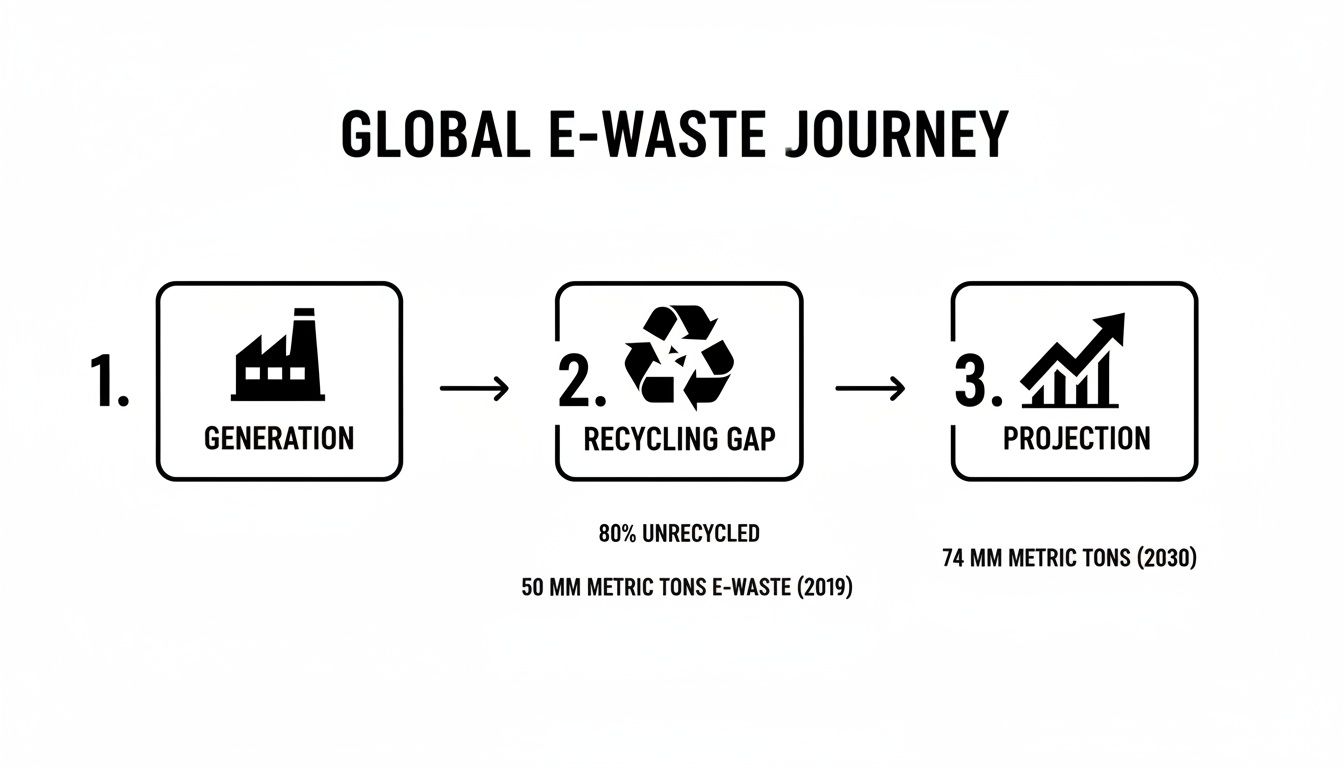
The controlled, professional process we follow is essential to closing that gap, ensuring we recover more of the valuable materials packed inside our old devices.
Stage 1: Secure Collection and Logistics
It all starts with getting the equipment from your facility to ours. This isn’t just a simple pickup; it’s the first and most critical link in the chain of custody. A professional team arrives on-site to handle everything, whether that means carefully de-installing sensitive lab equipment in a local clinic or methodically removing server racks from a nationwide data center network.
Every asset is inventoried, palletized, and loaded onto secure, GPS-tracked vehicles. This meticulous approach prevents any assets from getting lost and establishes an unbroken security protocol right from the start.
Stage 2: Manual Sorting and Decontamination
Once the equipment arrives at our certified recycling facility, the real work begins. The first step is manual sorting. Trained technicians triage every single piece, separating items by type, condition, and the materials they contain. This is also where specialized gear, like medical and lab devices, are inspected for potential biohazards and decontaminated according to strict safety protocols.
This hands-on stage is vital for a few key reasons:
- Safety First: It allows us to safely remove hazardous components like batteries, toner cartridges, and mercury-containing lamps before they can contaminate other materials.
- Maximize Value: Any devices that might have resale or refurbishment potential are identified and set aside. This helps maximize any potential return on investment for your organization.
- Streamline the Process: Sorting everything at the beginning makes the rest of the recycling process far more efficient, ensuring different material streams are sent to the correct downstream channels.
Stage 3: Data Destruction and Dismantling
With hazardous materials out of the way, the focus shifts to data security—a non-negotiable step for any organization. Hard drives, SSDs, and other data-bearing devices are physically removed and processed according to exacting standards.
The gold standard for data sanitization is the NIST 800-88 guideline. This process uses specialized software to overwrite a drive with random data, rendering the original information completely unrecoverable. For drives that are damaged or require absolute certainty of destruction, physical shredding is the final answer.
After the data is verifiably destroyed, we issue a formal Certificate of Data Destruction. This document is your legal, auditable proof that your organization has met its compliance obligations under regulations like HIPAA. Only then is the equipment sent for manual dismantling, where it’s broken down into its core components—circuit boards, plastics, metals, and wiring.
Stage 4: Advanced Materials Recovery
This final stage is where the "urban mining" really happens. The separated components are sent to specialized downstream partners who use a combination of shredders, powerful magnets, and sophisticated separation technologies to extract the raw materials.
For example, circuit boards are processed to reclaim tiny but valuable amounts of gold, silver, palladium, and copper. Plastics are shredded, sorted by polymer type, and melted into pellets for new manufacturing. Steel and aluminum are melted down to be reformed. This highly technical phase ensures that the maximum amount of material is returned to the supply chain, reducing the need for new mining and minimizing our collective environmental footprint.
To learn more about how we handle the logistics for your facility, check out the details on scheduling a free electronic recycling pickup.
Why Certified Recycling Is Non-Negotiable
Let's move past the mechanics of electronic waste recycling for a moment. It's time to talk about why choosing a certified process isn't just a good idea—it's an absolute must for any modern organization in the U.S.
When you're dealing with retired IT assets and lab equipment, the stakes are much higher than simply clearing out a storage room. Every single device is a potential liability, loaded with sensitive data and governed by a web of strict regulations.
Think of your old servers, computers, and medical devices as digital vaults. Even after they’re powered down for the last time, these vaults can still hold protected health information (PHI), customer financial records, or your company's proprietary data. Just handing them over to a general scrap hauler is like giving a stranger the keys. You have absolutely no control over what happens next.
This is where the line between a simple scrap dealer and a certified IT Asset Disposition (ITAD) partner becomes crystal clear. A certified partner operates under a strict, auditable framework that puts data security and environmental compliance above everything else.
The High Cost of Non-Compliance
For organizations in regulated fields like healthcare, finance, or government, the consequences of improper e-waste disposal can be catastrophic. A single data breach from a discarded hard drive can trigger devastating penalties under state and federal laws like HIPAA or GDPR.
And we're not talking about minor fines. A significant breach can lead to multi-million-dollar settlements, mandatory public disclosure, and irreparable damage to your organization's reputation. The legal and financial fallout can easily dwarf any perceived savings from using a cheap, uncertified vendor.
Certified electronic waste recycling is an essential pillar of risk management. It transforms asset disposition from an operational afterthought into a strategic defense against data breaches, regulatory penalties, and environmental liability.
This level of risk makes choosing the right partner a non-negotiable part of corporate governance. Certified recyclers provide an unbroken chain of custody and verifiable proof of data destruction, giving you the solid documentation needed to demonstrate due diligence to auditors and stakeholders nationwide.
A Global Issue with Local Solutions
The importance of using a domestic, certified partner is magnified by the global e-waste crisis. Recycling rates are all over the map, showing huge gaps in infrastructure and policy worldwide. While Europe leads with a 42.8% formal recycling rate, Asia—which generates half the world's e-waste—only recycles 11.8%. In Africa, the rate is less than 1%.
This massive disparity drives the uncontrolled shipment of 3.3 million metric tons of e-waste from high-income to low-income countries, where it's often handled in unsafe, unregulated conditions. By choosing a local, certified recycler, your organization ensures it isn't contributing to this global problem. You can discover more insights about these stark global e-waste disparities.
Choosing a certified Atlanta-area electronic recycling center guarantees your assets are processed under strict U.S. environmental and data security laws, preventing them from ending up in an unregulated international waste stream.
Beyond Compliance to Corporate Responsibility
Ultimately, certified recycling is about more than just avoiding penalties. It's a clear statement about your organization's commitment to corporate responsibility. It proves to your clients, employees, and community that you take data privacy and environmental stewardship seriously.
In a world where consumers and partners increasingly value ethical and sustainable practices, a transparent and responsible e-waste program is a powerful differentiator. It shows your organization understands the full lifecycle of its assets and is dedicated to managing them in a way that protects both people and the planet. This commitment is the true definition of what electronic waste recycling means for a forward-thinking enterprise.
How to Choose a Certified E-Waste Partner
Picking the right partner for your electronic waste is a huge decision. It directly impacts your data security, your compliance with environmental laws, and your company's overall risk. You're not just looking for a hauler to make stuff disappear; you need a specialist who understands the ins and outs of decommissioning IT assets and sensitive lab equipment for organizations nationwide.
Getting it right means finding someone who protects your interests from the moment they walk in the door until the very last drive is wiped clean.
The first step, before you even pick up the phone, is to inventory your surplus assets. You can't get an accurate quote or a solid logistics plan without knowing exactly what you have. Document everything—types, quantities, and where it's all located, whether it's server racks in a data center or centrifuges in a lab. This homework is the foundation for a smooth project.
Vetting Partners with Certifications
With your inventory list in hand, it's time to start vetting potential partners. The single most important thing to look for is certification. You want to see credentials like R2 (Responsible Recycling) or e-Stewards. These aren't just fancy logos for a website; they are hard-earned proof that a recycler meets the highest industry standards for environmental safety, worker protection, and data security.
These certifications mean your partner follows a documented, auditable process. They give you peace of mind that your equipment won't be illegally shipped overseas or dumped in a local landfill, which is crucial for protecting your organization's reputation. A non-certified vendor simply can’t offer that same level of assurance.
Inquiring About Data Destruction and Logistics
Once you have a shortlist of certified recyclers, it's time to dig into the details of their process. Data security is completely non-negotiable, so get ready to ask some direct questions:
- Do you provide data wiping that meets NIST 800-88 or DoD 5220.22-M standards?
- Can you physically shred non-functional hard drives, either on-site at our facility or at yours?
- Will we receive a Certificate of Data Destruction to prove everything was handled correctly?
Logistics are just as critical. A true partner does more than just show up with a truck. Make sure they can provide on-site de-installation, secure packing, and transport everything with their own fleet. This is especially vital for big jobs like a national facility shutdown, where you need a professional, coordinated team to manage the chaos.
Choosing a partner is about aligning their capabilities with your needs. An ideal recycler doesn’t just take your e-waste; they become an extension of your facilities and IT teams, managing the entire disposition process with precision and security.
The electronic waste recycling market is exploding, projected to grow by $32.74 billion at a compound annual growth rate of 21.6%. A big driver for this growth is tighter regulation, like the increasing number of states passing Extended Producer Responsibility (EPR) laws. For businesses everywhere, this means working with a certified recycler isn't just a good idea—it's essential for staying ahead of compliance demands. You can learn more about the economic and regulatory forces transforming e-waste recycling.
By following these steps, you can confidently choose a partner that will protect your data, keep you compliant, and handle your assets responsibly. To see how different providers compare, check out our guide on finding the right electronic waste recycling companies for what you need.
Common E-Waste Recycling Questions
Even with a solid plan, it's natural to have questions when you're getting ready to dispose of old equipment. Getting clear, straightforward answers is the best way to move forward with confidence.
Here are a few of the most common questions we hear from facilities we work with, from Atlanta-area hospitals to corporate data centers across the country.
What Types of Business Equipment Do You Accept?
A certified recycler should be able to handle a huge range of IT, lab, and medical equipment. This includes the usual suspects like servers, storage arrays, networking gear, laptops, and monitors. But for more specialized facilities, that list grows to include large-scale systems like centrifuges, mass spectrometers, incubators, and even diagnostic imaging machines.
The goal is to find a single partner who can manage a complex facility decommission from start to finish. If you have unique or proprietary equipment, don't hesitate to ask—a good partner can almost always find a solution.
How Is Our Sensitive Data Securely Destroyed?
This is non-negotiable. Data security has to be the absolute top priority. Reputable partners will offer hard drive wiping that meets strict government standards like NIST 800-88 or DoD 5220.22-M. These methods are designed to sanitize the drives, making the data completely unrecoverable by any software-based tool.
For hardware that's broken, outdated, or just requires the highest level of security, nothing beats physical shredding. If you go this route, always insist on a Certificate of Data Destruction. This document is your official, auditable proof that you’ve met your compliance obligations under regulations like HIPAA. You can find more details on why this is so critical in our guide to secure data destruction services.
Is There a Cost for E-Waste Recycling Services?
It depends. The cost really comes down to the type, amount, and condition of the equipment. Logistics, like whether you need a team to come on-site and de-install everything, also play a role. A lot of standard IT assets still have resale value, which means they can often be recycled at no cost—and sometimes, you might even get a check back.
On the other hand, older equipment with no secondary market value or a complicated lab cleanout might have a service fee. Any trustworthy partner will give you a transparent, itemized quote upfront. Their focus should be on maximizing your asset value to offset any costs.
How Do I Know a Recycler Is Environmentally Responsible?
The proof is in the certifications. Look for credentials like R2 (Responsible Recycling) or e-Stewards.
These aren't just fancy logos; they are your guarantee that the recycler follows strict environmental standards, protects its workers, and has ironclad data security procedures. A certified recycler won't hesitate to provide transparent downstream reporting, so you can see exactly where your materials ended up and have peace of mind that nothing was illegally exported or dumped in a landfill.
Ready to put a secure and responsible e-waste recycling program in place for your Atlanta-area or nationwide organization? Scientific Equipment Disposal provides certified solutions for laboratory, medical, and IT assets. Get a free quote and simplify your facility’s equipment disposition today.