A Guide to Understanding Toxic Hazard Signs in 2026

Toxic hazard signs are clear, visual warnings that communicate the presence of harmful substances. From the classic skull and crossbones to more specific pictograms, these symbols act as a universal language to prevent exposure, injury, and environmental harm in workplaces like labs and hospitals nationwide.
Why Toxic Hazard Signs Are Your First Line of Defense
Think about it: a simple symbol on a door can prevent a catastrophic chemical spill or stop a researcher from accidentally handling a carcinogen. That's the real power of effective toxic hazard signs. They aren't just a regulatory box to check off; they are your facility's first and most crucial line of defense against both immediate and long-term dangers.
In busy environments, these warnings are silent guardians. Whether it’s a bustling hospital in Atlanta, GA, a research lab in San Diego, CA, or a manufacturing plant anywhere in the United States, a clear sign instantly communicates a complex risk. This allows your team to take the right precautions without missing a beat. To really get it, you have to understand the broader purpose of safety signs and how they build a true culture of safety from the ground up.
A Universal Language for Workplace Safety
Don't think of these signs as a burden. Instead, see them as a universal language that speaks to everyone on your team, no matter their specific training or native tongue. This shared, instant understanding is vital for any business nationwide.
- Protecting Your Team: The most obvious benefit. These signs prevent accidental exposure to substances that could cause acute poisoning, chronic illness, or severe injuries.
- Ensuring Compliance: Let's be frank—proper signage is non-negotiable. It's required to meet strict OSHA and EPA regulations, helping you steer clear of hefty fines and legal trouble whether you operate in Georgia or nationwide.
- Safeguarding the Community: By keeping hazardous materials contained and handled correctly, these signs also prevent environmental contamination that could affect the public.
This visual communication system is critical throughout the entire lifecycle of a hazardous material or piece of equipment. It's there for daily operations, but it's just as important during the final decommissioning stages, where hidden risks from residual chemicals can pop up.
A solid grasp of what these signs mean is fundamental for all safe operations. As you'll see, it's also a key part of creating truly sustainable laboratory practices that protect both people and the planet.
How Past Tragedies Shaped Modern Hazard Signs
The toxic hazard signs we rely on today didn't just appear out of nowhere. They were developed in response to real-world disasters, with each symbol representing a hard-learned lesson. As industries began using more dangerous chemicals, the need for a clear, universal language of safety became tragically obvious.
This story goes back long before modern regulations. In the 19th century, many common household products were incredibly dangerous. For example, popular green wallpapers and fabrics were often made with arsenic-based dyes that released toxic fumes. These items were linked to hundreds of deaths, revealing a terrifying gap in public safety—there was simply no standardized way to warn people about the poison inside their own homes.
The Rise of Standardized Warnings
The first real steps toward modern hazard communication grew directly from these early tragedies. Lawmakers realized that simply telling people something was dangerous wasn't enough. They needed a visual symbol that was instantly recognizable. This led to some of the first laws requiring poison labels, a fundamental shift in managing chemical risks.
The idea of using a skull and crossbones to signify poison was first written into law as early as 1829 in New York. The state required this grim symbol on all poison containers in a direct response to widespread accidental poisonings, setting the stage for the visual warnings we use today.
Progress continued with laws like the Federal Caustic Poison Act of 1927. This act mandated clear labels for 13 corrosive substances, including common but powerful chemicals like sulfuric and nitric acid. It was a major milestone, and later analyses suggest it helped cut household poisoning incidents by half.
From National Rules to a Global System
The modern framework we know today really began to take shape with the creation of the Occupational Safety and Health Administration (OSHA) in 1970. The major turning point was OSHA's 1983 Hazard Communication Standard (HCS), which introduced a systematic approach to workplace labeling and the first set of official pictograms to warn workers across the U.S.
This evolution—from early skull-and-crossbones labels to today's globally recognized system—has saved countless lives. Since the HCS was introduced in 1983, U.S. data shows a remarkable 70% decrease in poisoning incidents.
The system became even stronger in 2012 when OSHA aligned with the Globally Harmonized System (GHS). Now used in over 180 countries, the GHS ensures that a toxic hazard sign for a substance in Atlanta is understood just as clearly in Anchorage or Amsterdam. You can explore a detailed timeline of how these chemical risks have been managed over the years to see the full picture.
Decoding the Most Common Hazard Pictograms
When you’re working in a lab or a research facility in Atlanta, Georgia or anywhere else, those hazard pictograms aren't just wallpaper. Each symbol tells a critical story, and for any facility manager or EHS officer, knowing how to read them isn't just about compliance—it’s about making the right split-second decisions that keep people safe.
The signs we use today didn't just appear overnight. They're the result of a long history of learning, sometimes the hard way, about how to communicate danger effectively. The journey from simple poison labels to the global standards we now rely on shows a clear push toward universal understanding.
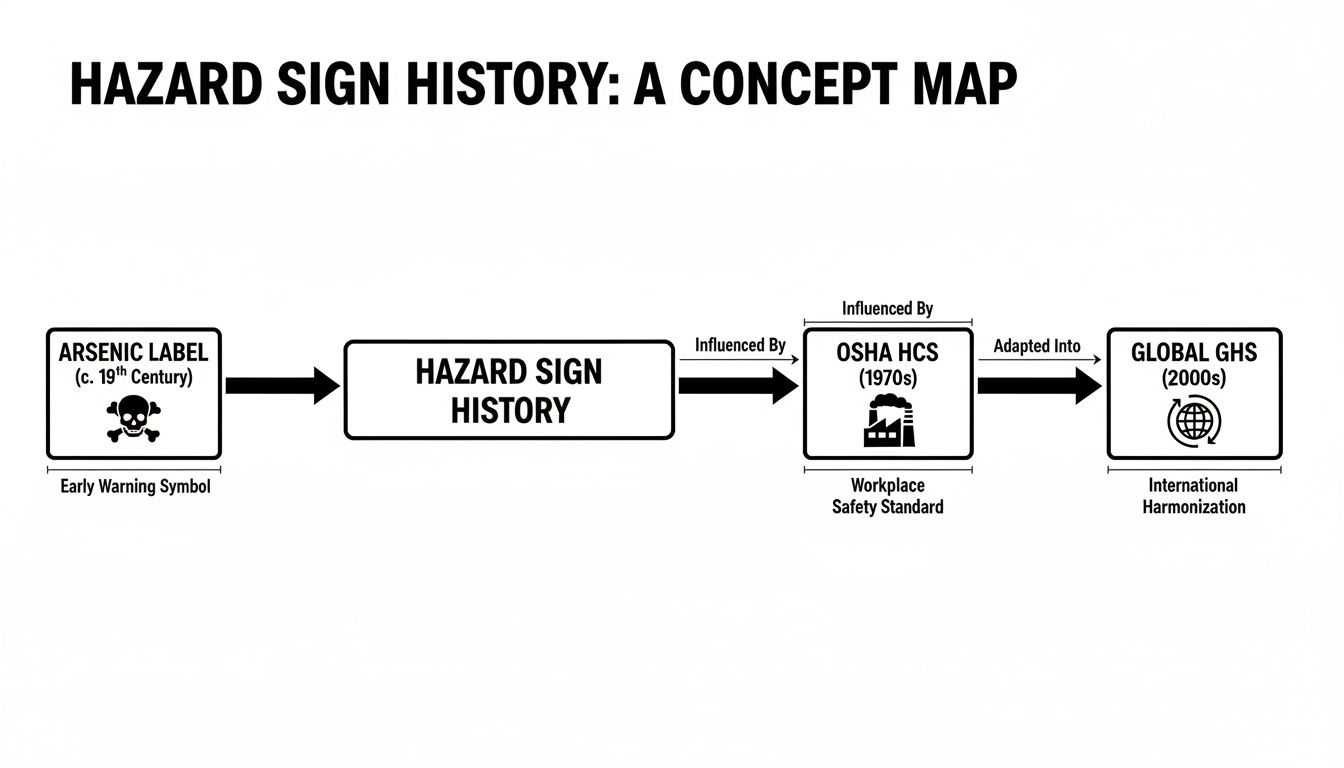
As you can see, we’ve moved from basic warnings like the first arsenic labels to the comprehensive Hazard Communication Standard (HCS) from OSHA, and now to the Globally Harmonized System (GHS). The goal has always been the same: create symbols so clear that anyone, anywhere, can instantly understand the risk.
GHS Pictograms: Acute vs. Chronic Risks
Under the GHS framework, a couple of symbols often cause confusion: the Skull and Crossbones and the Health Hazard pictogram. They both signal danger, but they speak to very different timelines.
- GHS Skull and Crossbones: This one is a warning about acute toxicity. It means a substance can cause serious harm or even death with just a single, short exposure. Think of a chemical that is fatal if inhaled, swallowed, or it touches your skin. The danger is immediate.
- GHS Health Hazard: This symbol, which looks like an exploding chest, signals chronic, long-term health risks. These are the silent dangers. This pictogram is used for substances that are carcinogenic (cause cancer), mutagenic (cause genetic defects), or can damage organs over time with repeated exposure. Asbestos is a perfect real-world example.
Telling these two toxic hazard signs apart is fundamental. One is an emergency waiting to happen, while the other is a hidden threat that demands specific, long-term handling protocols. If you want a deeper look at all the signs you'll encounter, you can learn more about all the critical laboratory hazard signs we see in the field.
Interpreting NFPA, Biohazard, and Radiation Symbols
Beyond GHS, a few other symbols are essential for facility staff nationwide and, just as importantly, for first responders arriving on-site.
The NFPA 704 diamond is basically a cheat sheet for firefighters and hazmat teams. It uses a color-coded system with a number rating from 0 (no hazard) to 4 (severe hazard) to instantly communicate risks. Red is for flammability, blue for health, yellow for instability, and the white section is for special hazards. A big "4" in that red diamond means you have a severe fire risk on your hands.
Other symbols communicate very specific, non-negotiable warnings:
- Biohazard Symbol: This three-circle design is universally understood. It warns of infectious biological materials like viruses, bacteria, or regulated medical waste. You’ll see it on sharps containers, waste bins in clinics, and equipment in research labs across the U.S.
- Radiation Trefoil: The distinct, propeller-like symbol (usually magenta or black on a yellow background) is a stark warning of ionizing radiation. It’s a clear command to keep your distance and adhere to strict safety measures.
These pictograms are vital tools. Knowing how to read them isn't an academic exercise—it's a core skill for anyone working around hazardous materials or decommissioning the equipment that handles them.
To make it even clearer, here’s a quick reference table breaking down these common symbols.
Common Hazard Pictograms and Their Meanings
This table gives you a side-by-side look at the key pictograms, what they mean, and where you're most likely to see them.
| Hazard System | Pictogram/Symbol | Meaning | Example Scenario |
|---|---|---|---|
| GHS | Skull and Crossbones | Acute toxicity (fatal or toxic) | A drum of chemicals that can cause death upon short exposure. |
| GHS | Health Hazard (Exploding Chest) | Carcinogen, mutagenicity, reproductive toxicity | A container of a substance known to cause cancer over time. |
| NFPA 704 | Diamond with numbers | Rates flammability, health, and instability | A tank where a high number in the red diamond indicates a severe fire hazard. |
| Biohazard | Three overlapping circles | Presence of infectious biological material | A waste bin in a hospital lab containing used needles and cultures. |
| Radiation | Trefoil (propeller) | Presence of ionizing radiation | The door to a room containing an X-ray machine or radioactive isotopes. |
Having a firm grasp of this visual language is the first step toward building a truly safe and compliant work environment, whether your facility is in the Atlanta area or across the nation.
Meeting OSHA and EPA Hazard Labeling Rules
It’s one thing to know what the toxic hazard signs mean, but it's another thing entirely to apply them correctly. Getting this right is what keeps your facility compliant and, more importantly, your team safe. Federal agencies like the Occupational Safety and Health Administration (OSHA) and the Environmental Protection Agency (EPA) have very clear rules for hazard labeling, and they apply to businesses across the United States. Make no mistake—failing to follow them can bring serious fines and legal headaches.
These rules weren't just created in a vacuum. They were forged from the hard lessons of industrial accidents. Take the 1976 Seveso disaster in Italy, a textbook example of why clear signage is a lifesaver. The trichlorophenol reactors involved didn't have the proper health hazard pictograms we use today. This lack of information delayed the emergency response and made a terrible chemical release even worse. That single event pushed Europe to create its toughest safety regulations and influenced standards worldwide, contributing to a 40% drop in similar incidents at EU facilities.
For universities and labs in the Atlanta area managing contaminated equipment, this history is a powerful reminder of why labeling is critical, especially during a lab cleanout. OSHA doesn't mess around, with violations bringing fines as high as $150,000. You can find more on how toxicologic misfortunes shaped global safety rules on aneskey.com.
Core Components of a Compliant Label
A compliant GHS label isn’t just a picture. To meet OSHA’s standards, every hazardous chemical container needs a few key pieces of information working together. Think of it as the chemical’s ID card—everything you need to know for safe handling is right there.
Here’s what every label must have:
- Product Identifier: The chemical's name or code, which has to match what’s on the Safety Data Sheet (SDS).
- Signal Word: Either "Danger" for the really serious stuff or "Warning" for less severe hazards.
- Hazard Pictograms: The symbols we’ve been discussing that give you a quick visual of the risks.
- Hazard Statements: Simple, standardized phrases that spell out the specific danger (e.g., "Fatal if swallowed").
- Precautionary Statements: The practical advice—how to avoid exposure, what to do if an accident happens, and how to store it safely.
All of these elements must be easy to see and read on every single container, from a massive drum down to a tiny vial.
From Active Use to Final Disposal
Your labeling responsibilities don’t end when you’re done with a chemical. The rules follow it all the way through its lifecycle, right up to disposal. This is especially critical for laboratory equipment that has been exposed to hazardous materials. That fume hood, centrifuge, or storage cabinet needs to keep its toxic hazard signs even after it’s been decommissioned.
This “legacy labeling” is absolutely essential for keeping disposal teams safe. A clear label that spells out the equipment’s last known contents gives decommissioning and transport crews the information they need to handle the asset without risking accidental exposure to whatever is left behind. This step is a cornerstone of EPA-compliant laboratory equipment disposal.
While OSHA and the EPA set the standards here in the U.S., it can also be helpful to see how other countries handle worker safety. For instance, looking at regulations like the Canadian Safety Standards offers a broader perspective on global best practices. By sticking to these rules, you create an unbroken chain of safety that protects everyone, from your staff in Atlanta all the way to the team at the final disposal facility.
Safe Decommissioning and Disposal Practices
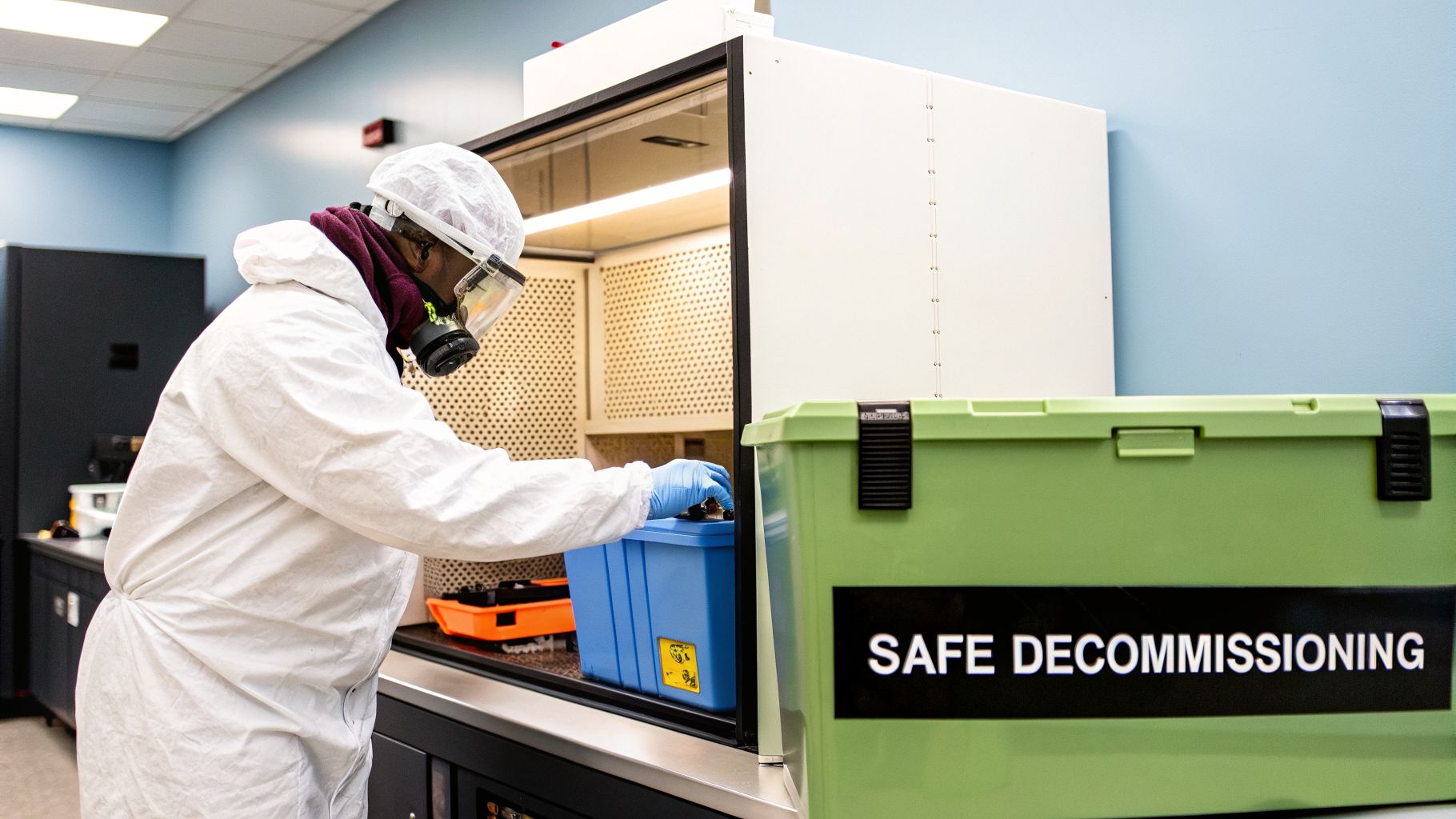
When it’s time for a facility shutdown or lab cleanout, it’s easy to get caught up in the big-picture logistics. But what about the equipment that has spent years handling hazardous materials? A fume hood, incubator, or centrifuge doesn’t just become harmless scrap metal overnight. It carries a legacy of everything it has ever touched.
Managing that legacy correctly is one of the most critical steps for ensuring safety and compliance nationwide. This isn’t just about unplugging a machine. It's a clear, step-by-step process for preparing, labeling, and disposing of equipment that may still harbor residual toxins, from mercury in older devices to invisible chemical films on interior surfaces.
Why Decommissioning Done Right Protects People
Here’s a fact we never forget: the toxic hazard signs on a piece of equipment are just as important during disposal as they are during active use. History has taught us some hard lessons here. The Bhopal disaster in India, one of history’s worst industrial accidents, was made far more tragic by a lack of adequate warning signs on the methyl isocyanate storage tanks. This failure to communicate the danger delayed an effective response, with devastating consequences.
That event directly influenced global safety reforms, including the expansion of OSHA's Hazard Communication Standard. For any lab or hospital, from Atlanta to Anchorage, this history drives home why clear, persistent labeling during decommissioning is absolutely non-negotiable. You can read more about the historical events that shaped modern safety standards on PMC.
A Practical Playbook for Disposal
A structured decommissioning process is your best defense against accidents and liability. It ensures every single asset is handled safely, from the moment it leaves your lab to its final destination. When you work with a specialist partner with nationwide reach, we can make this process completely seamless.
Here’s what a typical workflow looks like:
- On-Site Decontamination: The first and most important step. We follow strict protocols to clean and decontaminate the equipment, aiming to remove as much residual hazardous material as possible.
- Compliant "Legacy" Labeling: Once cleaned, every asset gets a tag. This label clearly details the last known substances it was exposed to and confirms that decontamination was performed. This is vital for the safety of everyone downstream, from transport crews to recycling technicians.
- Secure De-installation and Packing: Our pros can safely de-install heavy or complex equipment, like fume hoods or large centrifuges, and pack everything for compliant transport.
- Certified Transport and Recycling: Finally, a licensed carrier transports the equipment to a certified facility. This guarantees responsible recycling or disposal, so you know hazardous components won’t end up in a landfill.
A common and dangerous mistake is assuming a visibly "clean" piece of equipment is safe. Microscopic residues can still pose a real risk. Always treat decommissioned lab equipment as potentially hazardous until it is certified clean by a professional.
By following a clear plan, you ensure a safe and responsible transition. Our guide to lab equipment decommissioning services explained breaks down this process even further. It’s not just about getting rid of old gear—it’s about protecting your organization and showing a real commitment to safety and environmental stewardship.
Finding the Right Partner for Compliant Disposal
Knowing what all the toxic hazard signs and regulations mean is one thing. Actually putting that knowledge into practice is what keeps your organization safe and compliant. The final, most important step is choosing the right partner for your lab equipment disposal. Your goal should be to find a provider who takes the guesswork out of the entire process, whether you're located in Atlanta, GA or anywhere else in the U.S.
Whether you're a local Atlanta-area clinic or a national research corporation, the right partner is more than just a pickup service. They should act as a true extension of your own Environmental, Health, and Safety (EHS) team. They can turn a complicated logistical headache into a managed, predictable job from start to finish.
Key Services for Compliant Partnerships
You'll want to look for a company that offers a complete, end-to-end solution. This is the best way to minimize your risk and administrative workload, making sure no compliance gaps are left open.
Look for a partner that provides these essential services:
- On-Site De-installation and Pickup: A team that comes directly to your facility, whether in Atlanta or beyond, to safely de-install, pack, and transport everything from fume hoods to centrifuges.
- Certified Data Destruction: For any equipment that holds data, like lab computers, your partner must offer DoD-compliant data wiping or physical shredding to meet HIPAA and other privacy rules.
- Sustainable Recycling: A firm commitment to responsible recycling is non-negotiable. It ensures hazardous components from your old equipment are kept out of landfills, protecting the environment.
The ultimate goal is peace of mind. A reputable partner provides certificates of data destruction and recycling, giving you auditable proof that your assets were handled in full compliance with federal and state regulations.
The right disposal partner bridges the gap between knowing what a toxic hazard sign means and acting on it correctly. They help you fulfill your legal and ethical duties with confidence.
To learn more about what to look for, check out our guide on selecting an e-waste recycling company.
Frequently Asked Questions About Toxic Hazard Signs
Even when you have the rules down, real-world questions always pop up on the ground. We get these all the time from facility managers and lab personnel in the Atlanta metro area and nationwide, especially when it's time to dispose of old equipment. Here are the answers to some of the most common ones we hear.
What Is the Difference Between 'Warning' and 'Danger' on a GHS Label?
Think of these two words as a quick, at-a-glance way to understand how serious the risk is.
The word “Danger” is reserved for the worst-case hazards. It tells you a substance could cause severe injury or even death. On the other hand, “Warning” is used for hazards that are less severe but still need to be taken seriously.
For example, a chemical that’s acutely toxic if you swallow it will always get a “Danger” label. A different substance that might only cause skin irritation would likely use “Warning.” Knowing the difference is critical when you're handling, storing, and eventually getting these materials ready for disposal.
Do We Need to Label Old Lab Equipment That Has Been Cleaned Before Disposal?
Yes. 100% yes. This isn't just a best practice; it's often a regulatory requirement across the U.S., and for a very good reason. Even after you've thoroughly cleaned a piece of equipment, trace amounts of hazardous materials can get trapped in filters, tubing, or tiny crevices on surfaces.
You must always label the equipment with its last known contents and add a clear note saying it has been decontaminated. This simple step is vital for protecting the health and safety of the disposal and recycling teams who will handle the asset after it leaves your facility.
Are Digital Hazard Labels Compliant with OSHA Standards?
While digital inventory systems are great, they do not replace the need for a physical label. OSHA’s Hazard Communication Standard is very clear: physical toxic hazard signs must be attached directly to the immediate container of a hazardous chemical.
Think about it—what happens during a power outage or a system crash? Those physical labels have to be visible and readable no matter what. For any equipment being decommissioned, a durable, physical tag is absolutely essential to keep the safety chain intact during transport and processing, whether in Atlanta or any other state.
When you need to be certain your lab equipment is disposed of safely and by the book, getting expert help is the only way to go. Scientific Equipment Disposal provides full-service on-site de-installation, compliant labeling, and certified recycling for facilities throughout the Atlanta metro area and nationwide. Let us help you manage your next lab decommission with complete confidence.
Learn more at https://www.scientificequipmentdisposal.com.