Your Guide to Medical Equipment Decommissioning for Healthcare Facilities Nationwide

When we talk about medical equipment decommissioning, we’re talking about the formal, documented process of permanently taking medical devices out of service. This isn't just about unplugging a machine; it involves careful planning, managing inventory, destroying data securely, and disposing of everything in a way that protects patient privacy and meets strict environmental rules. Whether you're a major hospital in New York or a local clinic in Atlanta, the principles are the same, but the execution needs to be flawless.
Building Your Decommissioning Blueprint
Every successful decommissioning project, whether it’s for a massive nationwide hospital system or a local clinic, hinges on a solid blueprint. You have to get this right before a single device is unplugged. A well-thought-out plan is what stands between a smooth process and a chaotic mess of costly delays and compliance nightmares. This is where you set the scope, gather your team, and get real about your timeline and budget.
We break this down into three core phases: Plan, Assemble, and Define.
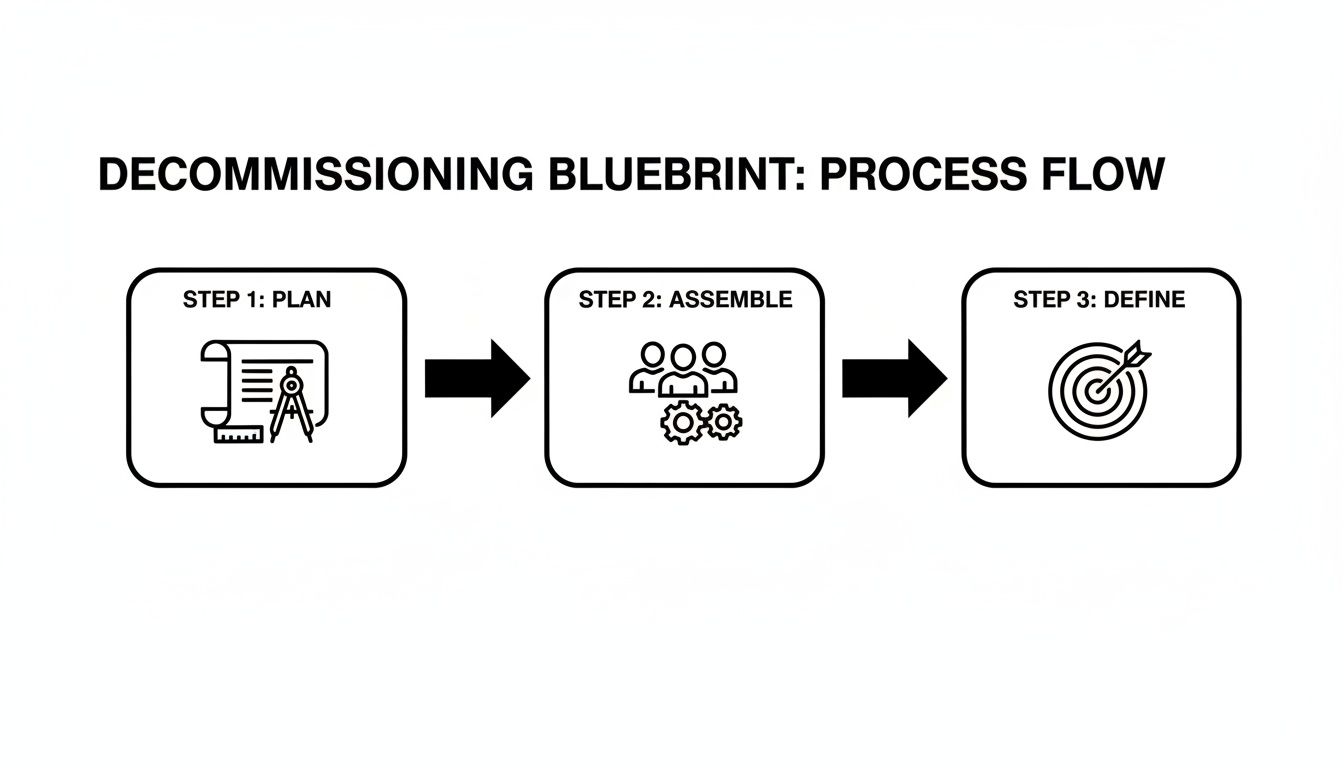
Think of it this way: the real work starts long before the physical removal begins. Success is built on strategy, not just brute force.
Assemble a Cross-Functional Team
One of the biggest mistakes we see is facilities treating decommissioning like an IT or a facilities-only job. It’s not. This process cuts across multiple departments, and you need a cross-functional team to act as the central command for the entire operation.
Get these people in the room from day one:
- Clinical Engineering (HTM): These are your equipment experts. They know its history, function, and maintenance needs better than anyone.
- IT and Cybersecurity: They are absolutely critical. Their job is to identify every device holding ePHI and ensure the data sanitization plan is bulletproof.
- Compliance and Legal: This team is your safety net, making sure every step aligns with HIPAA, EPA, OSHA, and any other federal, state, or local regulations that apply.
- Facilities Management: They handle the hands-on logistics—power-down sequencing, coordinating removal paths, and getting the site back to normal.
- Finance and Procurement: They’re in charge of the budget, asset depreciation, and figuring out if any of the equipment has resale value.
Bringing these experts together early gives you a 360-degree view. You’ll spot potential conflicts and roadblocks before they have a chance to derail the project.
Define Your Project Scope and Goals
With your team in place, it’s time to get crystal clear on your goals. Why are you decommissioning this equipment? Is it part of a facility-wide tech upgrade? Are you moving a department? Or are you just retiring old, end-of-life assets?
We worked with an Atlanta-based diagnostic clinic that was upgrading its imaging wing. They defined their scope perfectly: securely remove and dispose of two old MRI machines and a dozen ultrasound units. By having this clear goal, they could pre-schedule all the logistics and avoid a single minute of disruption to their patient schedule.
Your blueprint needs to be more than just a document; it has to be a practical, actionable plan. It helps to create a step-by-step guide that actually gets used by your team, ensuring everyone follows the same playbook. For a deeper dive, check out our guide on medical equipment disposal for hospitals and clinics.
Don’t underestimate the complexity here. The global medical waste management equipment market is on track to grow from $12 billion in 2025 to $20 billion by 2033, largely because of stricter disposal rules. This is exactly why partnering with a compliant, expert provider for medical equipment decommissioning services nationwide is no longer a "nice-to-have"—it's a necessity.
Mastering Your Inventory and Risk Assessment
Once you have a solid plan, it's time to get your hands dirty and figure out exactly what you're decommissioning. This isn’t just counting boxes. Think of it as a forensic accounting of every single asset—a critical step for a compliant and successful decommissioning project in any healthcare facility, from Los Angeles to Miami. A precise inventory paired with a sharp risk assessment will drive your entire strategy.
The process kicks off by physically identifying and cataloging every piece of equipment slated for retirement. We're talking about everything from massive MRI and CT scanners down to the smallest benchtop centrifuges, patient monitors, and all the IT hardware that supports them, like workstations and servers.
Creating a Comprehensive Equipment Inventory
Your main objective here is to build a master list. This list will be your single source of truth for the entire project. We’ve found the best way to manage this is with a robust tagging system, where you assign a unique ID to each asset that links back to a digital record.
This is where your Healthcare Technology Management (HTM) team truly shines. Their deep, hands-on knowledge of device lifecycles and functions is invaluable in making sure nothing gets missed. They are the unsung heroes who connect the physical device to its role in your security and operational world.
For each item, your inventory log should capture key details:
- Unique Asset ID: A tag number you assign specifically for this project.
- Device Type and Model: For example, "GE LOGIQ E9 Ultrasound Machine."
- Serial Number: The manufacturer's unique identifier.
- Current Location: Be specific—room, department, and floor.
- Operational Status: Is it working, broken, or only good for parts?
This detailed log becomes the bedrock for everything that comes next, from data security protocols to logistics planning. It turns what feels like an overwhelming mountain of equipment into a manageable, organized list.
Performing a Multi-Faceted Risk Assessment
With your inventory locked down, the risk assessment can begin. This is where you classify each asset based on the potential headaches it could cause if handled improperly. You need to look at this through three main lenses: data security, hazardous materials, and financial value.
A common mistake we see is facilities treating all equipment the same. A simple stainless steel cart has a completely different risk profile than a diagnostic workstation that has stored thousands of patient records. A proper risk assessment ensures you apply the right level of caution to the right assets.
This classification process dictates the specific handling procedures needed for every single item. It's the step that ensures you nail HIPAA requirements, protect your staff from hazardous exposure, and stay compliant with EPA regulations. Getting this wrong can lead to serious compliance failures and hefty financial penalties.
A thorough assessment of your IT assets is especially important. To get a better handle on this specific area, you can dig into our detailed guide on professional IT asset disposal services.
A Framework for Assessing Equipment Risk
To make this process a bit more straightforward, we recommend categorizing equipment into different risk tiers. This helps you prioritize resources and guarantees that high-risk items get the specialized attention they absolutely need, whether you're a local Atlanta clinic or a sprawling nationwide health system.
Here's a practical framework we've developed to help guide your classification.
Equipment Risk Assessment Framework
This framework is designed to help your team methodically classify equipment based on the different types of risks it might present during decommissioning.
| Equipment Category | Data Risk (ePHI) | Hazardous Material Risk | Recommended Action | Example |
|---|---|---|---|---|
| High-Risk Medical | High | Medium to High | On-site data destruction, certified hazardous material handling, secure transport. | PACS Server, C-Arm |
| General Medical | Low to Medium | Low to Medium | Data sanitization, segregation for specialized recycling (e.g., mercury). | Infusion Pump, Defibrillator |
| Laboratory | Low | High | Decontamination, certified chemical and biohazard disposal protocols. | Centrifuge, Fume Hood |
| IT Hardware | High | Low | Certified data destruction (NIST/DoD standards), e-waste recycling. | Workstation, Hard Drives |
| Furniture/Fixtures | None | None | General disposal, donation, or standard recycling. | Exam Table, IV Pole |
This framework is more than just a checklist; it’s a strategic tool. It forces your team to think critically about each asset, ensuring that the medical equipment decommissioning plan for your healthcare facility is both efficient and rigorously compliant.
By mastering your inventory and risk assessment, you lay the essential groundwork for secure data destruction, safe environmental disposal, and a smooth logistical execution from start to finish.
Ensuring Ironclad Data Security and HIPAA Compliance
Now we get to what is arguably the most sensitive part of decommissioning medical equipment: the data. For any healthcare facility in the U.S., protecting electronic protected health information (ePHI) isn't just a good idea—it's a strict legal and ethical mandate under HIPAA.
One wrong move can lead to a devastating data breach. We're talking about staggering fines and, worse, a complete loss of patient trust that can be impossible to get back.
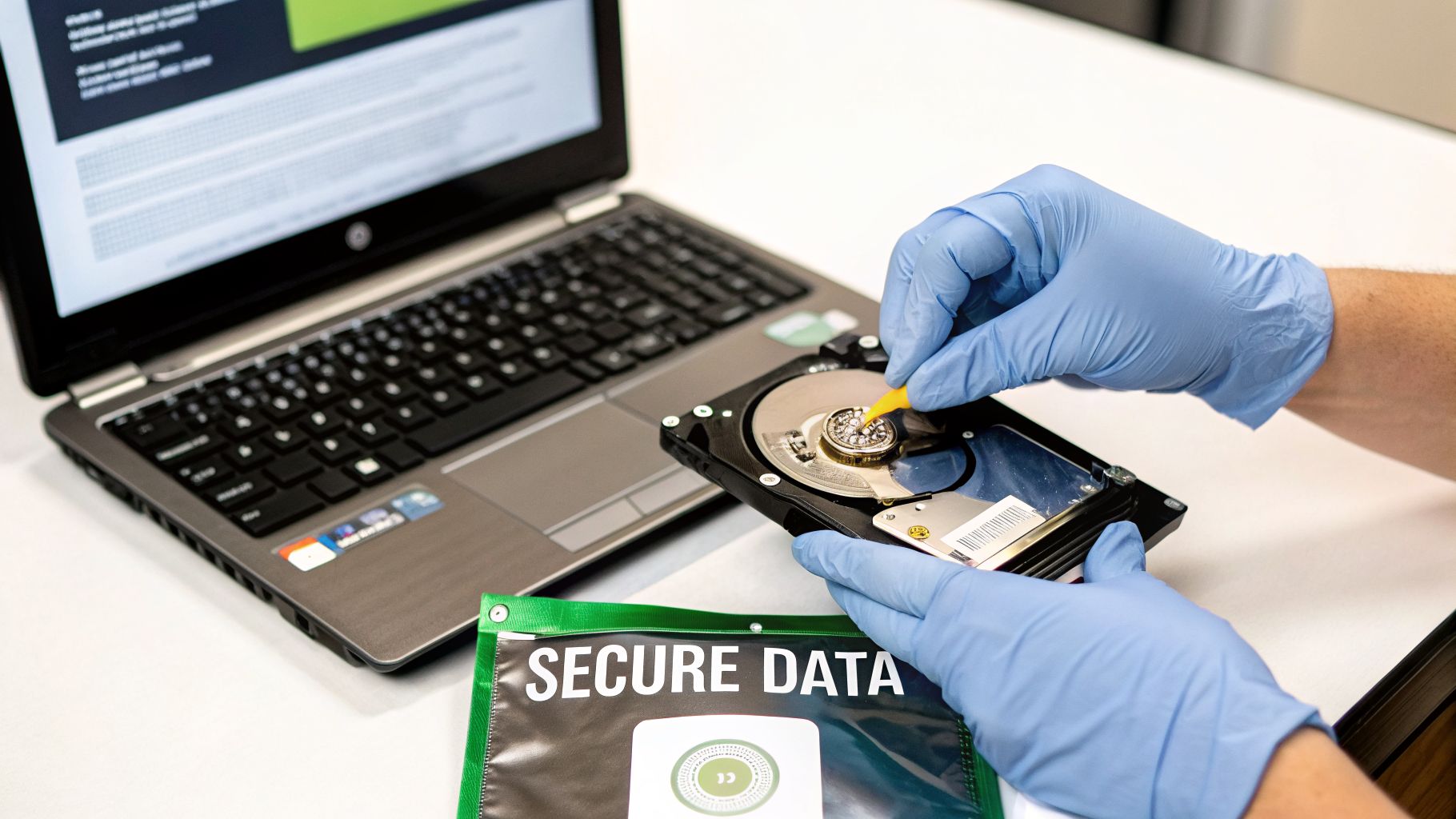
This is where all that careful inventory and risk assessment work really proves its worth. Any device you flagged as holding ePHI needs to be managed with an ironclad, documented data destruction plan. Just deleting files is a rookie mistake that leaves you wide open; that data can almost always be recovered. Real security demands a formal sanitization or, more often, a total destruction process.
Understanding NIST 800-88 Data Sanitization Methods
The National Institute of Standards and Technology (NIST) Special Publication 800-88 is the industry gold standard for media sanitization. It's not just a single method but a framework with three distinct approaches. The one you choose depends on the device and just how sensitive the data is.
Clear: This is a basic overwrite of user-addressable storage areas. Think of it as a factory reset. It’s okay for low-risk gear that will stay within your organization, but it’s not suitable for ePHI.
Purge: This method gets more serious, using techniques that make data recovery infeasible even with advanced lab tools. This is a stronger option for devices that might leave your direct control but don't hold the most sensitive patient information.
Destroy: This is the final word in data security. The storage media is rendered completely unusable through shredding, pulverization, melting, or disintegration. There is no coming back from this.
When dealing with devices that held ePHI, your only real options are Purge or Destroy. Anything less is a gamble you can't afford to take.
The DoD Standard and Why Physical Destruction Is King
For a long time, the Department of Defense (DoD) 5220.22-M 3-pass sanitization method was the go-to for data wiping. It's a software-based approach that overwrites data three times with different character patterns. While NIST 800-88 is the current guideline, the DoD method is still a solid process for wiping magnetic drives.
But here’s the reality for modern hardware: when it comes to Solid-State Drives (SSDs) or any device with highly sensitive ePHI, physical destruction is the only truly foolproof guarantee. Shredding a hard drive into tiny, confetti-like pieces makes it physically impossible for anyone to reassemble the platters and recover a single byte of data.
The single most important takeaway is this: If a device stored, processed, or transmitted ePHI, you must have an auditable, certified process to prove that data was rendered completely unrecoverable. Your reputation and HIPAA compliance depend on it.
To get your processes right from the start, it's smart to lean on established frameworks. A solid approach includes using a detailed HIPAA risk assessment template to spot and fix vulnerabilities before they can turn into full-blown incidents.
Chain of Custody and Certificates of Destruction: Your Proof
You can't just say you destroyed the data. You have to be able to prove it, especially if an auditor comes knocking. This is where two pieces of paper become your most important defense.
Chain of Custody: This is a detailed log that tracks every single data-bearing asset from the moment it leaves your facility until its final destruction. It records who touched it, when, and where, creating an unbroken and auditable trail that leaves no room for security gaps.
Certificate of Data Destruction (CoDD): This is your official receipt. Your certified disposal partner issues this document, which lists the serial numbers of the destroyed devices and legally confirms that the data was destroyed according to standards like NIST 800-88.
These documents aren't just administrative fluff; they are your legal shield in a security audit or breach investigation. Partnering with a vendor who provides this level of documentation is non-negotiable. At Scientific Equipment Disposal, we get what’s at stake. You can see our commitment in our overview of secure data destruction services.
Navigating Environmental and Safety Regulations
Once you’ve locked down the data security plan, the next minefield is the dense web of environmental and safety rules. This isn't just about being a good corporate citizen—it's about staying on the right side of the law. A single misstep in disposing of a device can land you in hot water with agencies like the EPA and OSHA, not to mention state-specific bodies like the Georgia Environmental Protection Division or California's DTSC.
The penalties for getting this wrong are no joke. We’ve seen facilities hit with crippling fines, forced shutdowns, and public relations nightmares that linger for years, all from mistakes that were completely avoidable. This part of the process demands a sharp eye for detail to identify, separate, and track every single hazardous component in the equipment you’re retiring.
Identifying and Handling Common Hazardous Materials
Medical equipment is often a cocktail of different materials, many of which are classified as hazardous waste the second they’re slated for disposal. Your initial risk assessment should have flagged these, but now it’s time to get hands-on. Every material has its own specific handling protocol to keep your people and the environment safe.
Look out for these common culprits in your medical devices:
- Mercury: You'll find this in older thermometers, blood pressure cuffs, and certain switches or lamps. Mercury is a powerful neurotoxin and needs to be handled with specialized containers.
- Lead: It's the go-to for radiation shielding in X-ray machines and CT scanners, and it’s also in lead-acid batteries. Lead is highly toxic, and its disposal is very tightly regulated.
- Bio-contaminated Components: Any part that touched bodily fluids, tissues, or infectious agents is considered biohazardous waste. These pieces must be fully decontaminated or thrown out in designated red bags and sharp containers.
- Chemical Residues: Lab analyzers and centrifuges can hold on to chemical traces. These have to be neutralized and cleaned properly, or the whole component has to be managed as chemical waste.
The healthcare industry has a massive environmental footprint. It’s not just about trash; pollution from the U.S. health care sector is linked to the annual loss of 614,000 disability-adjusted life-years. This staggering figure, detailed in research on the environmental footprint of U.S. health care, shows why specialized management is so critical.
The Importance of Segregation and Labeling
You can't just throw everything into a single dumpster and call it a day. Separating materials at the source is the bedrock of compliance. Your on-site team needs to be trained to distinguish general e-waste from items containing mercury, lead, or biohazards.
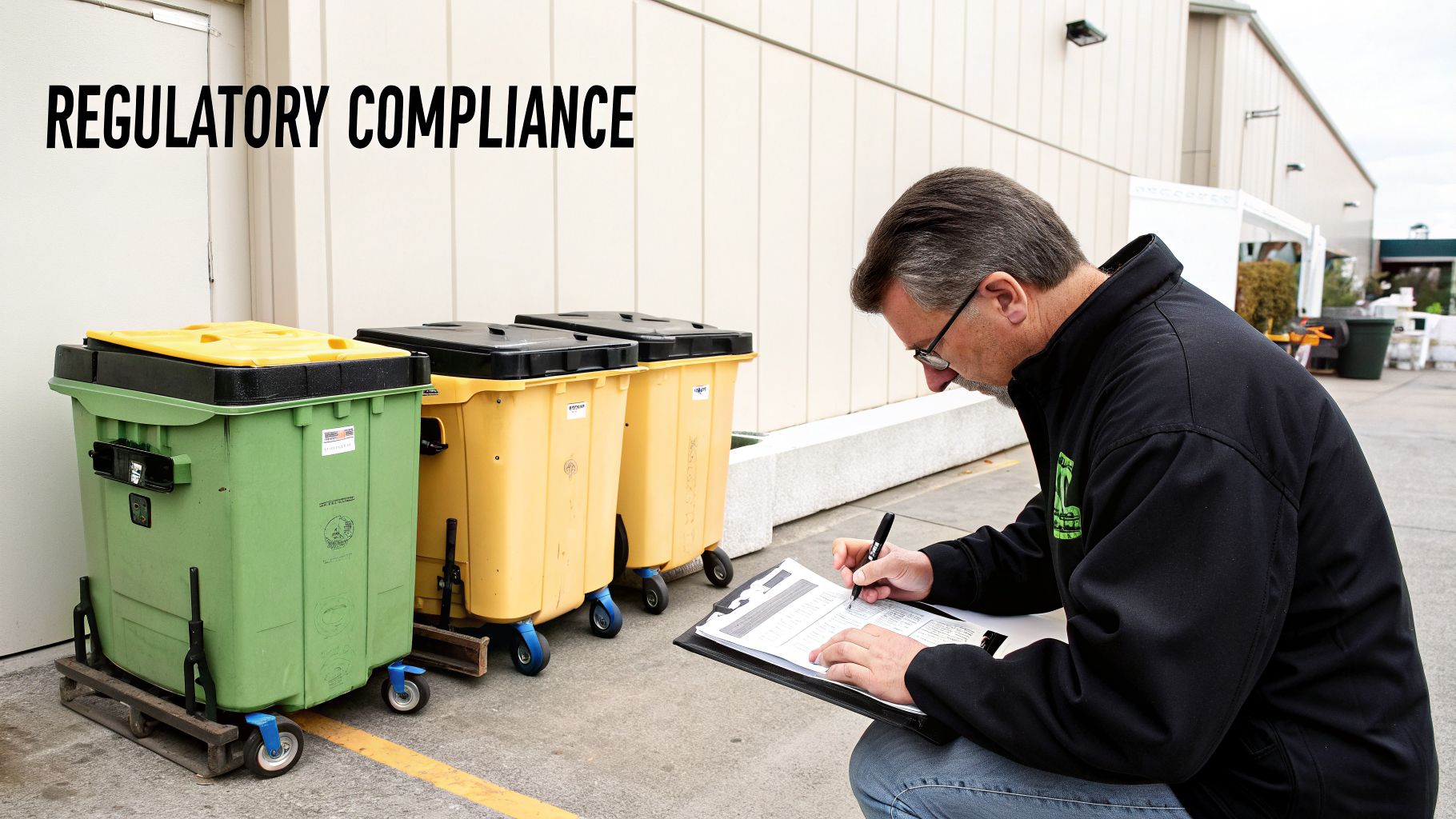
After separating, every single container must be labeled correctly. This isn’t just a good idea—it’s the law. Labels need to clearly state the contents, the type of hazard (e.g., "Biohazard," "Contains Mercury"), and the date you started accumulating the waste. This level of detail is non-negotiable for creating the hazardous waste manifest, the legal document that tracks waste from your door to its final destination.
Think of the hazardous waste manifest as the chain of custody for your environmental compliance. An incomplete or sloppy manifest can trigger fines because it signals a breakdown in your process. It's your official proof that you followed every rule.
For facilities handling a mix of assets, from clinical machines to lab instruments, knowing the specific disposal rules is everything. You can get more details on best practices in our guide to EPA-compliant laboratory equipment disposal.
Why a Certified Local or Nationwide Partner Is Your Best Defense
Let's be honest—navigating this regulatory maze is a full-time job in itself. For most healthcare facilities, especially those in the Atlanta area or with locations across the country, the smartest and safest move is to partner with a certified vendor who lives and breathes both local and federal environmental laws. A good partner becomes an extension of your own compliance team.
They bring the expertise to spot hazardous materials, supply the correct containers and labels, and make sure every piece of paperwork is perfect. Crucially, they are insured and certified to handle and transport these materials, which effectively shifts the liability off your shoulders and onto theirs. This partnership is your best defense against the costly and damaging fallout of a compliance mistake.
How to Choose the Right Decommissioning Partner
You’ve navigated the maze of inventory, data security, and environmental rules. Now comes the most important decision you'll make: picking the partner to actually execute the plan. The success of your entire medical equipment decommissioning project rests on this choice.
This isn't about hiring a simple hauling service. You need a certified professional who becomes a true extension of your own compliance and risk management teams. A subpar vendor can undo all your careful work, creating fresh liabilities just when you thought you were closing them out. The right partner, though, makes sure every single step is handled perfectly, protecting your facility from legal, financial, and reputational hits.
Core Credentials and Certifications
When you start looking at potential vendors, their certifications are the very first thing to check. These aren't just fancy logos for a website; they are hard-earned proof that the company meets strict, third-party audited standards.
Here are the key industry certifications to look for:
R2v3 (Responsible Recycling): This is a top-tier standard for any electronics recycler. An R2v3-certified partner guarantees they use best practices for environmental safety, data security, and worker protection.
e-Stewards: This is another highly respected certification, famous for its tough stance against exporting hazardous e-waste to developing countries. Choosing an e-Stewards partner means your old equipment won't become someone else's environmental disaster.
These certifications establish a baseline of trust. A vendor without them probably lacks the validated processes you need for responsible medical equipment decommissioning for healthcare facilities.
Verifying Comprehensive Insurance Coverage
Beyond certifications, your partner absolutely must carry solid insurance. This is your financial safety net if anything goes wrong. Standard business liability won't cut it; you need to see proof of policies designed for this specific, high-risk work.
Don’t be afraid to ask for a Certificate of Insurance (COI). This is standard procedure. You’re looking for things like Pollution Liability, Data Breach/Cyber Liability, and Errors & Omissions coverage. This protects you if there’s a hazardous material spill during transport or a data breach from their handling of your assets.
If they don't have the right insurance, any accident or liability falls right back on your facility. A true professional will have their COI ready to go and will carry coverage limits that make sense for a high-stakes healthcare environment.
Documented Processes for Security and Compliance
A partner you can trust operates with total transparency. They should be able to walk you through their standard operating procedures (SOPs) for every critical part of the job. Go ahead and ask to see their documented workflows for data destruction, chain of custody, and handling hazardous materials.
This kind of documentation proves they have a reliable, repeatable system. It shows they don't just "wing it" but follow a careful process designed to guarantee compliance for every single client. You can see what this looks like in the real world by exploring our approach to medical equipment removal and disposal services.
It's a huge challenge globally. In many Low- and Middle-Income Countries (LMICs), a shocking 40% to 70% of medical equipment is out of service. This fact, highlighted in research published by the NIH, really drives home why a strategic approach is so critical for facilities like yours.
Key Questions to Ask Potential Vendors
Once you have a shortlist of certified and insured vendors, it’s time to dig in. The answers to these questions will show you what they're really made of and if they're the right fit for your facility.
- Data Security: "Walk me through your data destruction process. What standards, like NIST 800-88, do you follow? What kind of documentation, like a Certificate of Data Destruction, will I get back?"
- Logistics: "What's your process for on-site de-installation and secure transport? Are your trucks and staff equipped to handle our sensitive, bulky medical devices?"
- Compliance: "How do you make sure you're compliant with EPA and state-specific rules for the hazardous materials in our equipment?"
- Reporting: "What does your final reporting package look like? Can I expect a full chain-of-custody record and certificates of recycling for our audit trail?"
Common Questions About Medical Device Decommissioning
Even with a solid plan, you're bound to have questions when a medical equipment decommissioning project gets underway. Facility managers, IT directors, and compliance officers all run into similar roadblocks. We get it.
Here are some of the most common questions we hear from facilities in the Atlanta area and across the country. We've put together some straight, practical answers to help guide your strategy.
What Is the Most Critical Step in Medical Equipment Decommissioning?
Every phase has its place, but if we had to pick one, the single most critical step is the comprehensive inventory and risk assessment. This is where everything starts.
If you don't accurately identify every single device and classify its risks—from stored ePHI to hazardous materials—you can't build a secure and compliant plan. It’s that simple. This first step directly shapes your data sanitization strategy, how you'll handle hazardous materials, and your overall disposal logistics.
A mistake here will create a domino effect, leading to potential HIPAA violations and serious environmental compliance issues down the road.
Can We Handle Decommissioning In-House to Save Money?
Trying to handle decommissioning in-house to cut costs is tempting. We see facilities consider it all the time, but the risks almost always outweigh the savings.
While your team can manage some of the basic organizational tasks, the specialized knowledge required for full compliance with regulations from HIPAA, the EPA, and OSHA is immense. Professional partners bring up-to-date expertise, certified data destruction methods that are auditable and legally defensible, and the right gear to safely manage things like mercury or lead.
A single compliance mistake, such as improper disposal of a device containing ePHI, can result in fines and legal battles that far exceed the cost of hiring a certified vendor. Outsourcing this risk to a qualified partner is often the most financially prudent decision.
How Does a Partner Handle Equipment with Resale Value?
Not all of your old equipment is just scrap. Many devices, especially functional ones being replaced during an upgrade, still have significant resale value. A trustworthy partner will have a transparent process for asset remarketing.
Typically, that process looks like this:
- Value Assessment: First, they'll evaluate the equipment to determine its fair market value.
- Certified Data Sanitization: All ePHI is wiped clean using rigorous, NIST-standard methods before any resale.
- Refurbishment: They’ll handle minor repairs and cosmetic touch-ups to get the asset ready for the secondary market.
- Revenue Sharing: You get a clear, pre-negotiated agreement that outlines exactly how the proceeds from the sale will be shared with your facility.
This approach can turn medical equipment decommissioning for healthcare facilities from just another expense into an opportunity to recover value from your retired assets.
What Documentation Should I Expect from a Disposal Partner?
Documentation isn't just paperwork—it’s your legal proof that you followed a compliant process. In an audit, these records are your first line of defense.
At a minimum, your disposal partner has to provide:
- A Full Chain-of-Custody Record: This tracks each asset from the moment it leaves your facility to its final destination, detailing every handoff.
- A Certificate of Data Destruction: For any device with a hard drive or storage, this certificate lists serial numbers and confirms all data was destroyed according to certified standards.
- A Certificate of Recycling or Disposal: This document certifies that the physical equipment was recycled or disposed of in an environmentally sound way, keeping hazardous materials out of landfills.
Without this complete paper trail, you have no verifiable proof that your facility met its legal and regulatory obligations.
Navigating the complexities of medical equipment disposal means finding a partner you can trust. Scientific Equipment Disposal offers certified, compliant, and secure decommissioning services for hospitals, clinics, and labs throughout the Atlanta metro area and nationwide. We provide the expertise and documentation you need to protect your facility and your patients.
Ready to ensure a compliant and stress-free decommissioning project? Learn more about our secure disposal process.