Secure Hard Drive Destruction in Duluth GA & Nationwide: Certified & Compliant

For any organization in Duluth, GA, or across the nation, just deleting files or reformatting a hard drive isn't nearly enough to protect your sensitive information. True secure hard drive destruction means calling in certified professionals who make sure that data is 100% unrecoverable. It’s the only way to be absolutely certain your data is gone for good, protecting your business from breaches and keeping you compliant, no matter where you operate.
Why Secure Data Destruction Is Non-Negotiable
In an age of constant data breach headlines, protecting sensitive information has gone from a good idea to a core business function. For organizations in Duluth, the greater Atlanta metro area, and across the United States, the risks that come with improper data disposal are enormous, carrying both financial and reputational costs that can sink a company.
Think of it this way: simply deleting files or reformatting a drive is like tossing your most confidential financial records into a curbside recycling bin. To a casual passerby, the bin might look empty. But anyone with a little determination can easily pull those documents right back out. It's the same with digital files—they're still on the hard drive, and basic software can bring them back with ease.
The Real Risks of Improperly Disposed Hard Drives
It's easy to forget just how much sensitive information gets stored on company hard drives over their lifespan. When these devices aren't properly destroyed, that data becomes a ticking time bomb.
| Data Type Found on Old Drives | Potential Business Impact |
|---|---|
| Patient Health Information (PHI) | Massive HIPAA fines, loss of patient trust, legal action |
| Customer Financial Data | Severe brand damage, regulatory penalties, class-action lawsuits |
| Employee PII & Payroll Info | Identity theft risks, employee lawsuits, internal security threats |
| Proprietary R&D / IP | Loss of competitive advantage, stolen trade secrets |
| Internal Business Strategies | Competitors gain insight into your plans, finances, and operations |
Failing to properly destroy these assets isn't just a compliance issue; it’s a direct threat to your organization's future, whether you're a local business or a national enterprise.
The Soaring Cost of Data Breaches
This threat isn't just theoretical; it’s a financial storm that’s getting worse every year. Recent statistics paint a grim picture. The number of data breach incidents in the U.S. skyrocketed to 3,158 cases in a single year, affecting 1.35 billion people around the world. That’s a massive jump from 1,108 cases impacting 310 million people just a few years ago.
High-profile events, like major ransomware attacks on healthcare systems, have led to response costs hitting an incredible $2.87 billion. These numbers show exactly why proactive data destruction is a must-have, not a nice-to-have. This reality makes specialized services a necessity for any organization managing private data. From hospitals and law firms concerned with HIPAA to corporate IT departments protecting intellectual property, the stakes are simply too high to leave to chance.
Proactive destruction isn't just an IT cleanup task; it's a foundational risk management strategy to safeguard your business, your clients, and your brand reputation.
A key part of secure data management is a solid understanding of data protection principles, which guide everything from how data is encrypted to its final, secure disposal. It’s a complete lifecycle, not a one-off task.
Protecting Your Organization's Future
Neglecting to securely dispose of old hard drives can unleash a flood of negative consequences:
- Crippling Financial Penalties: Failing to comply with regulations like HIPAA can lead to fines that run into the millions.
- Irreparable Brand Damage: A public data breach shatters customer trust that can take years, if not decades, to win back.
- Legal Liability: Lawsuits from affected customers or clients can drag you into long and costly legal fights.
- Loss of Intellectual Property: Stolen trade secrets, research data, or business plans can hand your competitors a massive, unearned advantage.
Ultimately, investing in secure hard drive destruction in Duluth, GA, or any other location isn't an expense. It's a critical investment in your organization's security, stability, and future.
Understanding Your Data Destruction Options
When it comes to getting rid of sensitive data for good, not all methods are built the same. A lot of people think hitting "delete" on a file makes it vanish, but that's far from the truth. It really just hides the file from your operating system, leaving it wide open for anyone with basic recovery software to find. For organizations in Duluth and across the country, picking the right destruction method is a serious decision that affects your security, compliance, and even your bottom line.
Getting to know the three main techniques—data wiping, degaussing, and physical shredding—is your first step. Each one offers a different level of security and is used for a different reason, whether you want to clean a drive for reuse or make sure it's gone for good.
This decision tree shows exactly why just deleting files is never the answer for real data security.
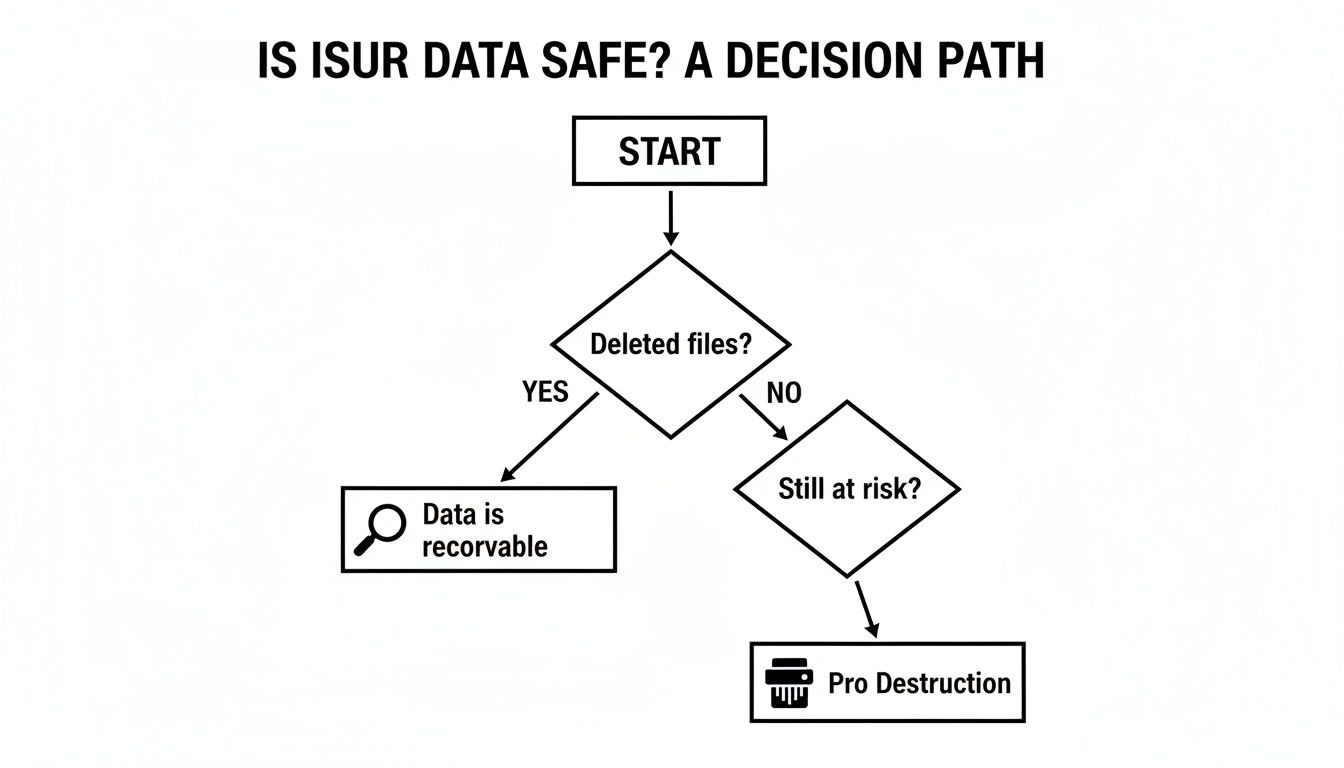
As you can see, there’s a clear path: data is always at risk until it's been handled by a professional, certified destruction process.
Method 1: Data Wiping or Sanitization
Data wiping, also called sanitization, is the process of writing new, random data over every single part of a hard drive. Think of it like painting over a canvas. You're not just wiping away the old picture; you're applying multiple, thick layers of new paint until absolutely no trace of the original image can ever be seen again.
This is the perfect method if you plan to reuse, donate, or resell your hard drives. By following strict standards like the DoD 5220.22-M 3-pass sanitization, the drive is completely cleaned and ready for its next life, letting you recover its value without risking a data breach. If you want to get into the technical details, you can check out our guide on how to wipe a hard drive completely.
Method 2: Degaussing for Magnetic Media
Degaussing is a fast and powerful technique made specifically for magnetic storage like traditional hard disk drives (HDDs) and old-school backup tapes. It works by hitting the drive with an incredibly strong magnetic field.
Picture holding a massive, industrial-strength magnet right next to a cassette tape. That magnetic force would instantly scramble the tape's audio into nothing but static. Degaussing does the exact same thing to the magnetic platters inside a hard drive, completely scrambling the data patterns that store your files. The drive is toast afterward, but the information is gone in a flash.
The risk of not handling old drives properly is huge. A study of 200 second-hand drives found that 36% of them still had recoverable files. Of those, an incredible 67% contained personally identifiable information (PII) and 11% held sensitive corporate data, like internal emails and spreadsheets. What’s worse, only 10% of the drives showed any attempt at proper data erasure.
Method 3: Physical Shredding, The Ultimate Solution
When you need absolute, undeniable proof that your data is destroyed, physical shredding is the answer. It’s exactly what it sounds like: a powerful, industrial shredder built for metal grinds the hard drive down into tiny, confetti-sized pieces. This method works on everything, including the solid-state drives (SSDs) that degaussing can’t touch.
There is no coming back from physical shredding. It offers total peace of mind, which is why it's the go-to method for hospitals, government agencies, and any organization with zero room for error.
When you're looking for a partner for secure hard drive destruction in Duluth, GA, or anywhere nationwide, make sure they can offer all three options. This gives you the flexibility to build a smart strategy that balances security needs, compliance rules, and getting the most value from your old assets.
On-Site vs. Off-Site Destruction for Your Business
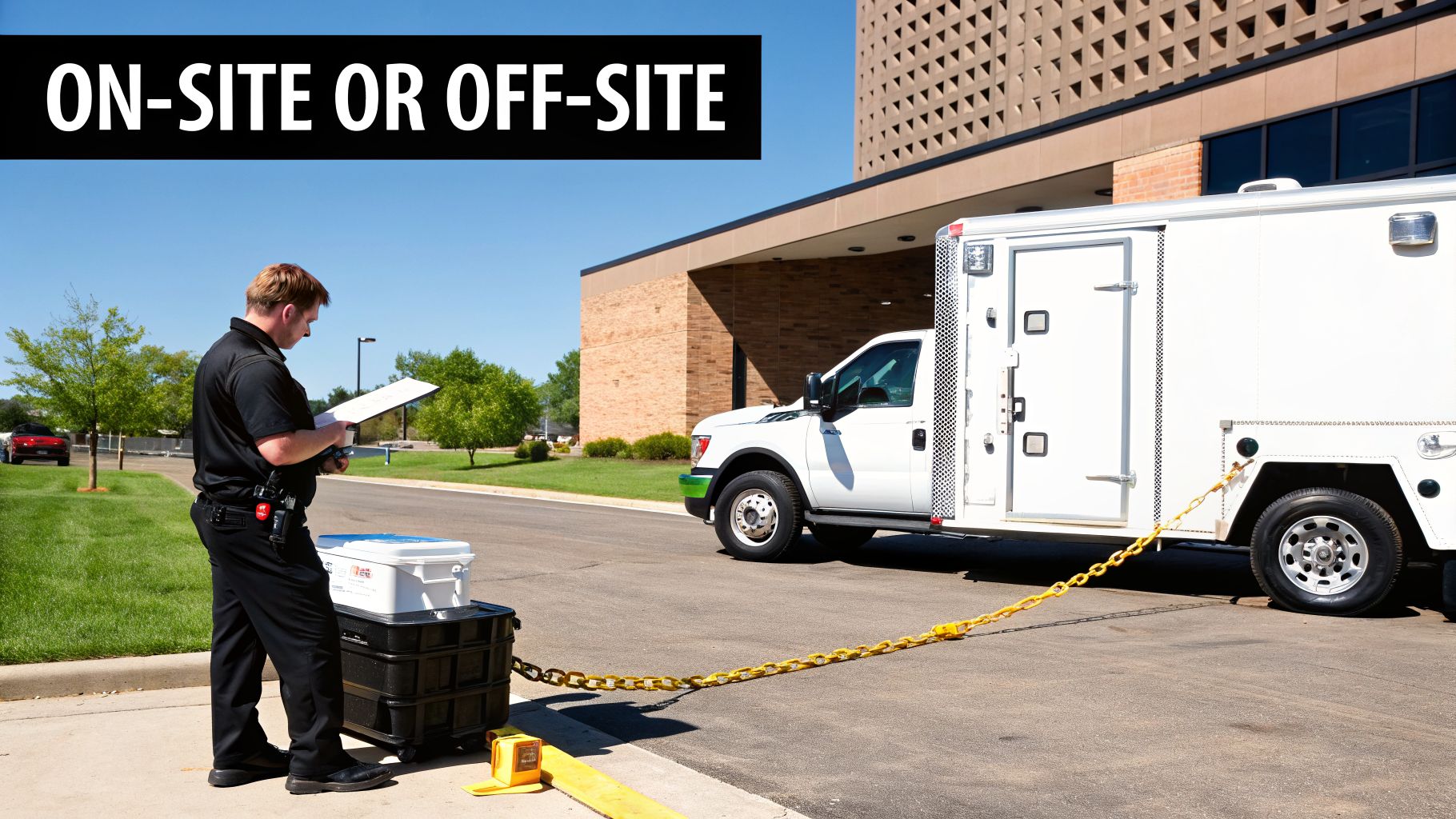
When you're ready to get rid of old hard drives for your business, one of the first questions you'll face is whether to do it on-site or off-site. Both services will get the job done, ensuring your data is completely gone. But the right choice really comes down to your organization's security protocols, compliance demands, and budget.
Think of it as choosing the right path for your specific needs. Understanding the difference is crucial for building a data destruction plan you can have complete confidence in. It's not just about getting rid of old equipment; it's about managing risk.
On-Site Mobile Destruction: The Gold Standard of Security
On-site destruction, also known as mobile shredding, brings the entire process right to your doorstep. We pull up to your facility—whether in Duluth or another city—in a specialized, high-security shredding truck. Your hard drives never leave your property until they are turned into tiny metal fragments right in your parking lot.
This method gives you the absolute highest level of security and transparency, which is why it's a must-have for organizations handling extremely sensitive information.
- Unbroken Chain of Custody: Your own team can watch everything, from the moment the drives leave your IT closet to the second they hit the shredder. There's zero risk of anything getting lost in transit.
- Immediate Verification: You get to see the destruction happen in real-time. There’s no wondering if the job was done—you'll have instant confirmation.
- Perfect for Compliance: This is the go-to method for healthcare providers bound by HIPAA, financial institutions, and government agencies. When you need witnessed, verifiable proof of destruction, this is it.
With on-site service, you get a live audit of your data disposal. That ability to watch the process unfold provides a level of peace of mind that’s hard to beat.
Off-Site Plant-Based Destruction: A Secure and Efficient Alternative
Off-site destruction is a secure, reliable, and often more budget-friendly way to handle data disposal. In this scenario, one of our certified technicians comes to your facility to securely pack up your hard drives and other media into locked containers. These assets are then transported in a GPS-tracked, secure vehicle to our destruction plant, which is under constant monitoring with strict access controls.
While the actual destruction happens at our facility, the security protocols are just as intense. The entire process is tracked from start to finish with a strict Chain of Custody document, ensuring full accountability.
This is where the Chain of Custody document is absolutely essential. It’s like a tracking manifest for your data, recording every single step:
- Who collected the drives and the exact time of pickup.
- The unique serial numbers of every asset being transported.
- Confirmation of their secure arrival at our destruction facility.
- The precise date and method used for final destruction.
This document serves as your legally defensible proof that your data was handled securely from the moment it left your control to its complete pulverization.
Of course, secure data destruction is just one piece of the puzzle. It’s also important to manage other retired assets responsibly. For a complete picture, you can learn more about our electronics recycling services in Duluth, GA for businesses to create a fully sustainable plan. This comprehensive approach makes off-site service a fantastic choice for businesses needing to balance top-tier security with cost and efficiency.
Meeting HIPAA and National Compliance Mandates
If you're in healthcare, finance, or government, getting rid of old hard drives isn't just a data security task—it's a strict legal requirement. Federal regulations like HIPAA, FACTA, and GLBA don't just suggest secure data disposal; they demand it. A slip-up here isn't a minor mistake. It can lead to staggering financial penalties and serious legal trouble.
These laws all boil down to one thing: protecting people from the disaster of a data breach. They require any organization that handles sensitive information to take real, provable steps to make sure that data is gone for good. This is where professional data destruction stops being an option and becomes a core part of your compliance plan.

The Certificate of Destruction: Your Legal Shield
Think of the Certificate of Destruction as your official, notarized proof for compliance. It’s much more than a receipt. This document is your auditable evidence that you met your legal duty to protect sensitive data.
Should you ever face an audit or a data breach investigation, that certificate is your first line of defense. It proves you handed your assets over to a certified expert who followed best practices to make the data unrecoverable. Without it, you have no way to show you did the right thing, leaving your organization exposed to fines and lawsuits.
Why Compliance Isn't Just a Local Issue
It doesn't matter if your facility is based right here in Duluth, GA, or you're part of a national organization. These compliance rules apply everywhere. HIPAA doesn't distinguish between a data breach at a huge Atlanta hospital and one at a small local clinic—the consequences are just as severe. That’s why you need a partner who understands both local logistics and national standards.
A certified vendor isn’t just providing a service; they’re delivering a full compliance package. This always includes:
- Auditable Chain of Custody: Detailed records that track every single hard drive from pickup to destruction, creating a clear paper trail for auditors.
- Adherence to National Standards: Using destruction methods that meet or go beyond the requirements of the Department of Defense (DoD) and the National Institute of Standards and Technology (NIST).
- Guaranteed Data Security: Processes that ensure 100% of your data is destroyed, whether it's through physical shredding or certified wiping.
Partnering with a certified provider for secure hard drive destruction in Duluth GA is a smart investment in your organization's legal and financial stability. It turns a compliance headache into a simple, documented process that shields you from risk.
To get your data handling policies even more in line with top industry standards, it's a good idea to look into resources on achieving SOC 2 compliance, which outlines tough benchmarks for managing data security.
The Real-World Cost of Getting It Wrong
The penalties for ignoring data protection laws are no joke. HIPAA violations alone can lead to fines up to $1.5 million per year for each type of infraction. Beyond the money, the damage to your reputation can destroy public trust and send your clients running to competitors who take security seriously.
For IT directors, lab managers, and hospital administrators, the decision is straightforward. Trying to handle hard drive disposal yourself without the right equipment or certifications creates a massive, unacceptable risk. The cost of just one compliance failure is far greater than the investment in a professional destruction service. For a full look at our process, you can find more details about our secure data destruction services and how they align with these mandates.
By working with a certified partner, you're not just shredding hard drives. You are building a solid wall around your organization's legal and financial future, making sure you're ready for any audit that might come your way.
How to Choose a Certified Data Destruction Partner
Picking the right vendor for secure data destruction is one of the most critical decisions you'll make to protect your organization. It’s a choice that has to go far beyond just looking at price tags. You're entrusting a partner with your most sensitive data, so they need to be thoroughly vetted for their security protocols, compliance knowledge, and how they operate. For any business in the Atlanta metro area or anywhere in the U.S., asking the right questions from the start is the only way to get total security and peace of mind.
A low-cost option might look good on paper, but if they can't show you verifiable proof of their security measures, you're opening up your organization to huge risks. A real partner provides a complete solution that protects you from the moment your hard drives leave your hands until you get that final Certificate of Destruction.
The Non-Negotiable Vendor Checklist
When you're looking at a potential partner for secure hard drive destruction in Duluth GA or for a national project, there are a few things that are simply non-negotiable. These are the benchmarks that separate the professional, certified operators from the amateur outfits that could put your data at risk. Before you sign anything, make sure the vendor gives you a clear "yes" to these questions.
- Are they NAID AAA Certified? The National Association for Information Destruction (NAID) is the gold standard for secure data destruction worldwide. NAID AAA Certification isn't just a piece of paper; it's a tough, third-party audit that checks a company's hiring, operational security, and destruction processes. It’s the most important seal of approval in our industry.
- What does their Chain of Custody protocol look like? Any legitimate provider will have a rock-solid, unbroken Chain of Custody process. This means they should be using serialized asset tracking, secure and locked containers for transport, and detailed paperwork that follows your media from your door to its final destruction.
- Do they operate their own secure fleet? This is a huge detail people often miss. A vendor that uses its own fleet of GPS-tracked, secure vehicles keeps complete control over your assets. The minute they hand off your drives to a third-party courier, the Chain of Custody is broken, and a major security gap opens up.
- Will they provide a detailed Certificate of Destruction? Don't be afraid to ask for a sample certificate. It must include key details like the destruction date, the methods used (shredding, degaussing), a list of the serialized assets, and a legal statement certifying the data is gone for good.
Look for a Full-Service Partner
Beyond these core security questions, the best data destruction partners offer a complete, end-to-end service. This approach simplifies the entire asset retirement process for you, saving an incredible amount of time and logistical headaches. A true full-service provider should handle everything from the heavy lifting to the responsible recycling at the end.
For instance, a comprehensive partner can take care of:
- On-site de-installation and inventorying of servers, computers, and other IT equipment.
- Secure packing and logistics, making sure every single asset is accounted for before it leaves your facility.
- Responsible e-waste recycling of the shredded metal and plastic, which helps your organization meet its sustainability goals.
Choosing a vendor who manages the entire lifecycle—from inventorying to recycling—ensures your project is not only secure but also efficient and environmentally responsible. It turns a complex, multi-step process into a single, coordinated project.
This all-in-one approach is especially valuable for big projects, like when you're decommissioning a lab or shutting down a data center. Managing your retired IT assets correctly is a vital part of your overall operational strategy. To learn more about this, you can check out our guide on finding the right computer recycling company in Duluth, Georgia for your business needs.
At the end of the day, a great partner doesn't just shred your drives. They deliver a seamless, secure, and compliant solution that lets you get back to focusing on your own work.
Your Secure Data Destruction Project Checklist
Alright, you understand the "why" behind secure data destruction. Now it's time for the "how." Moving from theory to action is where you actually protect your organization, and having a solid plan makes all the difference.
Think of this checklist as your step-by-step playbook. We've built this guide to take the guesswork out of the process, giving any manager the confidence to oversee a secure asset disposal project from start to finish. Whether you're managing a single project in Duluth, GA, or coordinating a nationwide decommissioning, these steps will keep you on track.
Phase 1: Initial Planning and Internal Alignment
Before you even think about calling a vendor, you need to get your own house in order. A little internal prep work up front prevents a lot of headaches and delays down the road.
Take a Full Inventory: First things first, you need to know exactly what you're dealing with. Create a detailed spreadsheet of every single device that holds data. This means hard disk drives (HDDs), solid-state drives (SSDs), backup tapes, old servers, and even company cell phones. Be sure to note their serial numbers, where they're located, and what kind of data they might hold.
Separate Your Assets: Go through your inventory list and sort your devices into two buckets: those you want to wipe for potential reuse/donation and those that need to be physically shredded. This is a crucial decision that balances recovering some value against the need for absolute, irreversible data security.
Map Out Your Approval Workflow: Figure out who needs to sign off on this project. In most organizations, this will involve IT leadership, a compliance officer, and maybe a few department heads. Getting this defined early on ensures you won't get stuck waiting for an approval signature later.
Phase 2: Vendor Engagement and Execution
With your internal plan locked in, you're ready to bring in a certified partner to handle the actual destruction. This is where you hand off the physical work but maintain full oversight.
The single most important part of this phase is choosing a partner who provides an unbroken, auditable trail. You're not just paying for destruction; you're paying for a documented transfer of liability that protects your organization.
Contact a Certified Vendor: Get in touch with a NAID AAA Certified provider. Discuss your inventory and project scope with them and request a detailed quote for secure hard drive destruction in Duluth GA or your specific service area. A good vendor will provide an itemized proposal, not just a flat fee.
Schedule the Service: Now, decide what works best for you. Do you want the transparency of on-site mobile shredding right in your parking lot, or is a secure, documented off-site pickup a better fit? Pick a date that works for your team.
Verify the Destruction: If you go with on-site service, make a point to witness the shredding yourself. For an off-site job, your focus should be on meticulously reviewing the Chain of Custody paperwork. It should account for every single asset from the moment it leaves your facility to its final destruction.
File Your Certificate of Destruction: This is the final, non-negotiable step. As soon as you receive the Certificate of Destruction, file it away with your permanent compliance records. This document is your official legal proof that you did your due diligence. To see what a proper certificate looks like, you can review a sample Certificate of Destruction and understand why it's so important for your records.
Your Hard Drive Destruction Questions, Answered
When you're dealing with secure data destruction, you want clear, straightforward answers. We get it. Whether you're planning a project for your facility in Duluth or coordinating a larger nationwide effort, these are the most common questions we hear—and the no-nonsense answers you need.
How Much Does Hard Drive Destruction Cost?
There's no single price tag for secure hard drive destruction. The final cost really comes down to a few things: the quantity and type of media you have, and whether you choose on-site mobile service or off-site plant-based destruction. For secure hard drive destruction in Duluth, GA, for example, costs may differ from a large-scale project across multiple states.
Most of the time, we'll quote you a price either per drive or based on the total weight. A trustworthy partner will always provide a clear, itemized quote right from the start, so there are absolutely no surprises.
Should I Wipe Drives Before You Shred Them?
Nope, you don't need to. This is a question we get all the time, but wiping a drive that's about to be physically shredded is like washing a dish before you smash it into a million pieces. It's an unnecessary step.
Physical shredding is the end of the line. The process grinds the drive and its data platters into tiny, mixed-up fragments, making it physically impossible to get any data back. Wiping is only necessary if you're planning to sell, donate, or reuse a drive.
What's the Timeline for a Destruction Project?
We know you're busy, so our process is built for speed and minimal disruption. From the moment you call us to the second you get your final paperwork, we keep things moving.
Here’s what a standard project looks like:
- Initial Call & Quote: We'll talk through your project and get a detailed proposal back to you in 1-2 business days.
- Scheduling & Pickup: We can often schedule your service within just a few days, depending on your needs.
- Destruction Day: On-site shredding is done right then and there. If you choose off-site, we typically complete the destruction within 24-48 hours of the drives arriving at our secure facility.
- Certificate of Destruction: You’ll receive your official certificate, ready for your audit trail, within 1-3 business days after destruction is complete.
The whole point is to get your project done securely and quickly, from scheduling the pickup to getting that final proof of destruction in your hands, without any runaround.
Can You Destroy More Than Just Hard Drives?
Yes, absolutely. Any good data destruction partner should be able to handle all kinds of electronic media. After all, your sensitive information isn't just sitting on old computer hard drives.
In addition to standard hard disk drives (HDDs), we destroy:
- Solid-State Drives (SSDs)
- Backup Tapes (LTO, DLT, and others)
- Mobile Phones and Tablets
- USB Drives and Flash Media
- CDs, DVDs, and other Optical Discs
Using a provider who can destroy everything at once just makes your life easier. You can clear out all your old IT assets in one go, with one secure process.
Ready to get your organization's data secured for good? The team at Scientific Equipment Disposal provides certified, compliant, and fully documented hard drive destruction for businesses in the Atlanta metro area and across the United States. Get in touch with us today to talk about your project and get a transparent quote.