A Guide to Recycling in Atlanta for Labs and Businesses in Georgia

Figuring out recycling in Atlanta can feel like a maze, especially if you're a business, hospital, or university in Georgia dealing with things like old lab equipment or data-heavy servers. While the City of Atlanta has done a great job streamlining things for residents, the rules for commercial and scientific organizations are a completely different ballgame, not just locally but nationwide.
This guide is your map. We'll start with the basics of Atlanta's city-wide programs but quickly shift gears to what you really need to know: how to handle specialized assets the right way across the United States.
Understanding Atlanta's Recycling Landscape
Recycling in Atlanta, and indeed across the nation, is a tale of two very different systems. For folks at home, it's pretty simple—toss your paper, plastics, and cans into the blue bin, and you're done. But for the city's booming corporate, medical, and academic sectors, getting rid of old equipment is a much more involved process governed by both local and federal regulations.
Think of it this way: recycling a plastic water bottle is a straight shot. A retired hospital server from a facility in the metro Atlanta area or an old university lab centrifuge has to navigate a winding road of strict regulations, data security protocols, and environmental laws. You can't just stick those items in with the regular recycling.
Getting this distinction right is critical. Tossing specialized equipment out improperly doesn't just hurt the environment; it can open your organization up to some serious legal and financial headaches, regardless of where in the U.S. your business operates.
The Two Worlds of Recycling: Residential and Institutional
Atlanta’s residential recycling programs are built for everyday household waste. They're focused on collecting common materials like cardboard, glass bottles, and aluminum cans. These city-run services are essential for keeping home-generated waste out of our landfills.
Institutional recycling, however, is a nationwide challenge designed for a completely different class of materials and comes with its own set of challenges. This category includes things like:
- Electronic Waste (E-Waste): Computers, servers, monitors, and networking gear that are often packed with hazardous materials like lead and mercury, regulated by the EPA.
- Laboratory Equipment: Highly specialized instruments like centrifuges, incubators, and fume hoods that demand careful, professional handling.
- Data-Bearing Devices: Any hard drive or storage system holding sensitive information requires certified, secure data destruction before it can be recycled, a requirement for businesses across America.
These items demand a specialized partner who gets the unique compliance and security landscape of recycling in Atlanta for businesses. To see what that involves, you can check out what goes into professional corporate e-waste solutions.
Why Specialized Recycling Matters in a Business Hub
Atlanta is a major economic engine, home to countless corporations, advanced research labs, and top-tier healthcare institutions. Every single one of them produces a constant stream of outdated or broken equipment that the city's services just aren't built to handle. This challenge is mirrored in business hubs across the country.
The success of any institutional recycling program hinges on bridging the gap between standard disposal and compliant asset disposition. It’s about protecting data, recovering valuable resources, and ensuring every step meets legal and ethical standards.
The city has made huge strides. Between 2017 and 2022, Atlanta's residential recycling rate more than doubled, jumping from 11% to 23%. This success was largely thanks to a collaboration between the Department of Public Works and The Recycling Partnership, which helped collect nearly 20,000 tons in 2023 alone.
But this incredible progress also shines a light on the gaps, especially when it comes to commercial waste. Assets like servers and complex lab instruments require a secure, green, and compliant disposal path that goes far beyond the blue bin.
Navigating Data Security and Compliance Regulations
For Atlanta's hospitals, research labs, and corporations, recycling goes way beyond environmental stewardship—it's a critical security function. Tossing out an old server, computer, or medical device isn't just wasteful; it's a potential data breach waiting to happen. The second an asset is retired, it enters a critical phase where data security and legal compliance have to be the top priorities.
Simply deleting files or reformatting a hard drive creates a false sense of security. This is where a verifiable digital chain of custody becomes absolutely essential. Think of it just like a legal chain of evidence: every single step, from the moment a device leaves your facility to its final destruction, has to be documented and secured.
This process ensures that all sensitive information—whether it’s patient records, proprietary research, or financial data—is permanently and irretrievably destroyed. This isn't just a best practice; it's a legal requirement with serious penalties.
The High Stakes of Non-Compliance
For many organizations, especially those in healthcare and finance, specific federal laws govern how data is handled and destroyed. These aren't suggestions—they are mandates with very sharp teeth. Failing to comply can lead to massive fines, legal battles, and irreparable damage to your reputation.
Two of the big ones you need to know are:
- HIPAA (Health Insurance Portability and Accountability Act): This is the cornerstone of patient data protection. Any healthcare provider in Atlanta, or anywhere in the U.S., must ensure all Protected Health Information (PHI) is rendered unreadable, undecipherable, and impossible to reconstruct before a device is recycled or thrown away.
- FACTA (Fair and Accurate Credit Transactions Act): This law requires businesses to destroy consumer information properly. For financial institutions and corporations, that means any document or device holding customer data must be securely disposed of to prevent identity theft.
Ignoring these regulations is a costly gamble. A single data breach can trigger fines exceeding $1.5 million per year under HIPAA, not to mention the loss of public trust that can cripple an organization.
This tricky regulatory landscape makes certified data destruction a non-negotiable part of recycling in Atlanta. It’s the only real way to prove you’ve met your legal obligations.
Certified Methods for Absolute Data Destruction
To meet these strict compliance standards, you have to use proven, certified methods for data destruction. There are two primary approaches, each designed for different types of media and security needs. Understanding them is key to protecting your organization.
1. Data Sanitization for Reusable Media
For hard drives that are still functional and might be resold or reused, data sanitization is the way to go. This involves using specialized software to overwrite the entire drive with random data, making the original information completely unrecoverable.
The industry gold standard is the DoD 5220.22-M 3-pass sanitization method. This process overwrites the drive three separate times, delivering a level of security that meets Department of Defense standards. For a deeper look into the technical side, learning more about the process of secure data destruction can provide some valuable clarity.
2. Physical Shredding for Non-Functional Media
When a hard drive, server, or storage device is broken, damaged, or just too old for reuse, physical destruction is the only guaranteed solution. This process involves feeding the media into industrial-grade shredders that pulverize it into tiny, unrecognizable fragments.
This method provides absolute certainty that no data can ever be recovered. Once it's done, a reputable recycling partner will give you a Certificate of Destruction—a legal document that serves as your official proof of compliance for audits and records. This certificate is your ultimate safeguard, confirming your assets were handled responsibly.
A Guide to Institutional E-Waste and Lab Equipment Recycling
When it comes to recycling in Atlanta for a large institution, we're talking about assets that are a world away from the cans and cardboard you leave on the curb. Organizations are faced with retiring highly specialized equipment, everything from sensitive data center hardware to intricate lab instruments. Each piece has its own unique disposal path, dictated by what it's made of and the data it holds.
The very first step toward responsible disposal is simply understanding what you have. Most institutional inventories are full of items that municipal recycling programs are just not built to handle. They might contain hazardous components, pose serious data security risks, or hold valuable, recoverable materials that require a specialized touch.
Differentiating Specialized E-Waste Categories
For IT directors and facility managers in Atlanta and beyond, the best way to tackle a big disposal project is to start by sorting assets into clear groups. This isn't just a logistical exercise; it's a critical compliance step. Each category has its own playbook for proper handling and disposal.
Common categories usually break down like this:
- Data Center Hardware: This is your heavy-duty tech—servers, storage arrays, networking switches, and uninterruptible power supplies (UPS). These items are often loaded with sensitive data that requires certified destruction, but they also contain valuable metals like gold, silver, and copper that can be recovered.
- General Office Electronics: This is the stuff everyone recognizes. We're talking desktop computers, laptops, monitors, printers, and all the peripherals that go with them. It's important to remember that older monitors, in particular, can contain hazardous materials like lead and mercury, which makes professional recycling a must.
- Laboratory and Medical Equipment: Now we're in a highly specialized area. This includes everything from centrifuges, incubators, and spectrometers to complex diagnostic imaging machines. These items can be tricky due to potential biological contamination or the presence of delicate, complex electronic components. If this is what you're dealing with, it's worth exploring professional lab equipment disposal services in Georgia.
Taking the time to properly inventory these assets will make your life much easier. You'll be able to clearly communicate your needs to a recycling partner and get a far more accurate quote for the job.
Why Institutional Waste Stays Out of the Blue Bin
So, why can't you just stick this stuff in with the regular recycling? The answer really comes down to two things: hazardous materials and recoverable resources. Think about a single server—it's a dense package of complex circuitry, heavy metals, and various plastics. Tossing it in a landfill isn't just bad for the environment; it opens you up to significant legal and financial risks under EPA regulations.
The goal of institutional recycling isn’t just about getting rid of old gear. It's a deliberate deconstruction process. It’s about safely isolating harmful substances while reclaiming valuable elements, turning a retired asset into a resource instead of a liability.
This careful, methodical process is what separates professional e-waste management from your standard waste collection service. It’s how we ensure that materials like lead from old CRT monitors or mercury from medical devices are kept out of our local environment. At the same time, it allows for precious metals to be reclaimed, which reduces the need for new mining operations. This dual focus is the cornerstone of any sustainable asset disposition strategy for an Atlanta-based organization.
The table below gives you a clear, side-by-side look at why your organization needs a dedicated partner for its recycling needs.
Comparing Atlanta's Residential vs. Institutional Recycling Streams
It can be confusing to know what goes where. This table breaks down the difference between common items for your home's curbside bin and the specialized assets that require professional e-waste and lab equipment disposal.
| Item Type | Residential Curbside Bins | Specialized Institutional Disposal |
|---|---|---|
| Computers & Laptops | No – Contains hazardous materials and sensitive data. | Yes – Requires secure data destruction and component recovery. |
| Servers & Data Storage | No – Poses significant data security risks. | Yes – Mandates certified data sanitization or physical shredding. |
| Lab Centrifuges | No – Considered specialized industrial equipment. | Yes – Needs professional handling for safe decommissioning. |
| Glass Bottles & Jars | Yes – A standard recyclable material in Atlanta's program. | No – Not typically handled by e-waste specialists. |
| Plastic Water Bottles | Yes – Easily processed through municipal systems. | No – Outside the scope of electronics and lab equipment services. |
| Medical Monitors | No – May contain lead or mercury; classified as e-waste. | Yes – Involves safe disposal of hazardous components. |
As you can see, the moment an item involves data, hazardous materials, or complex industrial components, it moves out of the municipal system and into the hands of certified specialists. This is the only way to guarantee compliance, security, and environmental responsibility.
Your Step-by-Step IT and Lab Asset Disposal Process
Let’s be honest. If you’re an IT director, facility manager, or lab coordinator in Atlanta, asset disposition probably isn’t the part of your job you look forward to. What starts as a simple plan to clear out old equipment can quickly spiral into a mess of data security risks, logistical headaches, and environmental compliance rules.
The good news? A clear, structured process takes all that uncertainty off your plate. When you know the roadmap from initial assessment to final certification, a potential migraine becomes a smooth, verifiable operation. Partnering with a specialist simplifies every stage, ensuring each piece of equipment is handled securely and responsibly—freeing you and your team up to focus on what you actually do.
This visual breaks down the journey your assets take during a professionally managed recycling process.
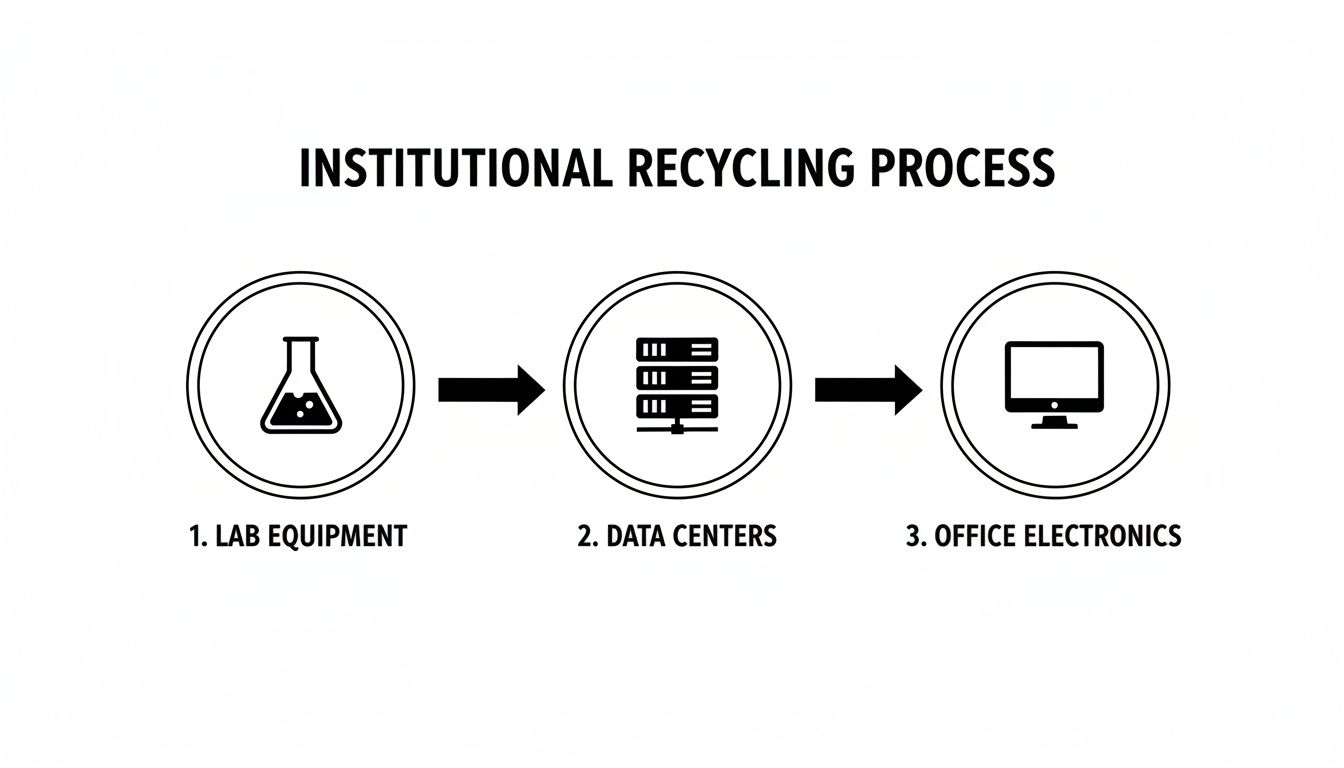
As you can see, whether it's bulky lab instruments, server racks, or old office PCs, every asset follows the same secure, unified path from your facility to its final, compliant destination.
Phase 1: Initial Inventory and Scheduling
Everything kicks off with an inventory. Before you pick up the phone, you need a solid handle on what you have. A detailed list—item types, quantities, and their locations in your building—is the key to getting an accurate quote and planning an efficient pickup.
With your list ready, it's time to get on the schedule. A good partner will work around your operations to find a pickup time that causes the least disruption. This is where a vendor with its own logistics fleet is a game-changer; they can offer flexibility and reliability that third-party shippers just can't match.
Phase 2: Professional De-Installation and Secure Transport
When pickup day arrives, a professional crew handles the heavy lifting—literally. This is more than just moving boxes. It's about carefully disconnecting servers, dismantling entire lab stations, and safely packing delicate electronics to prevent any damage in transit. For big jobs like a full lab decommission, this kind of professional handling is non-negotiable.
Once packed, your assets are loaded onto company-owned vehicles, immediately establishing a secure chain of custody. This is a critical security measure. It completely closes the loop on the risks that come with using unvetted freight companies to move sensitive, data-bearing equipment.
The trip from your building to the processing center is the most vulnerable point in the entire disposal lifecycle. An in-house, dedicated logistics fleet eliminates this security gap, ensuring your equipment stays in trusted hands from start to finish.
This controlled transport is fundamental to responsible recycling in Atlanta, especially for any organization that handles regulated data.
Phase 3: Final Processing and Certification
Once your equipment arrives at the secure facility, the final phase begins. Assets are sorted, and every single data-bearing device is flagged for destruction. Technicians then perform certified data wiping or physical shredding, depending on your organization’s specific requirements. This is where a well-thought-out IT asset disposal plan truly pays off.
After all the data is destroyed and materials are processed, you get the paperwork. This includes a Certificate of Data Destruction and a Certificate of Recycling, which serve as your official, legal proof of compliance. These documents are absolutely vital for internal audits and prove your commitment to data security and environmental standards.
A recent June 2025 City Auditor's report even noted Atlanta’s ongoing recycling contamination issues, underscoring the risks for institutions with surplus e-waste. By providing certified logistics and free hard-drive sanitization, specialized services offer a clear path to avoid landfill fines and compliance pitfalls.
How to Choose the Right Recycling Partner in Atlanta
Picking a vendor to handle your old e-waste and lab equipment isn’t just another line item on a spreadsheet. Think of it as choosing a guardian for your organization's sensitive data and its environmental reputation. The right partner gives you peace of mind and keeps you compliant. The wrong one? They could expose you to massive data security risks, serious legal penalties, and a PR nightmare you don't want.
For any institution in Atlanta, making a smart choice here is critical. It's about protecting your assets and proving your commitment to doing things the right way. You need a partner who will handle your retired equipment with the highest standards of security and sustainability from the second it leaves your control.
Vetting Your Vendor: The Non-Negotiable Checklist
When you start looking at partners for recycling in Atlanta, you need a solid set of criteria to sort the real pros from the rest. This isn't a time to make assumptions. A thorough vetting process that digs into certifications, security, and how they actually operate is your best defense against problems down the road.
You’ll want to zero in on three key areas:
- Industry Certifications: Keep an eye out for credentials like R2 (Responsible Recycling) or e-Stewards. These aren't just fancy logos for a website; they're hard-earned proof that a vendor follows the strictest industry standards for protecting the environment, securing data, and keeping their workers safe.
- Data Security Protocols: The vendor absolutely must have a clear, documented process for destroying data. You should see options for both DoD-standard data wiping and physical shredding, and they need to provide a verifiable certificate for every single device.
- In-House Logistics: Does the company run its own fleet of trucks? This is a huge plus. It creates a secure, unbroken chain of custody for your assets, cutting out the risks that come with hiring third-party movers.
These qualifications are the foundation of a partnership you can trust. They’re your guarantee that the disposal process will be both compliant and secure.
Critical Questions to Ask Every Potential Partner
Once you have a shortlist of vendors who look good on paper, it's time to dig deeper. The way they answer these questions will tell you everything you need to know about their capabilities and how seriously they take protecting you. Don't be shy—a transparent, confident partner will have these answers ready.
Get specific and ask them:
- Can you give me a certificate of data destruction for each individual serial number? This is non-negotiable. You need it for your audit trails to prove every single data-bearing device was wiped clean.
- What is your exact process for handling assets with sensitive data? They should be able to walk you through their entire workflow, step-by-step, from pickup at your facility to final destruction. No vague answers allowed.
- Are your logistics and transportation handled in-house or by a third party? You're looking for an "in-house" answer here. It signals a much tighter grip on security and accountability.
- Can we tour your facility to see your security and operations for ourselves? A legitimate, reputable vendor will be proud to show you how they work. If they hesitate, it’s a major red flag.
The right partner doesn't just take your equipment off your hands; they give you a transparent, verifiable process that shields you from liability. Their willingness to answer these questions is a powerful sign of their reliability.
Back in 2013, the city’s Cartlanta initiative boosted residential recycling by 23% and brought in $30 per ton in revenue. This just goes to show the value of a well-managed program. For institutions, it drives home the point: specialized partners whose compliant data wiping and on-site pickups can turn even complex lab decommissioning projects into sustainable, cost-effective wins. You can dive deeper into how Atlanta's recycling programs created value by learning more about these city-wide initiatives.
Frequently Asked Questions About Atlanta Business Recycling
When it comes to commercial and institutional recycling, a lot of questions pop up. For organizations all over Atlanta, getting the details right on asset disposition is the key to staying compliant, secure, and environmentally responsible. Here are some direct answers to the questions we hear most often from facility managers, IT directors, and lab coordinators.
Think of this as your quick-reference sheet for handling the unique challenges of specialized recycling in Atlanta. Our goal is to reinforce the main ideas we've covered and give you the confidence to take the next step.
What Is the Difference Between Data Wiping and Physical Shredding?
This is probably one of the most critical questions we get, and the answer really boils down to the condition of your equipment and what you plan to do with it next.
Data wiping, sometimes called sanitization, is a software-based process. It overwrites every single sector of a hard drive with random characters, making the original data impossible to recover. The industry benchmark for this is the DoD 5220.22-M 3-pass method. The big advantage here is that the physical drive is preserved, leaving the door open for reuse or resale.
Physical shredding, on the other hand, is the end of the line. It's the go-to solution for devices that are broken, too old to be useful, or held data so sensitive that total destruction is the only acceptable path. The drive is literally fed into an industrial shredder that grinds it into tiny metal fragments. There's no coming back from that. A good partner should offer both and help you figure out which makes the most sense for your assets.
How Do I Know If a Vendor Is Truly Compliant?
Knowing who to trust with your assets is everything. When you're vetting a potential partner for recycling in Atlanta, you have to look past the slick marketing and ask for hard proof of their qualifications and processes.
Here’s what you absolutely need to ask for:
- Industry Certifications: The two big names in the e-waste industry are R2 (Responsible Recycling) and e-Stewards. Having one or both of these proves a vendor is serious about environmental protection, data security, and worker safety. They aren't easy to get.
- A Clear Chain of Custody: The vendor should be able to walk you through their entire process, step-by-step. What happens from the moment they arrive at your facility to the moment you get your final certificates? This should include details about their secure, in-house logistics—no sketchy third parties.
- Verifiable Documentation: Any reputable vendor will provide a Certificate of Data Destruction and a Certificate of Recycling after the job is done. These aren't just pieces of paper; they are your legal proof that you met all compliance requirements.
If a potential vendor gets cagey about providing this info or won't let you tour their facility, that’s a major red flag. Move on.
Can We Recycle Old Laboratory Equipment?
Absolutely. Specialized lab equipment—things like centrifuges, incubators, spectrometers, and even big fume hoods—should never end up in a landfill. These items are often packed with complex electronics, heavy metals, and other materials that demand professional handling.
The real challenge with lab equipment is that it doesn't fit neatly into standard city recycling or typical IT asset disposal programs. You need a partner who has specific expertise in decommissioning and processing these unique instruments.
A qualified vendor will know how to safely de-install, transport, and break down these assets, making sure every component is recycled or disposed of according to environmental regulations. This keeps hazardous materials out of our local ecosystem and allows valuable resources to be recovered. When looking for the right fit, it's a good idea to research different electronic waste recycling companies to see who specializes in handling lab or medical gear.
What Are the Main Costs Associated with This Type of Recycling?
The costs for specialized recycling really depend on the project, but any transparent partner will give you a clear, itemized quote upfront. The main things that affect pricing are the type and amount of equipment you have, the logistics of the pickup, and any special services you need, like on-site de-installation.
For instance, a full data center decommission will have a completely different cost structure than a simple pickup of old office computers. But don't forget that many vendors offer services that can actually offset some of those costs. Some might provide free hard-drive wiping or offer fair market value for newer, reusable equipment, which can be credited against your final bill. Always ask for a detailed breakdown so you know exactly what you’re paying for.
Ready to simplify your equipment disposal and make sure your Atlanta organization stays compliant and secure? The team at Scientific Equipment Disposal provides comprehensive, sustainable solutions for all your lab and IT assets.