Recycle Electronics Free Pick Up A How To Guide For Local & Nationwide Service

Yes, you can absolutely get your old electronics hauled away with a free pick up service, especially if you're a hospital, university, data center, or lab. Specialized B2B recyclers often provide this service at no cost for larger quantities of valuable IT and lab equipment, offering both local and nationwide coverage. They handle everything—from the heavy lifting and de-installation right through to transportation.
Your Guide To Free Electronics Pick Up Services
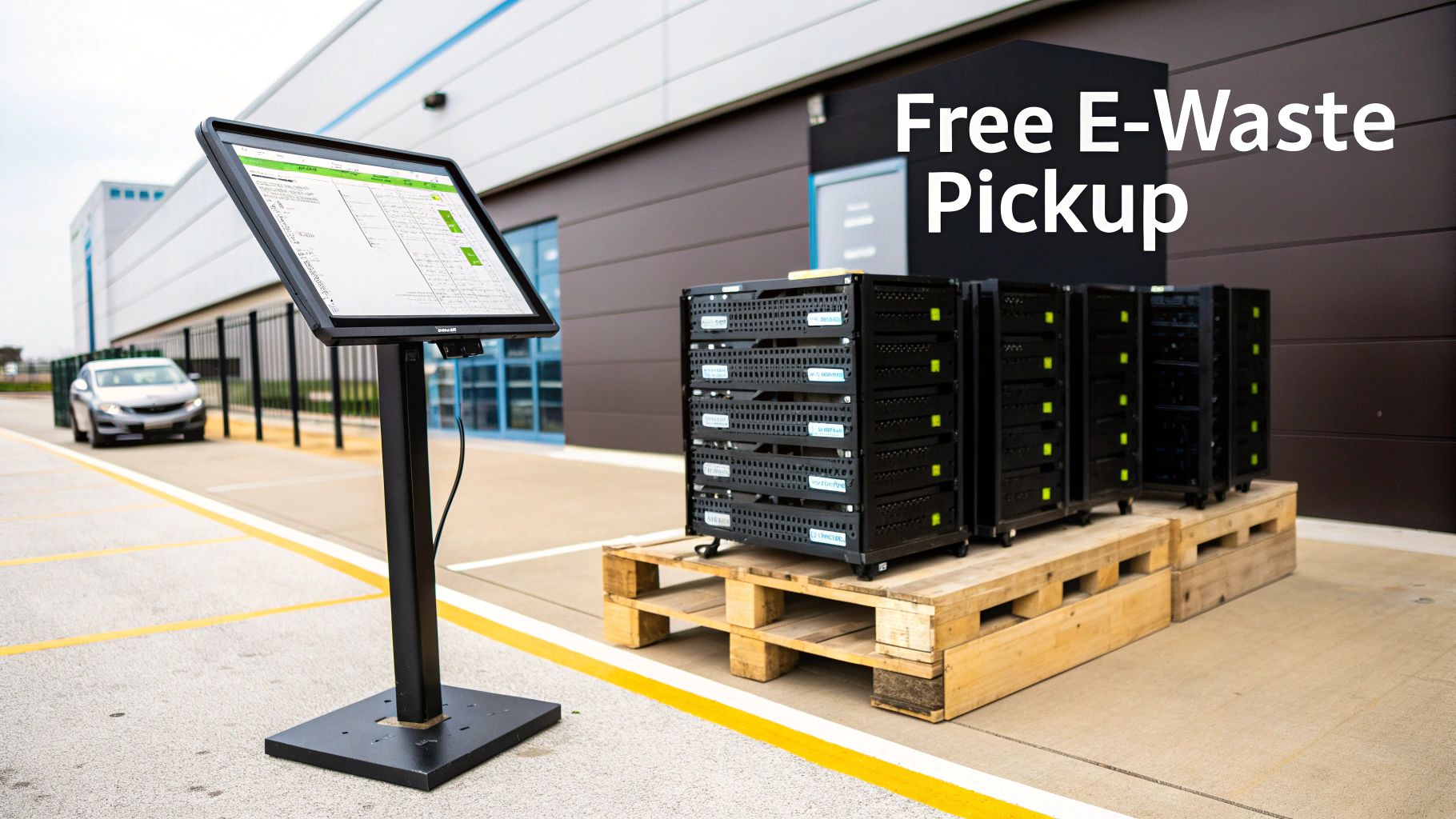
Whether you’re managing a full facility shutdown, decommissioning a lab, or just cycling through an IT hardware refresh, dealing with old electronics is a massive logistical headache. It’s never as simple as just getting it out the door. You have to worry about secure data destruction, environmental compliance, and coordinating the whole process, which can completely drain your internal resources.
This is exactly where a professional e-waste partner with nationwide reach becomes a strategic asset.
A dedicated B2B recycler turns a complicated disposal problem into a simple, managed solution. Instead of your team wrestling with dumpsters or trying to vet local scrappers, you get a single point of contact who takes care of the entire process, whether you're in Atlanta, GA, or anywhere else in the U.S. Think of this guide as your roadmap to doing it right.
Why Free Pick Up Is A Smart Business Decision
For any large-scale operation, the perks go way beyond just clearing out some space. Bringing in a specialized recycler for a free electronics pickup delivers some serious advantages that hit your bottom line and make your operations run smoother.
Before we dive into the "how-to," let's quickly break down the key benefits. Partnering with a professional service isn't just about convenience; it's a strategic move that saves money, protects data, and frees up your team.
Key Benefits of Free Electronics Pick Up
| Benefit Category | Key Advantage for Your Organization |
|---|---|
| Cost Avoidance | You completely sidestep expenses for transportation, labor for moving heavy gear, and potential disposal fees. |
| Resource Optimization | Your IT or facilities staff can focus on their actual jobs instead of inventorying, packing, and moving old assets. |
| Compliance & Security | Reputable partners provide certified data destruction, keeping you compliant with regulations like HIPAA and safe from data breaches. |
| Sustainability Goals | Proper recycling aligns with your corporate social responsibility (CSR) targets by keeping hazardous e-waste out of landfills. |
Ultimately, this is more than just getting rid of old equipment; it's about adopting a secure, compliant, and cost-effective asset disposition strategy.
By outsourcing e-waste disposal, you're not just getting rid of old gear; you're adopting a secure, compliant, and cost-effective asset disposition strategy. This approach is particularly critical for sectors handling sensitive data, such as healthcare, finance, and government.
To see how our process works from start to finish, you can learn more about our simple, coordinated pickup system here: https://www.scientificequipmentdisposal.com/how-it-works/. Next, we'll walk through exactly how to qualify for a pickup, prepare your assets, and understand the documentation that protects your organization every step of the way.
How To Qualify For Free Equipment Pick Up
Getting a recycle electronics free pick up service isn't about luck—it's about value. Professional recyclers run a business, and the logistics of sending a truck and crew have real costs, whether it's a local pickup in Atlanta or a cross-country trip. Those costs need to be offset by the recoverable value of the equipment being collected.
If the gear is valuable enough, the pickup is free. It's that simple.
The great thing is that this value isn't judged on a per-item basis. We look at the aggregate worth of your entire inventory. A single high-end server or a specialized piece of lab equipment can often cover the cost for a whole load of older, lower-value electronics, making the entire removal free of charge.
The Key Factors Are Quantity and Quality
The two things that matter most are the quantity and quality of your equipment. A small office trying to get rid of five ten-year-old desktop computers and a printer probably won't qualify. The cost to dispatch a truck and crew would far exceed the minimal scrap value of those outdated items.
On the other hand, a research university decommissioning an entire lab wing—complete with centrifuges, incubators, servers, and dozens of workstations—is a completely different story. The sheer volume and mix of higher-value assets make it a worthwhile project for the recycler, easily justifying the free service anywhere in the country.
Pro Tip: Stop thinking in terms of individual items and start thinking in terms of pallets. As a general rule, if you have enough equipment to fill at least one standard 40" x 48" pallet, your chances of qualifying for a free pickup go way up. A full truckload is even better.
This need for scale is precisely why free pick-up services are a lifeline for corporate IT departments, data centers, and research facilities. With Americans generating a staggering 6.92 million tonnes of e-waste annually and only recycling 15% of it, these large-scale services are critical. The U.S. electronic waste recycling market has ballooned to USD 14.1 billion, driven almost entirely by demand from industrial and corporate sectors.
Balancing Valuable Assets With Problematic E-Waste
So what happens if you have items that normally cost money to dispose of, like old CRT monitors or certain batteries? This is where the idea of a "blended load" comes in. A good recycler will assess the total value of your equipment as a whole, not just cherry-pick the good stuff.
Imagine a hospital with 20 valuable rack servers and 50 newer PCs, but also a storage closet full of ancient, heavy CRT monitors. The significant resale value of the servers and PCs can easily absorb the disposal fees for the monitors. The end result? Your organization gets everything hauled away for free, with no hidden fees or surprise charges.
It's all about the mix:
- High-Value Items: Servers, networking switches, storage arrays, and newer lab instruments often have a strong secondary market value.
- Low-Value Items: Older desktops, printers, keyboards, and basic peripherals typically have value only in their raw materials.
- Cost-Incurring Items: CRT monitors and anything with hazardous materials require special handling and processing, which creates a disposal cost.
A diverse inventory is often your best asset. When you understand what types of equipment recyclers are looking for, you can package your assets in a way that ensures a successful, no-cost pickup. To get a better idea, you can check out a comprehensive list of accepted IT and lab equipment to see what qualifies. This simple, strategic approach can turn a potential expense into a free and easy solution.
Preparing Your Assets For A Secure Pick Up
Once your recycle electronics free pick up is officially on the calendar, taking a few simple steps to prepare can make a world of difference. Proper organization doesn't just make the physical removal faster; it also tightens up your data security and documentation, ensuring a compliant, headache-free process from your door to ours.
This flowchart breaks down the key criteria—quantity, type, and value—that determine whether a collection qualifies for a free pickup service.
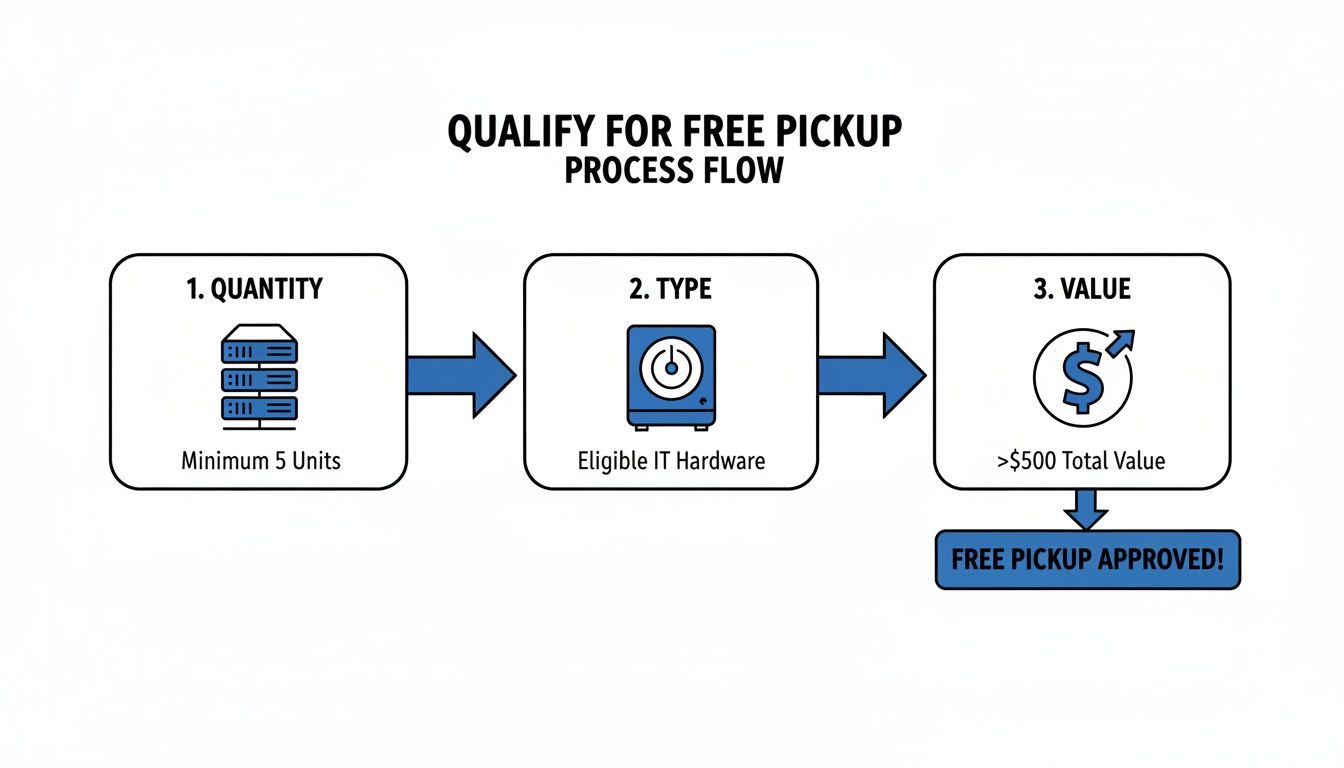
As you can see, a successful no-cost pickup is all about balancing these three factors. The goal is to make sure the combined value of the equipment covers the real-world costs of labor, fuel, and processing.
Create A Clear Asset Inventory
Before the truck arrives, it's a good idea to create a simple inventory list. This doesn't need to be some exhaustive, serial-number-level audit (unless your own internal policies require it, of course). For most pickups, a general manifest is all that's needed.
Just jot down the basics:
- Item Type: e.g., Dell PowerEdge Server, HP LaserJet Printer, Thermo Scientific Centrifuge.
- Quantity: A quick count of each item type.
- General Condition: A simple note like functional, non-functional, or for parts is helpful.
This list does two important jobs. First, it’s your internal record for tracking disposed assets. Second, it kicks off the chain of custody, giving everyone a clear picture of exactly what was handed over to us.
Consolidate Equipment For Easy Access
This next part is purely practical: make it easy for our crew to get to the equipment. If you can, consolidate everything in a single, ground-floor location. A loading dock, an empty office, or a storage room are all perfect spots.
This simple move saves a ton of time and cuts down on disruptions to your daily operations. A crew that can quickly palletize and load everything from one spot is way more efficient than one hunting through multiple floors or navigating cluttered labs. It also minimizes any safety risks for both your staff and our pickup team.
Make An Informed Data Destruction Decision
Data security is the one area where there's no room for compromise, especially for organizations dealing with HIPAA, FERPA, or other privacy rules. You need to decide where and how your data-bearing devices will be sanitized before they leave your control. You've generally got two solid options.
1. Off-Site Data Destruction
This is the most common and efficient path. Our team transports the assets to our secure facility, where we perform the data sanitization. It’s the ideal choice for large quantities of devices because it keeps the on-site process focused strictly on logistics—getting the gear out of your way quickly.
2. On-Site Data Destruction
For maximum security or to satisfy a specific compliance mandate, you can absolutely request on-site services. We'll bring industrial shredders or data wiping equipment right to your location. This lets you witness the destruction firsthand before the sanitized assets are removed.
Any reputable recycler should offer both. The key, no matter which method you choose, is the documentation. You should always receive a Certificate of Data Destruction that details the sanitization method and lists the serial numbers of the drives that were processed.
For hard drives that still have life in them, the gold standard is DoD 5220.22-M sanitization, a three-pass overwrite method that makes data recovery virtually impossible. For drives that are dead or obsolete, physical shredding is the only way to be 100% certain that data can never be recovered.
If you want to dig deeper into these methods, you can learn more about how to wipe a computer hard drive in our detailed guide. It'll help you make the best choice to protect your organization's sensitive information.
What To Expect On Pick Up Day
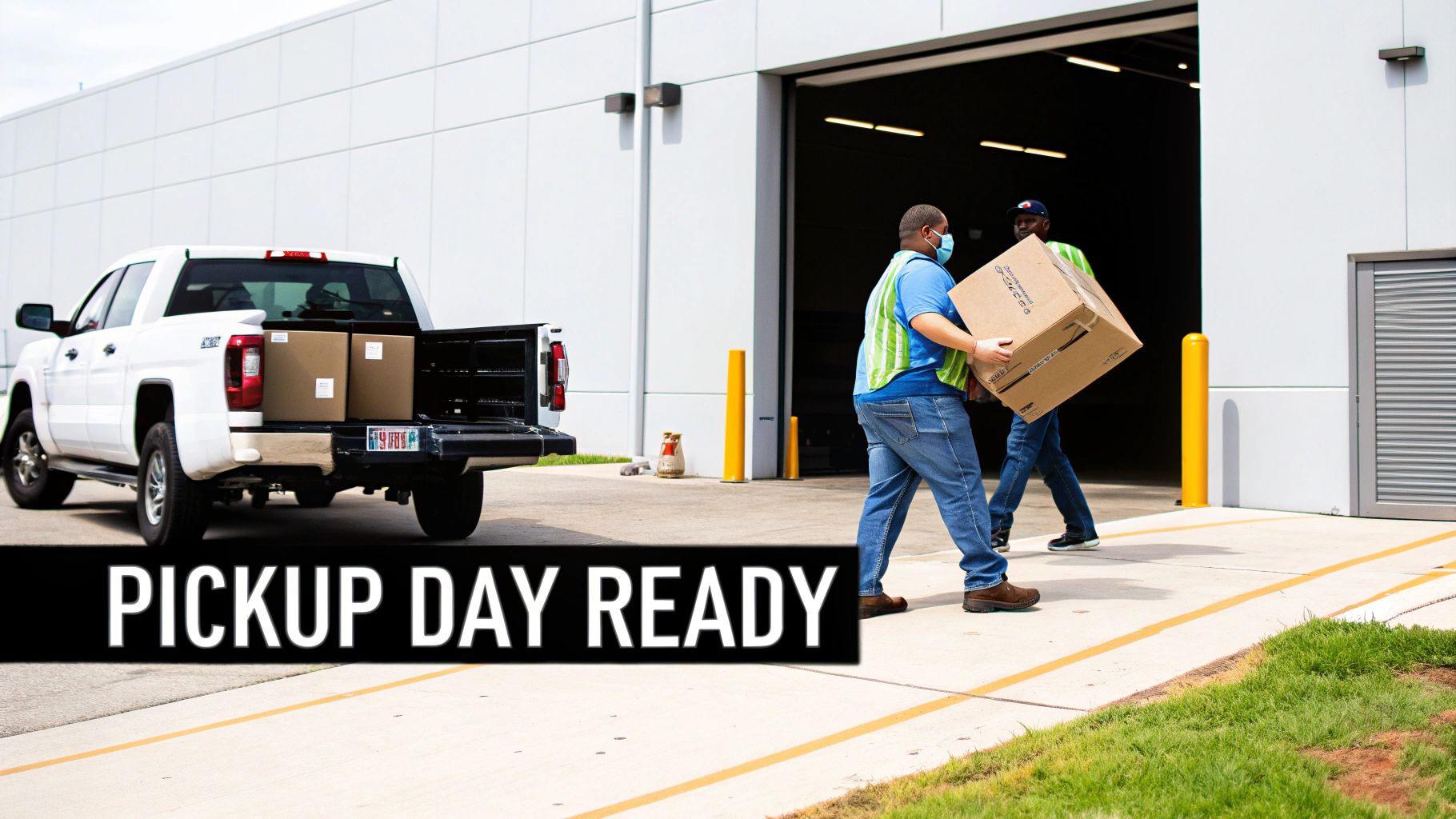
Arranging a recycle electronics free pick up shouldn't be a headache. The whole point is to make your life easier, and our process is built from the ground up to be efficient and hands-off for your team. From that first phone call to the moment our truck is loaded and gone, we handle the details for clients nationwide.
It usually starts with a quick chat or an email. You can send over an asset list if you have one, or honestly, just snapping a few pictures of the equipment with your phone works great. This gives us what we need to give you a quick, accurate assessment and confirm that your gear qualifies for our no-cost service.
Coordination and Logistics
Once we know what we're working with, our logistics team steps in. We get it—your hospital, lab, or data center can't just come to a standstill for an equipment pickup. That’s why we work directly with your facilities manager or IT director to lock in a time that causes the least amount of disruption to your operations.
This is also when we iron out all the on-site requirements. Do you have a loading dock? Are there specific hours when trucks are allowed? Does our crew need to check in with security or get special badges? Getting these questions answered upfront makes everything run like clockwork, whether your pickup is local or across the country.
One of the biggest advantages we have is our own fleet of trucks. This gives us a ton of flexibility compared to companies that have to rely on third-party freight. If you’re staring down an urgent facility move or a tight deadline for a shutdown, having our own dedicated fleet means we can often squeeze in last-minute requests and adapt to your schedule.
The global electronics recycling market is currently valued at a massive USD 43.2 billion and is expected to climb to USD 147.9 billion. That explosive growth underscores the critical need for dependable recyclers who can handle the sheer volume of e-waste coming from specialized facilities like yours.
The Day Of The Pick Up
On the scheduled day, our professional, insured crew will show up ready to handle everything. You don’t need to worry about the heavy lifting, the packing, or trying to navigate bulky equipment down narrow hallways. We bring all the necessary gear—pallet jacks, straps, packing materials, you name it.
For bigger jobs, like a full lab decommissioning or a data center clean-out, we can even handle on-site de-installation. Our technicians are trained to safely disconnect and dismantle servers from racks or detach sensitive instruments, giving you a truly turnkey solution.
The goal is simple: make the entire experience effortless for you. Your team just needs to point out the equipment, and our crew takes it from there. We load it, secure it, and transport it, leaving your space clear and ready for whatever's next. We turn what could be a major logistical nightmare into just another simple, scheduled event.
To get the ball rolling, you can easily schedule a pickup for your organization and let our team manage the entire process.
It’s Not Over Until the Paperwork Is Done
When you schedule a recycle electronics free pick up, the job isn’t finished once the truck pulls away from your loading dock. For any organization that handles sensitive information—hospitals, labs, universities, you name it—the documentation you receive after the pickup is just as critical as the physical removal itself.
This paper trail is your concrete proof that you’ve met all your legal and ethical duties for data security and environmental compliance. A verbal promise of proper disposal simply won't cut it. If an old company hard drive ever surfaces where it shouldn't, you'll have no defense without clear, official records. This is especially true for organizations bound by strict regulations like HIPAA or FERPA.
The Two Documents You Absolutely Must Have
Any legitimate e-waste partner will provide a set of documents that certifies the secure and compliant handling of your assets. Think of this paperwork as your compliance shield, proving exactly what happened to your equipment after it left your facility.
You should always expect to receive two essential certificates:
- Certificate of Recycling: This is your official confirmation that all your electronic assets were processed in accordance with federal, state, and local environmental laws. It’s your proof that hazardous materials were managed correctly and your old equipment stayed out of a landfill.
- Certificate of Data Destruction: This might be the single most important document you receive. It verifies that every data-bearing device was either professionally sanitized or physically destroyed. A proper certificate will detail the method used (like a DoD 5220.22-M wipe or physical shredding) and should include the serial numbers of the hard drives that were processed.
These certificates are non-negotiable. They are your first and best line of defense against the serious legal and financial fallout from a data breach or an environmental misstep.
Following the Chain of Custody
The "chain of custody" is the chronological paper trail that documents the handling of your assets, from the moment they leave your control to their final recycling or destruction. It starts with the initial inventory list you create and ends with the certificates you receive. An unbroken chain of custody is what proves you acted responsibly.
Imagine a hospital retiring a server that once held patient health information (PHI). A solid chain of custody, backed by a detailed Certificate of Data Destruction, is the only way to prove to auditors that the data was managed in a HIPAA-compliant manner. Without it, the hospital is left completely exposed.
Globally, the numbers on e-waste are staggering. Only 22.3% of the 62 million tonnes of e-waste generated was actually documented as properly recycled. This is an alarming gap, and it underscores why demanding thorough documentation from your recycling partner is so vital for accountability. You can read more about this global challenge in the Global E-waste Monitor 2024.
A free service should never come at the cost of compliance. The right partner knows that providing a comprehensive paper trail isn't an extra—it's a core part of the service. You can learn more about how proper documentation fits into a secure IT asset disposal strategy and ensure your organization is fully protected.
Questions We Hear All The Time About Free Electronics Recycling
Even with the best plans, you’re bound to have a few questions. That's perfectly normal. We get calls every day from facility managers, IT directors, and lab supervisors who are coordinating a major equipment clear-out for the first time.
Here are some of the most common things people ask, along with straight, simple answers.
What Kind Of Equipment Qualifies For Free Pickup?
We take just about everything. Our trucks haul away standard IT gear like servers, computers, and networking racks, but we also handle highly specialized lab instruments—think centrifuges, microscopes, incubators, and analyzers.
The key to a free pickup isn't about one specific type of item; it’s about the total value and volume of the entire load.
Now, some things like old, heavy CRT monitors have special disposal requirements and might have a small fee. But don’t worry—we often absorb those costs when they're part of a larger pickup with higher-value assets. The goal is to balance the load so you see no out-of-pocket expense.
Is Your Data Destruction Process HIPAA Compliant?
Yes, 100%. Data security isn't just a feature for us; it’s the entire foundation of our service.
For any hard drives that are still functional, we provide free DoD 5220.22-M 3-pass data wiping. This is a military-grade sanitization method that meets (and often exceeds) the standards required by regulations like HIPAA. It ensures every bit of sensitive information is gone for good.
What about drives that are broken, outdated, or damaged? Those go straight into our industrial shredders for complete physical destruction, making the data totally irrecoverable.
Once we're done, we issue a formal Certificate of Data Destruction. This isn't just a piece of paper; it's your official, auditable proof that your organization’s sensitive data has been securely and permanently destroyed, protecting you from future liability.
How Do I Schedule A Pickup In The Atlanta Metro Area Or Nationwide?
Getting the ball rolling is easy, whether your facility is right here in the Atlanta metro or on the other side of the country. We’ve made the process quick and painless because we know you have better things to do.
It really comes down to a few simple steps:
- Show Us What You've Got: Snap a few quick pictures of the equipment pile with your phone or just jot down a basic list of the items. This gives us a good idea of what we're working with.
- Get in Touch: You can either give us a call for a quick chat or fill out the simple contact form on our website.
- Get a Fast Quote: Based on your info, we’ll quickly assess everything and confirm if you qualify for a free pickup. No waiting around for days.
- We Handle the Logistics: From there, our logistics team coordinates directly with you to find the perfect time for our crew to arrive, ensuring we don't disrupt your workflow.
Our job is to make this whole process as hands-off for you as possible. You point, we handle the rest.
Ready to clear out that old equipment the smart, secure, and cost-free way? Scientific Equipment Disposal offers compliant, professional electronics recycling with free pickups for qualifying businesses in Atlanta and nationwide. Get a free quote and schedule your pickup today.