Expert Obsolete Factory Equipment Removal Services: Local & Nationwide

Getting rid of old factory equipment isn't just about calling a hauling company. Whether you're decommissioning a full production line in Chicago, a single lab in Atlanta, or an entire data center with multiple nationwide locations, a solid plan is the only way to minimize downtime, get the most money back for your assets, and stay on the right side of the law. Professional Obsolete Factory Equipment Removal Services are built around creating and executing that exact roadmap, whether your project is local or spans the country.
Planning Your Equipment Removal Project
I’ve seen it a hundred times: the most successful removal projects are won long before a single tool is picked up. Good planning is what separates a smooth, cost-effective clear-out from a logistical nightmare full of surprise costs and delays, especially for multi-site operations.
Think of it this way: a well-thought-out plan forces you to answer the tough questions early. What exactly do you have? Which machines have resale value, and which are just scrap metal? How are you going to handle sensitive data on old hard drives or comply with EPA and OSHA rules in different states? Answering these questions upfront sets a realistic budget and a timeline you can actually stick to, from your headquarters in New York to a plant in California.
Understanding the Key Stages
We break down every project into three main phases: planning, removal, and documentation. Each step builds on the last, making sure nothing falls through the cracks. This approach works whether we're clearing a small lab in a packed industrial park or managing a nationwide shutdown across multiple sites.
A few of the critical milestones you have to hit include:
- Defining the Project Scope: Are we talking about a few machines, an entire department, or a full facility shutdown? You have to draw a clear line.
- Asset Inventory & Valuation: This means creating a detailed spreadsheet of every single asset, noting its condition, and figuring out what it’s worth on the secondary market versus its scrap value.
- Compliance & Risk Assessment: You need to identify every regulation that applies, from environmental rules (EPA) and worker safety (OSHA) to data privacy laws like HIPAA, for each and every location.
- Logistics & Execution: This is the hands-on part—scheduling the de-installation, crating, and transportation of every piece of equipment, from a local job in Dallas to a cross-country haul.
This infographic gives a great high-level view of how a professional removal project flows from start to finish.
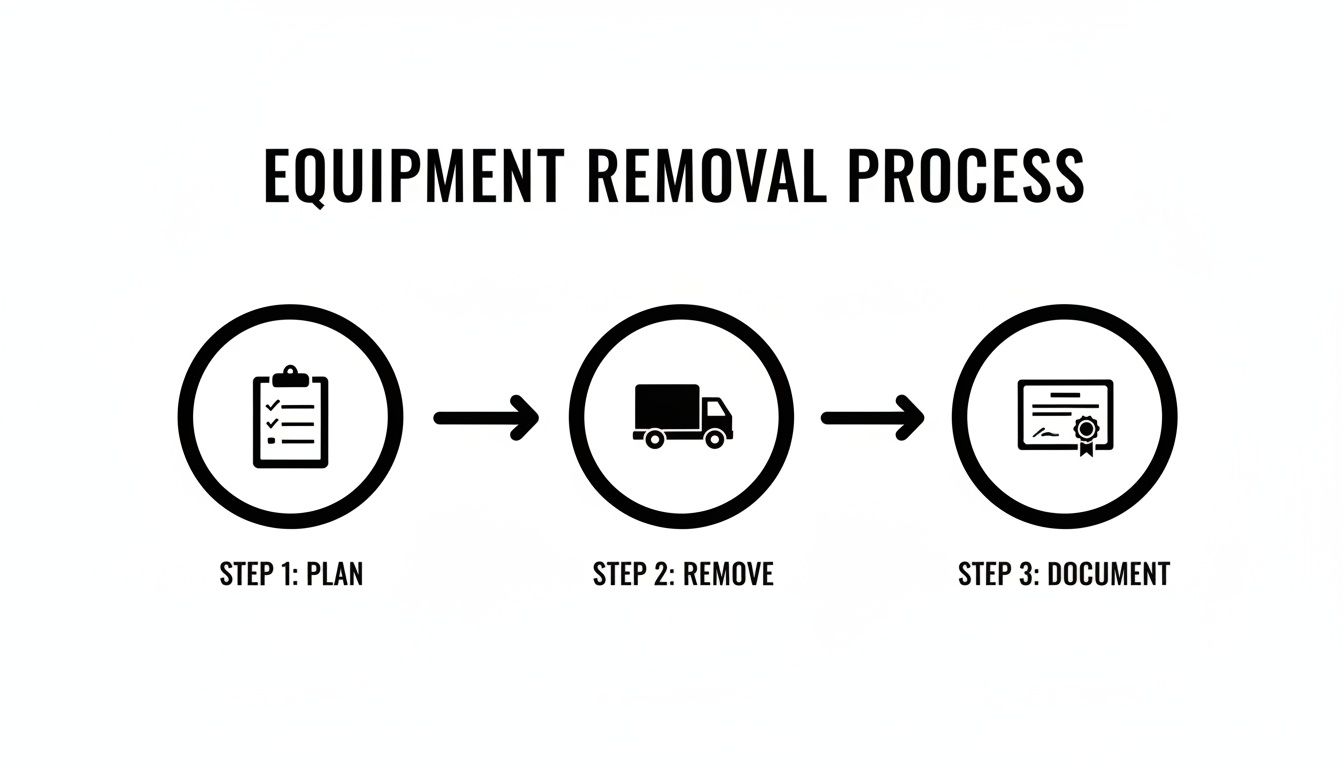
This simple 3-step process—plan, remove, document—underscores why you can't just jump straight to the physical work. The planning supports the execution, and the documentation proves it was all done correctly.
A well-structured removal project involves distinct phases, each with its own set of goals and activities. Here's a quick look at what that typically involves.
Key Stages of an Equipment Removal Project
| Phase | Primary Goal | Core Activities |
|---|---|---|
| 1. Planning & Assessment | Create a detailed roadmap, identify risks, and uncover value. | Asset inventory, valuation, regulatory review, data security planning, scope definition. |
| 2. Decommission & Removal | Safely and efficiently de-install, pack, and transport all assets. | On-site de-installation, media sanitization, secure packing, logistics coordination, transportation. |
| 3. Reporting & Closeout | Provide proof of compliance and finalize all financial settlements. | Issuing Certificates of Destruction/Recycling, asset settlement reports, project closeout documentation. |
Each stage is crucial for a seamless transition, ensuring all logistical, financial, and legal requirements are met.
Why a Strategic Plan Is Non-Negotiable
Trying to wing it is a recipe for disaster. Forget to properly document the disposal of a machine with hazardous materials at a facility in Texas, and you could be looking at massive fines years down the road. Fail to wipe hard drives correctly at your corporate HQ, and you’re risking a data breach that could cripple your company's reputation.
A detailed project plan is your primary tool for mitigating risk. It serves as a central reference for your team and your removal partner, ensuring everyone is aligned on goals, responsibilities, and procedures from start to finish.
This is also where you find hidden cash. An experienced partner with a nationwide network can spot equipment that, while useless to you, is exactly what someone on the secondary market is looking for. That revenue can often offset—and sometimes even cover—the entire cost of the project. To get a better handle on this, you can learn more about the specifics of factory equipment decommissioning for manufacturers and how to get your facility ready. A good plan isn't just about removal; it's about maximizing the opportunity.
Creating Your Asset Inventory and Valuation
Before a single truck shows up, the real work on an equipment removal project begins. Every decision—from logistics and cost to compliance—hinges on a solid asset inventory. Think of it as the project's bible.
Trying to run a decommissioning without one is a recipe for disaster. You’ll absolutely lose track of assets, run into surprise costs, and miss critical compliance steps. This is the moment you turn a mountain of machinery into a manageable, documented list.
Building Your Comprehensive Asset List
The goal here is simple: catalog every single piece of equipment that’s heading out the door. You need to be methodical, moving through your facility to make sure nothing gets missed. This isn't just a headcount; it's a detailed record-keeping effort.
As you build this master list, it helps to follow the best practices for inventory management to keep things accurate from day one.
Here’s a practical way to tackle it:
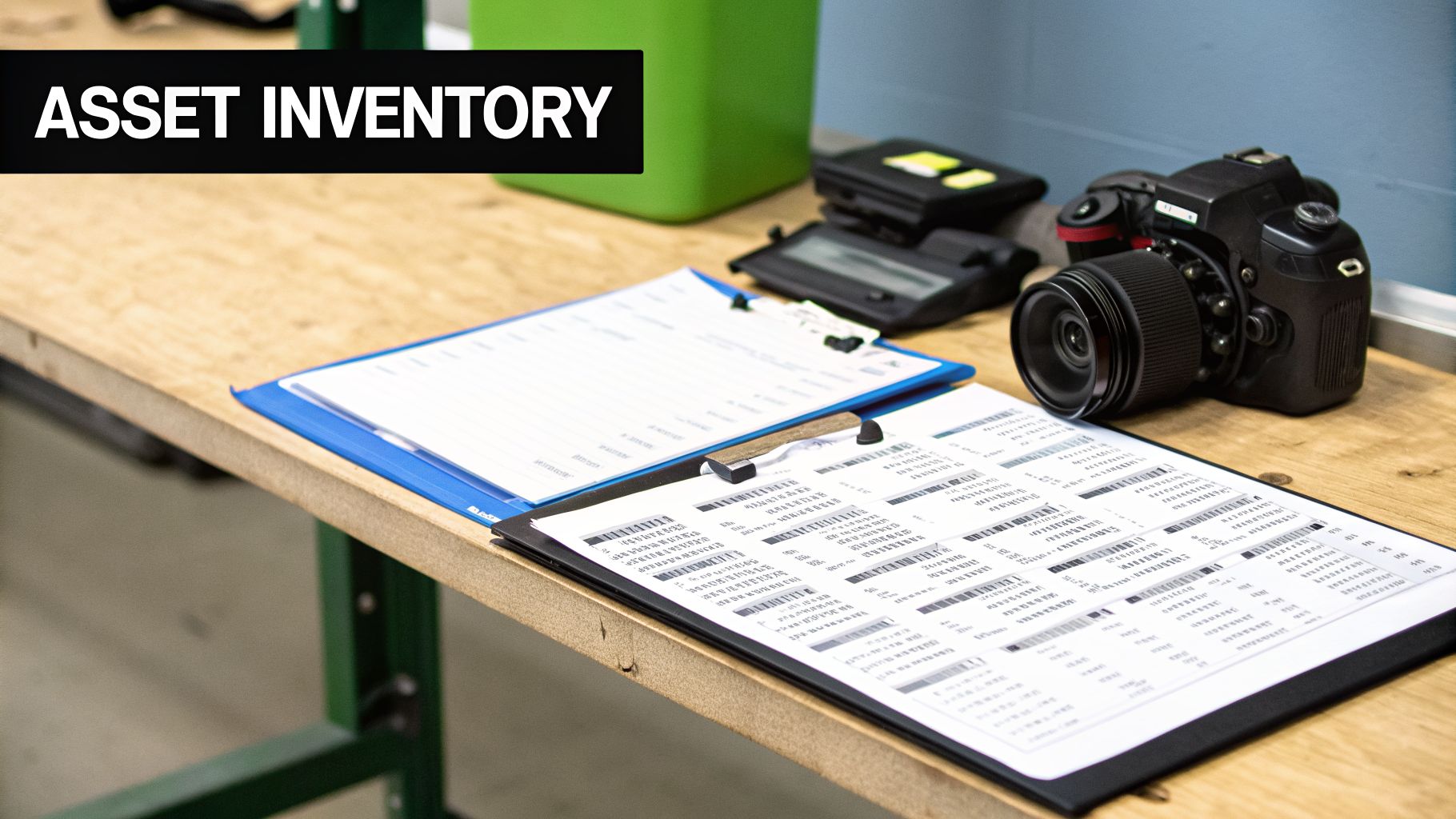
- Tag Every Asset: Get some simple adhesive labels and give every machine a unique ID number. This tag will follow the asset through the entire process, from your factory floor to its final destination.
- Photograph Everything: Take clear pictures of each item. Get shots from multiple angles, and be sure to capture any manufacturer plates, serial numbers, or obvious damage. These photos are gold for valuation and for your own records.
- Document the Details: Fire up a spreadsheet and start logging the key info for each tagged asset. This is where you link the physical machine to its data profile.
An inventory isn't just a list. It’s your main tool for project control. It’s what stops a valuable machine from being accidentally tossed in the scrap pile and ensures hazardous items are flagged early, avoiding nasty compliance surprises later on.
A detailed inventory is the foundation of professional obsolete factory equipment removal services, whether we're clearing out a facility in Atlanta or managing a nationwide shutdown.
Essential Data Points for Your Inventory
A useful inventory is all about specific, actionable information. For every piece of equipment, you should be capturing these details:
| Data Category | Specific Information to Record | Why It Matters |
|---|---|---|
| Identification | Unique Asset Tag #, Serial Number, Model Number | Crucial for tracking and making sure nothing gets mixed up. |
| Description | Equipment Type, Manufacturer, Key Specifications | This helps with valuation and finding potential buyers. |
| Location | Building, Floor, Room Number (and City/State for multi-site) | Absolutely critical for planning the physical removal logistics. |
| Condition | Fully Functional, Needs Repair, Parts Only, Scrap | Directly impacts its value and which disposal route it takes. |
| Data Storage | Note if it contains hard drives or other media | Flags items that need secure data destruction. |
This structured approach is the only way to ensure you have the right information to make smart decisions for every single asset. You can discover more about our production equipment disposal solutions to see how this inventory feeds into the entire process.
From Inventory to Valuation
With a complete inventory in hand, you can move on to valuation. This is where you decide the fate of each machine, both financially and logistically. Your equipment will almost always fall into one of three buckets:
- Assets for Resale: These are the items that still have life in them and value in the market. It might be newer lab instruments, specialized manufacturing tools, or even bulk IT gear like servers. An experienced partner can spot these opportunities and connect you with a network of buyers across the country.
- Assets for Recycling: The bulk of obsolete equipment ends up here. It might not have resale value, but its materials—steel, aluminum, copper—are valuable commodities. A certified recycler makes sure these materials get back into the supply chain instead of a landfill.
- Assets for Special Disposal: This is for anything containing hazardous materials like lead, mercury, or refrigerants. These items demand a fully documented, compliant disposal process to satisfy EPA and state rules.
Think about a university lab decommissioning we handled. The inventory turned up a $15,000 mass spectrometer that was still in high demand, dozens of older centrifuges tagged for recycling, and a -80°C freezer that needed special handling for its refrigerants. Without that initial list, the high-value spectrometer could have easily been scrapped—a huge financial loss. This is how you find the hidden value in your obsolete factory equipment.
Navigating Compliance and Data Security
When it’s time to clear out old factory equipment, the physical lifting is just the beginning. The real heavy lifting involves navigating a minefield of compliance and data security risks. Get it wrong, and you're looking at steep fines, legal headaches, and a reputation that’s hard to rebuild.
This is where professional Obsolete Factory Equipment Removal Services act as your first line of defense, shielding you from serious liability. It’s not just about hauling away old machinery; it’s about managing risk from start to finish, wherever your facilities are located.
Staying on the Right Side of Environmental Laws
The Environmental Protection Agency (EPA) doesn't mess around. The most critical regulation you need to know is the Resource Conservation and Recovery Act (RCRA), which gives the EPA the power to manage hazardous waste from its creation all the way to its final disposal.
If your factory equipment has any history with substances like mercury, lead, PCBs, or certain industrial solvents, it’s now considered hazardous waste. Under RCRA’s strict “cradle-to-grave” rules, you are legally responsible for that waste forever—even long after it’s left your property. This means you must have documented proof that it was handled, transported, and disposed of by a certified partner.
On top of federal law, every state adds its own set of rules.
- A facility in Georgia, for instance, has to follow the specific guidelines from the Georgia Environmental Protection Division (EPD), which can be even stricter than the EPA’s.
- If you’re running a project across multiple states, from Florida to Washington, you need a partner who knows the local playbook for every single location. No exceptions.
This intense focus on responsible disposal is reshaping the entire industry. The Plant and Machinery Dismantling Services market is expected to hit $5 billion in 2025 and is forecasted to grow by 7% annually through 2033. This boom is fueled by aging industrial sites and tougher environmental laws, with North America leading the charge. You can see the full analysis of this expanding market and its key drivers to get a better handle on these trends.
The Unbreakable Rules of Data Destruction
In many facilities, especially in research, healthcare, or finance, the biggest liability isn’t a chemical spill—it’s a data breach. Any piece of equipment with a hard drive, from a server rack down to a specialized lab instrument, is a potential goldmine for thieves.
For any organization that handles patient information, HIPAA compliance is non-negotiable. The law demands that all Protected Health Information (PHI) must be made completely unrecoverable before the device it was stored on is discarded. Simply deleting files does nothing.
You really only have two legitimate options for certified data destruction:
- Software-Based Sanitization: This uses specialized software to overwrite a drive with random data, usually following the DoD 5220.22-M standard. It’s a good choice for functional drives that you plan to resell.
- Physical Shredding: This is the only 100% foolproof method. We feed the hard drive into an industrial shredder that chews it up into tiny metal fragments. There’s no coming back from that. This is the gold standard for damaged drives or for anyone who can't afford to take chances.
When you're dealing with sensitive data, especially PHI, there's no room for "good enough." If you have any doubt about a software wipe or a drive's condition, demand physical shredding. Always get a Certificate of Data Destruction that lists the serial number of every single drive that was destroyed.
You can learn more about our secure data destruction process and how we ensure total compliance with standards like HIPAA.
Prioritizing On-Site Safety with OSHA
Finally, your compliance responsibilities include keeping everyone safe during the actual removal work. The Occupational Safety and Health Administration (OSHA) sets firm rules for everything from electrical safety (like lockout/tagout procedures) to the safe operation of heavy equipment.
A true professional partner won’t just show up and start working. They’ll come prepared with a detailed safety plan, conduct a thorough risk assessment on-site, and make sure their crew is fully trained and using the right Personal Protective Equipment (PPE). This protects their team, your employees, and your facility from accidents and costly disruptions.
Executing On-Site Removal and Logistics
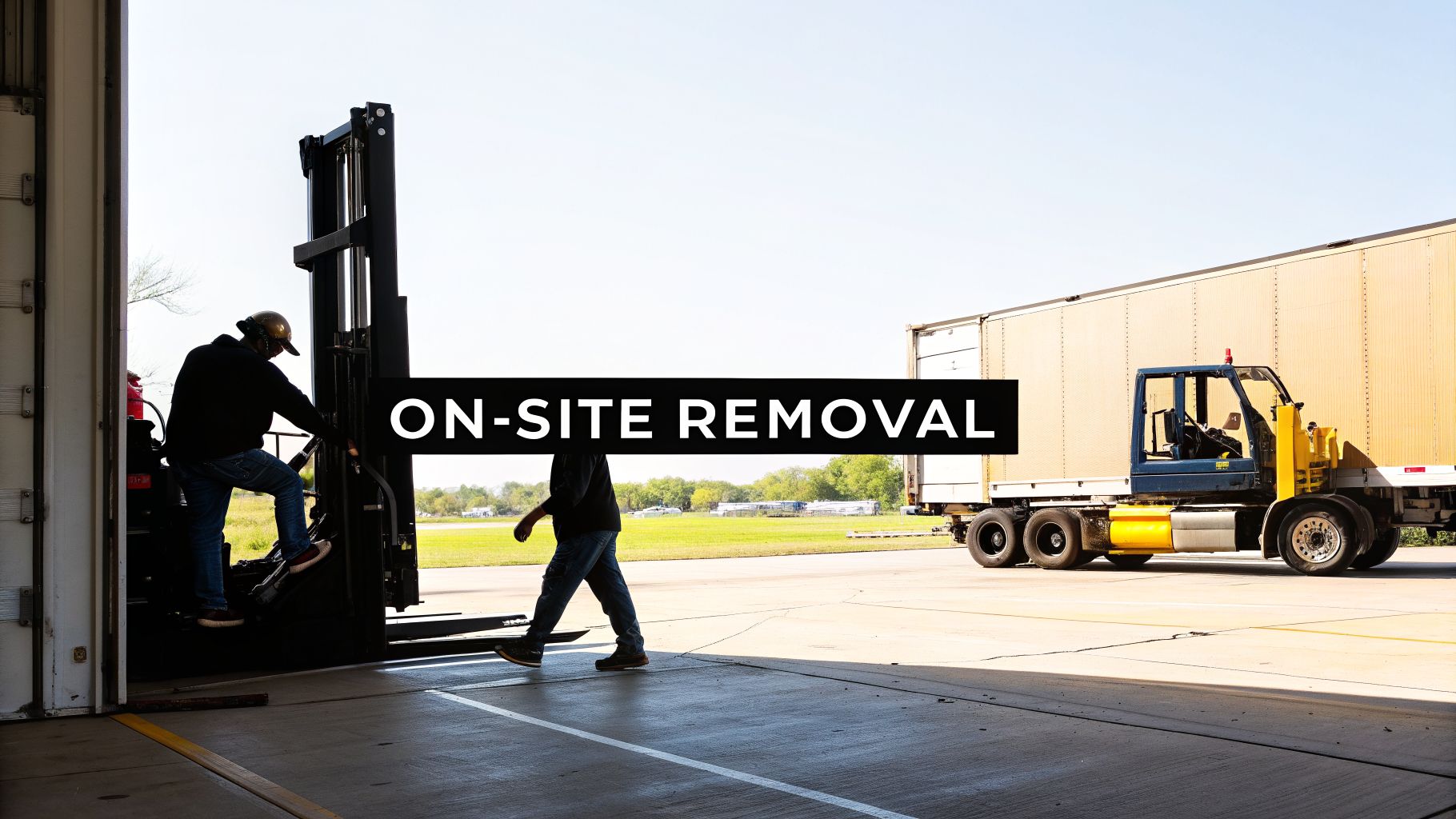
After all the planning, inventory lists, and compliance checks, removal day is finally here. This is where the rubber meets the road—and where your choice of an obsolete factory equipment removal services partner really shows its worth.
A professional crew won't just show up and start unbolting things. They arrive with a specific playbook for every single asset. They know which machines need a delicate touch, which ones require heavy-duty rigging, and exactly how to maneuver around your active production lines to keep your business running, whether you are in a dense urban center like Los Angeles or a remote industrial park.
The On-Site De-Installation Process
The de-installation itself is a carefully choreographed operation. First things first: protecting your facility. This means laying down heavy-duty floor protection, securing doorways, and establishing clear, safe corridors for moving tons of machinery.
Crews bring in the right tools for the job, from plasma cutters that slice through old steel supports to high-capacity dollies and machine skates for navigating tight spaces. Each piece of equipment is methodically disconnected from utilities, drained of all fluids, and prepped for transport, all following the project plan.
A dedicated on-site project manager isn't a luxury; it's a necessity. This person is your single point of contact, acting as the crucial link between the removal crew and your team. They give real-time updates, solve problems on the fly, and ensure the whole operation doesn't throw a wrench in your daily business.
This coordinated approach is absolutely critical, especially in complex or sensitive industrial environments. You can see how this process is tailored for different settings in our guide on manufacturing equipment cleanout services.
Managing Complex Transportation and Logistics
Once a machine is safely de-installed and on the ground, the logistics puzzle begins. We’re not just talking about loading a few pallets. This phase often involves coordinating several different types of trucks and making sure every single asset is tracked from your facility to its final destination, nationwide.
For exceptionally large or heavy pieces of obsolete equipment, using specialized drop deck trailers is often the only safe and efficient way to get them on the road. These trailers are built specifically for the oversized loads that standard flatbeds just can't handle.
Let's imagine a corporate data center shutdown with sites in both downtown Atlanta and a suburb like Alpharetta. A national provider with its own fleet would manage this by:
- Coordinating Pickups: Trucks are scheduled to arrive at each location on a strict timeline, preventing chaos and bottlenecks at your loading docks.
- Maintaining a Secure Chain of Custody: As each asset is loaded, it's scanned and cross-referenced with the master inventory. This creates an unbroken, documented chain of custody—a must-have for compliance and asset tracking.
- Using Flexible Routing: Having their own fleet allows the provider to consolidate shipments at a central processing facility, which is far more secure and efficient than juggling multiple third-party freight carriers.
This level of control ensures every item, from a single server rack to a massive manufacturing press, is fully accounted for on its journey. The focus on documented, sustainable disposal is a major force in the industry.
In fact, the Factory Equipment Dismantling Services market was valued at USD 2.5 billion in 2024 and is expected to hit USD 4.8 billion by 2033. This growth is fueled by a corporate push for sustainability, increasing the demand for certified partners who can prove they are minimizing environmental impact. You can read more about the factory equipment dismantling services market to see how these trends are shaping the industry, particularly where technical complexity and regulations intersect.
Finalizing Your Project with Documentation
Getting the old equipment off your factory floor feels like a huge win, but the job isn't quite done. The last, and frankly most critical, phase of any obsolete factory equipment removal services project is getting the paperwork right. This documentation is your legal shield, the definitive proof that you handled everything responsibly and officially closed the loop on every asset.
Without this final step, you're leaving your company open to some serious headaches down the road. The goal here is simple: receive a complete package of documents that creates a clear, unbreakable audit trail for every single piece of equipment that left your facility, no matter where it was located.
Tracing the Final Journey of Your Assets
Once your equipment hits a certified processing facility, its final chapter begins. Technicians get to work, systematically sorting everything. They separate the gear with resale potential from the items that are purely destined for materials recovery.
The recycling process itself is a masterclass in industrial efficiency.
- Commodity Recovery: Machines are methodically broken down into their core components. Valuable materials—steel, aluminum, copper, and even precious metals—are carefully harvested. These raw commodities are then reintroduced into the supply chain, which helps cut down on the need for virgin materials.
- Hazardous Component Management: Anything containing hazardous materials, like mercury switches, old lead-acid batteries, or refrigerants, is immediately segregated. These parts are passed to specialized teams who follow strict EPA protocols to the letter, preventing any environmental contamination.
This meticulous breakdown diverts tons of industrial waste from ending up in landfills, ensuring your old equipment is handled the right way.
The Certificates That Serve as Your Shield
After all the processing is finished, your removal partner is obligated to provide official documentation. These certificates are not optional—they are your official, permanent record of compliant disposal.
A Certificate of Disposal or Recycling is more than a receipt; it is your legal proof that you have met your cradle-to-grave responsibility for your assets. In the event of an audit by a regulatory agency, this document is your primary evidence of due diligence.
For any equipment that had hard drives or other data storage, you must also get a Certificate of Data Destruction. This isn't just a generic form; it should list the serial number of every single drive that was sanitized or physically shredded. You can check out a detailed guide on what to look for in a Certificate of Destruction template to really understand its importance.
Closing the Loop with Final Reporting
The final piece of the puzzle is the asset reconciliation report. This document ties everything together, matching every item from your original inventory list to its final outcome—whether it was resold, recycled, or disposed of. If any assets were sold, this report will also break down the revenue generated and show how it was credited back against your project costs.
This final documentation package gives you complete transparency and, more importantly, peace of mind. It's the confirmation that your project was handled professionally from start to finish. The demand for these certified processes is booming, a fact reflected in the market itself. The global Plant and Heavy Machinery Dismantling Services market hit US$11.1 billion in 2024 and is on track to reach US$14.6 billion by 2030. This growth shows a clear industry-wide shift toward professional, documented removal protocols. You can read the full research on this expanding market to see the momentum for yourself.
Answering Your Questions About Equipment Removal
After years of handling factory and lab cleanouts, we've heard just about every question in the book. Whether you’re shutting down a single lab in Atlanta or coordinating a complex, multi-state decommissioning, the core concerns are usually the same. Here are some straightforward answers to the questions we get asked most often.
Breaking Down the Cost of Equipment Removal
There’s no flat rate for a project like this. The final number really comes down to a few key variables, and understanding them helps you see the whole picture.
The main cost drivers we see are:
- Volume and Type of Equipment: A few small lab benches are one thing. A 50-ton industrial press is another. The weight, size, and complexity of the machinery are huge factors.
- On-Site Location and Accessibility: Is the gear on the ground floor right by a loading dock? Or is it stuck in a basement with no freight elevator? Tough access means more labor and specialized rigging equipment, which impacts the cost.
- Hazardous Materials: Anything containing refrigerants, oils, PCBs, or other chemicals needs special handling and disposal. This adds layers of compliance work and cost to the project.
- Transportation Distance: The mileage from your site to a processing or recycling facility plays a role. Working with a national provider offers efficiency for multi-state projects, while a local Atlanta-area partner provides cost advantages for projects inside the metro area.
But costs are only half the story. The other, more important half is the value we can get back for you.
A true partner in this process won’t just hand you a bill; they’ll give you a complete financial breakdown. This means a transparent quote for the removal services next to a detailed valuation of your recoverable assets. In many cases, the money from selling valuable equipment can seriously offset or even completely cover the project's cost.
How Do You Guarantee Data Is Secure on Old Lab and IT Gear?
This is non-negotiable for us. For any piece of equipment that has ever touched sensitive information—whether it's patient data in a lab or financial records on a server—just hitting "delete" is nowhere near enough.
We follow a strict, documented process for total data destruction.
- DoD 5220.22-M Sanitization: If a hard drive is functional and has resale value, we use a software-based wipe that overwrites the entire disk three times with random data. This method meets the Department of Defense standard.
- Physical Shredding: This is the ultimate guarantee. For drives that are dead on arrival or when a client needs absolute certainty, we physically shred them into tiny, confetti-like metal fragments. There's no coming back from that.
When the job is done, you receive a Certificate of Data Destruction. This document is your proof for any audit, listing every single drive we destroyed by its unique serial number. It’s essential for meeting compliance standards like HIPAA.
How Long Does a Typical Removal Project Take?
The timeline can swing wildly depending on the job's scope. While it's impossible to give one answer, we can offer a general idea based on project size.
| Project Type | Estimated Timeline | Key Factors |
|---|---|---|
| Small Lab Cleanout | 1-2 days | A few benches, centrifuges, and small electronics. |
| Full Department Removal | 3-5 days | Multiple rooms with larger equipment and IT assets. |
| Complete Factory Decommissioning | Several weeks or months | Extensive de-installation, heavy rigging, and complex logistics. |
The timeline always comes down to the amount of equipment, your building’s access, and your own operational schedule. A professional team will work with you to map out a detailed plan that causes the least disruption, whether it's a one-day job in Norcross or a phased, multi-week project across several states.
Can We Actually Get Money Back for Our Old Equipment?
Yes, absolutely. This is probably the most overlooked part of the equipment removal process. While a lot of old machinery is destined for the scrapyard, many other items still have real value on the secondary market.
This is especially true for:
- Newer or well-maintained laboratory instruments.
- Specialized manufacturing or production machinery.
- Bulk IT assets like servers, networking gear, and storage arrays.
A good partner will perform a thorough asset valuation during the initial walkthrough to spot these valuable items. They'll then handle the entire resale process for you, offering either a direct buyout or a credit applied right to your project invoice. This can turn what you thought was a costly headache into an unexpected financial win.
When you’re ready to tackle your next facility cleanout or lab decommissioning, trust the experts at Scientific Equipment Disposal. We provide secure, compliant, and sustainable solutions for businesses throughout the Atlanta area and across the nation. Visit us online to schedule your free project assessment.