Your Free Certificate of Destruction Template and Guide

A certificate of destruction template is your starting point for creating a legally defensible document that proves sensitive data or physical assets are gone for good. Think of this official record as your auditable proof—the document that protects your organization from compliance headaches and the nightmare scenario of a data breach, whether you're a local business in Atlanta or a nationwide corporation.
Why a Certificate of Destruction Is Non-Negotiable
A Certificate of Destruction (CoD) is much more than a simple receipt for disposed assets; it's a critical shield for your business. In a world where one lost hard drive can trigger crippling fines and destroy your reputation, this document serves as your definitive proof of due diligence. It officially closes the loop on an asset's lifecycle, turning a potential liability into a documented, secure conclusion for companies across the USA.
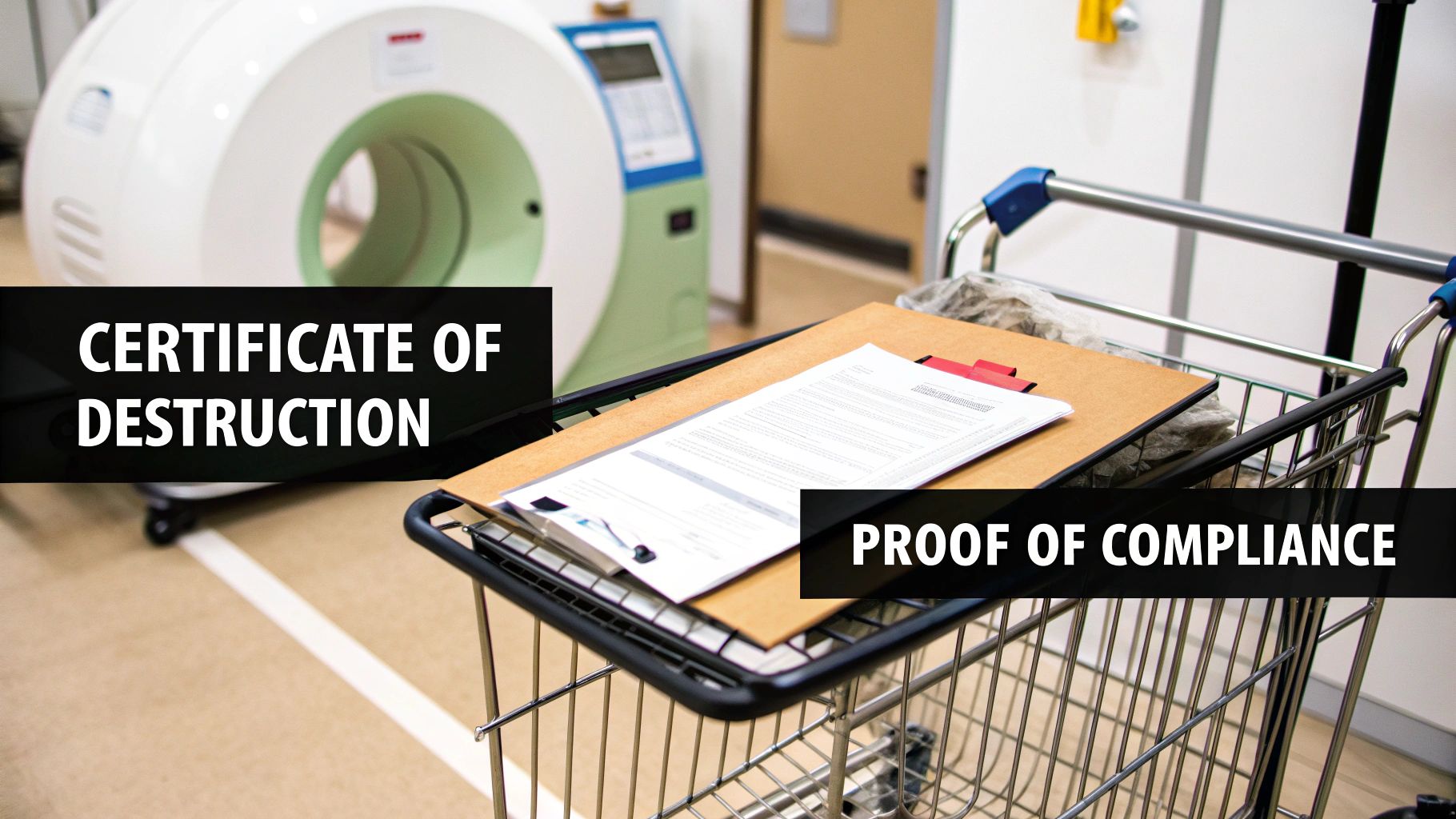
Without this verifiable paper trail, you have no way to prove that confidential information was handled correctly. That leaves your organization dangerously exposed. This isn't just a hypothetical problem; the consequences are very real and can be severe.
The Real-World Risks of Improper Disposal
Picture a healthcare clinic in Atlanta retiring old diagnostic equipment. Those machines are packed with hard drives full of protected health information (PHI), all governed by the strict rules of HIPAA. If they just send that equipment to a standard recycler without certified data destruction, they're sitting on a compliance time bomb.
If that data ever gets out, the clinic could be facing:
- Crippling HIPAA Fines: Penalties for HIPAA violations can soar up to $1.5 million per year for each violation category. That’s a massive financial blow for any organization.
- Costly Data Breach Lawsuits: Patients whose data is compromised can launch class-action lawsuits, dragging you into years of expensive legal fights and settlements.
- Lasting Reputational Harm: The loss of patient trust is often the worst part. It leads to a decline in business that can be incredibly difficult, if not impossible, to recover from.
A meticulously completed CoD provides the indispensable, auditable record you need to show you protected this information every step of the way. It proves the "who, what, when, where, and how" of the entire destruction process, from local facilities to national operations.
Your Legal Proof of Due Diligence
In any audit or legal investigation, the burden of proof falls squarely on your organization. A professionally executed Certificate of Destruction is your primary evidence. It confirms you followed established protocols for data sanitization and asset disposal, meeting both your legal and ethical obligations.
This document is your frontline defense against claims of negligence. It’s the formal attestation that you took deliberate, verifiable steps to prevent sensitive data from falling into the wrong hands, whether you're in Atlanta or anywhere nationwide.
This demand for verifiable proof is fueling massive market growth. The global hard drive destruction service market was valued at USD 1.65 billion in 2024 and is projected to skyrocket to USD 5.05 billion by 2035. This boom is driven by regulations like GDPR and HIPAA that require documented proof of secure disposal, making a CoD an essential compliance tool for businesses everywhere.
Creating a Document with Authority
A certificate's value is only as good as its credibility. The information has to be precise, the signatures must be legitimate, and the process it documents needs to be ironclad. It's helpful to understand how to make a certificate people value because its legal weight and trustworthiness depend on it.
When the CoD is issued by a certified third-party vendor, it gains an extra layer of authority. This provides independent validation that will stand up to the toughest scrutiny. To dig deeper into compliant methods, you might be interested in our guide on the principles of secure data destruction. This added assurance is exactly why partnering with a professional service is often the smartest move for guaranteeing compliance.
How to Use and Customize Your Free Template
Having a solid certificate of destruction template is your first move toward building an unbreakable chain of custody. To get you started, we're providing a free, professionally formatted template that you can download right now in both Word and PDF formats. Think of this not as just a blank form, but as a reliable foundation for creating the official, auditable records your organization depends on.
You can grab your free templates right here:
- [Download Your Free Certificate of Destruction Template – Word Doc]
- [Download Your Free Certificate of Destruction Template – PDF]
These files are made to be universally compatible. You can easily open and edit the .docx file in Microsoft Word, pop it into Google Docs for team collaboration, or tweak the PDF with any standard editor like Adobe Acrobat.
Creating Your Company’s Master Template
Before you start documenting specific destruction jobs, spend five minutes setting up a branded master version. Trust me, this one-time task will save you a ton of time down the road and makes sure every document you issue looks professional and consistent. It’s a small step that really reinforces the document's official weight.
Just open the template and drop your company’s logo into the header. Next, plug in your standard business information—the official company name, physical address, and main phone number. This simple act transforms the generic file into a document that's unmistakably yours.
Save this customized version as your “Master CoD Template.” This simple step prevents you from having to re-enter your company details every single time and dramatically cuts down on the chances of typos or inconsistencies slipping through.
Once that master template is saved, you're all set to create certificates for individual destruction events. A little prep work beforehand makes the whole process run smoothly.
Information to Gather Before You Begin
To complete the certificate accurately, you’ll need a few key details about the assets and the service itself. Keeping this checklist handy prevents last-minute scrambling and ensures every critical field is filled out correctly from the get-go.
- Asset Identifiers: For every single item, you need the serial number, your internal asset tag number (if you use one), and the make and model. Vague descriptions like "10 laptops" are a huge compliance red flag.
- Service Details: Pin down the exact date the destruction will happen and the location—whether it’s on-site at your facility in Atlanta or at a secure off-site plant nationwide.
- Personnel Information: Know who from your company will authorize the release of the assets and who from the disposal service will be receiving them.
Having these details ready turns filling out the certificate from a chore into a quick, methodical task. It all comes back to understanding the entire asset lifecycle. You can learn more about our process and how we handle equipment from pickup to final certification right here.
After getting your Certificate of Destruction process locked down, you might also find value in exploring a wide range of form templates to streamline other administrative tasks in your organization.
Filling Out the Certificate Field by Field
Taking a blank certificate of destruction template and turning it into a bulletproof legal document is all about getting the details right. Every single field on that form matters—they work together to build an unbroken chain of custody that’s legally defensible. This isn't just about good paperwork; it's how you create an indisputable record that protects your organization, whether you're at your Atlanta headquarters or a satellite office across the country.
Let's walk through a real-world scenario. Imagine the IT department at a local university is decommissioning a server rack that held sensitive student records and research data. They have to nail every detail on the certificate to sidestep any future compliance headaches.
The process is straightforward once you get the hang of it.
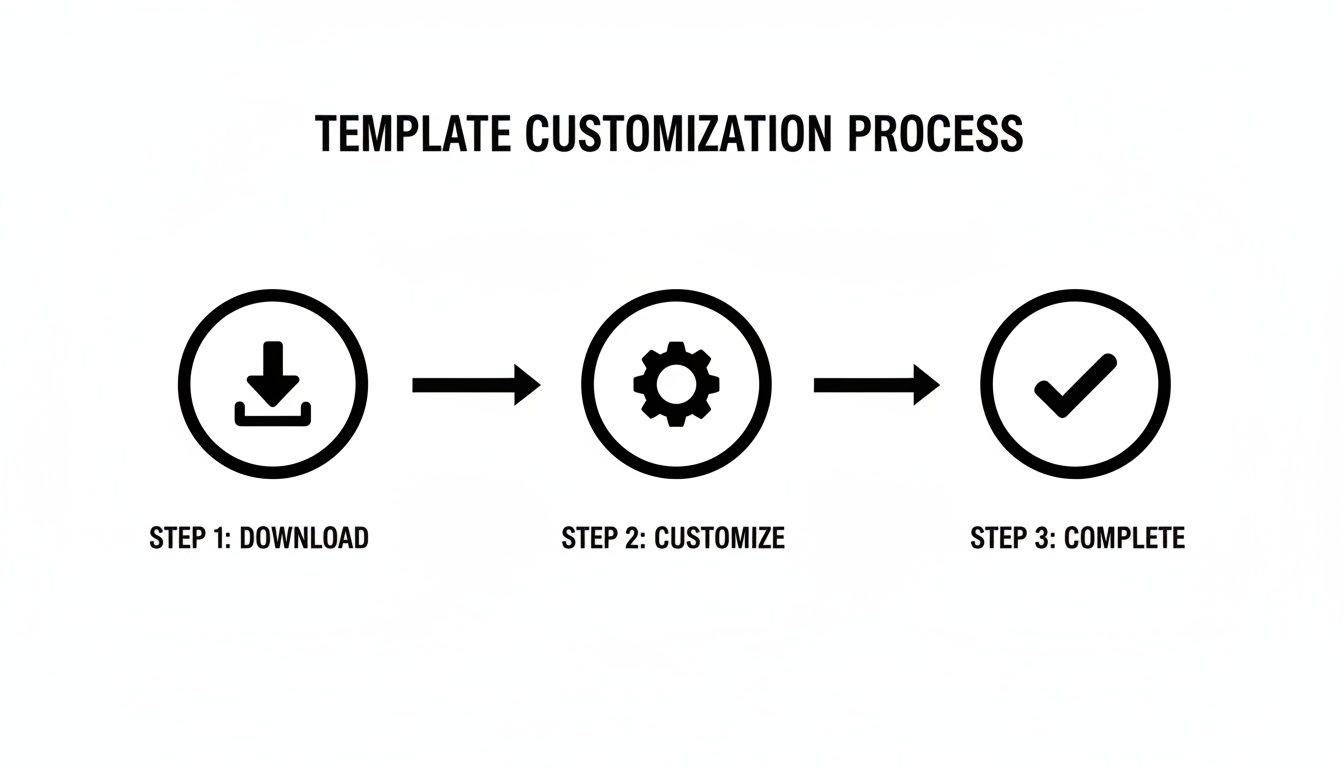
As the graphic shows, it boils down to three simple actions: download the template, add your branding, and then fill in the specifics for that particular job. This keeps everything consistent and accurate.
Essential Fields on a Certificate of Destruction
To make this crystal clear, let's break down the most critical fields you'll find on any compliant certificate. Getting this information correct is non-negotiable for creating a document that will stand up to scrutiny during an audit.
| Field Name | What to Include | Compliance Importance |
|---|---|---|
| Custodian Information | Your organization's full legal name, department, address, and the name/title of the authorized person releasing the assets. | Establishes the origin of the assets and the start of the chain of custody. |
| Receiving Agent Info | The full legal name, address, and contact details of the company taking possession of the assets for destruction. | Documents the formal transfer of liability and responsibility for the equipment. |
| Asset Description | A detailed inventory including item type, manufacturer, model, serial number, and any internal asset tags. | Provides irrefutable proof of exactly which items were destroyed, preventing ambiguity. |
| Method of Destruction | A specific description of the process, like "Physically shredded to 2mm particle size" or "Degaussed and pulverized." | Proves that you met industry-specific data security standards (e.g., DoD, NAID). |
| Date & Location | The exact date and physical location where the destruction took place (e.g., on-site or at a secure facility). | Provides a clear timeline and geographic context for the destruction event. |
| Signatures | Dated signatures from authorized representatives of both the custodian and the receiving agent, including their printed names and titles. | Legally validates the document, turning it into a formal attestation of the facts. |
Think of these fields as the building blocks of your legal protection. A missing serial number or a vague destruction method can create a weak link that an auditor could easily challenge.
Documenting the Handover: Custodian and Receiving Agent
First things first, we need to clearly state who is handing over the assets and who is taking them. This is the official starting point for your chain of custody.
The Custodian Information section is for your organization. Don’t just put the university's name—be specific. You need the full legal name, the exact department (like "University IT Services"), the physical address, and the name and title of the person authorized to release the equipment.
For our university example, it would look like this:
- Custodian: State University System – IT Department
- Address: 123 University Drive, Atlanta, GA 30303
- Authorized By: Jane Doe, Director of IT Infrastructure
Next up is the Receiving Agent Information. This identifies the professional service taking control of your assets. It must include their full company name, address, and the name of the representative who is physically accepting the items. This action confirms the legal transfer of liability.
Describing Assets with Unmistakable Clarity
This is where so many certificates go wrong. A lazy description like "3 servers" is a massive compliance red flag. If you want this document to hold up under pressure, every single asset needs a unique, detailed identifier. An incomplete asset list can invalidate the entire certificate during an audit.
Your Asset Description should function as a meticulous inventory. For maximum legal protection, especially with a long list, it's common practice to attach it as a referenced appendix.
Each item on the list must include:
- Item Type and Manufacturer: Get specific. Think "Dell PowerEdge R740 Server," not just "server."
- Serial Number: This is the absolute most important identifier. It's the unique number from the manufacturer and the gold standard for tracking.
- Internal Asset Tag: If your organization uses its own inventory tags, include that number here. It creates a bridge back to your internal asset management records.
A strong certificate proves precisely which assets were destroyed, leaving no room for interpretation. If an auditor ever questions the disposal of a specific server, you can point directly to the line item with its unique serial number.
Specifying the Destruction Method and Details
Documenting how the assets were destroyed is just as crucial as documenting what was destroyed. This section delivers the concrete proof that you met the required data security standards for your industry, whether that's HIPAA, FACTA, or something else.
The Method of Destruction field has to be explicit. Vague terms like "Destroyed" or "Sanitized" won't cut it.
- For hard drives and other data storage, a compliant entry would be: "Physically shredded to 2mm particle size in accordance with NAID AAA standards."
- Another highly secure method is: "Degaussed using an NSA-approved degausser, followed by physical shredding."
This level of detail is non-negotiable. If you want to learn more about the technical side of things, check out our guide to professional hard drive shredding.
Finally, you have to lock in the timeline and location. The Date of Destruction and Location of Destruction (e.g., "On-site at 123 University Drive" or "At the S.E.D. secure facility in Norcross, GA") provide the essential when and where for the entire event.
Finalizing with Authorizations and Signatures
A certificate is just a piece of paper until it’s signed. The signatures are what officially transform the document from a simple inventory list into a formal, legally binding attestation. This final step establishes personal accountability and validates the whole process.
You need signatures from both parties involved.
- Custodian Signature: This comes from the authorized representative at your organization who either witnessed the destruction or released the assets for destruction—in our scenario, Jane Doe.
- Receiving Agent Signature: This is from the professional at the destruction company who performed or supervised the job.
Every signature must have the person's printed name, official title, and the date it was signed. This creates a clear, accountable record that solidifies your Certificate of Destruction as irrefutable proof of proper disposal.
Navigating HIPAA and Data Security Compliance
For organizations in healthcare, finance, and government, a certificate of destruction is far more than just a piece of paper—it’s a cornerstone of your entire compliance strategy. When you’re handling protected health information (PHI) or other sensitive data, your disposal methods are rightfully under a microscope. This document is your hard proof that you’ve met the strict requirements of regulations like the HIPAA Security Rule.
The link is direct: HIPAA requires covered entities to have clear policies for the final disposition of electronic PHI and the hardware it lives on. Your Certificate of Destruction acts as the official, auditable record showing you followed those procedures to the letter.
Decoding Data Sanitization Standards
When you fill out the "Method of Destruction" section on a certificate, you aren't just describing a task; you're attesting to a specific technical standard. Two of the most common and respected standards in the U.S. are NIST SP 800-88 and DoD 5220.22-M. Understanding what these mean is non-negotiable for any serious organization, from a hospital in Atlanta to a nationwide financial firm.
- NIST SP 800-88: The National Institute of Standards and Technology provides the definitive guide for media sanitization. It outlines three methods: Clear, Purge, and Destroy. "Purge" makes data recovery practically impossible even with state-of-the-art lab techniques, while "Destroy" makes it physically impossible through shredding, incineration, or disintegration.
- DoD 5220.22-M: This Department of Defense standard is famous for its "3-pass wipe" method. The process overwrites all data on a hard drive three separate times with different patterns of ones and zeros, effectively turning the original information into digital gibberish.
Documenting that you used a "DoD 5220.22-M 3-pass wipe" on your certificate provides definitive proof of secure media sanitization, satisfying a core compliance mandate.
Wiping vs. Shredding: The Critical Difference
Choosing the right destruction method is a crucial decision that directly impacts your compliance posture and asset management strategy. The choice really boils down to one question: what's the future of the physical hardware?
Data Wiping (Sanitization) is the answer for assets you plan to reuse, resell, or donate. A 3-pass wipe using DoD standards renders the data unrecoverable while leaving the physical hard drive intact and ready for a new life. This is a common move for IT departments upgrading employee laptops or decommissioning servers that still hold some value.
Physical Shredding is the only way to go for end-of-life media. If a hard drive is obsolete, failing, or physically damaged, wiping just isn't an option. Shredding the drive into tiny, confetti-like pieces ensures the data can never, ever be reconstructed. It's the ultimate final step. For a closer look at how this works, our guide to secure hard disk disposal breaks it down.
Your Certificate of Destruction has to accurately reflect the method used. A mismatch—like documenting a wipe for a drive that was actually shredded—can create serious red flags during an audit.
Staying Ahead of Evolving Regulations
The rules around data destruction are constantly shifting, which makes proper certification more complex than ever. For example, the transition from NIST SP 800-88 Revision 1 to Revision 2 suddenly made 22% of existing destruction methods non-compliant, forcing many organizations into expensive equipment upgrades.
For businesses in the Atlanta area serving hospitals or government agencies, a properly formatted certificate that meets federal and state rules is an essential risk management tool. You can find more insights on these demanding data destruction requirements and their global impact.
This complexity really highlights why you need to not just use a template, but truly understand the compliance framework behind it. A Certificate of Destruction is your final word on an asset's lifecycle. By accurately documenting the destruction method and sticking to recognized standards like NIST and DoD, you build a powerful, defensible record that satisfies auditors and protects your organization from the fallout of non-compliance.
When to Partner with a Professional Destruction Service
Using a certificate of destruction template is a great first step for formalizing how you get rid of old assets. But let's be honest, there are times when calling in an expert is not just easier—it’s absolutely essential.
Working with a certified, professional destruction service takes your disposal process from a simple administrative task to an independently validated, audit-proof operation. For any organization that can’t afford to gamble on security, this is the smart move. A pro service lifts the entire logistical and administrative weight off your team's shoulders.
They manage the whole chain of custody from the moment they walk in your door, providing a level of security and detailed documentation that’s incredibly tough to match on your own. This is especially true for businesses in regulated industries, whether you're right here in Atlanta or operating across the country.
Gaining an Unbreakable Chain of Custody
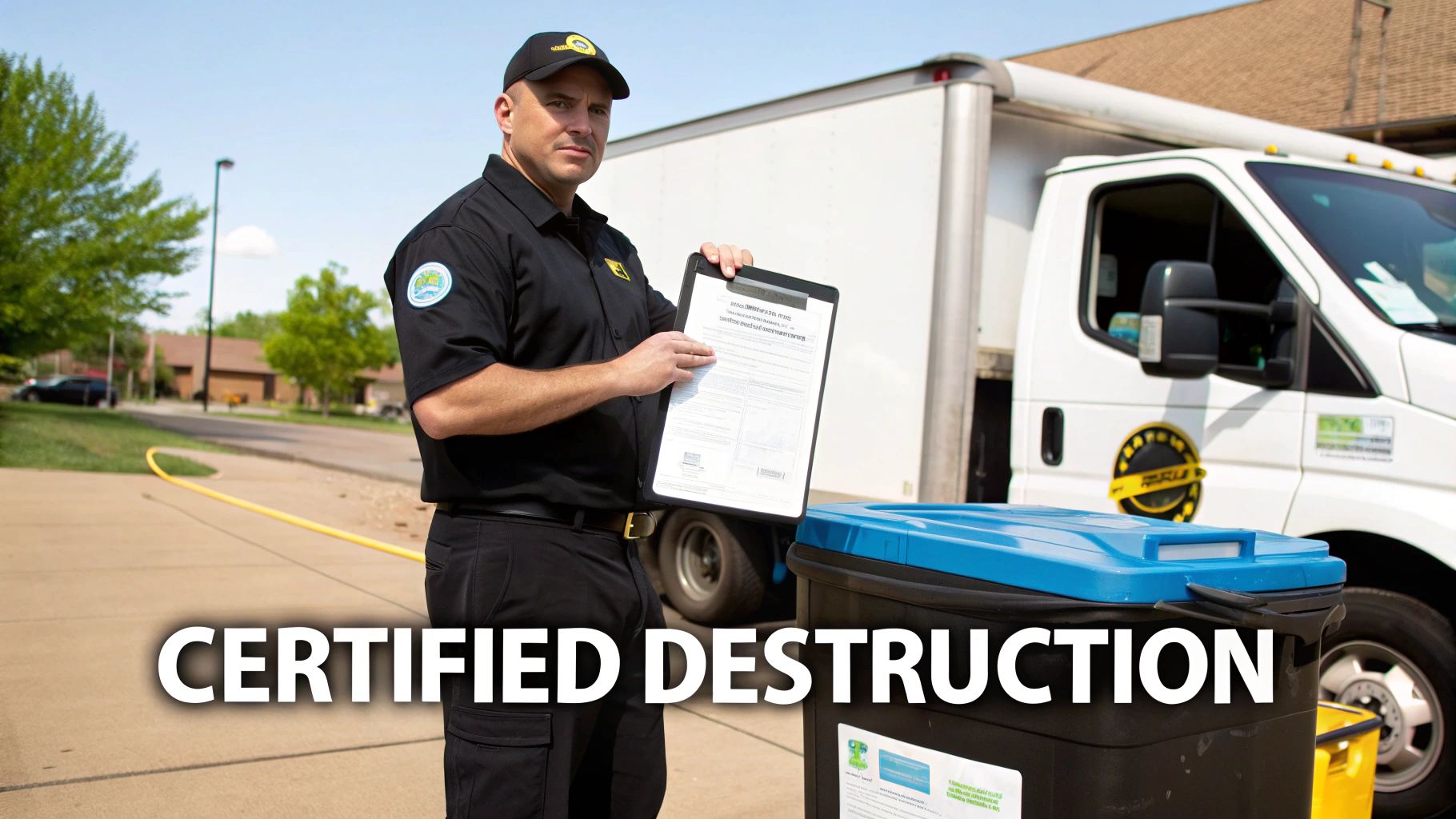
The second a certified vendor arrives at your facility, the chain of custody begins. The whole process is meticulous, designed from the ground up for maximum security and accountability.
- Secure On-Site Pickup: Trained, uniformed technicians show up in GPS-tracked vehicles to collect your assets. Everything is immediately placed into locked, tamper-evident security bins before it even leaves your office.
- Detailed Asset Tagging: Every single piece of equipment gets scanned and inventoried right there on-site. This creates a real-time manifest that ties the serial numbers from your gear directly to the work order, leaving zero room for anything to go missing.
- Final Destruction and Certification: Your assets are then transported to a secure, access-controlled facility for destruction. Once the job is done, the service issues a formal, serialized Certificate of Destruction that breaks down the entire process.
This seamless, fully documented journey from your office to final destruction is what makes professional services so powerful.
The Power of Third-Party Validation
Look, a certificate you create yourself is a decent internal record. But a CoD issued by a certified, independent third party? That carries serious legal weight. It acts as an impartial confirmation that your assets were destroyed following industry best practices and all relevant regulations.
An auditor will always give more credibility to a professionally issued certificate because it’s validated by an unbiased expert. That independent verification can be the one thing that proves your due diligence and helps you sidestep hefty non-compliance fines.
This is non-negotiable in sectors like healthcare and finance, where a data breach can be catastrophic. In fact, a 2023 report noted that 78% of organizations in North America and Western Europe now require formal destruction certificates for asset disposal. The trend is clear: verifiable, third-party proof is becoming the standard.
Beyond the Template to Guaranteed Compliance
At the end of the day, a template is just a tool to keep things consistent. A certified partner, on the other hand, is your guarantee of compliance. Real security isn't just about having a signed paper; it's about knowing a verifiable, audited process backs up every signature on that certificate. You can get into the nitty-gritty of hardware disposal by reading our guide on professional computer shredding services.
When you bring in an expert, you’re not just documenting destruction—you're ensuring it’s done right, done securely, and done in full compliance with the law. This approach turns a potential liability into a documented, secure conclusion, freeing up your team to focus on what they do best while the experts handle the critical work of end-of-life asset management.
Common Questions About Destruction Certificates
As you start using your certificate of destruction template, some real-world questions are going to pop up. Getting straight answers is the key to managing your asset disposal with confidence. Let's walk through the most common questions we hear from organizations here in Atlanta and across the country.
How Long Should We Keep a Certificate of Destruction?
This is one of the most critical questions for staying compliant over the long haul. While your own internal policies might have different requirements, the widely accepted best practice is to hang onto Certificates of Destruction for a minimum of six years.
This is especially true if you're dealing with compliance frameworks like HIPAA. That six-year window ensures you have a complete and accessible audit trail if a legal question or compliance check ever comes up, even years after the equipment is long gone. Many professional services, including ours, maintain secure digital copies for clients, which adds a great layer of backup for your essential records.
The Difference Between Destruction and Recycling Certificates
It’s easy to mix these two up, but they serve completely different—and equally important—purposes. They are definitely not interchangeable. For total compliance, you often need both.
- Certificate of Destruction: This document is all about data security. Think of it as legally defensible proof that the sensitive information on a device was permanently wiped or physically destroyed, making it impossible to recover.
- Certificate of Recycling: This one focuses on environmental responsibility. It confirms the physical hardware—the plastic, metal, and circuit boards—was processed and recycled according to all local, state, and federal e-waste rules, keeping hazardous materials out of landfills.
A truly thorough asset disposition partner will provide you with both documents. This gives you the complete compliance package, proving you met your obligations for both data privacy and environmental stewardship.
Can I Just Create My Own Certificate?
You can, but it’s a risky move. A professional template or a certificate issued by your vendor is designed to include all the legally required fields that auditors look for.
If you miss a single key detail, the entire document could be invalidated during a compliance check. Things like:
- The specific destruction method used (e.g., DoD 5220.22-M wipe)
- A complete chain-of-custody signature block
- Unique asset identifiers like serial numbers
…are non-negotiable. Forgetting one of them could leave you without the proof you need to show you did your due diligence.
For guaranteed compliance and the strongest legal standing, having an independent, third-party vendor issue the certificate is always the better choice. It provides impartial validation that’s far more credible to an auditor than an internal document.
Are Digital Signatures Valid on These Certificates?
Yes, absolutely. Secure digital signatures aren't just legally valid on a Certificate of Destruction; they're now the industry standard. In fact, they often provide a much stronger chain of custody than a traditional wet signature ever could.
Digital signatures create a clear, time-stamped, and easily auditable trail that’s much harder to forge or dispute. Reputable data destruction services use secure digital systems to manage their paperwork, giving you immediate and secure access to your completed certificates as soon as the job is done. It’s a modern approach that cuts out delays and makes your whole record-keeping process more secure.
When you need absolute certainty that your lab equipment and IT assets are handled securely and sustainably, trust the experts. Scientific Equipment Disposal provides certified data destruction and compliant recycling services for hospitals, universities, and businesses throughout the Atlanta metro area and nationwide. We deliver the peace of mind that comes with a fully documented, audit-proof process.