A Guide to IT Equipment Disposal Services in Lawrenceville GA and Nationwide

When your business needs to get rid of old technology, finding the right IT equipment disposal services in Lawrenceville, GA, is more than just spring cleaning—it’s a critical security and compliance task. For any company in Gwinnett County's busy tech corridor, or even a corporation with facilities across the United States, the partner you choose is your first line of defense, making sure sensitive data is gone for good and old hardware is handled the right way.
It’s about protecting your reputation and your bottom line, both locally and nationally.
Why Smart IT Disposal in Lawrenceville Is Non-Negotiable
As Lawrenceville grows into a major hub for the Atlanta tech scene, businesses are constantly upgrading servers, laptops, and networking gear. But what happens to all the old equipment? All too often, it gets stacked in a storage closet, quietly becoming a huge data security risk and an environmental liability. This same scenario plays out in offices from coast to coast.
Improperly handled IT assets can easily turn into devastating data breaches. Just think about it: a single forgotten hard drive from a decommissioned server could hold thousands of customer records, internal financials, or your company's trade secrets. If that drive falls into the wrong hands, the fallout can be brutal—six-figure fines, a damaged brand, and a total loss of customer trust.
The Hidden Risks of Neglecting Professional Disposal
The threats aren't just digital, either. Electronic waste, or e-waste, is packed with hazardous materials like lead, mercury, and cadmium. When old computers and monitors are just tossed in a dumpster, those toxins can seep into local soil and water, creating a serious environmental problem right here in our community.
This issue is bigger than most people realize. The Atlanta metro area, including Lawrenceville, has become a hotbed for data centers and tech companies, which means we’re generating a massive amount of obsolete equipment every year. This trend is mirrored nationwide. Here's a sobering fact: a mere 12.5% of global e-waste is ever properly recycled. That leaves a staggering amount of hardware that could end up in landfills, creating a huge environmental and data security headache.
From a Cluttered Closet to a Secure Process
This is where a dedicated partner like Scientific Equipment Disposal (S.E.D.) comes in. We turn the headache of IT asset disposition (ITAD) into a secure, compliant, and straightforward process for Lawrenceville businesses and national corporations alike. It’s not just about making space; it’s about putting a critical business function on autopilot to protect your organization.
A professional ITAD strategy has a few key parts:
- Certified Data Destruction: We make sure all data is permanently and verifiably wiped clean using methods that meet strict government and industry standards.
- Responsible Recycling: We stick to a zero-landfill policy, ensuring every component is recycled, refurbished, or repurposed according to all environmental regulations.
- Auditable Chain of Custody: You get detailed documentation that tracks your assets from the moment they leave your office to their final disposition. This is your legal proof of compliance.
For businesses in regulated fields like healthcare, finance, or education, this level of documentation isn't just a good idea—it's a legal requirement. A Certificate of Destruction is your definitive proof that you've done your due diligence to protect sensitive information, valid in any state.
Choosing a professional service for IT equipment disposal services in Lawrenceville, GA, means you're doing more than just getting rid of old hardware. You're actively managing risk, protecting your company's good name, and making a responsible choice for the environment. It’s an essential move for any modern business. With the right strategy, you can upgrade your equipment with confidence, knowing your old assets are in safe hands.
You can also check out our guide on comprehensive recycling in Atlanta, Georgia for more insights.
Vetting IT Disposal Vendors for Security and Compliance
Picking a partner for your IT equipment disposal services in Lawrenceville, GA, is more than just a line item on a budget. It's one of the biggest security decisions you'll make. This isn't about finding someone to haul away old computers; it's about handing over your company's (and your clients') sensitive data. One wrong move here can result in a data breach, leading to massive fines and trust issues that are hard to repair, whether your business is local or national.
You have to look past the sales pitch and really dig into a vendor’s process, certifications, and security. Any company can say they’re secure, but only a certified, transparent partner will show you the proof you need for compliance and peace of mind across all your locations.
Making Sense of the Certification Acronyms
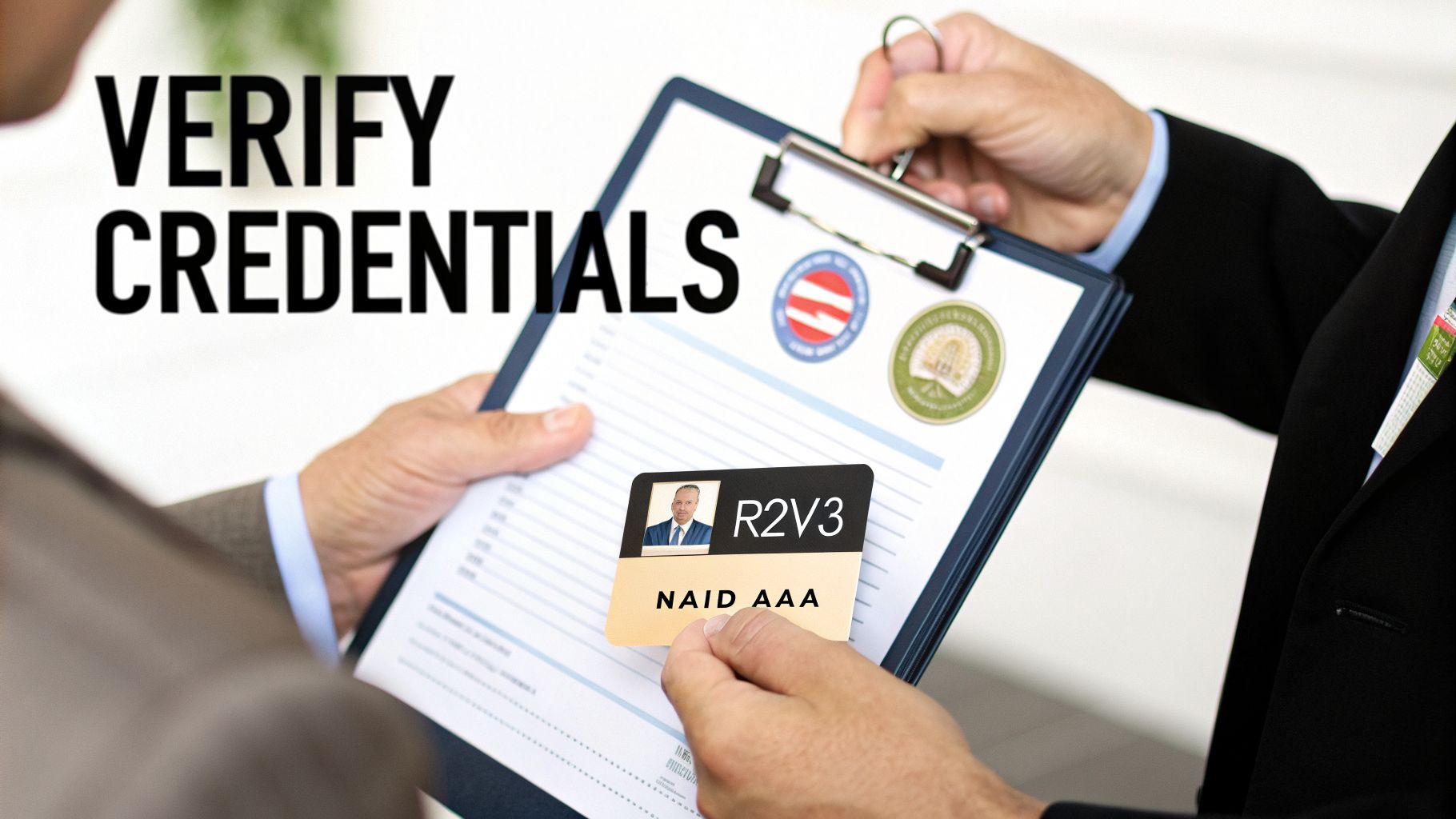
When you start looking at vendors, you'll see a lot of logos—R2, e-Stewards, NAID. These aren't just for show. They represent tough, third-party audits that prove a company is serious about security and handling e-waste the right way.
Here’s a quick breakdown of what to look for:
- R2v3 (Sustainable Electronics Recycling International): This is the gold standard for electronics recycling. An R2v3-certified vendor has demonstrated they meet high bars for environmental safety, worker protection, and data security. It also means they track all your old equipment downstream, so you know it’s not being dumped illegally. This certification is recognized nationwide.
- e-Stewards: This is the toughest environmental certification out there. It’s an absolute guarantee that no hazardous e-waste gets shipped to developing nations. It signals a deep commitment to ethical recycling.
- NAID AAA Certification: This one is all about data destruction. A vendor with NAID AAA certification is subject to unannounced audits to verify everything from employee screening and facility security to their chain-of-custody and data wiping procedures.
Don't just take a vendor's word for it. A legitimate partner will have no problem giving you their certification numbers, which you should always verify on the certifying body's website.
Data Wiping vs. Real Data Sanitization
A huge—and dangerous—misconception we see all the time is thinking that formatting a hard drive is enough to protect data. It’s not. Formatting just removes the pointers to the files, but the data itself is still there and can be recovered with simple tools.
True security comes from data sanitization, a process that completely overwrites the data. For instance, the DoD 5220.22-M 3-pass wipe is a trusted method. This Department of Defense standard writes over the entire drive three separate times, making the original data impossible to recover. If a drive is physically damaged and can't be wiped, it must be physically shredded.
This is non-negotiable for healthcare, financial, and educational organizations in the Lawrenceville area and beyond. Failing to properly sanitize data isn't just a slip-up; it's a direct violation of regulations like HIPAA and SOX, which apply across the country.
Key Questions to Ask Any Potential Vendor
To really understand who you’re dealing with, you need to ask direct questions that cut to the chase. Here are a few must-asks for anyone handling your IT equipment disposal services in Lawrenceville GA:
- Chain of Custody: Can you walk me through your chain-of-custody process from the moment you pick up my assets to their final destruction? How do you track and document everything?
- National Service: Do you offer services nationwide? If we have offices in other states, can you provide consistent service and compliance?
- Employee Security: Do you run background checks and drug screenings on all employees who will handle our equipment?
- Downstream Partners: Who do you work with for downstream recycling? Are they also certified?
- Facility Security: What kind of security do you have at your facility? I’m talking about access controls, 24/7 surveillance, and alarm systems.
- Data Destruction: What happens if a hard drive fails the sanitization process? Is on-site shredding an option?
A professional, trustworthy vendor will have clear, detailed answers ready to go. If you get vague responses or they seem hesitant to share specifics, consider it a major red flag. To see how we approach these issues, you can learn more about our role as a leading e-waste recycling company. Your goal should be to find a partner who acts as a genuine extension of your own security team.
The Reality of Data Destruction and Why It Matters Most
When you hand over old IT equipment to a disposal service here in Lawrenceville, GA, you're not just getting rid of outdated hardware. You’re trusting them with your company's entire digital history. One forgotten hard drive can turn into a massive liability, and the fallout from a data breach involving retired assets is a real and present danger for businesses everywhere.
Let's get specific. Think about a local healthcare practice retiring its patient record systems. If a single hard drive with thousands of electronic health records (EHR) isn't disposed of correctly, the consequences are devastating. We're talking about huge HIPAA violation fines, a shattered reputation, and a total loss of patient trust. This isn't just a hypothetical; it’s a risk every organization with sensitive data faces.
The same goes for a financial firm decommissioning a server that handled client investment data. Even a "wiped" drive, if it wasn't sanitized to professional standards, can have recoverable data fragments. In the wrong hands, this can fuel identity theft, financial fraud, and trigger serious penalties under regulations like the Sarbanes-Oxley Act (SOX) or the Gramm-Leach-Bliley Act (GLBA).
Going Beyond a Simple Drive Wipe
This is exactly why certified data destruction is the cornerstone of any IT disposal plan. Hitting "delete" or formatting a drive is practically useless for security. All that does is remove the signpost pointing to the data, leaving the information itself behind for anyone with basic recovery software to find. Real security requires professional-grade destruction.
At a minimum, a certified partner will use one of two methods to make sure your data is gone for good:
- Multi-Pass Data Wiping: This is a software-based approach that overwrites every part of a hard drive with random data. The gold standard is the DoD 5220.22-M 3-pass sanitization, which essentially buries the original data under three separate layers of digital gibberish. This makes the original info impossible to recover, even with forensic tools.
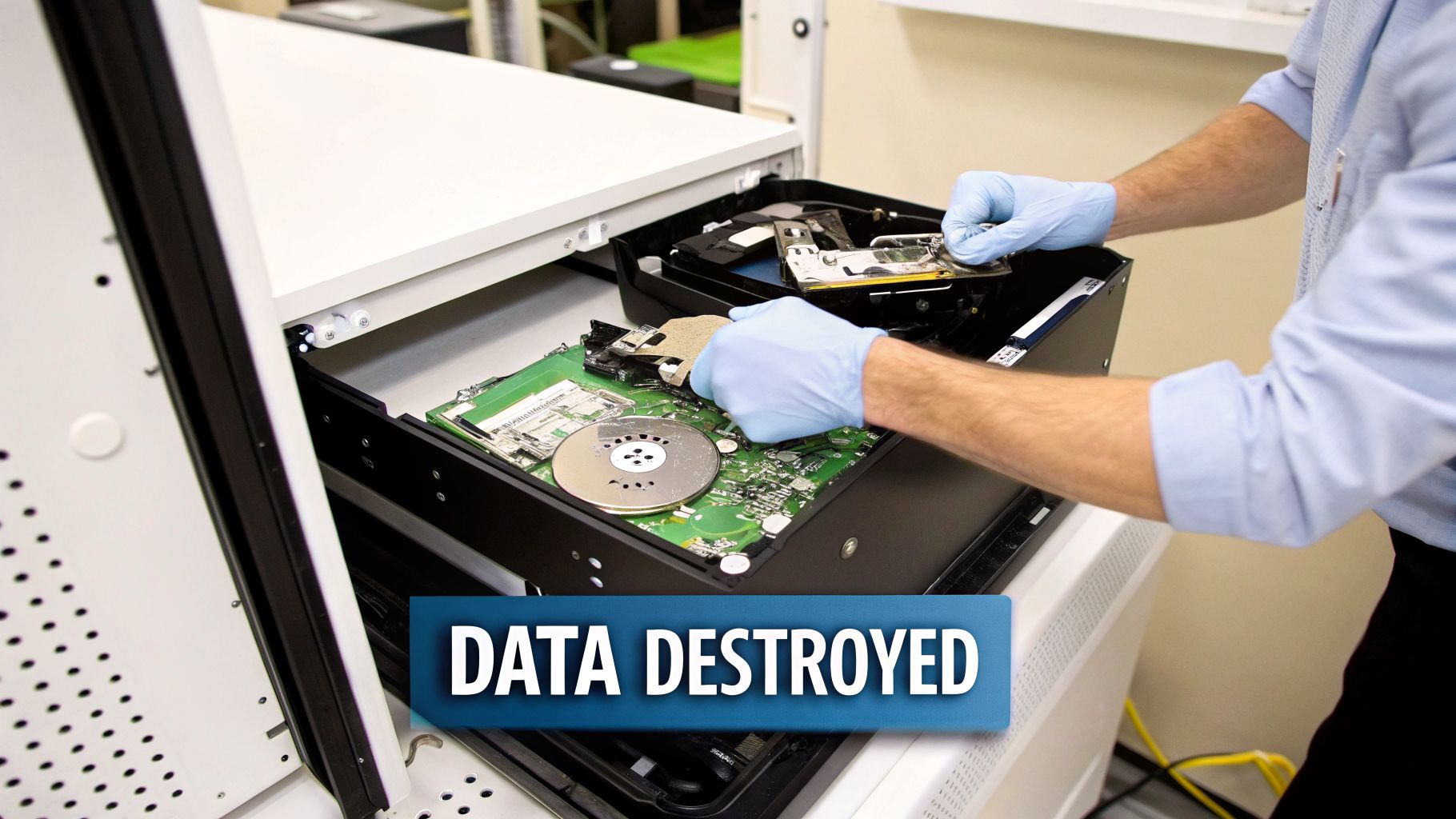
- Physical Destruction (Shredding): For drives that are old, broken, or simply can't be wiped, shredding is the only surefire solution. We feed these drives into industrial shredders that grind them into small, mangled pieces of metal. There’s no coming back from that.
A crucial piece of the puzzle is the documentation you get afterward. A reputable vendor will always provide a serialized Certificate of Data Destruction. This certificate lists the unique serial number of every single drive that was sanitized or shredded, giving you a clear, auditable paper trail to prove you met your compliance obligations.
The Growing Need for Secure ITAD Services
With cyber threats on the rise, data security in IT disposal is more critical than ever. Lawrenceville's role in Gwinnett County—a hub for corporate IT and research—only makes this more urgent. Experts point out that while over 98% of electronics like computers can be recycled by a certified provider, that doesn't account for the sensitive data still sitting on those drives. The global IT asset disposition (ITAD) market is expected to hit $20.6 billion by 2027, growing at a 10.8% CAGR from 2020, largely because of strict regulations like GDPR and HIPAA. You can explore the growth of responsible ITAD practices to see more on this trend.
This explosive growth highlights a simple truth: the cost of a data breach is infinitely higher than the cost of professional disposal. Choosing a certified partner for IT equipment disposal services in Lawrenceville GA is a direct investment in managing your risk. It’s the only way to ensure that when your technology’s life is over, your data's security isn't. To see how we put these principles into practice, you can learn more about secure data destruction and how it protects your organization.
A Practical Pre-Pickup Checklist for Your IT Assets
A smooth, secure disposal process doesn't start when the truck arrives at your Lawrenceville office. It starts with you. Proper preparation is the single best way to prevent last-minute headaches, strengthen your chain of custody, and ensure a seamless handoff, whether you're in Georgia or any other state.
Think of it like preparing to move. You wouldn't just throw everything into random boxes and hope for the best. The same logic applies here. A bit of organization upfront saves a ton of time and cuts down on risk later on. It's a hallmark of professional IT equipment disposal services in Lawrenceville GA.
Create a Simple and Effective Inventory
First things first: you need to know exactly what you’re getting rid of. You don’t need some complex database; a simple spreadsheet will do the trick just fine.
Your inventory should capture a few key details for every single asset:
- Asset Type: (e.g., Laptop, Server, Monitor, Printer)
- Brand and Model: (e.g., Dell Latitude 7490, HP ProLiant DL380)
- Serial Number or Asset Tag: This is your most critical piece of tracking information.
- Location: (e.g., IT Storage Room, Desk #14, Data Center Rack 3)
- Data-Bearing? (A simple Yes/No to flag devices with hard drives or other storage)
This list becomes the foundation for the entire disposal project. It helps the vendor give you an accurate quote and serves as the starting point for all your chain-of-custody documentation.
An accurate inventory is your first line of defense against "asset amnesia," where equipment mysteriously goes missing between your office and the disposal facility. When you can match your list against the final Certificate of Destruction, you create a closed-loop, auditable record.
To help you get organized, we've put together a simple checklist. Use this to track each step as you prepare your equipment for pickup.
Asset Preparation Checklist
| Task | Status (Checkbox) | Notes/Details |
|---|---|---|
| Inventory Created | ☐ | Spreadsheet complete with Asset Type, Model, Serial/Tag, Location, and Data-Bearing status. |
| Assets Segregated | ☐ | Data-bearing devices are physically separated from non-data e-waste. |
| Data Zones Marked | ☐ | Areas are clearly labeled (e.g., "Certified Destruction," "E-Waste Recycling"). |
| Remarketing Items Separated | ☐ | Functional, newer equipment is set aside for value assessment. |
| Physical Path Cleared | ☐ | Hallways, doorways, and loading areas are free of obstructions. |
| Special Logistics Noted | ☐ | Vendor has been notified of heavy items, stairs, or access challenges. |
| Team Notified | ☐ | Your internal team is aware of the scheduled pickup date and time. |
By checking off these tasks, you ensure nothing is overlooked and the pickup crew can work quickly and securely.
Segregate Assets Based on Data Sensitivity
Not all IT equipment carries the same risk. A server that held sensitive customer financials is a world apart from a box of old keyboards or a broken monitor. That’s why separating your assets before pickup is non-negotiable.
Designate distinct, clearly marked areas in your storage room. You can use different colored labels or even painter's tape on the floor to create zones:
- Certified Data Destruction Zone: This spot is exclusively for items with hard drives or storage media—think servers, PCs, laptops, and SANs. These are your highest-risk assets and must be handled accordingly.
- E-Waste Recycling Zone: Use this for all non-data-bearing items. This is where monitors, printers, keyboards, mice, cables, and other peripherals go.
- Asset Remarketing Zone: If you have newer, functional gear that might have some resale value, keep it separate. Your disposal partner can evaluate these for potential value recovery.
This simple act of sorting makes the pickup exponentially faster and drastically reduces the chance of a data-bearing device accidentally ending up in the wrong pile. To see how this fits into the larger process, you can learn more about arranging a free business electronics pickup in Gwinnett County, GA and how to properly prepare.
Prepare Your Physical Space for an Efficient Pickup
Finally, get your physical location ready for the disposal team's arrival. A few small preparations can make a huge impact on how quickly and safely the crew can work.
Clear a path from where the assets are stored to the nearest exit or loading dock. Make sure hallways, doorways, and elevators are completely unobstructed.
If you have especially heavy equipment or items in hard-to-reach places (like a basement or a secured data center), let your disposal partner know ahead of time. This allows them to bring the right tools for the job, whether it's heavy-duty dollies, server lifts, or extra hands. Communicating these details ensures the team shows up prepared, preventing delays and making sure the job is handled professionally from start to finish.
From Pickup to Paperwork: What to Expect from the Disposal Process
So, what actually happens after the truck with all your old IT gear pulls away from your Lawrenceville facility? It's a common point of anxiety for many businesses we work with. But when you partner with a certified ITAD company, the process is far from a black box. It’s a secure, transparent, and highly documented workflow from beginning to end.
The whole thing kicks off the moment you schedule a pickup. A professional provider of IT equipment disposal services in Lawrenceville GA, will coordinate with you to find a time that doesn't throw a wrench in your daily operations. For a small office getting a few new desktops, this might just be a quick one-hour stop. For a full data center shutdown or lab cleanout, we're talking about a more involved plan that could take a few days to execute.
Getting this first step right sets the stage for a smooth handoff. We find that clear communication here is what separates the pros from the rest, especially for organizations around the Atlanta area on tight deadlines for a facility move. They need service that is fast and, more importantly, predictable.
On-Site Logistics and Secure Transport
When the scheduled day arrives, our trained and background-checked technicians show up to manage the collection. This isn't just a "grab and go" job; it's a methodical process. Working from the inventory you prepared, the team will verify the assets and carefully pack everything into secure, sealed containers.
This is the moment the chain of custody officially begins. Every container is sealed and labeled, and all your assets are documented before they even leave your building. From there, the equipment is loaded onto a company-owned, GPS-tracked truck. We don't just move boxes—we maintain a solid, unbroken security trail from your door straight to our processing facility.
The GPS-tracked transport is non-negotiable for real security. It gives us—and you—real-time proof that your assets are on a direct, secure route with no detours or unauthorized stops.
To make sure this handoff goes off without a hitch, there are a few simple but critical things your team needs to do on your end.

Following this simple flow—inventory, segregate, and label—is the key to a seamless and totally secure pickup.
Facility Processing and Final Certification
Once the truck arrives at our secure facility, the container seals are broken and your assets are checked in against the inventory manifest created at your site. This is a crucial reconciliation step to confirm every single piece arrived safely. The equipment is then sorted for its final destination: data destruction, recycling, or remarketing.
Any device that holds data is immediately moved to a secure, restricted-access area for sanitization or physical shredding. After the data is gone for good, we generate the final, and most important, paperwork. You will receive a Certificate of Data Destruction, which itemizes every single hard drive by its serial number, giving you definitive proof that its data has been permanently destroyed in compliance with all regulations.
For assets that are recycled, you'll get a Certificate of Recycling. This document confirms that all materials were processed according to strict R2v3 standards under our zero-landfill policy. These certificates are your legal proof of due diligence. If you want to see what this critical paperwork looks like, check out this sample Certificate of Destruction to know exactly what to expect.
From the moment we arrive on-site to the final certificate landing in your inbox, the entire workflow is built to deliver security, compliance, and total peace of mind for businesses using professional IT equipment disposal services in Lawrenceville GA.
Your Top IT Disposal Questions, Answered for Lawrenceville Businesses
When it's time to clear out old tech, the same questions always pop up for businesses in Lawrenceville and across Georgia. You need clear, straightforward answers about the process, the real costs, and the benefits before you hand over your assets. We've heard them all, so here are the answers you're looking for when considering a certified expert for your IT disposal.
What Kind of Equipment Can You Take?
We get this a lot, especially from our healthcare and university clients. They worry they'll need multiple vendors to handle a full cleanout. The good news is, a single, certified partner can handle a surprisingly diverse range of equipment, well beyond your typical office gear. Whether you're a local business or a national enterprise, a full-service provider should accept everything.
We take a huge variety of assets, including:
- Standard Office & IT Gear: This is the easy stuff. Servers, desktops, laptops, networking hardware like switches and routers, and all the peripherals—monitors, keyboards, you name it.
- Data Center Hardware: We can decommission entire server racks, uninterruptible power supplies (UPS), storage area networks (SANs), and related components from data centers anywhere in the U.S.
- Specialized Lab & Medical Equipment: This is where true expertise matters. We manage complex devices from labs and hospitals, such as centrifuges, incubators, spectrometers, diagnostic imaging machines, and patient monitors. These often have embedded data and require careful handling.
For any university, hospital, or research lab in the Lawrenceville area, having one partner who can manage this entire scope is a game-changer. It simplifies facility cleanouts and decommissioning projects immensely.
How Do I Know Our Company Data Is Actually Destroyed?
This is the big one. Being told your data is gone isn't good enough. You need auditable, legally defensible proof that you've met your compliance duties, whether it's for HIPAA, SOX, or another regulation.
Our process is built on verification. First, every single device that holds data—from a massive server hard drive to a tiny laptop SSD—is inventoried by its unique serial number. From there, each drive is either wiped clean using multipass DoD 5220.22-M standards or physically shredded into tiny, useless fragments.
Once the job is done, you get a serialized Certificate of Data Destruction. This isn't just a piece of paper; it's your official record. It lists every single drive by serial number and confirms it was permanently destroyed. This is the exact proof you need to satisfy an auditor and show you did your due diligence.
What Are the Real Costs Involved?
It helps to think of professional disposal less as a cost and more as a risk management strategy. The price of a certified service is a tiny fraction of what a data breach could cost you—we're talking millions in fines, lawsuits, and a tarnished reputation.
Better yet, the net cost can often be much lower than you think. A lot of newer or high-value equipment might have resale value. We can remarket these assets and return that value to you, which directly offsets the disposal fees. Even older gear has value in its raw materials. This value recovery model works for businesses nationwide, helping to make secure ITAD cost-effective at scale.
Ultimately, making a modest investment in professional IT equipment disposal services in Lawrenceville GA, shields you from catastrophic financial and legal risk. It’s one of the most cost-effective moves your business can make.
How Does This Help Our Company’s Sustainability Goals?
Working with a certified ITAD partner gives you a powerful, documentable win for your corporate social responsibility (CSR) reports. If you're looking to boost your green credentials, this is one of the easiest ways to do it.
The environmental benefits come from two core promises:
- A Strict Zero-Landfill Policy: We guarantee that no part of your electronic waste will ever see a local landfill. Every single component is either refurbished for a second life, broken down for its raw materials, or recycled responsibly.
- R2v3 Certification: This is the gold standard. It ensures all our recycling processes meet the toughest global requirements for environmental safety, worker protection, and downstream accountability.
When you choose an R2v3-certified provider, you can tell your stakeholders with total confidence that your e-waste was handled the right way. It’s a clear signal that your brand is serious about sustainability.
When you need to know your old IT and lab equipment is handled securely, compliantly, and sustainably, it's time to call in the experts. Scientific Equipment Disposal offers certified, reliable services for businesses all over the Atlanta metro area and nationwide. Get in touch with us to schedule your pickup and make sure your data is protected for good.